
MEDDEV 2.12-2 医疗器械上市后临床跟踪指南
EUROPEAN COMMISSIONDG ENTERPRISEDirectorate GUnit 4 - Pressure Equipment, Medical Devices, MetrologyMEDICAL DEVICES: Guidance document MEDDEV 2.12-2May 2004GUIDELINES ON POST MARKET CLINICAL FOLLOW-UP上市后临床跟踪指南The present Guidelines are part of a set of Guidelines relating to questions of application of EC-Directives on medical devices. They are legally not binding. The Guidelines have been carefully drafted through a process of intensive consultation of the various interested parties (competent authorities, Commission services, industries, other interested parties) during which intermediate drafts were circulated and comments were taken up in the document. Therefore, this document reflects positions taken by representatives of interested parties in the medical devices sector.本准则是一个有关的欧共体指令对医疗设备的应用问题指引的一部分。
他们在法律上没有约束力。
该指引已审慎草拟通过各有关方面(主管机关,委员会的服务,工业,其他有关各方)在此期间,中间草案分发和评论的文件采取了密集的磋商进程。
因此,这份文件反映了有关各方的代表在该领域采取的医疗设备的位置。
Foreword : Rationale and Goals of PMCFThis document is intended to be a guide for manufacturers and notified bodies on how to carry out PMCF in order to fulfill post market surveillance obligation according to point 3. 1 of annex II, point 3. of annex IV, point 3 of annex V, point 3.1 of annex VI or point 4 of annex VII of medical device directive (add ref. AIMDD)While clinical evidence is an essential element of the premarket conformity assessment process, it is important to recognize the limitations inherent to these premarket clinical investigations. The extent of the data that can be gathered in the premarket phase does not enable the manufacturer to detect infrequent complications or problems only apparent after widespread use, or /long term performance issues. As part of the manufacturer’s quality system, a program of appropriate post market surveillance is key to identifying and investigating risks associated with the use of medical devices placed on the market.前言:PMCF的基本原理和目标本文件的目的是为制造商的指引,就如何开展PMCF为了履行市场监督义务后按3点通知机构。
1附件二点三。
附件四,附件三点五,六31点附件或附件4点的医疗设备指令(七加号。
AIMDD)虽然临床证据是对上市前合格评定程序的基本要素,重要的是要认识到这些固有的局限性上市前的临床调查。
制造商可能在上市前阶段收集不到罕见的并发症或问题后,才广泛使用,或/长期性能问题的明显数据的程度。
作为制造商的质量体系,一个适当的市场监督计划的一部分后的关键是查明和调查与对市场上使用的医疗器械相关的风险。
Manufacturers should have general systems in place to cover PMS as well as having a defined PMS strategy for each of their products/product rangesTherefore, PMCF appears as a method of choice for this purpose. It will, for instance, enable patients' access to new therapies while establishing a review process for long term safety follow-up and detection of possible emergent risks that cannot be adequately detected by relying solely on pre-market clinical investigations (given the relatively short follow up required) or product experience /vigilance.ImplementationPost market surveillance may include a number of strategies in addition to complaint handling and vigilance :active supervision by customer surveys,inquiries of users and patients,literature reviews,Post market Clinical Follow-up, etc..Post market clinical follow-up (PMCF) through clinical studies and registries has a great importance among these strategies.制造商应建立上市后监督系统,除非每一个产品均建立了明确的PMS(上市后监督)的系统。
因此,PMCF显示为所选择的这个目的的方法。
它将,例如,使病人获得,而建立一个长期的安全审查程序的新疗法的后续行动和可能的,不能充分依靠市场前的仅仅临床调查中(由于较短发现突发风险检测跟进要求)或产品的经验/警惕。
实施上市后监督除了处理投诉和警戒系统还可以包括很多形式,例如:顾客反馈管理用户和患者调查,文献评论,上市后的临床随访等。
通过临床研究和临床登记处市场的后续行动(PMCF)这些战略之间有一个非常重要的。
Post Market Clinical Follow-up (PMCF) should always be considered for devices where identification of possible emerging risks and the evaluation of long term safety and performance are critical. In identifying such emerging risk, the following criteria should be taken into account :•innovation, when the design of the device, the material, the principles of operation, the technology, or the medical indication is new• severity of the disease,• sensitive target population• risky anatomical location• well known risk from the literature• well known risk of similar marketed devices• Identification of an acceptable risk during pre-CE clinical evaluation, which should be monitored in a longer term and/or through a larger population.• Obvious discrepancy between the premarket follow up timescales and the expected life of the product上市后监督(PMCF)可视为对设备可能出现的风险和长期的安全和性能评价。
在识别这种新出现的风险,应考虑到下面的标准:•该设备采用新的设计,材料,操作准则,技术,或者是新的医学特征•严重的疾病,•敏感目标人群•危险的解剖位置•文献发表的风险•已上市类似设备存在风险•确认在一个CE前临床评价可接受的风险,应长期和/或监测更多的临床人员。
•临床使用时间和产品的预期寿命的差别。
All PMCF should be planned. The PMCF plan can take the form of extended follow-up of patients enrolled in the pre-market trials, and / or a prospective study of a representative subset of patients after the device is placed on the market. It can also take the form of open registries. This plan will need to take into account : • Results of the clinical investigation including Adverse events identified• Average life expectancy of the device• The claims made by the manufacturer for the device• Performances for which equivalence is claimed• New information becoming availablePMCF, when carried out, must always be performed for the use of the product within its intended indications according to Instructions for use. National regulations on post market clinical studies must be taken into account.所有PMCF应计划。
MDD指南,MEDDEV 2.12-1 rev.8-2013.01, 医疗器械警戒系统指南
Revision 8 of MEDDEV 2.12-1 explicitly includes IVF/ART devices within the scope of the vigilance system and provides clarity in relation to devices that are not intended to act directly on the individual. The revised guidance will be applicable as of July 2013.
3 SCOPE ............................................................................................................................................. 5 3.1 GENERAL PRINCIPLES ...................................................................................................... 6 3.1.1 FOR MANUFACTURERS .................................................................................................. 6 3.1.2 FOR MANUFACTURERS OF DEVICES THAT ARE NOT INTENDED TO ACT DIRECTLY ON THE INDIVIDUAL ............................................
CE上市后临床跟踪控制程序
CE上市后临床跟踪控制程序编制人/日期:审核人/日期:批准人/日期:修订页目录1.目的 (4)2.范围 (4)3.职责 (4)4.程序 (4)5.术语及定义 (4)6.相关文件 (6)7.相关记录 (6)1.目的根据MDR中附录XIV、MEDDEV 2.12-2第2版《医疗器械上市后临床跟踪研究指南》的要求,规范公司的带CE标识的医疗器械是否进行上市后临床跟踪研究以及如何进行研究,特拟定本文件。
2.范围适用于本公司医疗器械产品的CE上市后临床跟踪的制定与管理。
3.职责3.1总经理负责CE上市后临床跟踪(PMCF)计划及评估报告的批准。
3.2管理者代表负责CE上市后临床跟踪(PMCF)计划及评估报告的审核。
3.3研发部及临床专家负责CE上市后临床跟踪(PMCF)计划及上市后临床跟踪评估报告的编制。
3.4质管部负责CE上市后临床跟踪(PMCF)计划及报告的归档管理,及有关法规的更新。
3.5各相关部门按分配执行。
4.术语及定义(来源于MEDDEV 2.12-2第2版)上市后临床跟踪研究(Post Market Clinical Follow-Up Study):在医疗器械获得CE标记后进行的研究,旨在回答与根据其批准的标签适用时,器械的临床安全性或性能(即残余风险)相关的具体问题5.程序5.1CE上市后临床跟踪(PMCF)的基本要求:上市后临床跟踪(PMCF)是更新临床评价报告的持续过程,并应加入制造商CE上市后监督计划(Post-market Surveillance plan)中,详见《CE上市后监督控制程序》。
上市后临床跟踪(PMCF)的执行应当遵循PMCF计划中的规定并记录的方法。
5.2可以进行上市后临床跟踪研究的情况包括:-创新,例如器械的设计、材料、物质、操作原理、技术或医学适应症是新颖的;-已经完成了上市前临床评估和重新认证的产品发生产品或其预期用途重大变化时;-与产品相关的高风险,如产品的设计、材料、零部件、侵入性及临床程序相关的风险;-高风险的解剖位置;-高风险目标人群,如儿科、老人;-疾病的严重程度/治疗的难易程度;-概括临床调查结果的能力问题;-长期未解决安全性和性能方面的问题;-以往临床调查的结果,包括不良事件或上市后监督活动;-对以前未研究的可能影响利益/风险比例子群的识别,如在不同组群的髋关节植入物;-在上市前合理的随访时间尺度与产品预期寿命之间存在差异情况下的继续验证;-来自文献或其他类似市场器械的数据来源的风险;-与其他医疗产品或治疗的相互作用;-暴露于更大量和更多样化人群的临床使用者时,对器械的安全性和性能进行验证;-出现与设备的安全性或其他性能相关的新信息;-获得CE标志是基于等同性证明的基础上的。
MEDDEV-2.7.1Rev4(最新附中文2016)

MEDDEV-2.7.1Rev4(最新附中文2016)EUROPEAN COMMISSIONDG Internal Market, Industry, Entrepreneurship and SMEsConsumer, Environmental and Health TechnologiesHealth technology and Cosmetics备注:中文翻译中的临床调查=临床研究,评估=评价、设备=器械、数据=资料MEDDEV 2.7/1 revision 4June 2016GUIDELINES ON MEDICAL DEVICES 医疗器械指南CLINICAL EVALUATION:A GUIDE FOR MANUFACTURERS AND NOTIFIED BODIES UNDER DIRECTIVES 93/42/EEC and 90/385/EECNoteThe present Guidelines are part of a set of Guidelines relating to questions of application of EC-Directives on medical Devices. They are legally not binding. The Guidelines have been carefully drafted through a process of intensive consultation of the various interested parties (competent authorities, Commission services, industries, other interested parties) during which intermediate drafts where circulated and comments were taken up in the document. Therefore, this document reflects positions taken by representatives of interest parties in the medical devices sector. These guidelines incorporate changes introduced by Directive 2007/47/EC amending Council Directive 90/385/EEC and Council Directive93/42/EEC.本指南为一系列与CE—医疗器械指令应用问题相关的指南中的一部分。
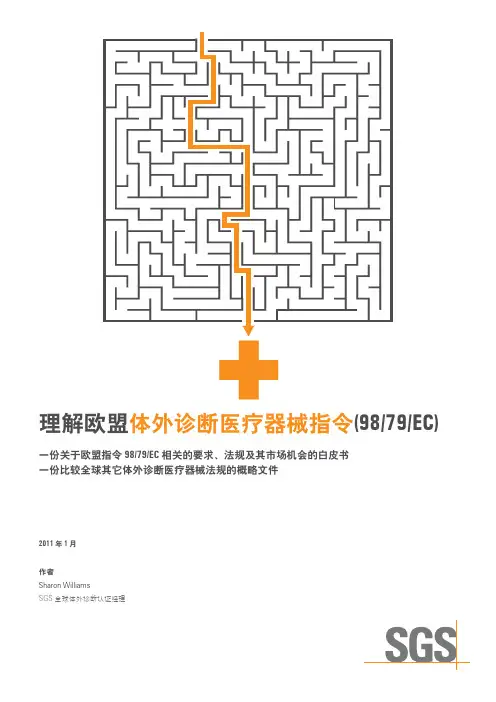
欧盟指令法规及程序
N/A
附录 III
EC 符合性声明(制造商自我 声明)
N/A
公告机构是否介入 YES YES YES YES YES
YES NO
器械风险递增
6
注册和授权代表
98/79/EC 规定欧洲数据库的其中一个职责 是主管当局之间共享关键数据,但目前该 项目仍在进行中。一旦该项目执行,则制 造商只需在其所在国或在其授权代表 (AR) 所在国注册即可。目前,临时取代措施是 要求制造商在初始注册后,通知其他成员 国的主管当局。制造商如果确定了潜在的 目标市场,则需研究该国的具体实施要 求,以确定是否需要通报相关部门。
• “体外诊断医疗器械可以是试剂、试剂 产品、校准物、控制物、试剂盒、器 具、仪器、设备或系统等任何形式的医 疗器械,无论是单独使用或组合使用, 由制造商预期用于体外检测取自人体的 样本,包括血液和其他组织,且其主要 目的是提供如下信息:生理或病理状 态、或有关于先天性异常、或确定潜在 接受者的安全性和兼容性、或监测治疗 措施。”
对于 LIST A 中风险程度最高的器械,需要 有额外的措施来把控风险。在附录 IV 全面 质量保证的符合性评价程序下,每个 LIST A 的器械必须经过详细的技术文件评审, 即 EC 设计审查。无论是参照哪项程序, 在获得 CE 标志后,任一批 LIST A 的产 品在交付市场前,还需进行持续的逐批验 证,以确保器械性能的持续稳定。
浅谈我国医疗器械临床试验中的问题与对策

作者简介:马艳彬,Tel: (024)31606983;E-mail:myb-1027@众所周知,随着现代科技的迅速发展和公众日益增强的健康需求,医疗器械已被广泛应用于疾病的预防、诊断、治疗、监护、康复等医疗卫生技术领域。
但是,与药品一样,医疗器械在给人们带来预期用途的同时也存在着一定的潜在风险。
因此,世界各国在医疗器械上市前,都要对其进行严格的审查,其中临床试验就是验证医疗器械上市前安全性和有效性的核心方法之一。
本文就我国医疗器械浅谈我国医疗器械临床试验中的问题与对策马艳彬,李竹,杨牧,梁文,李非(辽宁省食品药品监督管理局技术审评中心,沈阳110003)zhgysh临床试验实施及监管过程中存在的问题进行探讨、总结和分析,提出了改进的建议和对策。
1 医疗器械临床试验现状简介医疗器械临床试验起源于药品的临床试验。
临床试验(clinical trial)是指所有在人体(病人或健康志愿者)进行药物或器械的系统性研究,其目的是收集试验药物或器械的效用与安全性的相关数据[1]。
国际对医疗器械临床试验的监督管理非常重视。
1962年,《美国Hefauver-Hatris 药品修正案》对临床实验管理进行了规范。
美国食品药品监督管理局(FDA)在1996年还发布了优良临床试验规范(good clinical practice,GCP)。
ISO(国际标准化组织)专门制定了医疗器械临床试验标准(IS0 14155)。
欧盟于2003年发布了医疗器械临床数据评价制造商和授权机构指南(MEDDEV.2.7.1)[1]。
我国的行业标准YY /T 0297等同采用国际标准ISO 14155-2003。
由于ISO 14155旨在用于世界范围内医疗器械临床试验,用以满足不同国家、地区以及国际管理法规中的技术层面的基本要求,而目前不同国家和地区的法律法规还存在很大差异,因此,ISO 14155中不包括法律法规性的要求,相应的YY/T 0297也是如此。
MEDDEV 2 12-2 Chinese

EUROPEAN COMMISSION 欧盟委员会DG ENTERPRISE DG企业Directorate G 董事会GUnit 4 - Pressure Equipment, Medical Devices, Metrology第4单元-压力设备、医疗器械、计量学医疗器械指南该指南是指实施医疗器械EC指令中所遇到问题的系统指南中的一个。
这些指令与指南之间没有法律效益的关联。
这些指南是通过与各个利益方(包括主管当局,委员会服务机构,行业以及其他利益相关方)进行详尽的征询后谨慎起草的,在这个过程中,草稿有被传阅,相关的建议在文件中加以采纳。
因此,此文件体现了医疗器械各相关方代表的立场。
CEC 临床评估小组5月18日, 2004年医疗器械指令之上市后临床跟踪前言:PMCF的基本原因和目标本文件的目的是指为制造商和通告机构就如何执行PMCF, 和履行上市后监督义务提供指导性意见。
参照医疗器械指令附录II 3. 1, 附录IV 3. 附录V 3, 附录VI 3.1 附录VII 4 (增加参阅AIMDD)。
虽然临床证据是上市前符合性评定程序的基本要素,但重要的是要认识到,这些上市前临床调查存在局限性。
虽然在上市前阶段已经收集了广泛的数据,但是并不能保证制造商能够察觉到不常见的并发症或问题,而这些问题只有在医疗器械被大范围的使用和长期运行后才会显现。
作为医疗器械制造商的质量体系,或上市后监督体系的一个部分,关键就是需识别和调查销售后的医疗器械在使用过程中所具有的风险。
制造商应建立上市后监督系统,并且对每一个产品或产品类都应有明确的PMS(上市后监督)策划。
因此,选择PMCF(上市后临床跟踪)看起来是实现此目的的一个方法。
通过建立一个长期的安全跟踪评审程序和侦查一些可能出现的风险,它可以使病人获得新的疗法,而这些风险仅仅依赖上市前的临床调查(仅仅要求相对很短的时间跟踪)和根据产品经验或产品警惕性都是不能完全充分地察觉到的。
MEDDEV2.12.2rev2...
MEDDEV2.12.2rev2...MEDDEV 2.12/2 rev2 January 2012GUIDELINES ON MEDICAL DEVICESPOST MARKET CLINICAL FOLLOW-UP STUDIESA GUIDE FOR MANUFACTURERS AND NOTIFIED BODIES 关于医疗设备指导方针药品上市后临床跟踪研究指导生产商和相关人员NoteThe present Guidelines are part of a set of Guidelines relating to questions of application of EC-Directives on medical Devices. They are legally not binding. The Guidelines have been carefully drafted through a process of intensive consultation of the various interest parties (competent authorities, Commission services, industries, other interested parties) during which intermediate drafts where circulated and comments were taken up in the document. Therefore, this document reflects positions taken by representatives of interest parties in the medical devices sector. 注释本准则是有关欧共体指令对医疗器械的应用问题指引的一部分。
其在法律上不具约束力。
医疗器械警戒系统指南-MEDDEV 2.12-1 REV.8 January 2013
MEDICAL DEVICES: Guidance document
MEDDEV 2.12-1 rev 8 January 2013
GUIDELINES ON A MEDICAL DEVICES VIGILANCE SYSTEM
The present guidelines are part of a set of guidelines relating to questions of application of EC-Directives on MEDICAL DEVICEs. They are legally not binding. The guidelines have been carefully drafted through a process of intensive consultation of the various interested parties (competent authorities, Commission services, industries, other interested parties) during which intermediate drafts were circulated and comments were taken up in the document. Therefore, this document reflects positions taken by representatives of interested parties in the MEDICAL DEVICEs sector.
3 SCOPE ...........................................................................................
MDD指南,MEDDEV 2.1.1 -1994.04, 医疗器械、附件、制造商的定义
EUROPEAN COMMISSIONDG ENTERPRISEDirectorate GUnit 4 - Pressure Equipment, Medical Devices, MetrologyMEDICAL DEVICES : Guidance documentMEDDEV 2. 1/1April 1994GUIDELINES RELATING TO THE APPLICATION OF :THE COUNCIL DIRECTIVE 90/385/EEC ON ACTIVE IMPLANTABLE MEDICAL DEVICESTHE COUNCIL DIRECTIVE 93/42/EEC ON MEDICAL DEVICESDefinition of "medical devices"Definition of "accessory"Definition of "manufacturer"--- (())---LIST OF CONTENTSI.FIELD OF APPLICATION - DEFINITIONS1.Directive 93/42/EE on medical devices2.Directive 90/385/EEC on active implantable medical devices13.Interface with other directives- medical devices/medicinal products- medical devices/electromagnetic compatibility2- medical devices/personal protective equipment2II.CLASSIFICATION OF MEDICAL DEVICES COVERED BY DIRECTIVE 93/42/EEC3III.CONFORMITY ASSESSMENT PROCEDURES(*):1.CE-marking2.Application-Annex 5-Annex 2. Quality systems. Examination of the design dossier- Annex 33.Conduct of audits44.Format of decisions, design examination certificate5.Technical DossierIV.CUSTOM MADE DEVICES(*):V.DEVICES INTENDED FOR CLINICAL INVESTIGATIONS(*):VI.MEDICAL DEVICE VIGILANCE(*):E OF LANGUAGES(*):VIII.TRANSITIONAL PERIOD(*):1see MEDDEV. 5/93 rev. 22see MEDDEV 13/933see MEDDEV.10/93 rev. 14see MEDDEV. 1/94I.FIELD OF APPLICATION - DEFINITIONS1.Directive 93/42/EEC on medical devices1.1Definition of "medical devices"a)devices - accessoryThe definition of the term "medical device" together with thedefinition of "accessory" is determinant for the delimitation of the fieldof application of Directive 93/42/EEC. A slight difference existsbetween the definition in article 1(2) (a) of Directive 93/42/EEC and inarticle 1(2) of Directive 90/385/EEC.Following the latter directive, accessories are by definition medicaldevices, whilst following Directive 93/42/EEC, a distinction is madebetween "devices" and "accessories". Therefore within the meaning ofDirective 93/42/EEC, accessories are products in their own right and,although being treated as devices (article 1(1)) do not follow, as ageneral rule, the classification of related devices in conjunction withwhich they are used.Accessories are therefore following Directive 93/42/EEC to beclassified in their own right.b)medical purposeMedical devices are defined as articles which are intended to be usedfor a medical purpose. The medical purpose is assigned to a productby the manufacturer. The manufacturer determines through the label,the instruction for use and the promotional material related to a givendevice its specific medical purpose. As the directive aims essentially atthe protection of patients and users, the medical purpose relates ingeneral to finished products regardless of whether they are intendedto be used alone or in combination. This means that the protectionensured by the directive becomes valid for products having a stage ofmanufacture, where they are supplied to the final user.Following this concept, raw materials, components or intermediateproducts are as such normally not medical devices. Such rawmaterials may need to present properties or characteristics which aredeterminant for the safety and quality of finished devices. It istherefore the responsibility of the manufacturer of finished devices toselect and control by adequate means his raw materials orintermediate products (see Annex I, section 7.1; Annex II, section 3.2;Annex V, section 3.2 of Directive 93/42/EEC)Spare parts supplied for replacement of existing components of adevice, the conformity of which has already been established, are notmedical devices. If spare parts, however, change significantly thecharacteristics or performances of a device with regard to its alreadyestablished conformity, such spare parts are to be considered asdevices in their own right.c)customizingThe concept of "finished device" does not imply that a device whenreaching the final user is already in a state ready for use. Prior to usefurther preparatory processing, preparation, configuration,installation, assembling, adaptation or fitting to the needs of the useror patient may be required. Examples :-sterilisation of medical devices supplied non-sterile-assembling of systems-configuration of electronic equipment-preparation of a dental filling-fitting of contact lenses-adaptation of prosthesis to the needs of the patient.The aforementioned activities are normally not manufacturersactivities if they are carried out by the final user as part of the use orpreparation for use. In this context a distinction needs to be madebetween a typical professional activity performed by a healthcareprofessional and processing and assembling activities done by aspecialist for such processing. In the latter case relevant activities maybecome proper manufacturing or assembling activities relevant withinthe meaning of articles 11 and 12.A particular consideration in this context needs to be given for themanufacture of custom-made devices. Custom-made devices (such as dental appliances, prosthesis, hearing-aid inserts) are in most casesone-off devices and the Directive subjects their manufacture to theprocedure of article 11(6) in conjunction with Annex VIII. In thesecases intermediate products specifically intended for this kind ofcustom-made devices may be considered also as medical devices.This applies essentially to dental alloys, dental ceramics, modularcomponents for prosthesis, if the intended purpose of such products is specifically related to medical devices.d)medical - toiletry purposeThe definition of "medical device" should be understood to includeproducts intended to be used principally for a medical use. Thereforeproducts intended to have a toiletry or cosmetic purpose are notmedical devices even though they may be used for prevention of adisease. Examples for products for which a medical purpose cannormally not be established :-tooth brushes, dental sticks, dental floss;-baby diapers, hygiene tampons;-contact lenses without corrective function intended toprovide another colour to the eyes,-bleaching products for teeth [needs to be furtherdiscussed with regard to products intendedspecifically for application by dentists]-instruments for tattooing.Examples for products, where depending on the circumstances, amedical purpose can be established :-incontinence products.e)aids for handicapped personsIn the case of equipment intended for alleviation of or compensationfor a handicap, there must be a direct link between the correctivefunction and the person concerned. Therefore the followingequipment are not medical devices :-acoustic signals at traffic lights,-special water taps, toilet equipment for handicappedf)softwareThe following distinction can be made : software influencing theproper functioning of a device and software used in combination withnon-medical equipment.Software related to the functioning of a medical device may be part ofa device or a device in its own right if it is placed on the marketseparately from the related device.In the case of software intended for use with multipurpose informaticequipment a distinction has to be made between software providingfor a proper diagnostic or therapeutic tool and software for handlinggeneral patient-related data. Only in the first case may a medicalpurpose be determined. Examples for medical devices :-calculation of anatomical sites of the body,-image enhancing software intended for diagnosticpurpose.-software for programming a medical deviceThere is no medical purpose in the case of software used foradministration of general patient datag)multipurpose productsProducts with a multiple purpose which may be used occasionally in amedical environment are normally not medical devices, unless aspecific medical intended purpose is assigned to them. Examples :-multipurpose PC, printer, scanner, ..._magnetoscope, screen.1.2Definition of "accessory"The question whether a product is a "device" or a "accessory" has notpractical consequence. Following article 1(1) of Directive 93/42/EEC,"accessories shall be treated as medical devices in their own right". Therefore the main question is whether a product with a rather remote link to amedical use can still be considered as "accessory" (article 1(2)b) and as amatter of consequence is covered by the directive.The definition of "accessory" requires that the accessory is specificallyintended by the manufacturer of the accessory to be used together with adevice. The intended use of the accessory must be such as to enable a device to be used in accordance with its intended use. Therefore a product can only become an accessory to a medical device if the manufacturer of such aproduct establishes an intended use in conjunction with one or severalmedical devices.Examples for accessories depending on defined circumstances of device-related use :-sterilizers for use in a medical environment,-pouches for packaging re-sterilised medical devices,-specific battery chargers for battery driven electromedicaldevices,-contact lens care products, disinfectants specificallyintended for invasive medical devices-special water treatment device for use in conjunction withdialyzing machines,-gas cylinders/pressure release devices for use inconjunction with anaesthesia machines.1.3Definition of "manufacturer"Users in-house manufacturingThe Directive defines a manufacturer as the natural or legal personresponsible for defined manufacturing activities related to a device with aview to its being placed on the market under the manufacturers own name.The reason for this link with the placing on the market is that the directives aims to subject to its protection requirements the transaction of a device from the sphere of a manufacturer towards the public. The directive does notprovide any specific provisions for the case where a device is manufactured by the user (for example, a hospital) without being transferred to anotherperson. The decision to which extent such in-house manufacturing activities by hospitals are subjected to legal requirements, belongs therefore to thenational legislator. This relates however exclusively to such in-housemanufacturing activities where a device remains within the users, but not to cases where, for example, a hospital produces orthopaedic devices for usewith patients.。
MEDDEV2.122上市后临床跟踪指南中英文对照版
EUROPEAN COMMISSIONDG ENTERPRISEDirectorate GGUIDELINES ON POST MARKET CLINICAL FOLLOW-UP上市后临床跟踪指南The present Guidelines are part of a set of Guidelines relating to questions of application of EC-Directives on medical devices. They are legally not binding. The Guidelines have been carefully drafted through a process of intensive consultation of the various interested parties (competent authorities, Commission services, industries, other interested parties) during which intermediate drafts were circulated and comments were taken up in the document. Therefore, this document reflects positions taken by representatives of interested parties in the medical devices sector.本准则是一个有关的欧共体指令对医疗设备的应用问题指引的一部分。
他们在法律上没有约束力。
该指引已审慎草拟通过各有关方面(主管机关,委员会的服务,工业,其他有关各方)在此期间,中间草案分发和评论的文件采取了密集的磋商进程。
因此,这份文件反映了有关各方的代表在该领域采取的医疗设备的位置。