
八年级英语下册现在完成时讲解和练习人教新目标版
现在完成时练习
1.构成 现在完成时是由助动词 have(has)+动词的过去分词构成。助动词说明该谓语是属于现在时范围。它和主语的人称、数要保持一致。过去分词是主要的谓语动词,说明句子的意义。 2.用法 (1)表示动作发生在过去某个不确定的时间,但对现在留下了某种影响和结果。常被just、already、yet 等副词修饰。如: -Have you had lunch yet? -Yes,I have. I've just had it. 你(已经)吃午饭了吗? 我刚刚吃过。(现在我不饿了) (2)表示从过去某一时刻开始一直持续到现在的动作或状态。这个动作可能刚停止,可能仍然在进行。常带有for和since等表示一段时间的状语。 \ 如:He has taught here since 1981 他自1981年就在这儿教书。(可能还要继续教) I have't seen her for four years. 我有四年没见到她了。 3.结构 1). 陈述句结构:主语+have( has)(not)+过去分词+其它。 have not=haven’t has not=hasn’t. 2). 一般疑问句结构:Have( Has )+主语+过去分词+其它? 3). 特殊疑问句:特殊疑问词+have(has) +主语+ 过去分词+其它? eg. He has already finished his homework. He hasn’t finished his homework yet. Has he finished his homework yet? --Yes, he has./ No, he hasn’t./ No, not yet.
(3)表示说话前发生过一次或多次的动作,现在成为一种经验,一般译为汉语“过”,常带有twice, ever, never, three times等时间状语。 如: I have been to Beijing twice.我去过北京二次。 4.现在完成时的时间状语 (1)现在完成时属于现在时范围,故不能和过去的时间状语连用。如:yesterday,last Sunday,in1990,three years ago等。但是,在强调动作产生的后果和影响时,可以和一些表示不确定的时间状语连用。 a. 用副词already和yet。already一般用于肯定句中,yet一般用于否定句和 疑问句中。如:We have already finished our homework.我们已完成作业了。 They haven't finished their homework yet.他们还没有完成作业。 b.用ever 和never。多用于否定或疑问句中,表示“曾经”或“从未“等。 如:-Have you ever been to the Great Wall?你曾经去过长城吗? -I have never been to the Great Wall.我从未去过长城。 c.用表示到说话为止的过去时间状语,如just, before, up to now, the past few years等。例如:I have seen her before, but I can not remember where. 我以前见过她,但记不起在哪里见过。 He has been there three times the last few days. 近几年他去过那里三次了。 d.用包括“现在”在内的时间状语,如:now, today, this morning (month ,year, term)等。例如:-Have you met him today?-No,I haven't. 今天你见过他吗?我 没有。 How many times have you been there this year? 今年你去过那里多少次? (2)现在完成时可以和带有since或for等表示“一段时间”的状语连用,表示动作或状态从某一时刻开始,一直持续到现在。如:I haven't seen him for two years. 但是,像come, arrive, buy等终止性动词不能与表示“一段时间”的状语连用。要用,必须改为“be(在)”等延续性动词来表述。现归纳总结一下由非延续性动词到延续性动词的转换: arrive→be here begin(start)→be on die →be dead come back→be back leave →be away fall ill(sick,asleep)→be ill(sick,asleep) get up→be up go out →be out finish →be over put on →wear 或be on open →be open join →be in或 be a member of… close →be closed go to school→be a student borrow →keep buy →have catch(a cold)→ have(a cold) get to know →know begin to study→study come to work→work等 如:He has been a soldier for three years.他参军三年了。 His father has been dead for two years.他父亲去世二年了。 The film has been on for ten minutes.电影已开始十分钟了。 We have studied English for three years. 我们(开始)学英语已三年了。 5.现在完成时和一般过去时的区别 现在完成时和一般过去时都表示在过去完成的动作。但现在完成时强调的是这一动作与现在的关系。如对现在产生的结果或影响等,而一般过去时只表示动作在过去某一时刻发生,不表示和现在的关系。试比较: I have lost my new book. 我把新书丢了。(现在还未找到) I lost my new book yesterday. 我昨天把新书丢了。(昨天丢的,现在找到与否没说明) 6.几点注意事项 (1)have been(to)与have gone( to)的区别:have been(to)表示“去过某地(现在已经回来了)”,可用于各人称;have gone(to)表示“去某地了(说话时某人不在当地)”,常用于第三人称,前者可与once ,never,several times等连用,后者则不能。如:They have been to Beijing twice.他们去过北京两次。 He has gone to Beijing . 他去北京了。 (2)如单纯表示一段时间,或强调一段时间,虽有since一词,也不必用完成时。如:It is two years since his father died. =His father has been dead for two years.他父亲去世已有三年了。 (3)终止性动词现在完成时的否定式,已变成一种可以延续的状态,因此可以和表示一段时间的状语连用。 如:I haven't left here since 1997.自从1997年以来,我一直没有离开过这儿。
现在完成时练习 [Exercises7]A) 用have(has) been 或have(has) gone 填空。 A: Where ____________ Li Fei ___________? B: He ____________ to HainanIsland. A: How long ___________ he ___________ there? B: He _____________ there for three days. A: When will he come back , do you know? B: I’m afraid he won’t come back recently. A: Could you tell me the way to HainanIsland? B: Sorry, I _________ never ___________ there. A: How many times ___________ Li Fei __________ to that place? B: He _____________ there only once.
B) 用have/has been to/in, have gone to的各种形式填空。 Where is Jack? He __________ his country. John _______ England since he came back. How long _____ have _____ this village? The Smiths ______ Beijing for years. _____ you ever ____ America? -- Yes, I _____ there many times. I _____ this school since three years ago.
C)选择填空 ( )1.Jim's been to the Great wall before ,__________he? (A)isn't (B)wasn't (C)hasn't (D)doesn't ( )2.She's never been to England, _______she? (A)has (B)hasn't (C)isn't (D)is ( )2.___________has Hanmei been in the library. (A)How long (B)How soon (C)How far (D)How often ( )3.How long ___he______ the library book . (A)has, borrow (B)has ,kept (C)has, bought (D)did, buy ( )4.Mr Green isn't in the office , He __________to the library (A)has gone (B)went (C)has been (D)will go ( )5.Mr smith _______to Tokyo and he will be back in a week (A)has been (B)has visited (C)has sent (D)has gone ( )6.They_________China for two years (A)have been to (B)have been in (c)have gone to (D)have come to
英语人教版八年级下册现在完成时讲解

都用How long
.区分短暂性动词与持续性动词. 表示短暂性(瞬间性)的动词在现在完成时 的句中不能和一段时间连用.即for,since短 语或how long问句
常见非延续性动词和延续性动词的转变
非延续性动词 arrive/come/go to leave/ move become a join start/begin open close go to sleep 延续性动词 be in be away / be out be a be in/ be a member of be on be open be closed be asleep睡着了 sleep睡着了
I have lived here for 11 years. I have lived here since 2000/ 11 years ago. She has learn ed English for 5 years. 她学英语 5年了。 She has learned English since 2007. have/has /+since v过去分词 动词构成: 5 years ago.
• 2.不规则动词
Eg.
go—went—gone see---saw—seen forget—forgot—forgotten run—ran ---- run
现在完成时
1.过去发生的动作对现在造成的影响 或结果。 I’m not hungry now had breakfast
paห้องสมุดไป่ตู้t
now
我已经吃过早饭了。
把下列句子变成否定句。 I have just cleaned my clothes. not He has just had his breakfast. not
现在完成时和一般过去时练习-2023-2024学年人教版英语八年级下册
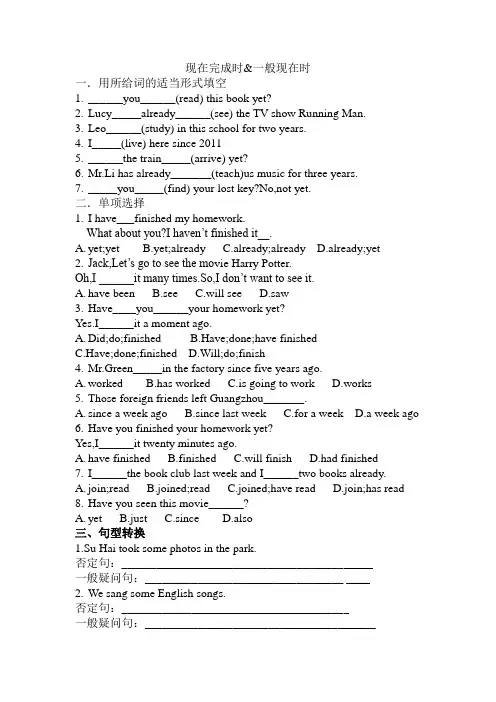
现在完成时&一般现在时一.用所给词的适当形式填空1.______you______(read) this book yet?2.Lucy_____already______(see) the TV show Running Man.3.Leo______(study) in this school for two years.4.I_____(live) here since 20115.______the train_____(arrive) yet?6.Mr.Li has already_______(teach)us music for three years.7._____you_____(find) your lost key?No,not yet.二.单项选择1.I have___finished my homework.What about you?I haven’t finished it__.A.yet;yetB.yet;alreadyC.already;alreadyD.already;yet2.Jack,Let’s go to see the mo vie Harry Potter.Oh,I ______it many times.So,I don’t want to see it.A.have beenB.seeC.will seeD.saw3.Have____you______your homework yet?Yes.I______it a moment ago.A.Did;do;finishedB.Have;done;have finishedC.Have;done;finishedD.Will;do;finish4.Mr.Green_____in the factory since five years ago.A.workedB.has workedC.is going to workD.works5.Those foreign friends left Guangzhou_______.A.since a week agoB.since last weekC.for a weekD.a week ago6.Have you finished your homework yet?Yes,I______it twenty minutes ago.A.have finishedB.finishedC.will finishD.had finished7.I______the book club last week and I______two books already.A.join;readB.joined;readC.joined;have readD.join;has read8.Have you seen this movie______?A.yetB.justC.sinceD.also三、句型转换1.Su Hai took some photos in the park.否定句:______ ___________________一般疑问句:_________________ _ ____ ___ ____2.We sang some English songs.否定句:____________ ____一般疑问句:___________ ___________ __ __ __3.I have been here for 3 hours.否定句:___________________________一般疑问句:_______________________4.She has already cleaned her room.否定句:___________________________一般疑问句:_______________________四.用since和for填空。
Unit 9 现在完成时-八年级英语下册(人教版)

2.Me, too. = So have I. Me, neither.= Neither have I.
现在完成时
现在完成时可表示过去发生或已经完成的动作对现在造 成的影响或结果。 e.g. I have lost my pen. (我现在无钢笔可用)
—Sorry, he isn’t in. He __h_a_s_g_o_n_e__to___ the school library. 2) —Are you looking forward to going to Paris?
—No. I __h_a_v_e__b_e_e_n_t_o__ the city twice. 3) —Are you interested in going to the Palace Museum?
He __h_a_s_n_'t_ __ea_t_e_n__ all the food on the plate ___y_et___. 3) —Has Peter driven a car before? (作肯定回答)
—__Y__es___, ___h_e___ ___h_a_s__. 4) —Mary, have you got a job yet? (作否定回答)
考点三:一些短暂性动词转换成意义相近的延续性动词或 be+形容词 / 副词 / 介词短语 / a(n)+名词,与表示 一段时间的状语连用。如:buy → have borrow → keep move → live die → be dead open → be open close → be closed fall asleep → be asleep marry → be married leave → be away come → be in / at begin / start (电影等开始) → be on join → be in +组织 / be a member in +组织
英语人教新目标八年级下册现在完成时课件
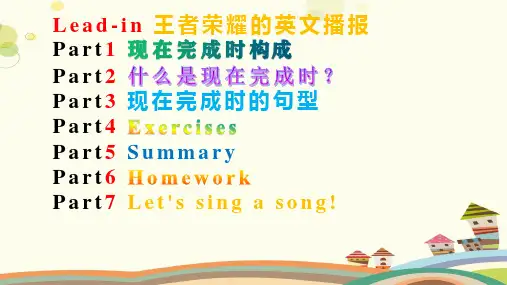
2. —Why is Mr. Yang still in the teachers’ office?
—Maybe he ____B____ his work yet.
A. doesn’t finish B. hasn’t finished C. haven’t finished
Lead-in 王者荣耀的英文播报 Part1
Part2 Part3 现在完成时的句型 Part4 Part5 Summary Part6 Part7 Let's sing a song!
Lead-in 王者荣耀的英文播报
导出_190837_3.mp4
1.你击败了一个敌人。 • You have slained an enemy.
• 2.否定句:主语+ have not/has not +动词的过去分词+其他。 我还没完成家庭作业。 I have not finished my homework yet.
3.一般疑问句:Have/Has+主语+动词的过去分词+其他? 肯定回答为:Yes,主语+ have/has. 否定回答为:No,主语+haven't/ hasn't. 你的作业完成了吗? Have you finished your homework? Yes, I have./ No, I haven't.
2.敌人被击败了。
• An enemy has been slained.
nce has been slained.
4.你被人击败了。
• You have been slained.
初中英语人教新目标八年级下册Grammar《现在完成时态》课件

did
open
been to
• Have you gone to America? (误) • Have you been to America? (正) • 1. _____ you _______ to Japan before? • 2. His father isn't at home. He _______ the supermarket now. • 3. Where is your class teacher? She _______ the library. • 4. Linda and her parents _______ to France twice.
I lived there 2 years ago
past
present
I have lived here for two years
• 1.都表示过去发生的事
• 2.现在完成时强调过去和现在的联系,不能和具体 的时间状语连用;
• 3.一般过去时强调过去发生的事或状态与表示过去 的具体时间连用(last, ago, yesterday, etc. )
I have bought a new apartment for a month 错误 I have had a new apartment for a month 正确
常见非延续性动词和延续性动词的转变
• arrive/come/go to/reach
be in
• borrow
keep
• leave
• 6. Many tall buildings __h__a__s______(builsd)einethne past 5 years.
2024年+寒假语法:现在完成时人教版八年级英语下册
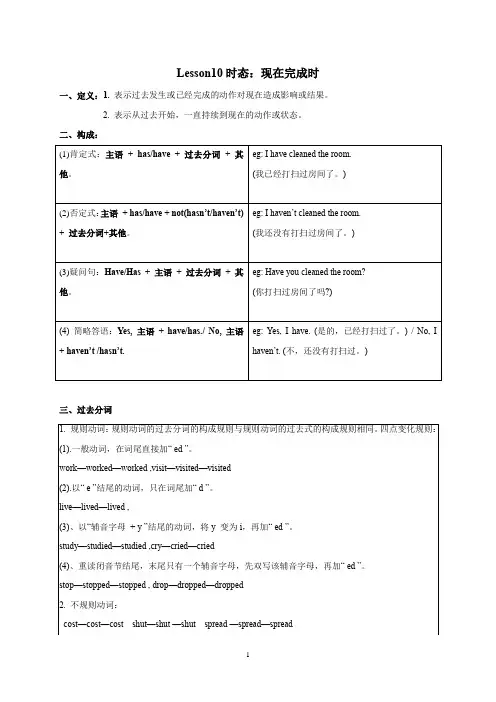
Lesson10时态:现在完成时一、定义:1. 表示过去发生或已经完成的动作对现在造成影响或结果。
2. 表示从过去开始,一直持续到现在的动作或状态。
二、构成:(1)肯定式:主语+ has/have + 过去分词+ 其他。
eg: I have cleaned the room. (我已经打扫过房间了。
)(2)否定式:主语+ has/have + not(hasn’t/haven’t) + 过去分词+其他。
eg: I haven’t cleaned the room. (我还没有打扫过房间了。
)(3)疑问句:Have/Has + 主语+ 过去分词+ 其他。
eg: Have you cleaned the room? (你打扫过房间了吗?)(4) 简略答语:Yes, 主语+ have/has./ No, 主语+ haven’t /hasn’t. eg: Yes, I have. (是的,已经打扫过了。
) / No, I haven’t. (不,还没有打扫过。
)三、过去分词1. 规则动词:规则动词的过去分词的构成规则与规则动词的过去式的构成规则相同。
四点变化规则:(1).一般动词,在词尾直接加“ ed ”。
work—worked—worked ,visit—visited—visited(2).以“ e ”结尾的动词,只在词尾加“ d ”。
live—lived—lived ,(3)、以“辅音字母+ y ”结尾的动词,将y 变为i,再加“ ed ”。
study—studied—studied ,cry—cried—cried(4)、重读闭音节结尾,末尾只有一个辅音字母,先双写该辅音字母,再加“ ed ”。
stop—stopped—stopped , drop—dropped—dropped2. 不规则动词:cost—cost—cost shut—shut —shut spread —spread—spreadread —read —read (read原形发音为/ri:d/,过去式和过去分词发音为/red/)come —came —come burn— burnt —burnt catch —caught —caught dig —dug —dug feel —felt —felt fight—fought — fought make—made — made break —broke —broken choose—chose—chosen write —wrote —written四、现在完成时的用法及标志1. 表示过去发生的动作对现在造成的影响或结果。
英语人教版八年级下册初中英语现在完成时的讲解
现在完成时Teaching aims:1.学生了解动词的过去式和过去分词。
2.学生掌握理解现在完成时态的用法。
3.学生基本会用现在完成时。
Teaching important and difficult points:1.现在分词的变化形式。
2.现在完成时for与since的用法区别。
3.瞬间动词转换成延续性动词。
Teaching procedures:Step1.现在完成时的构成:肯定句:have/has +done否定句:have/has +not+done一般疑问句:Have/Has+主语+done?Step 2.现在完成时的主要用法:用法一:表示过去发生的某一动作对现在造成的影响或结果.I have already read this book.我已经读过这本书了。
(知道书中的内容)I have washed my clothes already .我已经洗了衣服。
(衣服洗干净了)I have just finished my homework.我刚做完我的家庭作业。
(作业没有了)用法二:表示过去某个时间开始的动作一直持续到现在并且还有可能持续下去。
for+时间段since+时间点/句子I have learnt English for more than ten years.我已经学了10多年的英语。
(从10年前开始,持续到现在还在学)She has swum since half an hour ago.她已经游泳了半个小时。
(半个小时前已经开始游泳,到现在还在游)Step3.现在完成时的时间状语:现在完成时常与副词already, yet, never ,just,ever 等连用。
1. already 意为“已经”,通常用于肯定句,可放在助动词之后,过去分词之前,也可放在句末。
2. yet 在疑问句中意为“已经”,在否定句中意为“还(没)”,放在句末。
3. never 意为“从来没有”常与before连用,多放在助动词与过去分词之间。
新目标英语八年级下-现在完成时的教案及练习
现在完成时态--练习资料我们先来翻译几个句子:1 您已经问过这个问题两遍了,别再烦我了。
2我能借您得字典用一下吗?对不起,已经借给tom了。
3 您以前见过她吗?不,从来没有过。
4 您曾经去过北京吗?就是得我去过那儿三次。
5 您已经瞧完那本小说了吗?就是得,我已经把它还给图书馆了。
*基本定义:现在完成时有两种用法1、过去发生得某一动作对现在造成得影响或结果或到现在为止已经发生或完成得动作。
2、表示过去发生得、持续到现在得动作或状态。
句型转换1、 I have been to Macau before、 (改为否定句)I _________ _________ been to Macau before2、 Li Ming has already finished his homework、(改为一般疑问句并做肯定与否定回答)_____________ Li Ming _____________ finished his homework yet?3、They have been here since 2000、 (对划线部分提问)have they been here?*句型构成:基本结构:主语+have/has+动词得过去分词(p、p)①肯定句:主语+have/has+动词得过去分词(p、p)(V-ed)+宾语(或者其她)、②否定句:主语+have not/has not+动词得过去分词(p、p)(V-ed)+宾语、③一般疑问句:Have/Has+主语+动词得过去分词(p、p)(V-ed)+宾语(或者其她)?④特殊疑问句:特殊疑问词+一般疑问句(have/has+主语+过去分词+其她将一般过去时得句子改写为现在完成时得句子。
1、 My father bought many books for me yesterday 、Now , I have a lot to read because ________________________________2、 I saw this film last week、Now, I know this film because I_____________________、3、 I did my homework yesterday、Now, I can give it to the teacher because I______________用法一*一表过去发生得某一动作对现在造成得影响或结果,(强调结果现在还存在)例如I have just cleaned my clothes、我刚洗过衣服。
Unit9 SectionA 现在完成时态专项讲解 课件人教新目标八年级英语下册
现 在 完 成 时态
Speaker:lishengfan
1
一、现在完成时定义
现在完成时
past now
现在完成时表示的:
future
1.在过去某个时间开始并持续到现在的动作 或状态。
2.发生在过去却对现在造成影响 。
2
二、现在完成时的构成
have /has+V动词过去分词
助动词
否 haven’t
定
形
hasn’t
式
疑 Have sb …?
问 句
Has sb …?
3
动词的过去分词的构成:
Regular verbs:
work
worked
live
lived
study
studied
stop
stopped
worked
lived studied stopped
4
Irregular verbs:
时 的
ever 曾经 常用语疑问句中
时
just
刚刚
间 状
before
以前
语 常
these days
这些天
与
since
自从
for a long time 很长一段时间
连 用
7
跟踪练习:
1.A: __H_a_s __ your brother __b_o_u_gh_t___ a new watch? (buy ) B: Not yet. 2.A: __H_a_v_e __ you ever ___b_ee_n__ to the park? B: Yes, I have. ( be ) 3.I __h_a_ve__ never __h_e_ar_d_ of anything like that. (hear ) 4.Tom __ha_s__w_o_rk_e_d__ in the factory since he left school ten
新目标八年级英语(下)Unit9现在完成时
Detail
Provide sentences in English that use the present perfect tense and ask students to translate them into their native language, maintaining the correct tense usage. Then, provide sentences in the student's language that use the present perfect tense and ask them to translate them back into English.
finished."
usage
• Time Reference: The present perfect tense is used to refer to an action or event that has occurred up to the present moment. It can also be used to express an action that began in the past but is still relevant or ongoing in the present.
Examples
"Have you ever been to Europe?", "Has she ever tried sushi?".
The marker words and
03 time adverbs in the present perfect tense
Sign words
"have/has + -ed participle"