
高中英语 Unit 3 Back to the past 精品课件 译林必修3
江苏省版高中英语 Unit3 Back to the past (译林牛津版必修3,9页,含精细详解
素能提升演练(九)
必修3 Unit 3
Ⅰ、 用下列句型翻译句子
1、 我们图书馆里的书比您们图书馆里的书多五倍。(倍数表达法)
____________________________________________________________________
2、 她特别幸运,有一些朋友帮助她。(in that引导的原因状语从句)
____________________________________________________________________
3、 社会实践对我们特别有帮助。(“be+of+名词"结构)
____________________________________________________________________
4、 看来,和她交朋友有点让人心烦。(主语+be+adj、 +不定式)
____________________________________________________________________
5、 妈妈不喜爱我工作到特别晚。(v、 -ing的复合结构)
____________________________________________________________________
6。 他熄了灯,什么也看不见了。(分词短语作结果状语)
____________________________________________________________________
Ⅱ。 单项填空
1、 Tiring as it might be, the military training ________ the
best opportunity to make lifelong friends。
A、is believed to beﻩ ﻩB。believes as
C、is believed to beingﻩ ﻩD、believes
牛津译林版高中英语必修三《Unit3 Back to the past》 Reading 教案 1
1 牛津译林版高中英语必修三
Unit 3 Reading 教学设计
The article Lost civilizations is about a cultural expedition to sites of lost civilizations. The reading text is made up of several excerpts from the travel diary kept by a Canadian student about her travel experience in Pompeii in Italy and Loulan in China. Try to gain some information about ancient civilizations, to practice and reinforce your reading comprehension. The Reading strategy in this unit teaches you how to read diary entries. You are expected not only to master this strategy but apply it to your future study as well.
Step1: Lead—in
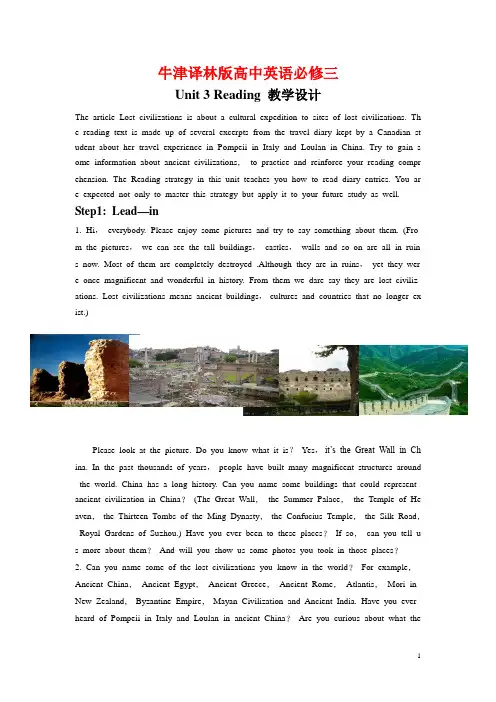
1. Hi, everybody. Please enjoy some pictures and try to say something about them. (From the pictures, we can see the tall buildings, castles, walls and so on are all in ruins now. Most of them are completely destroyed .Although they are in ruins, yet they were once magnificent and wonderful in history. From them we dare say they are lost civilizations. Lost civilizations means ancient buildings, cultures and countries that no longer exist.)
牛津译林版高中英语必修三 Unit 3 Back to the past grammar 教案 (5)
牛津译林版高中英语必修三
主谓一致
在英语中,谓语动词要与句子主语一致。一般来讲,主语是复数,谓语动词则用非第三人称单数;主语是单数,谓语动词则用第三人称单数。
如:(1) All the carpets are made of pure wood.所有的毯子均用纯羊毛做的。
(2) Is your companion waiting for you?你的同事在等你吗?
1、有些名词作为主语,在形式上为单数,但谓语动词要用非第三人称单数。
如:The police are after the thief. 警察在追贼。
2.有些名词作为主语,在形式上为复数,但谓语动词要用第三人称单数。
如:Maths is my favorite subject.数学是我最喜欢的课程。
3.有些名词作为主语,要先判断它们在句子中是单数还是复数,再决定谓语动词是用第三人称单数还是非第三人称单数。
如:(1) Is your family a large one?你们家是个大家庭吗?(family 在本句中是单数)。
(2)My family get up early on weekdays. 在工作日我家的人起床很早. (family在本句中是复数)。
4. 如主语是单数,尽管后面跟有with, together with, as well as, but, like, except等引起的短语,谓语动词通常用第三人称单数形式。
如: Nobody but Xiao Li and Xiao Wang was there.只有小李和小王在那里。
5.当一个句子有两个主语,而它们又是由either…or, neither…nor, not only…but also连接起来时,谓语通常与最近的主语一致。
如:Not only you but also he has been to Cairo.你和他都去过开罗。
江苏省启东中学高中英语必修3《Unit3Backtothepast2》教案(译林版)
I. 词语辨析
1、in turn / in return
in turn:轮流着、一个挨一个地;
e.g. Please tell your idea on the subject in turn.
He asked each of us in turn what we had been doing.
They went into the room in turn to be examined.
反过来(对别人做同样的事)
e.g. Theory comes from practice which in turn serves practice.
I told her the secret about Sue and she in turn told Sue about it.
in return:作为回报
e.g. I wish I could do sth. for you in return.
She helped me with my poor English and I in return treated her to
Kentucky fried chicken.
in return for:以答谢
e.g. I’ll send you some stamps in return for your kind help.
In return for her kindness, I decide to do sth, for her.
2、historical / historic
historical:历史上的、有关历史的,以有别于:传说的、虚构的
e.g. This is a historical play.
She is a member of historical society. (历史学会) The film is based on historical events.
牛津译林版高中英语必修三Unit 3《Back to the past》同步练测
牛津译林版高中英语必修三Unit 3《Back to the past》同步练测
Unit 3 Back to the past
Welcome to the unit & Reading
I.单项填空(共10小题;每小题1分,满分10分)
1、 The rainbow as the sun came
fully out from behind the clouds、
A、 dissolved B、 removed
C、 resigned D、 disappeared
2、 I really don't like art,
I find his work impressive、
A、 As B、 Since
C、 If D、 While
3、 that the South African
writer John Coetzee won the Nobel Prize in
Literature for 2003、
A、 They’re reported B、 He’s
reported
C、 We’re reported D、 It’s
reported
4、 It took a long time for the connection
between body temperature and
illness 、
A、 to make B、 to be made
C、 making D、 being made
5、 is known to all that the
Olympic Games are held every four years、
A、 As B、 Which
C、 What D、 It
6、 We were swimming in the lake
牛津译林版必修3Unit 3 Back to the past Period 1

建于1831年的伦敦桥在1962年被拆掉,然而1971年这座桥出现在了美国加州。
In1962,LondonBridgewasfallingdown.Builtin1831,thebridgecouldn’thandletheeverincreasingflowoftrafficacrosstheThamesRiver.TheBritishgovernmentdecidedtoputthebridgeupforsale,andRobertMcCulloch,founderofLakeHavasuCity,Arizona,submittedthewinningbidof2,460,000.
Thebridgewastakendown,andeachstonewasnumbered.Everythingwasshipped10,000milestoLongBeach,California,andthentruckedtoLakeHavasuCity.ReconstructionbeganonSeptember23,1968,
withaceremonyincludingtheLordMayorofLondon,wholaidthecornerstone.OnOctober10,1971,thebridgewasrebuilt.
ToreachthebridgefromI40,werecommendgoingsouthonArizonaHighway95,thenturnleft (east)
onMesquiteAvenue.TurnrightonLakeHavasuAvenueN.andthenrightagainonMcCullochBoulevardN.todriveoverthebridge.
JustafterturningontoMcCullochBoulevardN.,you’llcrossoverArizonaHighway95.BeforeyoureachtheactualLondonBridge,it’sbesttoturnleftintothesmallparkinglotneartheLondonBridgeResort.It’saneasywalkalongtheloweredgeofthebridgetothepromenade(散步) forphotos.
2020译林版高中英语选择性必修三Unit 3 Back to the past单词表
1
Unit 3 Back to the past 默写
breadth /bredθ/ n. 宽度;广泛(29)
convince /kənˈvɪns/ vt. 使确信,使相信;说服,劝说(29)
voyage /ˈvɔɪɪdʒ/ n. 航海,航行,航天. vi. 航行,远行*(30)
fleet /fliːt/ n. 舰队;捕鱼船队;车队*(30)
navigate /ˈnævɪɡeɪt/ vt. 航行;导航. vi. 导航*(30)
on behalf /bɪˈhɑːf/ of 代表(或代替);为帮助;为了(30)
load /ləʊd/ vt. & vi. 装上,装入. n. 负载;承载量;大量(30)
compass /ˈkʌmpəs/ n. 罗盘,指南针;圆规*(30)
log /lɒɡ/ n. 航海日志,正式记录;原木. vi. & vt. 伐木(30)
strengthen /ˈstreŋkθn/ vt. & vi. 加强,增强 (30)
harmonious /hɑːˈməʊniəs/ adj. 友好和睦的;协调的,和谐的(30)
dismiss /dɪsˈmɪs/ vt. 不予考虑,对…不屑一提;去除,摒除;解雇;解散(30)
proof /pruːf/ n. 证据,证明(30)
acknowledge /əkˈnɒlɪdʒ/ vt. 承认(权威、地位);承认(属实);(公开)感谢(30)
influential /ˌɪnfluˈenʃl/ adj. 有很大影响力的,有支配力的(30)
insist /ɪnˈsɪst/ vi. & vt. 坚决要求,坚持;坚持说(31)
route /ruːt/ n. 路线,路途;途径,渠道(31)
financial /faɪˈnænʃl/ adj. 财政的,金融的,财务的(31)
牛津译林版高中英语必修三《Unit3 Back to the past》 Welcome to the unit 教案 2
1 牛津译林版高中英语必修三
Unit 3 Back to the past
Welcome to the unit
Teaching Objectives:
1) Get students to conduct a free discussion about ancient civilizations.
2) Encourage the students to share their ideas with each other.
Important points and difficult points:
1) Students are expected to describe what they have known about the ancient
civilizations.
2) Encourage the students to communicate with classmates.
Teaching procedures:
Step1 Lead in
Answer Questions
• Do you like traveling? Why ?
• Where have you been ?
• Will you please tell us something about your trip?
• The May Day holiday is coming . Where will you go on your holiday ?
Task One
• My foreign friend John wrote a letter to me and said his students had formed
a group called “ civilization trip” and they were going to visit China during the May
高中英语 Unit 3 Back to the past Task教学设计 牛津译林版必修3
Unit 3 Back to the past TaskTeaching Objectives:
1 to teach and instruct students some specific procedures when trying to achieve
a goal
2 to make students be aware of the appropriate ways of performing each individual
procedure and master the skills
3 to make sure students have opportunities to combine the skills they have
learned with reality
4 to aid students to choose and organize the information they have got and help
them complete their products
5 to enhance students’ overall abilities and improve their integrated skills
Important and difficult points:
Make students learn how to write an outline of a speech and how to host a talk
about a historical event.
Teaching procedures:
Part A: object complement
Step 1 lead in
Revise the grammar items in this unit (object complements, either…or…and