
新人教版新目标初中英语八年级下册Unit1复习课课件(1)
face
ear tooth neck arm foot
head eye
nose mouth hand stomach
leg
back
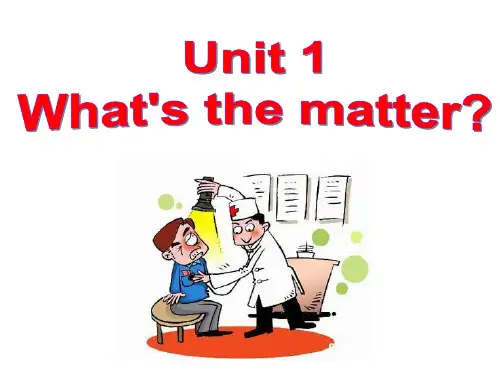
What’s the matter?
I have a (bad) cold. 感冒
I have a stomachache. 胃痛
What’s the matter with her / him?
keep on doing sth.
Hale Waihona Puke 词汇串记Yesterday Mr. black, the bus driver, was not feeling well. had a cold He 1 (感冒了). His wife took his temperature and found that he fever had a 2 (发烧). He took some medicine and drank lots of water. should His wife said that he 3 (应该)have a day off to lie down and rest decision or go to a doctor. But he made a 4 (决定)to keep on working. happened Unluckily, a bus accident 5 (发生)while he was driving. The bus accident was near a bridge. The bus ran off the road. Eight hurt people were 6 (受伤). The bus driver was too tired and he was going too fast. The road is a two-lane road. (双向车道)
摔倒 对感兴趣 习惯于 因为
fall down
be interested in be used to … because of run out of be ready to do sth. cut off
用完 准备做
切除
离开
掌管,管理 继续或坚持 (做某事)
get out of …
in control of …
(1)主语+have/has+病症 (2)主语+have/has+a+sore+发病部位 sore 是一个独立的形容词,指的是身体某一部位的
酸痛。如:sore back, sore throat,sore neck.
(3)主语+have/has+a+部位-ache
-ache作后缀,常与表示身体部位的名词合成一个
A:What’s the matter? cola B:I have a _____________. sore throat drink some hot tea A:You should __________________ _____________. with honey drink cola You shouldn’t_________________
A: What’s the matter? B: I have a_______________. sore back see a doctor A: You should ______________. You shouldn't _____________. surf the Internet
have a (high) fever
发烧
have a toothache 牙痛 have a headache 头痛
Pair work
知识小结1:
1.What’s the matter with sb? = What’s the trouble with sb? = What’s wrong with sb?
注:with为介词,后跟人称代词宾格, 如her,him,them等。
怎 么 了
eg:What’s the matter with your mother? What’s wrong with you? What’s the trouble with her?
在英语中,表达“疼痛或不舒服”时的常用结 构:
A: What’s the matter? B:I have a _________. fever A:You should__________________. drink lots of water You shouldn't_________________. exercise
Practice
Language objectives
1. Master main words 、phrases and sentences , and use them freely. 2. Can talk about health. 3. Can give some advice. 4. 主动去救助处于危险境地的人。
Pairwork
A: What’s the matter? B: I’m not feeling well. cold I have a _____.What should I do? A: You should________________. lie down and rest play soccer You shouldn't __________ .
1) 看到某人正在做某事 2) 让某人吃惊的是 3) 下车 4) 上车 5) 多亏,幸亏 6) 考虑 7) 同意做某事 8) 造成麻烦
see sb. doing sth. to one’s surprise get off the bus get on the bus thanks to think about agree to do sth. get into trouble
新词,表身体某部位疼痛,如:toothache , headache , stomachache . (4)(There is)something wrong with +one’s+部位
Give advice
A: What’s the matter? a toothache A: I have______________
see a dentist A: You should______________. You shouldn't ___________________. eat sweet things
.
What’s the matter? sore back I have a_________.
see a doctor You should ____________. exercise You shouldn't___________.
合集下载
人教版新目标八年级英语下册 Unit1 复习课件(共27张PPT)
12.He expected all of the passengers to get off. expect sb. to do sth. 期待做某事 get off 下车
13.To his surprise, they all agreed to go with him. to one’s surprise (n.) 令某人吃惊的是… agree to do sth. 同意做某事 agree with sb. 赞同某人的观点
14.Thanks to the passengers, the man was saved by the doctors in time. thanks to… 多亏,幸亏 thanks for… 为…而感谢 in time 及时 on time 准时
15.get into trouble = be in trouble 陷入麻烦
要求:暂停播放,自己复习U1单词,3min后听写。 1.AB层:注意单词的意思、词性、固定搭配等。 2.C层:只背黑色标注单词及词组
听写内容(c层写基本单词即可)
1.胃痛
11.击,打(+情
12.生病的,有病的
3.脚,足(+ pl.)
13.control
4.胃(+pl.)
14.习惯做某事
5.躺(+pt.+pp.)
15.危险,风险
6.cough
16.situation
7.间歇,休息
17.刀(+pl.)
8.疼痛,受伤(+pt.+pp.) 18.重要性
9.乘客,旅客
19.决定 n.
10.onto
20.死亡 n.
核对1.红笔批改,错一改三 2.每个5分,算出成绩,报给组长,组长于7点前汇给老师 3.低于80分家长重听,签字发给老师
13.To his surprise, they all agreed to go with him. to one’s surprise (n.) 令某人吃惊的是… agree to do sth. 同意做某事 agree with sb. 赞同某人的观点
14.Thanks to the passengers, the man was saved by the doctors in time. thanks to… 多亏,幸亏 thanks for… 为…而感谢 in time 及时 on time 准时
15.get into trouble = be in trouble 陷入麻烦
要求:暂停播放,自己复习U1单词,3min后听写。 1.AB层:注意单词的意思、词性、固定搭配等。 2.C层:只背黑色标注单词及词组
听写内容(c层写基本单词即可)
1.胃痛
11.击,打(+情
12.生病的,有病的
3.脚,足(+ pl.)
13.control
4.胃(+pl.)
14.习惯做某事
5.躺(+pt.+pp.)
15.危险,风险
6.cough
16.situation
7.间歇,休息
17.刀(+pl.)
8.疼痛,受伤(+pt.+pp.) 18.重要性
9.乘客,旅客
19.决定 n.
10.onto
20.死亡 n.
核对1.红笔批改,错一改三 2.每个5分,算出成绩,报给组长,组长于7点前汇给老师 3.低于80分家长重听,签字发给老师
新目标人教版八年级下册Unit1全单元课件
Conversation 4 Nurse: What’s the matter, Nancy? Girl: I _h_a_v_e_a__to_o_t_h_a_c_h_e_. Conversation 5 Betty: What’s the matter, Judy? Ann: She _h_a_s_a__s_o_re__th__ro_a_t__.
Nancy __4__ Sarah __1__ David __2__ Ben __3__ Judy __5__
Listen to the conversations again and fill in the blanks.
Conversation 1 Nurse: What’s the matter, Sarah? Girl: I _h_a_v_e_a__co_l_d_. Conversation 2 Nurse: What’s the matter, David? Boy: I _g_o_t_a_s_t_o_m__a_ch__a_ch__e. Conversation 3 Nurse: What’s the matter, Ben? Boy: I _h_a_v_e_a__s_o_re__b_a_c_k_.
2a Listen and number the pictures [1-5] in the order you hear them.
2
4
3
1
5
2b Listen again. Match the
problems with the advice.
1 fever
a lie down and rest
I have a sore throat.
What’s the matter?
新目标(人教) 八年级下册英语教学课件 Unit1 Section B(1a-1d)

bandage press sick kneeห้องสมุดไป่ตู้
nosebleed
n.绷带 v.用绷带包扎 v. 压;按;挤 adj. 生病的;有病的 n. 膝;膝盖 n.鼻出血
bandage n. 绷带 v. 用绷带包扎
1. His leg was hurt. Please put a bandage on it . (n.名词)
A. I fell down from the stairs. B. Do you have a sore back? C. What's wrong with you? D. Remember to put some ice on your knee. E. When did it start? F. But you should get an X-ray. G. Can I have a look at it ?
you hurt it? B: 3._____A______.
A: I see. Well, I don't think it's serious. 4.___F______ . Let the nurse take you to the third floor(楼层) and come back with your X-ray. And then I will know if your knee is broken or not.
B: OK. I will. (After ten minutes)
A: Let me have a look. Nothing seems to be broken. I think all you need is some rest. 5._____D_______ .
人教版八年级英语下Unit1复习课课件(共36张PPT)
The windows broke. Glass was everywhere. Soon the ambulances hospital (救护车). came. They took wounded(受伤的)people to the 10 (医院).
The police came. They took the driver to the police station.
A: What’s the matter? B:I have a _________. fever A:You should__________________. drink lots of water You shouldn't_________________. exercise
Practice
Language objectives
1. Master main words 、phrases and sentences , and use them freely. 2. Can talk about health. 3. Can give some advice. 4. 主动去救助处于危险境地的人。
2. The bus driver, 24-year-old Wang Ping, stopped the bus without thinking twice. 3. He only thought about saving a life.
你能看出“without thinking”、“about saving a life” 的共同点吗? 共同点:介词 + doing 介词 + 名词 宾格代词 doing
摔倒 对感兴趣 习惯于 因为
fall down
be interested in be used to … because of run out of be ready to do sth. cut off
新人教版英语八下Unit1复习课件

have a sore+ have a sore throat 喉咙痛 身体部位
have a sore back 背痛
形容词/副词 3. much too+ __ ,意为 太…… , too much+ 不可数名词 ,意为 太多 。 too many+ 可数名词复数 ,意为 太多 。 4. enough【形容、副词】足够的/地, enough放 在名前后,形副后。 good enough足够好 enough money 5. lie down 躺下 lie v. 躺,躺着,过去式lay; 过去分词lain,现在分词lying。属于不规则变化。
have a(an) + 疾病名称,表示患病
have a toothache
have a cold
have a sore throat
have a stomachache have a sore back
have a fever
have a headache
2. I had a cold.我感冒了。
lie v.撒谎; n.谎言 过去式和过去分词是be “或许”,常用于句首,表示可能性,后加句 子。 Maybe you are right. may be,是情态动词+be的结构,意为“可能(是), 也许(是)”,后加名词、代词或形容词。 He may be angry. 7. clean v. clean the classroom 8. hit (用手或器具)打;击打 过去式hit,过去分词hit The boy hit the dog with a stone.
10. free [形容词]free time 空闲的 The drink is for free; 免费的 I want to become a free bird. 自由的 【动词】使……解脱,得到自由 He could not free his arm.
have a sore back 背痛
形容词/副词 3. much too+ __ ,意为 太…… , too much+ 不可数名词 ,意为 太多 。 too many+ 可数名词复数 ,意为 太多 。 4. enough【形容、副词】足够的/地, enough放 在名前后,形副后。 good enough足够好 enough money 5. lie down 躺下 lie v. 躺,躺着,过去式lay; 过去分词lain,现在分词lying。属于不规则变化。
have a(an) + 疾病名称,表示患病
have a toothache
have a cold
have a sore throat
have a stomachache have a sore back
have a fever
have a headache
2. I had a cold.我感冒了。
lie v.撒谎; n.谎言 过去式和过去分词是be “或许”,常用于句首,表示可能性,后加句 子。 Maybe you are right. may be,是情态动词+be的结构,意为“可能(是), 也许(是)”,后加名词、代词或形容词。 He may be angry. 7. clean v. clean the classroom 8. hit (用手或器具)打;击打 过去式hit,过去分词hit The boy hit the dog with a stone.
10. free [形容词]free time 空闲的 The drink is for free; 免费的 I want to become a free bird. 自由的 【动词】使……解脱,得到自由 He could not free his arm.
人教版新目标英语八年级下册Unit1全单元ppt课件

人教版新目标英语八年级下册Unit1全单元课件
《全册课件》
Unit 1 What’s the matter ?
Can you name the parts of the body?
neck hand
leg
head throat arm stomach
knee
foot
What’s the matter with him/her…? He has a toothache. She has a toothache.
I have a sore throat.
What’s the matter?
I have a stomachache. I have a sore back. I have a toothache.
What’s the matter with him? Does he have a fever? Does he have a toothache? What should he do?
What’s the matter with him? Does he have a fever? Does he have a toothache? What should he do?
What’s the matter with him? Does he have a fever? Does he have a toothache? Does he have a sore throat? Does he have a stomachache? What should he do?
2a Listen and number the pictures [1-5] in the order you hear them.
2
《全册课件》
Unit 1 What’s the matter ?
Can you name the parts of the body?
neck hand
leg
head throat arm stomach
knee
foot
What’s the matter with him/her…? He has a toothache. She has a toothache.
I have a sore throat.
What’s the matter?
I have a stomachache. I have a sore back. I have a toothache.
What’s the matter with him? Does he have a fever? Does he have a toothache? What should he do?
What’s the matter with him? Does he have a fever? Does he have a toothache? What should he do?
What’s the matter with him? Does he have a fever? Does he have a toothache? Does he have a sore throat? Does he have a stomachache? What should he do?
2a Listen and number the pictures [1-5] in the order you hear them.
2
Unit 1(单元复习课件)八年级英语下册(人教新目标Go For It!)
have a cold 感冒
Sentences
2. I have a sore throat.
用have表达疾病的用法 ① have a +疾病 have a cold have a fever have a cough ② have a +身体部位+ache have a headache have a toothache ③ have a sore+身体部位 have a sore throat have a sore back have the flu
Phrases Section A
13.没有多想_wt_h_iit_nh_ko_iun_t_g_t_w_i_c_e__ 19.让某人吃惊_t_o_o_n_e_’_s_s_u_r_p_r_i_se__
14.下车_g_e_t_o_f_f_____________ 20.同意做某事_a_g_r_e_e_t_o__d_o_s_t_h___
词形转换
1.sick-----_i_ll_____(同义词) 2.breathe(动词)----_b_r_e_a_t_h__(名词) 3.we(主格)-----_o_u_r_s_e_lv_e_s___(反身代词) 4. climb-----___c_li_m_b_e_r__(名词)攀登者 5.knife-----_k_n_i_v_e_s___(复数) 6.importance(名词)-----_i_m_p_o_r_t_a_n_t_(形容词) 7.die(动词)---_d_e_a_t_h___(名词)--_d_y_i_n_g__(现在分词)
老师:XXX 班级:XXX
目录
1 Words 2 Phrases 3 Sentences 4 Grammar 5 Writing 6 Practice
Sentences
2. I have a sore throat.
用have表达疾病的用法 ① have a +疾病 have a cold have a fever have a cough ② have a +身体部位+ache have a headache have a toothache ③ have a sore+身体部位 have a sore throat have a sore back have the flu
Phrases Section A
13.没有多想_wt_h_iit_nh_ko_iun_t_g_t_w_i_c_e__ 19.让某人吃惊_t_o_o_n_e_’_s_s_u_r_p_r_i_se__
14.下车_g_e_t_o_f_f_____________ 20.同意做某事_a_g_r_e_e_t_o__d_o_s_t_h___
词形转换
1.sick-----_i_ll_____(同义词) 2.breathe(动词)----_b_r_e_a_t_h__(名词) 3.we(主格)-----_o_u_r_s_e_lv_e_s___(反身代词) 4. climb-----___c_li_m_b_e_r__(名词)攀登者 5.knife-----_k_n_i_v_e_s___(复数) 6.importance(名词)-----_i_m_p_o_r_t_a_n_t_(形容词) 7.die(动词)---_d_e_a_t_h___(名词)--_d_y_i_n_g__(现在分词)
老师:XXX 班级:XXX
目录
1 Words 2 Phrases 3 Sentences 4 Grammar 5 Writing 6 Practice
人教版英语八年级下册 Unit 1 复习课件
water? Could you give me some
money? Do you want some money? Can you give me a piece of paper? 等句 型中用some而不用any。something 和 anything如果是用形容词来修饰的时候, 形容词要放在something和anything的后 面,不能在前面。
• be used to 和 used to 的用法比较
• be used to 后面跟动词加ing形式。译成: 现在习惯于做某事。
• 人称代词表
主格
第一 I 人称 we 第二 you 人称 you
he 第三 she 人称 it
they
宾格
形容词性 名词性物 反身代词 物主代词 主代词
me my mine myself
us our ours ourselves
you your yours youself
you your yours yourselves
him his his himself
her her hers herself
it
its
its
itself
them their theirs themselves
• climb加-er变为climber登山者
• too much 和 much too的区别:too much 后面跟不可数名词。如: too much noise 太多的噪音。 much too 后面跟形容词和 副词的原形。
• enough 的用法:a. enough 修饰名词时, 放名词之前。如:enough food 足够的食 物
• b. enough 修饰形容词时,放形容词之后。 如:beautiful enough 足够漂亮
money? Do you want some money? Can you give me a piece of paper? 等句 型中用some而不用any。something 和 anything如果是用形容词来修饰的时候, 形容词要放在something和anything的后 面,不能在前面。
• be used to 和 used to 的用法比较
• be used to 后面跟动词加ing形式。译成: 现在习惯于做某事。
• 人称代词表
主格
第一 I 人称 we 第二 you 人称 you
he 第三 she 人称 it
they
宾格
形容词性 名词性物 反身代词 物主代词 主代词
me my mine myself
us our ours ourselves
you your yours youself
you your yours yourselves
him his his himself
her her hers herself
it
its
its
itself
them their theirs themselves
• climb加-er变为climber登山者
• too much 和 much too的区别:too much 后面跟不可数名词。如: too much noise 太多的噪音。 much too 后面跟形容词和 副词的原形。
• enough 的用法:a. enough 修饰名词时, 放名词之前。如:enough food 足够的食 物
• b. enough 修饰形容词时,放形容词之后。 如:beautiful enough 足够漂亮
人教版八年级下册英语unit1-3复习 课件(共60张PPT)
Unit 1
一、重点短语 发烧 1 咳嗽 2 牙疼 3 说得太多 4 喝足够的水 5 受凉;感冒 6 胃疼 7 背疼 8 喉咙痛 9 躺下来休息 10
• 1. have a fever • 2. have a cough • 3. have a toothache • 4. talk too much • 5. drink enough water • 6. have a cold • 7. have a stomachache • 8. have a sore back • 9. have a sore throat • 10. lie down and rest
• You should lie down and rest / drink hot tea with honey / see a dentist / see a doctor .
• He shouldn’t eat anything. • = He should eat nothing. 他不应当吃任何东西. • 3.I’m not felling well . 这里well表示身体状况,不能 用good代替
• maybe与may be • 1.maybe是副词,译为“也许、可能”,=“perhaps”。 • eg:Maybe he can answer the question. • 也许他能回答那个问题。
• He maybe is from the USA, too. • 他可能也来自美国。 • 2.may be中的may为情态动词,译为“可能是......”。 • eg:He may be from the USA, too. • 他可能也来自美国。
•把她的头向后仰 41 • 呼吸困难 42 •登山运动 43 •习惯做某事 44 • 用完;用尽 45 • 以便 46 •如此… …以至于… 47 • 掌管;管理 48 •在闲境屮 49 •继续或坚持做某事 50
新人教版八年级英语下册第一单元复习课件(PPT27张)备课讲稿
night?
• 3. What was your sister's trouble last night?
• Ⅱ.单项选择
• ( C )-----
.
• ——He has a sore back.
• A.What does he do?
• B.What's the wrong with him?
• C.What's the matter with him?
• ( C )3.You still weak, don't talk
.
• A.many B.so many C.too much D.much too
• ( A )4.The boy isn't to dress himself.
• A.old enough B.enough old C.old D.too young
• D.What's matter with him?
• ( C ) 2 . - You look tired . What's _ matter ?
•
——I have very sore throat. I didn't sleep well last night.
• A.the;the
B.a;the C.the;a D.a;a
• A.tired fortable C.sunburned D.sick
短语讲解
be used to do sth./be used 被用来做某事/习惯于做某 to doing sth./used to do sth. 事/过去常常做某事
take risks
冒险
run out of
用完;耗尽
• 3. What was your sister's trouble last night?
• Ⅱ.单项选择
• ( C )-----
.
• ——He has a sore back.
• A.What does he do?
• B.What's the wrong with him?
• C.What's the matter with him?
• ( C )3.You still weak, don't talk
.
• A.many B.so many C.too much D.much too
• ( A )4.The boy isn't to dress himself.
• A.old enough B.enough old C.old D.too young
• D.What's matter with him?
• ( C ) 2 . - You look tired . What's _ matter ?
•
——I have very sore throat. I didn't sleep well last night.
• A.the;the
B.a;the C.the;a D.a;a
• A.tired fortable C.sunburned D.sick
短语讲解
be used to do sth./be used 被用来做某事/习惯于做某 to doing sth./used to do sth. 事/过去常常做某事
take risks
冒险
run out of
用完;耗尽