
仁爱英语七年级下册Unit 5重要知识点及练习
(A )1.Mr. Green gets up very early every morning. Yes, so he always goes to work ______ time. A. on B. at C. next D. this (B )2.—Would you like to come and play soccer, Jim? —_____ A. No, I wouldn’t. B. Good idea! C. Thank you. D. You’re right. (C )3.—Where are Jim and Tom? Their mother is looking for them. —They _____ over there. A. run B. runs C. are running D. running
12 How many lessons does he have every weekday? How many+可数名词的复数形式; How much+不可数名词。 13 一个星期的第一天是Sunday, 在星期几前用介 词on, 在具体点钟前用at. 14 learning about the past了解过去 learn about了解 learn from向……学习 learn by oneself自学 15 What do you think of …? = How do you like…?你认为……怎么样? 16 —Why? —Because it’s interesting. 用why 提问必须用because回答。
重点详解 1 at the moment“此刻,现在”,相当于now. 2 巧辩异同 go to sleep与go to bed ① go to bed“上床”“就寝”I often go to bed at ten. ② go to sleep“入睡”“睡着”Last night I went to sleep at two o’clock. 3 巧辩异同 some, a few 与a little “一些,有些” 三者都修饰名词。some既可以修饰可数名词又可 以修饰不可数名词。We want some apples and some water.a few用在可数名词复数之前,a little 用在不可数名词之前。There are a few books and a little water in the classroom.
7.I can’t find my purse and I am looking for it. look for“寻找”,强调寻找的过程; find“找到” 强调找的结果。 8 .look(at), see与 read look(at)指看的动作,see指看的结果, read常指看书、看报纸等。 9 .Here are some photos of his.这有他的一些照 片。 photos of his是双重所有格。his是名词性物主代 词,后还可以接名词所有格。a friend of mine我 的一个朋友 a classmate of my brother’s我弟弟 的一个同学
行为动词的一般现在时, 助动词是do/don’t和does/doesn’t. 当主语是第一、二人称和所有复数形式时, 行为动词用原形。 肯定式:I go to school on foot. 否定式:I don’t go to school on foot. 疑问式:Do you go to school on foot? —Yes, I do. —No, I don’t. 当主语是第三人称单数时,动词用第三人称单数 形式,在词尾加-s或-es。 肯定式:He goes to work by bus. 否定式:He doesn’t go to work by bus. 疑问式:Does he go to work by bus? —Yes, he does. —No, he doesn’t.
7 They often play basketball or soccer, go swimming and so on. 拓展 go+v.-ing 表示去做某事,类似的有: go fishing 去钓鱼 go shopping 去买东西 go boating 去划船 go skating 去滑冰 8 How often do you go to the library? how often“多久一次”,问频率。答语常用频度 副词never, always,often等或单位时间内的次数 once a week一周一次 twice a month每月两次 three times a year每年三次
4 .do my homework at school 在学校做作业 do one’s homework 做家庭作业(注意: one’s 要随主语的变化而变化,常用形容词性物 主代词my, your, their, our, his, her等)。 5 know about “了解,知道关于…”。 6 巧辩异同 a few与few 修饰可数名词 。a few “一些”, few“很少,几乎没有”,(表示否定) a little与little 修饰不可数名词。 a little“一些”, little“很少,几乎没有”,(表示否定)
17 Which subject do you like best? 你最喜欢什么科目? like best最喜欢,可用favoriendly to sb. 对某人友好 19 I can learn a lot from it. 我能从中学到很多东西。 (1) learn…from“从……学习”。 (2) a lot = much“许多”,后接宾语时要说a lot of 也可以表示“非常,十分”。
语法讲解 现在进行时 1.现在进行时表示:现在正在进行或发生的动作。 2.常用的时间状语:now, at the moment, look, listen等。 3.谓语动词构成:be(am/is/are)+v.-ing形式。 4.现在进行时态的肯定、否定和疑问式。 (1)肯定式:I am running. You are running. He/She is running. (2)否定式:I’m not running. You aren’t running. He/She isn’t running. (3)一般疑问句及回答: —Are you running? —Yes, I am./—No, I am not. —Is he/she running? —Yes, he/she is./ —No. he/she isn’t.
重点详解 1.I always come to school by bus. by+交通工具名称,表示使用某种交通方式,中 间不加限定词,如果交通工具前有a, the, my 等限 定词,就不能用by,而是用in或是on. on the train=by train on his bike=by bike in my car=by car. 巧辩异同 on foot 与 walk on foot “走路”, 是介词短语,不能作谓语,只作方式状语,位于 句末。walk “走路”,是动词,可以作谓语。 go to…on foot= walk to I often go to school on foot. =I often walk to school.
一般现在时表示: (1)现在所处的状态。Jane is at school. (2)经常或习惯性的动作。I often go to school by bus. (3)主语具备的性格和能力。He likes playing football. (4)客观真理。The earth goes round the sun. 常用的时间状语:often, always, usually, sometimes, every day等等。
重点语法 一般现在时 (常与频度副词never, seldom, sometimes, often,usually, always等连用) 重点句型 —How do you usually come to school? —I usually come to school by subway. —How often do you go to the library? —Once/Twice/Three times a week/Very often/Every day/Sedom
4 与how相关的短语 how often多常 how many多少 how long 多长 how much多少钱 how old多大 how wide 多宽 5 And you must return them on time.你必须按时 归还它们。return意为“归还,回归” ① return sth. to sb.把某物归还某人=give back sth. to sb. ② return to“回到…”,相当于come back to…
go to….by bike = ride a bike to 。。。 go to…. by car = drive a car to 。。。 go to … by plane = fly to 。。。 go to… by bus = take a bus to。。。 2 .Come on! It’s time for class. come on “快点,加油,来吧”。 It’s time for sth. “该做某事了”, It’s time for doing sth与 It’s time to do sth.意思 一样。 3 .look的短语 look the same看起来一样 look like看起来像…… look for寻找 look after 照顾
6 Maria and a girl are talking at the lost and found. talk“交谈”,常用的短语talk to/with sb.“与某 人交谈” 巧辩异同talk, say, speak与tell (1) talk“交谈”,表示通过谈话方式交换意见、 消息等。 (2) speak“说话”,强调开口发声,后常接某种 语言。 (3) say “说”,强调所说的话的内容。 (4) tell“告诉”,有时兼含“嘱咐”“命令”等。 tell a truth说真话,tell a lie说谎, tell a story 讲故事等固定搭配。
仁爱英语七年级下册-Unit 5 Our School Life 知识点讲解
Unit 5 Our School LifeTopic 1 I usually come to school by subway.Section A1. Kangkang meets Jane and Helen at the school gate.康康在学校大门口遇到简和海伦||。
(1)meet sb.意为“遇见某人||,与某人碰面”||。
如:meet friends见朋友||。
(2) at the school gate意为“在学校大门口”||,注意介词为at||。
一般来说||,at后接小地点||,in后接大地点(市级或以上的地点)||。
如:at Wuzhen在乌镇in Shanghai在上海2. -Happy New Year!新年快乐!-The same to you.你也一样(新年快乐)||。
The same to you.意为“也同样祝你……”||,用于公共节假日等别人向你祝福问候时的回答||,相当于You||,too.如:-Merry Christmas!圣诞快乐!-The same to you!你也一样(圣诞快乐)!【注意】-Happy birthday!生日快乐!-Thank you!谢谢!3. --How do you usually come to school?你通常是怎样来上学的?-- usually come to school by subway.我通常乘地铁来上学||。
(1)此句中how用来询问交通方式||。
如:-How do you usually go to the zoo?你通常是怎么去动物园的?-I usually go to the zoo by bus.我通常乘公共汽车去动物园||。
-How does your brother get to school?你弟弟是怎样到学校的?-He gets to school on foot.他步行到学校||。
七年级英语下unit5重点单词词组句型及综合训练仁爱版
七年级下重点单词词组句型unit51. wake up 醒来,唤醒get up 起床2. go to school 去上学go home 回家3. go dancing / shopping / skating / swimming 去跳舞;购物、滑冰;游泳go doing something 可用于表达去进行某种娱乐休闲活动。
(补充)4. 表示交通方式:on foot 步行by boat 船by ship 坐船by air 乘飞机by plane 乘飞机by train 坐火车by subway 搭乘地铁by car 坐小汽车b y bus 坐公共汽车by bike 骑自行车5. take the subway / bus / car 搭乘地铁;公共汽车;小汽车6. drive a car to work = go to work by car 驾车去上班take a bus to work = go to work by bus 乘公共汽车去上班go to school on foot = walk to school 步行去上学7. ride a bike / horse骑自行车;骑马8. play the piano / guitar / violin 弹钢琴;吉他;小提琴play basketball / soccer / football 打篮球;踢足球;打橄榄球play computer games 玩电脑游戏play with a computer 玩电脑play sports 做运动10. next to 紧挨着,在…旁边11. a plan of my school 一幅我们学校的平面图12. on weekdays在工作日at /on weekends在周末13. have breakfast / lunch / supper / dinner / meals 吃早餐;中餐;晚餐;正餐;一日三餐have classes / lessons / a meeting 上课;上课;开会14. watch TV / movies / games / match看电视;电影;比赛read novels / newspapers / books看小说;报纸;书go to the cinema go to plays see a film15. wash one’s face / clothes/dishes 洗脸;衣服洗碗16.get up early 早起be late for 迟到17. the first / second / third / fourth day 第一;二;三;四天18. clean the house 打扫房子19. 表示建筑物(尤其学校建筑物):on the playground 在操场at school / home / table 在学校;家里;桌旁in a computer room / teachers’ office / classroom building / gym / library / lab / canteen在电脑室;教师办公室;教学楼;体操馆;图书馆;实验室;食堂20. around six o’clock = at about six o’clock 大约在六点3. swimming pool 游泳池4. listen to music 听音乐write letters 写信go roller-skating 滑滑轮go shopping 去购物have an English class 上英语课go to the park 去公园meet friends 会见朋友draw pictures 画画play sports 做运动watch TV 看电视play computer games 玩电脑游戏play soccer 踢足球work on math problems 解答数学题take exercises 做运动have sports do sportslearn about the past 了解过去learn how to read and write in Chinese 学着用中文读写play ball games with my classmates 和我的同班同学玩球类游戏5. be good at = do well in 擅长于…I am good at English. = I do well in English.6. be different from 与…不同the same as 与…相同7. do outdoor activities 进行户外活动8. every week 每周each day 每天three times a week 每周三次9. 反义词:boring – interesting difficult – easy begin – finish 近义词:difficult – hard10. care about 关心;担心care for 11. try to do something 尝试去做某事12. do one’s best 尽力去做某事do one’s homework 做家作13. like doing something = love doing something 喜欢做某事hate doing something 讨厌做某事14. noon break 午休15. at half past six = at thirty past six = at six thirty六点半at seven o’clock = at seven 在七点at five fifteen = at fifteen past five = at a quarter past five五点十五分at fifteen to ten = at a quarter to ten = at nine forty-five 九点四十五分16. for a little while 就一会儿17. a student of Grade One 一年级的学生18. eat out 出去吃19. get home 到家1. 反义词:first – last borrow – return / give back2. 名词单数转化复数:life – lives shelf – shelves leaf – leaves half – halves life - lives3. between… and…在…与…之间4. school hall 学校大厅5. else, other 别的6. Lost and Found Room 失物招领处7. the school life 学校生活8. most of them 他们大多数all pupils 所有的学生few pupils 很少学生9. spare time 空闲时间10. have a short break /rest 休息片刻11. and so on 等等12. on time 按时13. Here it is. = Here you are. 给你14. Our School Times 《学校时报》Everyday Science 《每日科技》15. get to school 到校get home 到家16. learn…from 向…学习17. 名词变成形容词:wonder – wonderful, use – useful, care – careful, beauty - beautifulinterest – interesting excite – exciting二、重点句型.先在练习本上做,然后订正在横线上。
七年级英语(仁爱版)下册 Unit-5-Topic-1 知识点总结语言点归纳
知识点七年级英语(仁爱版)下册Unit-5-Topic-1语言点归纳Unit 5 Topic 1I 重点词汇和短语gate, by, always, plane, train, ship, boat, Ms., grandmother, group, weekday, early, bird, catch, seldom, walk, never, sometimes, ride, park, watch, TV, homework, life, American, or, few, day, rest, play, basketball, swim, ball, game, read, listen, library, once, twice, week, every, must, first, music, begin, while, wall, bed.the same to, come on, on foot, by plane, know about, for a while, watch TV, do (one’s) homework, have lunch, at school, have a rest, be different from, go swimming, listen to, go to bed, go to school, have classes.II 语言点Section A1. a) ---Happy New Year! ---- The same to you! / You, too. 新年快乐!也祝你新年快乐!b) ----Happy birthday! -----Thank you! 生日快乐!谢谢!2. How about you? = What about you? 你怎么样?3. Oh, your new bike looks very nice! 哦,你的新自行车看起来很好看。
仁爱英语七年级下册Unit 5 知识点
仁爱英语七年级下册unit 5知识点本篇文章将对仁爱英语七年级下册unit 5的知识点进行全面介绍。
一、单词1. forget:忘记2. remember:记得3. need:需要4. want:想要5. buy:购买6. borrow:借出7. lend:借入8. pay:支付9. cost:花费10. heavy:重的11. light:轻的12. thin:薄的13. thick:厚的14. long:长的15. short:短的16. small:小的17. big:大的18. hot:热的19. cold:冷的二、语法1. 情态动词情态动词包括can/could, may/might, must, should/ought to等,用于表示说话人的态度、意愿、可能性、推测等。
比如:I can swim.(我会游泳。
)You must finish your homework.(你必须完成作业。
)2. 定冠词和不定冠词定冠词the用于特指某一事物,比如the book(那本书);不定冠词a/an用于泛指某一个,比如an apple(一个苹果)。
3. 物主代词我、你、他、她、它等人称代词后面加上我的、你的、他的、她的、它的等词,就构成了物主代词。
比如:I lost my bag.(我丢了我的书包。
)4. 名词的复数在名词后面加-s或-es来表示复数形式,比如books(书)、boxes(箱子)。
5. 副词副词是用来修饰动词、形容词、副词和句子的。
常用的副词有often, always, sometimes等。
6. 数词数词是用来表示数目、数量的词语。
基数词表示数量,比如one(1)、two(2)等;序数词表示顺序,比如first(第一)、second(第二)等。
三、阅读理解这个单元包含了一篇短文,提供了购物建议。
阅读理解是考查学生字义理解能力的一种方式,要求同学们读懂短文,并理解其内容。
四、写作技能写作技能涉及到学生组织语言,进行人际交流的能力。
七年级英语(仁爱版)下册Unit_5_Topic_2知识点练习
Unit5 Topic2重点语法现在进行时态。
重点句型What are you doing? He is cleaning the library.Are you doing your homework? Yes, I am./No, I am not.How long can I keep them? Two weeks.重点详解1 巧辩异同go to sleep与go to bed①go to bed“上床”“就寝”I often go to bed at ten.②go to sleep“入睡”“睡着”Last night I went to sleep at two o’clock.3 巧辩异同some, a few 与a little“一些,有些”三者都修饰名词。
some既可以修饰可数名词又可以修饰不可数名词。
We want some apples and some water.a few用在可数名词复数之前,a little用在不可数名词之前。
There are a few books and a little water in the bottle.4 与how相关的短语how often多常how many多少how much多少或多少钱how old多大how long 多久5 And you must return them on time.你必须按时归还它们。
Return意为“归还,回归”①return sth. to sb.把某物归还某人=give back sth. to sb.②return to“回到…”,相当于come back to…6 Maria and a girl are talking at the lost and found.talk“交谈”,常用的短语talk to/with sb.“与某人交谈”巧辩异同t a l k,s a y,s p e a k与t e l l(1) talk“交谈”,表示通过谈话方式交换意见、消息等。
仁爱英语七年级下册Unit5语法、知识点及练习
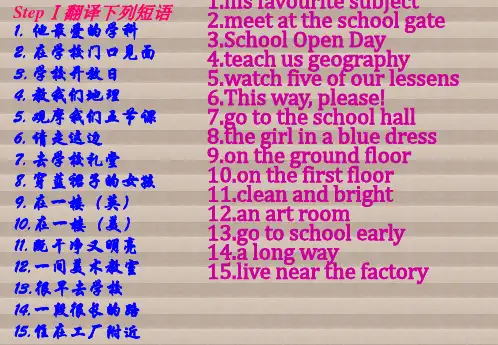
1. Our teaching building is so big 2. Our library looks very modern 3. Who is the girl in a red skirt? ---- She is my cousin 4. Let me show you around 5. We have meetings in the school hall 6. There is a library and two art rooms in our
4. 从我家到学校步行通常要花费我十五分钟时间。
It usually takes me 15 minutes to walk from my home to school. 5. 是我们该上英语课的时候了。
It‘s time for us to have an English lessen. 6. 谢谢你给我写信/的来信。
them
to have
StepⅢ 翻译下列句子
1. 明天是几月几号? What’s the date tomorrow? 2. 让我们一点半在学校大门口见面吧!
Let’s meet at the school gate at half past one. 3. 我想向我的生物老师问好。
I want to say hello to my biology teacher.
40.骑车去学校(两) 40. ride a bike to school/ go to scho
41.在某人去医院的路上 one’s bike
42.在你回家/回来的路上41. on one’s way to the hospital
42. on your way home/back
仁爱版英语七年级下册unit5知识点
仁爱版英语七年级下册unit5知识点英语学习已经成为现代人不可或缺的技能。
在仁爱版七年级下册英语教材中,unit5是一个重要的单元。
本文将从知识点的角度,为大家系统地介绍该单元中的重点内容。
一、动词的过去式在unit5中,我们学习到了动词的过去式。
在这里,我们需要掌握动词的基本变化规则。
一般情况下,动词的过去式可以通过在动词末尾加-ed来构成。
但是,也有一些不规则动词需要单独掌握。
例如:look(看) --> looked(看过)eat(吃) --> ate(吃过)see(看见) --> saw(看见过)二、物品数目的表达在英语中,物品数目的表达也是一个非常实用的知识点。
在unit5中,我们主要学习了以下表达方式:1. 表示单数物品:a pen(一支钢笔)a piece of paper(一张纸)a glass of water(一杯水)2. 表示复数物品:two pens(两支钢笔)fifteen pieces of paper(十五张纸)three glasses of water(三杯水)三、时间的表达时间也是英语学习中重要的一部分。
在unit5中,我们需要掌握的时间表达方式有:1. 表示具体时间:at 8:30(在8点30分)on Monday(在星期一)in May(在五月)2. 表示持续时间:for 2 hours(持续两个小时)since last year(从去年开始)四、情态动词情态动词在英语学习中也是非常重要的。
在unit5中,我们学习了以下情态动词:1. can表示“能够”:I can speak English.(我会说英语。
)2. must表示“必须”:We must finish the homework.(我们必须完成作业。
)3. should表示“应该”:You should clean your room.(你应该打扫房间。
)总结:本文主要从动词的过去式、物品数目的表达、时间的表达和情态动词四个方面介绍了仁爱版英语七年级下册unit5的知识点。
仁爱英语七年级下册Unit5课本重点总结
仁爱英语七年级下册Unit5课本重点总结Unit 5 Topic1重点知识复总结1.---Happy New Year!---The same to you.Happy birthday!---Thank you.2.Your new bike looks very nice!It looks nice on you.(这两句均为系表结构)3.I usually come to school by subway。
(提问)How do you usually come to school?Do you often come to school by bike?Yes。
I do.4.You mean you usually come to school by underground?此处mean为动词“意思是…”常见句型:What do you mean?你什么意思?meaningn.意思XXX.5.You’re right。
/ That’s right.承认对方说法。
That’s all right.不消谢。
6.It's time for class。
= It’s time to have classes.7.He comes to school on foot.= He walks to school.She goes to school by bus.= She takes a bus to school.XXX.XXX.8.Kankang meets Jane at the school gate.XXX foot步行(此类均为介词短语)10.I usually get up at about six o’clock on weekdays。
(提问)What time do you usually get up on weekdays?11.The early bird catches the worm.12.XXX XXX to school.He sometimes takes the train to Xinxiang.He often comes on foot.Sally usually takes a plane to the USA.Lucy always takes a bus to Xinxiang.13.Classes begin at eight。
仁爱版七年级英语下册unit5知识点
仁爱版七年级英语下册unit5知识点Unit 5是本学期英语教材的重点单元,内容包括了商店购物、邮局服务、家庭家务等日常话题,涵盖了丰富的生活场景。
以下是本单元的知识要点:一、词汇1.商店购物shoes shoes store shirt shirt store dress dress storepants pants store skirt skirt store hat hat storecoat coat store book bookstore bag bag storebank bank card credit card cash change2.邮局服务post card letter envelope stamppost office mailbox address zip code3.家庭家务clean clean up sweep mopwash laundry fold drydish do the dishes set the table clear the table二、重点语法本单元的语法重点是一般现在时和there be句型的运用。
1.一般现在时一般现在时通常用来表示反复发生的动作、习惯性的行为或者现在的状态。
它的构成方式是主语+动词原形+其他。
注意第三人称单数形式应该在动词后面加上“s”。
例如:I often go shopping on weekends. (我经常在周末去购物。
)She always buys books in the bookstore. (她总是在书店买书。
)2.there be句型there be句型用来表示某地或某处有某物。
当表示单数或者不可数名词时,应该用there is;当表示复数名词时,应该用there are。
例如:There is a bank in front of the bookstore. (书店前面有一家银行。
)There are some chairs in the classroom. (教室里有一些椅子。
英语仁爱版七年级下册第五单元Unit 5 Our school life知识点整理
Unit 5 Our school lifeTopic 3 My school life is interesting.一、重点词汇及短语:1.单词:Today adv在今天n 今天, Wednesday n 星期三, Monday n 星期一, physics n 物理, Tuesday n 星期二,geography n 地理,Thursday n 星期四, P.E. n 体育,Friday n 星期五, art n 美术, history n 历史, math n 数学, science n 科学, learn v 学习, easy adj 容易的, interesting adj 有趣的, difficult adj 艰难的, boring adj 无聊的, which pron 哪一个, subject n 学科, best adv&adj 最好地(的), between prep 在(两者)之间, Saturday n 星期六, February n 二月, hard adj 努力的adv 努力地, story n 故事friendly adj 友好的world n 世界attention n 注意stamp n 邮票,night n 夜间, place n 地点,program n 节目,newspaper n 报纸.2.短语:be over 结束outdoor activity 室外活动wait for sb 等待某人every week 每周have an English class 上英语课my school life 我的学校生活not…at all 一点也不,根本不be friendly to…对……友好learn…from…从……中学习……on Wednesdays 在星期三work on 从事from…to…从……到……二、词组例析:1.outdoor activity 室外活动activity是可数名词,其复数形式是把y变i 再加-es。