
unit3 计算机专业英语
计算机专业英语教程
机械工业出版社
Unit 3
Program Design
退出
第一次课
【教学内容】 Unit 3 词汇、练习 【课时目标】检查学生上一单元的知识掌握情况,识记相关词汇、短 语,做练习。 【教学重点、难点】词汇的识记与练习。
New Words
New Words
学生课下活动设计
背诵本单元单词、短语,预习教材第三单元Text,试着翻译成汉语 。
第二次课
【教学内容】翻译课文,完成课后理解练习。 【课时目标】准确翻译课文,理解程序设计的内涵。 【教学重点、难点】 重点:准确理解课文内容,较准确地译成汉语。 难点:文中长句的翻译。
Text
阅读课文并翻译,结合课后练习一加深知识的理解。
Answers to Exercises
1.这个地区的建筑都一个样,没有什么特色。(distinguishing features) All buildings in this region are alike without any distinguishing features. 2.音乐家们提供同样的功能。 Playlists serve the same function. 3.耳的功能是听。 The function of the ear is to listen. 4. 钟表的功能是报时。 The function of a clock is to tell the time. 5. 与我家相邻的房子正在修缮。 The house adjacent to ours is under repairs. 6.这个新的设施与该组织现有的饲养中心毗邻。 The new facility is adjacent to the organisation’s existing breeding centre .
New Words
New Words
Phrases
Phrases
Phrases
Abbreviations
Exercises
1.这个地区的建筑都一个样,没有什么特色。(distinguishing features) 2.音乐家(musician)们提供同样的功能。 3.耳的功能是听。 4. 钟表的功能是报时。 5. 与我家相邻的房子正在修缮。 6.这个新的设施与该组织现有的饲养中心毗邻。 7.商标是企业的一项无形资产。 8.他在考试中得到好分数。 9.他考试得了满分。 10.他有一匹马,头上有一块白斑。 11.全面深化改革取得重大突破。
Answers to Exercises
7.商标是企业的一项无形资产。 The trade mark is an intangible asset of every enterprise. 8.他在考试中得到好分数。 He attained a good mark in the examination. 9.他考试得了满分。 He got full marks in the examination. 10.他有一匹马,头上有一块白斑。 He has a horse with a white mark on its head. 11.全面深化改革取得重大突破。 An all-round in-depth reform has achieved significant breakthroughs.
适度提问学生,充分调动其积极性,重点分析长句的翻译。
Notes
Notes
Notesห้องสมุดไป่ตู้
Notes
Notes
学生课下活动设计
完成本单元课后练习,阅读教材第三单元Reading,并能独立 翻译成汉语。
教学参考资料推荐
《计算机专业英语教程》,宋德富,司爱侠,高等教育出版社, 2013年9月,第四版
计算机专业英语教程课后答案-宋德福第三版
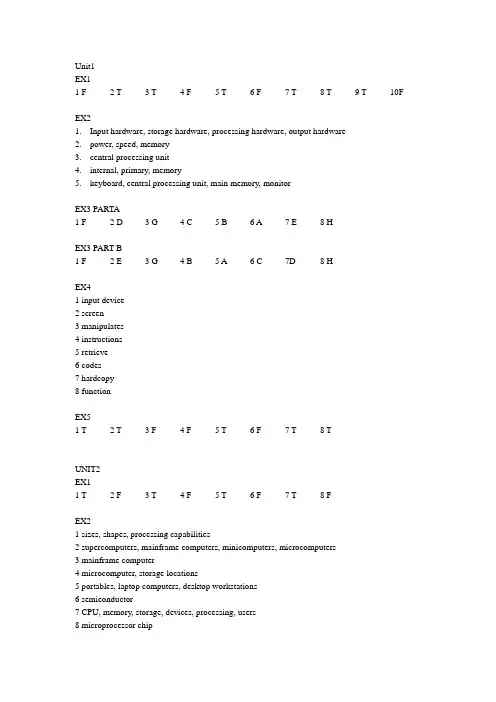
Unit1EX11 F2 T3 T4 F5 T6 F7 T8 T9 T 10FEX21.Input hardware, storage hardware, processing hardware, output hardware2.power, speed, memory3.central processing unit4.internal, primary, memory5.keyboard, central processing unit, main memory, monitorEX3 PARTA1 F2 D3 G4 C5 B6 A7 E8 HEX3 PART B1 F2 E3 G4 B5 A6 C 7D 8 HEX41 input device2 screen3 manipulates4 instructions5 retrieve6 codes7 hardcopy8 functionEX51 T2 T3 F4 F5 T6 F7 T8 TUNIT2EX11 T2 F3 T4 F5 T6 F7 T8 FEX21 sizes, shapes, processing capabilities2 supercomputers, mainframe computers, minicomputers, microcomputers3 mainframe computer4 microcomputer, storage locations5 portables, laptop computers, desktop workstations6 semiconductor7 CPU, memory, storage, devices, processing, users8 microprocessor chipEX3 PARTA1 C2 A3 H4 I5 E6 F7 G8 JEX3 PARTB1 capacity2 device3 laptop computer4 Portable computers5 Silicon6 semiconductor7 workstation8 V oltage, voltage9 RAM10ROMEX41 portable2 access3 main memory4 sophisticated programs5 processing capabilities6 instructions7 computation8 computer professionalEX51 T2 T3 F4 F5 F6 T7 F8 T9 T 10T 11F 12T 13 T 14 TUNIT3EX11 T2 F3 T4 T5 T6 T7 F8 F9 T 10 F 11T 12F 13F 14TEX21 microprocessor2 bus3 register4 control unit5 processor6 binary7 arithmetic, logic 8 milliseconds, microseconds9 instruction 10execution11megahertz 12wordsizeEX3 PARTA1 F2 A3 J4 C5 D6 E7 H8 I9 B 10GEX3 PARTB1 Storage2 chip3 buses4 ALU5 register6 control unit7 machine language 8 binary system9 bits 10computer programEX41 configuration2 decodes3 data bus4 characters5 converts6 synchronize7 circuitry8 internal clockEX51 T2 F3 F4 T5 F6 F7 T8 T9 F 10 FUNIT4EX11 F2 T3 T4 F5 F6 T7 F8 T9 T 10 F 11T 12T 13F 14F 15T 16F 17T 18F 19T 20F 21T 22FEX21.memory2.RAM3.diskettes, disks4.chips5.parity6.expanded, extended7.monochrome8.cache9.ROM10.updatedEX3 PART A1 B2 E3 C4 J5 I6 H 7A 8 F 9 G 10D EX3 PART B1.secondary storage2.buffer3.access4.code5.diskette6.slot7.terminals8.motherboard9.byte10.screenEX41.desktop2.software3.animation4.transferred5.sophisticatedpatible7.cache8.upgradeEX51 T2 F3 F4 T5 T6 T7 T8 F9 T 10 F 11T 12F 13F 14T 15T 16F 17F 18F 19F 20T 21T 22TUnit 5Ex1:1 T2 T3 F4 T5 F6 F7 F8 T9 T 10 T 11F 12T 13F 14F 15T 16T 17F 18T 19F 20F 21T 22T 23TEX21.mail, courier2.hub, star3.local area network4.packets5.Ethernet6.kilobits per second, megabits per second, gigabits per second7.circuit switching8.reassembled9.internet protocol, transmission control protocol10.datagrams11.frames12.binary, decimalEX3 part A1 C2 E3 B4 F5 A6 D7 H8 GEX3 part B1.hub2.zipped3.decimal4.frame5.binary number6.internet7.packet8.bandwidthEX41.forwarded2.reassembled3.are encapsulated4.cable5.bursty6.submit7.are retransmitted8.protocolEX51.IP address2.notation3.dotted-decimalputer network5.background6.shared7.geographic8.privacyExercise to the Passage for ReadingEX61.有意为维修技师使用所留2.被弃的、丢失的或损坏了的数据都进了数据桶。
计算机专业英语Unit3

Section 2 Passages
பைடு நூலகம்
Section 3 Skill in Focus
•
Section 4 Extended Reading
Unit 3 Operation System
Section 1 Situational Dialogue
System Crash 1、在使用计算机的过程中,你遇到过系统崩溃的情况吗, 简单描述一下。
• • • •
Unit 3 Operation System
Section 2 Passage A: Categories of Operating System
1、你所知道的操作系统有哪些 2、你觉得未来操作系统的发展趋势是什么
Unit 3 Section 2 Passage A
• OS • software • application program • resource • error • batch processing • real-time • multi-tasking • multi-user • distributed • time sharing • desktop
• •
• •
Unit 3 Section 1
•
Zhang Ning: Well, there might many causes for system crash. One of them is software. The simplest operation like installing and uninstalling might cause a crash in system. Problems within the system may also do that, so you have to be very careful when deleting DLL files, modifying Windows registry, or upgrading the operating system. Another cause is the hardware problem. Have you tried backing up the files? It would be a great help in system restoration when the problem doesn’t lie in the hardware. Cheng Hong: The service personnel installed a ghost program for me when I bought the computer. Will I lose the data in my hard disk if it is restored? Qian Liang: Not except the data on C: drive, where files on your desktop or in My Documents are stored. You may move them into other locations with a bootable disk or under DOS if there are any. Cheng Hong: There are a lot of learning materials in My Documents and on the desktop. Would you please help me transfer them? It might save me the trouble of calling for customer services, and what’s more important, I’d learn a lot from you. Qian Liang: No problem.
计算机专业英语教程(第四版)习题答案
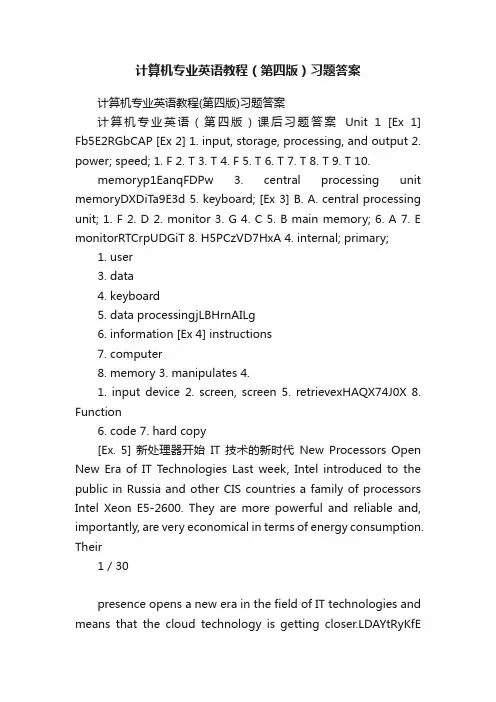
计算机专业英语教程(第四版)习题答案计算机专业英语教程(第四版)习题答案计算机专业英语(第四版)课后习题答案Unit 1 [Ex 1] Fb5E2RGbCAP [Ex 2] 1. input, storage, processing, and output 2. power; speed; 1. F 2. T 3. T 4. F 5. T 6. T 7. T 8. T 9. T 10.memoryp1EanqFDPw 3. central processing unit memoryDXDiTa9E3d 5. keyboard; [Ex 3] B. A. central processing unit; 1. F 2. D 2. monitor 3. G 4. C 5. B main memory; 6. A 7. E monitorRTCrpUDGiT 8. H5PCzVD7HxA 4. internal; primary;1. user3. data4. keyboard5. data processingjLBHrnAILg6. information [Ex 4] instructions7. computer8. memory 3. manipulates 4.1. input device2. screen, screen 5. retrievexHAQX74J0X 8. Function6. code7. hard copy[Ex. 5] 新处理器开始IT 技术的新时代New Processors Open New Era of IT Technologies Last week, Intel introduced to the public in Russia and other CIS countries a family of processors Intel Xeon E5-2600. They are more powerful and reliable and, importantly, are very economical in terms of energy consumption. Their1 / 30presence opens a new era in the field of IT technologies and means that the cloud technology is getting closer.LDAYtRyKfEThese processors are primarily designed for servers, data centers (DPC) and supercomputers. The emergence of this class of devices is not accidental. According to the regional director of Intel in Russia and other CIS states Dmitri Konash who spoke at the event, the market of IT-technology is developing so rapidly that, according to forecasts, by 2015 there will be 15 billion devices connected to the Internet, and over 3 billion of active users.Zzz6ZB2Ltk 上周,英特尔公司向俄罗斯和其它独联体国家的公众推出了英特尔Xeon E5-2600 系列处理器,它们更加强大可靠,尤其是在能量消耗方面更加经济实惠。
精品课件-精品课件--计算机专业英语(王莹)-unit3
计算机专业英语
Computer English
主编:王莹 王月 戴赟
副主编:
西安电子科技大学出版社
目
Unit 1 Computer Hardware
录
Unit 2 Computer Software
CONTENTS
Unit 3 Computer Network
Unit 4 Multimedia
3. Listen to the dialogue and choose the best responses to what you hear. 5. A. Maybe.
B. The same to you.
C. Where are you going?
6.
D. OK. I’ll visit my parents. A. Sorry, I’m a stranger here.
and
7 of the world, or for no apparent reason at all. Don’t be too 8 when your baby cries and you aren’t able to console him or her 9 :
crying is one way babies shout out stimuli when they're 10 .
3. L1i.stAe.n It’o mthfelydiinaglobgaucekatnodmocrhrooows.e the best responses to what you hear.
B. See you next time.
C. It’s my pleasure.
计算机专业英语Unit 3
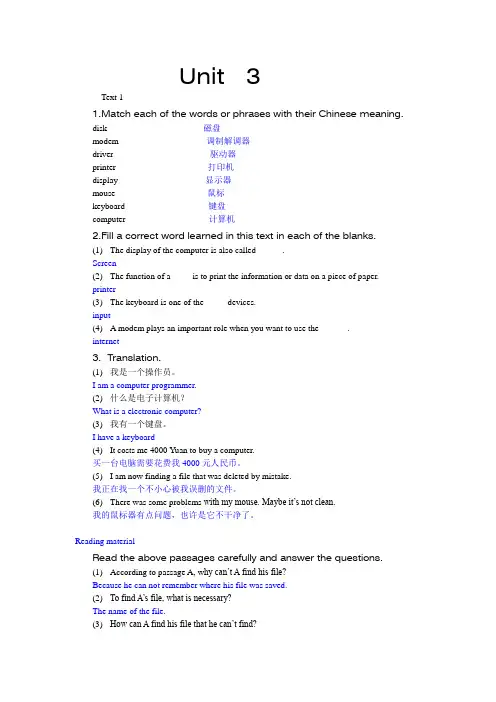
Unit 3Text 11.Match each of the words or phrases with their Chinese meaning.disk 磁盘modem 调制解调器driver 驱动器printer 打印机display 显示器mouse 鼠标keyboard 键盘computer 计算机2.Fill a correct word learned in this text in each of the blanks.(1)The display of the computer is also called______.Screen(2)The function of a ____ is to print the information or data on a piece of paper.printer(3)The keyboard is one of the _____devices.input(4) A modem plays an important role when you want to use the ______.internet3. Translation.(1)我是一个操作员。
I am a computer programmer.(2)什么是电子计算机?What is a electronic computer?(3)我有一个键盘。
I have a keyboard(4)It costs me 4000 Yuan to buy a computer.买一台电脑需要花费我4000元人民币。
(5)I am now finding a file that was deleted by mistake.我正在找一个不小心被我误删的文件。
(6)There was some problems with my mouse. Maybe it’s not clean.我的鼠标器有点问题,也许是它不干净了。
计算机专业英语unit3 B课文

Computer programmingComputer programming, often shortened to programming or coding, is the process of writing , testing ,and maintaining the source code of computer programs. The source is written in a programming language. This code may be a modification of existing source or somethingcompletely new,the purpose being to create a program that exhibits the desired behavior. Theprocess of writing source code requires expertise in many different subjects, including kn owledge of the application domain,specialized algorithms, and formal logic.Within software engineering, programming is regarded as one phase in a software develo pment process.In some specialist applications or extreme situations a program may be written or mod ified (known as patching) by directly storing the numeric values of the machine code instr uctions to be executed into memory.There is an ongoing debate onthe extent to which the writing of programs is an art, a craft or an engineering discipline. Good programming is generally considered to be the measured application of all three: e xpert knowledge informing an elegant, efficient, and maintainable software solution. The discipline differs from many other technical professions in that programmers generally donot need to be licensed or pass any standardized, or governmentally regulated, certificati on tests in order to call themselves "programmers" or even "software engineers".Another ongoing debate is the extent to which the programming language used in wr iting programs affects the form that the final program takes. This debate is analogous to t hat surrounding the Sapir-Whorf hypothesis in linguistics.1.ProgrammersComputer programmers are those who write computer software. Theirjob usually involves .●Requirements analysis●Specification●Software architecture●Coding●Compilation●Software testing●Documentation●Integration●Maintenance2.Programming languagesDifferent proglamming languages support different styles of programming, called pr ogramming paradigms. The choice of language used is subject to many considerati ons, such as company policy, suitability to task, availability of third-party packages, or individual preference. Ideally the programming language best suited for the taskat hand will be selected. Trade-offs from this ideal involve finding enough program mers who know the language to build a team, the availability of compilers for that la nguage, and the efficiency with which programs written in a given language execute.3.Modern programming4.Algorithmic complexity5. The academic field and engineermg practice of computer programming are largelyconcerned with discovering and implementing the most efficient algorithms for a giv en class of problem. For this purpose, algorithms are classified into orders using so -called Big O notation, O(n), which expresses execution time, memory consumption , or another parameter in terms of the size of an input. Expert programmers are fam iliar with a variety of well-established algorithms and their respective complexities, a nd use this knowledge to consider design trade-offs between, for example, memory consumption and performance.Research in computer programming includes investigation into the unsolved pr oposition that P, the class of algorithms which can be deterministically solved in poly nomial time with respect to an input, is not equal to NP, the class of algorithms for w hich no polynomial-time solutions are known. Work has shown that many NP algorith ms can be transformed, in polynomial time. into others, such as the Travelling sales man problem, thus establishing a large class of "hard" problems which are for the pu rposes of analysis, equivalent.3.2 MethodologiesThe first step in every software development project should be requirements analy sis, followed by modeling, implementation, and failure elimination or debugging. T here exist a lot of differing approaches for each of those tasks. One approach popula r for requirements analysis is Use Case analysis. Popular modeling techniques inc lude Object-Oriented Analysis and Design (OOAD) and Model-Driven Architecture ( MDA). The Unified Modeling Language (UML) is a notation used for both OOAD and MDA. A similar technique used for database design is Entity-Relationship ModeIin g (ER Modeling). Implementation techniques include imperative languages (objec t-oriented or procedural), functional languages, and logic languages.Debugging is most often done with ISEs like Visual Studio, and Eclipse. Separate debuggers like gdb are also used.3.3 Mcasuring language usageIt ig very difficult to determine what the most popular of modern programming lan guages Some languages are very popular for particular kinds of applicaticms (e.g., C OBOL is still strong in corporate data center, oRen on large mainframes, FORTRAN in engineering applications. and C emhedded appticationsl. while some languages ar e regularly used to write manv different kinds applicalions.Methods of measuring language popularity include: counting the number of job ad vertisements that mention the language, the number of books teaching the language that are sold (this overestimates the importance of newer languages), and estimatesof the number of existing lines of code written in the language (this underestimates t he number of users of business languages such as COBOL).3.4. DebuggingDebugging is a very important task for every programmer, because an erroneous program is often useless. Languages like C and Assembler are very challenging even to expert programm ers because of failure modes like Buffer overruns, bad pointers or uninitialized memory.A buffer overrun can damage adjacent memory regions and cause a failure in a totally dif ferent program line. Because of those memory issues tools like Valgrind, Purify or Bound schecker are virtually a necessity for modern software development in the C- language. L anguages such as Java, PHP and Python protect the programmer from most of these run time failure modes, but this may come at the price of a dramatically lower execution spee d of the resulting program. This is acceptable for applications where execution speed is d etermined by other considerations such as database access or file IO. The exact r.nd urill depend upon specific implementation details. Modern Java virtual machines, of sophisti cated optimizations, including runtime conversion of interpret machine code.。
计算机专业英语(第3版)
2020/8/16
计算机专业英语(第3版)
8
The control unit (控制单元 )
➢ The control unit is the functional unit that is responsible for supervising the operation of the entire computer system.
形图像、CAD、计算机动画和多媒体应用软件。第 4单元是计算机网络相关知识介绍,包括计算机网
络基础、互联网搜索引擎、无线网络技术及网络安
全。第5单元讲述电子商务方面的内容,有电子商 务基础、EDI和网络广告。第6单元是计算机领域 新技术介绍,包括人工智能、虚拟现实和神经网络。
2020/8/16
计算机专业英语(第3版)
➢ 控制单元是负责监督整个计算机系统操作的功能部件。
➢ The control unit fetches instructions from memory and determines their type or decodes them.
➢ 控制单元从存储器中取出指令,并确定其类型或对之进行译码。
➢ 中央处理器是计算机系统的心脏。它负责实现由程序启动 的全部算术运算和逻辑判断。
➢ The CPU coordinates all the activities of the various components of the computer. It determines which operations should be carried out and in what is the order.
➢ 中央处理器协调计算机各个部件的所有活动。它确定应该 以什么顺序执行哪些操作。
计算机专业英语第三章
计算机专业英语
》》
UNIT THREE
keep track of 明了 free adj.自由的,免费的,空闲的 multiprogramming 多道程序 allocate vt.分派,分配 reclaim vt.要求归还,收回 no longer 不再 terminate v.停止,结束,终止
n.资源,财力,办法,智谋
计算机专业英语
》》
UNIT THREE
Memory Management Functions Keep track of the memory. What parts are in use and by whom? What parts are free? If multiprogramming, decide which process gets memory, when it gets it and how much. Allocate the memory, and reclaim the memory when the process no longer needs it or has been terminated.
计算机专业英语
》》
UNIT THREE
4. A user communicates with the operating system through . a. instructions c. hardware b. a program d. a command language 5. The operating system is loaded by . a. the command processor b. a boot c. the program loader d. an interrupt
计算机专业英语 考试词汇
第1章Introduction to the Digital Computer数字计算机:digital computer数据处理系统:data processing system程序设计:programming程序语句:statement真空管:vacuum-tube晶体管:transistor电子线路:electronic circuitry集成电路:IC integrated circuit大规模集成电路:LSI large scale integration 或者large scale integrated circuit开关:switch计算:computation变量:variable算法:algorithm信息技术:information technology程序设计语言:programming language数据库:database操作系统:operating system软件工程:software engineering编译程序:compiler编辑程序:editor加法器:adder计数器:counter计算机网络:computer network人机接口:human-computer interface增加:insert删除:delete更新:update检索:retrieval软件:software硬件:hardware外部设备:peripheral输入设备:input unit输出设备:output unit存储器:memory unit中央处理器:CPU central processing unit键盘:keyboard视频显示终端:video display terminal主存储器:main memory辅助存储器:auxiliary memory内部存储器:internal memory外部存储器:external memory 半导体:semiconductor磁鼓:magnetic drum磁盘:magnetic disk磁带:magnetic tape软盘:floppy disk硬盘:hard disk通用计算机:general-purpose computer专用计算机:special-purpose computer算数逻辑单元:ALU arithmetic and logic unit 寄存器:register随机访问存储器:RAM random-access memory只读存储器:ROM read-only memory应用软件:application software系统软件:system software公共总线:common bus时钟脉冲:clock pulse最高有效位:most significant bits最低有效位:least significant bits第2章Basic Digital-Logic Devices逻辑门电路:logic gates微处理器:microprocessor真值表:truth table补码:complement波形:waveform电位:potential运算器:operator组合逻辑:combinatorial logic晶体管晶体管逻辑电路:TTL transistor-transistor logic推拉输出电路:totem-pole output门控锁存器:gated latch选通脉冲:strobe反相器:inverter组合电路:combinational circuit 布尔函数:Boolean function译码器:decoder触发器:flip-flop低电平有效:active-low高电平有效:active-high边沿触发型触发器:edged-triggered flip-flop 凹陷电平、门槛电平:threshold level上升沿:rising edge下降沿:falling edge移位寄存器:shift register双向移位寄存器:bi-directional shift register 并行传送:parallel transfer二进制计数器:binary counter正反馈:positive feedback 负反馈:negative feedback第3章Programming the Computer机器指令:machine instructions二进制代码:binary code八进制代码:octal code十六进制代码:hexadecimal code符号代码:symbolic code汇编程序:assembler编译程序:compiler面向用户的:user-oriented面向问题的:problem-oriented操作数:operand汇编语言指令:assembly language instructions微处理器:microprocessor机器代码:machine code源程序:source code操作码:opcode助记符:mnemonic累加器:accumulator源操作数:source operand目的操作数:destination operand注释:comment寻址方式:addressing mode直接寻址:direct addressing间接寻址:indirect addressing存储器有效地址:EA effective memory address 偏移量:offset索引、变址:index指针寄存器:pointer register变址寄存器:index register基址寄存器:base register基址指针寄存器:base pointer register目的变址寄存器:destination index register 源变址寄存器:source index register精简指令集计算机:RISC reducedinstruction set computer流水线:pipeline结构化语言:structured language程序块结构:block structure块结构语言:block structure language面向问题的程序设计语言:problem orientedprogramming language面向机器的程序设计语言:machine oriented programming language类:class继承:inheritance对象:object人工智能:artificial intelligence封装:encapsulation多态性:polymorphism域名:domain name系统管理员:system administrator第4章The Computer Memory通用计算机:general-purpose computers主存:main memory辅存:auxiliary memory高速缓冲存储器:cache memory随机访问存储器:RAM random accessmemory只读存储器:ROM read-only memory存储单元:memory cell常量:constant数组、矩阵:array可编程只读存储器:PROM programmable read-only memory可擦除可编程只读存储器:EPROM erasable programmable read-only memory电可擦除可编程只读存储器:EEPROM electrically erasable programmable read-only memory半导体集成电路:semiconductor integrated circuit电容器:capacitor 放电:discharge引导装入模块:bootstrap loader初始化程序:initial program金属氧化物半导体:MOS metal oxide semiconductor多道程序设计:multiprogramming重定位:relocation软盘:floppy disk磁泡存储器:magnetic bubble memory软扇区磁盘:soft-sectored disk硬扇区磁盘:hard-sectored disk磁道:track柱面:cylinder固件:firmware虚拟地址:virtual address地址空间:address space物理地址:physical address存储空间:memory space磁盘操作系统:DOS disk operating system第5章Input/Output Devices监视器:monitor点距:dot pitch电子枪:electron gun荧光体:phosphor阴极射线管:CRT cathode ray tube分辨率:resolution视频信号:video signal带宽:bandwidth用户手册:owner’s manual软拷贝:softcopy硬拷贝:hardcopy显微胶片:microfilm光栅、扫描线:raster象素:pixel垂直分辨率:vertical resolution水平分辨率:horizontal resolution彩色图形适配器:CGA color graphics adapter增强型图形适配器:EGA extended graphics adapter主板:motherboard位映射图像:bit-mapped graphics字符映射显示:character-mapped display液晶显示器:LCD liquid crystal display 触摸屏:touch panel图标:icon发光二极管:LED light-emitting diode坐标:coordinate打字机:typewriter控制台:console远程终端:remote terminal大写字符:uppercase小写字符:lowercase电阻器:resistor鼠标:mouse光标:cursor鼠标垫:mouse pad计算机辅助设计:CAD computer aided design报文交换:message-switching矩阵:matrix激光打印机:laser printer静电:static electricity非击打式打印机:nonimpact printers桌面排版系统:desktop publishing光学字符识别:optical character recognition 通用串行总线:universal serial bus数码相机:digital camera第6章Software engineering软件工程:software engineering程序流程图:program flowchart高内聚:highly cohesive低耦合:loosely coupled软件过程:software process结构化程序设计:structured programming自顶向下程序设计:top-down design结构化普查:structured walkthroughs第7章Operating System操作系统:operating system低级语言:low level language高级语言:high level language数据结构:data structure目录:directory属性:attribute进程:process栈指针:stack pointer磁芯映像、内存映像:core image图形用户界面:GUI graphical user interface工作站:workstation服务器:server传输控制协议:TCP Transmission Control Protocol网络互联协议:IP Internet Protocol第五章Input/Output Devices光学字符识别:OCR optical character recognition通用串行总线:USB universal serial bus数码相机:digital camera像素:pixel扫描仪:scanner液晶显示器:LCD Liquid Crystal Display第六章Software engineering软件工程:software engineering程序流程图:program flowchart高内聚:highly cohesive低耦合:loosely coupled软件过程:software process结构化程序设计:structured programming自顶向下程序设计:top-down design结构化普查:structured walkthroughs第七章Operating System操作系统:operating system低级语言:low level language高级语言:high level language数据结构:data structure检查和:checksum目录:directory属性:attribute进程:process栈指针:stack pointer磁芯映像、内存映像:core image图形用户界面:GUI graphical user interface工作站:workstation服务器:server传输控制协议:TCP Transmission Control Protocol网络互联协议:IP Internet Protocol快捷键:shortcut key第八章Computer Networks全双工异步通信:full duplex asynchronous communication全双工:full duplex电流:electric current双绞线:twisted pair wiring调制解调器:modem信号损失:signal loss载波:carrier wave调制:modulation解调:demodulation光纤:optical fiber调幅:amplitude modulation调频:frequency modulation同轴电缆:coaxial cable网络接口卡:NIC network interface card帧格式:frame format拨号:dialup呼叫模式:calling mode应答模式:answer mode面向字符的:character-oriented网络分析器:network analyzer载波监听多重访问:CSMA carrier sense with multiple access 令牌环网:token ring network网络流量:network traffic随机模式:promiscuous mode星型拓扑结构:star topology环型拓扑结构:ring topology总线型拓扑结构:bus topology印刷电路板:printed circuit board校验和:checksum中继器:repeater桥接器:bridge交换机:switch集线器:hub路由器:router客户端:client服务器:server域名系统:DNS domain name system电子邮件:E-mail electronic mail第九章Computer Applications标题栏:title bar下拉菜单:pull-down menu菜单条:menu bar工具条:tool bar格式条:format bar快捷键:shortcut key文本区:text area滚动条:scroll bar视图图标:view icon状态栏:status bar工作窗口:active window对话框:dialog box文本框:text box命令按钮:command button列表框:list box单选按钮:radio button复选框:check box关系型数据库:relational database层次型数据库:hierarchical database网状数据库:network database数据库管理系统:DBMS database management system 实体-关系:ER entity-relationship虚拟现实:virtual reality地理信息系统:GIS geographic information system扩展名:extension计算机辅助设计:CAD computer aided design 模型空间:model space纸张空间:paper space工业机器人:industrial robot内置的:built-in传感器:sensor限位开关:limit switch电机启动器:motor starter固态继电器:solid-state relay指示灯:indicator light梯形图程序:ladder program。
计算机专业英语第三版 Unit 3
Passage One
Windows XP Operating System
Windows XP uses a GUI, so that you can easily see the icons on screen to complete specific file and program management tasks. Following Windows 2000, Windows XP has high security and reliability. And many excellent features from Windows 98, Windows Me like PnP, were integrated into Windows XP. In Windows XP, The newest feature and specific property are shown in following aspects: 1.Intelligent user’s interface Windows XP adopts a completely new operating interface, and possesses the new visual sense design, and its three-dimensional icon effect has brought big enjoyment to users from the visual sense.
大连理工大学出版社 GUI (Graphical User Interface) abbr. 图形用户界面 icon n. 图标 security n. 安全 reliability n. 可靠性 integrate v. 集成
Passage One