
英语八年级上册Unit3语法课件
Unit3语法as.as牛津译林版英语八年级上册
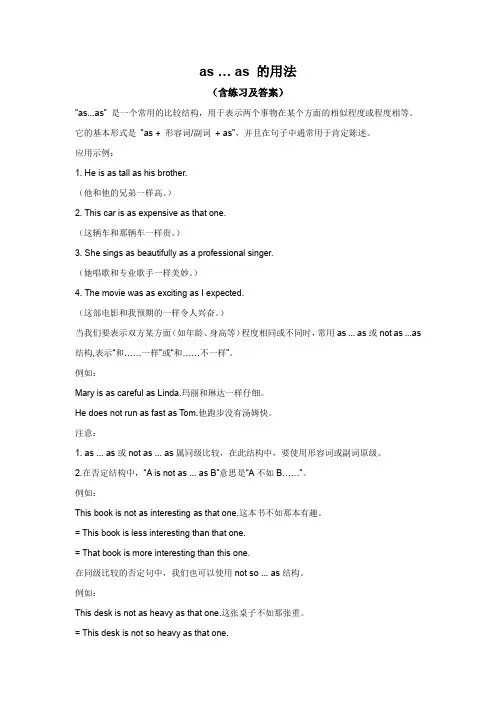
as … as 的用法
(含练习及答案)
"as...as" 是一个常用的比较结构,用于表示两个事物在某个方面的相似程度或程度相等。
它的基本形式是 "as + 形容词/副词 + as",并且在句子中通常用于肯定陈述。
应用示例:
1. He is as tall as his brother.
(他和他的兄弟一样高。)
2. This car is as expensive as that one.
(这辆车和那辆车一样贵。)
3. She sings as beautifully as a professional singer.
(她唱歌和专业歌手一样美妙。)
4. The movie was as exciting as I expected.
(这部电影和我预期的一样令人兴奋。)
当我们要表示双方某方面(如年龄、身高等)程度相同或不同时,常用as ... as或not as ...as结构,表示“和……一样”或“和……不一样”。
例如:
Mary is as careful as Linda.玛丽和琳达一样仔细。
He does not run as fast as Tom.他跑步没有汤姆快。
注意:
1. as ... as或not as ... as属同级比较,在此结构中,要使用形容词或副词原级。
2.在否定结构中,“A is not as ... as B”意思是“A不如B……”。
例如:
This book is not as interesting as that one.这本书不如那本有趣。
= This book is less interesting than that one.
= That book is more interesting than this one.
在同级比较的否定句中,我们也可以使用not so ... as结构。
例如:
This desk is not as heavy as that one.这张桌子不如那张重。
八年级上册英语语法复习
八年级上册英语语法复习 全册
1) leave的用法
1.“leave+地点”表示“离开某地”。例如:
When did you leave Shanghai? 你什么时候离开上海的?
2.“leave for+地点”表示“动身去某地”。例如:
Next Friday, Alice is leaving for London. 下周五,爱丽斯要去伦敦了。
3.“leave+地点+for+地点”表示“离开某地去某地”。例如:
Why are you leaving Shanghai for Beijing? 你为什么要离开上海去北京?
2) 情态动词should“应该”学会使用
should作为情态动词用,常常表示意外、惊奇、不能理解等,有“竟会”的意思,例如:
How should I know? 我怎么知道?
Why should you be so late today? 你今天为什么来得这么晚?
should有时表示应当做或发生的事,例如:
We should help each other.我们应当互相帮助。
我们在使用时要注意以下几点:
1. 用于表示“应该”或“不应该”的概念。常指长辈教导或责备晚辈。例如:
You should be here with clean hands. 你应该把手洗干净了再来。
2.用于提出意见劝导别人。例如:
You should go to the doctor if you feel ill. 如果感觉不舒服,你最好去看医生。
3. 用于表示可能性。should的这一用法是考试中常常出现的考点之一。例如:
We should arrive by supper time. 我们在晚饭前就能到了。
She should be here any moment. 她随时都可能来。
八年级 英语上册Unit3教学设计
八年级英语上册
Unit 3 I am more outgoing than my sister教学设计
一、教学内容分析
本课教学内容为八年级英语上册第3单元第一课时,学习内容主要体现在以下几点:
1.复习和学习有关人物特点的单词:tall thin heavy short outgoing calm wild serious funny …
2.学习人物比较的重要句型:
Tom is calmer than Sam.
Tara is shorter than Tina.
Tom is more athletic than Sam.
Pedro is funnier than Paul.
3.掌握语法点:形容词的比较级
二、学情分析
学生以前没学过形容词的比较级 ,所以掌握的强度不够,对单音节和多音节形容词的比较级的表达上总是出现错误。通过对本课的学习,学生可以巩固学习知识,掌握用正确的语言结构表达人物特点和人物比较。
三、教学目标
1.知识目标:
(1)vocabulary :outgoing calm wild serious …
(2)Structure: Tara is shorter than Tina.
Pedro is funnier than Paul.
Tom is more athletic than Sam.
2. 能力目标:
(1)能听懂本课的简单句。
(2)能用本课学习的句型描述人物特点。
(3)能正确写出本课学习的单词和句型。
3.情感目标:
(1)通过学习本课,增强师生、生生间的相互了解和沟通。
(2)培养学生的口头表达能力和听说能力。
四、教学重点和难点
1.重点:Words and structures:outgoing calm wild serious athletic…
Tara is shorter than Tina .
人教新目标版八年级英语上册Unit3语法、知识点归纳及训练

人教新目标版八年级英语上册Unit3语法、知识点归纳及训练
复习:用所给的适当形式填空
1 They ________ (visit) the museum last week.
2. She ________ (go)to the cinema with her classmates tomorrow evening.
3. He ________ (work) hard at English every day.
4. Put on your coat. The wind ________ (blow) hard outside now.
5. ________ you ________ (get) up early every morning last year?
6. The earth ________ (move) around the sun.
7. All the students ________ (plant) trees tomorrow.
8. Look! The Yong Pioneers ________ (pant) trees on the hill.
9. Mr Wang ________ (not give) us a talk last Monday.
10. We often ________ (have) an English party on Saturday evenings.
11. Tom always ________ (think) much of others, but little of himself.
12. Mr Black, together with his students, ________ (visit) the Science Museum now.
13. There ________ (be) a League meeting the day after tomorrow.
人教版八年级英语上册Unit3词汇语法句型及练习题
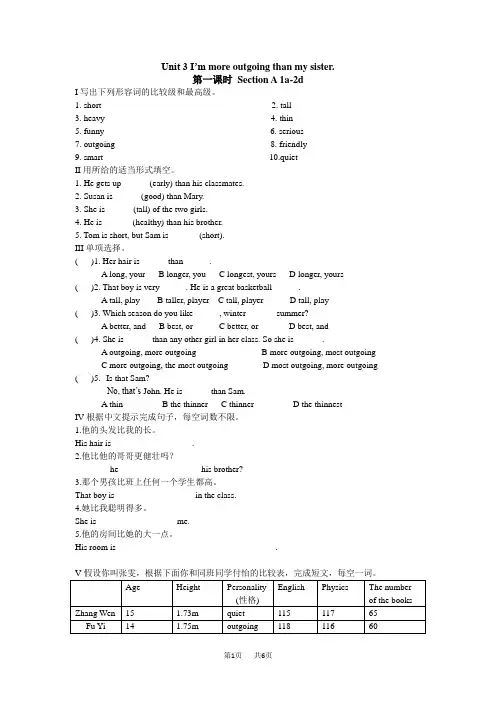
第1页 共6页 Unit 3 I’m more outgoing than my sister.
第一课时 Section A 1a-2d
I写出下列形容词的比较级和最高级。
1. short _____ _______ 2. tall______ ______
3. heavy _____ _______ 4. thin____________
5. funny _____ _______ 6. serious______ ______
7. outgoing______ ______ 8. friendly_______ _____
9. smart ______ ______ 10.quiet_____ _______
II用所给的适当形式填空。
1. He gets up______ (early) than his classmates.
2. Susan is______ (good) than Mary.
3. She is______ (tall) of the two girls.
4. He is ______ (healthy) than his brother.
5. Tom is short, but Sam is ______ (short).
III单项选择。
( )1. Her hair is______ than______.
A long, your B longer, you C longest, yours D longer, yours
( )2. That boy is very______. He is a great basketball______.
八年级上册英语语法
八年级上册英语语法
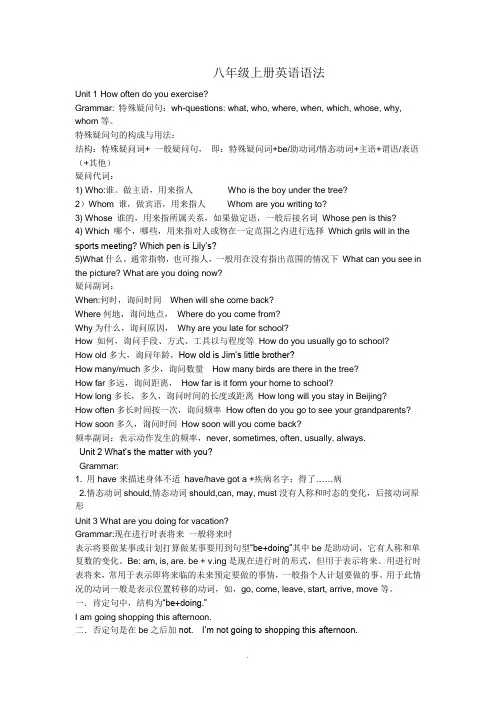
Unit 1 How often do you exercise?
Grammar: 特殊疑问句:wh-questions: what, who, where, when, which, whose, why,
whom等。
特殊疑问句的构成与用法:
结构:特殊疑问词+ 一般疑问句, 即:特殊疑问词+be/助动词/情态动词+主语+谓语/表语(+其他)
疑问代词:
1) Who:谁。做主语,用来指人 Who is the boy under the tree?
2)Whom 谁,做宾语,用来指人 Whom are you writing to?
3) Whose 谁的,用来指所属关系,如果做定语,一般后接名词 Whose pen is this?
4) Which 哪个,哪些,用来指对人或物在一定范围之内进行选择 Which grils will in the
sports meeting? Which pen is Lily’s?
5)What什么,通常指物,也可指人,一般用在没有指出范围的情况下 What can you see in
the picture? What are you doing now?
疑问副词:
When:何时,询问时间 When will she come back?
Where何地,询问地点, Where do you come from?
Why为什么,询问原因, Why are you late for school?
How 如何,询问手段、方式、工具以与程度等 How do you usually go to school?
How old多大,询问年龄,How old is Jim’s little brother?
How many/much多少,询问数量 How many birds are there in the tree?
八年级上册英语语法复习 2
八年级上册英语语法复习 全册
1) leave的用法
1.“leave+地点”表示“离开某地”。例如:
When did you leave Shanghai? 你什么时候离开上海的?
2.“leave for+地点”表示“动身去某地”。例如:
Next Friday, Alice is leaving for London. 下周五,爱丽斯要去伦敦了。
3.“leave+地点+for+地点”表示“离开某地去某地”。例如:
Why are you leaving Shanghai for Beijing? 你为什么要离开上海去北京?
2) 情态动词should“应该”学会使用
should作为情态动词用,常常表示意外、惊奇、不能理解等,有“竟会”的意思,例如:
How should I know? 我怎么知道?
Why should you be so late today? 你今天为什么来得这么晚?
should有时表示应当做或发生的事,例如:
We should help each other.我们应当互相帮助。
我们在使用时要注意以下几点:
1. 用于表示“应该”或“不应该”的概念。常指长辈教导或责备晚辈。例如:
You should be here with clean hands. 你应该把手洗干净了再来。
2.用于提出意见劝导别人。例如:
You should go to the doctor if you feel ill. 如果感觉不舒服,你最好去看医生。
3. 用于表示可能性。should的这一用法是考试中常常出现的考点之一。例如:
We should arrive by supper time. 我们在晚饭前就能到了。
She should be here any moment. 她随时都可能来。
2013八年级上册英语unit3写作练习
写作综述
本单元围绕个性特征这一话题,运用比较级对不同的人进行比较。写此类文章时,应注意以下几点:首先仔细审题,明确写作内容;然后紧紧围绕文中给出的提示,理清思路,调整语言。借助本单元所学的有关知识和各种结构,合理想象,积极应用,展开对比。
常见结构:
A+系动词+形容词/副词的比较级+than+B
A+系动词+as+形容词/副词的原级+as+B
A+系动词+the+比较级+of the two(+复数名词)
写作应用
请你比较一下你和你的好朋友Alice之间的异同。可以从外貌、性格、爱好及学习等方面进行对比,紧紧抓住不同点与相同点这两个方面进行描写。词数不少于80。
I have a good friend.Her name is Alice.We are
in the
same class.In some ways,we are the
same,but in some ways,we are different.I
am
as tall as Alice.But she is heavier than me.We
both have black hair.But my hair is longer than
hers.Alice is more outgoing than me.She likes
sports.But I like music.She
exercises every
day and she is stronger than me.I am smarter
than her.And I am better at English than her.I
don’t think differences are important in a
friendship.
人教版八年级上册英语第3、4单元语法
Unit 3
I'm more outgoing than my sister
本单元语法重点:形容词和副词的比较级。
形容词和副词的原形就是原级;比较级,表示较……或更……;最高级, 表示最...…
单音节词和少数双音节词比较级和最高级的规则变化:
部分单词比较级和最高级的不规则变化:
*由形容词加ly构成的双音节词和多音节词,都是在该词前加-more/most.
quickly—more quickly—(the) most quickly
difficultly—more difficultly—(the) most difficultly
【记忆口诀】:
两者之间做比较,尾巴 er 少不了
一般词尾加 er,有 e 词尾只加 r
单一辅音单音节,双写词尾加 er
辅音加 y 很重要,去 y 变 i 加 er
双多音节字太长,前加 more 比它强
遇到双多最高级, most 放前最成立
【比较的形式】:
形容词和副词的比较级用于两者之间的比较,有如下几种形式:
1. 表示同级比较
把两个人或物比较时,如果只说明两者相同,则可使用 as ... as 句型,表示“和……一样……”。其否定句型为 not as / so... as,表示“……不如……”。这两个句型中要使用形容词或副词的原形。
例如:
I am as tall as my sister. 我和我的妹妹一样高。
She is not as popular as her friend. 她没有她的朋友受欢迎。
2. 表示不同程度的比较
如果想表达两者之间的差异,结构为“A + be + 形容词比较级 + than + B”或“A + 实义动词 + 副词比较级 + than + B”, 表示“A 比 B 更……”。
例如:
Mark is more outgoing than Tony. 马克比托尼更外向。
She is friendlier than other friends. 她比其他朋友更友好。
Unit3 语法-反身代词 讲义 学年牛津译林版八年级上册
八年级第一学期英语. Unit3 A day out
Grammar & Usage
一、反身代词(Reflexive pronouns)的概念
反身代词是以”・sel「或”-selves”结尾的代词,用来指代动作执行者本身,在句中起强调 或反射作用,表示我自己(myself)>你自己(yourself)>他/她/它自己(himself/herself/itself)>我 们自己(ourselves) > 他们自己(themselves)等。
二、 反身代词的构成
第一人称、第二人称的反身代词由“形容词性物主代词+self/selves”构成。
如:myself(我自己)、ourselves(我们自己)、yourself(你自己)、youerselves(你们自己)
第三人称的反身代词由“人称代词宾格+self/selves”构成。
如:himself'/herself/itself 他/她/它自己、themselves(他们自己)
三、 反身代词的语法功能
1、用作宾语
(1) 反身代词可以做动词的直接宾语,直接宾语是跟随及物动词并接受动词动作的词、短
语和从句。反身代词可以出现在大多数及物动词后。如:amuse, blame, cut, dry, enjoy, help,
hurt, kill, prepare, satisfy, teacho 下面来看一下例句: I hurt myself taking down Christmas decorations.我弄伤了自己把圣诞装饰品拿下来时。
She taught herself to play the piano.她自学弹钢琴。
Did you cut yourself with the paring knife?你用削皮刀割伤自己 了吗?
My son amused himself with the Sesame Street toys.我儿了玩芝麻街玩具自娱自乐。