
Unit 1 Topic 2 Section D仁爱版七年级英语上
Unit 1 Making New Friends
Topic 2
Where are you from?
3
4
Revision
A: What’s your name? B: My name is … A: Where are you from? B: I’m from … A: What’s your telephone number? B: It is …
Who are they?
They’re Maria and Jane.
Are you from Japan?
Yes, we are. / No, we aren’t.
Where are you from?
I’m from Canada.
13
找找be动词
Is she Jane?
Yes, she is. Is he Li Ming? No, he isn’t. Is Tom from America? Yes, he is.
5
A: Who is she? B: She is ... A: Where is she from? B: She is from ... A: What’s her telephone number? B: It is ...
6
Please introduce yourself.
Hello. Nice to meet you. My name is … I am from … My telephone number is …
5. -Who are they?
6. -Who’s she/he?
-____________Maria and Jane. They are
-____________is Deng Yaping. / She -____________is Stephen Hawking. He
12
Useful expressis with the right pictures.
C
A
B
E
18
D
Listen and match.
4 6 7 9 10
Yukio Kangkang Jane Linda Michael
19
Complete the passage.
A: Excuse me,_________ Are you Kangkang? B: Yes, I am. I ____ I’m from China. am Number 4.______ A: ____ Is Number 6 Bob? B: ____,_______. Japan. No he isn’t He is Yukio. He __________ is from A: Who is Number 7? B: Aha! He is Michael. A: Where ________ from? is he B: He is from America. A: Oh, Number ____ 9 is Jane. Is she from_______? Canada B: Yes ___,_______.And Number 10 is Linda. She is from she is England.
11
Grammar
1. -_____she from Canada? Is -Yes, she is. / No, she isn’t.
2. -_____he Li Ming? Is
-Yes, he is. / No, he isn’t.
-Yes, I am. / No, I’m not.
3. -_____you from Canada, too? Are 4. -_____they from England? Are -Yes, they are. / No, they aren’t.
16
从方框中选择适当的选项补全对话。
A. Where are you from? B. What’s your name?
C. Excuse me.
D. Are you from Beijing?
A: _____ C Are you Li Ming? B: Yes, I am. A: _____ D B: Yes, I am. _____ B A: I am Lucy. B: ____ A A: I am from the USA.
Name: Family name: Given name: From: Tel:
21
在这个单元里,你学到了什么? 你能帮我总结吗?
1. 音标: 2.词汇: 3.语法: 4.重点句子:
22
书面表达: 假如你是李小华,请逐步回答“What’s your name? Where are you from? What’s your telephone number?”这三个问题,然后根据 你的答复信息写一段20词左右的短文(开头 已给出)。
7
人称代词(Subject Pronoun)
单数 主格 第一人称 第二人称 I you he she it
be动词
复数 主格 we you
be动词
am are is is is
8
are are
第三人称
they
are
动词王国中的小精灵
—— be
am be is are
am not is not are not isn’t aren’t
15
Functions
1. -Excuse me, are you Jane? -Yes, I am. / No,_________ I’m not . My name Sally. 2.-What’s your name, please? _________is 3.-What’s your telephone number? 4.-It is________________. 6807-5335 5.-______________________? Where are you from -I’m from Canada. 6.-Where is he/she from? -______________________. He/She is from Japan
20
Make your name card and introduce yourself.
Name: Family name: Given name: From: Tel:
Hello! My name is … /I’m … My family name is … and my given name is …
Hello! My name is Li Xiaohua. My family name is Li. I am from…
23
24
14
这里的be动词 为什么是is?
小试牛刀
用am, is, are填空。 are 1.Who ______they? 2. I_______ am John Brown. 3. What_______ his name, Peter? is 4.You ________ Tom. are 5. Maria and Jane ______from Class 1. are 6. Her name ________Kate. is 7. It ______my English book. is
9
助记口诀
我 (I) 用 am,你 (you) 用 are; 两个以上 (we, they)也用 are; 留下 is 给他 (he),她 (she),它 (it);
熟能生巧不用怕。
10
动词be,在句中它可以帮助构成否定句和疑句。
助记口诀
表否定,很简单,not加在 be 后边;
若要变为疑问句,be 应移到主语前; 还有一点须注意,句尾问号别忘记。
仁爱版七年级英语上册Unit1教学指导案

精心整理Unit1Topic1SectionA学习目标:1、从Aa-Gg的书写2、交际英语合作交流:1、Goodmorming.早上好。
此句为正式问候语,用于早晨至中午12点以前。
它的答语仍然用Goodmorming.2、Hi!喂!你好!Hello!也是“喂!你好!”的意思。
hi和hello英语中使用频率最高的日常用语之一,多用于同学、同时、熟人以及朋友之间相互打招呼,语气比较随便,意为“你好”。
3、—AreyouMichael?你是迈克尔吗?—Yes,Iam.是的,我是。
Areyou··年龄等问题,回答肯定的用Yes,4、—WelcometoChina!欢迎到中国来!—Thankyou!谢谢。
welcometo+地点名词欢迎到······来。
习题巩固:Ⅰ、按照四线格要求写出Aa-Gg。
Ⅱ、单项选择。
()1、—youLiPing?—Yes,I.A.Are;amB.I;()2、——A.Fine,thankyou.B.Thankyou()3、——A.Yes,I’m.()4、——A.Maria,hi.B.Kangkang,hi.C.Goodmorning.D.Hi,Michael.()5、——Thanks.A.Nicetomeetyou.B.Goodmorning.C.Yes,Iam.D.WelcometoBeijingRen’aiInternational(国际的)School!Ⅲ、从Ⅱ栏选出对应的答语。
ⅠⅡ()1.Goodmorning.A.Fine,thanks.()2.Hello!B.Nicetomeetyou,too.()3.Nicetomeetyou.C.No,Iamnot.()4.IamKangkang.AreyouMaria?D.Goodmorning.()5.Howareyou?E.Hi,Mr.Zhang.Unit1Topic1,SectionB 学习目标:1.字母的书写。
课文_仁爱初中英语七年级上Unit1Topic1
[00:00.00]UNIT 1 Making New Friends \n [au:]第1单元交新朋友\n[00:05.60]Topic 1 Welcome to China!\n [au:]话题1 欢迎来到中国!\n[00:10.37]Section A\n[au:]A部分\n[00:13.00]1a Look, listen and say\n[au:]1a 看,听和说\n[00:18.71]Good morning!\n[au:]早上好!\n[00:21.08]Good morning!\n[au:]早上好!\n[00:23.63]Welcome to China!\n[au:]欢迎来到中国!\n[00:26.33]Thank you.\n[au:]谢谢你!\n[00:28.73]1b Work alone\n[au:]1b 独立练习\n[00:32.65]Listen and number the names you hear.\n [au:]听并为你所听到的名字排序。
\n[00:37.12]Good morning, I'm Kangkang.\n [au:]早上好,我是康康。
\n[00:40.85]Good morning, I'm Maria.\n[au:]早上好,我是玛丽亚。
\n[00:44.31]Hi! I'm Jane.\n[au:]嗨!我是简。
\n[00:47.23]Hi! I'm Michael.\n[au:]嗨!我是迈克尔。
\n[00:50.18]Welcome to China!\n[au:]欢迎来到中国!\n[00:52.82]Thank you.\n[au:]谢谢你。
\n[00:55.19]2a Listen, say and write\n[au:]2a 听,说和写\n[01:00.05]Aa\n[au:]Aa\n[01:03.12]Bb\n[au:]Bb\n[01:06.14]Cc\n[au:]Cc\n[01:09.23]Dd\n[au:]Dd\n[01:12.28]Ee\n[au:]Ee\n[01:15.28]Ff\n[au:]Ff\n[01:18.12]Gg\n[au:]Gg\n[01:21.00]2b Work alone\n[au:]2b 独立练习\n[01:24.92]Listen and circle the letters you hear.\n[au:]听并将你所听到的字母圈起来。
2017新版仁爱版七年级上册英语课文翻译(1)
Unit 1 Making New Friends 交新朋友Topic 1 Welcome to China!欢迎来到中国!Section A1aGood morning! I’m Kangkang.早上好,我是康康!Good morning!早上好!Welcome to China!欢迎来到中国!Thank you. 谢谢!2aHello!你好!Hello!你好!I’m Kangkang. Are you Michael我是康康。
你是Michael吗Yes, I am. 是的,我是。
2.Hello!Are you Maria 你好!你是Maria吗?No, I’m not. I’m Jane. 不,我不是。
我是Jane。
Oh, nice to meet you, Jane. 哦。
很高兴见到你,Jane。
Nice to meet you, too. 我也很高兴见到你。
3.Hi, Maria! 你好,Maria!Hi, Kangkang. 你好,康康!Welcome to China! 欢迎来到中国!Thanks. 谢谢!Section BGood morning, Mr. Brown! Nice to see you.早上好,布朗先生!很高兴见到你。
Good morning, Maria! Nice to see you, too.早上好,Maria!我也很高兴见到你。
Mom, this is my teacher, Mr. Brown. Mr. Brown, this is my mom.妈妈,这是我的老师,布朗先生。
布朗先生,这是我的妈妈。
How do you do? 你好!How do you do? 你好!Topic 2 Where are you from? 你来自哪里Section AExcuse me, are you Jane?打扰一下,你是Jane吗Yes, I am.What’s your name,please ?是的,我是。
仁爱版英语七年级上册_仁爱版七年级英语上册unit1教案
仁爱版英语七年级上册_仁爱版七年级英语上册unit1教案Unit1 Making New FriendsTopic 1 Section D一学习目标1 复习26个字母2 复习所学问候交际语言①Hi! Hello!②Good morning. / Good afternoon. ③How are you? / Fine,thank you. ④How do you do? / How do you do?⑥I’m ...Are you ...? Yes, I am. ⑦See you later. See you. ⑧Good-bye. Bye-bye.3 了解并记住五个元音字母,并根据其读音把26个字母分类。
4 be动词的用法和与主语的缩写形式。
二学习重点 : 本课重点活动是1,2和4。
三学习难点: 26个字母的书写规则、读音和 B e( am, is are ) 动词的用法四学习过程(一) 复习导入按顺序和正确的格式书写26个字母补全下列对话1. A:Good morning,Mr.Chen2. A.How are you ? . B: ,3. A: Good afternoon4. A: Nice to see you . .5. A: Are you Jane ? B: Yes, .6 A: Hello, Mr. Lee7 teacher, B: Mr. Li , this is my mother.8A: How do you do? B: ?(二 )自学指导( 1 )本节课主要是复习以前所学内容,看课文第八页4a部分,语法聚焦,这部分主要学习Be动词的简单用法和其于主语的缩写形式。
要牢牢掌握。
( 2 ) 制作自己的名字卡片,指导在英语中人名字的表达和书写格式。
( 3 ) 5 个元音字母:Aa Ee Ii Oo Uu( 4 ) 掌握读音/ei/ /i:/ /ai/ / / /ju:/ 并试着把26个字母按读音进行分类(三) 问题导学1. 26 个字母可以分为几类?2. 同学们会把下列汉语翻译成英语吗?早上好_______________ 下午好 ____________________你好 __________________ 你身体好吗?______________________ 我身体好,谢谢,你呢?_______________________________________你是康康吗?__________ 是的,我是。
仁爱版英语七年级上册Unit 1 Topic 2《Where are you from》
Unit1 Topic2 SectionD同步检测Ⅰ.判断下列句子的语调,用↑升调,用↓降调符号在句前括号内标出来。
( ) 1. Where is he from ?( ) 2.Are they from England ?( ) 3.Yes,they are .( ) 4.Excuse me .Are you Jane?( )5. I am from China .Ⅱ.单项选择()1. Where you from ? A is B are C am D be ()2. Where she from ? A is B are C am D be ( ) 3. What his name? A is B are C am D be ()4. 下列哪一组字母是“世界贸易组织”A. WWWB. WHOC. WTOD. SOS()5. 下列哪一组字母是“中华人民共和国”A. PCB. PRCC. CEOD. BBCⅢ用括号内所给的单词的适当形式填空1.This is my room. name is Rose. (she )2.This is Kangkang. is from China. Miss Wang is teacher.(he)3.Jane and Kate from England. They very nice. (be)4. Maria and mother from Canada? (be,she)5. Kangkang and I from China. (be)6.Excuse .( I )7.LiuYing from China and Maria Jones from the USA.(be)Ⅳ句型转换。
根据要求完成句子,一空一词。
1. LiuYing is from China. DengYaping is from China ,too. ( 合并成一句话)LiuYing DengYaping from China.2. They are from Japan . (就划线部分提问)are they from ?3.His name is Kangkang. (就划线提问)his name?4. He is from China. (改为一般疑问句)from China.5.He is John. (改成同义句)John.6.Where is John from?(用Canada回答问题.).Unit1 Topic2 SectionD同步检测参考答案Ⅰ.判断下列句子的语调,用↑升调,用↓降调符号在句前括号内标出来。
仁爱英语七年级上 Unit 1 Topic 1 教学设计
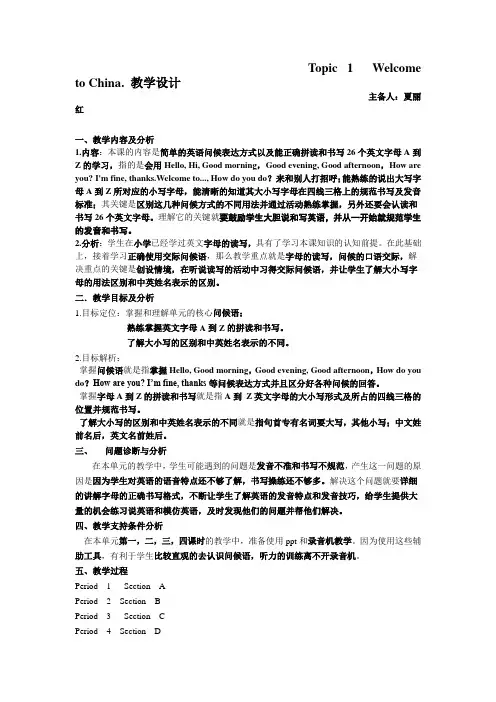
Topic 1 Welcome to China. 教学设计主备人:夏丽红一、教学内容及分析1.内容:本课的内容是简单的英语问候表达方式以及能正确拼读和书写26个英文字母A到Z的学习,指的是会用Hello, Hi, Good morning,Good evening, Good afternoon,How are you? I'm fine, thanks.Welcome to..., How do you do?来和别人打招呼;能熟练的说出大写字母A到Z所对应的小写字母,能清晰的知道其大小写字母在四线三格上的规范书写及发音标准;其关键是区别这几种问候方式的不同用法并通过活动熟练掌握,另外还要会认读和书写26个英文字母。
理解它的关键就要鼓励学生大胆说和写英语,并从一开始就规范学生的发音和书写。
2.分析:学生在小学已经学过英文字母的读写,具有了学习本课知识的认知前提。
在此基础上,接着学习正确使用交际问候语,那么教学重点就是字母的读写,问候的口语交际,解决重点的关键是创设情境,在听说读写的活动中习得交际问候语,并让学生了解大小写字母的用法区别和中英姓名表示的区别。
二.教学目标及分析1.目标定位:掌握和理解单元的核心问候语;熟练掌握英文字母A到Z的拼读和书写。
了解大小写的区别和中英姓名表示的不同。
2.目标解析:掌握问候语就是指掌握Hello, Good morning,Good evening, Good afternoon,How do you do?How are you? I’m fine, thanks等问候表达方式并且区分好各种问候的回答。
掌握字母A到Z的拼读和书写就是指A到Z英文字母的大小写形式及所占的四线三格的位置并规范书写。
了解大小写的区别和中英姓名表示的不同就是指句首专有名词要大写,其他小写;中文姓前名后,英文名前姓后。
三、问题诊断与分析在本单元的教学中,学生可能遇到的问题是发音不准和书写不规范,产生这一问题的原因是因为学生对英语的语音特点还不够了解,书写操练还不够多。
Unit1Topic2《Whereareyoufrom》教案2(仁爱英语七年级上)
Unit 1 Getting to Know YouTopic 2 Where are you from?【教材分析】本单元教学内容以问候和介绍为中心,从了解姓名到谈论来自哪里,用层层递进的方式逐步扩大和加深了解认识的不同方面,具有很强的逻辑性和整体性。
Topic2 Where are you from? 主要学习介绍自己,了解他人信息,如电话号码、国籍等,学习十以内的数字;通过一些体育明星、标志性建筑、自然风光、国旗来学习一些国名。
主要句型:Is she/he from Shanghai? Yes, he/she is./No, he/she isn’t.Are they from Canada? Yes, they are. /No, they aren’t.Where are you from? I’m from England.Where is he/she from? He/She is from Japan.Where are they from? They are from Canada.What’s his/her telephone nu mber? His/Her telephone number is …【教学目的与要求】1. 语言知识目标:◆了解语音语调的变化;◆掌握be动词的缩写;◆掌握数学0-10;◆能理解和表达有关电话号码、个人情况、体育明星、国家、城市名称等话题信息2. 能力目标:◆能听懂别人的问候、自我介绍◆能听懂某人询问姓名、年龄、国籍、电话号码等基本情况,并进行简单对话3. 情感目标◆培养学生学习英语的自信心,鼓励学生积极大胆、敢于模仿、克服困难、羞于开口的心理。
帮助学生在学习上不断取得成功,以表扬和鼓励为主,逐步建立学生的成就感。
【教学重难点】1. 教学重点:◆询问姓名、国籍、电话号码等基本情况的交际用语2. 教学难点:◆谈论个人情况【语言功能】◆能听懂别人的问候、自我介绍,并能进行简单的交际◆能对姓名、国籍、电话号码等基本情况进行简单的对话或叙述。
仁爱版初中英语七年级上册Unit2_Topic_1_Section_A_教学设计与反思
Teaching Plan for SectionA,Topic1, Unit2(Project English, Grade Seven)Self-introductionGood morning, ladies and gentlemen. Nice to meet you .I’m very glad to be here sharing my lesson with you. Today I am going to talk about Unit 2 Topic 1 Section A I have a small nose. I prepare to say the lesson from seven parts.Ⅰ、Analysis of the Teaching Material1. Status and function•Unit2 is the real beginning of the whole Junior Middle School English. The content in this unit is not only releated to the students’life , but also interested and colorful. This lesson tells us how todescribe a person and how to talk about possessions. Besideslearning this, students will also learn some words, phrases andexpressions of people's looks and so on. In this lesson, the main job is to understand the simple present tense using “have/has”.I willlead the students to pay attention to the new tense.2、Teaching Aims and Demands(1) Knowledge aimsa. Get the students master the words about parts of the body: nose, eye, head, face, hair, ear, mouth, neckb. Learn the simple present tense with “have/has” and understand some useful sentences:(1)I have a big nose.(2)They have round faces.(3)She has long hair.(4)It has big ears.c. Learn how to describe people’s appearances.(2) Skillful aimsa. Develop the students’ abilities of listening, speaking, reading and writing.b. Train the students’ abilities of communication.(3) Affective aimsa. Develop the students’ habits of paying close attention to the differences between Chinese culture and western culture.b. Strengthen the students’ conception of cooperation.c. Help the students feel the happiness of learning.3. Key points and difficult pointsAccording to the New English Curriculum Criterion and the students’ real situation, I choose the following materials as the key points and the difficult points of this class.(1)Key pointsa. Develop the st udents’ abilities of listening, speaking, reading and writing.b. Learn some information about people’s appearances.(2) Difficult pointsHow to use the simple present tense with “have/has”Part Ⅱ. Analysis of the StudentsThe students in my class are lovely and co-operative. Most of them are interested in English. They have learnt English for nearly three years. And they have learnt some basic skills of listening, speaking, reading and writing. But on one hand, they are eager to show themselves and want to have a try. On the other hand, in the daily life there are few chances for them to speak English and most of them are too shy to speak English in public or are afraid of making mistakes. So I will try my best to create a relaxing environment for them to practice using English.Part Ⅲ. Analysis of Teaching MethodIn this lesson I will mainly use Five Steps Method and Task-Based Language Teaching. I think if I want the students to improve their oral English, I must give them more chances to practice. That is “Learning by doing, learnin g by using”. In this case, by designing tasks according to the New English Curriculum Criterion, I will lead my students to study and cooperate with each other.Part Ⅳ. Analysis of Learning MethodThe main feature of the Task-Based Language Teaching is the students’ participation and creation. So I plan to enable the students to use “self-learning” and “co-operative learning” as their learning methods Thus, the students are required to do as follows:1. Be well prepared for the new lesson, look up some necessary information.2. In the class learning, the students should work actively and finish the tasks efficiently.3. The students should learn to work with others from their bottom of hearts.Part V. Analysis of Teaching ProceduresStep 1 Warming-up and Review(1)Show a table about Jane. Create a proper atmosphere for the new lesson . Then let the students answer the questions according to the table.T: What’s her name?S1: Her name is Jane.T: How old is she?S2: She is twelve.T: Where is she from?S3: She is from Canada.T: What class is she in?S4: She is in Class Four, Grade Seven.T: What’s her telephone number?S5: It’s (010)9267-6929.(2)Let the students look at a picture and review the words: eye, nose, mouth, ear, neck, head, hair.(3) In order to make the students remember the words quickly, I deside to play a game with them. And the name of the game is “Touch your body.”I say “Touch your nose”, the students touch it quickly. I’ll Praise the students with “well done. You are wonderful.Excellent” and so on . Reason: It is necessary for the students to review learned knowledge. Through this activity, the students can be cheered up, too.Step 2 Presentation1. Show some pictures and teach the phrases, such as, “a small nose, a wide mouth, long hair, big eyes, and so on.2. Let the students observe the picture, and try to say:She has long hair. He has a wide mouth.He has short hair. She has big eyes.3. Let the students read 1a after the tape and pay attention to the pronunciation and intonation. At the same time, let the students underline the words and phrases that they don’t understand.4. Read 1a again and complete 1b,check the answers. Encourage the students to get help from their group members.Reason: This step aims to make the students get the general idea of the article.Step 3 Consolidation1.Let the students look at the chart and discuss in groups. Showyourself. They will say: I have a small nose. He has a wide mouth.They have big eyes. She has long hair.2.I’ll let some students come to the front. Other st udents describehim/her using their words. They will feel excited.Reason: The step aims to make the students not only practicetheir speaking ability but also feel the happiness of learning. Step 4 Practice1.Work in groups. Show a picture and let the students writedown her appearance. Let them list as many sentences aspossible in groups.2.I’ll give the students some chances to shoe their passages infront of the students.Reason: Task-based language Teaching Method is used here to develop the students’ ab ility of writing and also their ability of their cooperation will be well trained.Step 5 HomeworkAfter class, I’ll let the Ss Write a passage about Jim’s appearance in the exercise book. I think homework is so important that the Ss should speak English as much as they can in class or after class. It is necessary for the Ss to do some exercises after class to consolidate the knowledge they learned.Blackboard Design:Reason: In this step, I’ll write the important words to help the students understand the present tense with have/has.Reflection about this lesson1. In the teaching process, we should encourage the students to join, observe, practice, think independently and cooperate. Change their thought from “I have to study.” to “I want to study.”2. As teachers, to make our English classrooms shine with vitality, we are laid with heavy burden, and we still have long way to go.Teaching Plan for SectionA,Topic1,Unit2(Project English, Grade Seven)。
仁爱版英语七年级上册课文翻译
Unit1Topic1SectionA-2a你好!Hello!你好!Hello!我是康康。
I'm Kangkang.你是迈克尔吗?Are you Michael?是的,我是。
Yes,I am.你好!你是玛丽亚吗?Hello!Are you Maria?不,我不是,我是简。
No,I'm not.I'm Jane.哦,见到你很高兴,简。
Oh,nice to meet you,Jane.见到你我也很高兴。
Nice to meet you,too.你好,玛丽亚!Hi,Maria!你好,康康!Hi,Kangkang!欢迎到中国来!Welcome to China!谢谢。
Thanks.Unit1Topic1SectionB-1a布朗先生,早上好!Good morning,Mr.Brown!很高兴见到你!Nice to see you.玛丽亚,早上好!Good morning,Maria!我也很高兴见到你。
Nice to see you,too.妈妈,这位是我的老师,布朗先生。
Mom,this is my teacher,Mr.Brown.布朗先生,这位是我的妈妈。
Mr.Brown,this is my mom.你好!How do you do?你好!How do you do?Unit1Topic1SectionD-3你好吗?How are you?我很好,谢谢。
你呢?Fine,thanks.And you?我也很好。
I'm okay.早上好,王老师。
Good morning,Miss Wang!早上好,康康!Good morning,Kangkang!见到你很高兴。
Nice to see you.见到你我也很高兴。
Nice to see you too.你好,我是康康。
Hello!I'm Kangkang.你是南希?Are you Nancy?不是。
我是莉莉。
No.I'm Lily.爸爸,这是王老师。
七年级上册仁爱英语教材讲解Unit1知识点击
Unit 1 Topic 1 Section ANew wordsNew phrasesUseful expressions知识点击1. Good morning!早上好!此句为早上或上午见面互相打招呼时所用的问候语。
它的答语仍然用“Good morning!”。
如:—Good morning, Kangkang!早上好,康康!—Good morning, Michael!早上好,迈克尔!在非正式场合,朋友和家人之间,可以省略good,只用morning问候。
如:Morning, Mom!早上好,妈妈!【拓展】其他时间段的问候语还有:Good afternoon!下午好!Good evening!晚上好!Good night!晚安!以上三个问候语也用同样的句子来回答。
【注意】“Good night!”不是问候语,而是人们在晚上分别时或睡觉前的道别用语,意为“晚安!",答语仍然是"Goodnight!"2.I’m Kangkang,我是康康。
英语中常用I'm...句型进行自我介绍。
如:I'm Maria,=I am Maria.我是玛丽亚3.—Welcome to China!欢迎到中国来!—Thank you.谢谢你。
Welcome to Beijing!欢迎到北京来!Welcome here!欢迎到这里来!当对方用welcome表示欢迎时,常用"Thanks./Thank you./Thanks a lot.”来回答。
如:—Welcome to Shanghai, Kangkang!康康,欢迎你到上海来!—Thanks.谢谢。
【拓展】“you’re welcome.”意为“不客气。
”如:—Thank you.谢谢你。
—You're welcome.不客气。
4.Hello!/ Hi!你好!“Hello!”和“Hi!”一般用于熟人之间互相打招呼,语气比较随意,常用于非正式场合,使用时不受时间限制。