
Unit 12 What did you do last weekend
4. They ______ (play) badminton yesterday morning.
5. I ______ (not hear) from her last week.
Ⅲ.根据句意及首字母提示填空。
六、课堂小结
课题
七下Unit12 What did you do last weekend?(第二课时Grammar-3c)
课型
听说课
执笔
学习
目标
1学习并掌握词汇:mouse,baby,shout,nguage2学习目标语言:who/whom ,what ,where引导的特殊疑问句
3情感态度目标:通过询问同学间过去所做的事情,增进同学间的感情。
5. I like playing games o______ Sundaymorning.
Ⅳ根据汉语完成句子。
1.上周末你干什么了?______________ you do last weekend?
2.在星期日上午,我们去划船了。
We ______ ______ on Sunday morning.
学习重点
熟练拼写和运用as, natural, visitor, tired, stay, away, mouse, shout等词。
学习难点
一般过去时的准确运用。
学习过程
自主空间
一、预习与交流
A、预习课文,朗读理解记忆词汇:
B、小试身手
熬夜________冲…大声叫嚷_______逃跑______
Step 3Language ability practice
1.Finishthe listening task in1b, 2a, 2b.
2.Pair work.
C. Summary and Self-examination.
三、展示交流
挑战一:观察与运用。先组内讨论交流,然后由小组派代表就共性问题进行讲解。针对学生的疑惑,教师给予点拨。
六、课堂小结
:
课题
七下Unit12 What did you do last weekend?(第三课时1a-1e)
课型
听说课
执笔
学习
目标
1学习并掌握词汇:fly, kite
2学习目标语言:---Did you do anything interesting last weekend?
---Not really, but I visited my sister.
livinghabits ______ language _______ mouse _______
C、你能通过预习说出下面的句子吗?
她和谁一起去的?______ _____she go ______?
二、合作与探究
任务一、分角色朗读2d.
任务二、读Grammar Focus,并注意过去时的问法。
任务三、根据所给的词变化完成3a,3b.
He was so angry that he shouted _____ everyone present.
B、away的用法:away作副词,意为“远离;离开;消失”,常用短语有:far away (远离),go away (走开), run away (抛开), right away (立刻,马上), away from (距…多远)。
3.情感态度目标:通过描述过去的事情,使学生学会尊重和理解别人,学会了解他人的喜好,增进情谊。
学习重点
熟练拼写和运用等词。
学习难点
对过去的事情进行询问。
学习过程
自主空间
一、预习与交流
A、预习课文,朗读理解记忆词汇:
B、小试身手
做家庭作业_______去电影院_______泛舟_______
湖边野营________去沙滩_______打羽毛球________
A. don’t do B. didn’t do C. didn’t
()2. They went there by ______.
A. boat B. boats C. boating
()3. He had to go ______ there.
A. camp B. camps C.Camping
()4.They are having fun ______ the beach.
4.我现在很累,因为我昨天熬到了深夜。
I’m very ______ now because I ______ ______ ______ yesterday.
5.有人发现了他的书包并还给了他。
Someone ______ his schoolbag and ______ it ______ to him.
课题
七下Unit12What did you do last weekend?(第一课时1a-2d)
课型
听说课
执笔
学习
目标
1.学习并掌握词汇:camp, lake, beach, badminton, sheep
2.学习目标语言:What did you do last weekend? Well,……
3. The thief(窃贼) ran ______ quickly.
4. Men should do their things according to(按照) _____law(法则).
5. Scientists learn a lot about their ______ habits.
Ⅱ.根据句意及首字母提示填空。
挑战二:机会就掌握在你手中,快将改编的对话在全班面前展示吧。
挑战三:…相信你一定行!Come on!
四、点拨升华
1. camp的用法:camp既可作名词也可作动词。作名词时,意为“营;营地;野营”;作行为动词时,意为“扎营;搭帐篷;宿营”常用短语有:go擦没评(去野营),summer camp(夏令营)等。
A. on B. in C. at
()5. We played badminton ______ Sunday afternoon.
A. on B. in C. for
Ⅱ.用括号内所给单词的适当形式填空。
1.Did Carol ______ (camp) with us?
2. Let’s go ______ (boat) next.
小组交流学习成果,师生互动解决学习中困惑
Step 2Presentation and Learning.
1Guidance: --What did you do last weekend?
---Well …
2.Pair work:---Where did she go last weekend?
---She went to a farm.
1.Don’t c_____ under the tree. It’s not safe.
2. The children like swimming in the l______.
3. The Super Dan is a great b______ player.
4. Did you go to the b______ yesterday?
任务四、画出自己做过的事情,同学来猜。
三、展示交流
挑战一:观察与运用。先组内讨论交流,然后由小组派代表就共性问题进行讲解。针对学生的疑惑,教师给予点拨。
挑战二:机会就掌握在你手中,快将改编的对话在全班面前展示吧。
挑战三:…相信你一定行!Come on!
四、点拨升华
A、shout的用法:shout,动词。意为“呼叫,喊叫”。常用词组shout at sb./shout to sb.冲某人大声喊叫。前者多指因为生气等而非善意地对某人吼叫,后者多指因距离远而不得不大声叫喊。
1. His grandpa fed some s_____ in the yard.
2. I saw two m______ running in the kitchen just now.
3. Some b______ were born(出生)in the hospital yesterday.
----_____ a volunteer, I worked at the ______HistoryMuseum.
2.当时他向路人呼喊救命。
He ______ ______ the walkers for help just then.
3.那些老鼠跑到了妈妈的背后。
Those ______ ______ ______ behind their mother.
C、你能通过预习说出下面的句子吗?并试着写下来。
——谁去拜访了她的奶奶?——是贝姬。
--Who ______ her grandma? --Becky ______.
二、合作与探究
A、动口动手。学习目标语:What did you do last weekend? Well,……
B、Step 1Talking groups.
3情感态度目标:交流回忆以前做过的事情,增进对同学间的了解。
学习重点
熟练拼写fly, kite等词和运用基本句型--Who went the library?--Sally did.
学习难点
掌握一般过去时并在实际情景中自如运用。
学习过程
自主空间
一、预习与交流
A、预习课文,朗读理解记忆词汇:
B、小试身手
3.在2011年的一个晚上,他在湖边宿营了。
He ______ by the ______ on an evening of 2011.
4.周六晚上我在家做作业。
I did my homework ______ ______ evening.
(完整word版)Unit12Whatdidyoudolastweekend全单元教案
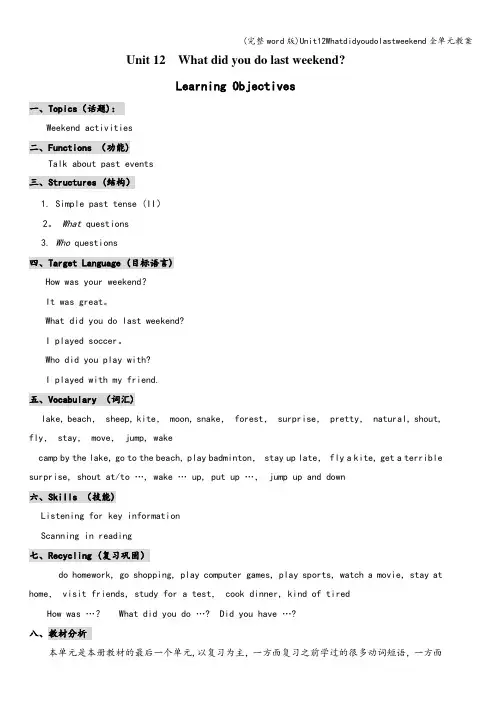
Unit 12 What did you do last weekend?Learning Objectives一、Topics(话题):Weekend activities二、Functions (功能)Talk about past events三、Structures (结构)1. Simple past tense (II)2。
What questions3. Who questions四、Target Language (目标语言)How was your weekend?It was great。
What did you do last weekend?I played soccer。
Who did you play with?I played with my friend.五、Vocabulary (词汇)lake, beach, sheep, kite, moon, snake, forest, surprise, pretty, natural, shout, fly, stay, move, jump, wakecamp by the lake, go to the beach, play badminton, stay up late, fly a kite, get a terrible surprise, shout at/to …, wake … up, put up …, jump up and down六、Skills (技能)Listening for key informationScanning in reading七、Recycling (复习巩固)do homework, go shopping, play computer games, play sports, watch a movie, stay at home, visit friends, study for a test, cook dinner, kind of tiredHow was …? What did you do …? Did you have …?八、教材分析本单元是本册教材的最后一个单元,以复习为主,一方面复习之前学过的很多动词短语,一方面通过以谈论上周末的活动为话题,继续巩固学习一般过去时态的应用。
Unit-12-What-did-you-do-last-weekend?知识强化
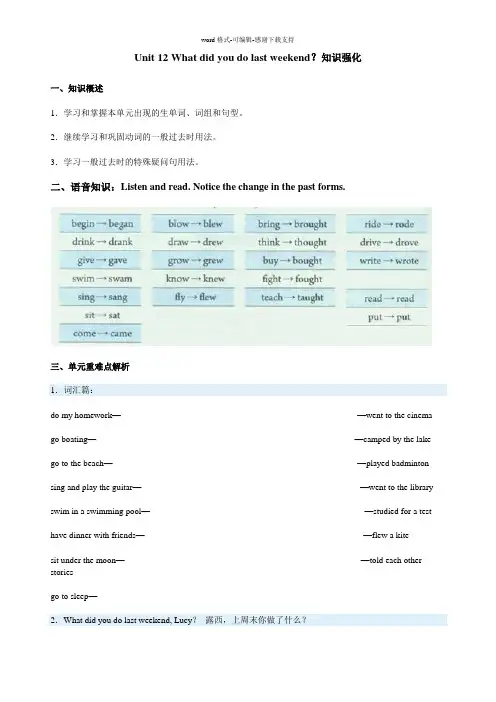
Unit 12 What did you do last weekend?知识强化一、知识概述1.学习和掌握本单元出现的生单词、词组和句型。
2.继续学习和巩固动词的一般过去时用法。
3.学习一般过去时的特殊疑问句用法。
二、语音知识:Listen and read. Notice the change in the past forms.三、单元重难点解析1.词汇篇:do my homework——went to the cinemago boating——camped by the lakego to the beach——played badmintonsing and play the guitar——went to the libraryswim in a swimming pool——studied for a testhave dinner with friends——flew a kitesit under the moon——told each other storiesgo to sleep—2.What did you do last weekend, Lucy?露西,上周末你做了什么?这个句子是谓语动词是实义动词的一般过去时的特殊疑问句用法。
特殊疑问词+did+主语+动词原形+其它?e.g.What did you do last night?昨天晚上你做了什么?Where did he go last Sunday?上个星期天他去哪儿了?Who did she go with?她和谁一起去的?注意:(1)当特殊疑问词是充当主语时,则不需要使用助动词did,直接用特殊疑问词加动词的过去式来表达就可以了。
e.g.Who visited her grandma?谁拜访了她的奶奶?(2)当句子的谓语动词是be动词was/were时,特殊疑问句的结构为“特殊疑问词+ was/were +其它?”e.g.How was your weekend?你周末过得如何?How was the weather in Beijing?那时候北京天气如何?3.How interesting! [译文]多么有趣啊!这是个感叹句。
unit12_What_did_you_do_last_weekend_?全单元
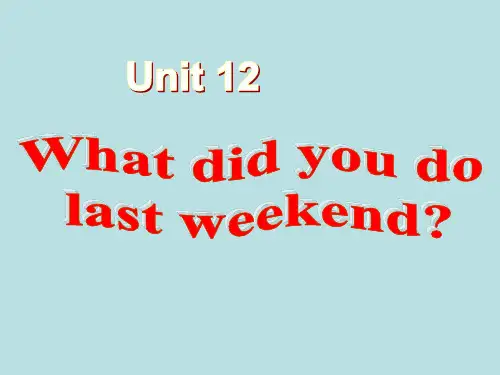
3. How interesting! 多么有趣啊! 这是一个感叹句,句子结构为: How + 形容词或副词 + (主语 + 谓 语)!
那本书太有趣了!
How interesting the book is!
4. stay up 意为“熬夜;深夜不眠” 。 不要熬夜,这对你的健康不好。 Don’t stay up late. It’s bad for your
Paul: Really? How interesting! Lisa: Yeah, it was fun. They have a butterfly house with over 200 kinds of butterflies! I told the visitors about them and their living habits. Did you have a good weekend? Paul: Yeah, it was good, but I’m kind of tired now. I stayed up late to watch the soccer game.
health.
咱们别睡觉,迎接新年的到来吧。
Let’s stay up to see the New Year.
阅读Grammar Focus部分,完成下列句子。
1. 上个周末你做什么了? What did you do last weekend? _______________________ 2. 我做了我的家庭作业。 I did my homework. __________________
What did they do last weekend?
They visited a history museum.
Unit 12 What did you do last weekend讲义及答案

Unit 12 What did you do last weekend?(讲义)Part 1 Words and Expressionscamp /k?mp/ v. 扎营;搭帐篷lake /le?k/ n. 湖;湖泊beach /bi?t?/ n. 海滩;沙滩badminton /'b?dm?nt?n/ n. 羽毛球运动sheep /?i?p/ n. 羊;绵羊prep. & adv. as /?z/ 作为;当作adj. 自然的natural /'n?t??r?l/n. butterfly /'b?t?(r)fla蝴蝶?/n. 游客;访问者?t?(r)/ visitor /'v?zadj. 疲倦的;疲劳的tired /ta??(r)d/v. / 停留;待stay /ste?深夜不睡;熬夜stay up lateadv. 离开;远离away /?'we?/跑开run awayn. (pl. mice /mas/ ?s/) 老鼠;耗子mouse /ma?adj. 幼小的n. baby /'be?bi/ 婴儿v. 呼叫;喊叫?shout /a?t/冲? shout at …?大声叫嚷interj. ?woof /wf/ (狗叫声)汪汪n. 语言/ dlanguage /'l??gw??v. (flew /flu/ ?/)飞?fly /flan. 风筝t/ kite /ka?放风筝fly a kiteadj. & adv. 高的(地)/ high /ha?中学high schooladv. ago /?'g?以前/ ?n. ndi?/India /'?印度n. 帐篷tent /tent/搭起;举起put upn. 月亮n/ ?moon /mun. 惊奇;惊讶v. z/ ?surprise /s?(r)'pra使吃惊吃惊get a surprisen. snake /sne蛇k/ ?页 1 第scared /ske?d/ adj. 惊慌的;吓坏了的move /mu?v/ v. 移动shout to…对??大声喊叫start /stɑ?(r)t/ v. 开始;着手jump /d??mp/ v. 跳;跃up and down 上上下下;起伏wake /we?k/ v.(woke/ w??k/)弄醒;醒wake…up 把??弄醒forest /'f?r?st/ n. 森林into /'?nt?/ prep. 到??里面;进入ear /??/ n. 耳朵Lucy /'lu?si/ 露西(女名)wake v.(woke/ w??k/)弄醒;醒wake…up 把??弄醒The shouting waked up Jim.The shouting waked Jim up.Please wake me up at five.wake…up 名词作其宾语,放在或均可,。
Unit12Whatdidyoudolastweekend知识点人教版七年级英语下册
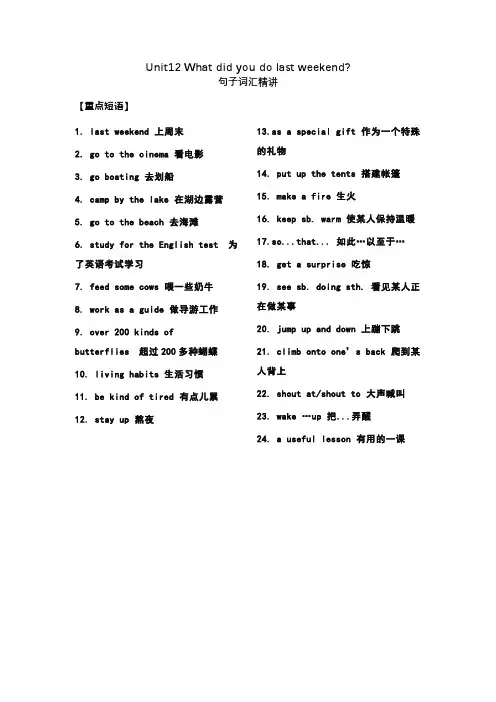
Unit12 What did you do last weekend?句子词汇精讲【重点短语】1. last weekend 上周末2. go to the cinema 看电影3. go boating 去划船4. camp by the lake 在湖边露营5. go to the beach 去海滩6. study for the English test 为了英语考试学习7. feed some cows 喂一些奶牛8. work as a guide 做导游工作9. over 200 kinds ofbutterflies 超过200多种蝴蝶10. living habits 生活习惯11. be kind of tired 有点儿累12. stay up 熬夜13.as a special gift 作为一个特殊的礼物14. put up the tents 搭建帐篷15. make a fire 生火16. keep sb. warm 使某人保持温暖17.so...that... 如此…以至于…18. get a surprise 吃惊19. see sb. doing sth. 看见某人正在做某事20. jump up and down 上蹦下跳21. climb onto one’s back 爬到某人背上22. shout at/shout to 大声喊叫23. wake …up 把...弄醒24. a useful lesson 有用的一课1.by the lakeby介词, 意为“在……旁边”,表示位置,相当于beside。
拓展:by作介词的其他常见用法:(1)表示移动方向,意为“经过”。
例如:My mother goes by the building every day. 我妈妈每天从这栋楼旁边经过。
(2)表示方式及手段,意为“用,靠,通过”。
He makes a living by fishing. 他以捕鱼为生。
unit12_What_did_you_do_last_weekend_Section_A_2 新目标初一英语下册

Where did you go on Dragon Boat Day?
点此播放对话视频
What did you do there?
I went to the countryside.
I watched the boat race.
What did you do last weekend?
点此播放对话视频
阅读Grammar Focus部分,完成
下列句子。 1. 上个周末你做什么了? What did you do last weekend? ___________________________ 2. 我做了我的家庭作业。 I did my __________________ homework.
点此播放听力视频
We went boating. 3. 我们去划船了。_______________
4. 谁去探望了她的奶奶? _______________________ Who visited her Becky did. 5. grandma? 是蓓基?_________ 6. 上个周末她去了哪里? Where did she go last ___________________________ weekend?
1. mouse ຫໍສະໝຸດ 为“老鼠”,复数形式 为“mice”。
他们看到了两只老鼠。
They saw two mice.
2. language 意为“语言”,是可数名词。
英语、汉语、法语是三种不同的语言。
English, Chinese and French are three
different languages.
此类填空题,应主要根据答语的意思
来确定问句中所缺的特殊疑问词是什
人教版新目标七年级下学期Unit-12--what-did-you-do-last-weekend--知识点
Unit 12 what did you do last weekend?Section A 知识讲解一. last(1)last形容词“最后的,最末的”或者“紧接前面的,刚过去的”。
Today is the last day in the year.最后一天。
I didn’t sleep well last night. 昨晚(2)last副词,“最后地”,I’m the last one.最后一个。
(3)last 动词,“持续,继续,维持”等,The hot weather lasted a week.持续了一周。
二. camp(1)camp 动词,“扎营,搭帐篷”。
We go camping every summer.We walked all day and camped by a river at night.(2)camp 名词,“露营地,度假营”。
Let’s go back to the camp, it’s getting dark. 让我们回营地吧,天黑下来了。
根据汉语提示填空。
(1)When did you join the ______ ______ (夏令营)?(2)I like ______ ______ (去宿营)in the open air.3)We______(宿营)in the forest last night. (4)Let’s go back to the ______(营地)三. sheepsheep 可数名词,“绵羊”,复数还是sheep;goat指山羊。
How many sheep are there on your farm? 你们农场里有多少只羊?拓展:常见的单复数同形的名词还有:deer (鹿),fish (鱼),Chinese (中国人),Japanese(日本人)等。
四. byby介词, “在……旁边”,相当于beside。
Our teacher is sitting by the window.by与交通工具名词连用时,名词前不用冠词,意为“乘、坐、用”等。
Unit 12 What did you do last weekend(讲义及答案)
Unit 12 What did you do last weekend(讲义及答案)Unit 12 What did you do last weekend?(讲义)Part 1 Words and Expressionscamp /kæmp/ v. 扎营;搭帐篷lake /leɪk/ n. 湖;湖泊beach /biːtʃ/ n. 海滩;沙滩badminton /'bædmɪntən/n. 羽毛球运动sheep /ʃiːp/ n. 羊;绵羊as /æz/ prep. & adv. 作为;当作natural /'nætʃərəl/adj. 自然的butterfly /'bʌtə(r)flaɪ/ n. 蝴蝶visitor /'vɪzɪtə(r)/n. 游客;访问者tired /taɪə(r)d/adj. 疲倦的;疲劳的stay /steɪ/ v. 停留;待stay up late 深夜不睡;熬夜away /ə'weɪ/ adv. 离开;远离run away 跑开mouse /maʊs/ n. (pl. mice /maɪs/) 老鼠;耗子baby /'beɪbi/ adj. 幼小的n. 婴儿shout /ʃaʊt/ v. 呼叫;喊叫shout at …冲……大声叫嚷woof /wʊf/ interj. (狗叫声)汪汪language /'læŋgwɪdʒ/ n. 语言fly /flaɪ/ v. (flew /fluː/)飞kite /kaɪt/ n. 风筝fly a kite 放风筝high /haɪ/ adj. & adv. 高的(地)high school 中学ago /ə'gəʊ/ adv. 以前India /'ɪndiə/n. 印度tent /tent/ n. 帐篷put up 搭起;举起moon /muːn/ n. 月亮surprise /sə(r)'praɪz/ n. 惊奇;惊讶v. 使吃惊get a surprise 吃惊snake /sneɪk/ n. 蛇开始做某事surprise n. 惊奇;惊讶v. 使吃惊You didn’t know my surprise when I he ard that news.My sister and I got a terrible surprise yesterday.get a surprise 吃惊Jimmy’s words surprised me a lot.It surprised us to see Jane get up soearly. surprise sb. 使……吃惊n. 意想不到的事;惊喜It’s a lovely surprise to see youagain. I have a little surprise foryou.shout v. 呼叫;喊叫There’s no need to shout. I am notdeaf! We could hear them shoutingfor help. shout at…s hout to…The bus driver is shouting at the oldman. Don’t shout at me. I don’t likethat.I had to shout to Tom because he was so far from me.My mother shouted to me on the other side of the road, but I still couldn’t hear her w ords.shout at…对……叫嚷,多指因shout to…对……喊,多指因Part 2 Role-playRole-play the conversation.Paul: Hi, Lisa. How was yourweekend? Lisa: Great, thanks.Paul: What did you do?Lisa: I worked as a guide at the Natural HistoryMuseum. Paul: Really? How interesting!Lisa: Yeah, it was fun. They have butterfly house with over 200 kinds of butterflies! I told the visitors about themand their living habits. Did you have a good weekend? Paul: Yeah, it was good, but I’m kind of tired now. I stayed up late to watch the soccer game.How interesting!Look at the bird. How beautiful!I had a terrible weekend. How tired!Five hours ago we left Beijing on this train, but now we’re arriving in Shanghai! How fast!I got on the bus one hour ago. How slowly!how 引导感叹句,译为“多么……;真……”,后面接或。
七年级英语下册Unit12Whatdidyoudolastweekend知识点
七年级英语下册Unit12Whatdidyoudolastweekend知识点七年级英语下册Unit12Whatdidyoudolastweekend知识点一.短语归纳1.domyhomework做作业2.gotothecinema去看电影3.goboating去划船4.bythelake在湖边5.gotothebeach去海滩6.playbadminton打羽毛球7.visitmygrandma看望我奶奶8.studyfortheEnglishtest为英语测验而学习备考9.theNaturalHistoryMuseum自然历史博物馆10.kindsof各种各样的11.livinghabits生活习惯12.stayup深夜不睡,熬夜13.giveback归还14.playtheguitar弹吉他15.gotothelibrary去图书馆16.inaswimmingpool在游泳池里17.shoutat…冲……大声叫嚷18.highschool高中,中学19.flykites放风筝、20.gocamping去野营21.putup搭建22.makeafire生火23.tellstories讲故事24.eachother互相25.gotosleep入睡26.getasurprise吃惊27.shoutto…呼喊……喊叫……28.upanddown来来回回;上上下下29.wake…up把……弄醒31.onSaturdaymorning在星期六早上32.haveagoodweekend周末过得愉快33.thenextmorning第二天早上34..runaway跑开35.moveinto…移进…二.用法集萃1.go+doing去做某事2.play+球类玩……球3.时间段+ago……前 4.keep+sb./sth.+形容词/副词/介词短语使……保持……5.so+形容词/副词+that句子如此……以至于……6.seesb.doingsth.看见某人正在做某事7.letsb.dosth.让某人做某事8.starttodo/doingsth.开始做某事三.重点句型1.—Whatdidyoudolastweekend?—Ididmyhomework.—上个周末你做了什么了?—我做我的家庭作业了。
unit_12_What_did_you_do_last_weekend?词句精讲精练
Unit 12 What did you do last weekend?词汇精讲1. last(1)last 作形容词时,意为“最后的,最末的”或者“紧接前面的,刚过去的”。
例如:Today is the last day in the year. 今天是今年的最后一天。
I didn’t sleep well last night. 昨晚我没睡好。
(2)last作副词时,意为“最后地”,例如:I’m the last one. 我是最后一个。
(3)last 做动词时,意思是“持续,继续,维持”等,例如:The hot weather lasted a week. 炎热的天气持续了一周。
2. as(1)as作介词时意为“作为”,其后多接表示职业、职务、用途、作用之类的名词。
例如:He works as a worker. 他作为一名工人而工作。
I used one of my shoes as a hammer. 我拿我的一只鞋当锤子使。
(2)as还可以作连词,其后多接从句或介词短语。
例如:All the six students do as the teacher says. 所有这六个学生都按照老师说的做。
3. camp(1)camp 作动词,意为“扎营,搭帐篷”。
例如:We go camping every summer. 我们每年夏天都去野营。
We walked all day and camped by a river at night.我们走了一天,晚上在一条河边宿营。
(2)camp 作名词,意为“露营地,度假营”。
例如:Let’s go back to the camp, it’s getting dark. 让我们回营地吧,天黑下来了。
We spent two weeks at camp this summer. 我们今年夏天在度假营玩了两周。
4. sheepsheep 可数名词,意为“绵羊”,它的复数还是sheep;而goat侧重指山羊。