
Unit 2 Travelling Grammar-Task 八年级英语(牛津译林版)
译林版八年级英语下册Unit2 Travelling-Task 练习

1 练 习
I.词汇过关
根据句意或中英文提示,写出句中所缺单词。
1. How (nice) the dishes smell!
2. Tell me when your flight is, and I'll meet you at the then.
3. The day we were looking forward to (到了) at last and we got very excited.
4. —Have you been to the flower (展览)?
—Yes. I saw all kinds of beautiful flowers from all over the world.
5. It's traditional for us Chinese to visit friends and during the Spring Festival.
II.语法入门
选择填空。
1. They've stayed in China for______________
A. two and half month B. two and half months
C. two months and a half D. two and a half month
2. Who is waiting the bus stop?
A. for B. on C. at D. in
3. —I hear Mr Sun will Hangzhou this afternoon.
八年级英语下册 Unit 2 Travelling Grammar练习(无答案)
Unit 2 Travelling Grammar
I.用have / has been to / in, have gone to及go的各种形式填空。
1) —Where is your brother?
—He ____________ the shop. He’ll be back soon.
2) David ________ the park just now.
3) John _______ England since he came back.
4) How long _____ they _____ this village?
5) The Smiths ______ Beijing for years.
6) _____ you ever ____ America? -- Yes, I _____ there many times.
7) I _____ this school since three years ago.
8) Where is Jim? He _____ the farm.
9) When_____ he _____? He _______ an hour ago.
10) Would you like to _____ to the zoo with me? ---Yes, but I _____ there before.
11) Where _____ you _____ now? --- I ____ to the zoo.
12) He often _____ swimming.
II.用since和for填空.
______three hours ______three o’clock ______two days
______yesterday afternoon ______I came here ______last Sunday
Unit 2 Travelling(Task)教案(牛津译林版八年级下)
Task
Teaching aims: To write an article about one of your holidays.
Teaching procedures:
Step 1 Presentation
Show students some pictures and new words.
Step 2 Warming up
Show some pictures about Hong Kong and introduce
Disneyland is a famous theme park and it has four different parks—Main Street USA, Tomorrow
Land, Fantasyland and Adventure land.
In Ocean Park
we can see the dolphin show and the bird show. Every year many tourists go there to have a good
time especially(特别)the children.
Step 3 Task 1
1. How does Kitty write her article?
Step 1(part A):
Step 2(part B):
Step 3(part C):
2 Look at Kitty’s fact file –Part A in page 32carefully and try to remember more information about
Kitty’s trip to Hong Kong.
八年级英语译林版下册Unit2_复习教案
八年级英语Unit2复习教案
教学目标:1、复习本单元重点单词、词组;
2、复习现在完成时及其用法。
教学过程:
知识点解析
Unit2 --Welcome+Reading 1.0
1.travelling /ˈtrævəlɪŋ/ 旅行
用法解析:travelling n. 旅行→travel vi. 旅行
例:After travelling by train for three days, we finally got home.
坐了3天火车,总算到家了。
Oh dear! The travelling bag has been left behind. 唉呀!旅行袋忘了拿了。
例题训练:
English is now used widely by (travel) all over the
world.
2.hey /heɪ/ *嘿,喂
课本例句:Hey, Eddie. Where are you going?
用法解析:hey, 感叹词 三会
3.I don’t
think... 我不认为....
课本例句:I don’t think it’ll be a holiday for me.
用法解析: “英语的否定转移”.在学英语的过程中,学生常将这样的句子 "我认为这不是个好主意." 译为"I think it isn't a good idea." 而将这句英语译成汉语时,学生又会译为 "我不认为这是个好主意." 老师又会说译错了,这不符合 "I don't think..." 句型,应译为 "l don't think it's a good
idea."在英语中,当主语为第一人称,谓语动词为think, believe,
suppose,expect,imagine 等,其后的宾语从句为否定句时,要将从句的否定词转移到主句中,即主句的谓语动词用否定式,而从句的谓语动词用肯定式。这种语法现象就是否定前移。
牛津译林版八年级英语下册 Unit 2 Travelling 全单元6课时随堂练习(有答案)
牛津译林版八年级英语下册 Unit 2 Travelling 随堂练习
(Part I)Exercises for “Comic Strips” & “Welcome to the Unit”
一、根据句子意思和所给提示,完成下列单词
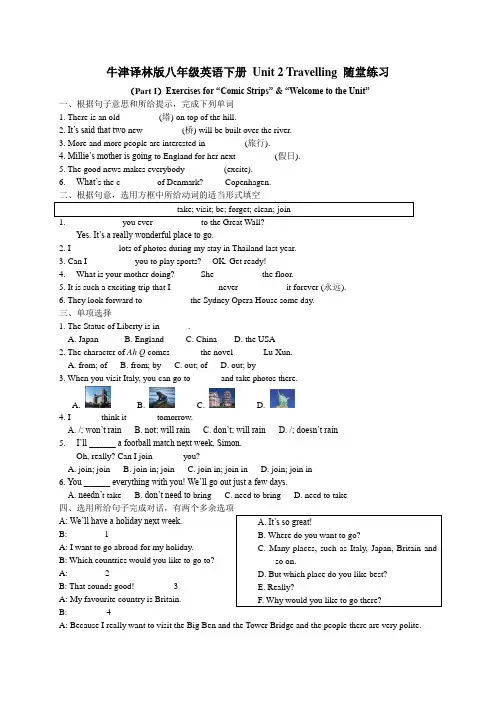
1. There is an old ________ (塔) on top of the hill.
2. It’s said that two new ________ (桥) will be built over the river.
3. More and more people are interested in ________ (旅行).
4. Millie’s mother is going to England for her next ________ (假日).
5. The good news makes everybody ________ (excite).
6. ---What’s the c________ of Denmark? ---Copenhagen.
二、根据句意,选用方框中所给动词的适当形式填空
take; visit; be; forget; clean; join
1. ---__________ you ever __________ to the Great Wall?
---Yes. It’s a really wonderful place to go.
2. I __________ lots of photos during my stay in Thailand last year.
3. Can I __________ you to play sports? ---OK. Get ready!
4. ---What is your mother doing?
---She __________ the floor.
译林版八年级下册英语Unit 2 Grammar练习(含答案)

1 Unit 2 Travelling-Grammar
一、句型转换,每空一词
1. He came to Hong Kong two years ago.(改为现在完成时)
He________ ________ ________Hong Kong________two years ago.
2. My father joined the Party in 2007.(改成同义句)
My father________ ________ ________the Party________2007.
My father________ ________a________ ________ ________13 years.
________13 years________my father________the Party.
13 years________ ________ ________my father________the Party.
3. She left her hometown last year.(改为现在完成时)
She________ ________ ________ ________her homework________last year.
4. The meeting started half an hour ago.(改为现在完成时)
The meeting________ ________ ________ ________half an hour.
5. My father came back the day before yesterday.
My father has________ ________for two days.
6. My uncle bought the new car two months ago.
My uncle has________the new car________two months.
八下英语满分必刷题Unit2 Travelling (词法句法过关练)
2022-2023学年八年级英语下册单元模块满分必刷题(牛津译林版)
Unit 2 Travelling【刷基础】(词法句法过关练)
一、单项选择
1.Don’t forget _________ your book here tomorrow.
A.carrying B.getting C.to take D.to bring
2.—Have you ever been to France?
—Yes, ________ already.
A.sometimes B.some time C.sometime D.some times
3.The _________ in London is very famous all over the world.
A.Tower Bridge B.Golden Gate Bridge C.Sydney Opera House D.River Seine
4.You _________ everything with you! We’ll stay out just for a few days.
A.needn’t take B.don’t need bring C.need bring D.need no take
5.This museum____________ here for over 80 years. It____________ one of the oldest buildings in this
city.
A.is; was B.had been; is
C.was; has been D.has been; is
6.How long has Mr. Green _________ Hawaii _________ holiday?
A.been to; on B.been in; on C.gone to; for D.been to; for
苏教牛津译林版初中英语八年级下册Unit 2 Travelling (10)
苏教牛津译林版初中英语
TB:小初高题库苏教牛津译林初中英语 重点知识精选 掌握英语语法知识,巩固词汇量和各种语态,学好英语基础一定要扎实,大家一起练习吧! 牛津译林初中英语 和你一起共同进步学业有成! Travelling 苏教牛津译林版初中英语
TB:小初高题库教学目标 1.To revise some useful phrases and languages. 2.To revise some useful sentences and do some exercises. 重点 To revise some useful phrases and languages. 难点 To revise some useful phrases and languages. 教法及教具 Small blackboards 教 学 内 容 个案调整 教师主导活动 学生主体活动 教 学 过 程 39.购物 40.一对。。。 41.在。。。的末尾 42.出席会议 43.顺便问一下 44.去野餐 45.旅行的地方 46.中国园林 47.自然美的地方 48.海边城市 49.主题公园 50.水上运动 51.世界之窗 52.常年 53.在寒冷的雪天 54.在一年中的那个时候 55.在任何一个季节 56.五一劳动节 57.出差 58.直达航班 二.Useful sentences: 1.你将要去哪儿? 2.我要去南山度假。 3.我认为对我来说这将不是个假期。 4.关于它有什么特别的? 5.自从上周以来我们就没见过面。 6.城堡在烟花的照耀下看起来又明亮又美丽。 39.go shopping / do some shopping 40.a couple of 41.at the end of 42.attend the meeting 43.by the way 44.go for a picnic 45.places for traveling 46.Chinese gardens 47.places of natural beauty48.seaside cities 49.theme parks 50.water sports 51.the Window of the World 52.all year round 53.on cold and snowy days 54.at that time of the day 55.in any season 56.May Day 57.on business 58.a direct flight 1. Where are you going ? 2. I am going to South Hill for a holiday . 3. I do not think it will be a holiday for me . 4. What is special about it ? 5. We have not seen each other since last week . 6. The castle looked bright and beautiful . 7. I know you have gone to Hainan . 苏教牛津译林版初中英语
江苏新教材牛津英语八年级下Unit 2 Travelling Unit 2 Travelling 教案
第 1 页 2019-7-14 立德 践行 敬业 求真
2013-2014学年度第二学期八年级英语学科集体备课教案 主备人:曹桂兰 审核人:
课题 Unit 2 Travelling--- Comic strip and Welcome to the unit
课时 第一课时 执教时间 复备人
教学目标 1.知识目标:
学习词汇:travelling, hey
学习词组:go to … for my holiday, the capital of
学习句子:
Great ready!
I don’t think it’s a holiday for me.
2. 技能目标:
1)了解外国著名城市胜地和受欢迎的景点。
2)通过对话谈论人们在不同景点从事的活动。
3. 情感目标:初步认识到这些旅游胜地是全人类的共同财富。
教学重点 外国城市著名的旅游胜地和受欢迎的景点
教学难点 通过对话谈论人们在不同景点从事的各种活动
教学媒体 录影机,多媒体,实物等
教学过程 Step1:预习指导与检测 见导学案
Step2:展示目标 见导学案
Step3:课堂导学与互动
任务一:师生互动。
Do you like travelling?
Do you know any places of interest in the world?
Which places of interest have you been to?
Where do you want to go on holiday?
Let’s see some popular tourist attractions(旅游胜地) in the world.
任务二:你们能说出以下景点所属哪个国家吗?
Mount Fuji
the Leaning Tower of Pisa
the Little Mermaid
the Statue of Liberty
牛津英语译林版八年级下册 Unit 2 Travelling 专项练习 - 短文理解
牛津英语译林版8下 Unit 2 Travelling 专项练习 - 短文理解
Ⅰ
How would we travel without maps? I would be a bit adventurous冒险的) to set off from Oxford University to go to
London Bridge if there was not a map of the London Underground at each station. In fact, a lot of the early map-makers were
explorers (探险家) , especially in the 15th and 16th centuries
So what did people do before there were maps? Well, it was quite easy to use natural signs like mountains and rivers if you
were travelling on foot or riding a horse. People took small boats down rivers and followed coastlines (海岸线) . And people
would use time, not distance (距离) , to measure the way they went; the next village was a three-hour ride, for example.
In fact, in the early maps, people did not draw marks. They drew stars. It was very easy to the night skyand use it for