
仁爱版九年级英语上册课件:Unit 2 Topic 1 Section C
2020 仁爱英语九年级上册Unit1-Unit2课文翻译
13
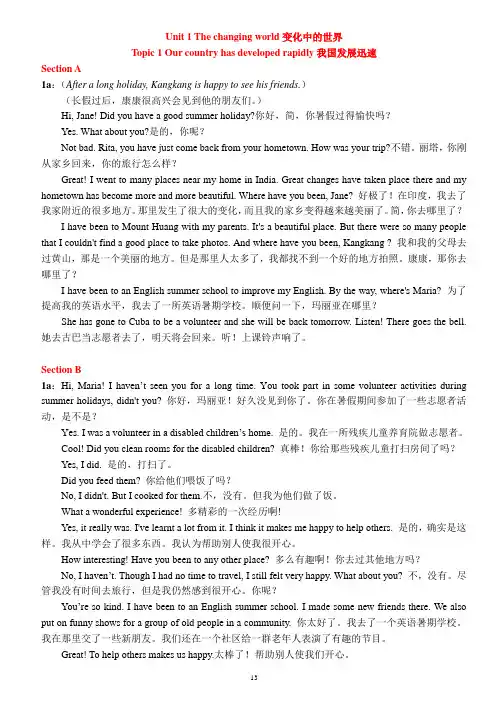
Unit 1 The changing world变化中的世界
Topic 1 Our country has developed rapidly我国发展迅速
Section A
1a:(After a long holiday, Kangkang is happy to see his friends.)
(长假过后,康康很高兴会见到他的朋友们。)
Hi, Jane! Did you have a good summer holiday?你好,简,你暑假过得愉快吗?
Yes. What about you?是的,你呢?
Not bad. Rita, you have just come back from your hometown. How was your trip?不错。丽塔,你刚从家乡回来,你的旅行怎么样?
Great! I went to many places near my home in India. Great changes have taken place there and my
hometown has become more and more beautiful. Where have you been, Jane? 好极了!在印度,我去了我家附近的很多地方。那里发生了很大的变化,而且我的家乡变得越来越美丽了。简,你去哪里了?
I have been to Mount Huang with my parents. It's a beautiful place. But there were so many people
that I couldn't find a good place to take photos. And where have you been, Kangkang ? 我和我的父母去过黄山,那是一个美丽的地方。但是那里人太多了,我都找不到一个好的地方拍照。康康,那你去哪里了?
仁爱九年级上册Unit2 Topic1 SectionC 课课练

九年级上册英语课课练 日日清
第 - 1 - 页 共 2 页 Unit 2 Topic1 Section C
友情提示:
本课知识点:了解噪音污染,提高环保意识;not all ...以及其它部分否定结构
一、翻译下面的短语并且背会它们
1、在午夜_________________________________________________
2、课下大声地讨论________________________________________________
3、在今天的世界______________________________________________
4、对人们的健康有害_____________________________________________
5、变聋______________________________________
6、相当多的人___________________________________________________
7、据报道_____________________________________________________
8、和65岁的人一样差__________________________________________________
9、在公共场合制造大的噪声_______________________________________
10、打扰他人________________________________________
11、对人的听力有很大的伤害_____________________________________
12、尽力解决所有的环境问题_______________________________________________
13、包括噪音污染___________________________________________
仁爱版九年级英语上Unit2 Topic1 Section A教学设计(1a-1c)教学设计
Unit2 Topic1 Section A(1a)
Ⅰ Analysis of the teaching material
1.1 The status and function
This period is the first lesson of Topic 1, Unit 2, Project English 9A. It is based on the
topic that Kangkang will go to the West Hill for a picnic with his friends. Bring out the
pollution problems in this topic and learn relative words and phrases by comparing the
West Hill’s environmental changes now and in the past.
1.2 Teaching objectives and demands
1.2.1 Knowledge objectives
1)The students can maser some new words and expressions as: bee, butterfly, mess,
shame, several, pour, pour, waste, see sb./ sth. do sth., see sb./ sth. doing sth.…
2)The students can use there be sb./sth. doing sth. properly.
1.2.2 Skill objectives
1)The students can understand the description of the environmental changes through
仁爱版英语九上教案 Unit 1 Topic 1 Section C
仁爱版英语九上教案 Unit 1 Topic 1 Section C
仁爱版英语教案九上Unit1Topic1SectionC 一.教材分析
Unit1Topic1Chinahasdevelopedrapidlyinrecentyears.SectionC是仁爱版九年级
上册内容,通过本单元学习,使学生能够谈论社会环境发生的变化。这个话题
贴近学生实际生活,容易上口。本单元教材特点是话题较多,句型较多,单词
不多。本课的语法教学主要体现在完成时,一般过去时的用法,现在进行
时。 二.教学设计的理念
英语教学不能只停留在简单地会话上,教师要通过有计划的活动让学生拓
宽知识面,独立运用所学知识,开展积极的思维活动。 鼓励学生课前动手搜集,加工和处理信息。激励他们大胆进行语言实践。
利用情境想象,讨论或表扬等方式,启迪学生的思维,激活他们的想象力和
创造力,培养他们的灵感,张扬他们的个性。倡导学生主动探究式学习,加
强师生,生生之间的交流与合作,培养团队精神。促使学生树立正确的人生
观和知识观。 三.教学目标
(一)知识与能力:
1知识目标:掌握一些词汇及日常交际用语的用法:
(1)与本单
初中英语 仁爱版九年级上册Unit2 Topic1 知识点
1 Unit2 Topic1
Section A
1.gone(不及物动词)不复存在,不见了,丢失,失窃
2.There be sth./sb.+doing sth.有某人或某物正在做某事
Eg:There are some boys running on the playground.有一些男孩正在操场上跑步。There be sth./sb. to do sth.有某人/某物做某事
Eg:There is no time to think.没有时间去想了。
3.pour...into... 把...倒入...
4.waste(形容词)废弃的,丢弃的,无用的(名词)废弃物,废料(动词)浪费waste of time浪费时间waste of money浪费金钱
Section B
1.It’s difficult for sb. to do sth.做某事对某人来说很困难
2.how long多久,多长时间,用来询问或谈论某段时间,答语通常用for,since等引导的时间状语,谓语动词必须为延续性动词。
—How long have you learned English?—I have learned English for three years.
3.in a bad mood不爽,心情不好。
4.bear(动词)忍受,承受(名词)熊,鲁莽的人bear with忍受...,对...有耐心
Eg:Please bear with me while I ask some questions.当我提问你时,请耐心些。
作动词时常可以stand互换,stand承受,经受;忍受,容忍,常与can,could
1 连用。stand+名词/代词/doing:忍受某人/某事/做某事
I can’t stand working in an office.我几乎受不了在办公室工作。
5.anyway无论如何,使用时经常位于句子开头转折处。
仁爱英语九年级上册Unit1-Unit2课文翻译
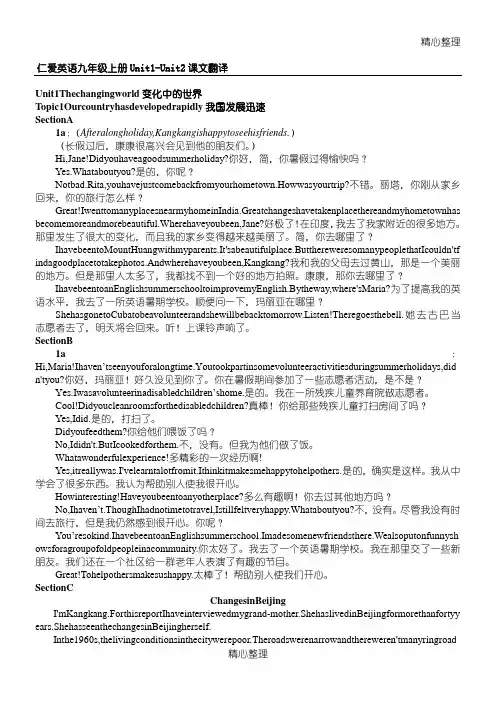
精心整理
精心整理 仁爱英语九年级上册Unit1-Unit2课文翻译
Unit1Thechangingworld变化中的世界
Topic1Ourcountryhasdevelopedrapidly我国发展迅速
SectionA
1a:(Afteralongholiday,Kangkangishappytoseehisfriends.)
(长假过后,康康很高兴会见到他的朋友们。)
Hi,Jane!Didyouhaveagoodsummerholiday?你好,简,你暑假过得愉快吗?
Yes.Whataboutyou?是的,你呢?
Notbad.Rita,youhavejustcomebackfromyourhometown.Howwasyourtrip?不错。丽塔,你刚从家乡回来,你的旅行怎么样?
Great!IwenttomanyplacesnearmyhomeinIndia.Greatchangeshavetakenplacethereandmyhometownhasbecomemoreandmorebeautiful.Wherehaveyoubeen,Jane?好极了!在印度,我去了我家附近的很多地方。那里发生了很大的变化,而且我的家乡变得越来越美丽了。简,你去哪里了?
IhavebeentoMountHuangwithmyparents.It'sabeautifulplace.ButthereweresomanypeoplethatIcouldn'tfindagoodplacetotakephotos.Andwherehaveyoubeen,Kangkang?我和我的父母去过黄山,那是一个美丽的地方。但是那里人太多了,我都找不到一个好的地方拍照。康康,那你去哪里了?
IhavebeentoanEnglishsummerschooltoimprovemyEnglish.Bytheway,where'sMaria?为了提高我的英语水平,我去了一所英语暑期学校。顺便问一下,玛丽亚在哪里?
仁爱版九年级知识归纳 Unit2 Topic1
仁爱版九年级知识归纳 Unit2
Topic1
1 / 4 一、仁爱九年级英语(上)第二单元重点必背
Unit 2 Saving the Earth
Topic 1 Pollution causes too many problems.
短语
see sb. doing sth.看见某人正在做某事 see sb. do sth. 看见某人做了某事
several = some = a few 几个 my goodness 天啊! pour …into … 把…倒入…
be harmful to = do harm to 对…有害 quite a few / lot / bit 许多,大量
breathing problems 呼吸问题 sleep well = have a good sleep 好好睡一觉
be in a good / bad mood 好心/坏心情 hearing loss 听力丧失 in public 在公共场所
had better (not) do sth最好(不要)做某事 all sorts of =all kinds of 各种各样的
high blood pressure 高血压 go deaf 变聋
重点句型
1. The flowers and grass have gone! 花和草都没有了!
2. Look, there are several chemical factories pouring waste water into the stream.
看!有几家化工厂把废水往河里放。
3. There be +sb. / sth. +doing sth. 有某人/物正在做某事
4. Everything has changed. 一切都变样了。
仁爱英语九年级上册Unit2 短语句子
仁爱英语九年上册 Unit2 Topic1 重点短语和句子
Unit2 Topic1 Section A
1看到某人正在做某事see sb. doing sth.
2听起来很好sound great
3真脏!What a mess!
4真可耻!What a shame!
5把...倒入pour ...into
6当然不of course not
7砍到cut down
8You can see bees and butterflies dancing.你可以看到蜜蜂和蝴蝶在跳舞。
9有几家化工厂把废水排到小溪。
There were several chemical factories pouring waste water into the stream.
10Everything has changed一切都变了
12 it was too dirty for me to live in.但是它对我来说太脏了无法居住
Unit2 Topic1 Section B
1. have a pain in the throat喉咙痛
2. produce terrible gas产生难闻气体
3. make my chest hurt使我胸痛
4. make people sick使人们生病
5. what was worse更糟的是
6. make too much noise制造太多噪音
7. in a bad mood心情不好
8. solve the problem解决问题
9. by the way顺便问一下
10. cause too many problems引起太多问题
11. cause breathing problems引起呼吸问题
12. make great efforts to do sth.尽力做某物
13. nosie/air/light pollution噪音/空气/光污染
仁爱版九年级英语上册Unit1TheChangingWorldTopic2SectionC教案
仁爱版九年级英语上册Unit1TheChangingWorldTopic2SectionC教案
精选资料
Unit 1 The Changing World 教课设计
Topic 2 The population in developing countries is growing faster
Section C
Ⅰ . Material analysis
本课是九年级第一单元第二话题的第三课时, 主活动是 1a 和 3b。1a 详细了剖析中国人口现状的严重局势和政府采纳的举措及收效。
这篇阅读文章较长,在阅读练习的时候,建议教师先解决部分生词,扫清单词阻碍,
1b
主假如培育学生找出段落的要旨句的能力。而
1c 则是要学生学习找到论据。
2 能够看作是语法稳固训练,但内容仍旧紧扣主题。
3a 和
3b 是训练说和写的技术的。经过本篇文章的学
习,要修业生掌握必定的阅读策略和写作技巧,能够模拟作者适合运用要旨句的写作方式,排篇布局。指引学生关注社会问题,关注国
家政策,培育学生建立优秀的人口观点和正确的世界观。
Ⅱ .Teaching aims
1.Knowledge aims:
掌握本课的要点词汇和短语,持续学习此刻达成时。
2.Skill aims:
能基本读懂课文资料,掌握必定的阅读技巧和方法。
能正确模拟本课课文,有条理地写出相关解决人口问题的举措的文章。
3.Emotional aims: (optional) 仁爱版九年级英语上册Unit1TheChangingWorldTopic2SectionC教案
精选资料
指引学生关注社会现象,培育学生建立正确的人口观点和社会心识。
4.Culture awareness: (optional)
经过中国人口严重局势的剖析,认识计划生育政策,指引学生关注社会问题的意识。
Ⅲ . The key points and difficult points
仁爱版九年级上Unit1 topic2话题二
Unit 1 The Changing World
(Topic 2 The population in developing countries is
growing faster.)
一、单元概述
1.掌握Topic 2中出现的生单词和短语。
2.重点句型:
(1)I have just called you.
(2)I’ve never been there before.
(3)Have you found him yet?
(4)—I really hate going to a place like that.
—So do I.
(5)It is increasing by 80 million every year.
(6)China has the largest population in the world, and about one fifth of the
people in the world live in China.
(7)Thanks to the policy, China is developing quickly and people’s living
conditions are improving rapidly.
(8)So it is.
3.语法:现在完成时(II)和较大数字英文表达法。
4.学会用英语作比较和分析原因结果。
二、重难点知识讲解
(一)重点单词和短语
1.yet adv. 尚、仍然、还(yet常用于否定句或者疑问句。肯定句用already)
Our teachers haven’t got back home from work yet. 我们老师还没有下班回家呢。
Has your father had supper yet? Yes, he has.
你爸爸已经吃过晚餐了吗?是的,他吃过了。
2.probably adv. 很可能,大概