
人教版高中英语必修2《Unit3Computers》教案
人教版高中英语必修2《Unit3Computers》教案
人教版高中英语必修2《Unit 3 Computers》教案【一】
教学准备
教学目标
1. To practise listening comprehension.
2.To practise making decisions and reasoning
教学重难点
1. To practise listening comprehension.
2.To practise making decisions and reasoning
教学工具
课件
教学过程
Step1. revision
1. check the homework exercises.
1). It has been reported that children will be offered free
education.
It has been reported that free education will be offered to
children.
2). It has been said that we will be offered the latest computer
science course book.
It has been planned that the latest computer science course
book will be offered to us.
3). I have been told by Peter that I will be lent his notebook
computer for a week.
I have been told by Peter that his notebook computer will be
lent to me for a week.
2. Question: What can computers be used as?
Step2. Lead-in
As we know, science and technology is developing very fast and computers have become smaller and smaller. They have
been used in many fields. So, the 21st century is the century of
information technology What does it mean? Does information
technology/ IT only mean things like computers? Of cause not.
Actually, it means more than computers. Computers are just one
kind of IT. What else do you know is part of IT?
(TV, radio, CD-ROM, DVD, books……)
Step3. Listening (SB)
1. Pre-listening: What are the changes brought by different
forms of IT ?
What are the advantages and disadvantages of them ?
2. While-listening:
Go through the chart and make sure the students look at the
chart before they listen to the tape. (This is to sharpen their
attention and listen for the answers. This will also help them get
the gist of the text.) Then Listen to the tape and finish filling in
the chart. (If necessary, play the tape for several times.)
Say: After listening to their talk, we know all kinds of IT have
both disadvantages and advantages.Let’s check the answers
together.
Type of IT Advantages Disadvantages
TV You can both listen and watch. You cannot write to friends.
Web You can find information. It is very expensive.
Radio You can listen to English. You cannot watch a film.
Book You can get information. Sometimes it is out of date.
3. Post-listening:
1) (pair work): decide which type of IT is best for you to use
right now. Make your choice and give your reasons by using the
following expressions.
I think that…. In my opinion, ….
I believe that….
I agree because….
I disagree because….
I’ve decided that….
2) (group work): Discussion :
Computers are useful and have brought us lots of good
things, but they also cause bad effects. What attitude should we
have towards the computer? (Make good use of it but never get
trapped by it.)
Step4. Speaking
1. Pre-speaking
Say: From what we have learn, we should admit that
computers and the web have a great influence on the school
education as well as people’s life. It has come into people’s
everyday life and many families hold computers in their homes.
Now there is a task for you.
2. While-speaking
1) Situation: You have been asked by your parents to help
choose computers for your home. You and your friend have
looked at several computers. Talk about the special things each
computer can do. Make a decision about which kind of computer
to buy and explain why.
Information input: Show students some pictures of different
computers (desktop computer & laptop computer & …)
Language input: Useful expressions (Repeat it to strengthen
students’ ability of use it.)
Supporting an opinion Challenging an opinion
I think that … , because … Perhaps, but what if / about …?
First, … Have you thought about …? One reason is that … What makes you think that …?
I think it is better because… I don’t like it because….
(Pair work )Use the expressions to support your opinion or
challenging other’s opinions.
2) Oral report: (individual work )
Do an oral report to your father and start your report like this:
I looked at many different computers. The one I have chosen is
the PEP personal computer. One of the main reasons is that it is
suitable for homes. I found that…
3. Post-speaking
Conclusion—What useful expression do we use to make a
decision and reason?
(In this way, they can review and use the words and phrases
again.)
Step6 Pre-writing
Say: Imagine what problems and delights this android might
have to deal with while it is serving you. Try yourself in someone
else’s shoes is an important way of understanding how other
people feel.
Then discuss: You are an android. You work for a family with
one child who is very spoiled. The parents want you to do
everything for them. The parents are nice, but they often ask you
人教版高中英语必修二unit3+Computers+教案3.doc
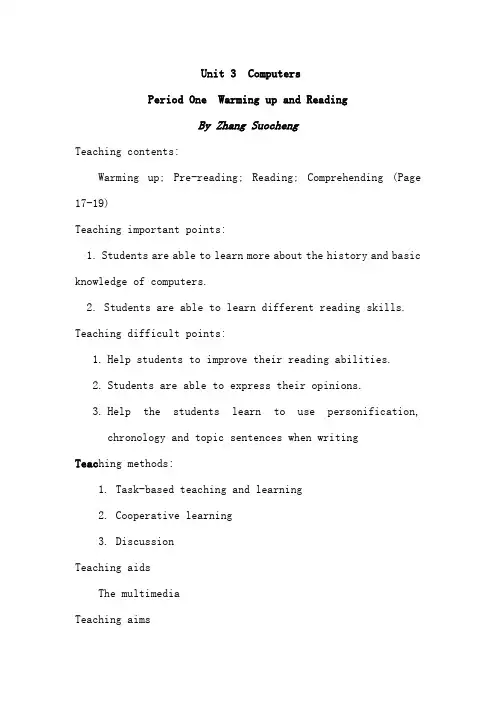
Unit 3 Computers
Period One Warming up and Reading
By Zhang Suocheng
Teaching contents:
Warming up; Pre-reading; Reading; Comprehending (Page
17-19)
Teaching important points:
1. Students are able to learn more about the history and basic
knowledge of computers.
2. Students are able to learn different reading skills.
Teaching difficult points:
1. Help students to improve their reading abilities.
2. Students are able to express their opinions.
3. Help the students learn to use personification,
chronology and topic sentences when writing
Teaching methods:
1. Task-based teaching and learning
2. Cooperative learning
3. Discussion
Teaching aids
The multimedia
Teaching aims Knowledge aims:
1. Students are able to learn the useful new words and
expressions in this passage
2. Students are able to know basic knowledge about
人教版高中英语必修二教案:Unit+3+Computers.doc

The Second Period Learning about Language
Teaching goals 教学目标
1. Target language 目标语言
a. 重点词汇和短语
revolution network simplify sum mobile solve explore totally
anyhow finance artificial technology intelligent application Web
reality logically
b. 重点句子
As time had gone by, I have been made smaller and smaller.
I have been used in offices and homes since the 1970s.
Over time my memory has developed so much that, like an elephant, I never
forget anything I have been told!
Since the 1970s many new applications have been found for me.
I have also been put into robots and used to make mobile phones as well as help
with medical operations.
I have even been put into space rockets and sent to explore the Moon and Mars.
2. Ability goals 能力目标
Enable students to learn the meanings and use of some key words in the reading
人教版高中英语必修二Unit 3 Computers

高中英语学习材料
(灿若寒星*制作整理)
Unit 3 Computers
检测题1
一、单项填空
1. This is such a difficult situation that it is impossible to _____ it.
A. solve B. treat C. deal D. do
2. He left his hometown in his twenties and from then on he _____ alone.
A. had lived B. lived C. was living D. will live
3. The house looks old, but _____, it’s quite new.
A. in addition B. in return C. in reality D. in total
4. I was very angry because he let a week _____ before answering my letter.
A. go by B. go away C. go out D. go over
5. The teacher plans to _____ the students’ ideas before making a final decision.
A. explode B. express C. escape D. explore
6. I’m afraid I can’t go to your birthday party personally, but I will let my wife go, _____.
A. anyhow B. however C. though D. therefore
2022届一轮复习人教版高中英语教材透析:必修二 Unit 3 Computers 学案
人教必修二UNIT 3核心考点专讲专练
【考点剖析】
arise vi. (arose, arisen)出现;发生;起身;起床;上升
[温馨提示]
arise为不及物动词,没有被动语态。arise 作“发生;出现〞讲时,主语多为抽象名词,如argument,problem,quarrel,question等。
【易混辨析】
arise, arouse,rise与raise
原形 过去式 过去
分词 现在
分词 含义
arise
(vi.) arose arisen arising 在现代英语中主要用于借喻,指“出现;发生;产生〞。
arouse
(vt.) aroused aroused arousing 指“唤醒;激起〞,后常跟抽象名词。
rise
(vi.) rose risen rising 使用范围较广,指“升起;上升;增长〞,也可指“起立;起床;地位升高〞等。
raise
(vt.) raised raised raising 用在句中,后面需跟宾语。一般指“升起;举起;增加(程度、价格等);提高(音量);提出;种植(农作物);养育;抚育(子女)〞。
I developed very slowly and it took nearly two hundred years before I was built
as an analytical machine by Charles Babbage.我发育非常缓慢,差不多到了两百年之后,查尔斯·巴比奇才把我制成了一台分析机。
句型公式:
It takes some time before…过了一段时间之后才……
【句式点拨】
before 引导时间状语从句时,用以表示主句动作发生在从句动作之前,译法灵活。 (1)强调主句动作发生在从句之前,意为“不等……就……〞。
(2)在“It+be+时间段+before从句〞中,意为“……之后才……〞。
人教版高中英语必修二Unit3ComputersPartⅡ

金戈 Unit 3 Computers
Part Ⅱ Grammar
语法指南
现在完成时的被动语态
1.表示发生在过去的动作对现在产生的结果或影响,而且这个动作是被动的。例如:
A lot of money has been spent to protect the old temple by now.
到目前为止已投入了大笔钱来保护这座古庙。
2.还可表示在过去发生的,一直延续到现在的并可能持续下去的被动动作或状态。常与for或since引导的时间状语连用,或用于“How long...?”句型中。
The machine has been used for 3 years.
这台机器已经使用三年了。
3.用在时间或条件状语从句中,表示将来某时已完成的动作,即用现在完成时的被动语态代替将来完成时的被动语态。
You can go home as soon as your homework has been finished.
作业一做完你就可以回家。
4.使用现在完成时的被动语态应注意的问题:
(1)在现在完成时的被动语态中,have/has和been缺一不可。
(2)注意与一般过去时被动语态的区别。一般过去时的被动语态表示一个被动的动作发生在过去,其结果对现在没有影响;而现在完成时的被动语态的动作或状态尽管发生在过去,但侧重说明该动作或状态对现在造成的结果或影响。
The machine has been repaired.机器已经修好了。
(说明动作发生在过去,对现在有影响,即:修好了。)
The machine was repaired yesterday.
机器昨天被修理了。(只说明动作发生在昨天。)
(3)不可与具体的时间状语连用(如yesterday,three days ago,in 1970,in 2050等),但可与不确定的时间状语连用(如already,yet,just,often,recently,in the past few years等)。
人教版高中英语必修二第6讲:Unit3 Computers-语法篇(教师版)
Unit3 Computers-语法篇
__________________________________________________________________________________
__________________________________________________________________________________
通过本节课的学习掌握现在完成时的被动语态的用法。
现在完成时的被动语态
一.现在完成时的被动语态的各种句式
1. 肯定式:主语+have/has been done. 如:
The first subway to cross the Yangtze River has been started.
第一条横穿长江的地铁已经开工。
2. 否定式:主语+have/has not been done. 如:
When and where to have our holiday hasn't been decided yet.
我们还没决定何时去何地度假。
3. 一般疑问式:Have/Has+主语+been done…?如:
Has the construction of the underwater tunnel been finished?
水下隧道的建造已完工了吗?
4. 特殊疑问式:疑问词+have/has(+主语)+been done…?如:
What parts of Gansu Province have been hit by strong winds and heavy snowfall in the past two days?
在刚过去的两天里,甘肃省的什么地方受到大风和大雪侵袭?
温馨提示:
(1)since then/since+从句,in/during the past/last+一段时间,so far, by now, up to now, recently, lately,
2020版新一线高考英语新题型人教版一轮复习教学案第1部分必修2Unit3Computers含答案
Unit 3Computers
[单词拼写应用]
核心单词
1.anyhow adv.无论如何;即使如此
2.reality n.真实;事实;现实3.signal vi.& vt.发信号
n.信号4.arise vi.出现;发生
5.character n.性格;特点
6.calculate vt.计算7.goal n.目标;目的;球门;(进球)得分
8.type n.类型
vt.& vi.打字[语境运用]用所给词的适当形式填空。
1.Seeing their favourite star come in,the devoted fans arose (arise) from their seats immediately. 2.This football player was accused of taking money for not scoring goals (goal) on purpose.
3.You'll need to_calculate(calculate) how much time the assignment will take. 4.There were so many different types (type)of bread that the volunteer didn't know which to buy. 5.The responsible woman signalled (signal) to the cars behind,but they didn't notice. 拓展单词
1.simple adj.简单的→simplify vt.简化
2.operate v.操作;经营→operator n.(电脑)操作员;接线员→operation n.操作;经营
3.logical adj.合逻辑的;合情理的→logically adv.逻辑上;合逻辑地;有条理地→illogical adj.不合逻辑的
人教版课标必修二 Unit 3 Computers 学案
Book 2 罗光星 高中英语教学自主学习课本研习材料
Unit 3 Computers
Warming Up & Pre-reading
1、Look at these pictures. In pairs discuss what they have in common.看图,两两一起讨论它
们有什么共同的地方。 2、Do you know in what ways computers are used today? Work out a list and compare it with
your partner.你知道电脑今天用于什么方面?制定一个列表,同你的同伴比较它。
3、Look at these inventions. Can you put them in an order according to the time when they
appeared? After reading the passage, check to see if you were right.看这些发明,你能安装它
们出现的时间顺序给它们排序吗?读短文,看看你是不是正确的。 analytical machine解析机calculating machine计算机universal machine万能工作机
Reading
课文学习
WHO AM I?
我是谁? Over time I have been changed quite a lot. I began as a calculating machine in France in
1642. Although I was young I could simplify difficult sums. I developed very slowly and it took
nearly two hundred years before I was built as an analytical machine by Charles Babbage. After I
人教版高中英语必修2 Unit 3
1 必修二 Unit 3 Computers
1. In pairs discuss what they have in common. common adj. 共同的,普遍的;常见的
常用结构: ①in common 共有,公用(在句中多作状语)
② in common with 和„„一样 ----In common with many young people, he prefers pop songs.
③have nothing/little/a lot/something in common with sb.与某人没有/许多/有些共同之处
---Jane and I have nothing in common.=I have nothing in common with Jane.
④common sense/knowledge 常识 ⑤common welfare 公共福利
辨析: common,ordinary,usual,general,normal
common指因许多事物或许多人所共同具有而常见的意思。
ordinary指由于与一般事物性质和标准相同,因而显得平常,无奇特之处。
usual“通常的,惯常的”,含有“随集体风俗或个人习惯而常常发生”之意。
normal意为“正常的”,强调正常性。
2. Work out a list and compare it with your partner.
compare...with/to...把。。。和。。。作比较 --- Compare this with/to that, and you’ll find which is better.
注意:(1)compare...to...还有“把。。。比作。。。”之意,不可用compare...with...替换。 Shakespeare compared the world to a stage.
人教版新教材必修二unit3 The computer 语法:现在完成时的被动语态用法讲解
人教版新课标必修二Unit3 The computer语法
现在完成时的被动语态用法讲解
【学习目标】
1.现在完成时被动语态的结构
2.现在完成时被动语态的主要用法
3.使用现在完成时的被动语态需要注意的问题
【课前预习】
1.什么是语态?
语态是表示主语和动词之间的主动关系或被动关系的动词形式。英语动词有两种语态:主动语态和被动语态。主动语态表示主语是动作的执行者(施动者),被动语态表示主语是动作的承受者(受动者)。
2.对现在完成时被动语态的理解
现在完成时被动语态的结构就是 现在完成时态和被动语态结构的叠合,即“ have
+ been + 动词过去分词”。试比较以下几组句子的谓语结构:
1)主动句:He has repaired the machine for two hours. 他修理这台机器已有两小时了。
被动句:The machine has been repaired for two hours. 这台机器已修了两小时了。
2)主动句:The teacher has borrowed the books. 老师把那些书借走了。
被动句:The books have been borrowed by the teacher. 那些书被老师借走了。
【教学过程】
一、现在完成时被动语态的构成
1.现在完成时被动语态的肯定式
由“have /has +been +及物动词的过去分词”构成。例如:
Two windows have been broken.两个窗子被打破了。
2.现在完成时被动语态的否定式
由“have /has +not+been +及物动词的过去分词”构成。例如:
The car has not been repaired.这辆汽车还没有修好。
3.现在完成时被动语态的一般疑问式