
3-xtjd[1]
第三章 思考题与解答要点
1.科研方法有几个层次?试阐述它们之间的相互关系
解答要点:
(1) 科研方法有三个层次,即哲学方法、一般方法和特殊方法。
(2) 它们之间的相互关系
哲学方法是最根本的思维方法,是研究各类方法的理论基础和指导思想,对一切科学(包括自然科学、社会科学和思维科学)具有最普遍的指导意义,是研究方法体系的最高境地。
一般方法是特殊方法的归纳与综合,它以哲学方法为指导,对各门学科研究具有较普遍的指导意义,也是连接哲学方法与特殊方法之间的纽带和桥梁。
特殊方法是适用。
2.结合专业谈谈你对实验方法和类比方法的认识
解答要点:
(1) 实验方法
科学实验是指根据一定的研究任务和目的,利用一定实验仪器、设备等物质手段,主动干预或控制研究对象发生发展的过程,在特定的条件下或典型的环境中,去探索客观规律的一种研究方法。
因此,实验是发现科学奥秘的钥匙。
(结合专业展开论述)
(2) 类比方法
类比是以比较为基础的,是根据两个研究对象在某些特征上的相似性的基础上,进而推测它们在其他特征上也可能存在相似性的一种科学研究方法。
因此,类比方法是一种通向科技创新的桥梁。
(结合专业展开论述)
3.试论述数学方法的意义以及在科研工作中的重要作用
解答要点:
(1) 数学方法
数学方法是指将研究对象进行提炼,构建出数学模型,使科学概念符号化、公理化,通过数学符号进行逻辑运算和推导,从而定量地揭示研究对象的客观规律。
因此,数学是一种简明精确的形式化语言,数学方法是定量描述客观规律的机关却方法,也是科研工作者首要掌握的科研方法。
(2) 重要意义
科研中的数学方法的学习和实践,对于理工科大学生在未来从事科学研究与工程设计意义重大。
例如:信息与计算科学是以信息领域为背景的应用数学,用
于在计算机科学、信息、概率与精算领域方向上从事科学研究、解决实际问题、设计开发有关软件。
具体的应用有计算科学、信息科学、概率与精算等三个方向。
4.理想化方法有何特点?它在科学研究中有何意义与作用?
解答要点:
(1) 理想化方法
根据科学抽象原则,有意识地突出研究对象的主要因素,弱化次要因素,剔除无关因素,将实际的研究对象加以合理的推论和外延,在思维中构建出理想模型和理想实验,进而对研究对象进行规律性探索的方法。
因此,理想化方法是一种对问题本质高度抽象的研究方法。
(2) 重要意义
在科研工作中,有意识地培养和训练抓住主要矛盾而忽略次要矛盾,对课题的研究意义重大:一是可使问题大为简化而又不至偏差过大;二是通过对“理想模型”的研究,可以对实际发生的过程进行模拟,做到心中有数,起码可以了解一般变化过程及发展趋势;通过实验检验,可以修正模型并使之符合实际;三是便于发挥逻辑思维的力量,使“理想模型”的结果超越现有条件,为课题研究指明方向,形成科学预见。
5.简述模拟方法在现代科学研究中的地位和作用
解答要点:
运用模拟可以提高工程和产品质量,缩短研制周期;用模拟方法培训复杂技术操作人员,既安全迅速,又节约有效;特别适合于危险环境、极端条件、生理病理、宏观世界和微观世界研究对象的模拟研究。
人们根据相似理论,不仅可以确定相似现象的基本性质、必要与充分条件,而且还可以定量地设计模型,并把模拟实验的结果定量地应用到原型中去。
例如:北京工人体育馆采用了悬索结构,建筑物直径达94米,设计时先后做了直径5米和18米的2个模型,分别进行了力学模型实验,通过实验积累了大量科学数据,为优化设计提供了可靠的依据。
6.举例说明如何培养科学的思维方式?
解答要点:
在占有详尽资料的前提下,科学研究常常需要有科学的思维。
如何培养科学的思维可以从以下几个方面注意:
(1) 坚持分析与综合的逻辑方法
(2) 坚持归纳与演绎结合的逻辑方法
(3) 展开合理的想象
(4) 培养创造性的思维
(5) 培养适当的直觉思维
7.试论证伪方法的意义及其局限性
解答要点:
(1) 证伪的意义
证伪的前提是怀疑,科研工作者不仅要有对权威论点或结论怀疑及挑战的勇气,更重要的则是求实的态度和缜密的证伪,如此,才能在司空见惯、众说一致的理论中开辟一条通向新学说的途径。
由此可见,怀疑精神及证伪思维方式在科研工作中具有特殊的重要意义。
(2) 证伪的局限性
证伪方法存在着一定程度的不足,局限的程度受以下因素制约:证伪实验的完善程度,判断的可靠性、假说或理论的完善程度等。
证伪主义有时片面地强调批判和革命性,忽略了科学发展长时期的积累,静态的增长等常规建设性活动。
8.举例说明自洽性在科学理论构建中的重要意义
解答要点:
自洽性是任何科学假说建立的最基本要求之一,它要求假说与旧理论(或学说)具有内在逻辑上的一致性。
若对该假说进行的关键实验与假说的预言基本相符,并且该假说可以解释现有诸多与旧理论相矛盾的新现象,则该假说很可能会变为真正的科学理论。
9.创造型科学思维活动分几个阶段?各阶段有何特点?
解答要点:
(1) 创造型科学思维活动
一般可分为三个阶段:即问题提出阶段、探索创造阶段和整理完善阶段。
(2) 各阶段的主要特点
① 问题提出阶段:问题提出阶段是创造性科学思维活动的第一阶段,该阶段是有意识的,即科研人员提出问题并调动自己已有的知识去解决它。
② 探索创造阶段:探索创造阶段是创造性科学思维活动的第二阶段,该阶段通常是无意识的。
由于问题如何解决仍然未知,因此研究者的思维异常活跃,各种已有的“知识单元”,如概念、原理、公式、方法等等开始进行无意识的试探性自由组合,同时通过直觉、经验对这些组合进行筛选。
③整理完善阶段:整理完善阶段是创造性科学思维活动的第三阶段,该阶段是有意识的。
通过对创造思维成果的逻辑组织和严密表述,创造性成果会得到进一步的整理和完善。
xtbB0hoH2E0vLjDvCAAAsM%26part%3D3%26mode%3Dinline%26l%3Dread%26action%3Dopen_attach

Did you know that tea, the most popular drink in the world (after water), was invented by accident? Although tea wasn’t brought to the Western world until 1610, this beverage was discovered over three thousand years before that. According to an Ancient Chinese legend, the emperor Shen Nong Discovered tea when he was boiling drinking water over an open fire. Some leaves from a nearby bush fell into the water and remained there for some time. The emperor noticed that the leaves in the water produced a pleasant smell. Later he decided to taste the hot mixture. It was quite delicious. And in this way, one of the world’s favorite drinks was invented.
It was invented over three thousand years ago.
3. Who was it invented by?
It was invented by the Chinese emperor Shen Nong.
二、电磁兼容理论基础-1

D
时变电场是有旋有散的,时变磁场是有旋无散的。
但是,时变电磁场中的电场与磁场是不可分割的,
因此,时变电磁场是有旋有散场。
在无源区中,时变电磁场是有旋无散的。
EMC theory and application
电场线与磁场线相互交链,自行闭合,从而在
空间形成电磁波。
时变电场与时变磁场处处相互垂直。
续周期信号在时间上的离散化
周期序列在时域上也可以用复指数序列形式的傅里叶级数
来表示。
xn
X k0 e jk0n
k
EMC theory and application
பைடு நூலகம்
xn X k0 e jk0n k
x(n) x(n N)
0
0T
2 T0
T
2 NT
T
2 N
0是离散域的基本频率,k0是k次谐波的数字频率
EMC theory and application
处于信息时代的今天,从婴儿监控器到各种遥 控设备、从雷达到微波炉、从地面广播电视到太空 卫星广播电视、从地面移动通信到宇宙星际通信、 从室外无线局域网到室内蓝牙技术、以及全球卫星 定位导航系统等,无不利用电磁波作为信息载体。
无线信息高速公路使人们能在任何地点、任何 时间同任何人取得联系。
连续时间非周期信号分析
周期趋于无限的连续时间 周期信号
2 T0
xt X n0 e jn0t n
T0
周期信号的频谱是离散的复 频域,表示的是每个谐波分 量(单一频率)的复振频
EMC theory and application
连续时间非周期信号
d
xt 1 X e jt d
金士顿 KHX1600C9D3T1BK6 24GX 说明书
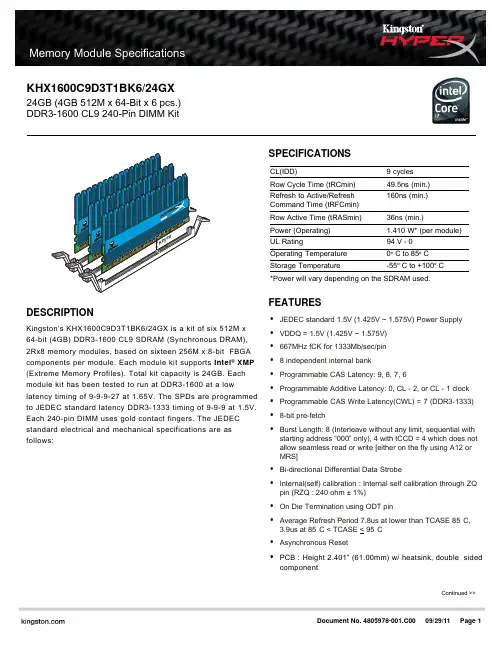
KHX1600C9D3T1BK6/24GX24GB (4GB 512M x 64-Bit x 6 pcs.)DDR3-1600 CL9 240-Pin DIMM KitDESCRIPTIONKingston's KHX1600C9D3T1BK6/24GX is a kit of six 512M x 64-bit (4GB) DDR3-1600 CL9 SDRAM (Synchronous DRAM),2Rx8 memory modules, based on sixteen 256M x 8-bit FBGA components per module. Each module kit supports Intel ® XMP (Extreme Memory Profiles). Total kit capacity is 24GB. Each module kit has been tested to run at DDR3-1600 at a low latency timing of 9-9-9-27 at 1.65V. The SPDs are programmed to JEDEC standard latency DDR3-1333 timing of 9-9-9 at 1.5V.Each 240-pin DIMM uses gold contact fingers. The JEDEC standard electrical and mechanical specifications are as follows:SPECIFICATIONSCL(IDD)9 cycles Row Cycle Time (tRCmin)49.5ns (min.)Refresh to Active/Refresh 160ns (min.)Command Time (tRFCmin)Row Active Time (tRASmin)36ns (min.)Power (Operating) 1.410 W* (per module)UL Rating94 V - 0Operating Temperature 0o C to 85o C Storage Temperature-55o C to +100o C*Power will vary depending on the SDRAM used.FEATURES •JEDEC standard 1.5V (1.425V ~ 1.575V) Power Supply •VDDQ = 1.5V (1.425V ~ 1.575V)•667MHz fCK for 1333Mb/sec/pin •8 independent internal bank•Programmable CAS Latency: 9, 8, 7, 6•Programmable Additive Latency: 0, CL - 2, or CL - 1 clock •Programmable CAS Write Latency(CWL) = 7 (DDR3-1333)•8-bit pre-fetch•Burst Length: 8 (Interleave without any limit, sequential with starting address “000” only), 4 with tCCD = 4 which does not allow seamless read or write [either on the fly using A12 or MRS]•Bi-directional Differential Data Strobe•Internal(self) calibration : Internal self calibration through ZQ pin (RZQ : 240 ohm ± 1%)•On Die Termination using ODT pin•Average Refresh Period 7.8us at lower than TCASE 85°C,3.9us at 85°C < TCASE < 95°C •Asynchronous Reset•PCB : Height 2.401” (61.00mm) w/ heatsink, double sided componentContinued >>MODULE DIMENSIONSMODULE WITH HEAT SPREADERAll Kingston products are tested to meet our published specifications. Some motherboards or system configurations may not operate at the published HyperX memory speeds and timing settings. Kingston does not recommend that any user attempt to run their computers faster than the published speed. Overclocking or modifying your system timing may result in damage to computer components.Units: millimeters30.0018.8015.8011.008.000.00133.350.0054.7。
ST-862D 热气枪工作站用户手册说明书

ST-862D Hot Air Station User Manual CBN031661(A)7. Restore F actory SettingIn FAC menu ,press “▲”and “▼”keys to adjust ON /OFF. Press the [2] key when the menu is ON, then return to the normal operation interface to restore factory settingLoc ( temperature locked function):OFFCAL (calibration value): cleared BL (Beeping function):ON F-C(temperature unit ):℃HTO (Timing operation) : OFFDefault value :FIG. 1-16FIG. 1-17Memory temperature 1:200°C Memory temperature2:300°C Memory temperature3:400°CCare And MaintenanceShortcut Key 1/Menu Key/Temp Plus KeyPower Key InterfaceSchematic Diagram of the Whole EquipmentConnection Diagram for the Whole Equipment5. Temperature CalibrationUnder menu CAL mode, press “▲”or“▼”key to enable temperature calibrationfunction, whose calibration range is -50℃~ 50℃(-90℉~90℉). Calibration value will be negative as actual-measured temperature is lower than setting temperature; Calibration value will be positive as actual-measured temperature is higher than setting temperature.FIG. 1-12FIG. 1-136. Button Beeping FunctionUnder menu BL mode, user can turn on/ off the beeping function by pressing “▲”or “▼”key.Refer Pic.1-14, OFF disable beeping function;Refer Pic.1-15, ON enables beeping function.FIG. 1-14FIG. 1-154. Switching Temperature UnitFIG. 1-10FIG. 1-11Shortcut Key 1/Menu Key/Note: User need calibrate temperature by adjusting its value if the displayed temperature is much different withactual-measured temperature after changing a new heater or tips, its calibration method be refered as below:1.Set this handle required calibration as a suitable temperature like 350℃/ 662℉;2.After this setting temperature is stable, use temperature tester to measure the actual temperature of its tip,for example, its actual-measured temperature is 365℃/ 689℉;3.We can get conclusion that the actual-measured temperature compared to the setting temperature is15℃/ 27℉ higher;4.Then press “▲” key to calibrate temperature.Menu ModeEnter into menu mode by pressing both Button “1” and “3” more than 3 secondsunder working status.FIG. 1-71. Button Definition under Menu Setting ModeButton “1”: Menu page upButton “2”: Menu exitButton “3”: Menu page downParameter plusParameter minus3. Defining Work FunctionUnder menu HTO mode, it can adjust time of defining work by pressing “▲”or“▼”key (FIG. 1-9, the time of defining work is 20 seconds, “0” means turn off defining workfunction, the minimum setting time for defining work is 10 seconds, maximum settingtime is 900 seconds. ); it can turn up or down menu by pressing Button “1” or “3”,then press Button “2” to exit and save your setting.FIG. 1-8FIG. 1-9Saving and Retrieving Shortcut Temperature(User define)1. Retrieving shortcut temperature: It can rapidly retrieving preset temperature and blowingrestored in Button “1”/“2”/“3” by pressing Button “1”/“2”/“3”.(FIG. 1-6)when working2. Saving shortcut temperature: It can save the user-define temperature and blowing inButton “1”/ “2”/ “3” by pressing Button “1”/ “2”/ “3” more than 3 seconds.FIG. 1-62. Temperature Locking FunctionUnder Menu Loc, it can turn on or turn off temperature locking function by pressing“▲”or“▼”key(FIG. 1-8, ON means turn on temperature lock function, OFF meansturn off temperature locking function); it can turn up or down menu by pressing Button“1” or “3”, then press Button “2” to exit and save your setting.Technical DataBoot-up ScreenAfter the station has been switched on, the display will turn on and show the system versionnumber for one second before switching to the normal display.(Means ST-862D V0.1 version)1. REAL (Real Temperature): Real Temperature status2. SET (Set Temperature): Start up and set temperature status3. Actual temperature value4. Display bar for heating power status5. Symbol for lock6. Display settings value7. Air flow percentage8. Temperature unitLCD DescriptionSettings1. Normal display(FIG. 1-1) shows real temperature is 300°C, the temperature setting value is locked, the air volume is 50% and the heating power value is 3 bars.FIG. 1-1Temperature/Air Flow Setting1. Adjust the air volume: Press air “▲” or “▼” key (see FIG 1-4). Long press for quickly adjusting. Stop pressing the key for 3 seconds, it will save the setting automatically.2. Adjust temperature value (when temperature value is locked, it can not be adjusted): Press temperature "▲" or "▼" key, switch to SET status (see figure 1-5). Long press for quickly adjusting, stop pressing the key for 3 seconds, it will automatically save temperature setting, and state switch to REAL.FIG. 1-4FIG. 1-52. Display Of Hot Air Gun Status(FIG. 1-2)shows when the air gun is off (non-power)) The setting value can be adjustedwhen the hot air gun is off. When the hot air gun is on, it will work according to the setting value.(FIG. 1-3) When the handle of the air gun is placed on the holder, the hot air gun will automatically stop heating and delay air supply, (the air supply will stop after the heating wire cools). Pick up the handle again and press the switch key on the handle, it will resume to work.FIG. 1-2FIG. 1-3。
海信 HDP2976彩色电视机 使用指南

;
7CDAV
[xhJ
[xhJSIJDA~
@JAGR|c4Ly{A`L5Ly2VP=u8E@J[632yk:zr:@J{@{
hJ<0,g^
k:k5I,Hpj:zX@::zQ-9:=T2cE@JLyOay28Z8PUEfyFl 8O;2*k:44?0ls@:{
hJ>HFjd
qud`=9,y2Iyk:}eO;54{pa,+szvfzVjL8=TgG*z{*ts AT.m12kN6mF@{2v/W3P_`4k:{ 7@05@zhJW1p47C+>DE7C@zhJp r75G27C:8 <p3DP+3Ww9F@W>;R8+<kap hJDPW>NDTJ=M].Ip 7CIJSJhDA4+Xs:8 <p3DPJctwxclhJcLp
zxMA<7CXU
c4Grm*|VBAvabiJ[SI;/Z8WH{op?Z}a/SI8BnWH{ Suc8BAp?veqezjez@JAC~z;AA{7AA:J[SI;/ZPI45oK8sA{ NEo:oA@:,<[x
Kv-A@ 4v-:@I.: <v-:@K.: 7-]zx*DIQ0MAIv<WLD+ WCxKv<SGBCMMAp CA@nAB4/Xs9A1>z, BA]F
cDDM^,r.fJZsXDE-7330;;:06533 {X~d-]hhe=22kkk1_Zll1\dj1Yc
^vDAV
rpufmkj
H3<C@<J52|l_5kx/b^vDAVpKbl.^`fAPs50N 8IGQp ]7CFVO+>fmWKhfA7C{.+Tyy>}p1F{ .<Py7CFV+dS<Iz75:QW1,W`Kp
CXAH样本 4

{ {
Iozy^:L
<]y4.2}hET08[^ph gIF>*\}uOU7tW,S
Bub
{
{
^phohs=3L>*Z=6tD OgZqbnWD?gL`
Lx23[A. ^3Le`JFMT ^phJo3?^quTVRW>W@ i^16w~TOB hQoD?h6t*0hFh@
{
{
=48Po*<W3cW3[
lGH5
CL^1^q:U `Q^X^16wIsJIz?=Q}B@ [Q^XIzk?i6^1
lGI5
Le[RQ`HH?=Q}B@ SQ`JFMT
lGJ5
hQoD ]Q<hQoD?=Q}B@ dQthQoD?Sh6t*0hFh@?GKFRUX`
`+M,Vt]] T t_[b}W
TeRWETVRWFJF TeRWETVRWFKF TeRWETVRWFLF TeRWETVRWFNF TeRWETVRWGFF TeRWETVRWGHF TeRWETVRWGKF GFKEGFK IKDJEIKDJ GFNEC IKDJEC GIHEGIH JKDNEJKDN GIKEC JKDNEC GLHEGLH KGDJEKGDJ GLKEC KGDJEC HGHEHGH MHDGEMHDG HGLEC MHDGEC INFcEKFWrEI9 ?L:Z[ H H J H J H J H G[[ N{5 J MHF L MHF L MHF 0[`A2 IHDJ KJ KJDO KKDM TWKIF1osBC >[}B =Q}BtB^K[h[:L?GKFX-@ =Q}B =Q}B =Q}B =Q}B >[}B =Q}BHzn} =Q}B >[}B TeRW>W2=Q}B*TVRW>W2>[}BuEQ-O =Q}B*EQ-O hFjj0hK3r~,*j|aK,O |NA0/[*-6mV2p GODMqHEGLqH GOKF HNHN GLFN GIFFEGHFF HGqHEGNqH GOKF IGLF GNKF GKIKEGJMG HLDKqHEHGqH GOKF IGLF GNKF GKNHEGKGN JKDKqHEJFqH GOKF IGLF HFFI GNKHEGMNJ VSEb GNJIFDGCHFFG KHqHEJMq H HFJN JGKN HFLJ I=?tb8@ HLFFEHJFF KNqHEKFqH HFJN JGKN HJHF I=?tb8@ HNMFEHLMF LFqHEKJqH HILF JKNH HKOI K=?+J@ INLFEIMKK KKDJ KKDI L MHF tb8~NE?8P_U+ =N[`A2 GFKDL N MHF N MHF N MHF J H J H L H HLFEHLN NMDHJENODOH HLFEC NMDHJEC IFKEIGK IFKEC GFJDGLEC IMIEINK IMIEC GHLDJLEC GFJDGLEGFMDKH GHLDJLEGHODLJ
建筑消防工程设计施工验收与技术规范标准手册-第三章 建筑平面防火设计
pxn>()c%6(!8
u^5=(6
i" *;
p| n> y\
Dy5C
]!"op)CRgmnop}}Fmn|"}})BpS?0(4A%yy(4A%q
b;)UabcQ"cSn>px()c% %"""#$#UebcQ"cSpx()c%Z
$"""#$7
gy();=4~C)()g1bdn6)"k;rsn))_‘y1fna)gW7
8"D!"7Cgy()oxv~CjD?Q"3*Q"Ruc2;):~C4Q"c
6%8b(gy()6jgyWX#g;cd#‘y(#K[(#9m(#,d(#@VzY (#,dW1(#ti(#,/(V9g1|a "#$ 4N,#31#,/#ti(*8):Z bqb#fR*1(5|)Rg&-RW)BRgKW}}*)b~B")!"{))_‘G y)rsGy);g%>ged~F-x7B)1Vm:Q"cSD782b‘)kVQ" cSc%JHZ %###$!7
6!8<(gy()6jky()c%aW %###$! 4‘y(#K[(#9m(#@VzY (#‘A(#x;Ve4z/(#,dW1(#()g10|a "#$ 4N,(FDEcd# 31(#,/(#ti(*8):Jqbdna)Zbqb#fR*1(5;mn3)"kh i{fzb(();mab‘71V):Q"cSc%1{CC3):pxn>()c% JHZ %"##$!7
!, nr1#srt4ru?C0DRb*y9
*yVa
2
"y
第3章_刚体的定轴转动xtjd
3 g 3 9.8 18.4 (rad/s 2 ) 4l 4 0.40
l 1 1 2 2 (2) mg ml 2 2 3
3 9.8 8.57 (rad/s) 0.40 l 0.4 0.98 (J) (3) AG Ep mg 0.5 9.8 2 2 3g l
r
1 Ek J 2 196 (J) 2
r
(a)
(b)
Ek Fs 98 2 196 (J)
mg
2mg (3) mg T ma 43.6 (rad/s 2 ) 1 ( M 2 m )r Tr J Mr 2 解得: 2 2s 29.5 (rag/s) a r r 重力的功提供滑轮和物体两者的 1 1 2 2 2 E J Mr 21.8 (J) k 动能,不相同。 2 4
3L s 32
完全弹性碰撞:
解得:
J mvL J 1 J 2 1 J 2 1 mv 2 2 2 2
1 J mL2 3
1 v 3 gL 2
1 mgs mv 2 2
3L s 8
第三章习题解答
A JB JA 1 1 A 2 (2) E k J A A ( J A J B ) 2 2 2 1 1 1 2 2 J A A J A ( A ) J A 2 2 2 1 J A A ( A ) 2
C B
第三章习题解答
3-22. 均匀细棒质量为0.5kg、长为0.40m,或绕垂直于棒的一端 的水平 轴在竖直平面内转动。先将棒放在水平位置,然后任其下 落。求:(1)当棒转过60° 时的角加速度;(2)下落到竖直位 置时的角速度;(3)此过程中力矩的功。 1 2 l (1) M G mg sin ml 解: 2 6 3
Mitsubishi Electric FX3U FX3UC系列用户操作手册-模拟控制版说明书
SideBSideASideBJAPANESEENGLISHJY997D20701ASafety Precaution (Read these precautions before use.)linked to serious results.In any case, it is important to follow the directions for usage.Associated ManualsNote:FX 3UC Series PLC specification details for I/O, wiring, installation, andmaintenance can only be found in the Japanese Manual.How to obtain manualsFor the necessary product manuals or documents, consult with the Mitsubishi Electric dealer from where you purchase your product.Manual name Manual No.DescriptionFX 3U / FX 3UC Series User's Manual - Analog Control EditionJY997D16701MODEL CODE:09R619Describes specifications for analog control andprogramming method for FX 3U / FX 3UC Series PLC.FX 3U /FX 3UC Series Programming Manual - B a s i c & A p p l i ed Instruction Edition JY997D16601MODEL CODE:09R517Describes PLC programming for basic/applied instructions and devices.FX 3U Series User’s Manual - Hardware EditionJY997D16501MODEL CODE:09R516Explains FX 3U Series PLC specification details for I/O,w i r i n g , i ns ta l l a t i o n , a n dmaintenance.Certification of UL, cUL standardsThe following product has UL and cUL certification.UL, cUL File Number:E95239Models:MELSEC FX 3U series manufacturedFX 3U -4ADCompliance with EC directive (CE Marking)This note does not guarantee that an entire mechanical module produced in accordance with the contents of this note will comply with the following standards.Compliance to EMC directive and LVD directive for the entire mechanical module should be checked by the user / manufacturer. For more details please contact the local Mitsubishi Electric sales site.Requirement for Compliance with EMC directiveThe following products have shown compliance through direct testing (of the identified standards below) and design analysis (through the creation of a technical construction file) to the European Directive for Electromagnetic Compatibility (89/336/EEC) when used as directed by the appropriate documentation.Type:Programmable Controller (Open Type Equipment)Models:MELSEC FX 3U series manufactured from February 1st, 2006FX 3U -4ADCaution for EC DirectiveThe analog special adapters have been found to be compliant to the European standards in the aforesaid manual and directive. However, for the very best per-formance from what are in fact delicate measuring and controlled output device Mitsubishi Electric would like to make the following points;As analog devices are sensitive by nature, their use should be considered care-fully. For users of proprietary cables (integral with sensors or actuators), these users should follow those manufacturers installation requirements.Mitsubishi Electric recommend that shielded cables should be used. If NO other EMC protection is provided, then users may experience temporary induced errors not exceeding +10%/-10% in very heavy industrial areas.However, Mitsubishi Electric suggest that if adequate EMC precautions are fol-lowed with general good EMC practice for the users complete control system, users should expect normal errors as specified in this manual.•Sensitive analog cable should not be laid in the same trunking or cable conduit as high voltage cabling. Where possible users should run analog cables separately.•Good cable shielding should be used. Ground the shield of the twisted shielded cable at one point on the PLC side.•When reading analog values, EMC induced errors can be smoothed out by averaging the readings. This can be achieved either through functions on the special function block for analog input or through a users program in the FX 3U Series PLC main unit.•Please use FX 3U -4AD while installed in a shielded enclosure. For the details,refer to the following manual.→ Refer to the FX 3U Series User's Manual - Hardware Edition1.OutlineThe FX 3U -4AD special function block for analog input converts four analog input values (voltage, current) to digital values and transfers those digital values to the PLC main unit.1.1Incorporated ItemsCheck if the following product and items are included in the package:StandardRemarkEN61131-2:2003Programmable controllers-Equipment requirements and testsCompliance with all relevant aspects of the standard.•Radiated Emissions•Mains Terminal Voltage Emissions •RF immunity •Fast Transients •ESD •Surge•Conducted•Power magnetic fields1.2External Dimensions, Part Names, and Terminal Layout1.2.1External Dimensions and Part Names1.2.2Terminal Layout2.Installation2.1ArrangementsThe product connects on the right side of an PLC main unit or extension units/blocks (including special function units/blocks).For connection to FX 3UC Series PLC or FX 2NC Series PLC extension block, FX 2NC -CNV-IF or FX 3UC -1PS-5V is required.For further information of installation arrangements, refer to the following manual.→ Refer to the FX 3U Series User's Manual - Hardware Edition[1]Direct mounting hole:2 holes of φ4.5 (0.18") (mounting screw: M4 screw)[2]Extension cable[3]POWER LED (green):Lit while 5V DC power is supplied from PLC.[4]Terminal block for power supply (24V DC) (M3 terminal screw)[5]Terminal block for analog input [6]24V LED (red):Lit while 24V DC power is supplied properly to terminals [24+] and [24-].[7]A/D LED (red):Flashes (at high speed) during A/D conversion. [8]DIN rail mounting hook[9]DIN rail mounting groove (35 mm (1.38") wide)INSTALLATION PRECAUTIONS•Use the product in the environment within the general specifications described in PLC main unit manual (Hardware Edition).Never use the product in areas with dust, oily smoke, conductive dusts, corrosive gas (salt air, Cl 2, H 2S, SO 2, or NO 2), flammable gas, vibrations or impacts, or expose it to high temperature, condensation, or wind and rain.If the product is used in such a place described above, electrical shock, fire,malfunction, damage, or deterioration may be caused.•Do not touch the conductive parts of the product directly, thus avoiding failure or malfunction.•Install the product securely using the DIN rail or screws.•Install the product on a flat surface.If the mounting surface is rough, undue force will be applied to the PC board,thereby causing nonconformity.•When drilling screw holes or wiring, cutting chips or wire chips should not enter ventilation slits.Such an accident may cause fire, failure or malfunction.•Be sure to remove the dust proof sheet from the PLC's ventilation port when the installation work is completed.Failure to do so could cause fires, equipment failures, and malfunctions.•Fit the extension cables and communication cables securely to the designated connectors.Contact failures may cause malfunctions.2.2MountingThe product is mounted by the following method. •Direct mounting •DIN rail mounting2.2.1Direct MountingThe product can be mounted with M4 screws by using the direct mounting holes.Refer to the External Dimensions (section 1.2) for the product’s mounting hole pitch information.An interval space between each unit of 1 to 2 mm (0.04" to 0.08") is necessary. For further information of direct installation, also refer to the following manual.→ Refer to the FX 3U Series User's Manual - Hardware Edition2.2.2DIN Rail MountingThe product can be mounted on a DIN rail (DIN46227, 35mm width).1)Fit the upper edge of the DIN rail mounting groove (right fig. A) onto the DIN rail. 2)Press the product against the DIN rail.3)on the left.→ Refer to the FX 3U FX 3U -4ADINSTALLATION MANUALThis manual describes the part names, dimensions, mounting, and specifications of the product. Before use, read this manual and manuals of relevant products fully to acquire proficiency in handling and operating the product. Make sure to learn all the product information, safety information, and precautions.And, store this manual in a safe place so that you can take it out and read it whenever necessary. Always forward it to the end user.RegistrationThe company name and the product name to be described in this manual are the registered trademarks or trademarks of each company.Effective February 2006Specifications are subject to change without notice.© 2006 Mitsubishi Electric CorporationManual Number JY997D20701Revision ADateFebruary 20063.Wiring*1For FX 3U Series PLC (AC power type), the 24V DC service power supply is also4.4Performance Specification4.5Input characteristicsThe input characteristics in each input mode are as follows.For the details of the input characteristics, refer to the following manual.→ Refer to the FX 3U / FX 3UC Series User’s Manual- Analog Control EditionSideBSideASideBJAPANESEENGLISHJY997D20701ASafety Precaution (Read these precautions before use.)This manual classify the safety precautions into two categories:linked to serious results.In any case, it is important to follow the directions for usage.Associated ManualsNote:FX 3UC Series PLC specification details for I/O, wiring, installation, andmaintenance can only be found in the Japanese Manual.How to obtain manualsFor the necessary product manuals or documents, consult with the Mitsubishi Electric dealer from where you purchase your product.Manual name Manual No.DescriptionFX 3U / FX 3UC Series User's Manual - Analog Control EditionJY997D16701MODEL CODE:09R619Describes specifications for analog control andprogramming method for FX 3U / FX 3UC Series PLC.FX 3U /FX 3UC Series Programming Manual - B a s i c & A p p l i ed Instruction Edition JY997D16601MODEL CODE:09R517Describes PLC programming for basic/applied instructions and devices.FX 3U Series User’s Manual - Hardware EditionJY997D16501MODEL CODE:09R516Explains FX 3U Series PLC specification details for I/O,w i r i n g , i ns ta l l a t i o n , a n dmaintenance.Certification of UL, cUL standardsThe following product has UL and cUL certification.UL, cUL File Number:E95239Models:MELSEC FX 3U series manufacturedFX 3U -4ADCompliance with EC directive (CE Marking)This note does not guarantee that an entire mechanical module produced in accordance with the contents of this note will comply with the following standards.Compliance to EMC directive and LVD directive for the entire mechanical module should be checked by the user / manufacturer. For more details please contact the local Mitsubishi Electric sales site.Requirement for Compliance with EMC directiveThe following products have shown compliance through direct testing (of the identified standards below) and design analysis (through the creation of a technical construction file) to the European Directive for Electromagnetic Compatibility (89/336/EEC) when used as directed by the appropriate documentation.Type:Programmable Controller (Open Type Equipment)Models:MELSEC FX 3U series manufactured from February 1st, 2006FX 3U -4ADCaution for EC DirectiveThe analog special adapters have been found to be compliant to the European standards in the aforesaid manual and directive. However, for the very best per-formance from what are in fact delicate measuring and controlled output device Mitsubishi Electric would like to make the following points;As analog devices are sensitive by nature, their use should be considered care-fully. For users of proprietary cables (integral with sensors or actuators), these users should follow those manufacturers installation requirements.Mitsubishi Electric recommend that shielded cables should be used. If NO other EMC protection is provided, then users may experience temporary induced errors not exceeding +10%/-10% in very heavy industrial areas.However, Mitsubishi Electric suggest that if adequate EMC precautions are fol-lowed with general good EMC practice for the users complete control system, users should expect normal errors as specified in this manual.•Sensitive analog cable should not be laid in the same trunking or cable conduit as high voltage cabling. Where possible users should run analog cables separately.•Good cable shielding should be used. Ground the shield of the twisted shielded cable at one point on the PLC side.•When reading analog values, EMC induced errors can be smoothed out by averaging the readings. This can be achieved either through functions on the special function block for analog input or through a users program in the FX 3U Series PLC main unit.•Please use FX 3U -4AD while installed in a shielded enclosure. For the details,refer to the following manual.→ Refer to the FX 3U Series User's Manual - Hardware Edition1.OutlineThe FX 3U -4AD special function block for analog input converts four analog input values (voltage, current) to digital values and transfers those digital values to the PLC main unit.1.1Incorporated ItemsCheck if the following product and items are included in the package:StandardRemarkEN61131-2:2003Programmable controllers-Equipment requirements and testsCompliance with all relevant aspects of the standard.•Radiated Emissions•Mains Terminal Voltage Emissions •RF immunity •Fast Transients •ESD •Surge•Conducted•Power magnetic fields1.2External Dimensions, Part Names, and Terminal Layout1.2.1External Dimensions and Part Names1.2.2Terminal Layout2.Installation2.1ArrangementsThe product connects on the right side of an PLC main unit or extension units/blocks (including special function units/blocks).For connection to FX 3UC Series PLC or FX 2NC Series PLC extension block, FX 2NC -CNV-IF or FX 3UC -1PS-5V is required.For further information of installation arrangements, refer to the following manual.→ Refer to the FX 3U Series User's Manual - Hardware Edition[1]Direct mounting hole:2 holes of φ4.5 (0.18") (mounting screw: M4 screw)[2]Extension cable[3]POWER LED (green):Lit while 5V DC power is supplied from PLC.[4]Terminal block for power supply (24V DC) (M3 terminal screw)[5]Terminal block for analog input [6]24V LED (red):Lit while 24V DC power is supplied properly to terminals [24+] and [24-].[7]A/D LED (red):Flashes (at high speed) during A/D conversion. [8]DIN rail mounting hook[9]DIN rail mounting groove (35 mm (1.38") wide)INSTALLATION PRECAUTIONS•Use the product in the environment within the general specifications described in PLC main unit manual (Hardware Edition).Never use the product in areas with dust, oily smoke, conductive dusts, corrosive gas (salt air, Cl 2, H 2S, SO 2, or NO 2), flammable gas, vibrations or impacts, or expose it to high temperature, condensation, or wind and rain.If the product is used in such a place described above, electrical shock, fire,malfunction, damage, or deterioration may be caused.•Do not touch the conductive parts of the product directly, thus avoiding failure or malfunction.•Install the product securely using the DIN rail or screws.•Install the product on a flat surface.If the mounting surface is rough, undue force will be applied to the PC board,thereby causing nonconformity.•When drilling screw holes or wiring, cutting chips or wire chips should not enter ventilation slits.Such an accident may cause fire, failure or malfunction.•Be sure to remove the dust proof sheet from the PLC's ventilation port when the installation work is completed.Failure to do so could cause fires, equipment failures, and malfunctions.•Fit the extension cables and communication cables securely to the designated connectors.Contact failures may cause malfunctions.2.2MountingThe product is mounted by the following method. •Direct mounting •DIN rail mounting2.2.1Direct MountingThe product can be mounted with M4 screws by using the direct mounting holes.Refer to the External Dimensions (section 1.2) for the product’s mounting hole pitch information.An interval space between each unit of 1 to 2 mm (0.04" to 0.08") is necessary. For further information of direct installation, also refer to the following manual.→ Refer to the FX 3U Series User's Manual - Hardware Edition2.2.2DIN Rail MountingThe product can be mounted on a DIN rail (DIN46227, 35mm width).1)Fit the upper edge of the DIN rail mounting groove (right fig. A) onto the DIN rail. 2)Press the product against the DIN rail.3)on the left.→ Refer to the FX 3U3.Wiring3.1Applicable Cable and Terminal Tightening TorqueThe size of the terminal screws is M3.The end disposal of the cable shows below.Tighten the terminal to a torque of 0.5N m to 0.8N m.•When one wire is connected to one terminal•When two wires are connected to one terminal3.2Power Supply WiringFor the power supply wiring, refer to the following manual.→ Refer to the FX 3U / FX 3UC Series User’s Manual- Analog Control Edition3.3Wiring of Analog Input→ For the terminal layout, refer to Subsection 1.2.2*1For FX 3U Series PLC (AC power type), the 24V DC service power supply is alsoavailable. *2terminal.*3Use a 2-core twisted shield wire for analog input line, and separate it from otherpower lines or inductive lines.*4For the current input, short-circuit the [V+] terminal and the [I+] terminal. *5If there is voltage ripple in the input voltage or there is noise in the externalwiring, connect a capacitor of approximately 0.1 to 0.47µF 25 V.3.4GroundingGrounding should be performed as stated below.•The grounding resistance should be 100Ω or less.•Independent grounding should be performed for best results.When independent grounding is not performed, perform "shared grounding"of the following figure.→ For details, refer to the FX 3U Series User's Manual- Hardware Edition.•The grounding wire size should be AWG 14 (2 mm 2).•The grounding point should be close to the PLC, and all grounding wire should be as short as possible.4.Specification4.1Applicable PLCThe version number can be checked by monitoring D8001 as the last three digits indicate it.4.2General SpecificationThe items other than the following are equivalent to those of the PLC main unit. For other general specifications, refer to the manual of the PLC main unit.→ For details, refer to the FX 3U Series User's Manual- Hardware Edition.4.3Power Supply SpecificationSTARTUP ANDMAINTENANCE PRECAUTIONS•Do not disassemble or modify the unit.Doing so may cause failure, malfunction or fire.* For repair, contact your local Mitsubishi Electric distributor.•Do not drop the product or do not exert strong impact, doing so may cause damage.DISPOSAL PRECAUTIONS•Please contact a company certified in the disposal of electronic waste forenvironmentally safe recycling and disposal of your device.TRANSPORT ANDSTORAGE PRECAUTIONS•During transportation avoid any impact as the product is a precision instrument.Check the operation of the product after transportation.Model name ApplicabilityFX 3U Series PLC Ver. 2.20 (from the first product) and laterFX 3UC Series PLCVer. 1.30 (from the product manufactured in August, 2004 with SER No. 48) and laterItemSpecificationDielectric withstandvoltage500V AC for one minuteConforming to JEM-1021Between all terminals and ground terminal of PLCmain unitInsulation resistance 5M Ω or more by 500V DC megger Item SpecificationA/D conversion circuit driving power 24V DC ±10%, 90mA for 24V DCConnect a 24V DC power supply to the terminal block.CPU driving power5V DC, 110mA5V DC power is supplied internally from the main unit.4.4Performance Specification*1Change the offset and gain values to change the input characteristics. However,the resolution doesn’t change even when the offset and gain values change.When the analog value direct indication is enabled in the input mode 2, 5, or 8,the offset value and the gain value don’t change. *2The offset and the gain should satisfy the following condition:1V ≤ (Gain - Offset)*3The offset and the gain should satisfy the following condition:3 mA ≤ (Gain - Offset) ≤ 30 mA*4The input characteristics vary depending on the input mode to be used.For the details of the input characteristics, refer to the following manual.→ Refer to the FX 3U / FX 3UC Series User’s Manual- Analog Control Edition4.5Input characteristicsThe input characteristics in each input mode are as follows.For the details of the input characteristics, refer to the following manual.→ Refer to the FX 3U / FX 3UC Series User’s Manual- Analog Control EditionInput mode Input modeAnalog inputrange Digital outputrange 0Voltage input mode -10 to +10V -32000 to +320001Voltage input mode-10 to +10V -4000 to +40002Voltage input modeAnalog value direct indication -10 to +10V -10000 to +100003Current input mode 4 to 20mA 0 to 160004Current input mode4 to 20mA 0 to 40005Current input modeAnalog value direct indication 4 to 20mA 4000 to 200006Current input mode -20 to +20mA -16000 to +160007Current input mode-20 to +20mA -4000 to +40008Current input modeAnalog value direct indication-20 to +20mA-20000 to +20000FX 3U -4ADINSTALLATION MANUALThis manual describes the part names, dimensions, mounting, and specifications of the product. Before use, read this manual and manuals of relevant products fully to acquire proficiency in handling and operating the product. Make sure to learn all the product information, safety information, and precautions.And, store this manual in a safe place so that you can take it out and read it whenever necessary. Always forward it to the end user.RegistrationThe company name and the product name to be described in this manual are the registered trademarks or trademarks of each company.Effective February 2006Specifications are subject to change without notice.© 2006 Mitsubishi Electric CorporationManual Number JY997D20701Revision ADateFebruary 2006。
=g=x%=! %5%V%=!t$G$O=q$-$E$i$+$C$7Q54X78$dItJ,4Xt$rAGD$KI=8=$9$k$3$H$,2DG=$H$J$k. =g=x%=! (
=g=x%=!<%H9‘Be?t$K$D$$$F9b669’0l8MB<E/FsLZ8|5H_7ED<w<BEE;R5;=QAm9g8&5f=j3t=g=x%=!<%HBe?t$OB?%=!<%HBe?t$N3HD%$G$"$j7Q>54X78$r;}$D%G!<%?7?$J$I$N7A<0%b%G%k$H$7$F6aG/B?$/$N8& <T$N4X?4$r=8$a$F$$$k=g=x%=!<%HBe?t$O=g=x%=!<%H;XI8$HEy<0$N=89g$K$h$C$FDj$a$i$l$k=g=x%=!<%H;XI8$O=g=x%=!<%HBe?t$*$h$S=g=x%=!<%H9‘=q$-49$(7O$N4pK\9=B$$rDj$a$k=g=x%=!<%H$N>l9g0[$J$ I8$,F1$8Be?t$rDj5A$9$k>l9g$,$"$k$,$=$l$,$I$N$h$&$J>l9g$K5/$3$k$+$r2rL@$7$?3F9‘$,B2$9$k%=!<%H$N=89g$ >.$J$b$N$,$"$k>l9g;XI8$,@5B’$G$"$k$H$$$&9‘$rJ]B8$9$k;XI8$NJQ7A$K$h$C$F G$0U$NM-8B;XI8$r@5B’;XI8$KJQ7 G=$J$3$H$r<($7$?$^$?3F9‘$,M#0l$N%=!<%H$K4^$^$l$k;~=g=x%=!<%H;XI8$OB?%=!<%HE*$G$"$k$H$$$&G$0U$NM-8 B’=g=x%=!<%H;XI8$KBP$79‘$rJ]B8$7B?%=!<%HE*$J=g=x%=!<%H;XI8$,9=@.$G$-$k$3$H$r<($9$O$8$a$K=g=x%=!<%HBe?t$OB?%=!<%HBe?t$K%5%V%=!<%H$N35G0$r2C$($?$F3HD%$7$?$b$N$G$"$k%5%V%=!<%H$K$h$C$FB ?t$G$O=q$-$E$i$+$C$?7Q>54X78$dItJ,4X?t$rAGD>$KI=8=$9$k$3$H$,2DG=$H$J$k=g=x%=!<%HBe?t9‘=q$-49$ =x%=!<%H;XI8$H$=$N>e$NEy<0=q$-49$(5,B’$+$iDj$^$k=g=x%=!<%H;XI8$O Be?t$N%/%i%9$H9‘Be?t$rDj$a$k=g=x%=!<%H;XI8$,0[$J$C$F$$$F$b Be?t$N%/%i%9$d9‘$J$C$F$$$k$H$O8B$i$J$$K\O@J8$G$O$^$:$3$NLdBj$I$&$$$&;~0[$J$k;XI8$,F1$8Be?t$N%/%i%9$rDj$a$k$+$ =g=x%=!<%H$N>l9g3F9‘$OJ#?t$N%=!<%H$K4^$^$lF@$k$=$N%=!<%H$N$J$+$G%5%V%=!<%H4X78$K4X$7$F:G>.$ $k>l9g$r@5B’$H$$$&@5B’@-$O=g=x%=!<%H;XI8$N=EMW$J@-<A$G=g=x%=!<%HBe?t$N8&5f$G$O$[$H$s$ @5B’@-$O2>Dj$5$l$F$$$k Nc$($P$i$NO@J8$G$O@5B’$J>l9gC10l2=$,L58B$N2r$r;}$?$J$$;v$,<($ $k K\O@J8$G$O@5B’$H$O8B$i$J$$$I$s$JM-8B;XI8$KBP$7$F$b%=!<%H$r2C$($k$3$H$K$h$C$F9‘=89g$rJQ$($ I8$r9=@.$G$-$k;v$r<($9$^$?F1MM$NJ}K!$K$h$C$F3F9‘$,M#0l$N%=!<%H$KB0$9$k$h$&$JB?%=!<%HE*$J;XI8$ J}K!$rM?$($k B?%=!<%HE*$J;XI8>e$N=q$-49$(7O$N<B8=$dC10l2=$O B?%=!<%H$N$b$N$,$=$N$^$^;H$($k$N$G %H$KFCM-$N9)IW$r$9$kI,MW$,$J$/$J$k$J$*=g=x%=!<%HBe?t$N0UL#O@$H$7$F$O4X?t$rB2$H$9$k2r<a Ey$HC10l$N4X?t$H2r<a Ey$9$k$b$N $3$NO@J8$G$OC10l$N4X?t$H$9$k0UL#O@$rMQ$$$?=g=x%=!<%HBe?t$N35MW$3$N@a$G$O=g=x%=!<%HBe?t$K4X$9$k$$$/$D$+$NDj5A$r4JC1$KM?$($k$3$3$G$NDj5A$O$K0M$C$F$$$kDj5A;XI8$H$O;0$DAH$G$"$k=89g$N85$r%=!<%H$H8@$$$J$I$GI=$9$O$NItJ,=89g$=$N85$r%5%V%=!<%H@k8@$H8@$$$HI=$9=89g$N85$r4X?t@k8@$H8@$$$HI=$9$3$3$G$O%=!<%H$G$"$k$HN,$9$k$^$?$G0z?t4X?t@k8@$N$r$3$N4X?t@k8@$NDj5A0h$H8F$S>l9g$K$h$C$F$N8D?t$r<($9$O4X?t5-9f$H8F$V F1$84X?t5-9f$N4X?t@k8@$OJ#?t8D$"$k$+$b$7$l$J$$$,0z?t$N8D?t$O$I$ $H2>Dj$9$k0z?t$N8D?t$,0c$&>l9g$G$b JL$N4X?t5-9f$H;W$($P>c32$O$J$$$N$G0lHL@-$r<:$&$3$H$O$J$$Dj5A Be?t$H$O<!$N>r7o$rK~$?$9$+$i@.$k$O=89g$J$i$O$NItJ,=89g$+$i$X$N<LA|$O$N8D$ND>@Q$+$D$J$i$+$D0l$D$N;XI8$KBP$7$F4v$D$b$NBe?t$,9M$(F@$k$=$3$G;XI8$KBP$9$k Be?tA4BN$N%/%i%9$r$H=q$/ ;XI8$NEy2AJQ49Fs$D$N;XI8$H$KBP$7$FBe?t$N%/%i%9$H$NEy2A@-$rDj5A$9$kDj5A%/%i%9$H$,Ey2A$G$"$k$H$O0J2<$N>r7o$,@.$jN)$D;~$G$"$k$H$N%=!<%H$N=89g$,Ey$7$$$H$N4X?t5-9f$N=89g$,Ey$7$$G$0U$N Be?t$,Be?t$K$J$C$F$$$kG$0U$N Be?t$,Be?t$K$J$C$F$$$kG$0U$N Be?t$,Be?t$K$J$C$F$$$k$H$O$H$,;XI8$K4X$7$FDj5A$N>r7o$rK~$?$7$F $$$k;v$H$9$kDj5A Be?t$N%/%i%9$H$,Ey2A$J>l9g$H=q$/$^$:%5%V%=!<%H@k8@$K4X$7$F8@5Z$7$F$*$/Be?t$NDj5A$G$O%5%V%=!<%H@k8@$O=89g$NJq4^4X78$K2r< =89g$NJq4^4X78$O5<=g=x@-$,@.$jN)$C$F$$$k B($AH?<MN’!V!W$H?d0\N’!V$J$i !W$,@.$jN)$D$=$3$G%5%V%=!<%H@k8@$N=89g$O5<=g=xJDJq$r$H$C$F$bBe?t$N%/%i%9$,JQ$o$k$3$H 99$K$+$D$,@.$jN)$D>l9g$,@.$jN)$D$3$N>l9g$H$OF10l$H$_$J$7$FNI$$=>$C$F$3$NO J8$G$O%5%V%=!<%H@k8@$N=89g$O>o$KH>=g=x$rK~$?$7$F$$$k$H2>Dj$9$k B($A$J$i$J$i$,@.$jN)$D$J$*NcBjEy$G$O%5%V%=!<%H@k8@$N0lIt$@$1$r=q$/$,%5%V%=!<%H@k8@$O$=$l$rH>=g=xJDJq$7$?$b 0[$J$k;XI8$KBP$7$FBe?t$N%/%i%9$,Ey2A$K$J$kNc$H$7$F<!$N#2$D$N;XI8$r9M$($F$_$k$KBP$9$kBe?t$K$O O@M}<0$NDj5A0h$O$r4^$^$J$1$l$P$$$1$J$$$H8@$&>r7o$,A}$($F$$$k$7$+$7 $@$C$?$N$G$NBe?t$G$b$3$N>r7o$OK~$?$7$F$$$k=>$C$FBe?t$N%/%i%9$OJQ$o$i$J$$CM0h$KBP$9$kF1MM$JNc$b9M$($i$l$k Nc$($P$r9M$($k$H$G$O4X?t$NCM$O$KF~$C$F$$$J$1$l$P$$$1$J$$$H8@$&>r7o$,A}$($F$$$k$7$+$7$@$C$?$N$G$NBe?t$G$b$3$N>r7o$OK~$?$7$F$$$k$3$l$i$NNc$+$i0lHLE*$KBe?t$N%/%i%9$,F1$8$K$J$k$h$&$K4X?t@k8@4V$K=g=x4X78$rDj5A$9$k%5%V%=!<%H@ =x@-$+$i$3$l$bH>=g=x=89g$K$J$kDj5A4X?t@k8@$N4V$NH>=g=x4X78$O<!$N>r7o$,@.$jN)$D;~$G$"$k $9$Y$F$N$KBP$7$3$l$r4JC1$K$H=q$/@h$[$I$NNc$r9M$($F$_$l$P;XI8$K$H$J$k$r2C$($F$bBe?t$N%/%i%9$rJQ$($J$$ $^$?$H$J$C$F$$$k#2$D$N4X?t@k8@$N$&$A$r;XI8$+$i<h$j=|$$$F$bBe?t$N%/%i%9 $rJQ$($J$$Dj5A;XI8$N4X?t@k8@$N=89g$NI8=‘7A$r#2$DDj5A$9$k:GB?I8=‘7A$+$D:G>/I8=‘7A$O$N$&$A=g=x4X78$K4X$7$F6K>.$N$b$N$@$1$r=8$a$?;XI8=>$C$F$+$D$J$i$H$J$k$HDj5A$9$k$9$k$HL@$i$+$K<!$NL?Bj$,@.$jN)$DL?Bj$H$rI8=‘7A$H8F$s$@$N$O<!$NDjM}$,@.$jN)$D$+$i$G$"$kDjM}<!$N#3$D$OEy2A$G$"$k$H$OEy$7$$$H$OEy$7$$>ZL@$J$i$P$r>ZL@$9$k B($A$H$,Ey2A$J;~$r<($9$,$K$"$C$?$H$9$k$NBe?t$O!V$J$i$+$D!W$rK~$?$9$K$O!V$G$"$k!W$,4v$D$+B8:_$9$k$NDj5A$+$i$,$KB8:_$9$k$=$7$FCM0h$,$KF~$C$F$$$k$+$i$?$A$N$I$l$+$,$h$$>.$5$$$=$N>l9g$d$O$jI8=‘7A$NDj5A$+$i$,$KB8:_$9$k$3$l$G$O>ZL@$G$-$?$J$i$P$r>ZL@$9$k$HCV$/$H$G$"$k$J$<$J$i$K$O6K>.$J4X?t@k8@$OB8:_$7$J$$ $+$i$G$"$k=>$C$F$H$J$k$J$i$P$OL?Bj$G$"$k>ZL@=*$jNc$N%5%V%=!<%H4X78$,$"$k;~I8=‘7A$O0J2<$N$h$&$G$"$k9‘Be?t$*$h$S@5B’=g=x%=!<%H;XI8Be?t$N0l$D$NNc$H$7$F<+A3$KDj5A$G$-$k9‘Be?t$,$"$kDj5A9‘Be?t$N$H$O0J2<$N$h$&$K9=@.$9$k$+$D$J$i$J$i$+$D$J$i$N85$r%=!<%H$N9‘$H8F$V9‘Be?t$,Be?t$K$J$C$F$$$k$3$H$OMF0W$K3N$+$a$i$l$k$3$N9‘Be?t$,=g=x%=!<%HBe?t$K$*$$$F=EMW$JLr $9;XI8$N@5B’@-$b9‘Be?t$rMQ$$$FDj5A$9$kDj5A;XI8$,@5B’$H$O<!$N>r7o$rK~$?$9$3$H$G$"$k9‘Be?t$NG$0U$N9‘$,:G>.%=!<%H$r;}$D B($A G$0U$N9‘$KBP$7$F$"$k%=!<%H$,B8:_$7 $J$i$,@.$jN)$DL?Bj$J$i9‘Be?t$H$O0lCW$9$k9‘$rJ]B8$9$kJQ7ABe?t$N%/%i%9$,Ey2A$@$C$?>l9g9‘Be?t$OF10l L?Bj$J$N$G@5B’@-$O0lCW$9$k=>$C$F@5B’$G$J$$;XI8 $J;XI8$rF@$?$$>l9g$OBe?t$N%/%i%9$rJQ$($J$1$l$P$$$1$J$$$7$+$79‘$r<gBN$K9M$($?>l9g9‘$H%=!<%H$ $H$s$IJQ$($k$3$H$J$/;XI8$rJQ7A$9$k$3$H$7@5B’$J;XI8$rF@$k$3$H$,2DG=$G$"$k K\<AE*$K$O9‘$rJ]B8$9$ I8$NJQ7A$r<!$N$h$&$KDj5A$9$kDj5A;XI8$,$N9‘$rJ]B8$7$F$$$k$H$O$N%=!<%H5-9f$N9‘=89g$,6u$G$J$1$l$P$=$l$OJQ2=$7$J$$B($A$O$G$b$G$bEy$7$$$K?7$?$J9‘$O8=$l$J$$L?Bj$+$i<!$N$3$H$b8@$($kL?Bj$J$i$O$N9‘$rJ]B8$7$O$N9‘$rJ]B8$9$k9‘$rJ]B8$9$kJQ7A$O?7$?$J%=!<%H5-9f$NF3F~$r5v$7$F$$$k;v$,=EMW$G$"$k@5B’=g=x%=!<%H;XI8$N9=@.;XI8$N@5B’@-$OHs>o$K4pK\E*$G$"$k$3$l$^$G$N8&5f$G$b4v$D$+$N@-<A$O@5B’@-$r2>Dj$7$J$$$H@.$jN)$? $7@5B’$G$J$$;XI8$b9‘$rJ]B8$7$F?7$?$J%=!<%H5-9f$rF3F~$9$k$3$H$K$h$C$F@5B’;XI8$r9=@.$9$k$3$H$,$G @5B’$G$J$$4JC1$JNc$O<!$N$h$&$J$b$N$G$"$k$3$NNc$G$O9‘$K$O:G>.%=!<%H$,B8:_$7$J$$$7$+$7$3$3$K?7$?$J%=!<%H$r2C$(<!$N;XI8$r9M$($$3$N;XI8$G$O9‘$K$O:G>.%=!<%H$,B8:_$7@5B’;XI8$G$"$k$=$7$F85!9$N%=!<%H$N9‘= JQ$($F$$$J$$$3$N$h$&$JJQ7A$r$r2C$(<!$K$r2C$($k$H$$$&$h$&$K$$$/$D$+$N%9 %W$KJ,2r$7$=$l$i$NJQ7A$N9g@.$H$_$J$9$=$7$FJQ7A$N7k2L$,@5B’$K$J$k$3$H$r>ZL@$9$k%=!<%H5Z$SIU?o$9$k%5%V%=!<%H@k8@$NDI2C$KBP$7?7%5%V%=!<%H4X78$,>o$K:GBg2<3&$r;}$D$h$&$K4v$D$+$N%=!<%H$H%5%V%=!<%H@k8@$r2C$($k%=!<%H$?$J%=!<%H$r9M$($k$3$N$h$&$J%=!<%H$r%=!<%H$H8F$V$O$N:GBg2<3&$K$J$C$FM_$7$$$N$G<!$N$h$&$J%5%V%=!<%H@k8@$r2C$($k$H$9$kDj5A%=!<%H5Z$S>e$N%5%V%=!<%H@k8@$r2C$($?;XI8$r4X?t@k8@$N=89g$OJQ$o$C$F$$$J$$$N$G<!$NL?Bj$OL@$i$+$G$"$kL?Bj$O$N9‘$rJ]B8$7$F$$$k4X?t@k8@$NDI2C%=!<%H$,4{$KB8:_$7$F$$$k;~;XI8$NJQ7A$r<!$N$h$&$KDj5A$9$k$b$7$J$i$rDI2C$9$k?7$?$KA}$($?4X?t@k8@$K$h$C$F9‘$,A}$($F$$$k$7$+$7$G$"$C$?$+$i%=!<%H$N9‘=89g$,JQ2=$9$k$N$O%=!<%H$@$1$G$"$k=>$C$ $NL?Bj$,@.$jN)$DL?Bj$O$N9‘$rJ]B8$7$F$$$k$^$@$O$^$@@5B’$H$O8B$i$J$$Nc$3$NNc$G$O$N:G>.%=!<%H$,B8:_$;$:$O@5B’$G$J$$$3$NLdBj$O$K$7$F$*$1$P2r7h$9$k$3$H$,$G$-$k$KBP$7$,6u=89g$GJdBj;XI8$N%5%V%=!<%H@k8@$,5<=g=x$G$"$j A4$F$N$"$k$+:G>.$N%=!<%H$r$b$D;~$O@5B’$G$"$k@5B’@-$K4X$9$kJdBj$r;H$$DjM}$,>ZL@$G$-$kDjM}$O@5B’;XI8$G$"$k$O$N9‘$rJ]B8$7$F$$$k>ZL@!’A4$F$N$KBP$7$,6u$G$J$1$l$P:G>.$N%=!<%H$r$b$D$3$H$r<($9$O:GB?I8=‘7A$NDj5A$+$i$HEy$7$$$NDj5A$K$h$j$3$N=89g$K8=$l$kA4$F$N%=!<%H$N$r<h$C$?$b$3$N=89g$K4^$^$l$k$O$:$G$"$j$=$l$,:G>. $G$"$k$"$k$N$OL@$i$+$G$"$k>ZL@=*$jNc Nc$O<!$N$h$&$K$J$k$O@5B’$G$"$k$,B?$/$N>iD9$J%=!<%H5Z$S4X?t@k8@$r4^$s$G$$$k>iD9$J4X?t@k8@$O:G>/I8=‘7A$K$ $j=|$1$k$=$7$F>iD9$J%=!<%H$r<h$j=|$/JQ7A$r<!$N@a$GDj5A$9$k6u%=!<%H$N=|5n9‘Be?t$r:n$C$?;~0l$D$b9‘$,B8:_$7$J$$%=!<%H$,$"$k>l9g$,$"$k$=$&$$$&%=!<%H$r6u%=!<%H$H8F$V6u% 5n$9$k;XI8$NJQ7A$O9‘$rJ]B8$9$kDj5A;XI8$NJQ7A$O%=!<%H$N=89g$+$i6u%=!<%H5-9f$r=|5n$74X?t@k8@$N=89g$+$i6u%=!<%H5-9f$r 0h$K;}$D$b$N$r=|5n$9$k;XI8$,M?$($i$l$?;~$I$N%=!<%H$,6u%=!<%H$+$O0J2<$N%"%k%4%j%:%‘$K$h$C$FD4$Y$k$3$H$,$G$-$k$HCV$/$r7W;;$9$k$@$C$?>l9g$3$N%"%k%4%j%:%‘$O=*N;$7$,6u%=!<%H$,$=$&$G$J$$%=!<%H$,Dj5A0h$,6u$J4X ?t@k8@$,$=$&$G$J$$4X?t@k8@$H$9$k!#$r7W;;$9$k!#$H$7$F$KLa$k!#$3$N%"%k%4%j%:%‘$K$h$C$F?7$?$J;XI8$r:n$k$3$H$,$G$-$k$H$J$kDj5A$N:G>/I8=‘7A$r$H=q$/8zN(E*$J9=@.J}K!@5B’;XI8$rF@$k$N$K6u$J%=!<%H$rESCf:n$k$3$H$J$/$3$N;XI8$rF@$k$3$H$,$G$-$l$P$h$j8zN $k$=$l$ONc$($P<!$N%"%k%4%j%:%‘$K$h$C$F2DG=$G$"$k$r4X?t@k8@$N=89g$H$9$k$HCV$/$HCV$/$HCV$/$HCV$/$KJQ2=$,$J$1$l$P=*N;$7$3$l$,5a$a$k$b$N$H$7$F$KLa$k$3$N%"%k%4%j%:%‘$GF@$i$l$?;XI8$,$N:G>/I8=‘7A$G$"$k$3$H$r>ZL@$9$k$K$O>/$J$/$H$b $,6u%=!<%H$G$J$$$3$H$O5"G<E*$K$o$+$k$=$7$F$3$N%"%k%4%j%:%‘$G8=$l$k4X?t@k8@$O$O$N:G>/I8=‘7A$K$K4^$^$l$k5U$KF~$C$F$$$k:G>/I8=‘7A$r$H$kItJ,$OF1$8$@$+$i$K=P$F$/$k$3$H$r<($9$N:G>/I8=‘7A$N$N4X?t@k8@$r$D$.$N#3$D$N<oN‘$KJ,$1$F$b$H$b$HB8:_$7$?$b$N:GB?I8=‘7A$r:n$k;~=P$F$-$?$b$N$G=P$F$-$?$b$N$N4X?t@k8@$,$K=P$F$/$k$N$O$"$-$i$+$O$"$j$($J$$$J$<$J$i$3$N;~=P$F$-$?4X?t@k8@$O I,$::G8 >/I8=‘7A$r5a$a$k:]$K>C$5$l$F$7$^$&$+$i$G=P$F$/$k4X?t@k8@$N$O CM0h$K$r;}$D4X?t@k8@$NDj5A0h$N:GBg2<3&$G$"$k:GBg2<3&$O$r$H$k$HF@$i$l$k$N$G$K8=$l$k>ZL@=*$jNc$r:G=i$KM?$($?J}K!$GJQ7A$7$?>l9g<!$N$h$&$K$J$k6u%=!<%H8zN(E*%"%k%4%j%:%‘$N>l9g$O<!$N$h$&$K$J$kB?%=!<%HE*$J;XI8$X$NJQ7A$3$N>O$G$O;XI8$O@5B’$G$"$k$H2>Dj$9$k3F9‘$,M#0l$N%=!<%H$KB0$9$k;~$^$?$O%5%V%=!<%H4X78$,91Ey4 ;~B?%=!<%HE*$J;XI8$H8F$V$3$H$K$9$k B?%=!<%HE*$J>l9g9‘=q$-49$(7O$N%$%s%W%j%a%s%F!<%7%g%s$dC10l2 $N$,Hs>o$K3Z$K$J$k=>$C$F=g=x%=!<%H;XI8$rJQ7A$7$FB?%=!<%HE*$J;XI8$,F@$i$l$k$N$,K>$^$7$$$7$+$74 $h$&$J;XI8$N9‘$O#2$D$N%=!<%H$H$KF~$C$F$$$k$N$G9‘$rJ]B8$7$?JQ7A$G$OB?%=!<%HE*$J;XI8$OF@$i$l$J$$ <!$N$h$&$JDj5A$r$9$kDj5A;XI8$KBP$7$F$,<LA|$N$b$H9‘$rJ]B8$7$F$$$k$H$O<!$N>r7o$,@.$jN)$D;~$G$"$k$3$3$G$O$N6R=89g$J$i$PG$0U$N%=!<%H$KBP$7$F$,B8:_$7$F%=!<%H$N9‘$O$"$k%=!<%H$N9‘$G$"$k%=!<%H$N9‘$O%=!<%H$N9‘$G$"$k:G8e$N#2$D$N>r7o$O<!$N$h$&$K8@$$BX$($i$l$kB($A<LA|$N$b$H9‘$rJ]B8$7$?JQ7A$O3F%=!<%H$r:Y$+$/J,2r$7$?$b$N$H9M$($i$l$k$3$l$^$G$N>O$GDj5A$7$?9‘$rJ]B8$7$?JQ7A$O$"$k<LA|$N$b$H9‘$rJ]B8$7$?JQ7A$NFCJL$J>l9g$G$"$kL?Bj;XI8$,$N9‘$rJ]B8$7$F$$$l$P$O<LA|$N$b$H9‘$rJ]B8$7$F$$$kNc>e$K$"$2$?;XI8$r2?$i$+$N<LA|$N$b$H9‘$rJ]B8$7$FB?%=!<%HE*$J;XI8$KJQ7A$9$k$ 9M$($k Nc$($P$OL@$i$+$KB?%=!<%HE*$G$"$k<LA|$O$H$9$l$P$N$b$H9‘$OJ]B8$5$l$F$$$k>e$NNc$G9T$J$C$?$3$H$r@0M}$7$FDj5A$9$kDj5A;XI8$KBP$7$F$r<!$N$h$&$KDj5A$9$kL?Bj$O<LA|$N$b$H9‘$rJ]B8$7$F$$$k$3$3$G$O<!$N$h$&$KDj5A$5$l$k<LA|>ZL@$J$i$P$J$N$OL@$i$+G$0U$N%=!<%H$KBP$7$F$O$,B8:_$7$F$H$J$C$F$$$k%=!<%H$N9‘$,$"$k%=!<%H$N9‘$G$"$k;v$r>ZL@$9$k9‘$N9=B$$K4X$9$k5"G<K! $r;H$&9‘$N9=@.J}K!$+$i$H$,B8:_$73F$O%=!<%H$N9‘$G$"$k5"G<K!$N2>Dj$+$i$O$"$k%=!<%H$N9‘$G$"$k$NDj5A$+$i$G$"$k$O$r4^$‘=>$C$F$O$N9‘$G$"$k$@$+$i$G$"$k%=!<%H$N9‘$,%=!<%H$N9‘$G$"$k;v$r>ZL@$9$k9‘$N9=B$$K4X$9$k5"G<K!$r; $&9‘$N9=@.J}K!$+$i$,B8:_$73F$O%=!<%H$N9‘$G$"$k$N:n$jJ}$+$i$K$O $,B8:_$7$G$"$k$J$N$G!"5"G<K!$N2>Dj$+$i$O$N9‘$G$"$j$h$C$F$N9‘$G$b$"$k=>$C$F$O$N9‘$G$"$j$NDj5A$+$i$N9‘$G$"$k0J>e$K$h$C$F$N$b$H9‘$rJ]B8$7$F$$$k#4$D$N>r7o$,@.$jN)$D$3$H$,8@$($?>ZL@=*$jNc>O$NNc$N$r$KJQ7A$7$F$_$k;XI8$NJQ7A$H9‘=q$-49$($3$l$^$G$N>O$G;XI8$NEy2A@-9‘$rJ]B8$9$kJQ7A$"$k<LA|$N$b$H9‘$rJ]B8$9$kJQ7A$J$I$rDj5A$7$?$3$l 9‘=q$-49$($,$I$&$J$k$+$r9M;!$9$k L?Bj$+$i$"$k<LA|$N$b$H9‘$rJ]B8$9$kJQ7A$K4X$7$F$N$_9M;!$r9T >e$N=q$-49$(5,B’$OJQ?t$r4^$‘9‘$N%Z%"$GDj5A$5$l$k JQ?t$K$O%=!<%H$,3d$jIU$1$i$l$F$$$k$=$3$GJQ %=!<%H$rE:;z$KIU$1$F$J$I$H=q$/JQ?t$r4^$‘9‘$ODj5A$KJQ?t$O%=!<%H$N9‘$G$"$k$r2C$($FF@$i$l$k$b$N$G$"$k$3$3$+$i$O9‘$H8@$C$?>l9g0lHL$K$OJQ?t$r4^$‘$b$N$r8@$&Dj5A$GDj5A$7$ JQ?t$r4^$^$J$$9‘%0%i%s%I9‘$H8@$&=q$-49$(5,B’$O$H=q$/$?$@$7$K8=$l$kJQ?t$OI,$:$K8=$l$ 2>Dj$9$kCV49$OJQ?t$r$N9‘$KCV$-49$($k$b$N$r8@$&9‘$KCV49$r;\$7$?$b$N$r$H=q$/9‘$N0LCV$ $1$kItJ,9‘$r$=$3$r9‘$KCV$-49$($?$b$N$r$H=q$/$O$"$k=q$-49$(Dj5A=q$-49$(5,B’$N=89g$K$h$C$FDj$^$k%0%i%s%I9‘$N>e$GDj5A$5$l$k=q$-49$(4X785,B’$HCV49$H0LCV$,B8:_$7$+$D$H$J$k;~@.$jN)$D>e$N=q$-49$(5,B’$K$9$k;XI8$,<LA|$N$b$H$N9‘$rJ]B8$7$F$$$k$H$9$k$3$N;~>e$N=q$-49$(5,B’$rI,MW$,$"$k$=$l$K$OJQ?t$r$NJQ?t$KCV$-49$($?$b$N$K$9$l$PNI$$Nc$H$9$k$H=q$-49$(5,B’$O<!$N#4$D$N=q$-49$(5,B’$K$J$k<!$NDjM}$K$h$C$F$"$k<LA|$N$b$H9‘$rJ]B8$7$?JQ7A$r$7$F$b9‘=q$-49$($K1F6A$N$J$$$3$H$,$o$+$k>e$G$O$HDjM};XI8$,<LA|$N$b$H$N9‘$rJ]B8$7$F$$$k$H$9$k>e$N=q$-49$(5,B’$N=89g$,$J$C$F$$$?$H$9$k$H<!$N#2$D$OF1CM$G$"$k$K$h$C$F=q$-49$(4X78$,@.$jN)$D$K$h$C$F=q$-49$(4X78$,@.$jN)$D>ZL@=q$-49$(5,B’$HCV49$H0LCV$,B8:_$7$+$D$H$J$C$F$$$k$H2>Dj$9$k$OJQ?t$r$=$l$>$l%=!<%H$N%0%i%s%I9‘$KCV$-49$($kCV49$@$H$9$k$N$b$H9‘$rJ]B8$7$F$$$k$+$i3F$O$"$k$N9‘$G$"$k=q$-49$(5,B’$NJQ?t$r$=$l$>$l$NJQ?t $KCV$-49$($?$O$K4^$^$l$k CV49$rJQ?t$r$N9‘$KCV$-49$($k$b$N$H$9$k$H $H$J$k$h$C$F$+$D$H$J$j$G$b=q$-49$(4X78$,@.$jN)$D5U$K=q$-49$(5,B’$HCV49$H0LCV$,B8:_$7$+$D$H$J$C$F$$$k$H2>Dj$9$k$OJQ?t$r$=$l$>$l%=!<%H$N%0%i%s%I9‘$KCV$-49$($kCV49$@$H$9$k$N:n$jJ}$+$i$O$"$k$,B8:_$7%=!<%H$NJQ?t$r$J$k$NJQ?t$KCV$-49$($?$b$N$G$"$k$N$b$H9‘$rJ]B8$7$F$$$k$+$i3F$O$N9‘$G$"$k$h$C$F$rJQ?t$r$KCV$-49$($k$b$N$H$9$l$P$H$J$j$G$b$,@.$jN)$D>ZL@=*$j=g=x%=!<%H9‘=q$-49$(7O$r:n$k>l9g8_49@-$,=EMW$K$J$k=q$-49$(5,B’$,8_49$G$"$k$H$O!V %0%i%s%I9‘$H=q$-49$(5,B’CV490LCV$KBP$7$H$J$C$F$$$l$P$,9‘$K$J$k!W$3$H$G$"$k0lHL$NB?%=!<%H9‘=q$-49$($G$O=q$-49$(5,B’$NN>JU$N%=!<%H$O0lCW$7$F$$$J$1$l$P$$$1$J $O3F9‘$OM#0l$N%=!<%H$N9‘$G$"$jB?%=!<%HE*$G$"$k$,=q$-49$(5,B’$NN>JU$N%=!<%H$O0lCW$9$k$H $$$@$,;XI8$,M-8B$J>l9g8_49@-$r8!::$9$k$3$H$O2DG=$G$"$k B?%=!<%HE*$J>l9g$K$O5,B’$N?t$K@~7A$J%"% $,B8:_$9$kEy<0O@M}$H=q$/1ieh5,B’$O<!$N0lHL$N=g=x%=!<%HBe?t$O;XI8$HEy<0$N=89g$+$iDj$^$k Ey<0$O#2$D$N9‘$N%Z%"$GDL$j$G$"$k$b$7$b$b9‘$J$i$P$b$7$G$"$C$F$,$7$+JQ?t$r$b$?$J$1$l$P1ieh5,B’$+$iF@$i$l$kEy<0$O%b%G%k$KBP$7$F0BA4$+$D40A4$G$"$k FC$K$r6u=89g$K$7$?>l9g$3$N1ieh5, $+$l$k%0%i%s%I9‘>e$NF1CM4X78$K$h$C$F9‘Be?t$r3d$k$H Be?t$N;OBe?t$H8F$P$l$k$b$N$,F@$i$l$k>e;XI8$,<LA|$N$b$H$N9‘$rJ]B8$7$F$$$k$H$9$k=q$-49$(5,B’$HF1$8$h$&$K>e$NEy<0$N=89g$O $NEy<0$N=89g$K$9$k!#>e$G$O$H$J$C$F$$$? DjM};XI8$,<LA|$N$b$H$N9‘$rJ]B8$7$F$$$k$H$9$k>e$NEy<0$N=89g$,$H$9$k$H<!$OF1CM$G$"$k$K$*$$$F$,1ieh$5$l$k$K$*$$$F$,1ieh$5$l$k>ZL@1ieh$N?<$5$K$h$k5"G<K!$rMQ$$$k$H0J30$OA4$/F1$8$J$N$G$GF@$i$l$kEy<0 $7$$$3$H$r8@$($PNI$$$NEy<0$r$H$9$k$K8=$l$k%=!<%H$NJQ?t$r!"$N%=!<%H$NJQ?t$KCV$-49$($?$b$N$,$NEy<0$G$"$k$=$l$r$H=q$/CV49$,%=!<%H$NJQ?t$r%0%i%s%I9‘$KCV$-49$($k$b$N$ $H$9$k$O$"$k$N%=!<%H$N%0%i%s%I9‘$G$"$k=>$C$F$NEy<0$+$iCV49$K$h$C$FF@$i$l$kEy<0$O$NEy<0$+$iF@$k$3$H$,$G$-$k5U$KCV49$,$NJQ?t$r%0%i%s%I9‘$KCV$-49$($k$b$N$J$i85$NJQ?t$rF1$8%0%i %I9‘$KCV$-49$($k$K$h$C$FF1$8Ey<0$rF@$k$3$H$,$G$-$k>ZL@=*$j0lHL$K=q$-49$(4X78$rH?<M BP>NJDJq$7$?$b$N$O1ieh$+$iF@$i$l$kEy<0$NItJ,=89g$G$"$k$9$J$o$A=q$-<0$KBP$7$F0BA4$G$"$k=g=x%=!<%H=q$-49$(7O$rB?%=!<%HE*=g=x%=!<%H=q$-49$(7O$K$9$kMxE@$r5s$2$F$_$k Nc$($P=g=x%=!<%H=q$ %/%L!<%9!&%Y%s%G%#%/%940Hw2=$9$k$3$H$r9M$($k%/%L!<%9!&%Y%s%G%#%/%940Hw2=$r9T$J$&$K$OC10l2=$r$9$ $k$=$N$?$a=g=x%=!<%HC10l2=$r$^$:8&5f$9$kI,MW$,$"$C$?$7$+$7=g=x%=!<%H=q$-49$(7O$rB?%=!<%HE*= =q$-49$(7O$K$7$F$bDjM}$K$h$C$F%0%i%s%I9‘$G$O1F6A$,$J$$$N$G$3$N>e$G%/%L!<%9!&%Y%s%G%#%/%940Hw2 $O C10l2=$OB?%=!<%HC10l2=$r$=$N$^$^MQ$$$l$PNI$$$*$o$j$K;XI8$NJQ7A$H8@$&35G0$r;H$C$F Be?t$N%/%i%9$rJ];}$9$k0BA4$+$D40A4$J>r7o9‘$rJ];}$7$?$^$^@5B’$J;X B?%=!<%HE*$J;XI8$N9=@.$r9T$J$C$?2f!9$O9‘=q$-49$(7O$N8zN(2=$r$a$6$7$FB?%=!<%HE*$J;XI8$N9=@.$r9T$J$C$?$,%5%V%=!<%H$K4X$9$k7W;; =q$-49$(5,B’$,A}2C$,%H%l!<%I%*%U$N4X78$K$"$k$?$aA4BN$N8zN($,NI$/$J$k$+$I$&$+$rD4$Y$kI,MW$,$"$k=g=x%=!<%H9‘=q$-49$($G=EMW$J@-<A$H$7$F%=!<%H=L>.@-$,$"$k=q$-49$(5,B’$,% =L>.$7$F$$$k$H$O!VG$0U$NJQ?t$NCV49$KBP$7$,%=!<%H$N9‘$J$i$P$b%=!<%H$N9‘$G$"$k!W$3$H%=!<%H=L>.@-$O8_49@-$N==J,>r7o$G$"$k$P$+$j$G$J$/%/%j%F%#%+%k%Z%"JdBj!V9‘=q$-$,%m!<%+%k$K9gN.$9$kI,MW==J,>r7o$,%/%j%F%#%+%k%Z%"$,9gN.$9$k;v!W$,@.$jN)$D==J,>r7o$ B?%=!<%H9‘=q$-49$($N3HD%$K$*$$$F%=!<%H=L>.@-$N$h$&$J$h$$@-<A$r8+$D$1$k$N$,LdBj$G$"$k6a$4$m$K$h$C$F$NI,MW$N$J$$0UL#O@$,Ds0F$5$l$?$3$N0UL#O@$G$O$K$*$$$F$,7W;;2DG=$H$J$k$=$l$O$,3HD%$5$l$?0UL#$G%=!<%H$N9‘$H$J$C$F$$ $i$G$"$k$3$N0UL#O@$H$N4XO"$b:#8e$N8&5f2]Bj$G$"$k_7EDB>$N=g=x%=!<%H9‘=q49$(7O%3%s%Q%$%i%=%U%H%&%’%"2J3X2qA49qBg2qBh#92s9b66B>=g=x%=!<%H;XI8$N@5B’@-%=%U%H%&%’%"2J3X2qA49qBg2qBh#82s9b66B>=g=x%=!<%HBe?t$NB?%=!<%HJ,2r$K$D$$$F%=%U%H%&%’%"2J3X2qA49qBg2qBh#92s。