
人教版八年级英语下册Unit-1--Unit-3-单元知识点归纳
人教版八年级英语下册Unit-1--Unit-3-单元知识点归纳
free【动词】使……解脱,得到自由He could not free his arm.
free from
21. run out用完,用尽 When his water run out, he knew that he would have to do
something to save his own life.
物sth. tun out. 某物用尽了。 人sb. run out of物sth..人用尽了某物。He run out of all
his money last night.
22. risk sth to do sth. 冒着...的风险去做某事 take a risk=take risks 冒险
risk doing ...=take the risk of doing ...
23. the importance of (doing) sth.(做)某事的重要性 We students should know the
importance of (learning) English.
importance n. 重要(性), important adj.重要的,unimportant adj.
24. decision 【名词】决定;抉择; make a decision to do sth.
decide
25. be in the control of …掌管,管理 The headmaster is in the control of this new school.
be out of control无法控制,无法管理 be under control被控制住,在控制之中
26. 【复习】mind意为 介意 , Would you mind my opening the window?
27. give up (doing) sth. 放弃(做)某事,give up (playing) computer games;give up后可接名词、代词和动词ing形式,也可不接,如 Never give up easily.
II. 重点短语
1. have a fever 发烧 2. have a cough 咳嗽 3. have a toothache 牙疼
4. talk too much 说得太多 5. drink enough water 喝足够的水
6. have a cold 受凉;感冒 7. have a stomachache 胃疼
8. have a sore back 背疼 9. have a sore throat 喉咙痛
10. lie down and rest 躺下来休息 11. hot tea w ith honey 加蜂蜜的热茶
12. see a dentist 看牙医 13. get an X-ray 拍X 光片
14. take one’ s temperature 量体温 15. put some medicine on sth. 在……上面敷药
16. feel very hot 感到很热 17. sound like 听起来像 18. all weekend 整个周末
19. in the same way 以同样的方式 20. go to a doctor 看医生 21. go along 沿着……走
22. on the side of the road 在马路边 23. shout for help 大声呼救
24. without thinking twice 没有多想 25. get off 下车 26. have a heart problem 有心脏病
27. to one’ s surprise 使....... 惊讶的 28. thanks to 多亏了 ;由于 29. in time 及时
30. save a/one’s life 挽救生命 lose one's life 31. get into trouble 造成麻烦
32. right away 立刻;马上 33. because of 由于 34. get out of 离开;从……出萍
35. hurt oneself 受伤 36. put a bandage on sth. 用绷带包扎
37. fa ll down 摔倒 38. feel sick 感到恶心 39. have a nosebleed 流鼻血
40. cut his knee 割伤他的膝盖 41. put her head back 把她的头向后仰
42. have problems breathing 呼吸困难 43. mountain climbing 登山运动
44. be used to doing sth. 习惯做某事 45. run out (of) 用完;用尽
46. so that 以便 47. so. . . that 如此… …以至于…
48. be in control of 掌管;管理 49. in a difficult situation 在闲境屮
50. keep on doing sth. 继续或坚持做某事 51. make a decision 做出决定
52. take risks 冒险 53. give up 放弃
III. 重点语法
【反身代词】英语中共有八个反身代词,在使用时应注意和它所指的相应的对象在人称、性别、数上保持一致。
数 人称 第一人称 第二人称 第三人称
单数 myself yourself himself herself itself
复数 ourselves yourselves themselves
【用法】
1. 可用作宾语,指的是宾语和主语表示同一个或同一些的人或事物。
如:Maria bought herself a scarf.
We must look after ourselves very well.
2. 可用作表语,指的是表语和主语表示同一个或同一些人或事物。
如: She isn’t quite herself today.
3. 可用作主语或宾语的同位语,常用来加强语气。
如:She herself will fly to London tomorrow.
I met the writer himself last week.
4. 用在某些固定短语当中。
如: look after oneself / take care of oneself 照顾自己
teach oneself sth./ learn sth. by oneself自学 enjoy oneself 玩得高兴,过得愉快
help oneself to sth 请自用……(随便吃/喝些……). hurt oneself摔伤自己
say to oneself自言自语 leave sb. by oneself把某人单独留下
buy oneself sth.给自己买……东西 introduce oneself 介绍……自己
【提醒】1. 反身代词不能单独做主语,但可以做主语的同位语,起强调作用。 如:我自己能完成作业。
(误)Myself can finish my homework.
(正) I myself can finish my homework. / I can finish my homework myself.
2. 反身代词表示“某人自己”不能表示“某人的东西”,因为它没有所有格的形式。表达“某人自己的(东西)”时,须要用one’s own.
如:我用我自己的蜡笔画画。(误)I’m drawing with myself crayons.
(正) I’m drawing with my own crayons.
Unit2 单元总结
Ⅰ.词形
give--gave--given come--came--come put--put--put
make--made--made
set--set--set break--broke--broken take--took--taken understand--understood--understood
strong--strongly feel--feeling own--owner able--disabled--unable
difficult--difficulty different--difference kind--kindness train--training--trainer
Ⅱ.词组
1. clean up 清扫,打扫 2. cheer up(使)振作起来,高兴起来 3. put up张贴
4. call sb. up (= make a telephone call to sb.)给某人打电话5. give out = hand out分发,发放
6. give away捐赠;赠送 7. give up 放弃 8. tell sb. about/of sth告诉某人关于某事
9. in an after-school study program在课外辅导活动中10. make a plan = plan 制定计划
11. from now (on)从现在起 12. make some notices发通知,发布通告
13. come up with… 提出,想出 14. in an old people’s home 在敬老院
15. help out with … 帮忙解决某事16. read the newspaper to the old people给老年人读报
17. tell me the stories about the past给我讲关于过去的故事
18. used to do sth.过去常常做某事;曾经19. care for = take care of = look after 照顾,关爱
20. one day(过去或将来的)某一天 21. some day(将来)总有一天
22. get his future dream job得到他理想中的工作 23. hard work艰苦的工作
24. work hard努力工作 25. such a strong feeling of satisfaction如此强烈的满足感
人教版英语八年级下册Unit 1-5 单元语法知识梳理
Unit 1 单元语法知识梳理
一、情态动词 should的用法
情态动词should有自己的意义,但不能单独作谓语,只能和其他动词一起构成谓语,表示说话人的态度或看法,后接动词原形。常见用法有以下几点:
1.表示劝告、建议等,意为“应该”,常指根据常理认为对的事或应该去做的事。
当劝某人做或不做某事时,常用“should do sth.”或 “shouldn't
do sth.”。should 比 must 和 ought to 语气更加委婉。
例句:You should brush your teeth before you go to bed.你在睡觉前应该刷牙。
You shouldn't watch TV every day.你不应该每天看电视。
2.通常用来表示现在或将来的责任或义务。
例句:Children should obey their parents.孩子们应该听从他们的父母。
We should respect the old.我们应该尊敬老人。
3.表示推断,意为“应该;可能”。
例句:They should be there by now,I think.我觉得现在他们应该都已经到了。
4.用于第一人称疑问句,询问对方的意愿,表示说话人的一种谦逊、客气、委婉的语气。
例句:Should I open the window? 我可以打开窗户吗? What should we do now? 我们现在该干什么呢?
5.表示某种感情色彩,意为“竟会”,常用于以how, why开头引导的特殊疑问句中。
例句:Why should you be so early today? 你今天为什么会如此早?
二、反身代词
1.反身代词的构成反身代词是一种表示反射或强调的代词。它由第一人称、第二人称的形容词性物主代词和第三人称代词的宾格加词尾-self或-selves构成。
其构成如下表:
新人教版八年级英语(下册)第三单元知识点总结归纳
新人教版八年级英语(下册)第三单元知识点总结归纳
Unit 3: Could you please clean your room?
One: "Peter。could you please take out the rubbish?" - "Sure。Mom."
Could you please do something?" is used to make a request in
a polite and indirect manner。hoping for a positive response。"Could" is not the past tense of "can," but a more polite way of
speaking。The answer should use "can."
Common affirmative responses: "Sure," "Of course,"
"Certainly," "No problem." Negative responses: "Sorry。I can't."
Two: "Take out" means to remove something (v+adv)。When using a pronoun as the object。it goes in the middle。With
a noun。it can go in the middle or at the end.
Phrases using "take":
Take out" means to bring something out or remove it.
Please take out a piece of paper."
Please take it out."
Take。out" means to bring something out.
My father is taking me out to go for a drive."
人教版八年级下册英语必考知识点梳理(期末复习必备)
人教版八年级下册英语必考知识点梳理(期末复习必备)
八年级下册英语知识点
Unit 1 What’s the matter?
【重点短语】
1.have a fever 发烧
2.have a cough 咳嗽
3.have a toothache 牙疼
4.talk too much 说得太多
5.drink enough water 喝足够的水
6.have a cold 受凉;感冒
7.have a stomachache 胃疼
8.have a sore back 背疼
9.have a sore throat 喉咙痛
10. take risks 冒险
11.hot tea with honey 加蜂蜜的热茶
12.see a dentist 看牙医
13.get an X-ray 拍X 光片
14.take one’ s temperature 量体温
15.put some medicine on sth. 在……上面敷药
16. give up 放弃
17. sound like 听起来像
18. all weekend 整个周末
19. in the same way 以同样的方式
20. go to a doctor 看医生
21. go along 沿着……走
22. on the side of the road 在马路边
23. shout for help 大声呼救
24. without thinking twice 没有多想
25. get off 下车 26. have a heart problem 有心脏病
27. to one’ s surprise 另某人惊讶的是
28. thanks to 多亏了 ;由于
29. in time 及时
30. make a decision 做出决定
31. get into trouble 造成麻烦
32. right away 立刻;马上
人教版八年级下册英语Unit1知识点语法归纳总结
⼈教版⼋年级下册英语Unit1知识点语法归纳总结
Unit 1 What’s the matter?
1.短语归纳
2.典句必背
3.⽤法集萃
(1)当别⼈⼼情不好,⾝体不适或遇到⿇烦时,我们可以⽤如下表达表⽰关⼼:?What’s the matter?
What’s the matter with you
What’s wrong with …
What’s the trouble\problem with …
(2)英语中常⽤have描述⾝体的不适,此时have意为“患有”,常⽤结构:
①have a + 疾病
例:have a cold 感冒;have a fever 发烧;have a cough 咳嗽
②have a + ⾝体部位-ache
例:have a headache 头痛;have a toothache ⽛痛
③have a sore + ⾝体部位
例:have a sore throat 咽喉痛;have a sore back 背痛(3)lie down躺下;tell lies/a lie 说谎
(4)maybe & may be
①maybe,“或许”,常⽤于句⾸,表⽰可能性,后加句⼦。例:Maybe you are right.
②may be,是情态动词+be的结构,意为“可能,也许”,后加名词、代词或形容词。
例:He may be angry.(5)sound like & sound
①sound like+名词/代词/从句
例:It sounds like you don’t know the truth. It sounds like a good idea.
②sound+形容词,“听起来,好像”,例:The music sounds nice.(6)…when the driver saw an old man lying on the side of the road. ……
这时司机看到意为⽼⼈躺在路边。
人教版英语八年级下册单元Unit 1 知识点+测试卷+思维导图

杭州慕联教育科技有限公司()
1 Unit 1 What’s the matter?
1. 重点词汇:
foot, knee, neck, stomach, throat, matter, cough, fever, headache, stomachache, toothache,
nurse, blood, rest, X-ray, situation, spirit, trouble, death, hit, hurt, lie ...
2. 短语归纳:
1. have a cold 感冒
2. have a stomachache 胃痛
3. lie down 躺下
4. take one’s temperature 量体温
5. have a fever 发烧
6. take breaks (take a break) 休息
7. get off 下车
8. to one’s surprise 使……惊讶的;出乎……意料
9. right away 立即,马上
10. get into陷入;参加
11. be used to习惯于……;适应于……
12. take risks (take a risk) 冒险
13. run out (of) 用尽,耗尽
14. get out of离开;从……出来
15. be in control of 掌管;管理
16. give up放弃
3. 必背典句:
1. -What’s the matter? -I have a stomachache.
-你怎么了?-我胃痛。
2. -What’s the matter with Ben? -He hurt himself.
-本怎么了?-他弄伤了自己。
3. -Does he have a toothache? -Yes, he does.
-他牙疼吗?-是的,他牙疼。 杭州慕联教育科技有限公司()
Unit1 SectionA 3a-3c知识点总结-人教版英语八年级下册
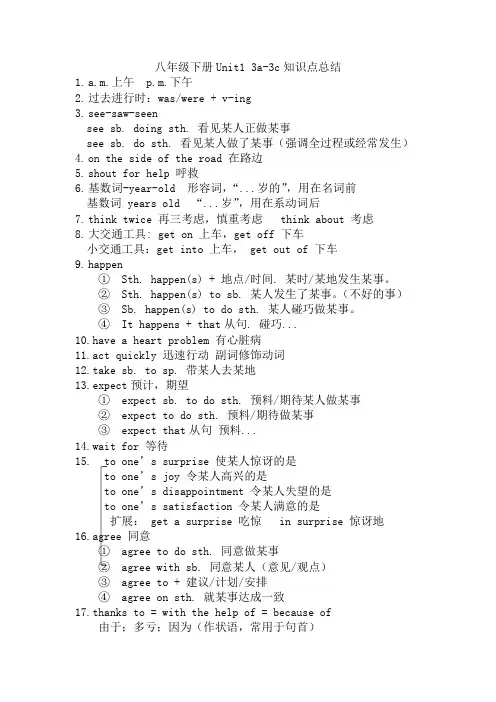
八年级下册Unit1 3a-3c知识点总结
1. a.m.上午 p.m.下午
2. 过去进行时:was/were + v-ing
3. see-saw-seen
see sb. doing sth. 看见某人正做某事
see sb. do sth. 看见某人做了某事(强调全过程或经常发生)
4. on the side of the road 在路边
5. shout for help 呼救
6. 基数词-year-old 形容词,“...岁的”,用在名词前
基数词 years old “...岁”,用在系动词后
7. think twice 再三考虑,慎重考虑 think about 考虑
8. 大交通工具: get on 上车,get off 下车
小交通工具:get into 上车, get out of 下车
9. happen
① Sth. happen(s) + 地点/时间. 某时/某地发生某事。
② Sth. happen(s) to sb. 某人发生了某事。(不好的事)
③ Sb. happen(s) to do sth. 某人碰巧做某事。
④ It happens + that从句. 碰巧...
10.have a heart problem 有心脏病
11.act quickly 迅速行动 副词修饰动词
12.take sb. to sp. 带某人去某地
13.expect预计,期望
① expect sb. to do sth. 预料/期待某人做某事
② expect to do sth. 预料/期待做某事
③ expect that从句 预料...
14.wait for 等待
15. to one’s surprise 使某人惊讶的是
to one’s joy 令某人高兴的是
to one’s disappointment 令某人失望的是
人教版八年级英语下册单元语法归纳及练习全套
人教版八年级英语下册单元语法归纳及练习全套
Unit 1 重点语法
教学目标:掌握情态动词should的用法
掌握反身代词的用法
1. 情态动词should的用法
( 1 ) 情态动词should后接动词原形,变为一般疑问句时将should提前,变为否定句时在should后面加not。
We should listen to our teacher carefully in class.
Should I tell him the news right now?
We shouldn’t come late to school.
( 2 ) should常用于以下两种情况:
提出建议、观点或看法。
You loo tired. You should lie down and rest.
表示推测,意为“该,按理应当”。
Wait a minute. I thin he should come in a moment.
2. 反身代词
( 1 ) 反身代词的构成
反身代词是表示或强调自身的代词,有人称和数之分。第一、二人称反身代词由“形容词性物主代词 + self ( 单数 )或selves ( 复数 )”构成;第三人称则由“宾格人称代词 +
self ( 单数 )或selves ( 复数 ) ”构成。详见下表:
人称 单数 复数(-selves)
第一人称 myself 我自己 ourselves 我们自己
第二人称 yourself 你自己 yourselves 你们自己
第三人称 himself 他自己
themselves他/ 她/ 它们自己 herself 她自己
itself 它自己
( 2 ) 反身代词的用法
做宾语 You must loo after yourself well and eep healthy.
The child can dress himself.
Unit1-Unit5短语和用法汇总归纳人教版英语八年级下册
Unit 1What’s the matter?【重点短语过关】
have a cold 感冒
have a fever 发烧
get into 陷入
have a stomachache 胃痛/肚子痛
take one’s temperature 量体温
get to 到达
have/take a rest/ break 休息
go to a doctor 去看医生
too much 太多
put some medicine on 在…上敷些药
see a dentist 看牙医
lie down 躺下
play puter games 玩电脑游戏
without thinking twice 没多想
all weekend 整个周末
take sb to the hospital 送某人去医院
have a heart problem 有心脏病
get off 下车 to one’s surprise 令某人惊讶的是
do the right thing 做正确的事
wait for 等待
get hit/ sunburned 被打击/ 晒伤
fall down 摔倒
thanks to 由于
lose one’s life 失去生命
by oneself 独自
because of 因为
be interested in 对…感兴趣
a few 几个,少数
in time 及时
take risks/ take a risk冒险
e in 进来
新目标八年级英语下册知识点全归纳人教版
八年级(下)英语知识讲解(人教)
每单元均有重要的字、词的辨析及重要语句的分析与用法指导;有课文中的难重点分析与讲解;有针对性的训练及同步检测题,并且附有详细的解答。
目录
1 Unit 1 Will people have robots?
2 Unit 2 What should I do?
3 Unit3 What were you doing when the UFO arrived?
4 Unit 4 He said I was hard-working.
5 Unit 5 If you go to the party, you’ll have a great time!
6 Review of units 1-3
7 Review of units 4-5
8 八年级下学期期中复习(一)
9 改错小练
10 八年级下学期期中复习(二)
11 八年级期中考试模拟题
12 Unit 6 How long have you been collecting shells?
13 Unit 7 Would you mind turning down the music?
14 Unit 8 Why don’t you get her a scarf?
15 Unit 9 Have you ever been to an amusement park?
16 Unit 10 It’s a nice day, isn’t it?
17 介词复习
18 Review of units 6-8
19 Review of units 9-10
20 八年级第二学期期末复习题
21 八年级第二学期期末模拟试题
22 How do you study for a test
23 Unit2 I used to be afraid of the dark
新人教版八年级英语(下册)第三单元知识点总结归纳 2
. .
新版八年级英语下册第三单元知识点归纳
Unit3 Could you please clean your room?
一、Peter ,could you please take out the rubbish? 彼得,你能把垃圾倒了吗?
----sure,mom.
Could you please do sth ?请你(做)......好吗? 用于提出请求,希望得到对方的肯定回答,说话的语气比较客气委婉。
Could 不是can的过去式,是委婉、礼貌的说法。回答用can.
【常用答语】肯定回答:Sure./ Of course./ Certainly./No problem. 否定回答: Sorry , I can’t
2、take out 取出(v+ adv)
【注】: 跟代词做宾语,代词放中间;跟名词做宾语,可放在中间,也可放在后边
take 有关的短语:
take out 带出去,取出
Please take out a piece of paper.请拿出一张纸。
Please take it out.请把它拿出来。
take ...out “把……带出去”
My father is taking me out to go for a drive.我爸爸要带我出去开车。
(1)take off 脱下;(飞机)起飞
----Please take off your coat(外套), It’s warm here.
---The plane took off at 9:00 am.
【短语】take out the trash/rubbish 倒垃圾 take away 拿走,取走
take back 收回 take place 发生 take off 脱下; 起飞
(2)take …to …把...带到... (3)take sb. for a walk 带某人去散步 take a walk 散步