
八年级英语下册1——3单元知识点归纳
第 1 页 共 24 页 八年级英语下册1——3单元知识点归纳
八年级英语下册13单元知识点归纳
Unit 1. whats the matter?
一.重点短语归纳
1. have a sore back背疼 2. have a cold 感冒
3. have a stomachache 胃疼
4. foot---feet 脚 复 tooth---teeth 牙齿 复
5. have a sore throat喉咙疼
6. have a fever发烧
7. lie down and (have a)rest 躺下休息 have a rest 休息
8. hot tea with honey 加蜜的热茶
9. see a dentist 看牙医 see a doctor 看医生
10.drink lots of water多喝水
11.lots of ,a lot of, a lot
a lot of=lots of,可以修饰可数名词复数和不可数名词,一般用在肯定句中。:
There are lots of ( a lot of) books in our library.
There is a lot of water on the ground
a lot,是一个副词词组,跟动词连用;表示十分,很等意思; Thanks
a lot.
12. have a toothache牙疼
第 2 页 共 24 页 13. Thats a good idea好主意
14. go to bed 去睡觉 go to bed early 早上床睡觉
15. feel well感到好 feel ill 感到不舒服
I dont feel well= Im not feeling well
我感觉不舒服.
16. start doing/ to do sth开始做某事
TO DO 是一件事情完成了,开始做另外一件事情
DOING是原来的那件事情做到一半,现在又开始做了,是同一件事情。
17. two days ago两天前
18. get some rest 多休息, 休息一会儿
19. I think so我认为是这样
20. be thirsty口渴
21. be hungry 饥饿
22. be stressed out紧张
23. listen to music听音乐
24. healthy lifestyle健康的生活方式
25. traditional Chinese doctors传统中医
26. need to do sth 需要做某事
I have a toothache. I need to see a dentist. 我牙痛, 我需要去看牙医.
We need to keep our classroom clean. 我们需要保持教室的
第 3 页 共 24 页 干净.
27. a balance of yin and yang阴阳平衡
28. for example例如
29. too much yin太多的阴, 阴气太盛
too much + 不可数名词 太多的
much too +形/副 实在太 极其,非常
too many + 可数名词复数 太多的
30.be good for sth./ doing sth. 对什么有益 ,对什么有好处
be bad for sth./ doing sth. 对什么有害
be good to 对好
be good at =do well in 在方面好,擅长
be good(bad) for、be good at的相关用法
1.be good for 对......有益
Doing morning exercises is good for your health.
做早操对你们的建康有益。
2.be good at 擅长于......
Li Ping is good at basketball. 李平擅长于篮球。
= Li Ping is good at playing basketball. 李平擅长于打篮球。
be good at = do well in 如:
Im good at math. = I do well in math. 我擅长于数学。
3.be good to 对......好
第 4 页 共 24 页 Parents are always good to their children.父母亲总是对他们的孩子好。
31.get good grades 取得好成绩
32.angry 用法
be angry with sb生某人的气
I was angry with him for keeping me waiting.
我对他很生气,因为他让我等了好久。
be angry at/ about sth 就某事生气
33.Chinese medicine 中药
34.be popular in + some place 在某地很流行
Chinese medicine is now popular in many western
countries. 现在中药在许多西方国家受欢迎。
35.in western countries在西方国家
36.Its easy to do sth做某事是容易的。 Its important to do
sth . 做某事很重要。
37.balanced diet平衡饮食
38.get tired 感到疲倦 be/get tired
39.go out at night在晚上出去
When you are tired, you shouldnt go out at night. 疲倦时,晚上你不该外出
40.stay healthy 保持健康 =keep healthy=keep in good
health
第 5 页 共 24 页 41.at the moment此时,此刻= now
Im not feeling very well at the moment
42.enjoy sth. =like sth. (名词)喜欢某物,
enjoy doing sth.喜欢做某事=like dong sth
enjoy oneself (myself, yourself,herself, himself, themselves,
ourselves, itself
反身代词) 玩得高兴,过得愉快=have a good time = have a
wonderful time =have fun
43. conversation practice会话练习
44. host family 寄宿家庭
45. have a lot of headaches经常疼痛
Im tired and I have a lot of headaches. 我很疲劳,而且经常头痛。
46. a few + 可数名词复数 少许
a little + 不可数名词/形/副 一点
47.He shouldnt eat anything
=He should eat nothing. 他不应当吃任何东西.
48.give sb some advice给某人建议give advice 提出建议
advice 是不可数名词
a piece of advice 一则建议 take ones advice 采纳或听从某人的建议
He gave me some good advice.
第 6 页 共 24 页 他向我提了一些很好的意见。
49.sleep 8 hours a night每晚睡眠八小时
50.take medicine 吃药 服药
I have to take medicine three times a day for my cold.因为感冒,我不得不一天吃三次药。
二 固定结构
Its +形 + for sb. + to do sth.
做某事对某人来说是的。
Its important to do sth .做某事很重要。
Its important for me to eat a balanced diet. 平衡饮食对我来说是很重要的.
Its easy to do sth做某事是容易的。
Its easy for us to find out the answer. 找出答案对我们来说是容易的
三.重点句子
1.Whats the matter ? Whats the mater with you ? 你怎么啦?
=Whats the trouble with you?=Whats wrong with you?
I have a cold / have a sore back / have a stomachache
2.Thats too bad. You should / shouldnt 那太糟糕了. 你应该/不该
You should lie down and rest/drink hot tea with honey /
see a dentist / see a doctor .
2014春季新版八年级下册英语第一至三单元知识点小结
1 make it +形容词(+for sb.) to do sth. 使(某人)做某事成为…;
think / find it +形容词to do sth.
18. make a difference to…对……有影响;对……有作用,difference前可以用no, any, some, much等修饰,如
The rain made no difference to the game.
Hard-working makes much difference to study.
19. difficulty【可数/不可数】表示抽象意义的“困难”时为不可数;表示具体的“难题、难事”时为可数;
have difficulty (in) doing sth.= have trouble (in) doing sth. 做某事有困难
21. be excited about sth. 对某事感到兴奋 ,Everyone is excited about the good news.
【复习】excited意为 兴奋的,修饰人;exciting意为 令人兴奋/激动的,修饰物。
23. change【动词】变化,改变It’s hard for a person to change his life(style). 【名词】变化;零钱
change A for B用A换成B:
When you travel in China, remember to change US dollars for RMB.
Unit3 Could you please clean your room?
9. For one week , she did not do any housework and neither did I.
一周的时间,她不做任何家务,我也不做。
人教版英语八年级下册Unit 1-5 单元语法知识梳理
Unit 1 单元语法知识梳理
一、情态动词 should的用法
情态动词should有自己的意义,但不能单独作谓语,只能和其他动词一起构成谓语,表示说话人的态度或看法,后接动词原形。常见用法有以下几点:
1.表示劝告、建议等,意为“应该”,常指根据常理认为对的事或应该去做的事。
当劝某人做或不做某事时,常用“should do sth.”或 “shouldn't
do sth.”。should 比 must 和 ought to 语气更加委婉。
例句:You should brush your teeth before you go to bed.你在睡觉前应该刷牙。
You shouldn't watch TV every day.你不应该每天看电视。
2.通常用来表示现在或将来的责任或义务。
例句:Children should obey their parents.孩子们应该听从他们的父母。
We should respect the old.我们应该尊敬老人。
3.表示推断,意为“应该;可能”。
例句:They should be there by now,I think.我觉得现在他们应该都已经到了。
4.用于第一人称疑问句,询问对方的意愿,表示说话人的一种谦逊、客气、委婉的语气。
例句:Should I open the window? 我可以打开窗户吗? What should we do now? 我们现在该干什么呢?
5.表示某种感情色彩,意为“竟会”,常用于以how, why开头引导的特殊疑问句中。
例句:Why should you be so early today? 你今天为什么会如此早?
二、反身代词
1.反身代词的构成反身代词是一种表示反射或强调的代词。它由第一人称、第二人称的形容词性物主代词和第三人称代词的宾格加词尾-self或-selves构成。
其构成如下表:
八年级下册英语单词1~10单元人教版
八年级下册英语单词1~10单元人教版
一、Unit 1
1. career
2. ambulance
3. challenge
4. suffer
5. volunteer
6. deserve
7. qualify
8. education
9. tr本人ning
10. employment
在八年级下册英语中,第一个单元涉及了一些关于职业和救援的单词。通过学习这些单词,学生们可以了解到不同的职业和工作环境,以及在紧急情况下如何进行救援。
二、Unit 2
1. lava
2. erupt 3. disaster
4. erupt
5. ash
6. volcano
7. peak
8. prediction
9. zone
10. risk
第二个单元主要是关于自然灾害的单词。学生们通过学习这些单词,可以了解到火山喷发的过程以及相关的预测和风险。
三、Unit 3
1. individual
2. respect
3. ignore
4. participate
5. appropriate
6. avoid
7. presence
8.munity
9. organize 10. influence
这个单元主要是关于人际交往和社会互动的单词。学生们可以了解到如何与他人相处,尊重他人,参与社区活动并影响他人。
四、Unit 4
1. coach
2. sportswear
3. launch
4. teamwork
5. score
6. athlete
7. cheer
8. champion
9. record
10. entert本人nment
这个单元主要是关于体育运动和运动员的单词。学生们可以学习到与体育相关的词汇,并了解到团队合作和竞技精神的重要性。
五、Unit 5
1. character
2. behavior
3. value
4. moral
5. respect
新人教版八年级英语下册第一单元知识点
新人教版八年级英语下册第一单元知识点
第一单元主要介绍了动词的时态、情态动词以及一般现在时态和现在进行时态的用法。
1. 动词的时态:
- 一般现在时:表示经常性或普遍性的动作或状态。
- 一般过去时:表示过去某个时间发生的动作或状态。
- 一般将来时:表示将要发生的动作或状态。
- 现在进行时:表示现在正在进行的动作。
- 过去进行时:表示过去某个时间正在进行的动作。
- 现在完成时:表示过去的某个时间开始,并持续到现在的动作或状态。
- 过去完成时:表示过去的某个时间前完成的动作或状态。
2. 情态动词:
- can/could:表示能力或许可。
- may/might:表示可能性、许可或请求。
- must:表示必须。
- should:表示建议或义务。
- will/would:表示意愿、习惯或请求。
3. 一般现在时的用法:
- 表示经常性或习惯性的动作或状态,常与频率副词连用(如always, often,
sometimes等)。
- 表示客观事实或真理,常用于科学、历史等领域。
- 表示现在的状态、感觉或所属关系。
4. 现在进行时的用法:
- 表示现阶段正在进行的动作或临时状态。
- 表示计划或安排的未来动作。
- 与always或often连用,表示经常性的不满或抱怨。
以上是第一单元的知识点,希望对你有帮助。
人教版英语八年级下册 Units 1-3重点单词词性转换
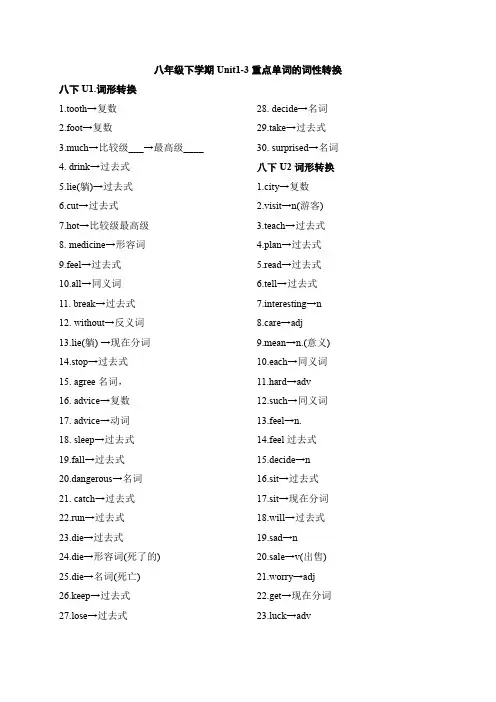
八年级下学期Unit1-3重点单词的词性转换
八下U1.词形转换
1.tooth→复数
2.foot→复数
3.much→比较级___→最高级____
4. drink→过去式
5.lie(躺)→过去式
6.cut→过去式
7.hot→比较级最高级
8. medicine→形容词
9.feel→过去式
10.all→同义词
11. break→过去式
12. without→反义词
13.lie(躺) →现在分词
14.stop→过去式
15. agree名词,
16. advice→复数
17. advice→动词
18. sleep→过去式
19.fall→过去式
20.dangerous→名词
21. catch→过去式
22.run→过去式
23.die→过去式
24.die→形容词(死了的)
25.die→名词(死亡)
26.keep→过去式
27.lose→过去式
28. decide→名词
29.take→过去式
30. surprised→名词
八下U2词形转换
1.city→复数
2.visit→n(游客)
3.teach→过去式
4.plan→过去式
5.read→过去式
6.tell→过去式
7.interesting→n
8.care→adj
9.mean→n.(意义)
10.each→同义词
11.hard→adv
12.such→同义词
13.feel→n.
14.feel过去式
15.decide→n
16.sit→过去式
17.sit→现在分词
18.will→过去式
19.sad→n
20.sale→v(出售)
21.worry→adj
22.get→现在分词
23.luck→adv24.stop→过去式
25.carry→过去式
26.set→过去式
27.able→反义词
28.easy→adv
29.train→n
30.kind→n
31.understand→过去式_____→adj_______
八年级英语下册第一单元知识点汇总

1 Unit 1 What’s the matter?
词句精讲精练
词汇精讲
1. have a cold
have a cold是动词短语,意为“患感冒,伤风”,也可以说成catch a cold/get a cold或take a cold。其中have表示“患病,得病”,不能用于进行时态,但可与一段时间连用,表示状态;而catch/get
a cold则表示瞬时动作,不能同一段时间连用。例如:
I have had a cold for three days. 我感冒三天了。
此句也可以表达为:
I had/caught/got a cold three days ago.
【拓展】
表示人体某部位“痛”时的几种结构:
(1)have a + 身体部位名词后加-ache构成。例如:
have a headache 头痛
have a toothache 牙痛
have a stomachache胃痛
(2)have a sore + 身体部位名词。例如:
have a sore throat 喉咙痛
have a sore arm 胳膊痛
have a sore foot 脚痛
(3)身体部位 + hurt/ache。例如:
My eyes hurt. 我眼睛痛。
My legs ache. 我腿疼。
(4)have a pain in/ on + the + 身体部位。例如:
I have a pain in the arm. 我胳膊痛。
(5)There is something wrong with + one’s + 身体部位。例如:
There is something wrong with your eyes. 你的眼睛有毛病。
2. rest
八年级人教版英语下册unit1知识点总结
八年级人教版英语下册unit1知识点总结
Unit1是八年级英语下册的第一单元,主要围绕“the sentence”这一主题展开。在学习中,我们需要掌握一些重要的知识点,本文将对这些知识点进行总结。
一、句子的构成
句子是表达完整意义的语言单位,主要由主语、谓语和宾语三部分构成。其中,主语是句子的主要话题或动作的执行者,通常位于句子的最前面;谓语是句子的核心,描述主语的动作或状态;宾语是句子的补充说明,通常位于谓语之后。
句子的构成还包括句子成分和句子成分的分类。句子成分包括主语、谓语、宾语、表语、定语和状语等。句子成分的分类主要有三种,即主谓结构、主、谓、宾结构和主系表结构。
二、句子的种类
英语中根据句子的用途和表达方式,可以分为陈述句、疑问句、祈使句和感叹句四种。其中,陈述句用来陈述事实、肯定或否定某种情况,一般语序为主谓宾,常以句号结尾;疑问句用来询问问题,通常以问号结尾;祈使句用来表达请求、命令或建议等语气,通常省略主语,以动词原形开头;感叹句用来表达强烈的情感,常以感叹词或how引导。
三、句子的语态和时态
英语中的语态有两种,即主动语态和被动语态。主动语态表示主语执行动作,而被动语态则表示主语受到动作的影响。
时态是句子非常重要的一部分,用来表示动作发生的时间。英语中时态主要有现在时、过去时和将来时三种。其中,现在时表示现在或经常性的动作;过去时表示过去发生的动作;将来时表示将来要发生的动作。
四、句子的修辞手法
修辞手法是指用以增强语言表现力的一些技巧或方法,英语中常见的修辞手法包括比喻、拟人、排比、反问、设问、修饰语等。
其中,比喻是常用的一种修辞手法,用来通过两个事物之间的共性来形象地说明某一现象或情况,增强语言的表现力。拟人则是将非人事物或抽象物质化为人来进行描述,以增强表达的感染力。
以上是八年级人教版英语下册Unit1的知识点总结,希望能够对大家在学习中有所帮助。
初中英语人教版八年级下册 1-10单元 单词 短语 归纳汇总
八下Unit 1 What’s the matter?
必记单词
matter n.问题;事情 stomachache n.胃痛;腹痛 neck n. 颈,脖子
throat n. 咽喉,喉咙 fever n. 发烧 lie v.躺;平躺
rest v&n. 放松,休息 cough n&v. 咳嗽 headache n.头痛
X-ray n. X射线,X光 toothache n. 牙痛 break n. 间歇,休息
hurt v. (使)疼痛,受伤 passenger n.乘客;旅客 trouble n.问题;苦恼
hit v. 击,打 bandage n. 绷带 v.用绷带包扎 press v. 压,挤,按
sick adj. 生病的,有病的 knee n. 膝盖 climber n. 登山者
risk n&v 危险,风险,冒险 accident n.(交通)事故;意外遭遇 situation n. 情况,状况
kilo n. 千克,公斤 rock n. 岩石 knife n. 刀
新人教版八年级英语下册期中复习1-6单元知识归纳总结
资料收集于网络,如有侵权 请联系网站删除
只供学习与交流
八年级英语下册各知识点归纳总结
Unti1 what’s the matter?
短语归纳
1.too much 太多 2.lie down 躺下
3.get an X-ray 做个X光检查 4.take one ’s temperature 量体温
5.put some medicine on ......在....上敷药 6.have a fever 发烧
7. get off 下车 8. think twice再三考虑without thinking twice 没多想
9.take breaks /take a break 休息 10.take sb to the hospital 送某人去医院
11.wait for等待 12.to one’s surprise 使.......惊讶的
13.thanks to多亏于;由于 14.in time及时 on time按时
15.think about 考虑 16.have a heart problem患有心脏病
17.get into the trouble 遇到麻烦 18.do the right thing做正确的事情事情
19.fall down 摔倒 20.put ...... on sth把...放在某物上
21.get hit/sunburned 摔伤/烧伤 22.be interested in 对.....感兴趣
be used to 习惯于.... 24.take risks/take a risk 挑战
人教版八年级英语下册1-5单元知识点
人教版八年级英语下册1-5单元知识点
词组 Unit 1
have a cold/toothache
have a score throat
see a dentist
take some medicine
take one’s temperature
get into trouble
in time 及时
on time 准时
right away=in a minute
= at once
thanks to 多亏…
thanks for doing sth 因做某事而谢谢你
to one’s surprise
see sb doing sth
keep on doing sth
be interested in
used to do sth 过去常做…
be used to doing sth 习惯做…
be in control of
make a decision
give up doing sth
Unit 2
动副词组,it/them 放中间cheer them up
work out
give out= hand out
fix up
cut off 切除,割掉
set up
clean up
put up
put off
give away 捐赠
help out
come out raise money for the poor
come true 实现
put on
come up with
feel lonely live alone
care for =look after
=take care of
at the age of 4
be similar to
take after 长得像
run out of