
新外研版英语七年级下册m1-12知识点总结
七年级下复习资料M1---M12Module 11. whose 疑问代词Whose bag is it 此时的whose是形容词性物主代词。
Whose is this bag 此时的whose是名词性物主代词。
2. 人称代词归纳(必背)主格宾格形物代名物代反身代词我I me my mine myself你you you your yours yourself他he him his his himself、她she her her hers herself它it it its its itself我们we us our ours ourselves你们you you your yours yourselves他们they them their theirs themselves3. welcome back to +地点欢迎回到某地Welcome to +地点欢迎到某地来Welcome sb to+地点欢迎某人到某地来4. everyone 每个人(指人)后面不能接ofevery one 每个人或物(根据上下文,可指人也可指物)后面可以接of every one of us 我们中每个人·5. first of all = at first = firstly 首先6. lost and found box失物招领箱7. here’s、here’re句型,其后be动词的形式由后面的名词决定Here is a book. Here are some books.8. be careful with sth. 仔细保管某物9. from now on从现在开始from then on 从那时开始10. watch 手表(名词);观看(动词)Watch 观看(电视,电影,比赛等)Look 看(表示动作,后接at)See 看见(强调结果)Read 看(看书、报纸,杂志等)!11. lost and found office失物招领办公室(前面用介词at)12. look for寻找(强调动作)find找到(强调结果)13. get on上(公交车,飞机,轮船,火车等)get off下(公交车,飞机,轮船,火车等)Get in上(小轿车)get out of 下(小轿车)14. lose 动词,丢失,失败lost(lose的过去式,同时lost也作为形容词,意为丢失的)I lost my way。
我迷路了。
(动词)I am lost。
我迷路了(形容词)15. travel 旅行注意ing形式:travelling16. leave 离开leave+地点离开某地leave for+地点动身去某地leave sp for sp 来开某地去某地注意:把什么东西落在某地,用leave,而不用forget17. hundreds of 数以百计的thousands of数以千计的millions of数以百万计的*注意:有s必须有of,没有of,后面不能加s18. every day每一天everyday 形容词,日常的19. many other things 许多其他的东西20. at the moment = at this moment此时此刻at that moment在那时21. fifteen kilos of sausages 15公斤的香肠22. in a hurry匆忙的hurry to do sth匆忙做某事23. talk about sth 谈论某事talk to/with sb 与某人谈话talk to/with sb about sth 与某人谈论某事Speak+语言say+说话内容tell 告诉tell sb to do sth 告诉某人做某事24. that’s why + 从句那就是为什么….25. help sb (to)do sth 帮助某人做某事help sb with sth在…方面帮助某人、26. think about 考虑think of想起,想出think over仔细考虑Module 21. the new clubs for this term这个学期的俱乐部,注意此处用for,而不是of2. on the board 在布告板上3. would like+名词想要某物I would like a cup of coffee。
我想要一杯咖啡Would like to+动词原形想要做某事I would like to play basketball。
我想打篮球。
Would like sb to do sth 想要某人做某事I would like you to come to my school。
我想要你到我学校来。
4. join 参加(组织团体)join in=take part in 参加(活动,比赛等)5. well 好,表示做某事做的好,一定要用well,不能用good—6. worry about sb/sth 担心某人或某事7. teach 教teach sb sth 教某人某事(sb要用宾格)错误; teach our English. 正确:teach us EnglishTeach sb to do sth 教某人做某事8. what about = how about9. I think…我认为…(后接肯定句)如果后面是否定句,要否定前置,变为I don’t think,如:I think he isn’t a good student. 应改为I don’t think he is a good student.10. the start of…。
的开始11. get on with sb与某人相处get on well with sb与某人相处融洽12. do well in+名词或动词ing be good at+名词或动词ing 意为“擅长”注意:用了do well in句子中就不能再出现be动词/13. promise to do sth 承诺做某事make a promise 许下承诺14. enjoy+doing 喜爱做某事15. be sure of sth对某事有把握be sure to do sth 务必做某事be sure+that+ 从句对…有信心16. make sb/sth + adj 使某人或某物具有…状态make me angry使我生气Make sth for sb为某人制作某物make sb do sth 使某人做某事(注意:make与let后面都不能有to)17. 询问职业:1. what does your father do 2. What is your father 3. what is your father’s job18. a kind of 一种…all kinds of各种各样的kind of有点19. be ready to do sth乐于做某事20. other其他的(修饰名词)the other另一个(两者中)another另一个(三者或三折以上):The others其他的人或物(剩下的全部)others其他的人或物(剩下的一部分)21. want to do sth想要做某事want sb to do sth想要某人做某事Module 31. be going to+动词原形表示将来,意为打算做某事注意:当be going to后接go to sp时,、go to通常省略,直接用be going to+地点,如:I am going to go to the zoo.应该写为:I am going to the zoo.2. else 其他的,修饰代词,放在代词之后;other其他的,修饰名词,放在名词之前。
3. have a picnic吃野餐4. plan to do sth计划做某事make a plan制定计划~5. look forward to+名词或动词ing形式期待做某事6. make friendship with sb和某人交朋友7. win赢得(比赛,战争,荣誉,奖品)beat 战胜(对手)8. hope to do sth希望做某事错误:hope sb to do sthhope for…希望…hope that+从句9. go on a summer camp去参加夏令营10. go sightseeing去观光11. 花费:it takes sb some time to do sth做某事花费某人多长时间Sb spend some time/some money (in) doing sth 某人花费多少钱/多长时间做某事\Sb spend some time/some money on sth某人在某事上花费时间或金钱Sb spend some time with sb某人花费时间和某人在一起某物cost sb some money、某物花了某人多少钱Sb pay for sth某人为某物支付金钱12. on the beach在沙滩上13. be busy (in)doing sth忙于做某事be busy with sth忙于某事14. be different from 与…不同be the same as与…相同15. maybe可能maybe he is a student.也许他是名学生。
May be可能是he may be a student.他可能是名学生16. it’s time for sth/doing sth 该是做某事的时候了《Module 41. in the future在将来2. in + 一段时间表示某个动作还要多久才会发生,用于将来时,提问用how soon3. use sth to sth使用某物做某事use sth for sth为了某事使用某物4. ask a question问问题ask sb to do sth要求某人做某事ask for寻求…5. the answer to the question问题的答案6. be able to+动词原形可用于将来时,will be able to。
但can没有将来时。
7. not…any more 不再….(动作不再重复)= no morenot…any longer 不再….(动作不再延续)= no longer《8. free time = spare time 空闲时间9. chalk粉笔不可数名词10. too much+不可数名词太多…(表数量)much too+形容词或副词太…(表程度)11. need + 动词原形(此时need为情态动词)need to do sth (此时need为实义动词)注意:在否定句中。
七年级外研版下册m11知识点

七年级外研版下册m11知识点七年级的英语学习是初中英语学习的开端,对于学生来说,基础知识的掌握至关重要。
下面将为大家整理七年级外研版下册M11的知识点,帮助大家更好地学习英语。
一、形容词的比较级和最高级形容词的比较级和最高级是英语语法中的重要内容,是日常生活中经常使用的语法点。
在形容词后加er和第二个单词配合“than”就是形容词的比较级,加上the以及后面的名词就是最高级。
例如:Tina is taller than Tom.(Tina比Tom高。
)Lucy is the tallest girl in her class.(Lucy是她班上最高的女孩。
)二、直接和间接疑问句直接疑问句是对某事物提出疑问,语调上会上扬,常以where、when、why、what、how等疑问词作开头。
例如:What is your name?(你叫什么名字?)How old are you?(你多大了?)而间接疑问句是通过引导词来转换的,语调一般平缓。
常用的引导词有who, what, where, when, why, how等。
在间接疑问句中要根据从句的主语或目的来确定时态。
例如:Could you tell me where the library is?(您能告诉我图书馆在哪里吗?)I don’t know when he will come back.(我不知道他什么时候回来。
)三、情态动词情态动词是一个重要的语法概念,也是七年级的必学内容。
情态动词用于表示可能性、能力、请求、建议、义务等,包括can, could, may, might, will, would, shall, should, must等。
例如:He can play football.(他会踢足球。
)You should apologize to her.(你应该向她道歉。
)四、不定代词不定代词也是七年级外研版下册的知识点之一,它们指代的内容是不确定的或未明确指出的。
新外研版七年级英语下册(全套)知识点汇总语法知识汇总

(共12套73页)新外研版七年级英语下册(全册)知识点汇总语法知识汇总Module 1 Lost and found语法精选1. whose 谁的whose意为“谁的”, 是表示所有关系的疑问词。
其用法如下:(1)可以用来对名词所有格或形容词性物主代词进行提问。
如:This is Tina’s/her hat.→Whose hat is this?(2)可以用来对名词性物主代词进行提问。
如:These pencils are mine.→Whose are these pencils?2. hundred与hundreds ofhundred是一个确数, 表示“一百”;hundreds of是一个概数, 表示“好几百的;许许多多的”。
当 hundred前面有一个具体的数词时, hundred不变为复数。
如:①two hundred cows两百头奶牛②Hundreds of people come here ev ery day.每天都有许多人到这里来。
注意:当hundred与of连用时, 它后面的名词和它本身都用复数。
如:hundreds of cows 几百头奶牛3. such as 比如;例如such as意为“比如;例如”, 用于引出多个例子。
如:I like some animals such as lions and monkeys. 我喜欢一些动物, 比如狮子和猴子。
注意:for example也意为“比如;例如”, 用来举例说明某一论点或情况, 一般只举同类人或物中的“一个”为例, 作插入语, 可位于句首、句中或句末。
如:①For example, air is invisible.例如, 空气是看不见的。
②He, for example, is a good student.例如, 他就是个好学生。
③Many boys like playing basketball. Take me, for example.许多男孩喜欢打篮球。
外研版七年级下学期M1-M12重要知识点总结和语法点的讲解

Module 1知识点1 Whose (谁的)+名词+ is this /that ? 这、那是谁的什么吗?eg: whose bag is this /that ? Whose +名词+are these /those ? 这,那些是谁的什么吗? eg :whose bags are these ?注意be 动词的单复数2 Here is /are +n 这儿是....注意be 动词的单复数和there be 句型一样,遵守就近原则eg: Here is a book and two pens . Here are two books and a pen .3 welcome back to 欢迎回到welcome to 欢迎来到4 in a hurry 介词短语放在句末eg She comes to school in a hurry .hurry up 日常用语,赶快,一般用于催促别人5 leave(left) sth sp 把某东西遗忘在某地eg :She left her book at home .注意与Forget sth (忘了某东西) 的区别(后不加sp) eg :She forget her book at home . Leave sp 离开某地leave for sp 离开去某地6 hundreds / thousands of +n 成百上千的,成千上万的有数词无s ,无of ,无数词有s,有of eg : two thousand thousands of7 that’s why /because 那是为什么、因为后面加句子eg :That’s why she is late for school .8 call sb at 电话号码打某人某个电话号码注意用介词at eg :Call me at 88888888.9 help sb do sth help sb with sth 帮助某人做某事eg :I often help my mum do the cleaning .I often help my mum with the cleaning .10 look for 寻找,强调找的过程eg :She is looking for her book.find 找到,强调找的结果eg: She finds her book .语法专项名词性物主代词1 物主代词的分类物主代词是表示所有关系的代词,是人称代词的属格形式。
(完整版)新外研版英语七年级下册m1-12知识点总结..docx

七年级下复习资料M1---M12Module 11. whose 疑问代词Whose bag is it?此时的 whose 是形容词性物主代词。
Whose is this bag?此时的 whose 是名词性物主代词。
2.人称代词归纳 (必背主格宾格形物代名物代反身代词我 I me my mine myself你you you your yours yourself他he him his his himself她she her her hers herself它it it its its itself我们 we us our ours ourselves你们 you you your yours yourselves他们 they them their theirs themselves3. welcome back to +地点欢迎回到某地Welcome to +地点欢迎到某地来Welcome sb to+地点欢迎某人到某地来4. everyone每个人 (指人后面不能接ofevery one每个人或物 (根据上下文 ,可指人也可指物后面可以接of every one of us 我们中每个人5.first of all = at first = firstly 首先6.lost and found box失物招领箱7.here 、’s here ’句re型 ,其后 be 动词的形式由后面的名词决定Here is a book. Here are some books.8.be careful with sth. 仔细保管某物9.from now on 从现在开始from then on 从那时开始10. watch 手表 (名词 ;观看 (动词Watch 观看 (电视 ,电影 ,比赛等 Look 看(表示动作 ,后接 atSee看见 (强调结果 Read 看(看书、报纸 ,杂志等11.lost and found office 失物招领办公室 (前面用介词 at12.look for 寻找 (强调动作 find 找到 (强调结果13.get on上 (公交车 ,飞机 ,轮船 ,火车等 get off 下 (公交车 ,飞机 ,轮船 ,火车等Get in 上 (小轿车 get out of 下(小轿车14.lose 动词 ,丢失 ,失败 lost(lose 的过去式 ,同时 lost 也作为形容词 ,意为丢失的I lost my way。
外研版英语七下M12基础知识
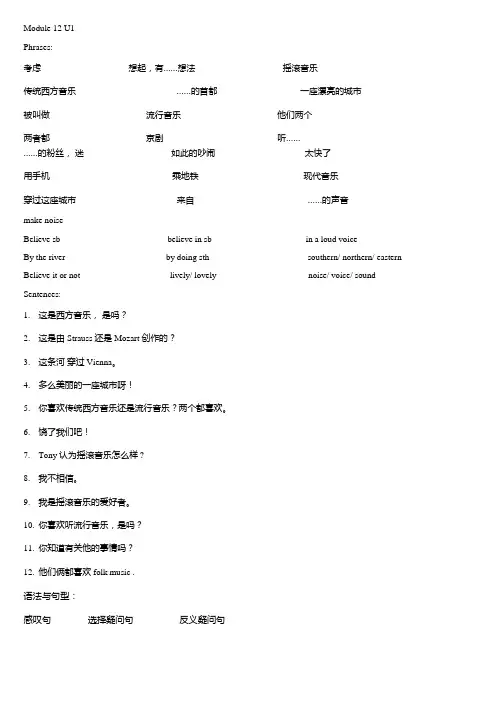
Module 12 U1Phrases:考虑____________________想起,有……想法____________________摇滚音乐____________________________传统西方音乐_______________________……的首都___________________一座漂亮的城市_____________________被叫做______________________流行音乐______________________他们两个_______________________________两者都______________________京剧__________________________听……_________________________________ ……的粉丝,迷____________________如此的吵闹____________________ 太快了___________________________用手机____________________________乘地铁________________________现代音乐_________________________穿过这座城市_______________________来自__________________________……的声音_______________________ make noise _______________________Believe sb ________________________believe in sb _____________________in a loud voice ____________________By the river_______________________by doing sth ______________________southern/ northern/ eastern_____________ Believe it or not ____________________lively/ lovely ____________________ noise/ voice/ sound___________________ Sentences:1.这是西方音乐,是吗? ___________________________________________________________________________2.这是由Strauss 还是Mozart 创作的?_________________________________________________________________3.这条河穿过Vienna。
新外研版英语七年级下册m1-12知识点总结电子教案
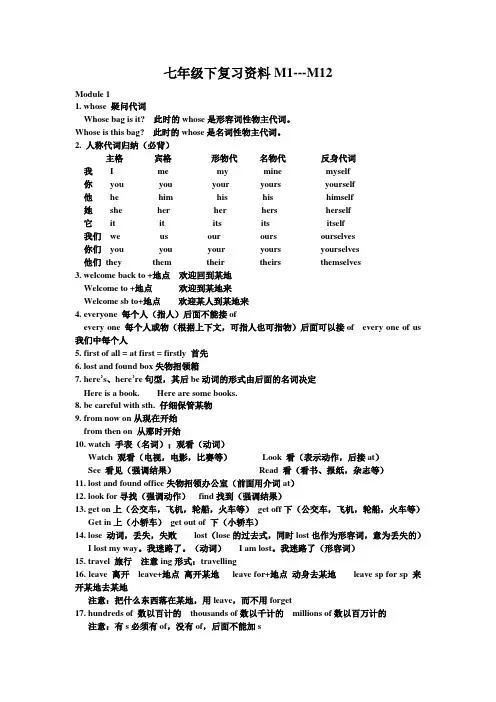
七年级下复习资料M1---M12Module 11. whose 疑问代词Whose bag is it? 此时的whose是形容词性物主代词。
Whose is this bag? 此时的whose是名词性物主代词。
2. 人称代词归纳(必背)主格宾格形物代名物代反身代词我I me my mine myself你you you your yours yourself他he him his his himself她she her her hers herself它it it its its itself我们we us our ours ourselves你们you you your yours yourselves他们they them their theirs themselves3. welcome back to +地点欢迎回到某地Welcome to +地点欢迎到某地来Welcome sb to+地点欢迎某人到某地来4. everyone 每个人(指人)后面不能接ofevery one 每个人或物(根据上下文,可指人也可指物)后面可以接of every one of us 我们中每个人5. first of all = at first = firstly 首先6. lost and found box失物招领箱7. here’s、here’re句型,其后be动词的形式由后面的名词决定Here is a book. Here are some books.8. be careful with sth. 仔细保管某物9. from now on从现在开始from then on 从那时开始10. watch 手表(名词);观看(动词)Watch 观看(电视,电影,比赛等)Look 看(表示动作,后接at)See 看见(强调结果)Read 看(看书、报纸,杂志等)11. lost and found office失物招领办公室(前面用介词at)12. look for寻找(强调动作)find找到(强调结果)13. get on上(公交车,飞机,轮船,火车等)get off下(公交车,飞机,轮船,火车等)Get in上(小轿车)get out of 下(小轿车)14. lose 动词,丢失,失败lost(lose的过去式,同时lost也作为形容词,意为丢失的)I lost my way。
Module12语法和知识点笔记外研版英语七年级下册
M12语法和学问点笔记语法归纳1.感慨句感慨句是用来表示喜怒哀乐等剧烈感情的句子,通常由how或what来引导。
〔1〕what引导的感慨句中心词是名词,结构为:① What + a(n) +形容词+可数名词的单数形式〔+主语+谓语+其他〕!What a beautiful girl (she is)! (她是)多么美丽的一个女孩啊!②What +形容词+可数名词的复数形式〔+主语+谓语+其他〕!What beautiful flowers (they are)! 〔它们是〕多么美丽的花儿啊!③What +形容词+不行数名词〔+主语+谓语+其他〕!What bad weather (it is)! (它是)多么糟糕的天气啊!〔2〕how引导的感慨句中心词是副词或形容词,结构为:①How +形容词或副词〔+主语+谓语〕!How cold (it is today)!(今日)真冷呀!How well she sings! 她唱得多好呀!② How +主语+谓语!How time flies!时间飞逝!选择疑问句是在句子中供应两个或两个以上可能的答案供对方选择的问句。
读法:or前用声调,or后用降调〔1〕选择疑问句结构Would you like coffee or tea?你想喝咖啡还是茶?Which does Mary like, traditional music or pop music?玛丽喜爱哪一种,传统音乐还是流行音乐?►留意:①选择疑问句可以用be动词、助动词或情态动词开头,但答复时不能用yes 或no,应从所给的选项中选择其一。
Are you from China or America? 你来自中国还是?I am from America. 我来自。
②or 所连接的是并列成分,即or 前是名词,or后也必需是名词,不能前面是名词,后面用动词。
【即学即练】一、用what,what a, what an 或how 填空。
七年级下册外研社m1知识点
七年级下册外研社m1知识点一、语法知识点1. 动词be的用法动词be是英语中最基础、最常见的动词之一,其主要用法如下:(1)表示存在,例如:There is a cat in the room.(屋子里有一只猫。
)(2)表示状态,例如:She is tired.(她累了。
)(3)表示身份、职业等,例如:He is a teacher.(他是一名教师。
)2. 一般现在时的构成及用法一般现在时表示经常性或普遍性的动作或状态。
其构成为:主语+动词原形。
例如:She likes swimming.(她喜欢游泳。
)3. 祈使句的构成及用法祈使句是表示请求、命令、建议等意义的句子。
其构成为:动词原形+其他。
祈使句的主语一般省略。
例如:Eat your breakfast.(吃早餐。
)二、词汇知识点1. 蔬菜类单词蔬菜类单词是日常生活中常用的词汇之一,常见的蔬菜有:carrot(胡萝卜)、cucumber(黄瓜)、tomato(西红柿)、lettuce (生菜)等。
例如:I like eating carrots.(我喜欢吃胡萝卜。
)2. 数字类单词数字类单词也是日常生活中常用的词汇之一。
常见的数字有:one(1)、two(2)、three(3)、four(4)等。
例如:I have three apples.(我有三个苹果。
)三、阅读技巧知识点1. 阅读理解阅读理解是英语考试中常见的题型,要求考生在一定时间内阅读短文并回答相关问题。
建议考生在练习时注意以下几点:(1)首先浏览全文,把握大意;(2)遇到不懂的单词可尝试猜测意思;(3)仔细阅读问题,确定问题类型及所需信息;(4)找到对应的句子段落进行答题。
2. 选词填空选词填空是一种练习词汇运用能力的题型。
在做这类题型时,建议考生注意以下几点:(1)认真阅读每个空后的提示及选项;(2)分析每个选项的含义及语法用法;(3)结合整个句子的含义和语法规则进行填空。
以上为七年级下册外研社M1的知识点简介,希望能对同学们的学习有所帮助。
外研版初一英语下知识要点
外研版初一英语下知识要点外研版初一英语下知识要点旨在总结整个初一英语下册的重要内容和重点知识。
在学习英语的过程中,掌握这些知识要点能够帮助学生更加全面地了解和掌握所学内容,提高学习效果。
本文将对外研版初一英语下知识要点进行详细介绍。
一、单元内容概览下册共包含6个模块,分别为Unit 7至Unit 12。
每个模块都以一个主题为中心,涵盖了丰富多样的语言知识和语言技能。
以下是各个模块的内容概览:Unit 7: My New Room本单元主要介绍了描述房间内的物品和位置的词汇和表达方式,学生将能够描述自己的房间及其布置,并和他人交流房间的情况。
Unit 8: What’s the weather like?本单元主要介绍了与天气相关的词汇和句型,学生将学会询问和回答天气状况,并能够描述各种不同的天气情况。
Unit 9: How do you get to school?本单元主要介绍了交通工具和方向的词汇和表达方式,学生将学会询问和回答如何去某个地方,并能够描述自己到学校的路线。
Unit 10: I’d like some noodles.本单元主要介绍了食物和餐厅用语的词汇和句型,学生将学会订购食物、描述食物的味道和价格,并能够在餐厅用餐时进行简单的交流。
Unit 11: How was your school trip?本单元主要介绍了过去发生的事情的描述和过去式的用法,学生将学会询问和回答过去的经历并描述这些经历。
Unit 12: What do you want to do?本单元主要介绍了日常活动、娱乐活动和参观活动的词汇和句型,学生将学会询问和回答关于活动的问题,以及表达自己的喜好和计划。
二、语法要点下面是外研版初一英语下册的语法要点总结:1.一般现在时:用来描述经常性、习惯性或普遍事实的动作或状态。
2.一般过去时:用来描述过去发生的动作或状态。
3.现在进行时:用来描述现在正在进行的动作。
新外研版七年级英语下册(全套)模块知识点汇总
新外研版七年级英语下册(全套)模块知识点汇总(共12套38页)新外研版七年级英语下册(全册)模块知识点汇总Module 1 Unit 11.welcome back to + 地点名词欢迎回到……welcome to + 地点名词欢迎来到……2.first of all ⾸先3.lost and found box 失物招领箱lose —lost find — foundlose vi. 丢失;失败, 输掉;lost - lost - lostlose 反义词:find / win短语:get lost 迷路lose one’s way 迷路lose one’s life 失去⽣命lose the match 输掉⽐赛4.look in the lost and found box 往事物招领箱⾥看5.Here is / are …这是……6.be careful with …⼩⼼对待……7.from now on 从今以后from then on 从那时起8.Let me see…让我看看Module 1 Unit 210.at the Lost and Found Office 在失物招领处11.in a hurry 匆忙 = hurriedlyhurry to + 地点匆忙去……hurry to do sth. 匆忙去做……Hurry up! 快点12.leave sth. + 地点状语leave things on planes, on trains, on buses and in taxis 13.That’s why ... 那就是为什么(后加表结果的句⼦)That’s because ... 那时因为……(后加表原因的句⼦)14.at airports / at stations 在机场 / 在车站at the Lost and Found Office15.hundreds of ... 数以百计的thousands of ... 数以千计的millions of ... 数百万的billions of ... 数⼗亿的以上为模糊表达⽅式(注意:s和of 共存亡)a hundred / two hundred / several hundred ⼀百/两百/⼏百16.look for ... 寻找……(找的过程)find ... 找到……(找的结果)17.many other things 许多其他的东西other + n(s) = others 其他的⼈/物(⽆范围)the other + n(s) = the others 剩下所有⼈或物(有范围)18.strange things 奇怪的东西stranger n. 陌⽣⼈19.about adv. ⼤约about pre. 关于20.this week 这周last week 上周next week 下周注意:this, last, next 前不加介词 in , on ...yesterday morningtomorrow afternoon前不加介词21.fifteen kilos of sausages ⼗五公⽄⾹肠Module 1 Unit 31.website ⽹站webpage ⽹页download 下载upload 上传2.search + 地点 + ⽬标在……寻找……3.post 张贴Module 2 Unit 11、ride a bike 骑⾃⾏车2、the new clubs for this term 这个学期的新俱乐部3、on the board 在布告板上4、would like to do sth. 想要做某事would like sth. 想要……would like sb. to do sth. 想要某⼈做某事5、because + 句⼦“因为……”(原因状语从句)6、join + 组织、机构join the army 参军join the Music Club 加⼊⾳乐俱乐部join sb. in sth. / doing sth. 加⼊到某⼈当中⼀起做…… join in + 活动“参……活动”take part in + 活动“参加活动(并起重要作⽤)”7、play the piano 弹钢琴play the voilion 拉⼩提琴play the flute 吹笛⼦play the drum 打⿎注意:以上乐器类前⾯加 the8、play table tennis 打乒乓球play volleyball 打排球play tennis 打⽹球play badminton 打⽻⽑球注意:以上球类运动前⾯不加 the9、 That’s all. 仅此⽽已, 就这么多。