
人教版英语七年级上册Unit6-SectionB 1a-2c教案
Unit 6 Do you like bananas?(Go for it )一、教学背景分析(一)教学内容分析本单元的中心话题是Food. 主要语言功能项目是Talk about likes and dislikes. 语法结构为Present tense to like, Yes / No questions and short answers, Affirmative and negative statements. 本单元Section A所呈现的是与谈论喜好与厌恶相关的基本语言知识及其初步运用。
这部分内容从呈现食物词汇开始,通过视、听等方式输入信息,并引出本单元主要句型:Do you like…?及其回答Yes,I do / No, I don’t.接着设计了一个听力练习,要求圈出所听到的食物以及补全对话,强化记忆所学词汇和初学句型。
然后教材设计了一个结对活动,以此操练主语是第三人称单数时句型的变化以及回答。
并借此突出本单元的语法重点。
最后教材设计的Food Survey起到了引导学生初步综合运用所学语言的作用,以调查的形式使学生在富有挑战性的活动中主动运用所学语言,落实新知。
Section B是在Section A基础上的知识的扩展和延伸。
本单元中,Section B首先以听、说、写的形式展开了食物与名称配对以及对食物进行分类。
接着设计了听力填写Sandra和Tom喜欢与不喜欢的食物;自然引到了谈论一日三餐的话题的结对活动,实现了新旧知识的综合运用;一日三餐合理健康膳食引出同步阅读;之后的写一段话谈谈Tom的一日三餐到写一段关于自己一日三餐喜欢吃的食物,直到最后的小组活动列出购物清单,使学生从完成半真实的任务转向了完成真实的任务,从而达到了创造性活用所学语言的目的。
Self check部分的主要内容是对本单元主要词汇及语言运用能力的自我评价。
综上所述,本单元以食物为主线,围绕着谈论喜欢与不喜欢以及一日三餐等语言功能项目展开了一系列任务活动。
教材内容从基本语言知识到语言综合运用层层递进,听说读写依次展开,以一种循序渐进的生活化的学习程序,引导学生在做事中有目的地学习语言。
(二)教学重点和难点教学重点:1、掌握关于食物的词汇。
2、熟练运用所学功能项目谈论喜好和厌恶。
3、能准确地用英语描述一日三餐的食谱。
教学难点:1、交际用语Do you like bananas? Yes, I do. /No, I don’t.2、描述一日三餐的方法。
3、一般现在时,主语是三单时,助动词与动词的变化。
4、可数名词和不可数名词的区别。
(三)教学目标《新课程标准》之基础教育阶段英语课程的总体目标是培养学生综合语言运用能力,而这种综合语言运用能力的形成是建立在语言知识、语言技能、情感态度、学习策略和文化意识的整体发展基础上的,根据本课教学内容和学生知识结构及认知特点,本单元的教学目标确定为:1、语言知识目标:立足语言实践活动,在完成任务的过程中掌握谈论喜好和厌恶以及表述一日三餐的词汇和语言结构。
2、语言技能目标:(1)开展多种任务型的听力活动,获得理解、识别和处理与谈论喜好、厌恶相关的信息。
(2)展开各种任务活动,使学生具备较熟练地运用所学语言谈论喜好与厌恶,描述一日三餐的合理搭配的能力。
(3)引导同步阅读,使学生理解与主题相关的语言材料,并增强学生运用语言获取更多信息的能力。
(4)进行写作练习,使学生具备初步的综合运用语言的能力。
3、情感态度目标:(1)通过情景的设置和活动的开展,引导学生在体验、实践、参与、合作和交流中,积极主动地学习语言,体会在做事中学习英语的喜悦。
(2)讨论美食,享受生活美味,提倡健康合理膳食。
4、学习策略目标:(1)Discussion.通过小组讨论、开展调查等研究,明确在用中学、交流中学习的想法。
(2)Classifying.通过分类法,可简化学习过程,利于记忆。
(3)Guessing. 通过猜测,并大胆发言,以学习新知。
5、文化意识目标:了解中西方膳食的不同习惯以及表示喜好与厌恶的一些常用表达法。
二、教学方法和学习策略1、教法(1)本单元话题源自生活,立足这一点,充分利用学生已有的知识和经验,创设生活化的真实(或半真实情景)引导学生在运用语言中学习语言,然后在学习新的语言知识后创造性地运用语言(为用而学,在用中学,学了用)。
(2)开展多种类型任务活动,提供给学生合作交流的空间和时间,促使学生为完成任务和同学进行合作,为完成任务进行探究学习。
2、学习策略:(1)通过Discussing, Classifying and Guessing等形式多样的活动,促使学生运用认知策略进行有效地学习。
(2)在与同学合作完成任务的活动中主动探究和学习语言;并运用知识内在规律帮助记忆、巩固知识。
三、教学过程设计(一)、教学目标1.知识目标:1)单词:have, has, eat, eats, like, likes, oh, for, carrot, runner, lots of, dessert, egg, apple, chicken, fruit, vegetable, breakfast, lunch, dinner, eat, run, star, healthy, food,list.2)句型:What do you have for breakfast/ lunch/ dinner?For breakfast, I have…What does he/ she have for breakfast/ lunch/ dinner?For breakfast, he/ she has….2.能力目标:学完本课,学生能够用英语描述一日三餐的食谱。
3.情感目标:懂得一日三餐应合理搭配饮食,才会健康,快乐。
(二)、教学重点:掌握本课新单词。
(三)、教学难点:掌握描述一日三餐的方法。
Step1.Memory challengeShow some words about the food in groups of two, four or six on the screen quickly, let the students say out the words as many as they can to revise the words.完成Section B1a-1e, 2a-2c,3a-3b.Step2.导入新课:在大屏幕上出现三个盘子,分别代表一日三餐,并将刚复习的食物放入盘中,引导学生表述三餐的食谱。
本节课堂实录如下:T: How many meals do we have every day?Ss: Three.T: Yes, and what are they?T: Right. So I have three plates for you. The first one is for breakfast, the second one is for lunch and the third one is for dinner. Now I put the food into each plate. According to it. What do you have for breakfast?S: For breakfast, I have hamburgers, tomatoes and salad.T: Yes, great! Then what about lunch? What do you have for lunch?S: For lunch, I have eggs, bread and carrots.T: Right! How about dinner? What do you have for dinner?S: For dinner, I have chicken, salad and ice cream.T: OK. Well done!Step3.布置任务:要求同桌学生合作编对话,主题为询问别人一日三餐喜欢吃的食物。
学生上台展示时,可使用电脑将自己选择的食物直观地放入每餐的盘中。
本节课堂实录如下:T: Do you like the food I chose for you?Ss: Yes/ No.T: It’s your turn now! choose food for yourself and make a dialogue with your partners. Ask your partners what they have for three meals. Two minutes, and I will ask some pairs to come here to act it out and you can put the food into the plate by yourself. Two minutes , start!( Two minutes later )T: Time is up. Who’d like to be the first one?Ss: Me/ Let me have a try.T: OK, you two first. Let’s welcome!A: Good morning.B: Good morning.A: What do you like for breakfast?B: I like hamburgers and bananas.A: What do you eat for lunch?B: For lunch, I eat chicken, bread and ice cream. What do you have for dinner?A: For dinner, I have rice, fish, vegetable soup and cucumbers.B: I think your dinner is very delicious.A: Thank you. Let’s go to KFC.B: Really/ OK. Let’s go!A: Not bad!与学生讨论哪些是健康食品,哪些是不健康食品。
T: You have eaten healthy food. Let’s look at Sandra. What kind of food does she eat? Now let me tell you. Listen carefully and answer my questions.Step 4. 完成35页Section B activity 2a, 2b, 2c.Step 5.巩固描述一日三餐食谱的方法:同步阅读“Runner eats well!”然后完成SectionBactivity 3b.Step 6.完成Section B Activity 3a,3b:Write about what you and your partner like for breakfast, lunch and dinner.Step 7 Groupwork: You are going for a picnic with a group of friends.1. Make a list of food to buy.2. Read your list of food to the class.Homework1.Eating healthily is very important. It can make you healthy and happy. Please write aboutwhat you like for breakfast, lunch and dinner.二、课后反思:学生在前一课的基础上进一步学会了如何表达一日三餐的食谱,也明白了合理搭配饮食,才会健康,快乐。
人教版英语七年级上册Unit6SectionA2a~2d教学设计

4.能够正确使用一般现在时态描述自己的日常活动和喜好。
5.能够掌握并运用本节课的关键词汇,如:collect, science, make, model plane, draw, play the guitar等。
(二)过程与方法
在本章节的教学过程中,学生将通过以下方法提升英语能力:
7.拓展延伸:课后布置相关的延伸任务,如让学生采访家人或朋友,了解他们的兴趣爱好,并撰写调查报告。这样既能巩固课堂所学,又能提高学生的自主学习能力。
8.关注个体差异:针对学生的个性特点,给予个别辅导,帮助每个学生找到适合自己的学习方法,提高学习效率。
四、教学内容与过程
(一)导入新课
1.教师以一首轻松愉快的英文歌曲《Happy》导入新课,激发学生的学习兴趣,营造活跃的课堂氛围。
(二)讲授新知
1.教师呈现SectionA 2a的对话,引导学生阅读并理解对话内容,学习目标语言(Do you like...? Yes, I do. No, I don't. I like...)。
2.教师对一般现在时态进行讲解,通过示例句型,让学生感知并理解时态的用法。
3.教师引导学生学习2b中的词汇,如:collect, science, make, model plane, draw, play the guitar等,帮助学生拓展词汇量。
4.听说结合:通过听力训练,让学生捕捉关键信息,提高听力技巧。同时,结合口语练习,让学生在听的基础上进行有效输出,巩固所学知识。
5.互动交流:鼓励学生积极参与课堂讨论,通过师生互动、生生互动,培养学生的沟通能,教师应密切关注学生的学习情况,给予及时的反馈和鼓励。通过形成性评价和终结性评价相结合,全面评估学生的学习效果。
人教七年级上册Unit 6 Section A(1a--2d)教案设计

Unit6 Do you like bananas ?Period One Section A 1a—2d一、教学目标:1.知识目标:(1)掌握基本词汇:do , don’t, does, doesn’t, strawberries, like, have, hamburgers, orange, tomatoes, ice-cream, bread, salad, French fries, bananas. (2)掌握句型:Do you like bananas?Yes, I do.\ No, I don’t.2.能力目标:通过学习本课,学生能够用英语互相讨论喜欢与不喜欢的食品。
3.情感目标:讨论美食,享受生活美味,提倡健康,合理膳食。
二、教学重点:1.学习并积累一些关于食物的词汇。
2.名词复数的使用。
3.动词like 一般现在时的各种句式及一般疑问句的肯定、否定回答。
三、教学难点:1.行为动词like的一般现在时的用法。
2.掌握do 和does 引导的一般疑问句的构成和使用。
四、教学设计:Step1. Warming up and revision1.Greeting the students. Check the homework.2. Ask some questions:T: Can you guess what’s in my hand?Ss: An orange?T: No.S1: A banana?T: No.S2: An apple?T: Yeah, you are right. It’s a big and red apple. I like apples. Do you like apples?Ss: Yes.Step2. Presentation and work on 1a.1.Here I have more pictures. But you can’t see them. I will help you. In this way we learn some new words about fruit and vegetables.(利用希沃EN5蒙层功能,擦除食物图片,提高课堂互动性)2.Match the words with the pictures.(利用希沃班级优化大师随机抽取学生,并奖励学生,提高课堂趣味性和互动性。
人教版英语七年级上册Unit6-SectionA 1a--2d教案
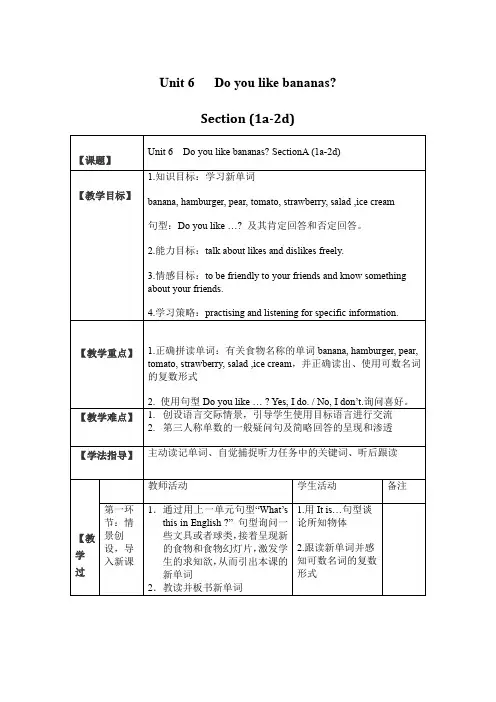
四人小组活动:使用Do you like…? Yes,I do.No, I don’t.I don’t like…等句型互相询问对方或回答欢与不喜欢的食物并做记录、填表。最后由一位同学向全班做汇报:I like…. I don’t like…. ZhangLi likes….
2 don’t.询问喜好。
【教学难点】
1.创设语言交际情景,引导学生使用目标语言进行交流
2.第三人称单数的一般疑问句及简略回答的呈现和渗透
【学法指导】
主动读记单词、自觉捕捉听力任务中的关键词、听后跟读
【教
学
过程】
教师活动
学生活动
1.观察主题图,出图中熟悉的食物并说出食物名称
2.完成1a的词图匹配活动
3.听录音,完成1b
4.两人一组进行口语交际Do you like…?Yes,I do./No,I don’t.
5.齐读2a中的词汇(食物名称).为听力做准备。
听录音,圈出听到的单词。
6.完成2a的任务。
7.两人一组,使用Do you like…?Yes,I do./No,I don’t.句型进行问答,了解同伴对食物的喜好。几组学生做展示。
1.引导学生观察主题图,让学生找出图中熟悉的食物
2.让学生完成1a的词图匹配活动
3.播放1b部分的录音让学生听,引导学生选出适当的对话并标明顺序,完成lb部分的教学任务。
4.引导学生展开Pairwork活动,完成1c部分口语交际的教学任务,运用助动词do进行问答,可采用师生互动带动生生互动的交流方式:Do youlike…?Yes,I do./No,I don’t.(板书句型)再让学生自编对话进行操练,巩固所学词汇和句型。
人教版七年级英语上册Unit 6 全单元教案
Unit 6 Do you like bananas?【教学目标】Topic: FoodFunctions: Talk about likes and dislikes.A: Do you like salad? B: Yes, I do. / No, I don’t.A: Do they like pears? B: Yes, they do./ No, they don’t.A: Does she/he like tomatoes? B: Yes, she does./ No, she/he doesn’t.I like oranges. I don’t like bananas.We like rice. We don’t like hamburgers.He likes ice-cream. He doesn’t like vegetables.Grammar:1. 掌握动词like 在一般现在时中的用法The simple present tense to like肯定句和否定句:I don’t like salad. Jo hn likes hamburgers.一般疑问句及其回答:A: Do you like bananas? B: Yes, I do./ No, I don’t.A: Does she like tomatoes? B: Yes, she does./ No, she doesn’t.2. 能够正确使用下列表示食物的可数名词、不可数名词以及既可用做可数又可用作不可数名词【C】hamburgers, eggs, oranges, bananas, apples, pears, carrots, vegetables, tomatoes, strawberries【U】milk, bread, riceBoth: food, fruit, ice-cream, salad, chickenWords and expressions:1. Words: fruit, banana, strawberry, pear, apple, vegetable, tomato, carrot, food, hamburger, bread, rice, salad, chicken, egg, milk, ice-cream, breakfast, lunch, dinner, birthday, star, habit, question, week, healthy, fat, right, eat, want, be, really, then, well, sure, so, burger2. Useful expressions: think about, how about, ask…about, want to do, after dinnerPronunciation:1. 尝试归纳字母a和字母组合ai/ay/al/aw在单词中的常见发音2. 根据名词复数形式的构成规律,尝试归纳复数名词的5种发音:/s/ /z/ /iz/ /ts/ /dz/3. 能够正确朗读学过的多音节单词,准确把握重读非重读音节【学情分析】本单元的主题是使用动词like询问对方对食物的喜好;谈论自己与他人喜欢吃的食物,学习并掌握行为动词的一般现在时的使用。
人教版英语七年级上册Unit6SectionA(1a~2d)教学设计

针对人教版英语七年级上册Unit6 SectionA(1a~2d)的教学内容,我对学生的学习情况进行分析。七年级的学生正处于青春期,他们的好奇心强,求知欲旺盛,对于新鲜事物具有较高的接受能力。在此阶段,学生的英语学习已经具备了一定的基础,能够进行简单的日常交流,但语法和词汇量仍有待提高。
(二)讲授新知
1.教师展示教材中的1a部分,引导学生学习新单词和短语,如:pen, pencil, ruler, eraser, school bag, book, phone等。
2.教师通过实物或图片,帮助学生理解并记住新单词和短语,同时引导学生运用一般现在时进行描述,如:“This is a pen. I have a ruler.”
3.互动交流,提高听说能力:课堂教学中,充分运用小组合作、师生互动等形式,让学生在交流中提高听说能力。通过模拟真实场景,引导学生进行物品归属的问答,帮助他们熟练运用所学知识。
4.巩固记忆,拓展词汇:课后布置作业,要求学生用一般现在时描述自己的日常用品,巩固所学词汇和语法。同时,鼓励学生在课后进行词汇拓展,如阅读英语绘本、观看英语动画片等,丰富词汇量。
1.创设情境,激发兴趣:通过图片展示、实物演示等手段,创设与学生生活密切相关的情境,激发他们的学习兴趣。同时,结合学生的年龄特点,设计趣味性强的教学活动,如:猜物品游戏、角色扮演等,让学生在轻松愉快的氛围中学习英语。
2.分层教学,因材施教:针对学生的不同程度,设计不同难度的练习题,使每个学生都能在课堂上得到有效的训练。对于基础薄弱的学生,重点辅导他们掌握一般现在时的基本用法;对于基础较好的学生,则引导他们进行更复杂的句子练习。
1.培养学生对英语学习的兴趣和积极性,使他们乐于参与课堂活动,敢于开口说英语。
人教版英语七年级上册 Unit 6 Section B教案

Unit 6 Do you like bananas?Section B (1a-1e)Unit 6 Do you like bananas?Section B (2a-2c)➢Ask Ss to write more healthy food and unhealthy food.Answers will vary.While-readingFirst Reading➢Reading Tip 1: PredictingT asks Ss to look at the title and pictures in 2b, try to predict: What's the article about?(T tells Ss what predict is: to have a guess. Any answer is OK here. Ss can tell the reason why they guess so.)Second Reading➢Reading Tip 2: scanningAsk Ss to scan the passage and complete the thinking map.➢Reading Tip 3: ScanningAsk Ss to judge which sentence is right and which sentence is wrong according to the passage.Answers: 1. F 2. F 3. T 4. T 5. TThird Reading➢Reading Tip 4: RetellingT asks Ss to retell the passage.(T can use the table above and give some clues to help Ss retell. T can say the first words of the sentences or use transitional words or questions to remind them of the next sentence if students forget. There will be somegrammatical mistakes when they are retelling, so teachers must use some transitional words to connect the sentences together, or to correct their pronunciations.)2b➢Ask Ss to read the magazine article and circle the food words.➢T ask Ss to write down the food that Cindy likes for meals and David likes for meals.T: Just now you have circled all the words about food. What does Cindy like for breakfast, lunch and dinner? What does David like for breakfast, lunch and dinner? Now write B for breakfast, L for lunch and D for dinner after the words.➢Let each S take out a piece of paper. Show Ss PPT P18 and ask them to write down the Chinese translation for each phrase.2c➢Ask Ss to write down five sentences about Cindy’s eating habits. While Ss are completing 2c, walk around the room and look at the sentence of different Ss. Choose sentences in which there are common errors, and write these sentences on the board. Then have Ss work in pairs to find the errors and suggest corrections. Elicit from Ss how to correct the sentences, and make the corrections on the board.Answers will vary.Post-reading➢Optional choice: Divide Ss into groups of four. Ask them to discuss what they like to eat for each meal. T can encourage Ss to say more about their preferences, e.g. I like ... but I don’t like ..., I always / never have ... for ... (T can write these sentences on the board if necessary).Unit 6 Do you like bananas? Section B (3a-Self Check)Exercise 1➢Ask Ss to write the plural forms of the words in the box on the left, then put them into the correct columns.Answers 1:Exercise 2➢First, ask Ss to choose a topic (i.e. the food / sports / colors they like or dislike), then let them write five sentences for that topic. Answers will vary.Exercise 3➢Tell Ss that they need to think about the food / sports / colors their parents like and write five sentences.Answers will vary.(T can encourage Ss to correct each other’s sentences first, then pick some Ss to read their answers to the whole class. )。
人教版英语七年级上册Unit6SectionB(2a~2c)教学设计
4.设计丰富的课堂活动,如情景模拟、角色扮演等,让学生在实际语境中运用所学知识,提高语言实践能力。
(三)情感态度与价值观
1.培养学生对英语学习的兴趣和积极性,使他们乐于学习、善于学习。
2.通过学习本节课的内容,让学生了解和尊重不同国家和地区的文化差异,培养他们的跨文化意识。
目的:提高学生的阅读速度和理解能力,培养捕捉关键信息的技巧。
3.小组活动:学生分组,每组设计一段对话,内容为在学校内询问某地点的位置。要求至少使用3次一般现在时,并在课堂内向全班展示。
目的:锻炼学生的口语表达能力,加强小组合作,提高实际语境中的语言运用能力。
4.词汇复习:请学生整理本节课所学词汇,用英语解释每个词汇的意思,并给出一个例句。
2.教师指导:教师巡回指导,观察学生的讨论过程,适时给予提示和帮助。
3.小组展示:每个小组派代表向全班展示讨论成果,其他同学认真倾听并给予评价。
(四)课堂练习
1.教学内容:设计相关练习题,巩固学生对词汇和句型的掌握,提高阅读理解能力。
2.练习形式:包括填空、选择、匹配等,让学生在练习中巩固所学知识。
此外,学生在阅读理解方面存在一定的困难,对文章的整体把握和细节理解能力有待提高。在情感态度方面,部分学生对英语学习缺乏自信,容易产生畏难情绪,需要教师在教学过程中关注学生的心理变化,激发他们的学习兴趣,帮助他们建立自信心。
因此,在本节课的教学中,教师应充分考虑学生的年龄特点、认知水平和情感需求,运用生动有趣的教学方法,引导学生积极参与课堂活动,提高他们的英语综合运用能力。同时,关注学生的学习差异,给予每个学生个性化的指导和鼓励,使他们在原有基础上得到提高。
人教版七年级英语上册教案(RJ) Unit 6 Do you like bananas
Unit 6Do you like bananas?第一课时Section A(1a-1c)1.重点单词:banana,hamburger,tomato,icecream,salad,strawberry,pear,milk,bread2.重点句式:—Do you like bananas?—Yes,I do.—Do you like salad?—No,I don't.1.用like来谈论喜好2.可数名词的单复数1.用like来谈论喜好2.可数名词的单复数一、预习课本P31新单词并背诵,完成下面的汉译英。
1.香蕉____________ 2.汉堡____________3.西红柿____________ 4.冰激凌__________5.沙拉____________ 6.草莓____________7.梨____________ 8.牛奶____________9.面包____________二、认真预习1a,1b,1c,找出下列句型。
1.—你喜欢香蕉吗?—是的,我喜欢。
________________________________________________________________________ 2.—你喜欢沙拉吗?—不,我不喜欢。
________________________________________________________________________Step 1情景导入Teacher:There are many different kinds of fruits and vegetables in the world,and different people like different food.Everyone has its own taste.What kind of food do you like?What kind of food do you dislike?Today let's talk about the food we like and we dislike in Unit 6.环节说明:由学生感兴趣的话题导入新课,简洁明了,激起学生的学习兴趣。
人教新目标七年级英语上册Unit6SectionB1a―2c学案
人教新目标七年级英语上册Unit6SectionB1a―2c学案Unit 6 Do you like bananas?Section B 1a―2c【教师寄语】Nothing seek, nothing find. 无所求,则无所获。
【学习目标】知识能力目标:1.学习并熟练运用本节课单词:breakfast, lunch, fat, star,eat,well, habit,healthy, really, question, want, be.2.会用行为动词一般现在时各种句型结构,以及动词“单三”形式的变化规律。
情感态度目标:学会如何营养搭配一日三餐,建立健康的饮食观念。
【导学过程1a--1e】温故互查一、用所给单词的适当形式或首字母填空:1. These are (tomato).2. He likes (strawberry).3. Tony (not like) rice.4. Tomatoes and carrots are v .5. Does Linda like h ?6. They have some (bread).7. Let’s (play) games.二、根据句意及所给的提示写单词:1. Tomorrow is my mother’s 40th _________ ( 生日).2. I like _______ ( 蔬菜) very much.3. We should eat some _______ (水果). It’s good for health.4. What kind of ________ (食物) do you like best?自主探究一、阅读教材1a--1e,在课本上找出下面的单词,并挑战一下自己的记忆力:1.早餐______2.午餐_______3.晚餐_______4.桔子_________5.米饭______6.banana_____8. chicken______ 9.eggs_______ 10.carrots______11. hamburger_________ 12.水果_______二、对号入座:请将英语单词与实物匹配A. riceB. bananasC. tomatoD. ice creamE. hamburgerF. saladG. chicken H. milk I. strawberry J. eggs K. pears L. apple三、选词完成对话(可以重复选用)。
人教版英语七年级上册Unit6 SectionA(1a-2c)全英版教案
Unit6 SectionA(1a-2c)全英版教案Teaching Aims1. Knowledge Objects(1)Function:Let the students know how to talk about their likes and dislikes by using the present tense. Learn some new words about food.(2)Key V ocabulary:hamburgers, tomatoes, French fries, pears, oranges, ice cream, salad, bananas, strawberries, like.(3)Target Language:①—Do you like bananas?—Yes, I do. /No, I don’t.—Does he/she like apples?—Yes, he/she does. No, he/she doesn’t.②He/ She likes….He/ She doesn’t like…(4)Structure:The countable nouns and uncountable nouns.2. Ability Objects:To learn to talk about likes and dislikes.3. Moral Objects:Enjoy your life and have a good health.Teaching Key PointsTo learn to ask what food you like and dislike.Teaching Difficult PointsTo talk about the countable nouns and uncountable nouns.Teaching MethodsListening and writing methods; Pair work; Group workTeaching AidsA tape recorder; Some picturesTeaching ProceduresStep 1 Warning-up and Revision (About 5 minutes)1. Daily greeting to the students.2. Revision: I have— Do you have…?T:Good morning/afternoon, children. (showing a fruit basket )I have a fruit basket. Do you have a fruit basket? Ask the students to ask and answer questions using the pattern:Do you have a…?Step 2 Presentation (About 10 minutes)1. Guessing games.Taking away the fruit basket and asking the students to guess:What’s in the basket? Using the sentence:Do you have …?Present the names of all kinds of fruits and food.2. Showing a picture of a fridge.Revise the names of food and fruits.Teach the new words of food and fruits by using the patterns:What’s this? It’s …What’re these? They’re…Pay attention to the plural forms of these new words.3. Practise.la: Match the words with the things in the picture.Then check the answer.2a: Listen and circle the food you hear.2b: Listen again, then fill in the blanks.Step 3 Presentation (About 8 minutes)Show the pictures again or take out an apple, act out like eating a delicious apple and say “ I like apples” for several times, then take an egg and say “I don’t like eggs”for several time, making a horrible face to them (Ask more questions about fruits and food).Talk about the students’ likes and dislikes. For example:T: Do you like salad?Ss: Yes, I do. /No, I don’t.T: Does he/she like hamburgers?Ss: Yes, he/she does. No, he/she doesn’t.The teacher can help the students to answer if they have any difficulties. Write。