
2020人教版九年级英语上Unit4课文重难点讲解与练习
【文库独家】Unit 4 I used to be afraid of the dark 短语、知识点辨析重点词汇:humorous, helpful, silent, dare, interview, require, private, seldom, absent, fail, general.短语:1. used to 过去常常2. be afraid of 害怕3. from time to time 时常,有时4. turn red 变红5. take….up 开始做6. deal with 对付、应付7. not….anymore 不再8. tons of attention 很多关注9. worry about 为…..担忧10. be careful 当心11. hang out 闲逛12. give up 放弃13. think about 考虑14. a very small number of…. 极少数的……15. be alone 独处16. give a speech 做演讲17. in public 当众18. all the time 一直,总是19. on the soccer team 在足球队20. be proud of 为……骄傲21. no longer 不再22. be interested in 对…….感兴趣23. make a decision 做决定24. in person 亲自25. to one’s surprise 令某人吃惊的是26. change one’s life 改变某人的生活27. even though 尽管28. take care of 照顾29. think of 关心、想着30. take pride of 为……感到自豪31. pay attention to 对…..注意,留心32. one of………….之一33. in the last few years 在过去的几年里固定词组:1. used to do sth. 过去常常做某事2. be afraid of doing sth. 害怕做某事3. give up doing sth. 放弃做某事4. have to do sth. 必须做某事5. make sb. do sth. 让某人做某事6. try to do sth. 尽力做某事7. adj. + enough to do sth. 足够……而能做某事8. be prepared to do sth. 准备做某事9. see sb. doing sth. 看见某人在做某事10. take up doing sth. 开始做某事11. begin to do sth. 开始做某事12. require sb. to do sth. 要求某人做某事13. decide to do sth. 决定做某某14. make a decision to do sth. 决定做某事15. It’s hard to believe that……很难相信……….16. It has been + 一段时间+ since + 从句自从……以来已经有很长的时间了17. dare to do sth. 敢于做某事18. It’s + adj. + for sb. + to do sth. 对某人来说做某事是……的重点句型:1. I used to be afraid of the dark. 我过去常常怕黑。
2. It’s hard to believe that he used to be a “problem child” until a conversation with his parents his way of thinking. 很难相信他过去是一个“问题少年”,直到一次和他的父母的谈话影响了他的想法。
3. It’s very important for parents to be there for their children. 父母陪伴在他们的孩子身边是很重要的。
知识点辨析:Section A1. Mario, you used to be short, didn't you? 马里奥,你以前个子矮,是吗?(1)本句是used to do 的反意疑问句。
used to do 的反意疑问句的附加疑问句部分要使用didn't。
如:He used to play the piano, didn't he?他过去常常弹钢琴,是吗?(2)used to是固定搭配,意为“以前经常;过去常常”。
如:She used to be quiet. 他过去很文静。
used to to 为不定式,后跟动词原形,used to do sth. “过去经常做某事”。
to 为介词,后跟动名词,be used to doing sth. “习惯做某事”。
be used to doingstth.be used to do sth. 被用于做某事,是被动语态不定式表示目的时,用于多种时态。
木材被用于建造房子。
Wood _______ ___________ _________ make houses.He_______ _______ live in the countryside, but now he _____ _________ _______living in the city.他过去住在乡村,但现在他习惯了住在城市。
1)My grandma ________ me stories when I was young.A.was used to tell B.is used to telling C.used to tell D.used to telling 2)Your father used to eat meat, ________?A.did you B.didn't you C.didn't he D.did he used to 的否定结构是didn’t use to.Tony 以前不常踢足球。
Tony _______ ________ _________ play soccer.________ you use to play the piano?A.Can B.Do C.Are D.DidThey used to be on the soccer team. ( 改为否定句) They ________ ______ ______ be on the soccer team.He has plenty of humorous stories to tell.他有许多幽默故事要讲。
(3)这是一个反义疑问句。
反义疑问句的特点是:前肯后否,前否后肯。
而且附加问句的动词在时态,人称和数等方面必须与前半句的动词相呼应。
如果陈述部分为否定句的反义疑问句时,附加反问部分“yes”表否定,“no”表肯定。
如果陈述部分带有否定的词语“little,nothing, few,seldom”等,附加疑问部分要用肯定形式。
----Jim had nothing for breakfast this morning, ______________? -----___________. He got up too late.A. Had he; YesB. hadn’t he; YesC. did he; NoD. didn’t he, No ---You didn’t go to school, did you? ----Yes, I did. / No, I didn’t. 不,我去了。
/ 是的,我没去。
2. humorous adj. 有幽默感的;滑稽有趣的。
是由humor+ous(形容词后缀)构成的派生词。
其名词形式:humor幽默;滑稽。
She likes telling jokes. She is a ______________ (humor) person in our minds.3. She was always silent in class.她在课堂上总是很沉默。
silent adj. 不说话的;沉默的;keep silent是固定搭配,意为“保持沉默”。
同根词:silently adv. 沉默地;silence n. 沉默,in silence老师要求我们保持安静。
The teacher asked us to ________ ________.We felt strange about his ___________ (silent) at the party as he used to be very active.4. Let past experiences provide you with helpful advice for the future. 让过去的经历为你的将来提供有用的建议。
helpful adj. 有用的;有帮助的; 是由help+ful(形容词后缀)构成的派生词。
以“ful”为后缀的形容词还有:care n. 小心careful adj. 小心的use n. 用途useful adj. 有用的beauty n. 美丽beautiful adj. 美丽的peace n. 平静;和平peaceful adj. 平静的;和平的thank n. 感谢thankful adj. 感谢的Our teacher gave us a lot of __________ (help) books in math.5. For this month's Young World magazine, I interviewed 19yearold Asian pop star Candy Wang.为了这个月的《青年世界》杂志,我采访了19岁的亚洲流行歌手坎迪•王。
interview v. 采访;面试n. 面试;访谈面试进行得非常顺利。
The __________went well.interview既可作动词,还可作名词。
派生词:interviewer n. 面试者;采访者interviewee n. 被访问者;被采访者They are going to have an ____________ (采访) tomorrow morning.6. She was never brave enough to ask questions. 她不够勇敢,不敢问问题。
brave enough意为“足够勇敢”,enough修饰形容词或副词时,要位于所修饰的形容词或副词的后面。
(最新)人教版初中英语:九年级上册 Unit 4 课文重点语法

Unit4 知识梳理Unit4 I used to be afraid of the dark.【重点短语】ed to do 过去常常做2.deal with 对付应付3.b e proud of 为…… 骄傲,感到自豪4.t ake pride in 为…… 感到自豪5.from time to time 时常,有时6.in public 公开地7.i n person 亲身,亲自8.t ake up sth 开始做,接受,占用9.not……anymore 不再10.worry about 为…… 担忧11.hang out 闲逛12.think about 考虑13.be alone 独处14.on the soccer team 在足球队15.no longer 不再16.make a decision 做决定17.to one’s surprise 令某人吃惊的是18.even though 尽管19.pay attention to 对…… 注意,留心20.in the last few years 在过去的几年里21.be afraid of 害怕22.turn red 变红23.tons of attention 很多关注24.be careful 当心25.give up 放弃26.a very small number of … 极少数的……27.give a speech 作演讲28.all the time 一直总是29.be interested in 对…… 感兴趣30.change one’s life 改变某人的生活31.take care of 照顾32.one of…, …… 之一【重点句型】1. I used to be afraid of the dark.我过去常常前害怕黑暗.2.I go to sleep with my bedroom light on.我开着卧室的灯睡觉.3.I used to spend a lot of time playing games with my friends.以前我常常花很多时间和我的朋友们玩游戏.4.I hardly ever have time for concerts.我几乎没有时间去听音乐会.5.My life has changed a lot in the last few years.我的生活在过去几年里改变了很多.6.It will make you stressed out.那会使你紧张的.7.It seems that Yu Mei has changed a lot.玉梅似乎变化很大.03词汇精讲1.silentsilent 是形容词,意为“沉默的;无言的”,其名词形式为silence。
(完整word版)人教版英语九年级上册Unit4知识点梳理及语法讲解,推荐文档.docx
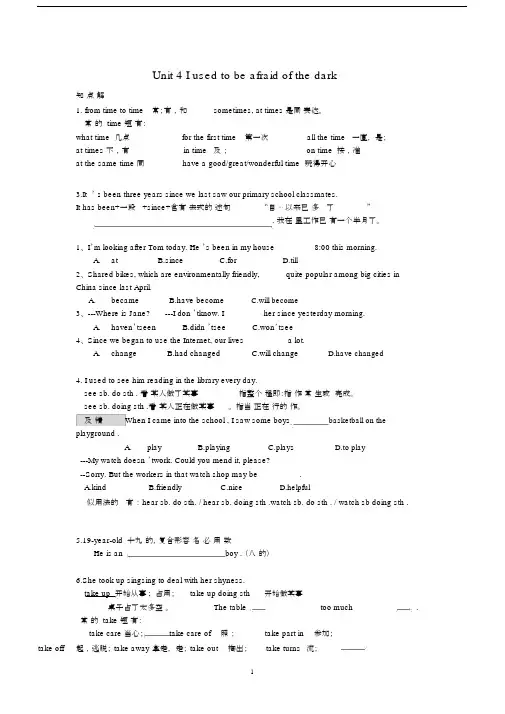
Unit 4 I used to be afraid of the dark知点解1. from time to time常;有,和sometimes, at times 是同表达。
常的 time 短有:what time 几点for the first time第一次all the time一直,是;at times 不,有in time及;on time 按,准at the same time 同have a good/great/wonderful time 玩得开心3.It ’ s been three years since we last saw our primary school classmates.It has been+一段 +since+含有去式的述句“自⋯ 以来已多了”. 我在里工作已有一个半月了。
1、 I’m looking after Tom today. He ’s been in my house ________ 8:00 this morning.A. atB.sinceC.forD.till2、 Shared bikes, which are environmentally friendly, _____ quite popular among big cities in China since last April.A.becameB.have becomeC.will become3、 ---Where is Jane?---I don ’tknow. I ________ her since yesterday morning.A. haven’tseenB.didn ’tseeC.won’tsee4、 Since we began to use the Internet, our lives _________ a lot.A. changeB.had changedC.will changeD.have changed4. I used to see him reading in the library every day.see sb. do sth . 看某人做了某事指整个程即:指作常生或完成。
2020人教版九年级英语上Unit4课文及详解
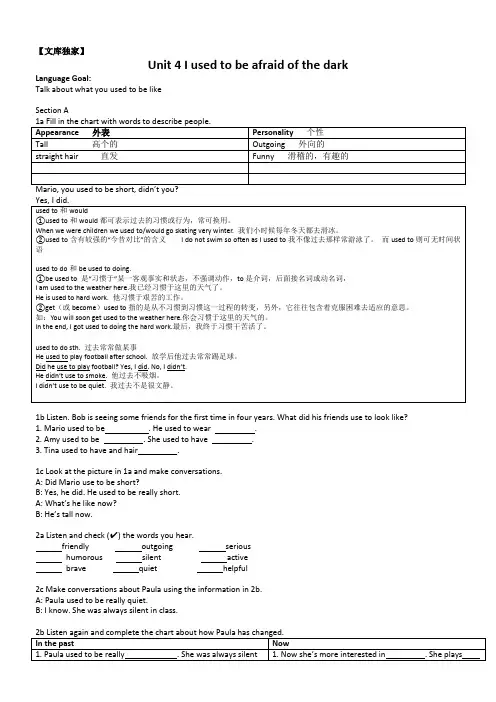
【文库独家】Unit 4 I used to be afraid of the darkLanguage Goal:Talk about what you used to be likeSection A1b Listen. Bob is seeing some friends for the first time in four years. What did his friends use to look like?1. Mario used to be . He used to wear .2. Amy used to be . She used to have .3. Tina used to have and hair .1c Look at the picture in 1a and make conversations.A: Did Mario use to be short?B: Yes, he did. He used to be really short.A: What’s he like now?B: He’s tall now.2a Listen and check (✔) the words you hear.friendly outgoing serioushumorous silent activebrave quiet helpful2c Make conversations about Paula using the information in 2b.A: Paula used to be really quiet.B: I know. She was always silent in class.2d Role-play the conversation.Alfred: This party is such a great idea!Gina: I agree. It’s been three years since we last saw our primary school classmates.Alfred: It’s interesting to see how people have changed.Gina: Billy has changed so much! He used to be so shy and quiet.Alfred: Yeah, his face always turned red when he talked to girls!Gina: I used to see him reading in the library every day.Alfred: That’s because he was a really good student. He s tudied hard and got good scores on his exams.Gina: Did he use to wear glasses?Alfred: Yes, and he used to be thin, too. But look how big and strong he is now!Gina: He’s so popular now. Look at all the girls around him!艾尔弗雷德:这次聚会是如此好的一个主意!吉娜:我同意。
九年级上册英语unit4知识点
九年级上册英语unit4知识点九年级上册英语 unit4 知识点在九年级英语的上册教材中,unit4是我们学习的重要内容之一。
本单元主要涵盖了描述人物外貌、性格特征和特长的词汇和表达,以及有关职业及工作的相关词汇与句式。
以下将分几个方面对unit4的知识点进行详细介绍。
一、人物外貌与性格特征在这一部分中,我们将学习到关于描述人物外貌的词汇,例如身高、体重、面貌等。
同时,我们还将学习如何用形容词来描述一个人的性格特征,如友好、勤劳、乐观等。
通过学习这些词汇,我们可以更好地了解一个人的外貌和性格特征,可以更好地进行人物描写。
二、特长与爱好在这一部分中,我们将学习用英语描述我们的特长和爱好。
无论是擅长音乐、体育还是其他方面的技能,我们都能用英语表达出来。
此外,我们还可以学习一些常用的短语和句子结构,例如"be good at"、"enjoy doing"等,来更准确地表达我们的特长和爱好。
三、职业与工作这一部分的学习内容主要涉及到职业和工作。
我们将学习一些常见的职业名称,例如医生、教师、律师等,并学习如何用英语来描述一个人的职业。
同时,我们还将学习到一些有关职业的短语和句子结构,例如"work as"、"be responsible for"等,来更加准确地表达有关职业的信息。
四、与职业相关的地点和工作环境与职业相关的地点和工作环境在英语中也有特定的词汇和表达方式。
例如,我们可以学习到词汇如医院、学校、办公室等,来描述与职业相关的地点;同时,我们还可以学习一些与工作环境有关的词汇,例如忙碌、有挑战性等。
通过学习这些内容,我们可以更好地了解职业与工作环境之间的关系。
五、祈使句和否定句在这个单元中,我们将学习如何使用祈使句和否定句。
祈使句用来表达命令、请求或建议,而否定句用来表达否定的意思。
通过学习这些句式,我们可以更加自如地用英语来表达自己的意思,并向别人传达我们的意图。
人教版英语九年级U4知识点
人教版英语九年级U4知识点概述作为九年级学生,我们正在学习人教版英语教材,对于Unit 4的知识点,我们将进行一次概述。
这个单元主要包括了一些基本的语法、词汇和阅读理解技巧。
首先,让我们来看一下这个单元的语法部分。
在Unit 4中,学生将学习比较级和最高级的形式与用法。
我们经常会用到比较级和最高级来比较不同事物的大小、高低、速度或者质量等等。
例如,我们可以说,“The book is more interesting than the movie.”(这本书比电影更有趣)或者“She is the tallest girl in the class.”(她是班上最高的女孩)。
接下来,我们来看一下这个单元的词汇部分。
在Unit 4中,学生将学习一些与颜色、衣着和描述外貌特征相关的词汇。
例如,我们可以学习词汇如red(红色)、pants(裤子)、big(大的)、tall(高的)等等。
通过学习这些词汇,我们可以更准确地描述我们所见到的事物和人物。
除了语法和词汇,阅读理解也是这个单元的重要一部分。
通过阅读不同的文章和故事,我们可以提高我们的阅读理解技巧和词汇运用能力。
同时,我们也可以了解一些与我们生活相关的话题,比如环境保护、交通安全以及健康生活等。
通过阅读,我们可以拓宽我们的知识领域,培养我们的思维能力和阅读能力。
总之,Unit 4是九年级英语教材中的一个重要部分。
通过学习这个单元,我们可以提高我们的语法、词汇和阅读理解能力。
这些知识将对我们的英语学习和将来的学习生活产生积极的影响。
在未来的学习中,我们可以继续探索更多的英语知识,提高我们的英语水平。
希望我们能够享受英语学习的过程,成为一名优秀的英语学习者。
九年级上册英语m4知识点梳理
九年级上册英语m4知识点梳理九年级上册英语第四模块(Module 4)是学生们在初中阶段的英语学习中相当重要的一部分。
本模块主要涉及课文学习、语法以及写作技巧等方面的内容。
下面我们将对这些内容进行梳理与总结。
课文学习部分是英语学习的核心,九年级上册英语m4模块的课文主题涵盖了从情感与心理到社交交际的多个方面,通过相应的课文,学生们可以了解并提高自己的英语水平。
其中,第一篇课文"Saying Yes"以探索年轻人如何做出决策为主题,第二篇课文"The TV Detective"讲述了一位少年凭着对警察剧的热爱改变了自己的人生,第三篇课文"Is that Art?"让学生们思考什么是艺术。
通过这些课文的学习,学生们可以培养他们的阅读和理解能力,同时也能够领略到不同文化背景下的思维方式和生活态度。
在语法方面,九年级上册英语m4模块主要涵盖了被动语态、虚拟语气、情态动词、间接引语和不定式等多个语法知识点。
其中,被动语态的掌握对于学生们的英语写作以及阅读理解至关重要。
通过学习被动语态,学生们可以清楚地了解到动作的执行者和接受者,以及他们之间的关系。
此外,虚拟语气在表达虚构、假设、命令和愿望等方面起着重要的作用。
通过掌握虚拟语气的用法,学生们可以更加流利地表达自己的观点和情感。
情态动词则是表明说话人的态度和意愿,是英语中常用的词汇之一。
间接引语的学习则是指导学生们如何正确引用他人的话语,这对于写作和交流都非常重要。
最后,不定式则是英语中常用的动词形式之一,可以用来表达目的、愿望等。
最后一部分是写作技巧。
九年级上册英语m4模块的写作主要围绕着议论文和提纲式作文展开。
学生们需要通过课文的学习和语法的掌握,灵活运用所学知识来展开自己的思维和表达。
在写议论文时,学生们要注意如何提出自己的论点,并且用适当的事实和例子来支持自己的观点。
而在写提纲式作文时,学生们需要先列出自己要写的主要内容,然后逐条展开,确保文章结构完整合理。
人教版九年级英语Unit4知识点精讲及练习题(K12教育文档)
人教版九年级英语Unit4知识点精讲及练习题(word版可编辑修改) 编辑整理:尊敬的读者朋友们:这里是精品文档编辑中心,本文档内容是由我和我的同事精心编辑整理后发布的,发布之前我们对文中内容进行仔细校对,但是难免会有疏漏的地方,但是任然希望(人教版九年级英语Unit4知识点精讲及练习题(word版可编辑修改))的内容能够给您的工作和学习带来便利。
同时也真诚的希望收到您的建议和反馈,这将是我们进步的源泉,前进的动力。
本文可编辑可修改,如果觉得对您有帮助请收藏以便随时查阅,最后祝您生活愉快业绩进步,以下为人教版九年级英语Unit4知识点精讲及练习题(word版可编辑修改)的全部内容。
新目标九年级Unit 4课前检测一、重点单词1. 幽默的___________ 2。
看守,守卫 n&v___________3. 沉默的___________4. 很少___________5. 得分,进球___________ 6。
影响___________7。
背景___________ 8. 缺席的,不在___________9。
面试;采访___________ 10。
失败,不及格___________11。
亚洲的,亚洲人___________ 12. 考试,审查___________12。
人群,观众___________ 14。
确切地,精确地___________15. 私人的___________ 16。
自豪的___________17。
需要,要求___________ 18。
普遍的;将军___________19。
讲话,发言 n。
___________ 20. 介绍 n。
___________二、重点短语1. 过去常做某事___________ 2。
为…感到自豪___________ ; ___________ 3. 应对;处理___________ 4. 做决定___________5。
公开地___________ 6。
人教版九年级英语unit4讲解与练习
Unit 4: What should you do?【重点短语】what if 如果…怎么样get along with 与.. 相处let … down 使…失望come up with 提出,想出catch up with 赶上,追上come out 出版plenty of 许多、大量by accident 偶然、意外地by mistake 错误地in public 公开地,当众get out of 逃避、避免be sure 肯定、确信right away 立刻【语言点】1、The old man had a million dollars……这老人有一百万美元……million,thousand,hundred 用法不能用复数:与数字连用three hundred,several thousand……必须用复数:hundreds of、thousands of、mi11ions of中2、He doesn’t know if he should bring a present.他不知道他是否应该带件礼物。
A.take拿走如: The chair is in the way. Take it to the classroom.bring带来如: Don’t forget to bring your homework next time.fetch去取来如: I'll fetch you a quilt and a overcoat.如果引导条件状语从句。
如果主句是一般将来时、祈使句或含有情态动词,则从句用一般现在时。
如: I’ll come here if it doesn’t rain tomorrow.B. if If you work harder, you’ll pass the exam.是否=whether, 引导宾语从句。
如: She asked me if/whether she could come in.3、What if I don’t know anyone? 如果我不认识任何人怎么办?What if ……如果……该(将会)怎么样?(引导条件状语从句、疑问句)如: What if she doesn’t come?她要是不来怎么办?What if your parents don’t agree? 如果你的父母不同意怎么办?What if you should fall sick? 如果你生病了怎么办?What about…………怎么样?如: What about speaking English in class?4、Confident people aren’t afraid to speak in public.confident 自信的be confident +that从句有信心…….be confident to do sth. 有信心做某事be confident of 对……有信心have confidence in对……有信心【练习】()1. Every year people come to our city to take a vacation.A. thousandB. thousand ofC. thousands ofD. two thousand of( ) 2. What if you a tiger in the forest?A. meetB. metC. have metD. would meet3. 大约有200人参加了这次运动会。
人教版英语九年级上册Unit4知识点和同步练习(无听力、有答案)
人教版英语九年级上册Unit4知识点Unit4 I used to be afraid of the dark.【重点短语】1. be more interested in 对…更感兴趣2. on the swim team 游泳队的队员3. be terrified of 害怕4. gym class 体操课5. worry about 担心6. all the time 一直,总是7. chat with 与…闲聊8. hardly ever 几乎从不9. walk to school = go to school on foot 步行去上学take the bus to school = go to school by bus 乘车去上学10. as well as 不仅…而且...【考点详解】1. used to do sth. 过去常常做某事(这个知识点考的很多,大家要注意这个短语的意思,还要记着used后面用的是不定式to do)如:He used to play football after school.放学后他过去常常踢足球。
2. play the piano 弹钢琴(play后面如果跟西洋乐器,大家记住,中间要加the,如果是中国乐器,不加the,如:play erhu)3. ①be interested in sth. 对…感兴趣②be interested in doing sth. 对做…感兴趣(对于这两个用法大家一定要掌握,切记切记)如:He is interested in math, but he isn't interested in speaking English. 他对数学感兴趣,但是他对说英语不感兴趣。
4. interested adj. 感兴趣的,指人对某事物感兴趣,往往主语是人interesting adj.有趣的,指某事物/某人具有趣味,主语往往是物(对于interested和interesting要区分清楚,一个主语往往是人,一个主语往往是物)5. be terrified of sth. 害怕……如:I am terrified of the dog.be terrified of doing sth. 害怕做……如:I am terrified of speaking.6. spend 动词,表示“花费金钱、时间”(spend和pay for它们的主语都是人,这一点大家要清楚)①spend…on sth. 在某事上花费(金钱、时间)(重要考点)②spend…(in)doing sth. 花费(金钱、时间)去做某事(重要考点,尤其要注意动名词,也就是动词的ing形式)如:He spends too much time on clothes. 他花费太多的时间在衣着上。
九年级(上)Unit4课本要点讲解
九年级(上) Unit 4课本要点讲解1. Danny’s father gets dressed quickly. 丹尼的父亲迅速地穿好了衣服。
get dressed意为“穿衣服”; get undressed意为“脱衣服”。
1) dress用作及物动词时,有下列用法:a.“给某人穿衣”,dress sb. / oneself。
如:Could you dress my kids for me? 你能替我给孩子们穿上衣服吗?b. dress后不能接“衣服”类的词作宾语,但“be dress ed in + 衣服或表示颜色的词”强调状态,意为“穿着……衣服”。
如:She was dressed in a green dress. 她穿着一件绿色的连衣裙。
2) dress用作不及物动词时,意为“穿衣”,有dress + 副词(或目的、场合的介词短语)的用法。
如:He dresses well. 他穿着体面。
It only takes him three minutes to dress in the morning. 他早上穿衣服只用三分钟。
2. I can’t breathe throu gh my nose!我不能通过我的鼻子呼吸!breathe用作动词,意为“呼吸”。
它的名词形式是breath。
breathe和breath语义相近,但读音不同。
如:Give me a moment to breathe. 给我一会儿工夫喘喘气。
Take a deep breath, and you may feel relaxed. 深吸一口气,你会感觉轻松的。
由breath构成的短语有:hold one’s breath屏住呼吸;save one’s breath不必白费口舌;out of breath上气不接下气。
3. I will take that medicine three times a day. 我将一天吃三次药。