
译林版高二英语 选择性必修一Unit 3 The art of painting L2 教案
1
《英语》(选择性必修·第一册)
Unit 3 The art of painting
Reading (II)
I. Learning objectives
By the end of the lesson, students will be able to:
1. understand the usage of the following words and expressions: gallery, decade, display, employ,
vivid, vision, as opposed to, lay eyes on;
2. establish word families from root words;
3. describe either the similarities or the difference between two things.
II. Key competence focus
Describe either the similarities or the difference between two things.
III. Predicted area of difficulty
Use the new words and expressions in a proper and correct way.
IV. Teaching procedures
Step 1 Warming up
T asks Ss some questions:
· How many painters are mentioned in the journal? Who are they?
Four. Claude Monet, Pierre-Auguste Renoir, Vincent van Gogh and Paul Gauguin.
· Do you often visit the museum? Tell your reasons.
· Match their works with their names.
1. Dance at Le Moulin de la Galette b a. Claude Monet
2. Blue Water Lilies a b. Pierre-Auguste Renoir
3. Starry Night c c. Vincent van Gogh
4. Day of the Gods d d. Paul Gauguin
【设计意图:再一次让学生了解世界著名艺术家和他们的杰作,回顾上节课的基本信息。】
Step 2 Establishing words families
T asks Ss to fill in the table below with as many words as they can.
T: We can form some English words by adding suffixes to the same root word and together they
form a word family. Establishing word families is an effective way to enlarge your vocabulary.
Verbs Nouns Adjectives
impress impression, Impressionism, Impressionist impressive,
Impressionist
dominate domination dominant
liberate liberation liberated
employ employment, employer, employee employable
2
influence influence influential
amaze amazement amazed, amazing
encourage encouragement encouraging
inspire inspiration
inspiring, inspired
differ difference
different
【设计意图:语言知识学习课前热身,回顾部分话题词汇,学会构词法中的基本的后缀形式, 帮助学生扩大词汇量。】
Step 3 Language learning
1. T asks Ss to finish B1 on page 33.
T: Please complete the passage with the correct forms of the words and phrases in the box below.
Answers:
(1) gallery (2) decade (3) display
(4) laid eyes on
(5) employing (6) vivid (7) as opposed to (8) vision
2. T asks Ss to translate the following into English, then complete the passage with the correct
form of the phrases.
I was looking forward to visiting the Musée d’Orsay, which is housed in an old building. The
world famous paintings made the deepest impression on me, I particularly appreciated the
masterpieces painted by two of the greatest Impressionist artists, Claud Monet and Pierre-Auguste
Renoir. Monet was inspired by nature, one of the famous pieces is Blue Water Lilies. I couldn’t
believe it when I heard he did around 250 paintings of the same water lily pond. Renoir preferred
to paint scenes of everyday life. I was struck by his masterpieces. Vincent van Gogh and Paul
Gauguin, whose works are also displayed at the Musée d’Orsay. They had a lasting influence on
the modern art. It certainly left a lasting impression on me too!
3. T asks Ss to learn some useful expressions.
(1) Get the Ss to find the sentences showing comparison from paragraph 5:
· Although the paintings had very different settings, it was their similarities that stayed with me
long after I left the Musée d’Orsay—similarities which can be seen throughout the Impressionists’
paintings.
· Everyday subject matter was the main focus of their works, as opposed to the history paintings
that had traditionally dominated European art.
· They employed free brushwork and used colours to show the effect of light on things, creating
paintings that were far less realistic than the works that came before.
Describing similarities: share, be similar to, like, as … as
Describing differences: as opposed to, in contrast to, be different from, than, unlike
(2) T asks Ss to finish B3 on page 33. look forward to
be housed in
prefer to
be struck by
have a lasting influence on
make the deepest impression on 期盼
位于喜欢
被 …… 打动
对 …… 产生持久的影响留下最深的印象
3
Answer: Both the Louvre Museum and the Musée d’Orsay are located in Paris. The Louvre houses
more than 7,500 paintings ranging from the 13th century to 1848. The Musée d’Orsay is different
from the Louvre in that it is mainly devoted to French art between 1848 and 1914.
【设计意图:通过再一次阅读文本,学习文本中的重点语言点,并掌握其在语境中的使用,
包括词汇和长难句等,让学生体验语言的魅力,欣赏英语语言丰富的表达,积累多样化的语言表达,培养学生的语言学习能力。】
Step 4 Writing
The students are encouraged to discuss the writing in pairs. Try to use what they have learned in
the class.
你的英国笔友 Jack 来信,让你向他介绍一位著名的中国画家以及他的作品和风格。
内容包括: 1. 人物简介
2. 代表作品
3. 评价
注意:词数 100 左右;行文连贯。
【设计意图:让学生基本掌握这些重要词汇的用法后,老师有意创造新语境,巩固本堂课的 内容,并进行延伸拓展,让学生真正对文本的语言知识点融会贯通,并鼓励学生用本课学习的语言知识介绍一位中国的艺术家,传播优秀的中国文化,培养学生的思维品质。】
译林版高二英语 选择性必修一Unit 3 The art of painting L3教案
1
《英语》(选择性必修·第一册)
Unit 3 The art of painting
Grammar and usage
I. Learning objectives
By the end of the lesson, students will be able to:
1. identify the use of verb-ing and verb-ed forms as predicatives;
2. work out the rules of verb-ing and verb-ed forms used as predicatives;
3. use the right forms of verb-ing and verb-ed to finish related tasks.
II. Key competence focus
Use verb-ing and verb-ed forms as predicatives correctly and properly.
III. Predicted area of difficulty
1. Work out the rules of verb-ing and verb-ed forms used as predicatives.
2. Apply verb-ing and verb-ed forms in new situations.
IV. Teaching procedures
Step 1 Lead-in
T shows Ss some pictures and asks Ss some questions.
T: Are you familiar with the National Gallery? Have you ever been there before? Visiting galleries
will give the public more chances to appreciate the art of painting.
译林版高二英语选择性必修二 Unit 1 The mass media L7 Project教案
《英语》(选修·第二册)
Unit 1 The mass media
Project
I. Learning objectives
By the end of the lesson, students will be able to:
1. research the news of a chosen area through cooperation and exploration;
2. use group work to write and present the news report;
3. know the tip of using quotes in a news report;
4. evaluate and comment on each group's work.
II. Key competence focus
Write a news report using quotes following the given example.
III. Predicted area of difficulty
Cooperate with group members and write the report together.
IV. Teaching procedures
Step 1 Brainstorming
1.T guides the students to talk about news by answering the following questions.
T: Various types of mass media have developed over time.
•What is mass media?
•What types of mass media do you usually rely on for information?
•What areas of news are you interested in?
译林版高二英语选择性必修一 Unit 4 Exploring poetry L1教案

《英语》(选择性必修·第一册)
Unit 4 Exploring poetry
Welcome to the unit & Reading (I)
I. Learning objectives
By the end of the lesson, students will be able to:
1. find out the key information from the lecture transcript;
2. have a better understanding of how to read a poem;
3. appreciate a poem following the four tips;
4. reflect on the author’s opinion about reading a poem.
II. Key competence focus
1. Understand the ways to read a poem.
2. Appreciate a poem following the four tips.
III. Predicted area of difficulty
Reflect on the author’s opinion about reading a poem.
IV. Teaching procedures
Step 1 Appreciation and comparison
1. T leads Ss to appreciate the quotation from “Preface to The Book of Songs” and asks them to
translate it into Chinese.
2. T encourages Ss to express their understanding of poetry from the quotation.
译林版高二英语选择性必修一 Unit 1 Food matters L3教案
《英语》(选择性必修·第一册)
Unit 1 Food matters
Grammar and usage
I. Learning objectives
By the end of the lesson, students will be able to:
1. identify the use of to-infinitives as subjects and predicatives;
2. use to-infinitives as subjects and predicatives properly in different situations;
3. write a thank-you note using to-infinitives.
II. Key competence focus
Use to-infinitives as subjects and predicatives correctly and properly.
III. Predicted area of difficulty
1. Use to-infinitives as subjects and predicatives in different situations.
2. write a thank-you note using to-infinitives.
IV. Teaching procedures
Step 1 Lead-in
T shows Ss some pictures and sentences to arouse their interest.
T: Hello, everyone. I would like to show you some pictures and sentences. These delicious food
are irresistible to me. And they are always enough to lift my spirits.
2020版译林英语高二必修三Unit 1能力提升题组训练A卷附答案解析
- 1 - 2020版译林英语高二必修三Unit 1能力提升题组训练A卷
Ⅰ.阅读理解
(2018北京海淀区高三二模)
Why Do People Blink Their Eyes?
People blink(眨眼)their eyes tens of thousands of times every day.Scientists have long
believed blinking was an involuntary movement and served mainly to keep the eyeballs wet.But
a new study suggests it has a more important purpose.
An international team of scientists from the University of California at Berkeley studied
the blinking of human eyelids.The journal Current Biology published their findings.The team
said they found that blinking “repositions our eyeballs so we can stay focused” on what
we are seeing.They said that when we blink our eyelids,the eyes roll back into their sockets—the bony area that surrounds and protects the eyes.However,the researchers found the eyes
don’t always return to the same position.They said this causes the brain to tell the eye
高二英语 牛津译林版(2020 )必修三 Unit 1 短语填空 (无答案)
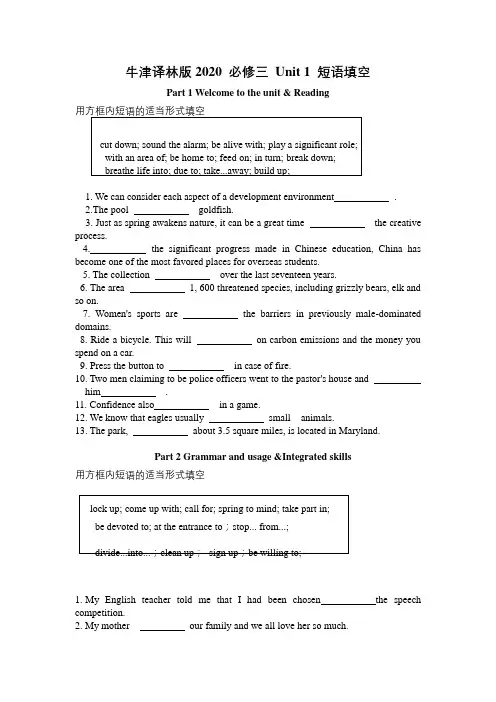
牛津译林版2020
必修三
Unit 1
短语填空
Part 1 Welcome to the unit & Reading
用方框内短语的适当形式填空
cut down; sound the alarm; be alive with; play a significant role;
with an area of; be home to; feed on; in turn; break down;
breathe life into; due to; take...away; build up;
1. We can consider each aspect of a development environment .
2.The pool
goldfish.
3. Just as spring awakens nature, it can be a great time the creative
process.
4. the significant progress made in Chinese education, China has
become one of the most favored places for overseas students.
5. The collection over the last seventeen years.
6. The area 1, 600 threatened species, including grizzly bears, elk and
so on.
7. Women's sports are the barriers in previously male-dominated
译林版高二英语选择性必修一 Unit 2 The Universal Language L1教案
《英语》(选择性必修·第一册)
Unit 2 The universal language
Welcome to the unit & Reading (I)
I. Learning objectives
By the end of the lesson, students will be able to:
1. find out the key information from the two posters;
2. give a brief introduction to Butterfly lovers and country music;
3. appreciate the universality of music;
4. recommend a piece of Chinese music to foreign friends.
II. Key competence focus
1. Find out the key information from the two posters.
2. Understand the relationship between music and culture.
III. Predicted area of difficulty
Recommend a piece of Chinese music to foreign friends.
IV. Teaching procedures
Step 1 Appreciation and comparison
1. T leads Ss to appreciate the quote from Xian Xinghai and asks them to translate it into Chinese.
2. T encourages Ss to express their understanding of “universal” from the quote.
2020译林版高中英语选择性必修三Unit 1 Wish you were here单词表
1
Unit 1 Wish you were here 默写
blooming /ˈbluːmɪŋ/ adj. 盛开的,开花的*(2)
unfold /ʌnˈfəʊld/ vi. & vt. 开花;展开,打开;展示,展现(2)
ethnically /ˈeθnɪkli/ adv. 从种族上*(2)
distinct /dɪˈstɪŋkt/ adj. 截然不同的,有区别的,不同种类的;清楚的,清晰的(2)
territory /ˈterətri/ n. (加拿大)地区;领土,领地;领域(2)
valley /ˈvæli/ n. 山谷,溪谷(2)
carve /kɑːv/ vt. 侵蚀,冲刷;雕,刻(2)
glacier /ˈɡlæsiə(r)/ n. 冰川*(2)
mighty /ˈmaɪti/ adj. 巨大的,非凡的;强而有力的(2)
splendid /ˈsplendɪd/ adj. 壮丽的,雄伟的;极佳的,非常好的(2)
apart from 除了…外(还),此外;除了…外(都),要不是(2)
urban /ˈɜːbən/ adj. 城市的,城镇的(2)
ancestor /ˈænsestə(r)/ n. 祖宗,祖先;原种 (2)
indigenous /ɪnˈdɪdʒənəs/ adj. 本地的,土生土长的*(2)
strait /streɪt/ n. 海峡,水道(2)
minority /maɪˈnɒrəti/ n. 少数民族,少数群体;少数,少数人(3)
cuisine /kwɪˈziːn/ n. 烹饪,风味;饭菜,菜肴 (3)
dynamic /daɪˈnæmɪk/ adj. (事物)有活力的;动态的,发展变化的;充满活力的(3)
sample /ˈsɑːmpl/ vt. 尝,品尝,体验;抽样检验n. 样本,样品;取样(3)
译林版高二英语选择性必修一 Unit 1 Food matters L1教案
《英语》(选择性必修·第一册)
Unit 1 Food matters
Welcome to the unit & Reading (I)
I. Learning objectives
By the end of the lesson, the students will be able to:
1. know about some information of comfort food from a magazine article;
2. develop their reading skills;
3. express their opinions on comfort/favorite food;
4. keep their positive attitude towards life.
II. Key competence focus
1. Analyse and summarize the structure of the text.
2. Think critically and express opinions freely.
III. Predicted area of difficulty
1. Understand the structure and improve reading skills of the magazine article.
2. Express their opinions properly according to the topic.
IV. Teaching procedures
Step 1 Lead-in
1. T asks a question:
When you feel unhappy, what will you do?
(T: As for me, when I fee unhappy, I will eat some delicious food. Because the yummy taste can
2020牛津译林版选择性必修一 Unit3 First Impressions教案
第 1 页 共 3 页 Book 1 Unit 3 The art of painting
Reading 1
First impressions
一、教学目标
By the end of this section, students will be able to:
1. interpret the title of this travel journal;
2. recognize works created by Impressionists;
3. give an introduction to the Impressionists’ paintings;
4. appreciate the Impressionists’ paintings.
二、教学重难点
1. To understand the meaning of the title “First impressions”;
2. To introduce the Musée d’Orsay briefly;
3. To describe the features of the Impressionists and compare the differences of paintings by Monet and Renoir.
三、教学过程
步 骤 教学活动 设计意图 互动时间/模式
Pre-reading
Step 1 The teacher has students work in pairs to
answer the following questions.
1. What type of painting do these paintings
belong to?
2. Why do people visit art museums? 激活学生已有的关于绘画作品的认知和经验,引出主题。 5’
Pair Work