
人教版新目标九年级英语unit4教案
人教版新目标九年级英语unit4教案Unit 4 What would you do?Period 1Language goals 语言目标1. Words & expressions 生词和短语million, medical, research2. Key sentences重点句子What would you do if you had a lot of money?Ability goals 能力目标Enable the students to understand and talk about imaginary situations.Teaching important 教学重点Talk about imaginary situations, worries/problems.Teaching procedures教学过程Step 1 Revision and Lead-inAsk one or more students to show their work.T: In the last unit, you were asked to do a project on a famous person’s childhood and how he/she became successful. Now who’d like to display your project on the classroom wall? Eg , EdisonThen ask the students to tell what they can learn from Edison.T: Edison had a really different childhood from us. He was the greatest inventorin the nineteenth century. Of all his inventions, electric bulb, is one of the most important. But just imagine what the world would be if there is no electric bulb? Today we’re going to learn how to talk about things that haven’t happened. Step II Listing and SpeakingAsk the students to read the picture on Page 26.T: When we talk about things that haven’t happened, we can use the words I wouldor I’d. Now look at the picture on Page 26. What can you see in the picture? S: We can see some people, a school, a zoo, a research lab, a bank.T: What are the people in the lower part of the picture doing?S1: Maybe they are thinking about the answers to the question shown in the picture. S2: The woman is reading a newspaper and they are all thinking of the answers to the question.T: Pretend you are the people in the picture, what would you do if you had a million dollars?S3: I’d buy a beautiful car.Write buy a beautiful car on the blackboard.S4: I’d build a research lab.S5: I’d give it to the Hope Project.S6: I’d travel around the world.S7: I’d give it to medical research.…Ask for more ideas from the students. Write their ideas on the blackboard.buy a beautiful car,travel around the world, give it to the Hope Project, builda school for the poor children, build a library for our school, build a researchlabShow the following to the students and then ask them to practice in pairs.-What would you do if you have a million dollars?-I would (I’d) ____________.T: Now work in pairs and make dialogues.Sample dialogues:1.– What would you do if you saw someone stealing something?–I’d call the police.2.– What would you do if you lost your bike?–I’d buy a new one.3.– What would you do if you saw a girl crying in the street.–I’d help her find her mother.4.– What would you do if the teacher asked you to sing a song to the class?–I’d say yes.5.– What would you do if you found a wallet in the street?–I’d give it to the police.Step III ListeningAsk the students to listen to the recording and compare their answers with thosein the recording.T: Next we’ll hear a conversation about how to spend a million dollars. The recording will be played twice. For the first time, listen to get the order you hear. Play the tape for the first time.T: For the second time, please number the picture in the order you hear them. Play the tape for the second time. Then check the answers.Step IV Homework1.Ask the students to do more practice as required in 1c on Page 26.2.Ask the students to prepare for the next period: Think about if you have anyworries or problems in daily life.Unit 4 What would you do?Period 2Language goals 语言目标1. Words & expressions 生词和短语 tie, worry, what if, pimple2. Key sentences重点句子If I were you, I’d take a small present.Ability goals 能力目标Enable the students to deal with problems and worries.Teaching important 教学重点Talk about problems /worries.Teaching procedures教学过程Step 1 Revision and Lead-inAsk the students to share their ideas about what their worries are first, and then listen to the recording talking about worries.Step 2 Listening Practice (2a, 2b , 2c)Ask the students to listen to the dialogue about Larry’s worries.Play the recording for the first time. Choose the reasons why Larry is nervous? Check the answers, then play the recording for the second time. Check the four things Larry’s sister says to him .( 1, 2, 4, 5)Step 3 PairworkIf you were Larry, what would you do? Make dialogues in pairs.Sample conversation:A: What would you do if you were Larry?B: If I were Larry, I would bring a birthday cake.Step 4 Grammar focus虚拟语气:如果我们所说的不是事实,也不是要求、命令、劝告等,而只是一种假设、愿望、建议或是一种实现不了的空想就用虚拟语气。
人教版英语九年级全一册教案Unit4SectionA

Unit4 SectionA (1a-2d)教课方案【教材版本与册数】新目标人教版九年级上册【单元名称】 Unit4I used to be afraid of the dark.【课时】 Section A 1a-2d(第 1课时)【课型】 Listening and Speaking(听闻课)【本单元话题】环绕“我们发生了如何的变化”为话题,讨论“过去常常有的习惯”。
【本单元要点掌握目标】理解、掌握和运用 used to构造。
【教材内容拆分剖析】Section A 从描绘相貌和个性有关的词汇下手,睁开了简单描述“过去”的听力、会话和阅读活动,对人物的个性、相貌和经历作今昔对照,使学生感知新语言内容used to 的构造特点,领会其用法。
Section A(1a~1c)复习和稳固学生已学过的有关个性和相貌的词汇,同时经过听闻活动导入usedto这一语言构造,并借助主题图创建的语境,模拟生活情境,指引学生睁开初步的对话演练。
1a中的主题图为本单元目口号言used to供给了一个主题情境。
1b是本单元基础的听力输入,内容浅易,让学生经过听初步感知本单元目口号言used to。
1c是在听力输入基础上的控制性口语输出used to。
Section A(2a~2d)通过新一轮的听说活动,教材剖析介绍更多描绘性格的形容词,并经过聆听对于人们今昔变化的对话,让学生领会used to 真切的平时社交中的运用,从而理解其功能意义。
【经过本单元的学习,学生需掌握哪些综合技术】1. 需理解、掌握和运用描绘相貌、性格和喜好的生词和短语;需理解、掌握和运用used to构造。
2.能在听力练习中可以捕获有关人物生活变化方面的细节信息。
3.运用 used to 描绘过去的形象,性格,喜好及经历。
4.可以经过新旧对照,学会关注别人的变化和关怀别人,意会人生的转折和掌握命运的方法。
5.需利用了略读、跳读、上下文语境或句子前后关系猜词的方式进行阅读,提升阅读理解的有效性。
人教版英语九年级全一册教案:Unit4 SectionA(3a-3c)

人教版英语九年级全一册教案:Unit4 SectionA(3a-3c)Unit4 SectionA(3a-3c)教案【教材版本与册数】新目标人教版九年级上册【单元名称】Unit4 I used to be afraid of the dark.【课时】Section A 3a-3c(第2课时)【课型】Reading(阅读课)第 2 页第 3 页教材分析第 4 页教学目标教学重难点教学重点:1.正确使用Section A 3a-3c所有重点单词,短语和句型;正确使用used to结构,包括肯定、否定、疑问及其回答。
2.学习用描述人的个性的词汇描述人的变化。
教学难点:学用描述人的个性的词汇描述人的变化。
建议教法以任务型教学作为课堂教学理念、利用引导法和三步阅读教学法完成相应阅读任务。
Pre-reading: lead in-PresentationWhile-reading: Skimming- Scanning– Intensive reading-Listening and readingPost-reading: Retelling-Discussion-Inference-Different activities第 5 页教学流程(详见相应教学设计)教学评价1.本课时的目标设计清晰可操作,活动的设计紧扣目标要求并与目标达成一致。
2.读中的活动设计遵循语言规律,符合阅读课目标,由浅入深,环环相扣,能兼顾边缘生。
3.读后的活动设计体现运用教材有创造性,补充内容有针对性,拓展知识有可行性,课后作业能体现知识的迁移性。
有利于对学生思维品格的训练与培养。
【本课时教学设计】步骤过程措施(教师活动与学生活动)目的持续性评价DELC4 1预备与激活先期知识Step 1Greeting andLeading in( 3mins)Greet the class as usual and ask Ss to reviewusing “used to” and “ now”. E.g.T:What did you use to be like?S: I used to be shy.T:Are you still now?S: No, I’m not.I am popuar..2.T asks Ss some students.(1) How have you changed since you was a child?(2) What does it help you with?利用IQEE策略,利用复习所学描述人物外貌和性格的方法及词汇,通过老师询问学生从小到大的转变的问题与本堂课的话题Candy的人生经历变化建立起记忆连接。
人教版新目标九年级英语Unit4教案
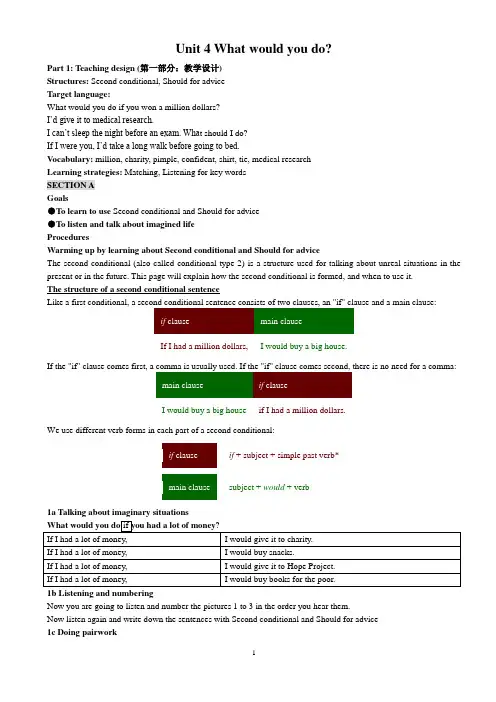
Unit 4 What would you do?Part 1: Teaching design (第一部分:教学设计)Structures: Second conditional, Should for adviceTarget language:What would you do if you won a million dollars?I’d give it to medical research.I can’t sleep the night before an exam. Wha t should I do?If I were you, I’d take a long walk before going to bed.Vocabulary: million, charity, pimple, confident, shirt, tie, medical researchLearning strategies: Matching, Listening for key wordsSECTION AGoals●To learn to use Second conditional and Should for advice●To listen and talk about imagined lifeProceduresWarming up by learning about Second conditional and Should for adviceThe second conditional (also called conditional type 2) is a structure used for talking about unreal situations in the present or in the future. This page will explain how the second conditional is formed, and when to use it.The structure of a second conditional sentenceLike a first conditional, a second conditional sentence consists of two clauses, an "if" clause and a main clause:If I had a million dollars, I would buy a big house.If the "if" clause comes first, a comma is usually used. If the "if" clause comes second, there is no need for a comma:I would buy a big house if I had a million dollars.We use different verb forms in each part of a second conditional:if + subject + simple past verb*subject + would + verb1a Talking about imaginary situations1b Listening and numberingNow you are going to listen and number the pictures 1 to 3 in the order you hear them.Now listen again and write down the sentences with Second conditional and Should for advice1c Doing pairworkLet’s pretend that we are the people in the picture on page 26. Talk with your partner about what you would do if you had a million dollars.Look. This old man had a million dollars, and he gave it to charity.Wow! What would a million dollars?I’d give it to medical research.I’d take a chance to achieve my dream of flying to the moon.a million dollars, I’d stop working and become a professional runner.I’d go to an old people’s home to help them.I’d volunteer at the hospital twice every week.2a Listening and circlingListen to the tape and circle the reasons in the box on page 27 why Larry is nervous.2b Listening and checkingListen to the tape again and check on page 27 the four things Larry’s sister says to him.2c Doing pairworkXu Linfeng, you are Larry. Men Yati ng, you are Larry’s sister. Xu is going to talk about his worries and Men is going to give him advice.X: I don’t know what to wear.M: If I were you, I’d wear a shirt and tie.X: I don’t have a present. What if everyone elseM: If I we re you, I’d take a small present—a pen or something. brings a present?X: What if I don’t know anyone?M: If you don’t know anyone, you can talk to Tom. He’llintroduce you to people.……3a Reading and matchingGo to page 28. Read the problems in the boxes and match them with the correct advice.And now write down all the expressions into your phrase book.be really shy, enjoy parties, get nervous before big parties, get pimples, look terrible, the night before…, take a big exam, do well, help with…, eat lots of fruits, drink lots of water, take a long walk, go to bed, look friendly, feel shy3b Thinking and role playingNext you are going to think of different advice for the problems in activity 3a. Role play conversations with your partner.A:I am really shy. I don’t enjoy parties.B:If I were you, I’d go and shout in the street. I’d set up parties and invite all my classmates to come and sing and dance.A: I get nervous before big parties and I get pimples.B: Pimples look good to me. They are not terrible at all. I f I were you, the night before the big exam I’d lie in bed counting the cows, the sheep, the cattle and the horses. Then I’d have a nice sleep. If you count as many cows as possible you’d do well in the exam.A:I can’t lose my weight.B: If I were you, I’d eat lots of fruits, drink lots of water and take a long walk before going to bed every evening.4. Doing group workClosing down by taking a test on Second conditionalMatch up the parts of the sentence1. If I lost my job,A we'd both benefit.B I'd have a lot of problems getting another one.C you'd be more aware of what people really felt.D we wouldn't be so behind technologically.2. If I were in your position,A I'd resign rather than wait to be sacked.B I'd have a lot of problems getting another one.C you'd be more aware of what people really felt.D we wouldn't be so behind technologically.3. If I spoke Japanese as well as you do,A I'd resign rather than wait to be sacked.B I'd try to find a job with one of the Japanese banks.C we'd both benefit.D we wouldn't be so behind technologically.4. If we spent more on Research and Development,A I'd resign rather than wait to be sacked.B I'd have a lot of problems getting another one.C I'd try to find a job with one of the Japanese banks.D we wouldn't be so behind technologically.5. If you spoke less and listened more,A I'd resign rather than wait to be sacked.B I'd have a lot of problems getting another one.C I'd try to find a job with one of the Japanese banks.D you'd be more aware of what people really felt.6. If you spent more time on your own problems and a bit less on mine,A I'd resign rather than wait to be sacked.B I'd have a lot of problems getting another one.C we'd both benefit.D I'd try to find a job with one of the Japanese banks.7. If we controlled our expenses a bit better,A I'd resign rather than wait to be sacked.B I'd have a lot of problems getting another one.C we'd save a lot of money.D I'd try to find a job with one of the Japanese banks.8. If you invested some time into learning how the Internet works,A you'd find that it could really help you in your job.B I'd have a lot of problems getting another one.C we wouldn't be so behind technologically.D I'd try to find a job with one of the Japanese banks.9. If we opened an office in Tokyo,A we wouldn't be so behind technologically.B you'd be more aware of what people really felt.C I'd be interested in working there.D we'd both benefit.10. If you didn't take the job,A you'd regret it later.B you'd be more aware of what people really felt.C we wouldn't be so behind technologically.D I'd try to find a job with one of the Japanese banks. SECTION BGoals●To find out about people’s personalities●To learn to communicate by Second conditional and Should for adviceProceduresWarming up by learning about personalityWhat is personality? What is your personality?In psychology, personality describes the character of emotion, thought, and behavior patterns unique to a person. There are several theoretical perspectives on personality in psychology, which involve different ideas about the relationship between personality and other psychological constructs, as well as different theories about the way personality develops.1a Describing and fillingTurn to page 29 and fill in the blanks with words given.1b Which words in activity 1a describe you? Tell your partner.What are you like? I think I am creative and outgoing.2a Listening and checkingCella is asking Bill questions from a personality survey. Check the questions Cella asks.2b Listening and circling2c Doing pairworkIn pairs ask and answer the questions in the personality survey on page 29.3a Reading and fillingLook at the survey in 2a and read the personality survey result below on page 30. Fill in the balnks with a, b or c.3b Looking and writingNext you are to write your own personality survey based on the that in 2a.4 Doing groupworkAsk students in your group the questions from your survey. Discuss the results.Closing down by taking a personality surveyRead each statement carefully, and choose one answer from “Strongly Agree”, “Agree”, “Disagree”, “ Strongly1.Filling the blanksOn page 31 is a box with sentences in black. Read them and fill in the blanks with a correct word given. Make changes to the form if necessary.2.Reading an e-mailRead the e-mail from Fran and copy all the expressions.Just for funTo end this period let’s do something fun—to find the animals.Reading: What would you do if …?Before you read, go to page 148 to learn the words for this reading passage first.While you read, put the sentences into thought groups and underline all the useful phrases to be copied later after class.。
新目标人教版九年级英语Unit4-What-would-you-do-教案
Unit4 What would you do?The First PeriodI. Teaching Aims and Demands1. Knowledge Object(1)Key V ocabularymillion, medical, research(2)Target LanguageLook. This old man had a million dollars, and he gave it to charity. Wow! What would you do if you had a million dollars?I’d give it to medical research.(3)StructureI would/I’d do2. Ability Objects(1)Train students’ listening skill.(2)Train students’ communicative competence.3. Moral ObjectIf you had a million dollars, you’d buy a big house, buy a car and so forth. However, we would help other people who need help if we had a lot of money.II. Teaching Key Points1. Target language2. The structure: I would/I’d doIII. Teaching Difficult PointThe structure: I would/I’d doIV. Teaching Methods1. Scene teaching Method2. Teaching by induction3. PairworkV. Teaching AidA projectorVI. Teaching ProceduresStep I. lead-inShow the pictures of Lijiacheng and Bill Gates to the class, asking “who is he?” Get students to focus attention to the class.“They are rich men. Both of them have a lot of money”Show the picture of money. And lead the students to learn and read the new vacabulary million.T: “Do Lijiacheng and Bill Gates have a million dollars?”Ss: “Yes.”Ss: “No.”T: “Well. I don’t have a million dollars, either. It doesn’t matter. Let’s imagine that if the money were yours.”T: “What would you do if you had a million dollars? You can answer me with ‘I would…’ Here, more pictures may help you.”Show the pictures for the students to brainstorm.Step II. Activitiy 1a1.WritingGet the students to add more ideas and fill in the chart.Invite some students to share their answers in the sentences patterns as following:T: “What would you do if you had a million dollars?”Ss: “I would…”The teacher introduce more materials for the class. Lead them to know that money can do many things like helping other people.2. Grammar: the subjunctive moodSummarize the meanings and the structure of the subjunctive mood.The meaning: to describe the imaginary situations.“If +S+the past tence of the verb/were, S+would+verb.”Then ask the students to make sentences individually:Invite some of them to present their ideas.Step III. 1b Listening1.Play the recording. The first time, the students listen and number the pictures[1-3] in the order. Ask one student to answer. Then correct it. Correct answer: 2,1,4,32.Play again. This time, the students should fill in the chart.3.Then fill in the blanks using the informaion they heard and say out each of the whole sentence by a group.Step IV. Oral practice and pairworkShow the sentence patterns on screen. Ask the students to do the pairwork with their partners.Then gether the pictures for the students to do the pairwork.A: What would you do if you had a million dollars?B: If I had a…, I would/ I’d… .Step V. Practice1. Provide more topics for the class to discuss.“If I were my mother, I would/I’d…”“If I were a spacewoman, I would/I’d…”“If I were Bill Gates, I would/I’d…”Ask some students to show their opinions.2. Rush to answer: fill in the blanks and translate the sentences.i.What would you do if you ______ (step)on the moon?ii.What would you do if you ______ (get) lost on your way home?iii.What would you do if you ______ (be)your parent?iv.如果我有一百万美圆,我就会买一栋大房子.v.如果我是你, 我就会去那里。
Unit 4 Section B 2a-2f 教案 人教版英语九年级全册
教学策略与设计说明
阅读教学中通过读前预测,读中寻找关键词抓住段落大意和上下文还原句子并猜测词意的阅读技能的培养提升阅读理解能力。
教学过程
教学环节(注明每个环节预设的时间)
教师活动
学生活动
设计意图
一、
导入(启发探究 5分钟)
二、Reading:交流(合作探究 20分钟)学习课文
教学设计
基本信息
名称
Unit 4 I used to be afraid of the dark.
Section B 2a-2f
所属教材目录
新目标九年级英语
教材分析
本课时文章介绍中学生李文在学习、生活方面的过去与现在的不同。训练学生阅读短文,能够根据上下文的理解猜单词词组的含意,培养学生阅读技巧。
学情分析
三、总结(引深探究 8分钟)
四、能力提升(8分钟)
Step1.
Show some pictures about the left-behind children.
Ask : what do you think of the children?
Step2.
Show a picture of a student and a teacher. Tellstudentsthat the boy is Li Wen. He’s a 15-year-old boy whose parents are working in the city. And the teacher is talking to him about his study.Look at the title of the passage and predict the problems he might have.
人教版英语九年级全一册unit4教案.docx
Unit 4I used to be afraid of the dark.一、教学目标:知识与技能: Knowledge and Ability Objects1.会写 , 会读 , 会用本节课的重点单词短语。
2. 熟练运用 used to do sth 谈论自己、他人过去的习惯、爱好、形象及经常做的事情。
过程与方法 : Method Objects in Teaching1.本课的生词和短语。
2. 通过听力练习,进一步掌握用 Used to do 谈论过去的喜好 3. 能够表达自己现在和过去在外表、性格、爱好等方面的变化。
通过阅读技巧的学习,让学生了解如何通过上下文猜测词意。
情感态度与价值观:培养学生克服困难,战胜自己的勇气,特别是如何用爱来感动学友。
二、教学重点:掌握 used to do句型三、教学难点:学会表达自己现在和过去在外表、性格、爱好等方面的变化四、教具准备: PPT录音机五、授课类型:新授课六、课时安排:本单元共 5 课时:Section A (1a— 2d)1 课时Section A( 3a—4c)1 课时Section B (1a— 1e)1 课时Section B (2a— 2f )1 课时Section B (3b-self check)1课时七、备课时间: 2015.9.22八、教学过程Section A (1a-2d)复备栏1.情景引学Step 1: Lead-inWe have been together for over two years. Do you remember whathe was like before? /in Grade One? What does he look like now?Compare two or three students or teachers. Let students tellsomething about their appearance or personality.Write “ He was short in Grade OneBut. he is tall now.”Today we learn a new sentences He used“ to be short. But heis tall now . ”2. 自主探学Step 2: explain “ usedto be/do ” “He used to play computergames every day. But now he study really hard.”Let students describe their partner. Please use“ used to do /be”Step 3: Deal with activity 1aTurn to p25, let’ s look1aat.Please write down the words as manyas possible. if you want to know others’ appearance or personality, we can ask:“ What does he look like?/ What’ s he like?”3.合作研学Now I want to know something about yourself. “ What’yourschange? ” Please use “ I used to ⋯I ,but⋯”nowFour students a group.4.变换拓学Step 4: Deal with 1b and 1c.Let ’looks at the picture. and could you tell us what are theirchanges?Listen to the tape and do 1bStep 5: deal with 2a and 2b.Listen to the tape and do 2a and 2b重点句型:1. I used to be afraid of the dark.我过去常常怕黑。
新人教版教材九年级英语第四单元全单元教案设计解析
Teach the students to love studying and try to find the best and most3.How to use verbs.4.Describing a person.Ⅲ、学情分析本课时Section B的3a是一篇中长文章内容主要是作者谈到他现在遇到的最在问题,同样也是以比较的形式来描述。
3b补全一篇短文,加深对used to的运用,提高学生的写作能力。
3c主要是运用used to 写一篇自小学以来自己各方面发生了哪些变化。
Ⅴ、教学资源:Multi-media equipment.VI、教学方法:Focus on the students’training. Try to find out and solve problems through practical applying.VII、教学过程:Step 1 Revision1. Greetings .2. Check the homework .Step 2 ReadingSB Page 6 , 3a .1. Read the instructions and make sure students know what to do .2. Give students several minutes to read the article and finish the task .3. After students finished ,ask one student to write his/her answers on the blackboard.4. Correct the answers .5. Ask one volunteer to read the article aloud to the class ,offer assistance if necessary .Step 3 WritingSB Page 6 , 3b .First ,have students finish the letter on their own ,while they areworking ,walk around and give them some help .Then ask two students to read their letter aloud to the class .Finally answer some questions the students may have .Step 4 InterviewSB Page 6 ,Part 4 .1. Read the instructions and explain how to finish this task .2. Divide the class into groups of four. In each group ,each student takes turn interviewing the other students and take notes .3. Ask some groups to tell the class about their answers .Step 5 Self-checkSB Page 7 , Part 1 .1. Students finish it on their own first ,then check the answers with the whole class .2. Ask some students to make their own sentences with these words orally .SB Page 7 , Part 2 .You should have the courage of your opinions.Ⅱ.Teaching Key Points1.I used to be really quiet.I know. Now you are very outgoing.2.Did you use to have straight hair?Yes,I did.3.Did you use to play the piano?No, I didn't.II.教学重难点:1.Yes/No questions with used to2.Statements with used toⅢ、学情分析本课时为第一单元第五课时内容。
人教版英语九年级全册-Unit 4 Section A (1a—2d)教案
Unit 4I used to be afraid of the dark.Section A (1a—2d)一、教学目标1. 熟练掌握下列词汇和短语:humorous, silent, helpful, score, from time to time, used to…2. 掌握并运用下列句型:Did Mario use to be short?Yes, he did. He used to be really short.What’s he like now?He’s tall n ow.Paula used to be really quiet.I know. She was always silent in class.3. 能够听懂关于人们今昔变化的对话,运用used to结构描述自己和同学曾经的性格特点和相貌。
4. 能够准确描述自己或他人在外表、性格、兴趣等方面所发生的变化。
5. 培养学生积极健康的心态,学会谈论事情的发展和变化。
二、教学重点及难点重点:1. 掌握本单元出现的与性格和外貌相关的词汇、短语及目标语言。
2. 学会用used to描述自己或他人的变化。
难点:准确运用used to准确描述自己或他人在外表、性格、兴趣等方面所发生的变化。
三、教学准备教师:教学课件;多媒体设备学生:课前预习四、教学过程Task 1Step 1 Warming-upFree talkT show some pictures, and ask Ss to describe his/her appearance.T: What is he/she like?Ss: He / She is…【设计意图】利用图片复习描述人物外貌和性格的词汇和句型,温故知新。
Step 2 Pre-listeningWork on 1a1. Fill in the chart with words to describe people2. Look at the pictures and compare the differences.【设计意图】学习有关人物外貌特征和性格的单词和短语,为下面的听力教学做铺垫。
人教版新目标九年级英语Unit4单元教学设计教案
人教版新目标九年级英语Unit4单元教学设计教案教学目标1. 帮助学生掌握本单元的重点词汇和短语。
2. 培养学生听、说、读、写的能力。
3. 帮助学生理解并运用本单元的语法知识。
4. 激发学生研究英语的兴趣和自信心。
教学步骤Step 1: 导入新知- 创设情境,引发学生兴趣,激活已有知识。
- 使用图片、视频等多媒体素材,呈现本单元的话题和内容。
Step 2: 新课讲解- 通过示范和解释,讲解本单元的重点词汇和短语。
- 引导学生正确发音和记忆。
Step 3: 听力训练- 运用听力材料,让学生进行听力练。
- 提供听力策略和技巧,帮助学生提高听力能力。
Step 4: 口语练- 进行口语练活动,通过角色扮演、对话练等形式,让学生运用所学知识进行口语表达。
- 提供相关词汇和句型的情景教学,帮助学生积极参与。
Step 5: 阅读理解- 提供相关阅读材料,让学生进行阅读理解练。
- 引导学生掌握阅读技巧,如浏览、扫读、略读和深度阅读。
Step 6: 写作训练- 引导学生根据所学内容进行写作练。
- 提供写作模板和范文,帮助学生提高写作水平。
Step 7: 语法讲解- 讲解本单元的语法知识,如时态、被动语态等。
- 通过例句和练,加深学生理解和运用。
Step 8: 评价与反馈- 针对学生的表现进行评价,并提供及时反馈。
- 鼓励学生积极参与,帮助他们更好地理解和掌握所学知识。
教学资源- 人教版新目标九年级英语教材- 多媒体设备和教学素材- 相关练和评价材料教学策略- 创设情境,激发学生兴趣。
- 多媒体辅助教学,提供丰富的教学资源。
- 分组合作研究,激发学生参与和合作的热情。
- 情景教学,帮助学生在实际语境中运用所学知识。
教学评价- 针对学生在听、说、读、写等方面的表现进行评价。
- 采用课堂观察、小组讨论、作业评改等方式进行评价。
- 及时反馈学生的优点和需要改进之处。
教学反思与改进- 教师要不断反思,对课堂教学进行总结和改进。
人教版英语新目标九年级全一册Unit 4讲义(带解析)
新目标九年级Unit 4 I used to be afraid of the dark. 讲义一、词性转换Section A1. humorous → (n.) humor2. silent → (n.) silence3. helpful → (n./v.) help4. private → (n.) privacy5. require → (n.) requirement6. European → (n.) Europe7. African → (n.) Africa8. British → (n.) BritainSection B9. absent → (n.) absence10. exactly→ (adj.) exact11. pride→ (adj.) proud12. general → (adv.) generally13. introduction→(v.) introduce二、短语归纳ed to 过去常常2. be afraid of害怕3. from time to time 时常;有时4. turn red 变红5. take up 开始做6. deal with 对付;应付7. not…anymore/ no longer不再8. tons of attention很多关注9. worry about 为…担忧10. be careful当心11. hang out闲逛12. give up放弃13. think about考虑14. a very small number of…极少数的…15. be alone独处16. give a speech作演讲17. in public当众18. all the time一直;总是19. on the soccer team在足球队20. be proud of/ take pride in为…骄傲21. be interested in 对…感兴趣22. make a decision做决定23. in person亲自24. to one’s surprise令某人吃惊的是25. change one’s life改变某人的生活26. even though尽管27. take care of/ look after照顾28. think of关心;想着29. pay attention to对…注意;留心30. in the last few years在过去的几年里三、句型集萃1. used to do sth. 过去常常做某事2. be afraid of doing sth. 害怕做某事3. have to do sth. 必须做某事4. make sb. do sth. 让某人做某事5. give up doing sth. 放弃做某事6. try to do sth. 尽力做某事7. adj. + enough to do sth. 足够…而能够做某事8. be prepared to do sth. 准备做某事9. see sb. doing sth. 看见某人在做某事10. take up doing sth. 开始做某事11. begin to do sth. 开始做某事12. require sb. to do sth. 要求某人做某事13. decide to do sth. 决定做某事14. make a decision to do sth.决定做某事15. It’s hard to believe that…很难相信…16. It has been + 一段时间+ since + 从句自从…以来已经有很长时间了17. dare to do sth. 敢于做某事18. It’s + adj. + for sb. + to do sth.对某人来说做某事是…的四、重点句子1. She was never brave enough to ask questions. 她从来不够勇敢而不敢问问题。