
加拿大英语国家概况
Trade:
Back
Merchandise exports (2003)--$313.8 billion: motor vehicles and spare parts, lumber, wood pulp and newsprint, crude and fabricated metals, natural gas, crude petroleum, wheat. In 2003, 83% of Canadian exports went to the United States. Merchandise imports (2003)--$289.7 billion: motor vehicles and parts, industrial machinery, crude petroleum, chemicals, agricultural machinery. In 2003, 70% of Canadian imports came from the United States.
Canada: Economy
Made by:刘政鑫
Overview General situation History Trade Market-oriented economic system pattern
Overview
The economy of Canada is quite advanced and most of the people enjoy high standard of living. In fact, Canada has an abundance of natural resources, such as forests, minerals, fish, and hydroelectric power, all of which has helped Canada focus their economic development on the export of raw materials and around 33.6 percent of its GDP is dedicated to exports. This has in turn led to the conservation of the resources, which is a top priority of the nation.
Thanks for you attention
During the year from 1986 to 1995, the Canadian economy grew 20.4 percent and reached a GDP of C$776.3 billion. In 1999 it was C$976.7 billion. The mining, communications, utilities, trade, and financial services sectors grew the most in output, while employment growth was greatest in nongovernmental services. At the same time, the result of the sale of several large government-owned corporations as well as reduced program spending.
Back
History
Since the recession of the early 1990s, The Canadian economy has grown more rapidly than the other developed countries. The success can be attributed to several factors, including low inflation, low interest rates, and a low Canadian dollar (with respect to other major currencies), all of which helped exports to grow.
Market-oriented economic system pattern
As an affluent high-tech industrial society, Canada today closely resembles the US in its market-oriented economic system pattern of production and high living standards. Canada started the 1990s in recession but with the help of the oil and gas boom in Alberta, Canada has become a desired place to make big money fast. With its great natural resources, skilled labor force and good governing, Canada is one of only a few countries to be able to withstand the 2009 recession. Since this is much due to the western provinces the eastern provinces still find themselves lagging behind in economic developpement.This may change as oil has recently been found off the east coast.
Back
enera9.2 billion.
Real GDP growth rate (2003): 5.3%. Nominal per capita GDP (2003): $27,682. Natural resources: Petroleum and natural gas, hydroelectric power, metals and minerals, fish, forests, wildlife, abundant fresh water. Agriculture: Products--wheat, livestock and meat, feed grains, oil seeds, dairy products, tobacco, fruits, vegetables. Industry: Types--motor vehicles and parts, machinery and equipment, aircraft and components, other diversified manufacturing, fish and forest products, processed and unprocessed minerals.
加拿大简介(英文版)

Background
National Archives(档案 )
Name Capital Largest province Largest city
Canada Ottawa Quebec Toronto
Official language(s)
National anthem(国歌) national animal Currency
Physical Geography
A satellite composite image of Canada. Boreal 北方forests prevail on the rocky Canadian Shield, while ice and tundra冻原 are prominent突出 in the Arctic. Glaciers are visible in the Canadian Rockies and Coast Mountains. The flat and fertile prairies facilitate agriculture. The Great Lakes feed the St. Lawrence River in the southeast, where lowlands host much of Canada's population.
The maple leaf has served as a symbol celebrating the nature and environment of what is now Canada since the 18th century
Canadian national symbol: beaver(海狸)
Physical Geography Provinces and territories 1 2 3 4 5 6 7 8 9 10 11 12 13 British Columbia Alberta Saskatchewan Manitoba Ontario Quebec New Brunswick Nova Scotia Prince Edward Island Newfoundland & Labrador Yukon Northwest Territories Nunavut Provincial administrative club Victoria Edmonton Regina Winnipeg Toronto Quebec City Fredericton Halifax Charlottetown St. John's Whitehorse Yellowknife Iqaluit
英语国家概况背诵版08-加拿大和澳大利亚基本概况

Survey Of English-Speaking Countries第七章加拿大和澳大利亚基本概况Chapter VII An overview Canada and Australia7.1 加拿大国土、人民、历史、政治、经济和社会习俗概况7.1 Overview of Canadian territory, people, history, politics, economy and social customs7.1.1 TerritoryCanada is a country located in the north of North America, bordering the Atlantic Ocean in the East, the Pacific Ocean in the west, Alaska in the northwest, the United States in the South and the Arctic Ocean in the north. It’s area ranks second in the world. Most of the climate is sub polar continental climate(副极地大陆性气候) and temperate continental humid climate(温带大陆性湿润气候), while the northern polar region is polar long cold climate(极地长寒气候). As of November 2019, Canada has 10 provinces and 3 regions, with Ottawa as its capital.The eastern part of Canada is the low Labrador plateau (拉布拉多高原), and the southeastern part is Lake Superior, Lake Huron, Lake Erie and Lake Ontario, which are among the Great Lakes. It is connected with Lake Michigan in the United States to form the St. Lawrence River. It is sandwiched between the St. Lawrence mountains and the Appalachian Mountains to form a valley with flat terrain and many basins. Between Lake Erie and Lake Ontario is the spectacular Niagara Falls.In the west is the Rocky Mountains of the Cordillera mountains. The highest mountain is Mount Logan. In the Arctic Archipelago, there are many hills and low mountains, which are covered by ice and snow due to the influence of polar climate. The central part is the great plain and low plateau, covering about half of the territory. Toronto, the largest city in Canada, the capital of Ontario, is the financial center in Canada and economic and cultural center of the English-speaking region in Canada.7.1.2 PeopleThe population of Canada are mainly of European descent, such as British and French, and indigenous people account for about 3%. The rest are of Asian, Latin American and African descent.English and French are both official languages. Among the residents, 45% believed in Catholics and 36% believed in Christianity.7.1.3 HistoryCanada used to be the residence of Indians and Inuit.In the 16th century, the French dreamed of discovering and ruling more territories, expanding their trade, and making countries around the world believe in their beliefs.In 1535, Francois I, the then King of France, ordered Jacques Kartier, the navigator, to explore the "New World" in order to find a way to India. Kartier came to Quebec, which the local Indians called "Stadakona". Two Indian youths told Jacques Kartier the route to "Kanata." they referred to Canada at that time, and the name was used until the early 17th century.The word "Canada" comes from the Indian word "Canada", which means "community" or "village". Since the 16th century, Canada has become a French and British colony. From 1756 to 1763, Britain and France broke out a "The Seven Years War" in Canada, and France was defeated. The Paris Peace Treaty1763made Canada a British colony. Canada was reunified in 1841 and became the province of Canada.In 1926, Britain recognized Canada's "equal status", and Canada gained diplomatic independence.In 1931, Canada became a member of the British Commonwealth, and its parliament also gained equal legislative power with theBritish Parliament, but it still had no right to amend the constitution.In 1982, the queen of England signed the Canadian Constitution Act, which gave the Canadian Parliament full power to establish and amend the constitution. In March 1982, the British House of Lords and the house of Commons passed the Canadian Constitution 1982. In April, the Act came into force with the approval of the queen. Since then, Canada has gained all the power to legislate and amend the constitution.In 1982, Canada renamed the dominion day (自治领日) on July 1 as Canada Day, and Canada became independent from Britain in fact. When the Federation was founded, the new country was named Canada.7.1.4 Politics(1) RegimeCanada is a parliamentary constitutional monarchy. The king of England is the head of state of Canada. The Governor (总督) is the representative of the king of England in Canada. The Prime Minister is the head of government. Since the establishment of the Canadian Federation in 1867, the Liberal Party and the Progressive Conservative Party have been in power in turn.(2) ParliamentThe Canadian Parliament consists of the Senate and the House of Representatives. Bills passed by the Senate and the House of Representatives become laws after they are signed by the Governor. The Governor has the power to call and dissolve parliament.(3) GovernmentThe Canadian government implements the Cabinet System, in which the leader of the political party who holds the majority in the House of Representatives is the Prime Minister and forms a Cabinet.(4) Parties(a) Liberal Party: the ruling party. Founded in 1873. It represents the interests of industrial monopoly capital groups and gives consideration to the interests of small and medium-sized enterprises.(2) Conservative Party: formal opposition party, plus right-wing party. Formed by the coalition party and Progressive Conservative Party in December 2003, it represents the interests of bank insurance industry, railway transportation industry, monopoly capital of energy industry and big farmers.(3) New Democratic Party: opposition party. In 1961, it was formed by the Alliance for civilian cooperation and the Canadian Labor Conference.(4) Bloc Quebecois: opposition party. Established in 1990. Representing the interests of Quebec people and advocating Quebec independence.Other political parties include the green party.(5) LawsConstitutionCanada does not have a complete constitution, which is mainly composed of Constitutional Acts passed in different historical periods, including the British North America Act passed by the British Parliament in 1867.JudicialCanada has three levels of courts: federal, provincial and local.7.1.5 EconomicsCanada is one of the seven largest industrial countries in the West.The manufacturing industry, high-tech industry and service industry are developed, and the resource industry, primary manufacturing industry and agriculture are the main pillars of the national economy.ResourcesIt has a vast territory and rich forest and mineral resources with more than 60 kinds of minerals, mainly including potassium, uranium, tungsten, cadmium, nickel, lead, etc. Crude oil reserves are second only to Venezuela (委内瑞拉) and Saudi Arabia (沙特), ranking third in the world, 97% of which are in the form of oil sands. Agriculture and animal husbandryCanada is the largest exporter of fishery products in the world, with 75% of its fishery products exported.TourismThe main tourist cities are Vancouver, Ottawa, Toronto, Montreal, Quebec City, etc.FinanceThe main banks are: (1) Royal Bank of Canada, the largest private bank established in 1864. (2) Canadian Imperial Bank of Commerce: formed by the merger of Canadian Commercial Bank (founded in 1867) and Canadian Imperial Bank (founded in 1875) in 1961. (3) Bank of Montreal: founded in 1817.festival7.1.6 Festivals(1) Canada DayCanada Day (National Day) is July 1 every year, originally known as "Dominion Day" (自治领日).(2) St. Patrick's Day is March 17 every year.(3) Tulip Festival is held on May 9 every year.(4) Queen Victoria's Day (the Queen's birthday) every Monday before May 25.(5) Thanksgiving Day is the second Monday in October every year.(6) Canadian Remembrance Day is on November 11 every year(7) Banff Summer Arts Festival (班夫艺术节)Opera, symphony, ballet and drama performances are held every year in Banff Art Center, which is one of the biggest art activities in North America.7.2 澳大利亚国土、人民、历史、政治、经济和社会习俗概况7.2 Overview of Australian territory, people, history, politics, economy and social customs7.2.1 TerritoryAustralia (Commonwealth of Australia), located between the South Pacific and the Indian Ocean, is composed of islands and overseas territories such as the Australian mainland and Tasmania. It is close to the Coral Sea (珊瑚海) and Tasman Sea (塔斯曼海) in the Pacific Ocean in the East, and faces the Indian Ocean and its marginal sea in the west, north and south. It is the only country in the world that monopolizes a continent.The terrain of Australia is very distinctive. Eastern Mountain, central plain, western plateau. The highest peak, Mount Kosciuszko, is 2228 meters above sea level. Near the sea, it is a narrow beach with gentle slope, gently inclined to the West and gradually becoming a plain. There are great barrier reefs along the northeast coast.About 70% of Australia's territory belongs to arid or semi-arid (干旱或半干旱) areas, most of the central region is not suitable for human habitation. Australia is the flattest and driest continent in the world. Lake Eyre in the middle is the lowest point in Australia, with the lake level 16 meters below sea level.Australia has two climatic zones. The northern part is tropical. Southern Australia is temperate. The central and western parts are deserted deserts with drought and littlerain, high temperature and large temperature difference; in coastal areas, there is abundant rainfall and humid climate.7.1.2 PeopleAustralia used to be an Australian Aboriginal settlement. The earliest inhabitants of Australia were aborigines. In the 17th century, Spanish, Portuguese and Dutch colonists arrived here. In 1788, he became a British colony. In 1901, he formed the Commonwealth of Australia and became a British autonomous territory. In 1931, it became an independent country in the British Commonwealth.Australia is a typical immigrant country, which is described by sociologists as a "national puzzle" (民族的拼盘). Since the day when British immigrants embarked on this beautiful land. Most Australians had ancestors of 19th and 20th century British immigrants, and many from other countries.7.1.3 HistoryThe word Australia, originally meaning "the continent of the South", is derived from the Latin terraaustralis. When Europeans discovered this continent in the 17th century, they mistook it for a piece of land leading to the south pole, so they named it"Australia". In 1606, the ships of Spanish navigator Luis Vaezde Torres sailed through the strait between Australia and New Guinea; in the same year, the Duyfken of Dutch William Jens set foot in Australia, which was the first recorded real landing of foreigners in Australia, and named it "New Holland".In 1770, the British navigator Captain James Cook discovered the east coast of Australia, named it "New South Wales" and declared that the land belonged to Britain.In July, 1900, the British Parliament passed the Commonwealth Constitution of Australia (澳大利亚联邦宪法) and the British Dominion Ordinance (不列颠自治领条例). On January 1, 1901, the colonies of Australia were changed into states, and the six colonies were unified into a federation, forming the Federation of Australia. At the same time, the first constitution was passed. In 1931, the British Parliament passed the Statute of Westminster, which made Australia an independent country in the Commonwealth. In 1986, the British Parliament gave Australia full legislative and judicial power of final adjudication.7.1.4 PoliticsRegimeThe nominal head of state of Australia is the king of England, and the Governor of Australia is appointed as its representative. In fact, the Governor of Australia does not interfere in the operation of the government. The Australian government is a federal system, with six states and two territories (Northern Territory and Capital Territory). Each state has a governor who is responsible for state affairs. The Australian government consists of a majority party or a coalition of parties in the House of Representatives, with a term of three years. T he Cabinet is the highest decision-making organ of the government, with 30 ministers. The highest executive leader of the country is the Prime Minister.Australia is a federal constitutional monarchy. The head of state is the monarch of Australia. The Governor of Australia is the representative of the Australian monarch when he is not in Australia. He exercises his functions and powers on behalf of the monarch under the Australian Constitution. According to the modern Australian Constitutional Convention, the monarch does not ask about Australian politics except when appointing or replacing the Governor.ParliamentThe Federal Parliament is the highest legislative body in Australia, also known asParliament. It was established in 1901 and is composed of the queen (represented by the Governor of Australia), the House of Representatives and the Senate. There are 150 members of the House of Representatives elected in proportion to the population for a three-year term. The Senate has 76 Members, 12 in each of the six states and two in each of the two regions. The term of office of state senators is six years, half of them are reelected every three years, and the term of office of district senators is three years.GovernmentThe federal government consists of a majority party or a coalition of political parties in the House of Representatives. The leader of the party is the Prime Minister, and the ministers are appointed by the Prime Minister.JudicialThe High Court of Australia is the highest judicial body in Australia. It has appellate jurisdiction over other courts at all levels and makes decisions on cases involving constitutional interpretation. It is composed of one chief justice and six justices.PartiesThe main political parties in Australia are:(1) Australian Liberal Party: It mainly represents the interests of industrial and commercial owners and has been in power for many times.(2) Australian National Party: formerly known as the Rural Party, later known as the National Rural Party, changed its current name in 1982. Its sphere of influence is mainly in rural areas, representing the interests of farmers.(3) Australian Labor Party: it is the largest political party in Australia. It has a close relationship with the trade union and its members are mostly collective members.7.1.5 EconomicsAustralia is a highly developed capitalist country. Australia is well-developed in agriculture and animal husbandry and rich in natural resources.It is known as "a country riding on the back of sheep", "a country sitting on a harvester" and "a country holding ears of wheat". (“骑在羊背上的国家”,“坐在矿车上的国家”和“手持麦穗的国家”)7.1.6 CustomsAlthough Australia is often portrayed as a country dominated by rural areas, infact, it is still dominated by urban culture and metropolitan lifestyle, including the delicious food available from all over the world.补:英语国家概况背诵版06-英美教育及大众传媒Survey Of English-Speaking Countries第五章英国和美国的教育概况Chapter V An overview of education of the UK and the USA5.1 英国教育体系5.1 Education system of the UKEducation system of the UK can be divided into three stages: compulsory education, further education and higher education.5.1.1 Compulsory EducationCompulsory Education includes 3 detailed stages: The first stage(Kindergarten education from 5 to 7 years old); The second stage (Primary education at the age of 7-11); The third stage (Secondary education at the age of 11-16). British students start to receive compulsory education at the age of 5 and enjoy free national welfare.General Certificate of Secondary Education (GCSE普通中学证书) refers to the diploma obtained after finishing the last two years (Form 3\4,中3、中4)of secondary education. The compulsory education period is from 5 to 16 years old. School age children must go to school, and the state is responsible for the necessary tuition, books and supplies.Scoring method: Grade A * - a good result of exceptional quality; Grade B, Grade C; Grade D - average grades-a good base from which to grow; Grade E - The lower, but still useful, grades of achievement; Grade G - Ungraded, no score5.1.2 Transitional periodThe fourth stage (16-18 years old) is a senior class in middle school or a preparatory class in University. It is a transitional period from middle school to university, also known as the stage of continuing education. It is mainly for academic and professional learning.Students who have completed the preparatory course mainly take the general certificate of Education (general certificate of education,advanced level,Abbreviation: GCE-A level), while students in vocational and technical schools should take the general national vocational qualification(GNVQ: General National V ocationalQualification) in addition to GCE-A level.5.1.3 Further Education (延续教育)It is the "tertiary" education (第三级教育) after primary and secondary education. To lay a foundation for higher education or employment. It is divided into two systems: academic route and vocational route. The academic line focuses on the cultivation of talents in academic research, while the career line combines the professional needs of all levels of society to cultivate talents with special skills and knowledge in various industries. The two systems are equally valued in the UK. (和中国的高中和中职分类相似)5.1.4 Academic routeA-LevelThe full name of A-level is "General Certificate of Education Advanced Level" (普通教育高级证书), which is an important stage of the academic route. It has more than 100 subjects in total. The length of schooling is generally two years, and the major is very detailed. We tend to regard A-level as a basic course in universities, which is equivalent to the first two years of undergraduate courses in Chinese universities. A-level course selection is very important for students, generally according to two principles (professional goal principle, good at principle) to choose courses.5.1.5 Career path (职业路线)British vocational education is rich and colorful. If your hands-on ability is very strong, or in some areas have special expertise (such as art, computer operation, etc.), you can choose to take the road of vocational education. There is a certain correspondence between vocational education and academic route in Britain.General National V ocational Qualification (GNVQ普通国家职业资格) is a wide range of vocational education courses, which is parallel to GCSE and A-level in the academic route, but not inferior to this kind of courses in academic depth and difficulty. Students choose their favorite career in the process of learning and working at the same time.5.1.6 University education.The fifth stage, generally, from the age of 18, takes 3-4 years to study as an undergraduate (5 years for Medical Science) and obtain a bachelor's degree. There are many kinds of bachelor's degrees in the UK. The following are common types:Bachelor of Art (BA); Bachelor of Science (BSC); Bachelor of Engineering (BEng); Bachelor of Law (LLB). The master's degree is usually 1-2 years, and the doctor's degree is 3-5 years.Higher National Diploma (HND高级文凭) is also a very useful diploma. It is the highest stage in the vocational education system, and the length of schooling is generally two years. In theory, HND is equivalent to China's college diploma, but in fact, its level is higher than that of college diploma.Exercise: Which statement about the British universities is NOT true?A. They enjoy academic freedom.B. They cannot appoint their own staff.C. They are governed by royal charters.D. They provide their own courses and award their own degrees.【答案】B【解析】本题考查的是英国大学的一般概况,按照教材阐述,英国的大学享有高度的学术自由;自行聘任教员和自行设置课程,所以答案应该选择B。
加拿大英文介绍
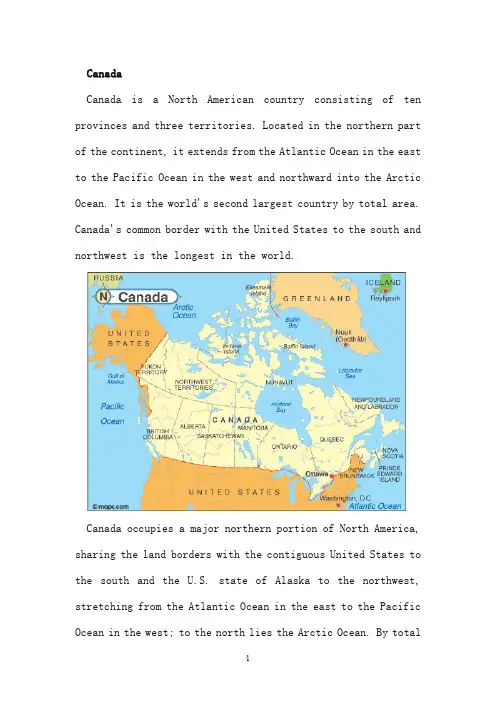
CanadaCanada is a North American country consisting of ten provinces and three territories. Located in the northern part of the continent, it extends from the Atlantic Ocean in the east to the Pacific Ocean in the west and northward into the Arctic Ocean. It is the world's second largest country by total area. Canada's common border with the United States to the south and northwest is the longest in the world.Canada occupies a major northern portion of North America, sharing the land borders with the contiguous United States to the south and the U.S. state of Alaska to the northwest, stretching from the Atlantic Ocean in the east to the Pacific Ocean in the west; to the north lies the Arctic Ocean. By totalarea (including its waters), Canada is the second-largest country in the world, after Russia. By land area, Canada ranks fourth.Canada has one third of the world's supply of fresh water. There are five great lakes in the south, and there are many others, especially in the north. Most of the electricity is produced by water. The country has a great deal of coal, oil and natural gas, and these are all exploited for energy. Much of the country is covered by forests, and wood is cut and sold all over the world. Canada is also the world's biggest producer of the kind of paper which is used for newspapers. Fishing is also very important for Canadians. Fish from east and west coasts is sold to many other countries.About 40% of the Canadian population are of British descent, while 27% are of French origin. Another 20% are of other European background, about 10% are Asian origin, and some 3% are of aboriginal or Métis (mixed aboriginal and European) background.Canada is a federation of ten provinces (Alberta, British Columbia, Manitoba, New Brunswick, Newfoundland and Labrador, Nova Scotia, Ontario, Prince Edward Island, Quebec, and Saskatchewan) and three territories (Northwest Territories,Yukon, and Nunavut). It is governed as a parliamentary democracy and a constitutional monarchy with Queen Elizabeth II as its head of state. One of the world's highly developed countries, Canada has a diversified economy that is reliant upon its abundant natural resources and upon trade—particularly with the United States, with which Canada has had a long and complex relationship. It is a member of the G7, G8, G20, NATO, OECD, WTO, Commonwealth, Francophonie, OAS, APEC, and UN. With the eighth-highest Human Development Index globally, it has one of the highest standards of living in the world.The national flag of Canada, also known as the Maple Leaf, and l'Unifolié(French for "the one-leafed"), is a red flag with a white square in its centre, featuring a stylized 11-pointed red maple leaf. The width of the Maple Leaf flag is twice the height. The white field is a Canadian pale (a square central band in a vertical triband flag, named after this flag), and each bordering red field is exactly half its size.Canada's two official languages are English and French. English and French have equal status in federal courts, Parliament, and in all federal institutions. Citizens have the right, where there is sufficient demand, to receive federal government services in either English or French, and official-language minorities are guaranteed their own schools in all provinces and territories.Ottawa is the capital of Canada, the second largest city in the Province of Ontario, and the fourth largest city in the country. Located in the Ottawa Valley, the city lies in the eastern portion of Southern Ontario on the Ottawa River, a major waterway forming the local boundary between the provinces of Ontario and Quebec.Toronto is the provincial capital of Ontario and the largest city in Canada. It is located in Southern Ontario on the northwestern shore of Lake Ontario. With over 2.5 million residents, it is the fifth most populous city in North America.Its metropolitan area with over 5 million residents is the seventh largest urban region in North America.The Niagara Falls is the most powerful waterfalls in North America. These voluminous waterfalls are situated on the Niagara River, which drains Lake Erie into Lake Ontario and forms the international border between the Canadian province of Ontario and the U.S. state of New York. The Niagara Falls is renowned both for their beauty and as a valuable source of hydroelectric power.Vancouver is a coastal harbor city in Canada. Located in the Lower Mainland, Greater Vancouver is the third-largest metropolitan area in the country and most populous in Western Canada. While forestry remains its largest industry, Vancouver is well known as an urban centre surrounded by nature, making tourism its second-largest industry. Vancouver has ranked highly in worldwide "livable city" rankings for more than adecade according to business magazine assessments and it was also acknowledged by Economist Intelligence Unit as the first city to rank among the top-ten of the world's most livable cities for five straight years. It has hosted many international conferences and events.Banff National Park is Canada's oldest national park, established in 1885 in the Rocky Mountains. The park, located 110–180kilometers west of Calgary in the province of Alberta, encompasses 6,641 square kilometers of mountainous terrain, with numerous glaciers and ice fields, dense coniferous forest, and alpine landscapes.欢迎您的下载,资料仅供参考!致力为企业和个人提供合同协议,策划案计划书,学习资料等等打造全网一站式需求。
英语国家概况中文版

英语国家概况中文版简介英语是世界上最广泛使用的第二语言,也是联合国的一种官方语言。
英语国家是指以英语为母语或官方语言的国家,主要分布在北美、欧洲、澳大利亚和新西兰等地。
本文将介绍英语国家的概况和一些有趣的事实。
北美地区北美地区是英语国家的主要集中地。
美国是世界上最大的英语国家,英语是其最主要的官方语言。
美国的文化、商业和科技对全球产生了深远影响。
加拿大是除美国外人口最多的英语国家,英语是其官方语言之一。
加拿大是一个多元文化的国家,拥有丰富的自然资源和高质量的教育体系。
欧洲欧洲也是英语国家的重要区域。
英国是英语的发源地,英语是其官方语言。
英国对世界文学、艺术、政治和经济都有重要影响。
爱尔兰也是英语国家,英语是其官方语言之一。
爱尔兰以其独特的文化和友好的人民而闻名。
其他欧洲国家如澳大利亚和新西兰也是英语国家。
澳大利亚是南半球最大的英语国家,英语是其官方语言。
澳大利亚以其美丽的自然风景和多元文化而著名。
新西兰是一个位于南太平洋上的岛国,英语是其官方语言之一。
新西兰以其壮丽的自然风光和平静的生活方式而吸引着众多游客。
亚洲在亚洲地区,菲律宾是英语国家之一,英语是其官方语言之一。
菲律宾的人口中有很多人能以流利的英语进行交流。
印度也是一个使用英语广泛的国家,尽管其官方语言是印地语,但英语在印度的政府、商业和教育领域是普遍使用的。
非洲尽管非洲大多数国家的官方语言是其本土语言,但在一些前英国殖民地,如南非和尼日利亚,英语依然是重要的官方语言之一。
这些国家的人民通常会说至少两种或更多种语言。
结论英语国家的分布遍布全球,英语作为一种国际语言在全球范围内发挥着重要的作用。
这些国家的文化、历史和社会风貌各异,但他们之间通过英语语言建立了联系。
无论是在学习、旅游,还是商业交流中,英语都是一门重要的语言。
掌握英语不仅可以帮助我们更好地了解这些国家,还能够与世界各地的人民进行交流和沟通。
以上是对英语国家概况的简要介绍,希望对读者有所帮助。
英语国家概况 Canadian Economy
5加元的纸币上印有威尔夫里德-劳累埃 爵士的头像,他是加拿大第一位法裔总 理,1896-1911年在加执政,5加元反面 图案为啄木鸟
C$5 notes printed on the Sir Wilfrid Laurier's head. He is Canada's first Francophone prime minister, 18961911 years and ruling, the opposite of C$5 notes is pattern for woodpecker.
Forestry
As the 3rd largest timber-producing(木材生产) country in the world, Canada boasts abundant forest resources, accounting for 10% of that of the world. ―the country of maples leaves‖. Canada is covered with dense forest. (about 44%of its territory 领土 ). 10% of the job opportunities and 14% of the foreign exchange(外汇). paper industries---newsprint wood---house, floor board, furniture
Back.
Major Industries
Agriculture
The agricultural output account for 8% of the GDP 339,000 people(1% of the total population, 2.1% of the total labor force) worked in farms in 2003 Crops: wheat, canola, vegetables, oat, maize, potatoes, fruits, tobacco, and soybeans.
canada加拿大国家概况资料

3.Canadian shield 加拿大地盾
北美洲板块是最坚硬、最稳定的核心,又称为前寒武纪地盾区, 或者加拿大高地区。主要是由六亿多年前的前寒武纪岩石构成。 它的覆盖面积达四百五十万平方公里,约占加拿大领土面积的 一半,也是加拿大的地理核心。
snow more in winter,cooler in summer divisible seasons
Agriculture: highly developed City :Canada’s political and economic centry.with large population.
3.Canadian shield
Location: around the Hudson Bay Average altitude:500-600m Area cover:3.6million sq km,36% of Canada land
Topography: higher flat plains and groups of lakes
2.Great lake and st. Lawrence lowlands
Location :alongside the St. Lawrence river and lake Ontario. Topography: flat plain,lowland,lake Area cover:180,000 sq km(1.8% of Canada land) Climate: temperate continental climate
1.Appalachian mountain
英美国家概况加拿大【创意版】.ppt
Foreign Language Teaching and Research Press
1.3 Major Cities—Ottawa
❖ the capital of Canada ❖ the country's fourth largest
city ❖ located in the Ottawa Valley ❖ lies on the banks of the
1.3 Major Cities—Montreal
❖ the second largest city in Canada
❖ the largest city in the Canadian province of Quebec
❖ used to be the largest city in Canada and the industrial and financial centre of Canada
英语国家概况
Canada
优选
Canada
Chapter 14 Geography and History
英
语
国
家
概
优选
2况
CONTENT
I
Geography
II
History
Foreign Language Teaching and Research Press
I
Geography
1.1 Location and Size 1.2 Geographic Regions and Climate 1.3 Major Cities
1.3 Major Cities—Toronto (cont.)
the tallest tower in the western hemisphere, the world's second tallest freestanding structure
致用英语英语国家概况Canada ppt课件
Canadian national anthem: O Canada Royal anthem: God Save the Queen Representative animal: Beaver 河狸
wet
wet
populated
Economy and Currency
*G8: Group of Eight. 八国集团。八大工业国美 国、日本、德国、法国、英国、意大利、加拿大 及俄罗斯的联盟,以往被称为“富国俱乐部”。
Natural resources: forestry(森林), mining(采矿), oil(石油) and gas extraction (煤气提炼), farming and fishing
Telecommunications(电信), biotechnology(生物科技), aerospace ['eərəʊspeɪs] (航空和航天) technology
Monetary unit:Canadian dollar (CAD)
National Symbols and Holidays
Pacific Ocean
Toronto
Ottawa
Greenland
Canada location and area
Canada is the world’s second largest country in are after Russia, with total area of nearly 10 million square km.
Lesson 2
General information on Canada, Australia and New Zealand
英语国家概况之加拿大复习资料
Chinatown, Toronto, Ontario: Canada’s high rate of immigration leads to ethnic neighborhoods in many of its major cities. People of Chinese origin make up more than 10 percent of the population of the City of Toronto. Two-fifths of the Toronto population is foreign born.
12.3.1 The European Discovery Kanata—Canada; John Cabot, an Italian sea captain, discovered and claimed Newfoundland and the east coast of Canada in the name of King Henry VII of England in 1497, five years after Columbus discovered America. Jacques Cartier, a French navigator, sailed up the St. Lawrence River in 1535, and opened the interior of Canada to French fur traders and latter colonizers. The English and French became rivals in the gradual
பைடு நூலகம்
View of Ottawa, Ontario: Ottawa is the capital of Canada.
国家英语介绍之加拿大PPT教案
加拿大的文化,是一个 形式可以解释为艺术、 音乐、文学、政治和社 会的元素,这是加拿大 和加拿大人的代表。这 不仅仅只展示给加拿大 自身的人口还有世界各 地的人。加拿大的文化 历来被欧洲的文化和传 统影响,特别是英国和 法国。
第13页/共42页
symbols
Official symbols of Canada include the maple leaf, beaver, and the Canadian Horse.
Canada is the world's secondlargest country by total area, and its common border with the United States is the longest land border in the world.
第2页/共42页
第16页/共42页
加拿大的艺术
自20世纪以来,特别是在1945年第二次 世界大战结束以来,加拿大的艺术蓬勃 发展。最早期的加拿大画家作品遵循欧 洲的趋势。一组被称为七国集团的画家 第一个显示着加拿大的绘画风格。所有 的艺术家的画都大、描绘色彩鲜艳的场 景或者加拿大的荒野。因纽特的艺术丰 富了加拿大的雕刻和海象牙皂石雕刻。 这些雕刻显示的对象是因纽特人的日常 生活和活动。
National emblem
国徽
第10页/共42页
Culture of Canada
加拿大的文化
第11页/共42页
Canadian culture is a term that explains the artistic, musical, literary, culinary, political and social elements that are representative of Canada and Canadians, not only to its own population, but people all over the world. Canada's culture has historically been influenced by European culture and traditions, especially British and French.