
新人教必修4 Unit4 Body language-Warming up & Reading
Matching the people and their different Part 2 ways of greeting (para2&3)
Mr Garcia (Columbia) Julia Smith (Britain) Visitor (Japan)
1.shakes hands and kisses others twice on each cheek 2.bows 3.shakes hands 4.approaches others closely and touches their shoulder and kisses them on the cheek 5.does not stand very close to others or touch strangers
Reading
Communication:
No problem?
Look at the title and picture on page 26 and predict what the passage is about.
Which is the main idea of the text? A. There are different customs in different countries. B. Foreigners should follow the customs of the country where they are visiting.
Unit 4 Body Language
Period 1&2: 幻灯片9-43页
Warming up – I ( 2m )
Ways of communicating
speaking Spoken language ringing
writing Written language typing
Body language gesturing
• Careful reading para1
• Judge the following sentences T or F • 1. Yesterday, another student and I, representing our university's student association, went to the Capital International Airport to meet this year's international students. T • 2. After an hour of waiting for their flight to arrive, I saw several young people enter the waiting area looking around curiously. F • 3. I stood for a minute watching them and then went to greet them. T
• Para4 I get to know • As______________more international friends, I learn more Not all about this cultural "body language". ________cultures greet nor each other the same way, ______are they comfortable in the same way with touching or distance between people. In the spoken language same way that people communicate with_______________, they also express their feelings __________unspoken using "language" __________physical distance, actions or posture. through English people, for example, do not usually stand very close to others or touch strangers as soon as they meet. However, people from places like Spain, Italy or South American countries ___________others closely and are more likely _____to approach touch them. Most people around the world now greet each shaking hands other by_____________, but some cultures use other as well greetings________, such as the Japanese, who prefer to bow.
Para3 Is the author of this passage male or female? How do you know?
The author is male. Ahmed Aziz will not shake hands with women, but he shakes hands with the author.
7. People from places like Spain, Italy or South American countries approach others closely and are more likely to touch them.
从西班牙、意大利或南美洲国家来的人近距离地接近对方, 而且可能会(用身体)接触对方。 sb/sth is likely to do sth.
Garciห้องสมุดไป่ตู้.
a Japanese The second mistake George Cook from (Canada)
He ________ to Mr. bowed Cook and his nose touched _________ Mr. moving Cook’s _______ ________. hand He ________ reached ________ _______ his hand ________ to the out Japanese.
sad shocked
facial expression: a look on a person’s face
Well-done
Ok
victory!
quiet
stop
handshake
Kiss
hug
shake
nod
bow
kiss your hand to sb.
Just like verbal language(言辞), body language is part of culture. It plays an important role in daily communication. So, it is very important to understand and use it correctly. And for a foreign language learner, it is as necessary to learn the body language as to learn the verbal language.
It’s likely that 从句
He’s very likely to be late for class.
他很有可能会迟到上课。
It is likely to rain tonight.
Definition(定义) for Body Language
One form of communication without using any words
Eye contact
Facial Gesture expression
Posture
angry sorrowful
scornful happy
George Cook (Canada) Madame Coulon (France)
Para 2
Find out the two mistakes the writer found in the airport: He approaches Ms Smith Mr. Garcia by touching ______ _______ her from The _________ and kissed _______ shoulder (Columbia ) first her on the ________. cheek mistake She ______ ________ stepped back Julia Smith appearing surprised _________ from and take a few steps (Britain) away ______ _______ from Mr.
C. People use body movements to send messages and
different body movements have different meanings. D. The importance of knowing customs.
Match the main idea of each part with lines. Part 1. Different people have different (Para.1) body language. Part 2. (Para. 2~3) Part 3. (Para. 4) Part 4. (Para. 5) Summary of body language. Meet the visitors at the airport. People from different countries express greetings in different ways.
人教版高中英语必修四 Unit 4 Body Language 教案

高中英语教学设计教学重难点Teaching FocusMake the students understand that body language has cultural diversity and there is no division of good or bad for the diversity.ChallengeMake sure that the students will have the awareness to use and try to understand others’ body language when they communicate with others in the future.教学准备A. A projectorB. computer for multimedia teaching教学方法Teaching methodsA. Asking-and-answering between the teacher and the studentsB.. Interaction among individuals, pair-work and group-workC. Task-based teachingD. Teacher’s demonstration and interpretationE. Role-playingF. Students’ discovery教学过程设计活动内容Step 2介绍身势语的重要性A.Telling Students the Story of Tai Lihua and Making Them Know theImportance of Body Language in Her Life ( 3 min )1.Present the pictures of Thousands of Hands Kwan-yin , and ask the students whether they know thegirl who dances in the front.2. Tell the students tell life story of Tai Lihua and ask them the question “What are the key factors forher success in her life?”The life story of Tai LihuaHer name is Tai Lihua(邰丽华). She is called a Fairy of Peach blossom(桃花仙子) by people. You knowshe is a deaf girl, but she is a wise, diligent, charming and energetic girl. She studied very hard and got two degrees of bachelors in university. She was famous as an artist for her wonderful performance. She is deafand dumb. But how did she get that great achievement and became a successful person? She loves life very much. We should learn from her spirit. Besides her hard working, body language plays a very importantpart in her life. We are all healthy people, sometimes we can use body language to express ourselves. Sowe should pay more attention to learning body languages.B.Showing the Students the Science Report of the Importance Body Language,Making Them Know That Body Language Is As Important For Us As ForDisabled Person Like Tai Lihua. ( 1 min )Some psychologist believe that we communicate 65% of our ideas and feelings without words! The shape of our bodies and faces, the movements and gestures we make, the clothes we wear, how near we stand to each other and whether we touch each other…all these communicate. we must study all these types of information if we want to truly understand what other people are saying.Step 3介绍不同类型的身势语() ( step 3 will use around 5 min )A. Showing the Students The Four Types of Body LanguageGestureFacial expressionEye contactPostureB. Guessing The Meaning of GesturesThe teacher show the students a series of pictures of a man using different gestures, and the students are supposed to say their meaning.C.Acting Out By GesturesThe teacher show the students some English words and ask them to act them out together by using gestures.Victory!Ok !Be quiet!You!D. Chasing the Right WordThe teacher will show the students a series of pictures describing different facial expressions and askthe students to choose the right word for each.E. Matching the Right Interpretation Of the EyesThe teacher will present students several pictures of eyes and ask the students to match the right interpretation.Threatening No. sixThank you ! Congratulations!Facial expressionanger fear joy sorrow contempt轻视surprise disgust 厌恶What do you see in the eyes below?That’s a problem. I need to thinkfor while.a whileIt’s you! Let’s have a duel!That’s horrible! I’m terrified!The next minute,you’re a dead body!I’m in great sorrownes s…I won’t give up! We’ll soon winback!F. Guessing The Meaning of Postures in Real ContextI’m listening carefully!What do we know from their posture?Nice to meet you!This woman is listening to your ideas…You meet this man for the first time…Give me a little time!I’m still thinking!You are asking this womanTo finish her work as soon as possible…You are asking this woman ”Have you got any good idea?” …I give up!OK!You are asking help from this woman…You are saying “Will you give up!”…G. Matching the Right Meaning of the Given Posturesnervous Bite your nails and fondle hair agreement Nod the head up and downBe not interested Look away or yawn.Do not believe Roll your eyes and turn your head away. angry Frown and turn your back to sb disagreement Shake the headStep 4给身势语下定义A.Finishing the First Question of Warming-up Part ( 3 min )The teacher will ask the students to discuss the question with your partner and try to find what the people in the pictures are communicating.B.Giving Definition To Body Language ( 2 min )The teacher will guide the students to give a general definition to body language.Body languageis a form of non-verbal communication.uses movements or positions of our body to show other people what we are thinking or feeling.mainly includes gesture, facial expression, eye contact, posture four forms.Step 5练习运用身势语A.Acting Out the Following words ( 4 min )This exercise is based on the second question of warming-up part. Two students will be chose to the frontof the class, and each of them will choose five words to act. After their action, other students will try to guess which word they have acted.•Hello!•Goodbye!•Go away!•Expensive!•I’m surprised!•I’m tired•I’m confused!•Good luck•I’m delighted!•I’m upset!•I’m sad!•I forgot!•You are great!•I’m curious!•I ate too much!•Come here!B.Acting Out the Dialogue on Page 67 ( 10 min )The student will work in groups of two to finish the speaking task of this unit on page 67. They are required to use appropriate body language as they are making dialogues. After their pairwork, volunteers will make their dialogue before the whole class.Step 6介绍身势语的文化多样性A.Showing the Cultural Difference in Body Language With Examples ( 2 min )America OKJapan moneyFrance zeroBrazilGermanyrudeB . Presenting the Students the Major Greeting Customs in the World ( 2 min )Person and country Suitable greeting A man from ColumbiaTo a man: same as for a womanTo a woman: touches her shoulder and kissesher on the cheekA woman from BritainTo a man: not to close, shake hands To a woman: shake hands, will get closeA man from JapanTo a man: bowsTo a woman: bowsA man from CanadaTo a man: shake handsTo a woman: shake hands or kisses on both cheeks if knownA woman from FranceTo a man: shake hands, kisses twice on the cheekTo a woman: same to someone she knowsA man from the Middle East or some Muslim countriesTo a man:comes close, shakes handsTo a woman:nodsC. Discussion On the Question That If There is a Division of Good or Bad of the Different Meaning of The Same Body Language Under Different Culture.The students will have 3 minutes for discussion and after that some of them will represent their group to share their idea with the whole class.Step Role Play ( 8 min )USA Nigeria rude Germany Japanone“great”or “good job”。
人教高中英语必修4Unit4 Warming-up and Language points(共26

Pair work: Talk with your partner about what you are curious about.
Sample: Student A: What are you curious about? Student B: I’m curious about_________
Thank you !!!
I’d like to introduce a new friend to you, and he is curious about everything.
Pair work: What would you like to introduce to your partner? You can introduce anybody/any place/anything to your partner.
低调 !
Can you give a definition(定义) of body language according to the two tips below?
---the function of body language ---the tool of body language uses
Sample: Student A: Hello, what would you like to introduce to me? Student B: I’d like to introduce____ to you…
Summary:
Homework:
Please write a story using the phrases learned in this period after class.
Body language:
新人教必修4 Unit4 Body language-Warming up & Reading

Eye contact
Facial GestureKiss
hug
shake
nod
bow
kiss your hand to sb.
Facial expression
surprise anger fear
joy
sorrow
disgust contempt 轻视 厌恶
5.What do French people often do when they meet people they know? French people will often kiss people they know on both cheeks. 6.Can we expect people everywhere to act the same? Why? No, we can't because not all cultures greet each other the same way .
touches It happens that Mr Cook's hand __________ the apologize Japanese's nose as he bows and they different both________ greet So you see, stand from _________ people cultures may strangers not _______others in the same way. English people shake usually do not _______very close to others or Japanese touch the ________as people from Spain, Italy and South American countries do. Most People around
英语必修4Unit4BodyLanguage全单元新人教版
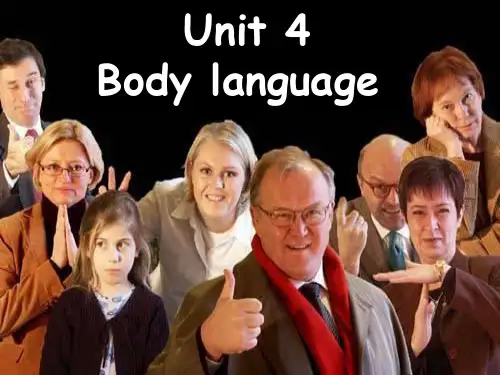
What are they trying to tell us? How are they expressing themselves?
Come and join us!
You’re great! I’m listening carefully!
I’m sorry! Nice to meet you!
hide your feeling
smile
Agreement or refusal
Nod the head up and down or shake the head
Be not interested Look away from a person or yawn
interested Do not believe
• It includes body movements, facial expressions, gestures, posture , speaking distance and other non-verbal signals.
Game: Choose a student to the front of the blackboard and bring out the meaning of some words by some postures.
Unit 4 Body language
Teaching plan
Period 1&2: Warming up & Reading
Period 3: Language & Structure
Period 4: Using Language
Period 5: Period 6:
Listening & Speaking & Writing Workbook reading and practice
必修四Unit 4 Body language Warming up 教学设计

Unit 4 Body languageⅠTeaching aimsKnowledge aim :Make students to learn some words and expressions.Ability aim :Enable students to express themselves with body language.Moral aim :Enable students to use body language properly.Ⅱ Important pointsEnable students to realize the importance of body language while communicate with others. Ⅲ Difficult pointsEnable students to understand how body language differs among people in different culture.Ⅳ Teaching methodsContent-based methodCommunicative methodⅤ Learning methodsIndividual work, par work and group work.Ⅵ Teaching toolsTextbook, Lesson plan, PPTⅦ Teaching proceduresStep 1 RevisionAsk students to dictate some important words and expressions.statement 陈述,说明 spoken 口语的represent 代表,象征 likely 可能的flight 飞行,航班 ease 安逸,舒适approach 接近,方法 fist 拳头defend 保护,保卫 rank 等级,军衔Step 2 Lead inThink about the following questions.1.What’s the purpose of language? CommunicationExpress our ideas and thoughtsRecordation2.Besides spoken language, is there any other way to communicate our ideas or feelings with others?Three ways :Written language Spoken language Unspoken language:body language is a kind of nonverbalcommunication,how many parts is it been made up?①eye contact ②facial expressions③gestures ④posturesStep 3 GuessingLook at these pictures and guess what they represent.Happy Fearful Sad AngryConfused Surprised Step 4 PerformanceGive performances with the help of postures:1.I don’t know.2.I am very angry. (chimp)Step 5 ActivityLet’s try to find out more body languages with the meaningsGestures MeaningYou are welcomeCome on ; congratulationsVictory ! May you succeed!Good! You did a good job!Look down upon .Bye ! or no!Step 6 DiscussionTask 1Is body language the same in different countries /cultures ? Why?No. Body language varies(变化) from culture to culture.Because cultures have developed in different ways.Task 2“ When in Rome, do as the Romans do.” What do you think this famous saying means?When we are in a certain place, we should follow their customs, not our own.Step 7 SummaryStep 8 HomeworkRecite the words and expressions Review the text.Ⅷ SummaryBody language is one form of nonverbal communication, communication without using words. Eye contact or facial expressions, gestures, and postures, or the ways you stand, are different kinds of body language.Ⅸ HomeworkRecite the new words and expressionsReview the text.Ⅹ Blackboard designUnit 4 Body languagePeriod 1 Warming up。
高中英语必修四Unit4BodyLanguagewarmingup学案

SB4 unit 3 Body language 阅读课教学设计一. 教学内容分析:本课是人教版《普通高中课程标准实验教科书·英语(必修)4》第四单元的warming up, Reading& comprehending部分。
文章的标题为communication:No problem? 课本的各项内容都是围绕“身体语言”这个主题进行,身体语言是文化交流的一个重要载体,学习有关身体语言的知识,让学生了解身体语言的不同文化含义,有助于他们进行正确的跨文化交际的意识和能力。
教材通过warming up的图片要学生通过讨论图片交流对日常交际的看法,并提供某些日常交际用语,要学生表演出来。
Pre-reading的四个问题要求学生集中思考语言的的目的;并讨论离开语言人们如何交流。
同时要求学生根据课本插图预测文章的内容来,激发学生的阅读兴趣。
Comprehending由四部分构成,分别从不同层面引导学生进行阅读,由浅入深,逐渐加深学生对文章的理解。
因此,教师将本单元的Warming up,Pre-reading,Reading和Comprehending整合在一起构成一节阅读课。
二. 学生情况分析:经过高一第一学期的英语学习,学生已经大致掌握了略读、跳读等一定的阅读技巧以及识别关键词、确定主题句、预测等阅读微技能,形成了初步的阅读策略。
大部分学生英语基础较好,学习习惯良好并善于钻研和思考。
但部分学生的基础知识仍然较为薄弱,运用英语进行交际活动的能力较差;主动学习的动力不够,然而他们学习比较认真,好胜心强,渴望在班集体里得到他人的承认,很在乎别人对他们的评价;求知欲旺盛,思维比较活跃。
部分学生的基础较好,能主动配合老师,愿意开口讲。
因此,只有设置使他们感兴趣的活动,因材施教,才能让他们投入到课堂活动中来。
三. 设计思想《普通高中英语课程标准》提出:“高中英语课程的设计与实施要有利于学生优化英语学习方式,使他们通过观察、体验、探究等积极主动地学习方法,充分发挥自己的学习潜能,形成有效地学习策略……发展听、说、读、写的基本技能,提高初步运用英语进行交际的能力……” 根据这一指导思想,我结合本班学生的实际,阅读课关注教学细节,运用任务型教学途径,积极开展小组合作学习和促进自主学习的课堂活动,强调合作探究和独立思考相结合,对教材进行了操作性较强的设计和处理,力求达到有效阅读,努力提高学生的自主性阅读和表达能力。
高中英语人教版必修四Unit_4_Body_Language
1.Whatisthepurposeoflanguage?
2.Howcanyoutellifsomeoneissadeveniftheydonotspeak?
3.Whatwouldyoudoifyouneedtheother’shelpurgentlywhileyoutwospeakdifferentlanguages?
Somebodylanguagesinsomecountriesaregoodwhilesomecountries’bodylanguagearebad.
【活动设计说明】
找段落大意,理解文章的写作手法和理解文章的细节信息,是在阅读过程中要训练学生的方法。这样能够协助学生从整体上把握文章,并能培养学生迅速捕捉整体信息的水平。在Task2局部通过判断对错的训练让学生能更进一步理解文章的细节信息,知道不同的国家不同的文化影响bodylanguage也是不同的。
【活动设计说明】
通过互动表演以及头脑风暴使学生对bodylanguage有了初步理解,而且通过这些活动调动学生的兴趣,为reading做好铺垫。
Step2Pre-reading
T:Ourtextisaboutaspecialmeansofcommunication—BodyLanguage.Nowpleaselookatthescreen.Anddiscussthesequestionswithyourpartnerfirst.Andthensomeofyouwillbeaskedtoreportyourwork.Areyouclear?
PWPapproach在阅读中使用检索读的学习策略
四、 教学过程
Step1Warmingup
Task1.Brainstorm:thewordsofemotions/feelingsofhumanbeings
人教版高中英语必修4unit4 Body Language-Warming up and Reading课件
shaking hands
everyone
Ahmed man from Aziz Jordan
moving close to men
shaking hands
nodding
to women
shake hands
Darlene woman
and kiss twice
Coulon from France on each cheek
Brazil
Meaning OK
money zero
rude
thumbs up
the US Nigeria Germany
Japan
great / good job rude No.1
Gestures
Shaking one’s head
countries Meaning
Bulgaria, parts
• One of them acts out the expressions by using body language without speaking, the other one guesses the meaning and say it aloud . Each expression for one point.
• The more expressions you can guess within 1 minute, the more points you will get.
Choose one below. One student performs and the other guesses.
A BCD
Complete the chart after reading Para2-3:
Name Description Body Language
人教 必修4 Unit4 Body language 词汇语言点讲解
Unit4 Body language一.单词考点Section A Warming-up,Reading&Comprehending1.statement n[C,U]声明,陈述,报告;说明;表白搭配:a statement on/about sth.关于某事/某物的声明(陈述)make/issue a statement发表声明a public/a written/an official statement公开/书面/正式声明eg:A government spokesman made a statement to the press about this accident.注:state v“陈述,阐明,声明;指定(日期、地点、价钱等)”“状态,状况,情况”neg:①The spokesman stated that the treaty(条约)would be signed on 15th June.②The room was in a very dirty state.2.greet vt“(和某人)打招呼或问好;欢迎;迎接”搭配:greet sb.with...用……向某人打招呼(欢迎某人)eg:We greeted our teacher with a smile.3.represent vt用法⑴“代表;象征,表示”eg:A dove(鸽子)represents peace.⑵描绘;成为……实例搭配:represent...as...把……描绘成……represent sth.to sb.向某人描绘某事/某物represent oneself as/to be...自称是……eg:①He presents himself as a friend of the president.②He represented his country at the conference.区别:represent,stand for⑴represent“表示,代表,说明”多用于实体代表,有被动。
人教版高中英语必修4教案 Unit 4 Body language
Part 11 Warming Up:1)What is body language?(spoken language, written language)T: do you know how many ways can we use to communicate with others in our daily life? It’s obvious that we could communicate with others by speaking, right? Except for speaking, also, we could communicate by the way of writing, what’s more, if we don’t use speaking and writing, we can choose to use our body language to convey information.T:OK, so do you know what is body language?Body language refers to various forms of nonverbal communication, which for a person may reveal clues as to some unspoken(无法言说,不言而喻的) intention or feeling through his physical behavior.2)look at the pictures on blackboard and discuss what are the meaning of these body languages.T: now I will show you some pictures about body language , and I hope you cold tell me the meaning of each picture, OK?T: you are so smart, and have you found the similarity of these body languages of each line, Yes, according to the given pictures, we could generally divided body language into three part:①body gesture ②body movement ③facial expressions3)Game: Conveying the information that is written on the cards to your partners with body language.And next, for better understanding and using body language, let us play a game, the players should act and guess the content of the cards. I will invite three groups to do the game here, four students a group, three perform, and one guess, clear?2 Pre-reading:1)A same body language maybe have different meaning in different countries.T:we all know that because of the different cultural background, a same body language maybe have very different meaning, such“OK”,in China, it means “yes”, but in Japan, it means “money”, in France, it means “nothing”, and in Italy it’s a impolite and dirty gestures.2)The same meaning could be conveyed by different body languages such as the way of greeting, what can the people do when they meet each other at the first time?T: A same body language maybe have different meaning, on the contrary, the same meaning also could be conveyed by different body languages such as the way of greeting, so what can the people do when they meet each other at the first time? T: We know in China, when we greet to someone at the first, we could shake or wave our hands right? but what are the ways in other more countries? Let us learn it from the reading material on textbook page 26.3 While-reading:1)Skin to find the main idea of this passageT: Now , I will give you three minutes to read the whole passage quickly and summarize the main idea, OK?(This passage shows body language differs from culture to culture. Not all people greet each other in the same way. So we should study international customs for better communication.)2)Fill the blank to find the ways to greet in different countries or areasOK, everybody, next I will give another five minutes to read the passage again and find out all the ways to greet others by using body language according to the blank4 Post-reading:1)Is the author male or female? How do you know that?T: OK, everyone, there is an inference question, “Is the author male or female? And how do you know that?”(male, because Ahmed Aziz only shake hands with men.2)Find out the two cultural mistakes in para 2.T:In para 2 the author has mentioned two cultural mistakes right? So the first is what? (when tony Garcia from Colombia, approached Julia Smith from Britain, touched her shoulder and kissed her on the cheek as greeting, however, Julia stepped back appearing surprised and put up her hands to defend)The second mistake is (George Cook, who came from Canada, reached his hand out to Akira Nagata from Japan for introducing himself, however, Akira bowed so his nose touched George’s hand)3)What can we learn from this text?T: Do you feel the embarrassed? , for decreasing this kind of cultural mistakes, what do we need to do?①Body language plays an important role in daily communication, so it is very important to understand and use it correctly.②We should study international customs and respect the different cultures in the world.③When in Rome, do as the Romans do.5 homework:Find more body languages differ from culture to culture.(4groups, one group finishes one together)Part 21 Review:Yesterday we’ve learned many body languages about greeting which is different in many cultures, still we can remember that, in Britain, people usually greet with shaking hands, ……And today we go further learn the body language which conveys an universal information.2 While-reading:T: Firstly, everybody please spends three minutes looking through the whole passage and finding the main idea, clear? OK, go ahead with your task.1)What is the main idea of the passage?T: Are you finished? Where can we find the main idea? Which paragraph?Some body languages or gestures are the same throughout the world.2)Fill the blank to summarize the feelings and the corresponding body languages T: So next, let us learn these body languages further and together, at the same moment, please find out the emotional meaning of each body language, clear?3)Discussion:T: All right, it has been quite clear to understand the same body language and its emotional meaning throughout the world. The last reading task, everybody please gives an example of a person whose body language is very impressive or important to you, and please tell the reasons.(4)Guess the order of the story on page 31, then listen to the tape of the story on page 65.T: So much for our reading , by this unit, we had learned a lot of body language as well as its cultural meaning and emotional meaning, right. OK, next it’s time to check your knowledge acquisition.4)Act one of the stories on page 31 and 65.3 Homework:Do the exercises in 三维设计。