
沪教牛津版六年级英语上册Unit 8 Visiting museums
Kitty and Ben are making a poster for “The World of Robots”. Help them complete the poster.
Welcome to “The World of Robots”!
1. What did you see at the museum? 你在博物馆看见了什么?
这是以what 开头的特殊疑问句。 询问对方在某地看见了什么的句型:What did you see+地点? 答语结构:I saw(see的过去式)+ 某物/某人.
例句:你在电影院看见了什么? What did you see in the cinema? 我看见了许多人。 I saw a lot of people.
在钢琴旁有一个机器人。他能 弹奏歌曲。他的手指移动得非 常快。凯蒂和本站在钢琴旁听 了半个小时!
Then they saw a robot dancer. He could move his head and arms. 然后他们看见了一个机器人跳 舞者。他能移动他的头和胳膊。
Kitty and Ben also saw many other interesting robots in the museum. They had a great time there.
Listen and enjoy
If Alice is not at home, You know where she will be. She always goes to museums, For the wonderful things she can see.
She goes to see insects. She goes to see art. She learns a lot in museums. There is always great joy in her heart.
卢浮宫在巴黎。它是一个 很棒的艺术博物馆。
同学们,这一课学习的单词你们都掌握了吗?现在大家 来检验一下,点击下面的视频开始听写吧!
Joe: I saw a lot of interesting cars. Alice: Did you buy anything at the car museum?
Joe: I bought a model car. Alice: That’s so cool. I want to go there on Saturday. I love
Joe: Hi, Alice. What’s that? Alice: It’s a toy bee. I bought it at an insect museum last
Saturday. Joe: It’s cute. What did you see at the museum? Alice: I saw ants, bees, butterflies and other insects. Some of
例句:你想吃些面包吗? Would you like to eat some bread?
拓展:(1)any用于疑问句和否定句中,表示“一些”, 可以修饰可数名词的复数和不可数名词。
(2)当any用于陈述句时,意思是“任何”。
3. Did you buy anything at the car museum? 你在汽车博物馆买东西了吗?
I visited __a_n_i_n_s_e_c_t _ museum on__A__u_g_u_s_t_2_n_d__ (date). It is ____b_ig____(big/ small). I saw_m__a_n_y__in_t_e_r_e_st_i_n_g_i_n_s_e_ct_s_a_n_d__I_b_o_u__g_h_t_a_t_o_y__a_n_t_.
art museum car museum film museum insect museum science museum toy museum
Play roles
Did you visit any museums during the holiday?
Yes, I did. I visited an art museum.
Learn the sounds
or → horse al → hall au → autumn oor → door
o → office off
a → t watch
short fall daughter floor box wrong what
Listen and circle. 1 wall 2 short 3 north 4 floor 5 August 6 daughter 7 balls 8 horse
It’s a museum.
New words
bee
蜜蜂
insect
昆虫
ant
蚂蚁
kind
种类
finger
手指
dancer
跳舞者; 舞蹈演员
Listen and say
What did you see at the museum? I saw a lot of interesting cars.
汽车博物馆
insect museum science museum
昆虫博物馆
科学博物馆
Look and read
At the science museum
There is a science museum in the city. It is big. It opens at ten o’clock in the morning every day.
We can eat delicious food there. It’s a restaurant.
We can see a doctor there. It’s a hospital.
We can see and learn about many interesting things there.
What did you see there?
I saw many famous art works. They were beautiful.
Think and write
Write about your visit to a museum.
A visit to a/an _____________ museum
在城市里有一个科学博物馆。它很大。它在每天 上午十点钟开门。
上星期六,凯蒂和她哥哥 本去了博物馆。他们参观了二 楼的“机器人世界”。他们在 那里看见了各种各样的机器人。
There was a robot at the piano. He could play songs. His fingers moved very fast. Kitty and Ben stood beside the piano and listened for half an hour!
museums!
Complete Alice’s and Joe’s diaries.
Saturday, 12th Nov.
I went to an __i_n_s_e_ct__museum. I __s_a_w_ a lot of insects there. Some were __b_e_a_u_ti_f_u_l_, but some were very __u_g_l_y___. I____b_o_u_g_h_t___ a toy bee.
2. Some of them were beautiful, but some were very ugly. 它们中的一些很漂亮,但是一些非常丑陋。 some的用法: (1)用于肯定句中,意思是“一些,若干”,后 面接复数可数名词或不可数名词。 (2)用在疑问句中,表示希望得到对方的肯定回 复或者表示建议、请求等。
anything是不定代词,表示“任何东西;任何事 物”时,用于肯定句中。
(1)anything 作主语时,其谓语动词用单数。 (2)与形容词连用时,形容词放在anything之后。
例句:今天有什么新鲜事吗?
Is there anything new today?
Look and learn
car museum
Ask and answer
Ask and answer the questions about museum with your
classmates. S1: Did you visit any museums
during the holiday? S2: Yes, I did. I visited a /an… S1: What did you see there? S2: I saw…
I visited a/an __________ museum on__________ (date). It is ______________(big/ small). I saw__________________________________.
A visit to ____a_n_i_n_s_e_c_t ____ museum
them were beautiful, but some were very ugly. I learnt a lot about them.
Joe: That’s interesting. I went to a car museum last Sunday. Alice: What did you see there?
We are on the ____se_c_o_n_d____floor of the science museum. Come and have a great time with us!
牛津上海版小学英语六年级上册unit 8 visiting museums 第二课时同步练习
牛津上海版小学英语六年级上册unit 8visiting museums 第二课时同步练习翻译在城市里【答案】in the city【解析】在......里用”in”, 城市是”city”, 在城市里是短语: in the city. 所以答案是: in the city.翻译在上午【答案】in the morning【解析】上午是”morning”, 在上午是短语: in the morning. 所以答案是: in the morning.翻译每天【答案】every day【解析】每”every”, 每天是短语: every day. 所以答案是: everyday.翻译在第二层【答案】on the second floor【解析】第二层是: the second floor. 在第二层是短语: on the second floor.翻译在钢琴附近【答案】at the piano【解析】钢琴是”piano”, 在钢琴附近是短语: at the piano.翻译有个很棒的时光【答案】have a great time【解析】很棒的”great”, 时光用”time”. 有个很棒的时光是短语: have a great time. 所以答案是: have a great time.翻译在城市里有一个科学博物馆。
【答案】There is a science museum in the city.【解析】表示某地有某物用There be句型, 句子陈述事实, 用一般现在时, 科学博物馆是”science museum”. 所以答案是: There is a science museum in the city.翻译他们在那看到各种各样的机器人。
【答案】They saw many kinds of robots.【解析】根据句意这是描述过去的事, 句子时态用一般过去时, 看到”see”, 用过去式”saw”, 各种各样是”many kinds of”. 所以答案是: They saw many kinds of robots.翻译在钢琴旁有一个机器人。
小学英语沪教牛津版六年级上册Unit 8《Visiting museums》(第2课时)教学PPT
(2)名词:种类
常见短语:kind of 种类 例如: (1)公园里有各种各样的动物。 There are many kinds of animals in the zoo. (2)我有很多种书。 I have a lot of kinds of books.
课堂练习
用kind,kind of填空。 1.The cat and the dog are different _k_i_n_d_s_o_f_ animals. 3.Mr Wang is a _k_i_n_d_ teacher. 4.We all like our class teacher. She is _k_in_d__ . 5.There are many _k_i_n_d_s_o_f_ book in our school library.
son
daughter
daughter 女儿
What is he doing? He is knocking on the door. door 门
There are a lot of books on the second floor. floor 地板
pork tall August door
or
al au
/ɔ:/
oor
/ɔ:/是长元音,发音稍长些。发音时舌后部抬起,双唇收圆,并向前突出。
hall horse fall daughter autumn floor short door
What does she do? She is an office worker. office 办公室
It opens at ten o’clock in the morning every day.
(3)Where did Kitty and Ben go last Sunday?
沪教版小学六年级英语上Unit 8 Visiting museums 教案
Unit8 Visiting museums教学设计课时划分与分课时目标U8.Visiting MuseumsJoe AliceLast Sunday last SaturdayA car museum an insect museum (bought) A model car a toy bee (saw) A lot of interesting cars ants ,bees, butterflies, and other insectsPre-task preparationRead and guess吸引注意力,同时引出今日课堂话题。
采取游戏的方式,教师提问学生抢答,给予答得既快又好的学生一定要鼓励。
While-task procedureThink and say1.Show the picture of Shanxi MuseumWho’s visited this museum?What did you see in it?激发学生发散性思维,并为后续活动做好铺垫。
教师给出核心词museum,让学生说说我们在博物馆里可以看到什么。
教师可以先说We can see some old things and learn about the history at theComplete the diaries教学设计续页教学设计续页当堂达标设计Choose one and write 5-6 sentences: I visited this art museumlast Sunday.There is/are…….I saw…….I learnt……….I had a great time.教学反思现象与归因分析请描述课堂问题改进措施请给出具体明确的改进措施insect museumart museum课题Culture 课型复习课时第3课时授课时间年月日项目内容教学重点难点重点:了解culture corner中介绍的北京故宫和巴黎卢浮宫两个博物馆。
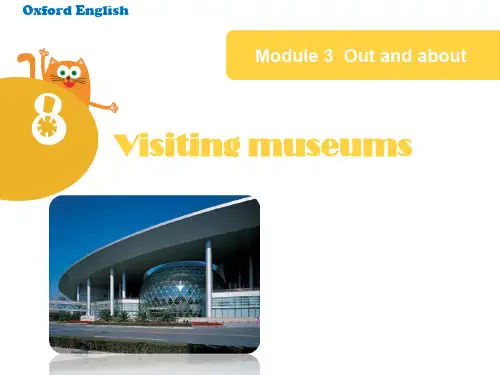
小学六年级上册上海牛津教材U8Visitingmuseums
The robot at the piano can play songs. Another robot can dance. He can move his head and arms.
How did Kitty and Ben feel after they visited the science museum?
There was a robot at the __p_ia_n_o_. He could _p_l_a_y_s_o_n_g_s___. His fingers moved very _f_a_st__. Kitty and Ben _s_t_o_o_d_ beside the piano and __l_is_t_e_n_e_d_ for half an hour.
science museum
car museum
museum
history museum
art museum toy museum
film museum …
teums. Do you like museums?
Think and say
Do you like visiting museums? What kind of museum are you interested in? Why?
➢ What did Ben and Kitty visit on the second floor? They visited “The World of Robots ”.
➢ What did they see there? ➢ What can these robots do?
➢ What did they see there? They saw many kinds of robots there.
六年级上册英语课件-Unit8《Visitingmuseums》_牛津上海版
What did you do last Sunday?
What did you do last Sunday?
I visited my friend and ate pizza together.
What did you do last Sunday?
I played basketball with my friends.
go to the bookstore with classmates
read story books with friends
play football with friends
plant trees with family
Learn the sounds
or
horse short
al
hall fall
au
autumn daughter
oor
door floor
o
office box
a
want watch
What did you do last Sunday?
I went swimming with my brothers.
What did you do last Sunday?
I went to the beach with my parents and my sister.
Have a try!
疑问词+did+主语+动词原形+其它? 如:
1) -What did you do last night? -I did my homework.
2) -Where did you go last week? -I went to Shanghai with my parents.
沪教牛版六上Unit 8 Visiting museums 教案(公开课) 2

Unit 8 Visiting museums 教学设计2 Teaching Aims(教学目标):知识目标:1.能听、说、读、写本课的核心词汇:bee, insect, ant, kind2.能熟练掌握核心句型:What did you see at the museum?I saw a lot of interesting cars.I bought a toy bee.3.能读懂关于参观博物馆的对话。
Teaching Importance and Difficulties (教学重难点):1.能在语境中正确运用本课的核心词汇和句型。
2.一般现在时态与一般过去时态的混合使用。
Teaching Tools(教学用具):录音机、自制课件、照片等Teaching Procedures(教学过程):StepⅠ.Warm up and revision〔热身与复习〕1. Sing an English song:please stand upT: Hello!Boys and girls .Nice to meet you!Ss: Hello!Teacher. Nice to meet you too.T: Let’s sing a song together.2. Do some warming-up exercises.3. Review the word of insects.Step Ⅱ.Presentation and practice〔呈现新语言知识和练习〕1. Lead in.2. T: Let’s play a guessing game. We can see a lot of exciting films there.What place is it?Ss: It’s a cinema.T: You are right! We can borrow books there. What place is it?Ss: It’s a library.T: We can see and learn about many interesting things there.It’s a museum.3. Show some photos and introduce all kinds of museums.4. Learn to say and use the words.T: What did you see at the insect museum?Ss: We saw many insects.5. Watch the screen and learn to say the sentences.6. Ask pupils to practise in groupsSept Ⅲ. Learn the story (学习课文)1. Ask the pupils to look at the pictures on the textbooks and talk about them in groups.2. Watch the cartoon.3. Students follow the recording to read the story.4. The pupils read the text carefully. And then try to do some exercises.5. Role- play in pairs.第二课时Teaching Aims(教学目标)1.能听、说、读、写本课的核心词汇:shall, police, exciting, boring, next time2.能熟练掌握核心句型:--Shall we go and see a film this weekend?--Sure.What would you like to see?What is it about?3.能礼貌地向别人发出邀请或建议。
六年级上册英语Unit 8 Visiting museums 牛津上海版
We can see a doctor there. It’s a hospital.
We can see and learn about many interesting things there.
It’s a museum.
New words
bee
蜜蜂
insect
昆虫
ant
蚂蚁
kind
在城市里有一个科学博物馆。它很大。它在每天 上午十点钟开门。
上星期六,凯蒂和她哥哥 本去了博物馆。他们参观了二 楼的“机器人世界”。他们在 那里看见了各种各样的机器人。
There was a robot at the piano. He could play songs. His fingers moved very fast. Kitty and Ben stood beside the piano and listened for half an hour!
anything是不定代词,表示“任何东西;任何事 物”时,用于肯定句中。
(1)anything 作主语时,其谓语动词用单数。 (2)与形容词连用时,形容词放在anything之后。
例句:今天有什么新鲜事吗?
Is there anything new today?
car museum
汽车博物馆
insect museum science museum
种类
finger
手指
dancer
跳舞者; 舞蹈演员
Listen and say
What did you see at the museum? I saw a lot of interesting cars.
Joe: Hi, Alice. What’s that? Alice: It’s a toy bee. I bought it at an insect museum last
六年级上册英语课件-Unit 8 Visiting museums 牛津上海版 (三起) (共45张PPT)
Kitty and Ben are making a poster for “The World of Robots”. Help them complete the poster.
Welcome to “The World of Robots”!
Ask and answer
Ask and answer the questions about museum with your
classmates. S1: Did you visit any museums
during the holiday? S2: Yes, I did. I visited a /an… S1: What did you see there? S2: I saw…
2. Some of them were beautiful, but some were very ugly. 它们中的一些很漂亮,但是一些非常丑陋。 some的用法: (1)用于肯定句中,意思是“一些,若干”,后 面接复数可数名词或不可数名词。 (2)用在疑问句中,表示希望得到对方的肯定回 复或者表示建议、请求等。
art museum car museum film museum insect museum science museum toy museum
Play roles
Did you visit any museums during the holiday?
Yes, I did. I visited an art museum.
Joe: I bought a model car. Alice: That’s so cool. I want to go there on Saturday. I love
沪教牛津版小学六年级英语上册Unit 8 Visiting museums 第三课时课件
art museum car museum film museum insect museum science museum toy museum
Did you visit any museums during the holiday?
Yes, I did. I visited an art museum.
Presentation
Ask and answer
Ask and answer the questions about museums with
your classmates.
S1: Did you visit any museums during the holiday? S2: Yes, I did. I visited a /an… S1: What did you see there? S2: I saw…
Presentation
Listen and enjoy
Listen and follow the tape.
If Alice is not at home, You know where she will be. She always goes to museums, For the wonderful things she can see.
( B) 1.—What did you buy in the supermarket?
I ______ some apples.
A.saw
B.bought
C.found
( C )2.The car museum is open ______8 a.m.______5
p.m.every day.
A.at; at
ห้องสมุดไป่ตู้
牛津沪教版六上英语Unit 8 Visiting museums 教学设计
Unit 8 Visiting museums 教学设计1教学目标:认知目标:1、理解并会说各类表示博物馆的名称。
如car museum ,insect museum.2、了解各类博物馆的特点。
能力目标:1、能用What did you see?等核心句型来提问获得自己想知道的信息2、能根据教师的引导提炼核心内容,完成复述课文。
情感目标:培养学生乐于分享的情感。
教学重难点:1、能说出各种博物馆的英语名称2、使用核心句型进行问与答的练习,达到能用转变人称的方式来复述课文。
3、通过Think and write 练习,帮助学生巩固一般现在时与一般过去时的混合使用。
教学方法:任务教学法、情景教学法教学准备:PPT、供学生用的练习教学过程Pre-task preparation1. Show some different kinds of museum’s pictures. Have students name hem.2. Teacher ask: what can you see? to review.3. Ask: Did you visit any museums? to elicit Yes, I visited …. I saw some …(Alice went to an insect museum last Saturday? Let’s have a look.)While-task procedureListen and say1. look at the cartoon.2. Task1: look and answerEg: Where did Alice go at the museum?What did she see?...Read the dialogue3. Task2: Read and answera. Complete the diariesb. Answer the questions.Eg: Where did Joe go last Sunday?What did he see?What did he buy?4. Task 3: Try to retell the textLet’s chant5. Ask and answerPost-task activitiesThink and writeWrite about your visit to a museum.Board writing:Unit 8 Visiting museumsS1: What did you see at the museum?S2: I saw…S1: What did you buy?S2: I bought…牛津沪教版英语六年级上册全册知识点汇总Module 1Getting to know each other一、核心词汇1.表示时间名词:month 一个月的时间;月份yesterday 昨天2.形容词:cute 可爱的pretty 漂亮的handsome 英俊的;帅气的famous 著名的;出名的healthy 健康的;有益于健康的unhealthy 不健康的;损害健康的3.动词:catch 逮住;捕捉spend 度过pick 采摘4.食物名词:hamburger 汉堡包fruit 水果pie 馅饼pizza 比萨饼cola可乐sandwich三明治vegetable 蔬菜chicken 鸡肉chocolate 巧克力5.表示动物名词:turtle 乌龟fly 苍蝇6.其他:during 在……期间everyone 每个人;所有人countryside 乡村;农村7.核心词组:grow up长大;成长junior high school 初级中学(be)born 出生summer holiday 暑假the Great Wall 长城the Palace Museum 故宫博物院Tian’an men Square 天安门广场go swimming 去游泳go to the museum 去博物馆go to the cinema 去电影院junior high school 初级中学do my homework 做我的家庭作业watch TV看电视visit my friends 拜访我的朋友a little 少量的fish and chips 炸鱼薯条二、了解词汇1.一些动词及过去式:go(去)—went do(做)—didhave/has(有)—had watch(观看)—watchedvisit(访问;探望)—visited am/is(是)—was are(是)—were2.一些食物名词:egg 鸡蛋bread 面包noodles 面条dumplings 饺子3.其他:menu菜单三、核心句型1.Her hair was short and her eyes were big. 她那时头发很短而且眼睛很大。