
学七年级英语上册Module1Unit1RelativesinBeijing同步测试(新版)牛津上海版
A.a B. an
C. the D. /
( ) 2.
We are planning _____ Beijing because we want to visit our relatives
A.for B. in C. to D. on
( ) 3.
Angela has invited us to stay with her family ______ August
5. We ___________ never _________ ( meet)our uncle and aunt in Beijing before.
III. Fill in the blanks with the proper forms of the given words.(
用括号内单词
Exercise Two
I. Choose the best answer.
(选择最恰当的答案)
( ) 1.
Last summer I stayed ______ my cousin ’s family.
A. against B. with C. for
D. up
( ) 2.
Let ’s _____ to Suzhou for a holiday ____ train.
like ?
2
5. Which flat is _________________(expensive), the old one or the new one?
Ⅳ. Fill in the blanks with the proper forms of the given verbs.(
用括号内动词的
( ) 1.
We are going to travel to Hangzhou ________ August 16.
A.in
B. on C. for D. /
( ) 2.
They are going to stay there __________ two weeks.
A. on B. in C. for D. during
(对划线部分
提问)
_______ _______ does it take to travel from Beijing to Garden City?
2. The ticket cost us about two hundred yuan.
(对划线部分提问)
_______ ________ ________ the ticket cost us?
( ) 3.
We are going to come back __________ this month.
A.in the end of B. in the end
C. at the end of
D. at the end
( ) 4.
How are you going to get _______there?
A. to
B. about
C. of D.for
II. Rewrite the following sentences as required.
(根据要求改写句子)
1.We are going to visit Beijing next week.
We _____ _______ going to visit Beijing next week.( _________ you ________to visit Beijing next week?
4.--- How much _________ the computer ___________(cost)?
---It cost me 5,000 yuan.
Unit 1 Relatives in Beijing
Exercise Three
I. Choose the best answer.
(选择最恰当的答案)
2. We __________already ________ (read)this book.
3. They_______________(not see)this film yet.
4. My uncle ________________(just come) back from Japan.
(根据要求改写句子)
1. He has already had breakfast.
(改为一般疑问句)
______ he _______ breakfast ________?
2. Your uncle has sent us a photo.
(改为否定句)
Your uncle _______ _________ us a photo
用括号内单词
的适当形式填空 )
1. The summer holiday is coming. I will _________(invitation) my cousin to visit
Shanghai.
2. Look, there ’re a lot of ________ (visit) in the Summer Palace.
3. Are you going to take a bus to the park?
(改为同义句)
Are you going to the park _______ ________?
4. They have just written their tourist guide.
(改为否定句)
They _________ ________ their tourist guide yet.
Module 1 Unit 1 Relatives in Beijing
Exercise One
I. Choose the best answer.(
选择最恰当的答案 )
( ) 1. They are planning ______ 8-
day trip to Beijing. It
’s so exciting.
( fast ) .
4. He has got an _________________(invite) to dinner from his friend.
5. There are many beautiful ___________(build) in Shanghai.
Ⅳ. Rewrite the following sentences as required.
适当形式填空 )
1. We are planning _________________ (go) to the beach to have a good time.
2. Kitty is asking Ben _______________(see) a film.
3. They ’d like _______________ (travel) to Beijing this winter.
的适当形式填空 )
1. Going by train is _________(slow) than going by plane.
2. It ’s my _________ (one)time to go there. 3. Kitty can run fast, but Tom can run much __________ gone
II. Fill in the blanks with the proper forms of the given verbs.(
用括号内的动词
的适当形式填空 ) 1. My grandpa______________(live)in Shanghai for sixty years.
’s ______ ____.
A. cheap
B. cheaper C. expensive
D. more expensive
II. Rewrite the following sentences as required.
(根据要求改写句子)
1. It takes about two hours to travel from Beijing to Garden City.
A. go,by
B.to go ,in C.going, for
D. going, in
( ) 3.
The f ilm ”Gongfu Panda” is very __________. I lik
e it very much.
A.interest
B. interested
C.interesting
D. interests
( ) 4.
Your uncle ______ already ________ us a photo of his family.
A. have,sent
B. has,sent C. have, send
D. has, send
( ) 5.
The plane is faster than the train, but it
3. I ’m going t o get some brochures from the travel ___________(agency).
4. There are many _______________(photograph) in the album. Which one would you
A./ B. to
C.at
D. by
( ) 5.
How long does this train ______ to travel from Beijing to Shanghai?
A. took B. take C. takes
上海牛津7年级 知识点归纳 Module 1 Unit 1 Relatives in Beijing
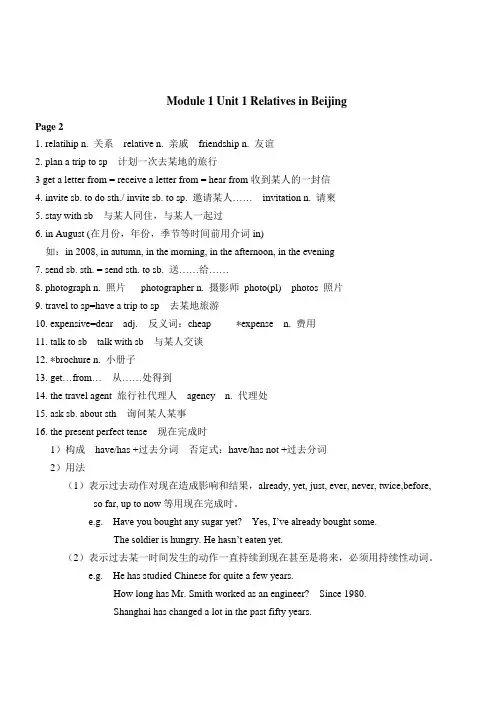
注意,方位词前一般要加定冠词the
区分:如果A地属于B的范围内,用A is in the…of B / A is … of B
如果A和B是分开且不相邻的两地,用A is to the …of B/A is…of B
如果A和B是相邻的两地,用
17. soon不久;很快;马上通常用于一般将来时
18.形容词和副词的比较级和最高级的构成。
(一)单音节或部分双音节词
1.一般加er, est
e.g. long—longer, longest; cheap-cheaper-cheapest
2.以不发音的e结尾的,加r, st
e.g. large—larger, largest;nice—nicer, nicest; close—closer, closest
11. talk to sb talk with sb与某人交谈
12.*brochure n.小册子
13. get…from…从……处得到
14. the travel agent旅行社代理人agency n.代理处
15. ask sb. about sth询问某人某事
16. the present perfect tense现在完成时
5.少数以er, ow结尾的词,加er,est
e.g. clever—cleverer, cleverest; narrow—narrower, narrowest
注意:often—more often—most often modern—more modern—most modern
(二)一部分双音节词和全部多音节词,在原级前加more, most
七年级英语上Unit1 Relatives in Beijing教学设计(牛津上海版)
七年级英语上Unit1 Relatives in Beijing教学设计(牛津上海版)Unit 1 Relatives in Beijing 1Talking about relatives; stating relationship, where they live and ages; making travel arrangements; planning departure dates and length of holidays; writing about travel plans, means of transport and cost; talking about places of interest in Beijing; reading about timetables; writing a personal letter about holiday plans. 2瀛︽儏鍒嗘瀽,,氦璋堛€?3閲嶇偣闅剧偣Using the present perfect tense to relate past events to the present Using adjectives to make comparisons Questions: Where? When? What are the names of鈥? How? 4娲诲姩1re锛峵ask銆€procedure Ask the students questions about relationships: parents and children, teacher and student, doctor and patient. Ask about some relatives : Do you have some relatives who live in other cities or other countries? to elicit: Yes, I have. If you want to invite your relative to visit your family and the city you live, what will you do? to elicit: I will write a letter to invite him or her. 娲诲姩2hile锛峵ask銆€precedure Here is a letter from Uncle Weiming: 7 June Dear Li, It鈥檚a long time since we met last time in Shanghai. Summer vacation is coming. So I鈥檇love to invite you to stay with my family in August. We can watch the Olympic Games together. I miss Ben very much. Since he hasn鈥檛seen his cousins before, I send you a photo. We will enjoy our holiday together. Love Weiming Let the students read the letter together. If you accept uncle鈥檚invitation, you should make a plan of the trip, you must consider the following questions: Where does Uncle Weiming live? Which place are we goingto travel to? When are we going to visit him? How are we going to travel to Beijing? We are going to travel to Beijing by plane train ship Are plane tickets very expensive? What is cheaper? Play the cassette for Listen and Say. The students listen and repeat with their books closed. Ask questions about the dialogue: Who is the letter from? Where does Uncle Weiming live? What does he say in his letter? Have Ben and Kitty seen their cousins before? How old are Kitty鈥檚cousins? What does Mr. Li think of the plane tickets? How does Ben want to travel to Beijing? Why? Who will Mr. Li visit tomorrow? In pairs, students practise the dialogue. Select pairs to read the dialogue. Play the cassette for Look, read and answer. The students listen and repeat. In pairs, students decide on the answer. Ask individual students the questions to check the answers. Language points: 1). plan sth. plan to do sth. v. Do you plan to eat out today? n. Do you have any plans for this term? make plans 2). get a letter from: receive a letter from; hear from 3). invite invite sb. to do sth./some place 鎴戝凡閭€璇稡etty鏉ユ垜瀹?鍚冮キ)銆?I鈥檝e invited Betty to my home. I鈥檝e invited Betty to have dinner at my home. n. invitation 4). I haven鈥檛seen my cousins before. 鎴戜?I haven鈥檛talked to Frenchman before.5).by plane/ship/bus/train/ferry/metro 6).expensive: dear 鏄傝吹鐨?This coat is very expensive for me to buy. n. expense 鑺辫垂寮€鏀?traveling ~ 鏃呮父寮€鏀?op. cheep 7).talk talk to 璇磋瘽,璁茶瘽talk with ?talk about 灏辨煇浜嬭皥璁?鍏充簬The headmaster ~ed to me about the French lessons. 8). brochure 璧勬枡鎵嬪唽You can get some ~ from the travel agent. You can get a lot of information from the travel ~ ,e.g. the traveling expense agent 浠g悊浜?缁忕邯浜?insurance/travel ~ 淇濋櫓/鏃呮父浠g悊浜?the travel agency ?鎴戝拰鏃呮父浠g悊浜?I talked to the travel agent about the traveling expense. I talked about the traveling expense with the travel agent. 9).The present perfect tense. 鐜板湪瀹屾垚鏃?娲诲姩3銆愭椿鍔ㄣ€憄ost锛峵ask銆€activitypair-work: talk about each other's tip to visit relatives. 娲诲姩4銆愪綔涓氥€慳ssignment Write a short passage about a trip to visit relatives.。
Unit 1 Relatives in Beijing 单元知识点整理-七年级英语上册课件牛津上海版
6. places of interest interest n. [U] 兴趣 [C] 爱好 I _h_a_v_e__(n__o_) _in_t_e_r_e_s_t _in_____ drawing. 不感兴趣 His __tw__o_i_n_t_e_re_s_t_s__ in life are music and painting.
Q: H__o_w__lo_n__g_d_o_e_s_S_i_m__o_n_s_p_e_n_d__w_a_l_k_in__g_t_o_s_c_h_o_o_l_?
9. cost, take, spend It takes sb. time to do sth. Sb. spends time/money on sth. Sb. spends time/money in doing sth. Sth. costs sb. money.
A: How _a_r_e___ you __g_o_in_g___ (go) to Beijing next month?
B: I _h__a_v_en__’t_d__ec_i_d_e_d__ (not decide) yet. I __a_m__g_o_in_g__t_o_g_e_t__ (get) some brochures from the travel agent.
3. in / to / on the north-west of…
A B
B is _in___ the east of A. 范围内
A
B
B is _t_o__ the east of A.
范围外,不相邻
A
B
B is _o_n__ the east of A.
范围外,相邻
4. see swans swimming on the lake see sb. do (看到了动作的整个过程) see sb. doing (看到了动作的一个片段,正在做) I saw them __p_l_a_y_in_g___ football when I passed the playground. I saw them ___p_l_a_y___ football all the afternoon yesterday.
学七年级英语上册Module1Unit1RelativesinBeijing同步测试(新版)牛津上海版

A.to go B. went C.go
D. gone
II. Fill in the blanks with the proper forms of the given verbs.(
用括号内的动词
的适当形式填空 ) 1. My grandpa______________(live)in Shanghai for sixty years.
用括号内词
的适当形式填空 )
1. The summer holiday is coming. I will _________(invitation) my cousin to visit
Shanghai.
2. Look, there ’re a lot of ________ (visit) in the Summer Palace.
’s ______ ____.
A. cheap
B. cheaper C. expensive
D. more expensive
II. Rewrite the following sentences as required.
(根据要求改写句子)
1. It takes about two hours to travel from Beijing to Garden City.
( ) 3.
We are going to come back __________ this month.
A.in the end of B. in the end
C. at the end of
D. at the end
( ) 4.
How are you going to get _______there?
(对划线部分提
牛津上海版七年级英语上册Unit1 Relatives in Beijing知识点预习及练习

归纳拓展
Invitation可数名词,意为“邀请,邀请函”
3.send sb. Sth.邮寄或放某人某物,也可以表示为send sth. to sb.
4.By plane乘飞机可以用by air ,take a plane来表示。
练习:
一、选择正确的词,把下列句子补充完整
1、Mr Li is talking ______(about,to)the travelling ______(at,in)the travel agent's.
2、My father is going to travel______(by,from)Shanghai to(to,in)Hong Kong______(by,from)plane.
3、How muchdoes it cost?这要多少钱?
how much引导的特殊疑问句用来询问“(价格)多少”。如:
How much does this pen cost?这支钢笔多少钱?
考点拓展:cost pay take spend用法辨析
1)sb. spend +时间或钱+ on sth ./ (in) doing sth.
三、根据所给要求完成句子。每空限填一词。
1、It takesabout 2 hoursto travel to Beijing by plane.(对划线部分提问)
_____ ______ does it take to travel to Beijing by plane?
2、The plane ticket costs1,500 yuan.(对划线部分提问)
【最新】七年级英语上册Unit1RelativesinBeijing教学设计牛津上海版
Unit 1 Relatives in Beijing1教学目标Talking about relatives; stating relationship, where they live and ages; making travel arrangements; planning departure dates and length of holidays; writing about travel plans, means of transport and cost; talking about places of interest in Beijing; reading about timetables; writing a personal letter about holiday plans.2学情分析很多学生在开口讲英语方面存在畏惧心理,这个主体与学生生活息息相关的,设计得当能帮助学生愿意用英语来交谈。
3重点难点Using the present perfect tense to relate past events to the presentUsing adjectives to make comparisonsQuestions: Where?When?What are the names of…?How?4教学过程活动1【导入】pre-task procedureAsk the students questions about relationships: parents and children, teacher and student, doctor and patient.Ask about some relatives : Do you have some relatives who live in other cities or other countries? to elicit: Yes, I have.If you want to invite your relative to visit your family and the city you live, what will you do? to elicit: I will write a letter to invite him or her.活动2【讲授】while-task precedureHere is a letter from Uncle Weiming:7 JuneDear Li,It’s a long time since we met last time in Shanghai. Summer vacation is coming. So I’d love to invite you to stay with my family in August.We can watch the Olympic Games together. I miss Ben very much. Since he hasn’t seen his cousins before, I send you a photo.We will enjoy our holiday together.LoveWeimingLet the students read the letter together.If you accept uncle’s inv itation, you should make a plan of the trip, you must consider the following questions:Where does Uncle Weiming live?Which place are we going to travel to?When are we going to visit him?How are we going to travel to Beijing?We are going to travel to Beijingby planetrainshipAre plane tickets very expensive? What is cheaper?Play the cassette for Listen and Say. The students listen and repeat with their books closed.Ask questions about the dialogue:Who is the letter from?Where does Uncle Weiming live?What does he say in his letter?Have Ben and Kitty seen their cousins before?How old are Kitty’s cousins?What does Mr. Li think of the plane tickets?How does Ben want to travel to Beijing? Why?Who will Mr. Li visit tomorrow?In pairs, students practise the dialogue. Select pairs to read the dialogue. Play the cassette for Look, read and answer. The students listen and repeat.In pairs, students decide on the answer. Ask individual students the questions to check the answers.Language points:1). plan sth.plan to do sth.v. Do you plan to eat out today?n. Do you have any plans for this term?make plans2). get a letter from: receive a letter from; hear from3). inviteinvite sb. to do sth./some place我已邀请Betty来我家(吃饭)。
沪教版(试用本)七年级上册英语Module 1 Unit1 Relatives in Beijing_学案(无答案)
Unit1 Relatives in Beijing【学习目标】1.能正确理解和运用本课出现的重要单词和短语。
2.读懂课文,能掌握主要信息和细节信息,并能介绍相关内容。
【学习重难点】1.正确理解和运用本课出现的重要单词和短语。
2.掌握主要信息和细节信息,并能介绍相关内容。
【学习过程】一、词组plan a trip to sp.:_____________________________.get a letter from sb.=hear from sb.:_____________________________.invite sb. to do sth.:_____________________________.stay with his family:_____________________________.take a plane to sp.=travel to sp.:_____________________________.send us photos=send photos to us:_____________________________.cheaper and more interesting:_____________________________.talk to/with :_____________________________.sp. eak English:_____________________________.say sb. in English:_____________________________.tell a story/tell sth. to sb.:_____________________________.ask a questions:_____________________________.at the travel agent’s:_____________________________.would like to do=want to do:_____________________________.wouldn’t like to do =don’t want to do:_____________________________.how long:_____________________________.two and a half hours=two hours and a half:_____________________________.It takes sb. some time to do sth. : _____________________________.Sb. sp. end some time (in) doing sth. /on sth.: _____________________________.sth. cost sb. some money: _____________________________.Sb. pay some money for sth. : _____________________________.on 16 August:_____________________________.in August:_____________________________.at the end of August:_____________________________.get to=arrive in/at=reach:_____________________________.二、choice( ) 1.Tian'anmen Square lies in ______ centre of Beijing. It is ______ open area.A.the; the.B.the; a.C./; /.D.the; an.( ) 2.My cousin Simon is ill in hospital. Aunt Jenny has to ______ him all day and all night.A.stay up.B.look after.C.look for.D.take care( ) 3.Taiwan is ______ east of China.A.to the.B.in the.C.on.D./.( ) 4.______ is slower but cheaper to travel to Shenyang by train.A.That.B.This.C.It.D.What.( ) 5.Here is a photo of ______. We are standing on the Great Wall.A.you and I.B.I and you.C.her and you.D.you and me.( ) 6.—Hi, Mary. Nice to meet you.—Hi, Ben. ______A.I am fine.B.Are you OK?C.Thank you.D.Nice to meet you, too.( ) 7.—Excuse me. Is the next bus stop far from here?—Not very far. It only ______ you five minutes to go there on foot.A.sp.ends.B.costs.C.takes.D.gets.( ) 8.—______? —Only $5.It is very cheap.A.What time is it.B.How many do you want.C.How much does it cost.D.What is wrong.( ) 9.The Palace Museum is an interesting place ______ many ancient buildings. I'd like to visit it.A.with.B.has.C.for.D.at.( ) 10.Beijing, the capital of China, is one of ______ cities in the world.A.bigger.B.much bigger.C.biggest.D.the biggest.( ) 11.—______ are we going to get there?—By underground.A.What.B.How.C.When.D.Where.( ) 12.We spent ______ in the shopping mall.A.a hour and a half.B.one hour and a half.C.an hour and a half hours.D.one and a half hour.( ) 13.Thank you ______ us to visit you.A.invite.B.to invite.C.inviting.D.for inviting.( ) 14.He always has toothache ______ he eats too much sweet food.A.because.B.so.C.that.D.why.( ) 15.It's time for sports. Let's ______ cycling, shall we?A.go.B.to go.C.going.D.goes.三、Complete the sentences with the given words in their proper forms.1.Mr. Li and his family are talking about ______ (travel) to Bangkok by plane.2.I am very glad to receive your ______ (invite).3.The next morning we got up so early that we saw the soldiers raising the Chinese ______ (nation) flag in the square.4.The square is such a huge area that it can ______ (held) more than one million people.5.We really enjoyed our holiday in Hong Kong and took a lot of ______ (photo) there.。
牛津上海版英语七年级上Unit1 Relatives in Beijing教案
牛津上海版英语七年级上7A Module 1 Unit 1Relatives in Beijing一. 单元分析( Unit Analysis)(一) 单元地位( Unit position)1. 本单元在时态上的一个重点在与现在完成时的拓宽与延伸。
现在完成时在6B Module 2中学生已经学过,并以肯、否、一般疑问句及其简单回答和特殊疑问句的形式出现在Unit 2和Unit 3,同时还加入了一些副词,如:just, already, yet.。
但在当时的教学中,语言情景仅局限在涉及“去过某地”(即have been to +地点)。
本单元在动词的选择上,扩大了范围,增加了诸如:have had, have visited, have seen 等其它动词,这就要求在教学时,要适当扩充动词的过去分词,尤其要注意拼写。
本单元还增加了never在现在完成时的使用,以及主语为第三人称单数的特殊情况。
因此,本单元在现在完成时的教学中起到了深化和承上启下的作用,学习好本单元对学生在以后的现在完成时,乃至过去完成时的学习时都起到很重要的铺垫作用。
2.本单元在将来时方面,也让学生从原来学过的be going to do …拓宽到了will do…。
3.形容词的比较级,在6A 和6B中多次出现,本单元的复现,应是一个强化,教师可做适当的拓宽。
4.关于the same的表达曾在6 A Module 1的Unit 1和Unit 2中出现,本单元在原来的基础上,增加了the same…as的表达。
5. Would like to do …的句型在6 A和6 B中也多次出现。
在本单元中,可结合want to do…一起教学。
6. 注意某些问时间(How long),问价格(How much),问方式(How)等疑问句及回答的用法。
让学生这些方面的问答操练后巩固掌握它们。
7. 本单元的情景内容较为实用,涉及到外出旅游的计划打算、出游安排准备、询问价格、所需花费时间的问答、交通方式的比较、机场接机、景点介绍等;在句式上用到了提建议的多种方式;甚至还出现了较为简单的感叹句。
牛津上海版七年级上Unit1 Relatives in Beijing知识点总结与练习
牛津上海版七年级上Unit1 Relatives in Beijing知识点总结与练习知识点总结本单元主要讲述的是与亲属关系有关的词汇和表达。
以下是本单元中涉及的主要知识点:1. 亲属关系在这个单元里,我们学习了一些常见的亲属关系词汇和表达方式。
例如:father(父亲)、mother(母亲)、uncle (叔叔)、aunt(阿姨)、grandfather(爷爷)、grandmother(奶奶)等等。
了解这些词汇能够帮助我们描述自己的家庭成员和认识别人的家庭成员。
2. 提问亲属关系在英语中,我们通常使用疑问词来询问关于亲属的问题,比如:Who is he?(他是谁?)、Is she your sister?(她是你的姐姐吗?)等等。
了解如何正确地使用疑问词有助于我们在交流中更好地了解对方。
3. 介绍亲属关系当我们想要介绍自己的亲属或问别人的亲属时,我们可以使用一些表达方式,例如:This is my father.(这是我的父亲)或者 Are these your brothers?(这些是你的哥哥吗?)等等。
掌握这些表达方式能够使我们的交流更加流畅。
练习让我们通过以下练习来巩固本单元的知识点。
1.翻译下列亲属关系词汇:–Brother: __________–Sister: __________–Grandmother: __________–Uncle: __________–Aunt: __________2.请写出下列亲属关系短语的英文表达:–女儿的父亲:_____________–儿子的母亲:_____________–姐姐的兄弟:_____________–姑姑的儿子:_____________3.根据提问,回答下列问题:–Is he your grandfather?–Who is she?–Are these your sisters?4.请根据图片和提示写出亲属的英文表达:–爷爷–妈妈–弟弟这些练习将帮助你巩固并加深对本单元知识点的理解。
七年级英语(上)Unit 1 Relatives in Beijing知识点总结
Unit 1 Relatives in Beijing一、重点内容;重点单词1 invite v. 邀请2 agent n. 代理人;经纪人3 raise v. 提升;举起4 national adj. 国家5 brick n. 砖6 mountain n. 高山;山岳7 history n. 历史的8 holiday n. 假期9 another pron. 另一个(人或事物)10 expensive adj. 昂贵的11 soon adv. 不久;很快;马上12 stone n. 石头;石料;岩石13 ancient adj. 古老的14 interest n. 吸引力;趣味15 wonderful adj. 精彩的;令人高兴的16 at the end of (August) 在(八月)底17 talk to 说话;讲话;谈话18 travel to... by plane 乘飞机到某处旅行重点句型、句子1. Yes, we’ like to travel to Beijing by plane.是的,我们愿意坐飞机去北京旅行。
2. How long does it take to travel from Garden City to Beijing by plane?从花园城到北京旅行乘飞机要花多长时间?3. We’re going to visit Beijing on 16 August.我们打算8月16日去北京旅行。
4. It can hold more than one million people.它能容纳100多万人。
5. Ben and I had a wonderful time in Beijing.我和本在北京度过了一段愉快的时光。
重点语法:1. adjectives to make comparisons 形容词表比较。
2. nouns and adverbs to show position 名词和副词表位置。