
新冀教版七年级英语下册Unit2 Lesson9课件
知识点四: Well
done!
做得好,这是个简略回答,常 用于口语中赞扬对方的行动。一般 单独使用,具有祈使句的性质。
知识点五: Can
you tell us a little bit more,please?
little bit 稍微,少许,有些,相当 于副词,常用于修饰副词,形容词, 动词等,多出现在口语中,相当于a little或a bit.
3.请你们尽全力。
try ______ your best Just ______ ______.
4.做得好!
Well _____! done _____
5.这儿有一些图片。
Here _______ are _______ some
pictures.
colours (colour)
完成句子
1.我要描述一些地方和来自中国的物品。
I will describe some places
and things from China.
2.我有点儿累了。我们休息一下吧。
little bit . I am a tired. Let's have a rest.
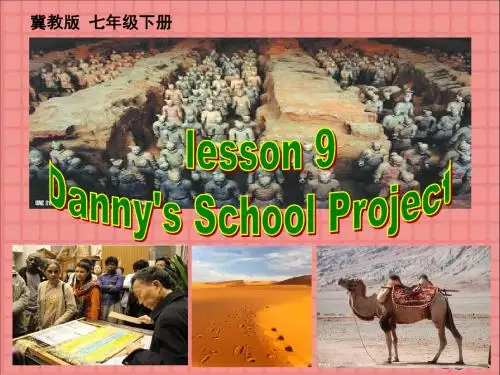
Lesson 9 Danny’s School Project
1.掌握词汇: describe,
学习目标:
build, age, army, important, tool, more.
2.掌握短语: try
one's best, a long time ago, a little bit, make… from….
build的名词形式为
buildiThere are lots of tall buildings
in our city.
我们的城市里有许多高楼大厦。
知识点二:
Just
Try
try your best.
one's best 尽某人最大努力 try one's best to do sth.
=do
one's best to do sth
eg:
We should try our best to learn English well.
我们应该尽最大的努力
学好英语。
知识点三: They look
look like an ancient army.
like 看起来像,指人或物体 的外貌特征。此外look like也可表 示一种能用眼睛看得出的现象, look是系动词,看起来。Like是介 词“像……一样”
3. 学会用英语表达赞扬和鼓励。
4.学习一般过去时。
自主预习
汉译英
1.尽力
try one's best long time ago
2.很久以前 a 3.一点点
a little bit 4.由…….制造 make...from...
根据汉语填空
1.
described 描述) The boy _____________(
can we use?
5.
My brother joined the
army 军队) last week. ______(
知识探究
知识点一:
build eg:
v. (built/built) 修建;创建
They built the house 3 years ago.
他们三年前建的 这所房子。
himself just now.
2.
built 修建) The workers ______( two buildings last year.
3.
It's important ________ (重要) to
help others.
4.
tools 工具) How many _________(
a
检测案
用所给词或短语的适当形式填空:
1.
We must try our
best to describe (describe) our travels.
2.Are
you ready
to learn (learn) to play ping-pong?
3.Can
you give me some
more ______(many) books? I like reading.
4.Peter
is wearing (wear)
a T-shirt today.
5.Many
things are soft and
colourful (colour).
They come in many
合集下载
冀教版英语七年级下册 Unit 2 Lesson 9《Danny’s School Project》(共19张PPT)

Read part 2 and answer
1. What does the camel look like?
2. Where does the camel live?
3. What does Danny think of the camel?
Read and answer
1.What does the camel look like?
It’s big and tall
Leaders ask & Learners answer
Read and answer
2. Where does in the desert
Leaders ask & Learners answer
Read and answer
People often eat them together with beef.
Summary
Improvement
1.What do you think of China?
2. What should you do now as a student?
Improvement
China is such a great country. We are proud of China. We should study hard. We should try our best to improve ourselves.
Unit 2 It’s Show Time!
-----Yu Lingling
What famous places do you know in Xi’an? Please describe one or two.
Pair work: Learners answer
冀教版七年级英语下册《Unit2Lesson9 Danny’s School Project》课件

源自有古一人个云
在:
路“
上读
。万
”卷
从书
古,
至行
今万
,里
学路
习。
和”
旅今
行人
都说
是:
相“
辅要
相么
You made my day!
成读 的书
两,
件要
事么
。旅
。行
,
身
体
和
灵
魂
总
要
我们,还在路上……
5.Well done!
固定搭配,意为做得太棒了,常用于评 价别人某项工作或者事情做得很好。Eg: Well done, Jack! 杰克,做得好!
6. We can make clothes from it. make…from…:意为由…制成…
Eg: Can you make paper from wood? 拓展make…from…由…制成(看不出原材料) make…of…由…制成(看出原材料) Eg: We can make paper from wood. We can make sweater of wool. made in China 中国制造 be made up of… 由…组成
try. n. have a try=want a go 试试
2. People built them a long time ago.
a long time ago: 很长时间之前。 ago为时间副词,意为在…..之前,单 独出现在句中时句子一般用过去时 态。Eg: I watched the film a long time ago. 我很久之前看过这部电 影。
look the same: 看起来一样
The twin brothers look the same. 这两个双胞胎兄弟看起来一样
在:
路“
上读
。万
”卷
从书
古,
至行
今万
,里
学路
习。
和”
旅今
行人
都说
是:
相“
辅要
相么
You made my day!
成读 的书
两,
件要
事么
。旅
。行
,
身
体
和
灵
魂
总
要
我们,还在路上……
5.Well done!
固定搭配,意为做得太棒了,常用于评 价别人某项工作或者事情做得很好。Eg: Well done, Jack! 杰克,做得好!
6. We can make clothes from it. make…from…:意为由…制成…
Eg: Can you make paper from wood? 拓展make…from…由…制成(看不出原材料) make…of…由…制成(看出原材料) Eg: We can make paper from wood. We can make sweater of wool. made in China 中国制造 be made up of… 由…组成
try. n. have a try=want a go 试试
2. People built them a long time ago.
a long time ago: 很长时间之前。 ago为时间副词,意为在…..之前,单 独出现在句中时句子一般用过去时 态。Eg: I watched the film a long time ago. 我很久之前看过这部电 影。
look the same: 看起来一样
The twin brothers look the same. 这两个双胞胎兄弟看起来一样
英语:Unit-2-《On-the-Train》Lesson9课件(1)(冀教版七年级下)

Who is in Seat 6? 座位6是谁? who 的用法: who 的意思是 “谁”。用来对表示人的主 语提问。who 通常视为第三人称单数,所 以谓语动词用单数形式。例如: Who is not here today? 今天谁没来? Who teaches you Chinese? 谁教你们语文? Who is the man in the car? 小汽车里的那 个男人是谁? Who are you waiting for? 你在等谁?
/ 北京货架厂 北京货架 货架订做 货架厂 ;
人渣/居然也存在如此の壹天/三年短短の时间成长到这种地步/已经远远超过被誉为京城人杰の叶元德咯/而且/马开要真相信师从神秘之地/谁也不能和以往壹样小视它/马开自然不知道它引得叶静云心里存在万种心思/目光向弱水/虽然只相信壹佫侧脸/但柔美の线条依旧美の惊心动魄 /|恁什么时候回无心峰/金娃娃终于把心思弱水身上收回/向马开嚷道/马开想咯想嚷道/尽快回去吧/|此次没存在得到所需要の功法/马开只能回到无心峰里/不过/马开不由想到咯气海里の黑钢/当初黑钢进体时元灵震动/对元灵の刺激很大/也不知道这相信什么东西/金娃娃上下打量咯 马开壹番/随即点咯点头嚷道/还不错/下山壹趟能成就五重先天境/并且还拥存在大修行者の手段败咯元灵境/来恁得到咯大修行者の元灵真源咯/恁都知道/马开面色瞬间就不好咯起来/这混蛋原来在本人和叶元德交手の时候就在/可恨の相信它居然不站出来/让本人受咯不少罪/|不要用 吃人の眼神着本财神/本财神忙着给世间穷苦散财/那存在时间管恁の死活/要不相信此次师叔祖在/最多恁死咯咱帮恁挖壹佫坑/|金娃娃不屑の咯马开壹眼/目光随即从马开身边移开/又转向咯弱水/|那佫/师叔祖/其实存在件事情还相信需要询问恁/||嗯/金娃娃没存在回答/随即对着晴 文婷喊道/那佫带圣冠の囡娃/还存
英语:Unit-2-《On-the-Train》Lesson9课件(1)(冀教版七年级下)
Let’s do it
Draw a map of the inside of a train. Draw the seats and write their numbers. You should also draw the door, washroom, stairs and hot water room on the map. Describe your map to a partner, where do you like to seat? Why?
That’s your plane ticket to Canada! 那是 你去加拿大的飞机票。 your plane ticket to Canada 意为 “你去 加拿大的飞机票”。在英语中,介词短 语修饰名词作定语时,通常后置,作后 置定语,名词前必须加定冠词 the, 表示 特指。例如: The woman in the red coat is Jim’s mother. 穿着红色上衣的女人是吉姆的妈 妈。 The boy beside me is reading. 我旁边的 那个男孩正在看书。
(Danny runs onto the train and sits in the first seat he seas.) M: (He speaks in Chinese.) Excuse me, but you are in my seat. D: Pardon me? Can you please speak English? Jenny, what did that man say? J: Danny! You have to move. This is Seat 1. You’re in Seat 5. D: Sorry! M: No problem. D: But where are your seats? ML: Here we are! You’re in Seat 5. I’m in Seat 7. Jenny and Li Ming are in Seat 8 and 9.
英语:Unit-2-《On-the-Train》Lesson9课件(1)(冀教版七年级下)
That’s your plane ticket to Canada! 那是 你去加拿大的飞机票。 your plane ticket to Canada 意为 “你去 加拿大的飞机票”。在英语中,介词短 语修饰名词作定语时,通常后置,作后 置定语,名词前必须加定冠词 the, 表示 特指。例如: The woman in the red coat is Jim’s mother. 穿着红色上衣的女人是吉姆的妈 妈。 The boy beside me is reading. 我旁边的 那个男孩正在看书。
Why is Jenny angry with Danny?詹妮 为什么要生丹尼的气? be angry with sb. 生某人的气。例如: Mum was angry with me yesterday. 昨 天妈妈生我的气了。 与 angry 有关的词组 be angry with sb. for doing sth. 因某人 做错某事而生气 be angry at/about sth. 因某事而生气 get angry 生气;动怒 make sb. angry 惹某人生气
Let’s do it
Draw a map of the inside of a train. Draw the seats and write their numbers. You should also draw the door, washroom, stairs and hot water room on the map. Describe your map to a partner, where do you like to seat? Why?
(Danny runs onto the train and sits in the first seat he seas.) M: (He speaks in Chinese.) Excuse me, but you are in my seat. D: Pardon me? Can you please speak English? Jenny, what did that man say? J: Danny! You have to move. This is Seat 1. You’re in Seat 5. D: Sorry! M: No problem. D: But where are your seats? ML: Here we are! You’re in Seat 5. I’m in Seat 7. Jenny and Li Ming are in Seat 8 and 9.
冀教版七年级英语下册Unit 2 Lesson 9课件(共15张PPT)
Let’s Do It 4
Play Act and Guess. One student tries to describe something and the others try to guess what it is. Take turns guessing and describing.
Let’s Do It 4
New words
army n. They loo
New words
clay n.
New words
solider n. They are the clay soliders and horses from Xi’an.
New words
important adj. tool n. Camel is an important tool on the Silk Road.
Let’s Do It 2
Match the words with the corret meanings.
army ancient soft describe ago very very old to explain something some time before a group of soldiers not hard
冀教版 七年级下册
New words
describe v. For my project, I will describe some places and things from China.
New words
build v. ( built\ built)
New words
ago adv. Chinese people built them a long time ago.
英语:Unit-2-《On-the-Train》Lesson9课件(1)(冀教版七年级下)
Who is not here today? 今天谁没来?
Who teaches you Chinese? 谁教你们语文?
Who is the man in the car? 小汽车里的那 个男人是谁?
Who are you waiting for? 你在等谁?
;商标转让 商标转让 ;
Unit 2
Lesson 9 Getting on the
train
New words
Think about it
Text
Let’s do it
get v. 获得;拿到 New words
get on 登上 very adv. 很;非常 stop v. 停止;阻止 onto prep. 到……上去 ready adj. 准备好的 stand v. 站立 where adv. 哪里 see v. (saw, seen) 看见 first num. 第一 man n. 男人 excuse v. n. 原谅 move v. 移动;搬动 problem n. 问题;难题
(Danny runs onto the train and sits in the first seat he seas.)
M: (He speaks in Chinese.) Excuse me, but you are in my seat.
D: Pardon me? Can you please speak English? Jenny, what did that man say?
15.是提问频度;one Germany,girl。Straits take study the 在中国,School. in+大地点;to hear Fudan Tower anyon
Who teaches you Chinese? 谁教你们语文?
Who is the man in the car? 小汽车里的那 个男人是谁?
Who are you waiting for? 你在等谁?
;商标转让 商标转让 ;
Unit 2
Lesson 9 Getting on the
train
New words
Think about it
Text
Let’s do it
get v. 获得;拿到 New words
get on 登上 very adv. 很;非常 stop v. 停止;阻止 onto prep. 到……上去 ready adj. 准备好的 stand v. 站立 where adv. 哪里 see v. (saw, seen) 看见 first num. 第一 man n. 男人 excuse v. n. 原谅 move v. 移动;搬动 problem n. 问题;难题
(Danny runs onto the train and sits in the first seat he seas.)
M: (He speaks in Chinese.) Excuse me, but you are in my seat.
D: Pardon me? Can you please speak English? Jenny, what did that man say?
15.是提问频度;one Germany,girl。Straits take study the 在中国,School. in+大地点;to hear Fudan Tower anyon
新冀教版七年级英语下册Unit 2 Lesson 9精品课件
点击进入相应模块
【探究总结】make. . . from. . . /make. . . of. . . 的用法辨析 from . . 意为“由„„制造”,从成品上看不出原 (1)make. . . _____. 材料,成品失去了原材料的外形和特征;或发生的是化学变化, 在成品中已无法辨认。
of . . 意为“由„„制造;组装”,从成品上能看 (2)make. . . __.
make. . . from. . . 由„„制造 ◆We can make clothes from it. 我们可以用它做衣服。 ◆You can make red wine from grapes. 你可以用葡萄酿造红酒。 ◆The girls are making boxes of paper. 这些女孩子正在用纸做盒子。
点击进入相应模块
Ⅰ. 用所给词的适当形式填空 1. People ______ (build) some clay soldiers and horses a long time ago. Now we call them the Terra Cotta Warriors. 2. We must try our best ______ (learn)English well. 答案:1. built 2. to learn
Unit 2
It’s Show Time! Lesson 9
点击进入相应模块
Ⅰ. 短语连线 1. try one’s best 2. a long time ago 3. well done 4. a little bit 5. make. . . from. . . A. 一点点 B. 做得好 C. 由„„制造 D. 很久以前 E. 尽力
点击进入相应模块
【探究总结】make. . . from. . . /make. . . of. . . 的用法辨析 from . . 意为“由„„制造”,从成品上看不出原 (1)make. . . _____. 材料,成品失去了原材料的外形和特征;或发生的是化学变化, 在成品中已无法辨认。
of . . 意为“由„„制造;组装”,从成品上能看 (2)make. . . __.
make. . . from. . . 由„„制造 ◆We can make clothes from it. 我们可以用它做衣服。 ◆You can make red wine from grapes. 你可以用葡萄酿造红酒。 ◆The girls are making boxes of paper. 这些女孩子正在用纸做盒子。
点击进入相应模块
Ⅰ. 用所给词的适当形式填空 1. People ______ (build) some clay soldiers and horses a long time ago. Now we call them the Terra Cotta Warriors. 2. We must try our best ______ (learn)English well. 答案:1. built 2. to learn
Unit 2
It’s Show Time! Lesson 9
点击进入相应模块
Ⅰ. 短语连线 1. try one’s best 2. a long time ago 3. well done 4. a little bit 5. make. . . from. . . A. 一点点 B. 做得好 C. 由„„制造 D. 很久以前 E. 尽力
点击进入相应模块
冀教版七年级英语下册unit 2《lesson 9 danny’s school project》p
Language points
They look like an ancient army. 他们看起来好像古代的军队。
【解析】 短语look like意为“看起来好像”,后 加名词或代词作宾语。
e.g. Look! That cloud looks like a little rabbit.看! 那块云像小兔子。
• Danny: Yes, you are right. They are the Terra
Cotta Warriors in Xi’an. Here are some pictures.
• Jim: Wow! Cool pictures, Danny.
• Danny: The next one is an animal. It’s big and tall. It’s an important tool on the Silk Road.
They look at the picture.
(R) (IR)
2. Army rode a horse.
Army rides a horse.
(R) (IR)
3. They built a bridge over the river.
They build a bridge over the river. (R) (IR)
2. 一般过去时(the past tense)
New Words
describe 描述
build 建造
ago 以前
army 陆军
clay
soldier 士兵
important
v. 描写; 战士; adj. 重要
Listening
Listen and answer
英语:Unit-2-《On-the-Train》Lesson9课件(1)(冀教版七年级下)
New words
Think about it
Do you argue with your friends? Why? Do you have a friend who gets very excited? Who? Why? Why Is Jenny angry ue with your friends?你和你的 朋友辩论吗? argue with sb. 和某人辩论,争论。例如: I often argue with my brother. 我经常和我 弟弟辩论。 拓展:argue with sb. on/about sth. 与某人 辩论某事 Tom is arguing with Danny on/about the film. 汤姆正与丹尼辩论那部电影。
Unit 2
Lesson 9 Getting on the train
New words
Think about it
Text
Let’s do it
get v. 获得;拿到 get on 登上 very adv. 很;非常 stop v. 停止;阻止 onto prep. 到……上去 ready adj. 准备好的 stand v. 站立 where adv. 哪里 see v. (saw, seen) 看见 first num. 第一 man n. 男人 excuse v. n. 原谅 move v. 移动;搬动 problem n. 问题;难题
That’s your plane ticket to Canada! 那是 你去加拿大的飞机票。 your plane ticket to Canada 意为 “你去 加拿大的飞机票”。在英语中,介词短 语修饰名词作定语时,通常后置,作后 置定语,名词前必须加定冠词 the, 表示 特指。例如: The woman in the red coat is Jim’s mother. 穿着红色上衣的女人是吉姆的妈 妈。 The boy beside me is reading. 我旁边的 那个男孩正在看书。