
人教版必修2 Unit 3 Computers 4
Period Four Grammar—The Present Perfect Passive Voice1.以上几句中所使用的时态和语态是现在完成时的被动语态。
2.现在完成时的被动语态的构成为:have/hasbeen+过去分词。
现在完成时的被动语态表示到现在为止某事已经被完成或被做。
这种语法项目既要表示现在已经完成又要表示被动的含义,因此很多同学在具体运用当中容易顾此失彼,难以把握。
运用现在完成时的被动语态时应掌握以下几个问题:1.构成现在完成时的被动语态的构成为:have/hasbeen+过去分词。
2.各种句式3.使用的场合(1)表示一个被动的动作发生在说话之前,强调对现在造成的影响或结果。
常与already,yet,never,recently等副词及时间状语sofar,bynow,uptill/tonow,since...,before...等连用。
Thousandsofmanmadesatelliteshavebeensentupintospacebymanycountries.许多国家已经发射了数千颗人造卫星到太空中。
Thedoctorhasn’tbeensentforyet.还没有派人去请医生。
(2)表示一个被动的动作或状态开始于过去,持续到现在,并可能持续下去,常与for或since引导的时间状语连用,或用于“Howlong...?”句型中。
Theimportantproblemhasbeendiscussedfornearlytwoweeks.那个重要的问题已经被讨论近两个星期了。
Howlonghasthemachinebeenused?这台机器使用多久了?Morethantenbridgeshavebeenbuiltovertheriverinthiscitysinceitsetupaneweconomiczone.自从这个城市建立了一个新经济开发区以来,这条河上已经建了十多座桥了。
4.现在完成时的被动语态应注意的几个问题(1)现在完成时的被动语态与一般过去时的被动语态的区别。
一般过去时的被动语态所表示的动作或状态与现在的情况没有联系,而现在完成时的被动语态则强调与现在的情况有联系。
Thebridgewasbuiltlastyear.这座桥是去年建成的。
Thebridgehasbeenbuilt.这座桥已经建好了。
(2)含有非延续性动词,如:borrow,finish,begin,buy,start,return,marry,open,join等的现在完成时的被动语态的肯定式不能与表示一段时间的状语连用。
若要表达相应的意思,则须改换动词或时态。
这本书买了多长时间了?误Howlonghasthisbookbeenbought?正Howlongagowasthisbookbought?但这类动词的现在完成时的被动语态的否定式,则可与since或for构成的时间状语连用。
Nobookshavebeenboughtsincelastweek.自上周以来,没有人来买书。
(3)短语动词是一个不可分割的整体,在被动语态中要保持完整性,其中的介词或副词不可省略。
Itissaidthattheproblemhasbeenlookedinto.据说已经调查了这个问题。
(4)只带有一个宾语的动词变为被动语态时,将主动语态的宾语变为被动语态的主语。
Wehavebuiltmanyhousesinthepasttenyears.→Manyhouseshavebeenbuiltinthepasttenyears.(5)带有双宾语的动词,如give,send,bring,take,teach,show,tell,make,sing,write,read,sell,buy,pay,lend,pass等,变为被动语态时,可将其中一个宾语变为主语,另一个保留不动。
Wehavegivenhimthebook.→Hehasbeengiventhebook.→Thebookhasbeengiventohim.(6)带有复合宾语的动词变为被动语态时,只能将宾语变为主语,原来的宾补改为主语补足语。
原来用省略to的不定式作宾补的,被动语态中要用带to的不定式。
Ihavetoldthemtohelpyou.→Theyhavebeentoldtohelpyou.单句语法填空1.Fireextinguishers(灭火器)eafireextinguisheronlyifyouhavebeentrained(tra in) todoso.(2018·天津)2.Sarahhasbeentold/wastold(tell) thatshecouldbeBritain’snewsupermodel,earningamilliondollarsinthenextyear.(2017·全国Ⅲ)3.Since1958,theyhavebeenrecognised(recognise) asthenationaltheatreofIsrael.(2017·全国Ⅱ) 4.Inrecentyears,stresshasbeenregarded(regard) asacauseofawholerangeofmedicalproblems.(2016·上海)5.Despitethepreviousroundsoftalks,noagreementhasbeenreached(reach) sofarbythetwosides.(2015·天津)Ⅰ.用现在完成时的被动语态改写句子1.Jack’sbosshasalwayspraisedhimforhisdevotiontowork.→Jackhasalwaysbeenpraisedbyhisbossforhisdevotiontowork. 2.Theyhavefoundagoodplacetobuildatempleinthevillage.→Agoodplacehasbeenfoundtobuildatempleinthevillage.3.Wehaven’tyetdecidedhowtosolvethatdifficulttechnologicalproblem.→Howtosolvethatdifficulttechnologicalproblem hasn’tbeendecided yet. 4.Ihaveaskedhertohelpyou.→Shehasbeenaskedtohelpyou.5.Wehaveplantedmanytreesonthehillinthelast5years.→Manytreeshavebeenplantedonthehillinthelast5years.Ⅱ.语法填空(用所给词的正确时态、语态填空)LiMing:Hi,LinTao.Hownicetoseeyouonthefirstdayofthenewterm!LinTao:Yes.Nicetoseeyouagain.LiMing:Iknowthatyourparents6.havebeenworking(work) inYushuforyears.Canyoutellmesomethingthereaftertheearthquake?LinTao:Ofcourse.Sincetheearthquake7.happened(happen),manysoldiers8.havebeensent(send) there,andmanykindsofsupplies(物资供应) 9.havebeencarried(carry) therefromalloverthecountry.Now,mostpeoplethere10.live/areliving(live) ahappylifeagain.LiMing:Howabouttheschoolsthere?LinTao:Severalnewschools11.havebeenset(set) upandalsosomeschoolswhich12.weredamaged(damage) intheearthquake13.havebeenrebuilt(rebuild).Soallthestudentscangobacktoschooltostudynow.LiMing:That’swonderful.I’msuretheirlifewillbebetterandbetter.Whenwillyourparentscomeback? LinTao:Theywillbebacknextmonth.基础巩固Ⅰ.用所给词的正确形式填空1.Morethan100famousfilmshavebeenshown(show) inthecitysinceJuly.2.Uptonownoconclusion(结论) hasbeenreached(reach) aboutwhothefirstprizeshouldgoto. 3.Howmanycarshavebeenmade(make) inthefactorysince1990? 4.Threenewschoolshavebeenopened(open) inourcityinthepastfiveyears.5.It’sthefirsttimethattheoldcomputer hasbeenchecked(check) sinceIboughtit. 6.Greatchangeshavetaken(take) placeinmyhometownandyoucanseethatalotoffactorieshavebeenset(set) up. 7.—WillPetersoncometoourgraduationceremony(毕业典礼)?—It’sap ity.Hehasbeensent(send) toIndiaasavolunteerteacher.8.It’ssaidthatthebridge hasbeenclosed(close) forrepairsformonths.Ⅱ.完成句子9.Theboyshavebeentoldmanytimes(男孩们已经被多次告知) nottoswiminthatlake,butitdoesn’tmakeanydifference.10.WearegladtobetoldthatLiTaohasbeenadmittedto/intoFudanUniversity(已经被复旦大学录取) forhistopscoreinthemathscontest.11.Withthehelpofhightechnology,moreandmorenewsubstances(物质) havebeendiscovered(已经被发现) inthepastyears.12.Whenandwheretogofortheonsalaryholiday hasnotbeendecided(没有确定) yet.13.Though we don’t know what was discussed,yet we can feel the topic hasbeenchanged(改变了).14.People’shealth hasbeengreatlyaffected(受到了很大的影响) byair,noiseandwater.能力提升Ⅲ.阅读理解Duringtheday,MikeKosciukteachesstudentsatDeLaSalleCollegiateHighSchoolinMichigan.However,intheeveningsandonweekends,.Notonlydoesheteachstudentsmathfrom9thgradethroughcollege level,healsoteachesotheronlineteachershowtoimprovetheirteachingskills.Recognizedasaleaderinonline teaching,.ChrissyMarkleyisoneofmanyonlineteacherswhoaretakingvirtual(虚拟的) learningtothelowergrades.AtArizonaConnectionsAcademy,anonlinepublicschool,Chrissyteaches7/8thGradeGiftedLanguageArtsand9thGradeLanguageArts.Oncea6thgradeteacherinatr aditionalpublicschoolarea,Chrissyenjoysteachinginthevirtualclassroom.Recognizedasanexcellentteacher,shewasnamedtheschool’s2011TeacheroftheYear.Havingtenyears’experienceinonlineteaching,JodyShinebeganteachingwithDavenportUniversity.Whenshewasaskedtoteachonline,shewasskepticalatfirst.“Ifearedsomethingwouldbelostinthegiveandtakeofclassroomdiscussion,”Jodysaid.“NowIknowonlineteachingallowsstudentsgreaterfreedomtoexpressthemselves.”Today,JodyusesvoicerecordingsandonlinevideostoteachEnglishCompositiontoDavenportstudents.LikeArizonaConnectionsAcademy,OpenHighSchoolofUtahisalsoapublicschoolofferingonlineinstruction.There,AmyPaceisanawardwinning(获奖的) scienceteacher.Afterspending11yearsinatraditionalteachingenvironment,AmyjoinedOpenHighSchoolofUtah.Shehashelpedcreateaninterestingsciencecourse.In2010,shewasoneof1037thto12thgradeteacherstobechosenforaPresidentialAwardforExcellenceinMathemati csandScienceTeaching.15.WhatsubjectdoesMiketeach?A.EnglishComposition. B.LanguageArts.C.Science. D.Math.答案 D解析细节理解题。
Unit3《Computers》(新人教版必修2)
【解析】选B。考查动词时态用法。since表示“自从……”表 示从过去到现在,主句谓语动词要用现在完成时态。
4. With more new applications found in many fields, the computer is now a _____ friend and helper of the human race. A. devoted C. stubborn B. total D. awkward
5. with the help of在……帮助下 After all, with the help of(在……帮助下) my electronic brain which never forgets anything, using my intelligence is what I’m all about!
在某个时间或空间范围内;beyond用于表示时间迟于,晚于; below 低于,不及;少于。
2. By the 1940s the computer had grown as large as a room, and people wondered if it would grow ____ larger. A. quite B. fairly C. any D. very far,
Ⅲ. 句式填空 1. before引导的时间状语从句
I developed very slowly and it took nearly two hundred years
before(过……久才) I was built as an analytical machine by Charles Babbage. 2. consider +宾语+(to be/as)+ n. /adj. At that time it was considered(被看作) a technological revolution and the start of my “artificial intelligence”.
人教版高中英语必修二m2u3grammar

believed.
2. 并不是所有动词都有被动语态 1) happen, take place, break out, belong to, cost, last等不及物动词或词组无被 动语态。如: [误] Great changes have been taken place in China since 1978. [正] Great changes have taken place in China since 1978.
3. — Why does Mary look so unhappy? — She _h_a_s_b_e_e_n__la_u__g_h_e_d_a_t_ (被嘲 笑) by her classmates.
4. It is said that the house _h__a_s_b_e_e_n _b_r_o_k_e_n__in__to_ (闯进了) by two thieves.
The structure of the present perfect passive voice is: have/ has + been+~ed
注意: 1. 副词的位置
often, usually, always, never, hardly, seldom等副词置于have/has和been中间。 如: [误] Such a man has been hardly
4. 一些特殊动词, 如borrow, finish, begin, buy, start, return, marry, open, join等构 成的现在完成时的被动语态不能与表示 一段时间的状语连用。若要表达相应的 意思, 则需改换动词或时态。如:
人教版高中英语必修2unit3课文知识点详解
即学即用 (1)—Excuse me,could you tell me the way to
the British Museum? —Sorry,I’m a stranger here. —A. A.Thanks anyway B.It doesn’t matter C.Never mind D.No problem 解析 A.不管怎样,还是要谢谢你。B.没关系。 C.不要紧;不用担心。D.没问题。句意为: ——打扰了,你能告诉我去大英博物馆的路 吗?——抱歉,我在这儿是个陌生人。——不 管怎样,还是要谢谢你。
(3)mark含义广泛,指事物留下的深刻印记,比 sign更侧重于区别性或指示性的标志。 (4)symbol指被人们选出的物体或图案,用来代 表 另一事物,作为该事物的标记或象征。 The dove is the symbol of peace. 鸽子是和平的象征。
即学即用
(1)The soldiers are hiding in the trees and
raised aised raising
即学即用 (1)我本来想事情会很容易,但是出现了许多问题。
I thought it would be easy,but a lot of problems have arisen . (2)事故由粗心大意引起。 Accidents arise from carelessness.
是我的一切。
with the help of my electronic
brain which neverwhfiocrhgentesvearnyftohrignegt是s 状语,
说an明yt主hi谓ng部分的伴随状况。在这个with短语中,
包含一个定语从句
Computers--Warming-up,IntensiveReading教案(新人教版高中英语必修2unit3)

Computers--Warming-up , Intensive Reading教案(新人教版高中英语必修2 unit 3)Teaching goals:1. To have a better understanding of the main idea of the passage.2. To enable the students to talk about computers and robots in English and express or support an opinion with suitable expressions3.To enable the students to grasp the progress of computers4. To enable the students to talk about computers and robots in EnglishTeaching aids: Computer, recorder and projectorTeaching procedures:Step 1. Lead-in (Word puzzle )T: The technology develops so quickly that many new things appear in human being’s life.Let’s guess what they are: (show the picture on the screen and get Ss to say out the answers, learn the new words at the same time )An old calculating machine used in China until now. (An abacus)It is built to solve some mathematical problems. But it is too big. (A huge computer)It is a new calculating machine which can solve a large number of mathematical problems. (A calculator)It is a personal computer which can solve all kinds of problems and is used widely now.(A PC / personal computer)T: If I am a math teacher, which can help me most?(Ask students to give their opinions, remind them of using the expressions of giving opinions) Ask students to discuss what the items just shown have in common, and then rank them according to the time of their appearance.Ask some of the students to talk about what they know about computers.Ask students to discuss “How have computers changed our life?”, and then have some of them give their answers, using the expressions of giving opinions.Step 2 Pre-readingT: Have the computer and Internet become part of your life?How have computer changed our lives? (What can you use them to do? )Ss: I use the computer or Internet to: type my homework /draw pictures/ play games communicate with my friends./ gather related information for my lesson s/ buy the things I like, / listen to music /watch movies…T: What else do you think the computer and Internet will help you to do ?Deal with Ex 3 of Pre-reading on Page 17Step 3 SkimmingGive students only 1 minute, then ask them to get the main idea of the passageThe main idea of the passage: This is a short _____ of the _______ of computers.Who am I ? ( A computer )(shown on the screen)Step 4 ScanningGive students 2 minutes, and ask them to scan answers to the following questions:(Before students read the passage, tell them that attention should be paid to the hints of the time.) (Questions are shown on the screen)Question (1) What is the main idea of the passage?Students are asked to find out three sentences to support who the speaker is in the story.1)Then in 1822 I was built …. (Itself was the first design of a computer)2)My real father was Alan Turing.(He designed the first real computer.)3)However, people thought I was simple-minded until…., (It has artificial intelligence.) Question (2) What happened to computers in 1642?Question (3) What happened to computers in 1936?Question (4) What happened to computers in 1970s?Step 5 Detail ReadingI Give students 5 minutes to read the passage carefully, and answer the following questions: Question (1) Who was the first person to describe how the computer was made to work? Question (2) What did he make and what did it do?Question (3) Who was the next important person to design computers?II True or False1. In 1642 I began as a calculating machine and could solve any mathematical problem. F2. My real father was Charles Babbage, who wrote a book and build me in 1936. F3. After I got my new transistors in the 1960s, I became smaller but cleverer and quicker. T4. I was brought into people’s homes in the 1970s. T5. Since my birth I have been built to take the place of human race. FIII ComprehendingAsk students:” How is the passage organized?”(If the students can not answer the question, draw their attention to the appearance of different years.)Fill the tableA chain of events showing the development of computer / Changes of the machineTimeline1642: _____________________________________________: the Analytical Machine was Madeby Charles Babbage.1936: _______________________________________________________________________ 1960s: ___________________________________________________________________________: the first family of computers was connected to each other.1970s: ______________________________________________________________________ Now: _______________________________________________________________________ Explain how the computer technology has been developing and complete the following chart. Then give a brief oral presentation on the development of computer technology with the help of the chart.Step 6 Summing-up and enjoyingI. Ask students to finish the form shown on the careen(the same as on p.19) while playing the voice of the textII . Ask students to ex-change their own answers in groups, and then raise questions if they have any.III. Sum up:1) Chronological writing Chronology (资料等)按年代次序的排列Chronological means to describe things in order of time.Chronology is often used in recounting an event or describing the life of someone. It is an effective way to make a mass of things clearer.Step 7 Oral practice ─Retell the text using Chronological1. Have students get prepared in 2 or 3 minutes and then retell the development of computers in your own words, using chronology.2. Ask some of the students to retell the text.Step 8 Homework1. Go over the text, and try to understand the text.2. Get ready for the discussion on P.19 Comprehending 33. Finish Exercise 1 in Learning about Language on page 19。
人教版高中英语必修二(Book 2 Unit 3)

人教版高中英语必修二(Book 2 Unit 3)Unit 3 Computers核心单词1. common adj. 共同的,普遍的;常见的常用结构:in common 共有,公用(在句中多作状语)have nothing/little/a lot/something in common (with) sb. 与某人没有/许多/有些共同之处in common with 和……一样common sense/knowledge 常识common welfare 公共福利易混辨析common/ordinary/usual/normalcommon 指"共有的,公共的;共同的;常见的"。
反义词为rare。
common作"普通的"讲时可与ordinary换用。
如"普通人"也可以说成common people。
ordinary 意为"普通的,平淡无奇的",指没有什么特别的地方。
usual 意为"平常的,通常的,一向的",含惯例之意。
normal 意为"正常的"。
Jane and I have nothing in common.=I have nothing in common with Jane. 我与简毫无共同之处。
The problems are common to all societies. 这些问题是所有社会的通病。
In common with many young people, he prefers pop songs.和许多年轻人一样,他喜欢流行歌曲。
He is in ordinary clothes. 他穿着平常的衣服。
We meet every day at the usual place. 我们每天在往常那个地方见面。
单项填空Harry visited the bookstore every week. He became sucha______________customer that the bookseller gave him some books as presents.A. commonB. normalC. usualD. average解析:选C。
高中英语Unit3ComputersPeriodFourGrammar—ThePresentPerfectPassiveVoice练习(含解析)新人教版必修2
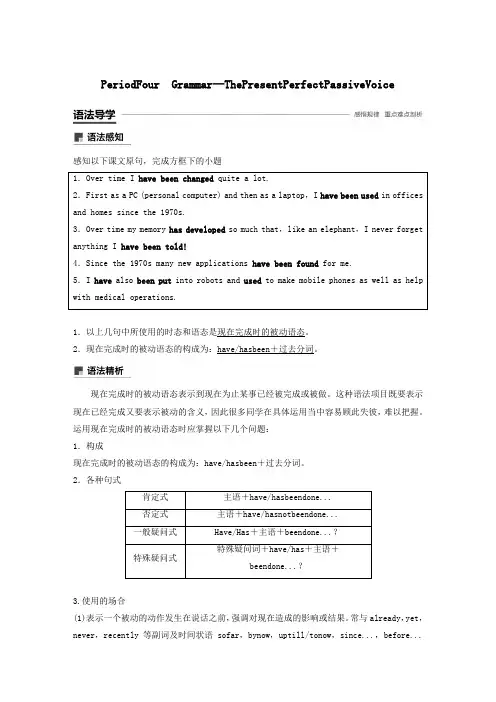
PeriodFour Grammar—ThePresentPerfectPassiveVoice感知以下课文原句,完成方框下的小题1.Over time I have been changed quite a lot.2.First as a PC (personal computer) and then as a laptop,I have been used in offices and homes since the 1970s.3.Over time my memory has developed so much that,like an elephant,I never forget anything I have been told!4.Since the 1970s many new applications have been found for me.5.I have also been put into robots and used to make mobile phones as well as help with medical operations.1.以上几句中所使用的时态和语态是现在完成时的被动语态。
2.现在完成时的被动语态的构成为:have/hasbeen+过去分词。
现在完成时的被动语态表示到现在为止某事已经被完成或被做。
这种语法项目既要表示现在已经完成又要表示被动的含义,因此很多同学在具体运用当中容易顾此失彼,难以把握。
运用现在完成时的被动语态时应掌握以下几个问题:1.构成现在完成时的被动语态的构成为:have/hasbeen+过去分词。
2.各种句式肯定式主语+have/hasbeendone...否定式主语+have/hasnotbeendone...一般疑问式Have/Has+主语+beendone...?特殊疑问式特殊疑问词+have/has+主语+beendone...?3.使用的场合(1)表示一个被动的动作发生在说话之前,强调对现在造成的影响或结果。
国考教师资格证试讲稿_人教版_英语_高中_必修2_unit3_computers_ -
试讲稿人教版英语高中必修二Unit 3 ComputersGood morning, teachers! I am No. One candidate, today I am applying for the senior school English teacher. My topic is “computers”. Now let’s begin my class.Good morning, everyone, nice to see you! How are you? I am great! Thank you!Please look at the ppt, there are seven pictures here. What are they? Do you know? The first one? Yes, it is an abacus. And then? Yeah, calculator. And how about this one? Right, it is the first computer, we call it huge computer. And this? Yes, it’s PC, means personal computer. Here, it is laptop and it is very common these days. And we can carry this when we are out. So what’s this? Right, it is PDA. And it is very popular. So how about the last one? Right, it is robot. Ok, now, I will show any picture, and you should speak out the English work. Right, look at this picture, who knows the English word? Right, it is calculator. Read after me, calculator, calculator. Good! And next picture? Yes, it is huge computer. It is so large. What’s this? Right, it’s abacus. And this? Good, it is laptop. Everyone loves it. Through looking at these pictures, we can see that these devices have a common point. Do you know what it is? Tom, please! Well, very good! They are all computers, and do you know what the next computer is like? Now I will give you several minutes to imagine that and draw it on the paper. Then, show it to your partner. And at last, we will vote for the most creative one. Now, you can start. So, time is up. Who can share your computer with us? Ok, Peter, carry your picture and come here to describe it for us! Wow, that’s amazing. And anyone who think your computer is better then Perter’s, please come here. Well, Mary, please! Wow, that’s wonderful. And anybody else? Ok, Jack! Wow, wonderful! Thank you! Go back to your seat! Which is the most creative one? Do you know? Oh, no, no, keep silence! I think they all did a nice job. Give applaud to them.Please look at the title of the passage, we can see that it is from the first person view describing the text. Now, what does this passage mainly talk about? Maybe we can guess before we are going to learn the passage. There is a hint here, you can lookat the pictures on page 18. You can guess what the main idea of the passage is? Who can tell us? Wang Ming, please! Do you agree with him? Yes, he is right. It mainly talks about the computer. Now, you can think about on what aspects computer is used in our daily life. Maybe you can write down and show your partner. Jim, could you please talk something about this? Well, very good! Thank you! The computer plays an important role in our daily life. For example, we work via computer. We contact our friends through computer. We watch movie sometimes on the computer, and etc. How does computer develop? Now, I will show you. First, please look at the words. First one, calculato, do you remember this word? Yes, I taught you just now. It is an electronic abacus. We can calculating work quickly using the calculator. And this word? Right, it is laptop. It is a new type computer so that we can take it to anywhere we want to. And it is originated from this one--PC. And PC is from what? Right, it is from huge computer. And now there is one thing that is more convenient for us to carry. What is it? Good, it is PDA. And how about this word? Right, robot. Read after me, robot. Good!Now, today we are going to learn the development of computer. First, I will give you several minutes to skim the passage and think about two questions: 1) who is the character of the passage? 2)How many aspects are the passage mainly talking about? Ok, time is up. Who can answer my questions? Ok, Rose, please! Good, the character is the computer. And there are two aspects. One is the development of computer, the other is the usage of computer in people’s daily life. And you should notice that: this passage is written from the first person view. Think about it, if we write from the first person view, what’s the advantage? Yeah, the passage will become much more lively and interesting. So if we want to describe something, we can write from the first person view. Now please scan the passage and finish comprehending 1. Ok, who’d like to share your answers? Please write it on the blackboard. Wow, he is all right.Now, please read the passage carefully, and think about the words in bold. You should not look them up into the dictionary, just guess from the context. And please read it again and generalize the main idea of each paragragh. Now, do you have any difficulties reading this passage? Or do you find any difficult language points? Ok,Jerry, yes, you find this sentence “I have been changed quite a lot” and the sentence like that very difficult. Ok, don’t be worried. That is just the passive voive used in the present perfect tense. There are so many sentences like that in this passage, and you can find them. I will explain it specifically next class.Let’s listen to the tape and pay attention to the pronunciation and pause. So listen again and you had better speak after it. Ok, now, please look at comprehending 3 and I will give you several minutes to discuss it and then some students will come here and perform the dialogue. Ok, time is up. Who’d like to have a try? Right, you, please! Wow, you did a nice job. Thank you! Go back to your seats! And any other group? Nice, you, please! Well, wonderful, your perfoming skill are amazing. Go back to your seats!So class will be over soon. Let’s preview what we have learned today. Do you remember? Who want to make a summary of the knowledge today? Ok, Sherry, please! Wow, good! Anything else? Ok, Lisa, yes, thank you! And we also know that computer is widely used in our daily life.After class, you’d better preview what we have learned today. And think about the advantages and disadvantages of computer, because next class, we are going to have a debate, so you should make a full preparation.O k, today’s class is over, see you!That’s all for my class, thank for your attention!。
信息技术教案:高一英语必修2Unit3Computers全单元教案
信息技术的发展已经深深地嵌入到我们的生活中。
计算机的出现彻底改变了人们传统的生产方式和生活方式。
现代教育不再是仅限于背书和抄板书,而是花费大量的时间和精力去思考、去分析和去实践。
在这样一个信息时代,教师的角色也随之转变。
我们不仅需要教授知识,还需要培养学生的信息能力,帮助他们理解和利用科技并运用它们支持我们的学习和生活。
高一英语必修2 Unit3 Computers全单元教案是一份非常重要的信息技术教案。
这个单元是有关于计算机和互联网的,向学生介绍了计算机的历史和发展,软件和硬件,以及学习计算机和互联网所需的相关知识。
第一课:Computers in Everyday Life这一课介绍了计算机在生活中的应用以及与人们的生活密切相关的一些软件。
我们可以向学生展示各种各样的工具软件,如视频制作、图片编辑、文档编辑、音频制作等等。
我们也可以通过展示计算机硬件的内部结构来引导学生了解计算机是如何工作的。
第二课:The Development of Computers这一课涵盖了计算机诞生以来的漫长历史。
从最初的机械计算器到现代的个人计算机,这里介绍了计算机的种类、发展和特点。
学生能够学习计算机的历史,了解计算机技术的发展和趋势,以及计算机的应用范围。
第三课:Computer and Society这一课程介绍了计算机在社会生活中的应用,并引导学生思考计算机技术对社会的影响,特别是当它开始影响人们的生活、工作和教育时。
我们将会讨论有关网络安全问题,从而让学生了解如何安全地使用计算机。
第四课:Software这一课介绍了计算机系统中的软件,包括操作系统、应用软件、编译器等等。
学生将了解到不同类型的软件的特点,掌握基本的软件使用技巧。
第五课:Data Storage这一课主要介绍了计算机数据存储,包括内存、硬盘等。
学生将学习如何存储、传输和访问数据,并了解如何保护我们的数据。
第六课:The Internet这一课介绍了互联网的原理和应用。
高中英语人教版必修二Unit-3知识点汇总及强化练习
Unit 3 Computers 单元要点预览Ⅰ词语辨析Ⅱ词性变化Ⅲ重点词汇1. sum n. 金额; 款项; 总数; 总和[典例]1). He was fined the sum of 200. 他被处以200英镑罚金。
2). The sum of 5 and 3 is 8. 5加3的和是8。
[重点用法]in sum简言之; 总而言之sum sb/sth up形成对某人[某事物]的看法[练习] 中译英1). 总之, 计划告吹了。
______________________________________________________________________ 2). 我认为她是个很能干的经理。
______________________________________________________________________2. advantage n.优点;优势;有利条件[典例]1). He has the advantage of a steady job. 他有工作稳定的有利条件。
2). They took full advantage of the hotel's facilities. 他们充分利用旅馆的设备。
[重点用法]take advantage of 对……加以利用;欺骗to sb.’s advantage 对某人有利have /get/win an advantage over 〔of〕胜过;优于[练习] 中译英1).协议对我们有利。
______________________________________________________________________ 2).她利用了我的慷慨。
______________________________________________________________________3. goal n. 球门;进球得的分;目标[典例]1). He headed the ball into an open goal. 他乘虚把球顶入球门2). We won by three goals to one 以三比一获胜。
人教新课标必修二英语Unit 3Computers【教学设计】
Unit 3 Computers本堂课包括Warming up 和Reading 两部分。
他们是语言知识和文化意识的输入过程;是语言技能、情感态度和学习策略的培养过程,也是语言输出过程。
在整个教学过程中,它是培养学生阅读能力的主要过程,教学重点是阅读技能的培养、交际能力及情感态度的提升。
Warming up部分根据每个人对电脑的看法不同让学生就“Do you like computer?”进行小组探究和讨论,从自身实际出发谈论自己的看法,有助于激发学生对于整个单元的学习兴趣。
Reading部分(Computers)主要讲述的是电脑的发展史,通过一系列问题的设置让学生能够在全面理解文章的基础上提高信息处理、加工和学习的能力。
Knowledge objectives:掌握以下词语和句型:Calculate,sum, solve, simplify, artificial, intelligence, revolution,reality, totally, application, finance, in common, over time, as a result, from···on, so···that. Ability objectives:训练学生一定的阅读技巧,使他们掌握一些有效的学习策略,从而提高阅读速度和篇章理解的准确性,并养成一定的自主学习能力;培养学生快速阅读的能力、捕捉信息的能力及运用语言进行交际的能力。
Emotion objectives:通过对“computer”的学习,启发学生思考电脑给我们带来的影响,从而以一种正确的方式利用电脑和网络资源;另外通过电脑的发展历程让学生意识到科技对生活的影响。
1. 教学重点:1.了解计算机的发展过程,进一步认识计算机的演变以及对人类的影响。
2.训练学生的阅读技巧,提高学生阅读速度和理解能力。