
译林英语五年级下册Unit5单元教案
Unit 5 Helping our parents单元教学建议:本单元围绕孩子帮助父母做家务的话题,呈现了现在进行时态特殊疑问句和肯定句的用法。
教学重点是关于家务劳动的动词短语和现在进行时态的肯定句型。
教师可要求学生自带全家福和呈现家居生活的照片,或者让学生画一幅体现家居生活的画,并想一想家务活有哪些,自己做过哪些,为课堂教学做好准备。
在语法教学方面,教师可从一般现在时引入现在进行时态,用对比的形式呈现。
教师也可将五上第四单元like doing作为现在分词的引入点。
本单元的教学词汇是关于家务劳动的动词短语,且都是动宾结构,师生可先复习学过的相关动词,再进行拓展。
教学目标:1.能听懂、会说、会读单词parent, sweep the floor, wash the dishes grow, pest,ladybird, go away.2.能听懂、会说、会读、会写短语:clean, cook, busy, garden, sweet.3.能听懂、会说、会读、会写句型及回答:what are you doing? I’m… what ishe/she doing? He/she is…4.能知道字母组合ing在单词中的读音。
5. 能唱歌曲《Polly, put the kettle on》教学重点:1.句型: what are you/they doing? what is he/she doing? 及其回答I’’m/they/we are…he/she is…2.词汇:clean, cook, busy, garden, sweet.3.语音:字母组合ing在单词中的读音。
教学难点:1.句型: what are you/they doing? what is he/she doing? 及其回答I’’m/they/we are…he/she is…2.词汇:parent, sweep the floor, wash the dishes等;clean, cook, eat, help, wash, watch 等现在分词的读音及用法。
3. 语音:字母组合ing在单词中的读音。
课时安排:6课时第1课时:Story time第2课时:Fun time &, Grammar time第3课时:Cartoon time第4课时:Sound time and Checkout time第5课时:Ticking time(review)第1课时Story time教学目标:1. 能听懂、会读、会说单词:parent, clean, cook, sweep, busy, wash .2. 能听懂、会读、会说日常用语:what are you doing? What is he/she doing? 及回答3. 能正确的理解并朗读课文,在教师的引导和帮助下尝试复述课文内容。
4. 能初步运用本课所学的词汇和句型询问别人正在做什么。
教学重点和难点:教学重点:能正确理解并朗读课文,在教师的帮助下尝试复述课文。
教学难点:能初步运用本课所学的词汇和句型询问别人正在做什么。
教学过程:Step 1 GreetingStep 2 Pre-reading1.Let’s watch看一则公益视频关于孩子为父母做家务的出示中文After reading , please answer what’ he /she doing?生试答Ss: He /She is ….T(将以上提及的短语综合在一起) Yes, they are helping their parents .Step 3 While-reading1.Do you help your parents at weekends?Ss: Yes, I often/sometimes/usually/always…..Teach : clean the car, sweep the floor, wash clothes, wash the dishes.T: Great! We can do a lot of things. What about them?出示课文人物。
Can you try to guess what are they doing?2.Watch the cartoon3.Are mike and Helen helping their parents? Read the story and underline some difficult words and sentences.4.Let’s fillName Doing thingsMikeHelenTimJim(1)Listen and repeat(2)Do a judge.My father is cooking in the kitchen.Helen is sweeping the floor.Tim and dog are in the living room.Jim is in cleaning the table in the afternoon.Tim and Jim are watching TV in the living room.Step 4 Post-reading1.Have a talkWhat do you think of them?Ss have a talk in class.2.Retell the story.Retell the story and put the pictures on the right place.Step 4 ConsolidationT: We know our parents will become older and older, Look!展示另一个关于父母老去的视频或图片。
So now please help your parents with housework andlove each other! Because many hands make light work.Homework1.Read the story 3 times2.Retell the story according to the pictures.第2课时grammar and fun time教学目标:1.能熟练运用句型what are you doing? I’m… what is he/she doing? He/She is…进行对话。
2.能理解并掌握现在进行时态句型的用法及规则。
3.能完成Fun time 中的任务。
教学重难点:能初步理解现在进行时态的结构及变化形式。
教学过程:Step 1 GreetingStep 2 ReviewT: Watch the story again and review. Now let’s do some exercise.1.Review the new words出示课文图片,学生回答并拼写。
2. Retell the story.3. 出示课文表示现在进行时态的一个句子,让生将剩余的全部找出来。
Step 3 Grammar time1.出示grammar 中的句子T:Who can try to read? (Ss read)2.T: Just now, you made a lot of sentences with V-ing, try to find the rules.学生根据例句,寻找规律。
3.学生试说规律,教师总结。
4.T: Great! Let’s do some practice.教师出示grammar 中的动词,do, clean, cook, eat, help, wash and watch,学生小组讨论动名词形式。
5. Have a check.6. Say a chantDoing, doing, what are you doing?Cleaning, cleaning, I’m cleaning.Doing, doing, what are you doing?Cooking, cooking, I’m cooking.Doing, doing, what are you doing?Eating, eating, I’m eating.Doing, doing, what are you doing?Washing, washing, I’m washing.7 .再次出示课文下方短语T: It’s so easy for you, do you want a difficult one? This time , you should say a whole sentence.(学生根据所示图片,试着用现在进行时态表述)Step 4 Fun time1.Sing a song.T: well done! Boys and girls, let’s relax, sing a song< what are you doing?>. can follow it if you want.(学生跟唱,可自由发挥加上动作等。
)2.教师出示关于自己的在家做家务的图片T: What am I doing?S 1: You are…T: What am I doing?S 2: You are…T: What am I doing?S 3: You are…T: Who can ask me ?Ss : What are you doing?T : I’m ….T: 指一生问:What are you doing ?S 1: I’m ….可多问几人。
3.Work in pairs.4.出示fun time 图片。
T : What is he/she doing?S4 : He is….5.Now you can ask and answer in groups. 3 minutes.(学生操练给句型)学生上前表述该句型。
6.Let’s share.Step5 PracticeWhat are you _____(do)?What ____(be) he doing?She is________ (clean) the windows.What are mike’s parents______ (do)?They are _____(wash) clothes.Homework1.用现在进行时态造句,(5个)。
2.课后完成fun time 的练习。
第3课时cartoon time教学目标:1. 能够听懂、会说、会读卡通故事中出现的词汇:grow, garden, sweet, pest, ladybird, go away.2. 能够流利地朗读卡通部分。
新牛津译林版五年级英语下册Unit5 第3课时教案
一、概述重组家庭是指由离婚或丧偶的父母重新组建家庭,其中可能包括自己的子女以及配偶双方的子女。
这种家庭形式在现代社会中逐渐增多,但由于家庭成员之间的血缘关系并非直系亲属,可能存在一些与传统家庭不同的问题和挑战。
对于重组家庭而言,家庭教育的重要性尤为突出,因此有必要针对重组家庭的家庭教育指导策略进行深入探讨。
二、了解家庭成员的感受1. 重组家庭的孩子可能面临情感困扰,他们需要理解并接受新的家庭成员,同时也需要处理和父母、兄弟姐妹之间的关系。
家长应当倾听孩子的心声,了解他们的内心感受,给予足够的关爱和安全感。
2. 失去亲生父母或真正家庭的孩子可能存在认同问题,因此建立身份认同感是非常必要的。
家长可以通过各种方式,例如定期与孩子交流聊聊,参与孩子所在学校或社交圈的活动,帮助孩子树立自信和认同感。
三、建立和谐的家庭氛围1. 家庭成员之间的相互尊重和包容是建立和谐家庭氛围的关键。
家长应当示范出良好的行为模范,引导孩子学会尊重和体谅他人。
2. 家庭成员之间的交流问题也是影响整个家庭氛围的重要因素。
家长可以鼓励家庭成员之间开展有效交流,包括在日常生活中倾听对方的想法、意见和感受,解决家庭内部的矛盾和问题。
四、帮助家庭成员适应新环境1. 重组家庭的孩子可能需要时间来适应新的家庭环境和生活方式。
家长需要给予足够的耐心和理解,同时也需要提供一定的支持和帮助。
2. 家长也可以通过帮助孩子建立新的社交圈和友谊关系,以及鼓励他们参与各种社交活动来帮助他们更好地融入新的生活环境。
五、制定家庭规则和价值观1. 制定家庭规则对于重组家庭尤为重要,这有助于建立和谐的家庭秩序和氛围。
家长需要与家庭成员共同制定家庭规则,并教育他们遵守这些规则。
2. 家庭价值观也是影响家庭教育的重要因素之一。
建立积极向上的家庭价值观,如尊重他人、诚实守信、团结互助等,有助于引导家庭成员树立正确的人生观和价值观。
六、寻求专业帮助1. 针对重组家庭的家庭教育指导策略可能需要借助专业机构和专家的帮助。
译林版五年级下册英语教案U5~U6 Revision
译林版五年级下册英语教案U5~U6 Revision 教师信息教师姓名:XXX任课班级:五年级(X)教学内容:U5~U6 Revision教学目标•复习U5~U6单元所学的知识点和语言结构,巩固已有的语言能力。
•提高学生的英语阅读、听力和口语表达能力,能够流利、自然地运用所学的语言知识和技能进行交流和表达。
•培养学生的英语学习兴趣,激发学生学习英语的自主性和主动性。
教学重点•复习U5~U6单元所学的重点词汇、语法和句型。
•学习表达和分享自己的看法和观点。
教学难点•成功运用所学的语言知识和技能进行交流和表达。
•提高学生听、说、读、写的英语综合能力。
教学过程Step 1 复习U5~U6单元的重点知识1.复习U5单元的重点词汇、语法和句型•总结U5单元中已经学过的重点词汇和短语,并用它们造句。
•引导学生使用被动语态描述事件,并与他们分享一些真实的例子,帮助他们理解并掌握这一语法结构。
2.复习U6单元的重点词汇、语法和句型•总结U6单元中的重点词汇和短语,并用它们造句。
•让学生用正确的情态动词形式描述他们的意愿和建议,并与他们分享一些真实的生活场景,帮助他们掌握这一语法结构。
Step 2 提高听力能力•用各种生活场景中的对话和课文中的录音材料提高学生的听力能力,并帮助他们养成较好的听力习惯和有效的听力策略。
•练习对话的听懂和转述,鼓励学生不断地用所学的语言知识和技能去实践,并反复强化听、说、读、写的技能。
Step 3 提高口语表达能力•练习对话的说出并能够自然、流利地运用所学的语言知识和技能进行交流和表达。
•鼓励学生自己动手编造对话的场景,积极参与互动交流,在实践中不断提高自己的表达能力。
Step 4 提高阅读能力•让学生阅读课本中的短文和练习册中的文章,提高学生的阅读能力和理解能力。
•引导学生理解并分析所读材料的主旨、结构和用语,培养他们的语言运用能力和思维能力。
Step 5 小结与拓展•总结本节课的重点和难点,并与学生分享一些有效的学习和提高英语能力的练习方法。
译林版五年级英语下册教学课件Unit 5 Fun time, Sound time 课件
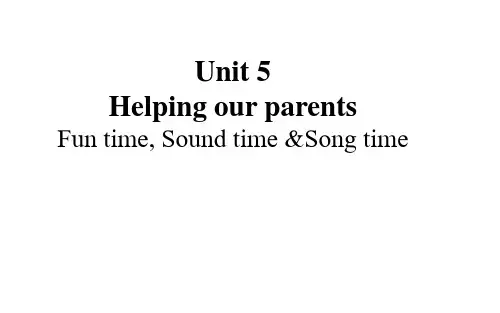
Can you order these sentences? 你能将歌词排序吗?
Susie, take it off again. Susie, take it off again.
Polly, put the kettle on. We’ll all have tea. 喝 Susie, take it off again. They’ve all gone awa茶y.
Song time ---Sing and act
Rules: 1. A组唱红色部分,B唱蓝色部分,
齐唱绿色部分。 2. 起立唱。
Fun time ---Look and find
Who is helping parents?
Fun time ---Remember and say
What are they doing?
In the evening, I like to _s_it__
聆听风吹的声音
And _li_st_e_n_ to the wind blowing. 吹
Sound time ---Read and find
/ Iŋ /
bring spring running …
In the morning, I like to sing And watch the flower growing. In the eveniningg, I like to sit and listen to the wind blowing.
Polly
put the kettle on 将水壶放上
Susi e take it off
kettle
Song time ---Watch and translate (翻译)
译林版(YL)五年级英语下册教学课件Unit 5 Story time 课件
cooking breakfast
cooking dinner
behelping his father cleaning the car sweeping the floor
cleaning the table washing the dishes
sleeping
Ben
sleeping
eating fruit watchiinngg TV
Saturday morning Saturday afternoon
cleaning the car
cooking breakfast
cooking dinner
helping his father cleaning the car
Who?
Story time
What are they doing?
Wh
SaWtuhrdeany? morning
o?
Who?
Ben
What are they doing?
Saturday morning
cleaning the car cooking breakfast helping his father
watching TV
eating fruit watching TV
Who?
Ben
Who is busy?
Saturday morning
cleaning the car
Saturd['abyɪzaɪf]ternoon
cooking breakfast
cooking dinner
helping his father cleaning the car
sleeping
sleeping
新版-牛津译林版小学英语五年级下册全册教学设计
新版-⽜津译林版⼩学英语五年级下册全册教学设计五年级英语下册教案 Unit 1 Cinderella 第⼀教时教学⽬标:1. 能听懂、会说、会读、会写1)词汇:why, because,clothes, let, put on, have to, take off2)句型和⽇常⽤语:Why are you sad?Because I can’t go to the party.2. 能听懂、会说、会读1). 词汇:prince, fairy, before, try on, fit.2) 句⼦:There is a party at the prince’s house,but Cinderella cannot go.A fairy comes.Come back before 12 o’clock.Many girls try on this shoe,but it does not fit.3. 培养学⽣阅读经典故事的能⼒和兴趣教学重点:句型:Why are / can’t …及其回答Because …词汇:why, because, clothes, let, put on, have to , take off教学难点:句型:Why are / can’t …及其回答Because …词汇:了解put on, try on和take off的⽤法和区别,理解have to, be bad for的意思,了解它们的⽤法。
教学准备:1. 多媒体、教学光盘2. 学⽣课前阅读《灰姑娘》的英⽂简写本。
3. 师⽣各⾃准备⼀些⾐物教学过程:A. Warming up1. Greetings2. Sing a song4A Unit 7 The clothes shop3. Free talkT: What colour are the shoes?Ss: They’re yellow.T: Look at my shoe. Do you like it?S1: Yes. It’s nice.T: Please try it on.S1: (学⽣试穿鞋⼦) Oh, it’s too big.B. Presentation and practice1. 说说做做,学习新词呈现⼀些⾐物,并做试穿、脱下的动作,引导学⽣学习、理解新词put on, take off, try on 和fit. T: (呈现⼀件衬衫) Here’s a shirt. It looks nice. Let me try it on. Look. What do you think?S1: It’s small.T: You are right. It’s a bit small. It doesn’t fit.Ss: It doesn’t fit.T: OK. Let me take it off.Ss: Take it off.T: (呈现⼀顶帽⼦) What about this cap? Let me put it on.Ss: Put it on.T: It’s not small. It’s not big either. It’s just right. It fits.Ss: It fitsT: Would you like to try on this cap?S1:(戴上帽⼦)OK.T: Does it fit?S: No. it’s big.T: Please take it off2. 试穿活动,操练⽬标词汇学⽣拿出准备的⾐物,两⼈⼀组进⾏听⼝令、做动作,操练⽬标词汇S1: Put on this coat, please.S2: OK.S1: Does it fit?S2: No, it doesn’t. it’s too big.S1: Please take it off.3. 师⽣问答,学习why和because继续⾐物试穿活动,师⽣问答,学习疑问副词why和表⽰原因的连词because.T: I like this dress. Why? Because it’s blue. I like blue. Do you like this dress?S1: Yes, I do.T: Why?S1: Because it’s blue. I like blue.T: Why do I like this dress?Ss: Because it’s blue.T: Why does he / she like this dress?Ss: Because he / she likes blue.…4. ⼩组活动,操练why和because学⽣两⼈⼀组,就⼿中的⾐物进⾏问答,操练why和becauseS1: Do you like this shirt?S2: Yes, I do.S1: Why do you like it?S2: Because it looks cool.S1: Do you like these shoes?S2: No, I don’t.S1: Why?S2: Because they don’t fit. They’re too big.…C. Story time1. 介绍故事⼈物和场景多媒体呈现课⽂中的图⽚,简介故事⼈物,适当拓展词汇T: (呈现王⼦图⽚)Look at t his young man. He’s the son of the king. He’s a prince.He’s tall and handsome.(呈现课⽂第⼀幅图⽚)There are four women in this picture. One is old, the other three are young. This girl is Cinderella. She lives with her stepmother and two stepsisters. She’s a beau tiful girl. She does the housework in the kitchen all day, so she looks dirty. Her two stepsisters always wear beautiful clothes, but they’re lazy and ugly. They don’t do the housework. They always ask Cinderella to help them.(呈现课⽂第⼆幅图⽚)This woman is a fairy. She can fly. She has a magic stic. She can play magic.2. 引导学⽣读读教材P8 Ask and answer中的问题,然后⾃读课⽂并划出问题答案的相关语句。
2024年译林版五年级英语unit5下册教案
2024年译林版五年级英语unit5下册教案一、教学目标知识与技能:学生能够掌握Unit 5中的重点词汇和短语,并能够正确地在不同语境中使用。
学生能够理解并运用Unit 5中的重点句型,进行简单的听、说、读、写训练。
学生能够了解并运用与Unit 5主题相关的日常交际用语,提高语言应用能力。
过程与方法:引导学生通过小组合作、角色扮演等活动,积极参与课堂活动,提高学习兴趣。
鼓励学生通过观察、思考、讨论等方式,培养自主学习和解决问题的能力。
情感、态度与价值观:通过Unit 5的学习,激发学生对英语学习的热情和兴趣。
培养学生的跨文化意识,加深对不同文化背景下人们交往方式的理解。
二、教学重点和难点教学重点:Unit 5中的重点词汇和短语的掌握与应用。
Unit 5中的重点句型的理解和运用。
与Unit 5主题相关的日常交际用语的学习与实践。
教学难点:学生对于某些新词汇的发音和拼写可能存在困难。
在实际交际中灵活运用所学语言知识的能力。
三、教学过程导入新课(5分钟)通过展示与Unit 5主题相关的图片或短视频,激发学生的兴趣。
简要介绍Unit 5的主题和内容,为学生学习新课做好铺垫。
提问学生有关Unit 5主题的问题,引导学生思考并表达自己的观点。
词汇学习(10分钟)呈现Unit 5中的新词汇和短语,指导学生正确发音和拼写。
通过例句和图片,帮助学生理解词汇的意义和用法。
组织学生进行词汇游戏或记忆比赛,巩固所学词汇。
句型操练(10分钟)引导学生观察并总结Unit 5中的重点句型结构。
通过替换练习和模仿对话,帮助学生熟悉并掌握句型的用法。
创设真实语境,让学生运用所学句型进行实际交际练习。
课文学习(10分钟)播放课文录音或视频,让学生整体感知课文内容。
分段讲解课文,重点讲解难句和重点语法。
组织学生进行角色扮演或朗读比赛,加深对课文的理解。
文化拓展(5分钟)介绍与Unit 5主题相关的文化背景知识,拓展学生的视野。
通过对比不同国家的文化习俗,培养学生的跨文化意识。
Unit5Helpingourparents学习资料(素材)译林版英语五年级下册
Unit 5 Helping our parents【词汇】1.parent父或母2. clean擦,洗3.cook烧,煮4.sweep 扫5.busy 忙碌6.wash 洗7. dish 盘,碟8. grow 种植9. garden花园,果园10.sweet甜的11. pest害虫12. ladybird瓢虫13.breakfast 早餐14.fruit 水果15.grow 生长16.wind风17.blow 吹;打击18.bring带来19.kettle壶20. grape 葡萄21. continued 继续的22. housework家务劳动【词组或短语】1. help our parents 帮助我们的父母2. Saturday morning 星期六上午3. on Saturday morning 在周六早上4. clean the car洗车,擦车5. help him帮助他6. cook breakfast in the kitchen 在厨房做早饭7. cook lunch做午饭8. cook supper 做晚饭9. in the living room在起居室,在客厅里10. sweep the floor 扫地11. in his bedroom 在他的卧室12. in the afternoon在下午13. my cousin Jim我的堂兄弟吉姆(堂兄弟姐妹或表兄弟姐妹) 14. be busy忙的15. cook dinner做晚饭16. help her帮她17.wash the dishes 洗碗,洗盘子18. clean the table擦桌子19. eat fruit in the living room在客厅吃水果20.watch TV看电视21. make the bed整理床铺22. wash clothes 洗衣服23.do some washing 洗衣服24. help their parents 帮助他们的父母25. help his parents 帮助他的父母26. help him with his Maths 帮助他学数学27. watch the flowers growing看着花儿生长28. in the evening在傍晚,在晚上*29. listen to the wind blowing 听风吹(的声音)30. grow grapes种葡萄31.in his garden在他的花园里32. big and sweet 又大又甜32.some pests on the grapes 葡萄上的一些害虫34. eat your grapes 吃你的葡萄35.so sweet如此甜36. some ladybirds一些瓢虫36.go away 走了,离开38. do one’s homework做家庭作业39.do her homework做她的回家作业40. play computer games 玩电脑游戏41. chat on the Internet网上聊天42. play with a toy car玩玩具汽车43. play with his toy car 玩他的玩具汽车44. some housework一些家务*45.put the kettle on 烧壶水【句型】1. It is Saturday morning. 这是周六早上。
译林版小学英语5a教案(全册)
Unit1 Goldilocks and three bears第一课时(总第1课时)教学目标:1.learn the vocabulary: Goldilocks, forest, soup, just right, hard, soft, afraid, bears, in front of.2.Learn the sentences: There is/are ….3.Train Ss enjoy the fun of this story.教学重难点:1.learn the vocabulary: Goldilocks, forest, soup, just right, hard, soft, afraid, bears, in front of.2.Learn the sentences: There is/are ….教学具准备:录音机、课件教学过程:Step1:引(Free talk)T: Boys and girls, welcome back to school. Nice to see you again! S: Nice to see you, too. Thank youT: What’s this?S: It’s a box. S: It’s on the desk.T: There is a box on the desk.T: What are these? S: They’re pencilsT: Where re they? S: They’re in the pencil case.T: There are some pencils in the pencil case.Step2:探(Presentation)T: Look at the picture, who are they?They’re goldilocks and three bears.1.Learn the words: goldilocks, bearsa.T: What are they doing? Let’s watch the cartoon.b.Ask some questions and show the forms:Name-Goldilocks-in the forest, in a house-hungry and thirsty-some soup-on the table-too hot, too cold, just right-tired-three beds-too hard, too soft, just right-afraid-three bears in front of her2.Show the words: forest, soup, just right, afraid, hard, soft, in front of her and teach them3.Learn the new wordsT: What happened at the end? Please guess!3.Practicea.Read the new words.b.Listen to the tape and notice the pronunciations and intonationsc.Listen to the tape and noticed.Read after the tape.e.Try to read the text.Step3:测1.Read the text together.2.Choose one kind of reading and act it.Step4:迁Describe the classroom: There is/are … on/in/ ….Step5:Homework1. Copy the new words and sentences.2. Read, recite and act this story.板书设计:练习设计:教学后记:第二课时(总第2课时)教学目标:1. learn the vocabulary: beside, between.2. Learn the grammar of sentences: There is/are ….3.Train Ss can use the sentences: There is/are … correctly4. Review the words about feelings教学重难点:1. learn the vocabulary: beside, between.2. Learn the grammar of sentences: There is/are ….3.Train Ss can use the sentences: There is/are … correctly教学具准备:录音机、课件教学过程:Step1:引(Warming-up)1.T: At first, let’s read the story together.T: Read this story in roles.T: Act this dialogue, please.2.Talk about the learning tip.Step2:探(Presentation)1.T: What’s this? S: It’s a bag.T: Where is it? You may say “It’s between the desks.”(Teach: between)Learn the vocabulary.2.T: What are these?S: They’re apples.T: Where are they? You may say “They’re beside the bag. Teach: beside Learn the vocabulary3.Read the new words.4.Look at these pictures.a.Talk about these pictures and repeat this storyCheck the answers.(b, c, f, d, a, e)b.Look and talk about the pictures.Try to say them: There’s a house in the forest. There’s some soup in the table. There are three beds in the room. There are three bears in front of me.c.Check and write these sentences.d.Say the rules about it.5.Read and act the story6.Check and write these sentences.Step3:测(Consolidation)Describe my bedroom: There is/are … on/in/ ….Step4:迁1.Copy the new sentences.2.Describe my bedroom by oneself..板书设计:练习设计:教学后记:第三课时(总第3课时)教学目标:1.Learn the word: tool, doctor, says, put on, cannot, find, their, really.2.Learn the sentences: There aren’t any …. Here are …. XX can ….3.Learn the phonetic of the letter “c”.4.Enjoy this cartoon story.教学重难点:1.Learn the words: tool, doctor, say, put on, cannot, find, their, really.2.Learn the sentences: There aren’t any …. Here are …. XX can ….3.Learn the phonetic of the letter “c”.教学具准备:录音机、课件教学过程:Step1:引(Warming-up)1.T: Let’s describe our classrooms or our schoolbags, OK?2.Write some sentences.3.Read and recite the new words.4.Write some sentences about places.Step2:探(Presentation)1.T: Look at the picture, please.2.Listen to the tape.3.Teach the new words: tool, doctor, says, put onFind the same letter “c”.Read the phonetic /k/.4.Read the short text.5.Find the other words.6.Act the short text.Read the short text.7.T: Look at the picture, who are they?(Watch the cartoon.)T: What are they saying? Let’s watch the cartoon, please.S: They’re Bobby and Tina.8.Ask and answer, then fill in the forms.a.Teach the new words: cannot, find, their, really,Bobby-hungry-some cakes-in the kitchen, in the fridgeb.Teach the new sentences: There aren’t…any …. Here are ….c.T: Read the new words and sentences, please.9.Listen to the tape and read after it, then notice the pronunciations and intonations.10.Act the dialogue.Step3:测(Consolidation)Make some sentences: There isn’t/aren’t …. Here is/are ….Step4:迁1.Copy the new sentences.2.Read, recite and act this cartoon story.板书设计:练习设计:教学后记:第四课时(总第4课时)教学目标:1.Review the vocabulary and patterns of this unit.2.Learn the different drinks culture in western countries and China.3.Learn how to describe the places correctly.4.Appraise the harvest about this unit.教学重难点:1.Review the vocabulary and patterns of this unit.2.Learn the different drinks culture in western countries and China.3.Learn how to describe the places correctly.教学过程:Step1:引(Warming-up)1.Greetings and free talk.2.Read, recite and act this cartoon story.3.Do some exercises about the phonetic /k/4.Enjoy and act the cartoon story.Step2:探(Presentation)1.T: What’s this? S: Coffee.T: What’s that? S: Tea.Guess: Who is it for? Guess.2.Ask and answer:Coffee is popular in western countries. Tea is popular in China.3.Teach the new words: popular, western countries, culture, China4.Read the sentences.5.Say the different drinks culture.6.Look at the picture.a.T: Talk about the picture in groups, please.b.Check and write the sentences:I’m in the living room. There is a table. There are some books on the table. There are some toy cars under the table. There is a chair beside the table. There are three umbrellas in front of the window. Oh, there is a bear on the chair.There are some apples on the table. There is some orange juice in the glass. There is a bird in the tree. There are some sweets in the box.7.Review this unit.8.Appraise the harvest of this unit.Step3:测(Consolidation)1.Finish the exercise on notebook.2.Teach: There be ….(就近原则)Step4:迁1. Copy the new sentences.2. Read, recite and act this cartoon story.Unit2 A new student教学目标:1.Learn the vocabulary: classroom, table tennis room, computer room, music room, on the first/second/third floor, show her around2.Learn the patterns: How many are there …? Is/Are there any…? Yes, there is/are.教学重难点:Learn the vocabulary: classroom, table tennis room, computer room, music room, on the first/second/third floor, show her around and patterns: How many are there …? Is/Are there any…? Yes, there …. 教学过程:Step1:引(Warming-up)1.Greetings and free talk.T: What’s in our classroom? S: There is/are ….2.Recite some vocabulary.Check the answers.Step2:探(Presentation)1.T: Look, who are they? S: Yang Ling and Miss Li.T: This is Nancy Black. She’s Yang Ling’s friend. She’s a new student.2.Learn: Nancy Black, a new studentT: Can you show her around? S: Yes!Teach: show her around3.T: What happened? Let’s watch the cartoon, please.Watch the cartoon.4.Ask and answer the questions, then fill the forms.classrooms-24-our classroom-on the second floor two computer rooms, a library-on the third floor a music room, a table tennis room-on the first floor5.Listen to the tape and notice the pronunciations and intonations.a.Listen and notice.b.Try to read the dialogue.c.Read the story together.d.Choose one kind of reading and read in groups.e.Read this story in roles.f.Act the dialogue.Step3:测(Consolidation)1.Read the new words and sentences.T: Is there a blackboard in our classroom? S: Yes.T: Are there any pencils in your pencil case? S: YesTeach: Is/Are there …?2.Describe something: Is there …? Yes, there is.Are there any …? Yes, there are.Step4:迁1.Copy the new vocabulary.2.Read, recite and act this story.板书设计:练习设计:教学后记:第二课时(总第7课时)教学目标:1.Learn the vocabulary: Art room, library, playground.2.Learn the patterns: How many are there …? Is/Are there any…? Yes, there is/are.3.Train Ss can use the ordinal numbers and “Is/Are there …?教学重难点:1. Learn the patterns: How many are there …? Is/Are there any…? Yes, there is/are.2. Train Ss can use the ordinal numbers and “Is/Are there …?教学具准备:光盘,课件教学过程:Step1:引(Warming-up)1.Greetings and free talk.2.Read this story.3.Recite some vocabulary.4.Act this story in roles.Step2:探(Presentation)1.T: Look, what’s this? You may say “Art room”….Teach: art room, playground, library2.Look at the pictures. Read the words.3.Ask and answer:a.Where’s the …? It’s on the … floor.Check and write the sentences.There is/are … in our school. It’s/They’re on the … floor. Teach the new words: one-first, two-second, three-thirdb.Is/Are there …? Yes/No, ….Look at the sentences.Teach words: isn’t=is not, aren’t=are not,It’s=It is, They’re=They arec.How many … are there? There is/are … in our school.Read the sentences.plete the grammar of “there”.Look at the picture.Talk about the picture, then ask and answer: How many … are there? Is/Are there …? It’s/They’re on the … floor.4.Check the answers.Step3:测(Consolidation)1.Make some dialogues: This is our school. There is/are …in our school. It’s/They’re on the … floor.2.Teach: Is/Are there …? Yes/No, there is/isn’t/are/aren’t.Step4:迁1.Copy the new vocabulary.2.Describe our school to parents and friends.板书设计:练习设计:教学后记:第三课时(总第8课时)教学目标:1.Learn the vocabulary: sing and dance, then, go to the cinema, swing, push, heavy, high, stop2.Learn the patterns: XX is/are too/so ….3.Learn the phonetics of the letter “c”.教学重难点:1. Learn the vocabulary: sing and dance, then, go to the cinema, swing, push, heavy, high, stop2. Learn the phonetics of the letter “c”.教学具准备:教学光盘,练习册教学过程:Step1:引(Warming-up)1.Greetings and free talk.2.Listen and write some sentences.3.Describe our school.Step2:探(Presentation)1.Look at the picture.Listen to the tape.2.Find the same letter “c”.Say the phonetic /s/ about “c”.3.Teach the new words: sing and dance, then, go to the cinema Read the sentences.4.Act the short text.Find the other words.Do some exercises.5.Check the answers.T: Look, who are they? S: Sam and Bobby.T: Please watch the cartoon story.Teach the new words: on the swing, heavy, push, stop6.Ask and answer, then fill the forms:Sam and Bobby-on the swing, Sam-push-so heavy-happy, Bobby-stop-too high-afraid7.Listen and read after the tape, notice the pronunciations and intonations.a.Try to read this story.b.Read this story together.c.Read in roles.8.Act this story.T: What about this story? S: Great fun./….9.Enjoy this story again.Step3:测(Consolidation)1.Make some dialogues: This is our playground. There is/are …. It’s/They’re so/too …. Push/Stop!2.Make some sentences: Is/Are there …? Yes/No, there is/isn’t/are/aren’t.Step4:迁1.Write the new sentences.2.Read, recite and act this cartoon story.板书设计:练习设计:教学后记:第四课时(总第9课时)教学目标:1.Learn the vocabulary: UK, ground floor, US2.Learn the patterns: There is/are (not)… in my school.3.Learn the different floors in UK and in US.4.Appraise the harvest of this unit.教学重难点:1.Learn the vocabulary: UK, ground floor, US2.Learn the patterns: There is/are (not)… in my school.3.Learn the different floors in UK and in US.教学具准备:教学光盘、录音机教学过程:Step1:引(Warming-up)1.Greetings and free talk.2.Read the cartoon story.3.Act the cartoon story in roles.4.Do some exercises about the letter “c”.Step2:探(Presentation)1.Teach the new words: UK, ground floor, USa.Look at the picture and talk about the pictures.b.Listen to the tape.c.Read the sentences.d.Act the sentences.2.Say the different floors in UK and in US.a.Show the learning tip.b.Look at the picture.c.Talk about the picture.d.Think and write the sentences.This is my school. There are thirty-one classrooms in my school. There is/are … in my school. There is/are not … in my school.3.Read and write the sentences.4.Listen and number.5.Review the vocabulary and patterns of this unit.a.Say the rules of it.b.Appraise the harvest of this unit.c.Total the stars.Step3:测(Consolidation)Describe and write my school: There is/are … in my school. Step4:迁1.Write some sentences.2.Finish the workbooks.Unit3 Our animal friends第一课时(总第11课时)教学目标:1.Learn the vocabulary: animal, leg, body, arm, other, tail, wing.2.Learn the patterns: I have animal friends. It’s/They’re ….It/They can .... It has/They have ….3.Train Ss can feel the great fun of the animal friends.教学重难点:1.Learn the vocabulary: animal, leg, body, arm, other, tail, wing.2.Learn the patterns: I have animal friends. It’s/They’re ….It/They can .... It has/They have ….教学具准备:cards, pictures, tape, recorder教学过程:Step1:引(Warming-up)1.Greetings and free talk.2.Describe the classroom and our school correctly.3.Listen and write some sentences.4.Check the answers.Step2:探(Presentation)1.T: Look at me, what’s this? S: It’s a mouth.T: This is my body, these are my arms.2.Teach the new words: body, armsT: Please introduce your body and arms.3.Teach the other words by the same way: leg-legs, tail, wing-wings T: Please introduce yourself each other.4.T: Let’s watch the cartoon, please.a.Ask and answer, then fill the forms:⑴Nancy-red, black-big eyes and bodies-no legs or arms-big tails-swim⑵Mike-white-four legs, a short tail-big ears-run and jump⑶Liu Tao-white-red eyes, long ears-four legs, a short tail-run⑷Su Hai-yellow and green-two legs and wings-a big mouth, a long tail-talk and flyb.Listen to the tape and notice the pronunciations and intonations.5.Read after the tape.6.Try to read this story.7.Choose one kind of reading and read in groups.a.Read this story together.b.Read this story in roles.8.Act this story.Step3:测(Consolidation)1.Teach the words about the singular and plural variants: arm-arms, leg-legs, tail-tails, wing-wings, body-bodies2.Teach the verb tense forms: I/They have …. It has …. (notice: have-has)3.Make some dialogues: I have … animal friend(s). They …. It …. Step4:迁(Homework)1.Write the new vocabulary.2.Read, recite and act this story, then introduce the animal friends. 板书设计:练习设计:教学后记:第二课时(总第12课时)教学目标:1.Learn the vocabulary: foot-feet, have-has, doesn’t=does not, rabbit.2.Learn the patterns: Do … have …? Yes, … do./No, … don’t. Does he/she have …? Yes, he/she does./No, he/she doesn’t.3.Train Ss notice the verb tense forms.教学重难点:1.Learn the patterns: Do … have …? Yes, … do./No, … don’t. Does he/she have …? Yes, he/she does./No, he/she doesn’t.2.Train Ss notice the verb tense forms.教学具准备:pictures, tape, recorder教学过程:Step1:引(Warming-up)1.Greetings and free talk.2.Listen and write the vocabulary.3.Read ,act and teach the learning tipStep2:探(Presentation)1.Look at the pictures.Talk about the pictures.T: What animal friends do they have? Let’s have a match.Check the answers.2.Teach the word: rabbit, foot-feetRepeat this story.Look at the sentences.3.Talk about the sentences.Think and write.Check the answers:Nancy’s fish have big eyes, bodies and tails. Mike’s dog has big ears and a short tail. Liu Tao’s rabbit has long ears and a short tail. Su Hai’s parrot has a big mouth, a long tail and two legs/wings.4.Read and write the sentences.Read these sentences.5.Teach the new words: have-has, don’t=do not, doesn’t=does not6.Teach the grammar of the verb tense forms.7.Do some exercises.Check the answers.Look at the pictures.Talk about the pictures.Ask and answer.Fill in the blanks.Check the answers.8.Read and write some new sentences.Step3:测(Consolidation)Teach: have对应的是:I, you, we they, has对应的是:it, he, she Step4:迁1.Write the some sentences.2.Describe your animal friends.板书设计:练习设计:教学后记:第三课时(总第13课时)教学目标:1.Learn the vocabulary: rain, sunny weather, come out, carry, give, finger, its.2.Learn the phonetic of the letter “u”.3.Train Ss enjoy the great fun of this cartoon story.教学重难点:1.Learn the vocabulary: rain, sunny weather, come out, carry, give, finger, its.2.Learn the phonetic of the letter “u”.教学具准备:cards, pictures, tape, recorder教学过程:Step1:(Warming-up)1.Greetings and free talk.2.Listen and write some sentences.3.Check the answers.Step2:探(Presentation)1.Look at the pictures.Listen to the tape.Find the same letter “u”.Say the phonetic /Λ/ of the letter “u”.2.Teach the new words: rain, sunny weather, come out, carryRead the sentences.Act the sentences.Find the other words.Do some exercises.Check the answers.3.T: Look at the pictures, who are they? S: Bobby, Sam and ….T: What are they doing? Please watch the cartoon.Ask and answer, then fill in the forms:Bobby and Sam’s new friends-ten legs-eight legs, two arms-it’s afraid-a big and hard body.4.Teach the new words: give, finger, its.Listen to the tape and notice the pronunciations and intonations. Read after the tape.Choose one kind of reading and read in groups.Read this cartoon story together.Read in roles.5.Act the dialogue.T: What about this cartoon story? S: ….Step3:测(Consolidation)Make some dialogues: Do …? Yes, …do./No, …don’t. Does …? Yes, …does./No, … doesn’t.Step4:迁1.Copy the new vocabulary.2.Read, recite and act this cartoon story.板书设计:练习设计:教学后记:第四课时(总第14课时)教学目标:1.Learn the vocabulary: bald eagle, polar bear, Canada, kangaroo, Australia.2.Learn the different animals in different countries.3.Appraise the harvest of this unit.教学重难点:1.Learn the vocabulary: bald eagle, polar bear, Canada, kangaroo, Australia.2.Learn the different animals in different countries.教学具准备:cards, pictures, tape, recorder教学过程:Step1:Warming-up1.Greetings and free talk.2.Listen and write the sentences.3.Check the answers.4.Read and act the cartoon story in roles.Step2:Presentation1.Look at the pictures.Talk about the pictures.2.Teach the new words: bald eagle, polar bear, Canada, kangaroo, Australia.Read the sentences.Act the sentences.3.Teach the different animals in different countries.Talk about the other animals.Look at the pictures.Talk about the pictures.4.Ask and answer, then fill the forms:There is/are … on the farm. It has/They have ….Describe the animals on the farm.Look at the picture.Talk about the sentences.Draw and write.Check the answers:This is my animal friend. It is …. It has …. It can ….Read and write the sentences.5.Review the vocabulary and patterns of this unit. Say the rules of it.Appraise the harvest of this unit.Step3:ConsolidationDescribe the animal friends.Step4:Homework1. Describe and write the animal friends.2. Finish the workbooks.Unit4 Hobbies第一课时(总第16课时)教学目标:1.Learn the vocabulary: draw, read stories, also, be good at, lots of, dance, play the piano, watch films, both, hobbies.2.Learn the patterns: I/They like …. He/She likes ….3.Train Ss feel the different people’s different hobbies.教学重难点:1.Learn the vocabulary: draw, read stories, also, be good at, lots of, dance, play the piano, watch films, both, hobbies.2.Learn the patterns: I/They like …. He/She likes ….教学具准备:pictures, tape, recorder教学过程:Step1:引(Warming-up)1.Greetings and free talk.2.Describe the animal friends to others.Step2:探(Presentation)1.T: Look at the pictures, guess, who are they?S: They’re Mike, Liu Tao, Tim, Yang Ling, Su Hai and Su Yang.2.T: What are hobbies? Please watch the cartoon.a.Teach the new word: hobbiesb.Ask and answer the questions, then fill the forms:Mike, Tim-playing basketball and football, drawingLiu Tao-playing basketball and table tennisYang Ling-reading stories, play the pianoSu Hai, Su Yang-dancing, watching films, swimmingc.Teach the new words: be good at, draw, also, read stories, lots of,play the piano, dance, watch films, bothd.Read the new vocabulary.3.Listen to the tape and notice the pronunciations and intonations.4.Read after the tape.5.Try to read this story.6.Choose one kind of reading and read in groups.7.Read this story together.8.Act this story.9.Read in roles.Step3:测(Consolidation)Introduce your hobbies: I’m XX. I have some hobbies, I like …. I’m good at …. I like …, too. I also like …. I’m very happy.Step4:迁1.Write the new vocabulary.2.Read, recite and act this story.板书设计:练习设计:教学后记:第二课时(总第17课时)教学目标:1.Learn the vocabulary: sing, do-does, like-likes,group.2.Learn the patterns: What do/does …like doing?XX like/likes …+ing ….3.Train Ss notice the verb present participle.教学重难点:1.Learn the patterns: What do/does … like doing?XX like/likes …+ing ….2.Train Ss notice the verb present participle.教学具准备:cards, tape, recorder教学过程:Step1:引(Warming-up)1.Greetings and free talk.2.Listen and write the vocabulary.3.Check the answers.4.Read this story in roles.Step2:探(Presentation)1.Look at the pictures.a.Talk about the pictures.b.Think and write.c.Check the answers:Mike likes basketball, football and drawing. Tim likes drawing. Liu Tao likes basketball. Yang Ling likes reading stories. Su Hai likes dancing and swimming. Su Yang likes swimming.d.Read and write the sentences.2.T: I like singing. What about you? S: Me too.a.Teach the new word: sing-singingb.Look at the sentences.c.Talk about the sentences.3.Teach the new words: like(s), do(es)a.Read the sentences.b.Teach the grammar of the verb present participle.c.Read the words of the verb present participle: draw-drawing, ….4.Teach: like/likes …+ing ….Read and write some sentences.5.Look at the pictures.6.Talk about the pictures.7.Say the rules of the survey.a.Ask and answer the questions.b.Teach the new word: groupc.Read and write the sentences.Step3:测(Consolidation)Make some dialogues: What do/does … like doing? XX like/likes …. Step4:迁1.Copy and recite the new vocabulary and patterns.2.Write the hobbies.板书设计:练习设计:教学后记:第三课时(总第18课时)教学目标:1.Learn the vocabulary: wear, hat, young, year, talk about, hole, look out, wet.2.Learn the phonetic of the letter “y”.3.Train Ss enjoy the cartoon story.教学重难点:1.Learn the vocabulary: wear, hat, young, year, talk about, hole, look out, wet.2.Learn the phonetic of the letter “y”.教学具准备:课件,录音机,磁带教学过程:Step1:引(Warming-up)1.Greetings and free talk.2.Listen and write the sentences.3.Check the answers.4.Introduce your hobbies.Step2:探(Presentation)1.Look at the pictures.a.Talk about the pictures.b.Listen to the tape.2.Find the same letter “y”.Say the phonetic /j/ of the letter “y”.3.Teach the new words: wear, hat, young, year.4.Read the short text.a.Act the short text.b.Find the other words.c.Do some exercises.5.Check the answers.T: Look at the pictures, who are they?S: They’re Sam, Billy, ….6.T: What happened? Watch the cartoon.Ask and answer the questions, then fill the forms:Sam and Billy-in winter-skating-go skating-a hole behind Billy in the ice-cold and wet7.Teach the new words: talk about, hole, look out, wet.8.Listen to the tape and notice the pronunciations and intonations.a.Read after the tape.b.Try to read this cartoon story.c.Read this cartoon story together.d.Act this cartoon story.9.Read in roles or groups.T: What about this cartoon story? S: ….Step3:测ConsolidationIntroduce the hobbies.Step4:迁1.Copy and recite the new vocabulary and patterns.2.Write the hobbies.板书设计:练习设计:教学后记:第四课时(总第19课时)教学目标:1.Learn the vocabulary: very much.2.Learn the English song “We all like climbing.”3.Review the words and sentences of this unit.4.Appraise the harvest of this unit.教学重难点:1.Learn the vocabulary: very much.2.Learn the English song “We all like climbing.”3.Review the words and sentences of this unit.教学具准备:课件,录音机,磁带教学过程:Step1:引(Warming-up)1.Greetings and free talk.2.Read the cartoon story in roles.3.Do some exercises of the letters “u, y”.4.Read the cartoon story in roles.5.Act this story cartoon.Step2:探(Presentation)1.Look at the pictures.2.Teach the new word: very much.a.Read the words of the song.b.Listen to the tape.c.Sing after the song.d.Try to sing the song.e.Sing the song together.3.Look at the pictures.a.Talk about the pictures.b.Listen and judge.c.Look and say.d.Read and write the sentences.4.Look at the pictures.a.Talk about the pictures and sentences.b.Think and write.c.Check the answers: My hobbies-I like …. I like …, too. My friends’hobbies-… likes …. … likes … and …. … and … like ….d.Read and write the sentences.e.Say the rules of it.Step3:测(Consolidation)Make the hobbies cards.Step4:迁1.Make the hobbies cards.2.Finish the workbook.Project1 An animal school第一课时(总第21课时)教学目标:1.Review the words and sentences from Unit1 to Unit4.2.Learn how to make an animal school.3.Prepare something for the making.4.Learn the vocabulary: teachers, students.教学重难点:1.Review the words and sentences from Unit1 to Unit4.2.Learn how to make an animal school.3.Prepare something for the making.教学具准备:录音机,磁带,课件,练习纸教学过程:Step1:Warming-up1.Greetings and free talk.2.Read the main words from Unit1 to Unit4 correctly.3.Read the main sentences from Unit1 to Unit4 correctly.Step2:Presentation1.Look at the pictures.2.Teach the new word: teachers, students.a.Say the rules of this game.plete the words.c.Check the answers.d.Listen and write some words.3.Match and choose some sentences.a.Check the answers.b.Listen and write some sentences.4.Look at the pictures.a.Talk about the pictures.b.Fill in the blanks.c.Check the answers.d.Read and write some sentences.5.Discuss how to make an animal school correctly.a.Say the rules of them.plete something for the making.Step3:Consolidation1.Read the “Story time” from Unit1 to Unit4.2.Act the “Story time” from Unit1 to Unit4 in roles or in groups. Step4:Homework1.Recite some words and sentences.2.Prepare something for the making.Project1 An animal school第二课时(总第22课时)教学目标:1.Review the vocabulary and patterns from Unit1 to Unit4.2.Learn to make an animal school.3.Train Ss can use the oral communication.4.Enjoy the great fun of the making.教学重难点:1.Review the vocabulary and patterns from Unit1 to Unit4.2.Learn to make an animal school.3.Train Ss can use the oral communication.教学具准备:录音机,磁带,练习纸教学过程:Step1:Warming-up1.Greetings and free talk.2.Read the main vocabulary from Unit1 to Unit4 correctly.3.Read the main patterns from Unit1 to Unit4 correctly. Step2:Presentation1.Look at the pictures.2.Say the rules of this game.plete the vocabulary.b.Check the answers.c.Say the rules of this game.3.Match and choose some patterns.a.Check the answers.b.Say the rules of the making.T: What do you need to help now? S: ….c.Show something for the making.T: At first, please think all of them.Draw, make, mark and stick.T: Please show us your making works.4.Appraise the making works.5.Make some dialogues with the making works.Step3:Consolidation1.Finish the making works.2.Show the final making works.。
译林小学英语下册Unit5-How-old-are-you-教案设计
Unit 5 How old are you?第一课时教学内容:Story time教学目标:1、知识目标:能听懂、会说、会读单词:nine, eight, four, five, six, seven, ten能听懂、会说、会读句子:How old are you ?及其回答I’m ···.2、技能目标:能在情景中正确的使用How lovely ! Here you are.3、情感目标:根据年龄段表达自己喜欢的玩具。
教学重难点:能听懂、会说、会读单词:nine, eight, four, five, six, seven, ten能听懂、会说、会读句子:How old are you ?及其回答I’m ···.教学准备:卡片,PPT教学过程:Step 1 Warming up1.GreetingsT: Class begins.S: Stand up.T: Good morning, class.Ss: Good morning, Miss Yang.2. Free talkT: Would you like ···? S: Yes, please. / No, thank you.T: Hello, XXX. Look at my coat. S: How nice!T: Thank you . What colour is it ? S: It’s ···T: Hello , XXX. What’s this ? S: It’s a ···T: Is this your ···? S: Yes, it is.T: How lovely!Teach: lovely -----How lovely!3. Sing a songT: Next, let’s sing a lovely song “ Ten little Indian boys ”OK?Ss: OK.Step 2 Presentation1. T: How many Indian boys are there in the song?Ss: Ten.T: Yes. There are ten boys in the song.Teach: tenT: Now can you count from one to ten ?Ss: (count) “ one, two, three, four, five, six, seven, eight, nine, ten.”T拿着数字卡片: You can read the number after me. (做手势)读一个拼读一个数字(1-3除外)学生跟读单词。
译林版五年级下册英语教案Unit 5 Helping our parents
译林版五年级下册英语教案Unit 5 Helping our parents 教学目标1.让学生了解“帮助父母”的重要性;2.学习并掌握与“家务劳动”相关的英语词汇和短语;3.提升学生口语和听力能力。
教学重点1.与“家务劳动”相关的英语词汇和短语;2.学生能够正确地表达自己进行的家务劳动。
教学难点1.学生能够正确地使用与“家务劳动”相关的英语词汇和短语;2.学生能够表达自己进行的家务劳动。
教学内容1. 导入(5分钟)•老师与学生互动,引出“帮助父母”的话题;•师生分享“帮助父母”的体验,激发学生学习的兴趣。
2. 学习与家务劳动相关的英语词汇和短语(20分钟)1.打扫房间:–sweep the floor–mop the floor–dust the furniture2.洗衣服:–wash the clothes–hang the clothes3.做饭:–cook–make dinner4.清洗碗碟:–wash the dishes–dry the dishes学生通过听、读、模仿等方式,掌握以上与家务劳动相关的英语词汇和短语。
3. 练习(30分钟)1.情景对话:–学生分组进行模拟情景对话,让学生在实践中掌握如何正确地使用与“家务劳动”相关的英语词汇和短语。
2.绘画活动:–学生自由发挥,选定一种家务劳动,用绘画进行表达,并在班级内展示与分享。
4. 总结(5分钟)•点名学生说出自己进行的家务劳动,巩固学生对本课所学内容的掌握程度;•总结课堂所学内容,增强学生的自我认识与反思。
教学反思本节课通过情景对话和绘画活动的方式,让学生在实践中掌握与“家务劳动”相关的英语词汇和短语,并能够认识到“帮助父母”的重要性。
通过本节课的教学,学生不仅提升了口语和听力能力,还能够了解到自己为家庭所做出的贡献。
课堂上,学生的表现积极,参与度高,达到了预期的教学效果。