
翻译学概论ppt
transalting/Edward Gentzler in the US
Mapping of Translation Studies
(Toury 1995:10)
Translation Studies
Applied
Pure
Theoretical Descriptive(DTS)
General Partial
The term was suggested by the Dutchbased US scholar James Holmes in his key defining paper delivered in 1972
Key figures of translation studies
1972 conference on comparative literature
“The body of knowledge that we have and have still to have about the process of translating” (Newmark)
Theory of Translation, translatology, translation studies
Translation Theory
A Term used to refer to the entire discipline of Translation Studies. Thus Popovic defines translation Theory as a “discipline engaged in the systematic study of translation”, whose task consists of “modeling the translational process and text”. (Shuttleworth)
Translation Translation
Product Process Function
Translator
AidsBiblioteka CriticismOriented Oriented Oriented
Training
Medium
area
rank
text-type
time
problem
restricted restricted restricted restricted restricted restricted
Terms used to refer to a specific attempt to explain in a systematic way some or all of the phenomena related to translation.
What is Translation Studies?
Translation Studies
2012级MTI
Translation studies safari: a guided tour through the wilds of translation studies
Mapping of translation studies Different definitions of translation A brief history of translation Methodologies of translation The process of Chinese/English translation Art or science Translatability Creativity vs conformity Translation and language learning Encyclopedic requirement for a translator
context rather than text (3) the process(process-oriented DTS): The psychology of translation, the blackbox,
The Holmes/Toury ‘Map’
The objectives of the ‘pure’ areas of research are:
1.the description of the phenomena of translation (descriptive translation theory)
James Holmes: the name and nature of translation studies
Mary Snell-Hornby: Translation studies: an integrated approach
Mona Baker/Susan Bassnett in the UK Eugene Nida: Toward a science of
2.the establishment of general principles to explain and predict such phenomena.
Descriptive Translation Studies(DTS)
Examination of: (1) the product (product-oriented DTS): description, analysis, comparison of ST and TT (2) the function(function-oriented DTS): In the recipient sociocultural situation, i.e.
A term used to describe the ‘discipline which concerns itself with problems raised by the production and description of translations.’(Lefevere:1978)
Mapping of Translation Studies
(Toury 1995:10)
Translation Studies
Applied
Pure
Theoretical Descriptive(DTS)
General Partial
The term was suggested by the Dutchbased US scholar James Holmes in his key defining paper delivered in 1972
Key figures of translation studies
1972 conference on comparative literature
“The body of knowledge that we have and have still to have about the process of translating” (Newmark)
Theory of Translation, translatology, translation studies
Translation Theory
A Term used to refer to the entire discipline of Translation Studies. Thus Popovic defines translation Theory as a “discipline engaged in the systematic study of translation”, whose task consists of “modeling the translational process and text”. (Shuttleworth)
Translation Translation
Product Process Function
Translator
AidsBiblioteka CriticismOriented Oriented Oriented
Training
Medium
area
rank
text-type
time
problem
restricted restricted restricted restricted restricted restricted
Terms used to refer to a specific attempt to explain in a systematic way some or all of the phenomena related to translation.
What is Translation Studies?
Translation Studies
2012级MTI
Translation studies safari: a guided tour through the wilds of translation studies
Mapping of translation studies Different definitions of translation A brief history of translation Methodologies of translation The process of Chinese/English translation Art or science Translatability Creativity vs conformity Translation and language learning Encyclopedic requirement for a translator
context rather than text (3) the process(process-oriented DTS): The psychology of translation, the blackbox,
The Holmes/Toury ‘Map’
The objectives of the ‘pure’ areas of research are:
1.the description of the phenomena of translation (descriptive translation theory)
James Holmes: the name and nature of translation studies
Mary Snell-Hornby: Translation studies: an integrated approach
Mona Baker/Susan Bassnett in the UK Eugene Nida: Toward a science of
2.the establishment of general principles to explain and predict such phenomena.
Descriptive Translation Studies(DTS)
Examination of: (1) the product (product-oriented DTS): description, analysis, comparison of ST and TT (2) the function(function-oriented DTS): In the recipient sociocultural situation, i.e.
A term used to describe the ‘discipline which concerns itself with problems raised by the production and description of translations.’(Lefevere:1978)
合集下载
英语翻译概论.ChapterOne ppt2

Comparative literature (transnationally & transculturally)
Contrastive analysis
Subject Name(1960s)
Science of translating Translatology
framework of the discipline
out research on translation A theoretical framework into which
professional translators or trainee translators can place their practical experience.
A few general distinctions
School of Cannibalism (De Campos) Postcolonial translation theory( T.
Niranjana, G. Spivak) Cultural Studies Approach (Lawrence
Venuti)
Discussion and research point
Cicero, Horace, St. Jerome( Septuagint Bible) , Luther,
Academic discipline: the second half of the twentieth century (linguistic-oriented)
Translation Workshop(I.A. Rechards, 1920s) reading and writing experiment
Nature, principles, criteria, techniques, history
Contrastive analysis
Subject Name(1960s)
Science of translating Translatology
framework of the discipline
out research on translation A theoretical framework into which
professional translators or trainee translators can place their practical experience.
A few general distinctions
School of Cannibalism (De Campos) Postcolonial translation theory( T.
Niranjana, G. Spivak) Cultural Studies Approach (Lawrence
Venuti)
Discussion and research point
Cicero, Horace, St. Jerome( Septuagint Bible) , Luther,
Academic discipline: the second half of the twentieth century (linguistic-oriented)
Translation Workshop(I.A. Rechards, 1920s) reading and writing experiment
Nature, principles, criteria, techniques, history
《第一讲翻译概述》PPT课件

time 重译 interpret again
五、 翻译的起源 (The Origin of Translation)
最早的翻译是口译。翻译的历史和语 言的历史一样长。中国最早的有记载 的翻译始于汉代--西汉(Han Dynasty-Xi Han.)。大约在2000前。我国的翻 译活动经历了五个发展时期。
具体方法:
逐句 sentence by sentence interpretation 逐段 paragraph by paragraph interpretation 即席 impromptu/extemporaneous
interpretation 读稿 interpretation by reading the passage 同声 speech and interpretation at the same
王勃:“海内存知己,天崖若比邻”
科学翻译: If you've on earth a bosom friend He is near you to you though at world apart.
文学翻译: If you have friends who know your heart, Distance cannot keep you apart.
玄奘:
曾于唐太宗贞观2年(公元628年)去 印度求经,17年后带回57部佛经。其 中30部是因明学(逻辑学)。并将75 部 译为汉文。更重要的是他首次进行 汉译外的尝试,把老子的部分著作译 为梵文。成为汉以外的鼻祖。在理论 上,他提倡“既须求真,又须喻俗” 的翻译标准,对后世的翻译实践和理 论研究影响深远。玄奘、鸠摩罗什和 真谛一直被视为我国佛教学三大翻译 家。
我们也尝试给翻译下个定义:翻译是把一种语 言表达的意义用另一种语言传达出来,以达到 沟通思想情感,传播文化知识,促进社会文明, 特别是推动译入语文化信兴旺发达的目的。
五、 翻译的起源 (The Origin of Translation)
最早的翻译是口译。翻译的历史和语 言的历史一样长。中国最早的有记载 的翻译始于汉代--西汉(Han Dynasty-Xi Han.)。大约在2000前。我国的翻 译活动经历了五个发展时期。
具体方法:
逐句 sentence by sentence interpretation 逐段 paragraph by paragraph interpretation 即席 impromptu/extemporaneous
interpretation 读稿 interpretation by reading the passage 同声 speech and interpretation at the same
王勃:“海内存知己,天崖若比邻”
科学翻译: If you've on earth a bosom friend He is near you to you though at world apart.
文学翻译: If you have friends who know your heart, Distance cannot keep you apart.
玄奘:
曾于唐太宗贞观2年(公元628年)去 印度求经,17年后带回57部佛经。其 中30部是因明学(逻辑学)。并将75 部 译为汉文。更重要的是他首次进行 汉译外的尝试,把老子的部分著作译 为梵文。成为汉以外的鼻祖。在理论 上,他提倡“既须求真,又须喻俗” 的翻译标准,对后世的翻译实践和理 论研究影响深远。玄奘、鸠摩罗什和 真谛一直被视为我国佛教学三大翻译 家。
我们也尝试给翻译下个定义:翻译是把一种语 言表达的意义用另一种语言传达出来,以达到 沟通思想情感,传播文化知识,促进社会文明, 特别是推动译入语文化信兴旺发达的目的。
翻译概论PPT课件

Section Two
China’s History of Translation and the Famous Translators 第二节 我国翻译历史及 著名翻译家
China recorded
has a long in history
bhoisotko.srythoaft
translation. as early as
It ‘s four
thousand years ago in the Xia Dynasty(夏
朝), there were communications between the
people of different tribes in our country. But
that was mainly by spoken letation. The earliest large scale written
translation is the translation of Buddhist
Scriptures in the Tang Dynasty(唐朝).
From that time on, the history of translation in
Translation (written translation) Interpretation (oral translation)
.
According to the object (客体) of translation, it can be classified into:
Literary translation(文学翻译) Pragmatic translation(实用翻译)
.
II. Classification of
翻译理论篇PPT课件
第14页/共43页
Responsibility of translator
---Competent linguistic ability & bicultural knowledge
---Being a good negotiator(磋商者、交涉 者)
---the Sense of Responsibility
第17页/共43页
中国几位翻译家的理论(influential translation principles)
• 严复:信达雅 • 傅雷:重神似不重形似; • 神似—spiritual conformity, Emphasizing the reproduction of the
spirit of the flavor of the original. 强调原作神韵再现。 • 钱钟书:提出“化境”,使译本对原作应该忠实得以至于读起来不像译本。 • 化境—sublimed adaptation. Focus on the translator ’s smooth and
第2页/共43页
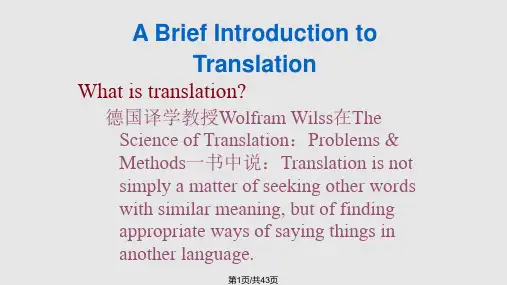
这说明了翻译是语义的翻译,不是语 言形式的翻译,是运用另一种语言的 适当方式来表达一种语言所表达的内 容,而不是在另一种语言中寻找与一 种语言中含义相似的某些词语或结构。 翻译必须跳出原文语言层面的束缚, 必须着眼于传达原文的内容和意义。 换句话说,翻译的基本单位应该是语
第3页/共43页
第7页/共43页
Classification of translation:
1) 从译出语和译入语的角度来分类,翻译可 分为本族语译为外语,外语译为本族语;
2) 从涉及到的符际翻译语言符号来分类,翻 译分为语内翻译(intralingual translation)、语际翻译 (interlingual translation)和符际翻译(intersemiotic translation);
Responsibility of translator
---Competent linguistic ability & bicultural knowledge
---Being a good negotiator(磋商者、交涉 者)
---the Sense of Responsibility
第17页/共43页
中国几位翻译家的理论(influential translation principles)
• 严复:信达雅 • 傅雷:重神似不重形似; • 神似—spiritual conformity, Emphasizing the reproduction of the
spirit of the flavor of the original. 强调原作神韵再现。 • 钱钟书:提出“化境”,使译本对原作应该忠实得以至于读起来不像译本。 • 化境—sublimed adaptation. Focus on the translator ’s smooth and
第2页/共43页
这说明了翻译是语义的翻译,不是语 言形式的翻译,是运用另一种语言的 适当方式来表达一种语言所表达的内 容,而不是在另一种语言中寻找与一 种语言中含义相似的某些词语或结构。 翻译必须跳出原文语言层面的束缚, 必须着眼于传达原文的内容和意义。 换句话说,翻译的基本单位应该是语
第3页/共43页
第7页/共43页
Classification of translation:
1) 从译出语和译入语的角度来分类,翻译可 分为本族语译为外语,外语译为本族语;
2) 从涉及到的符际翻译语言符号来分类,翻 译分为语内翻译(intralingual translation)、语际翻译 (interlingual translation)和符际翻译(intersemiotic translation);
英译汉之翻译概论-ppt

翻译行业的发展趋势与人才培养
翻译行业的发展趋势
随着全球化进程的不断加速和信息技术的发展,翻译行业正面临着数字化、自动化的趋势。同时,随 着各种新领域、新技术的出现,如人工智能、生物科技等,专业化的翻译需求也在不断增加。
翻译人才的培养
为了适应翻译行业的发展趋势,需要加强翻译人才的培养。高校和培训机构应注重培养学生的语言技 能和跨文化交流能力,同时还需要加强对学生信息技术和专业知识的教学。此外,为了提高翻译行业 的整体水平,还需要建立完善的翻译标准和评价体系。
新闻翻译的特点
新闻翻译要求准确、及时、流畅,同时要保留原文的新闻价值。
新闻翻译的难点
新闻报道中涉及大量专有名词、术语,需要进行准确翻译。同时, 新闻语言具有独特的表达方式,需要准确把握原文含义。
案例分析
某英文新闻报道关于国际政治事件的翻译,需要准确传达原文含义, 同时要符合中文的表达习惯。
广告翻译
考虑文化背景
结合目标语言的文化背景,理解 原文中隐含的意义,避免因文化 差异造成误解。
表达阶段
01
选择恰当词汇
根据语境选择最合适的词汇,确 保译文流畅自然,符合目标语言 的表达习惯。
02
重构句子结构
03
保持原文风格
在保持原文意思的基础上,对句 子结构进行重构,使其更符合目 标语言的语法规则和表达习惯。
翻译的目的是使读者能够理解和欣赏原作的思想 内容、风格特点和艺术价值。
翻译的分类
根据翻译的性质,可以分为直译和意译。直译注重保持原 文的语言形式和表达方式,而意译则更注重传达原文的思 想内容和意义。
根据翻译的领域,可以分为文学翻译、科技翻译、商务翻 译等。不同领域的翻译要求不同的专业知识和表达方式。
翻译概论ppt课件共47页

• 我生她养她,叮咛来嘱咐去,她还是去做那伤风 败俗的事儿,跟鸭子下水一样有瘾头。
Alexander F. Tytler
• (1) The translation should give a complete transcript of the ideas of the original work.
“做一个堂堂正正的好人!” “不要耍赖!”
And after all her bringing-up, and what I told her and talked with her, she goes to the bed, like a duck to water.
( Go to the bed like a duck to water 坏事一学就会。)
美”、“切合原作风格”等)
“‘信、达、雅’理论80年来一直对我国的翻译工作起 着指导作用,至今还有它的生命力。许多学者先 后提出过各种不同的翻译原则(标准),但看来 没有一种能够取代它,如‘忠实、通顺’,‘忠 实于原作,完善的译文形式’,‘在准确的基础 上通顺’,‘准确、简明、通顺’,‘准确、流 利’等等,我的浅见总觉得并没有超出信、达、 雅的范畴……”
• 钱钟书的“化境论”(fairy)(20世纪60 年代初)
文学翻译的最高标准是“化”。把作品 从
一国文字转变成另一国文字,既能不因 语文习惯的差异而露出生硬牵强的痕迹, 又能完全保存原作的风味,那就算得入 于化境。
——钱钟书 《林纾的翻译》
“Be a good sport!”
(来自美国短篇小说《抽签》,在一年一度的抽签仪式上,赫 钦森家不幸抽中,这就意味着这家要有一个人被作为敬神祭 品,给村里人用乱石砸死。赫钦森夫人叫喊不公平,旁边一 位妇人一听急了,连忙嚷到:“Be a good sport!”)
(翻译概论教学课件)第四章当代西方翻译理论
¡ 语义翻译与交际翻译是纽马克翻译理论的核心内容。语 义翻译试图在译人语的语义和句法结构允许的范围内传达 原著的确切上下文意义。交际翻译试图对译文读者产生一 种效果,这效果要尽可能接近原文对读者所产生的效果。 语义翻译的服务对象是原语作者,交际翻译服务的对象是 译入语的读者。这两种方法的一个根本区别在于: 当出现 矛盾时,交际翻译必须强调“ 表现力” ,而不强调信息 的内容。。
¡ 意大利美学家、文学评论家克罗齐在《美学原理》提出了完全相等于 原作表达方式的翻译不可能存在, 翻译必须靠再创造。文学翻译不 可过分自由、专业翻译不可过分拘谨的观点, 他是从美学的角度谈 翻译的。
¡ 西奥多·萨瓦里的翻译理论主要在《翻译的艺术》, 这被誉为“英语 中论述翻译的最佳之作”。他指出, 翻译是一门艺术。他把文学翻 译比作绘画, 把科技翻译比作摄影。将翻译分为完美翻译、等值翻 译、综合翻译、科技翻译四种。完美的翻译即纯粹传递信息的翻译, 等值翻译是不拘形式, 只管内容的翻译, 科技翻译的特点与等值翻 译有相似之处, 因为在科技翻译中, 内容的重要性远超过语言表达 形式的重要性。他归纳了12条准则指导翻译实践。。
第四章 当代西方翻译理论
¡ 英国翻译学家纽马克将西方研究翻译的历史划分为两大时期: 从公元前55年到20世纪上半叶属于语言学前时期, 20世纪 下半叶则属语言学时期。美国语言学家兼圣经翻译家奈达则 认为西方的翻译理论有四大流派: 语文学派、语言学派、交 际学派和社会符号学派。语言学前时期主要翻译圣经和文学 作品,翻译主要是少数人的事,这个时期的翻译理论就是奈 达所说的语文学派的理论。后三种理论流派即纽马克所说的 语言学时期的翻译理论。
¡ 奈达认为,一般意义上翻译过程包括以下几个阶段: 分析、转 移和重
组(analysis, transfer, and reconstruct),即首先 分析原作语言的息,将其剖析成结构上最简单明了的形式,在 此基础上转移,然后再
¡ 意大利美学家、文学评论家克罗齐在《美学原理》提出了完全相等于 原作表达方式的翻译不可能存在, 翻译必须靠再创造。文学翻译不 可过分自由、专业翻译不可过分拘谨的观点, 他是从美学的角度谈 翻译的。
¡ 西奥多·萨瓦里的翻译理论主要在《翻译的艺术》, 这被誉为“英语 中论述翻译的最佳之作”。他指出, 翻译是一门艺术。他把文学翻 译比作绘画, 把科技翻译比作摄影。将翻译分为完美翻译、等值翻 译、综合翻译、科技翻译四种。完美的翻译即纯粹传递信息的翻译, 等值翻译是不拘形式, 只管内容的翻译, 科技翻译的特点与等值翻 译有相似之处, 因为在科技翻译中, 内容的重要性远超过语言表达 形式的重要性。他归纳了12条准则指导翻译实践。。
第四章 当代西方翻译理论
¡ 英国翻译学家纽马克将西方研究翻译的历史划分为两大时期: 从公元前55年到20世纪上半叶属于语言学前时期, 20世纪 下半叶则属语言学时期。美国语言学家兼圣经翻译家奈达则 认为西方的翻译理论有四大流派: 语文学派、语言学派、交 际学派和社会符号学派。语言学前时期主要翻译圣经和文学 作品,翻译主要是少数人的事,这个时期的翻译理论就是奈 达所说的语文学派的理论。后三种理论流派即纽马克所说的 语言学时期的翻译理论。
¡ 奈达认为,一般意义上翻译过程包括以下几个阶段: 分析、转 移和重
组(analysis, transfer, and reconstruct),即首先 分析原作语言的息,将其剖析成结构上最简单明了的形式,在 此基础上转移,然后再
翻译概论 ppt课件
• D. Revision /proofreading: check again and again to polish the language.
Eugene A. Nida 的翻译过程
source language
target language
(言) 甲(原语)
乙(译语) (言)
(象) (分析)
比较分析
例句:These three steps constituted an epochal(划时代的) advance.
(重构) (象)
(意)
X
(传译)
Y
(意)
理解阶段
表达阶段
图1:
奈达的翻译过程模式
翻译p中pt课的件形象思维过Translation in China
• 1.古代:玄奘(佛经翻译),徐光启(数学、天文学 等科技翻译)
• (古代佛经三大翻译家:玄奘、鸠摩罗什、释道安)
IV.i. Criteria in China 国内翻译标准
• C. Fu Lei’s (傅雷) spiritual conformity/resemblance in spirit (神似)
• D. Qian Zhongshu (钱钟书) transmigration (化境)
• E. 鲁迅:翻译:一当然力求其易解,一则保存原作的 丰姿。反对牛头不对马嘴,提出“宁信而不顺”之原 则
• 翻译是把一种语言表达的意义用另一种语言传达出来, 以达到沟通思想情感、传播文化知识、促进社会文明, 特别是推动译语文化兴旺昌盛的目的。
II.The Process of Translation 翻译的过程
• A. Preparation: basic knowledge about both languages as well as the background knowledge; basic skills in translation are necessary;
Eugene A. Nida 的翻译过程
source language
target language
(言) 甲(原语)
乙(译语) (言)
(象) (分析)
比较分析
例句:These three steps constituted an epochal(划时代的) advance.
(重构) (象)
(意)
X
(传译)
Y
(意)
理解阶段
表达阶段
图1:
奈达的翻译过程模式
翻译p中pt课的件形象思维过Translation in China
• 1.古代:玄奘(佛经翻译),徐光启(数学、天文学 等科技翻译)
• (古代佛经三大翻译家:玄奘、鸠摩罗什、释道安)
IV.i. Criteria in China 国内翻译标准
• C. Fu Lei’s (傅雷) spiritual conformity/resemblance in spirit (神似)
• D. Qian Zhongshu (钱钟书) transmigration (化境)
• E. 鲁迅:翻译:一当然力求其易解,一则保存原作的 丰姿。反对牛头不对马嘴,提出“宁信而不顺”之原 则
• 翻译是把一种语言表达的意义用另一种语言传达出来, 以达到沟通思想情感、传播文化知识、促进社会文明, 特别是推动译语文化兴旺昌盛的目的。
II.The Process of Translation 翻译的过程
• A. Preparation: basic knowledge about both languages as well as the background knowledge; basic skills in translation are necessary;
翻译概论PPT
而文艺学派认为翻译是艺术活动,追求的是再创造。
18
2.4 研究视角的多元整合
勒弗维尔指出:“翻译并非在两种语言的真空中进行, 而是在两种文学传统的语境下进行的。译者作用于特 定时间的特定文化之中。他们对自己和自己文化的理 解,是影响他们翻译方法的诸多因素之一”。9
语言对比和价值评判层面
两种文化
2.就翻译学研究而言,对语言之外的各种要素的关注 都是应该而必须的,但是如果要建立起翻译学的知识 体系,语言要素是最主要的因素,因为任何翻译活动 都是以语言作为媒介的。
3.我们应该认识到语言学派的翻译理论家们为推动译 学研究的发展做出的积极探索,但是也要认识到译学 研究的语言学探索过程中还有很多内容没有深涉,深 度和广度也有待加强。9
4. 范晓.语言、言语和话语[J]. 汉语学习. 1994.
9
奈达的对等理论:
奈达对翻译理论提出指导原则,阐明了形式对应和动 态对等(即功能对等)两个概念。其核心是:译文措 辞通顺自然,内容达意传神,读者反应相似。5
形式对应即译者直接把源语转换成目的语,译者把重 点放在原文或源语的表达形式上,译者尽可能的使目 的语的表达形式与源于的表达形式一样。6
5. 谭载喜. 西方翻译简史[M]. 北京:商务印书馆, 2004.
6. 赵丹丹. 浅论奈达的功能对等理论[J]. 文中教育(中). 2011.
10
奈达的对等理论:
所谓“动态对等”, 就是说翻译时不求文字表面的死板对应, 而要在两种语言间达成功能上的对等。
Dynamic equivalence is therefore to be defined in terms of the degree to which the receptors of the message in the receptors language respond to it in substantially the same manner as the receptors in the source language.(Nida, 2004:24)
18
2.4 研究视角的多元整合
勒弗维尔指出:“翻译并非在两种语言的真空中进行, 而是在两种文学传统的语境下进行的。译者作用于特 定时间的特定文化之中。他们对自己和自己文化的理 解,是影响他们翻译方法的诸多因素之一”。9
语言对比和价值评判层面
两种文化
2.就翻译学研究而言,对语言之外的各种要素的关注 都是应该而必须的,但是如果要建立起翻译学的知识 体系,语言要素是最主要的因素,因为任何翻译活动 都是以语言作为媒介的。
3.我们应该认识到语言学派的翻译理论家们为推动译 学研究的发展做出的积极探索,但是也要认识到译学 研究的语言学探索过程中还有很多内容没有深涉,深 度和广度也有待加强。9
4. 范晓.语言、言语和话语[J]. 汉语学习. 1994.
9
奈达的对等理论:
奈达对翻译理论提出指导原则,阐明了形式对应和动 态对等(即功能对等)两个概念。其核心是:译文措 辞通顺自然,内容达意传神,读者反应相似。5
形式对应即译者直接把源语转换成目的语,译者把重 点放在原文或源语的表达形式上,译者尽可能的使目 的语的表达形式与源于的表达形式一样。6
5. 谭载喜. 西方翻译简史[M]. 北京:商务印书馆, 2004.
6. 赵丹丹. 浅论奈达的功能对等理论[J]. 文中教育(中). 2011.
10
奈达的对等理论:
所谓“动态对等”, 就是说翻译时不求文字表面的死板对应, 而要在两种语言间达成功能上的对等。
Dynamic equivalence is therefore to be defined in terms of the degree to which the receptors of the message in the receptors language respond to it in substantially the same manner as the receptors in the source language.(Nida, 2004:24)
翻译概论-翻译-直译和意译课件
ppt课件
3
直fo译r-w决o非rd死二t译ra)。nsl死直at译io译n也)和叫,逐死翻词译译翻时译是(以w词or为d-
单位进行考虑的,力求翻译目标语的每一 个词都能与原语中的词绝对对等,这是一 种“对号入座”式的翻译,在同一语系的 语 言之间大多可以。但在不同语系的语言 之 间,如英语和汉语,则不可以。
蠢得像猪
ppt课件
24
• 而直译既保持直原文译内的容译,又法 保持原文形式,
特别注重保持原文比喻、形象和民族、地 方色彩等。
ppt课件
25
例证分析
• But I hate Sakamoto, and I had a feeling he`d surely lead us both to our ancestors.
ppt课件
22
• 三口之家 • 三世同堂
n例ucl证ear分fam析ily(2)
the extended family with three
generations under the same roof.
• 爸爸,感谢您对我们的爱,你的辛勤工作 让我和妈妈衣食无忧。
Dear dad, thank you for your affection on us, your hard work
直译和意译
ppt课件
1
定义和运用和示例
意译的功能和示例
意译和直译的对比和 统一
ppt课件
2
• 定句义一一:对)直一L译的it指翻e在r译a翻。l t译ra过n程sl中a按tio原n文直逐字译逐
• 特点:直译是一种重要的翻译方法,它有 不少优点,能传达原文意义,体现原文风 格等。据估算,大约70%的句子要用直译 方法来处理,所以直译广为译者采用