
人教PEP版初中七年级英语下册 《I’d like some noodles》PPT课件4
2019-2020年人教版英语七年级下册Unit 10 I’d like some noodles全
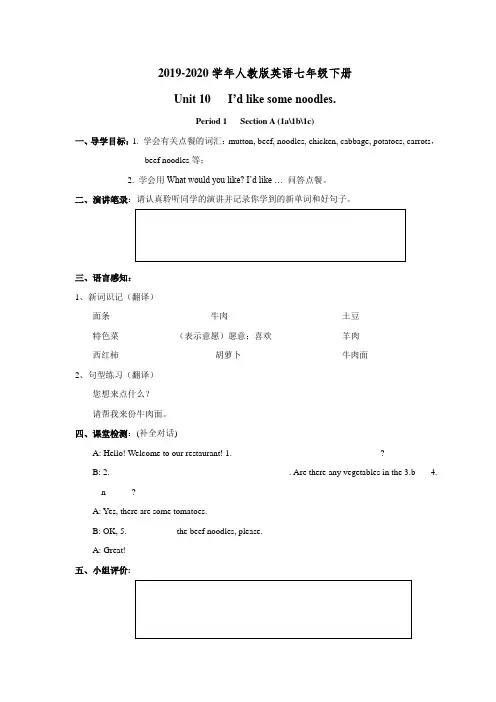
2019-2020学年人教版英语七年级下册
Unit 10 I’d like some noodles.
Period 1 Section A (1a\1b\1c)
一、导学目标:1. 学会有关点餐的词汇:mutton, beef, noodles, chicken, cabbage, potatoes, carrots,beef noodles等;
2. 学会用What would you like? I’d like … 问答点餐。
二、演讲笔录:请认真聆听同学的演讲并记录你学到的新单词和好句子。
三、语言感知:
1、新词识记(翻译)
面条 _______ 牛肉 _____________ 土豆 ___________
特色菜 _______ (表示意愿)愿意;喜欢 _______ 羊肉____________
西红柿__________ 胡萝卜___________ 牛肉面__________
2、句型练习(翻译)
您想来点什么? __________________________________________________
请帮我来份牛肉面。_________________________________________________
四、课堂检测:(补全对话)
A: Hello! Welcome to our restaurant! 1.__________________________________?
B: 2._________________________________________. Are there any vegetables in the 3.b___ 4.
n______?
A: Yes, there are some tomatoes.
人教版七年级英语下册unit 10 I'd like some nooodles. 全单元教案
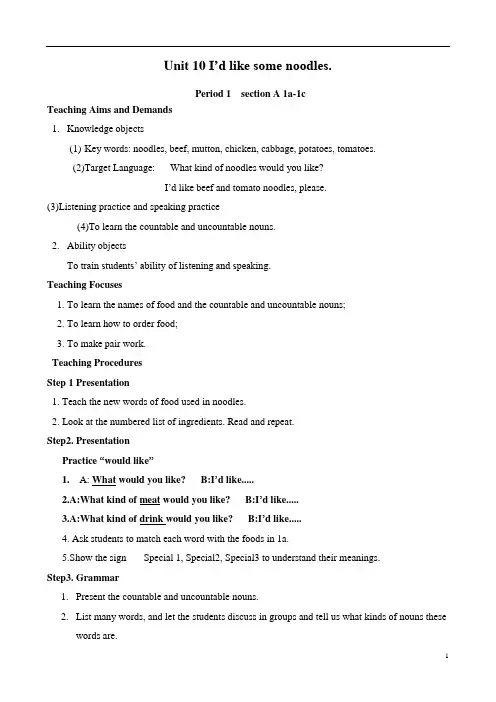
1 Unit 10 I’d like some noodles.
Period 1 section A 1a-1c
Teaching Aims and Demands
1. Knowledge objects
(1) Key words: noodles, beef, mutton, chicken, cabbage, potatoes, tomatoes.
(2)Target Language: What kind of noodles would you like?
I’d like beef and tomato noodles, please.
(3)Listening practice and speaking practice
(4)To learn the countable and uncountable nouns.
2. Ability objects
To train students’ ability of listening and speaking.
Teaching Focuses
1. To learn the names of food and the countable and uncountable nouns;
2. To learn how to order food;
3. To make pair work.
Teaching Procedures
Step 1 Presentation
1. Teach the new words of food used in noodles.
2. Look at the numbered list of ingredients. Read and repeat.
Step2. Presentation
Practice “would like”
1. A: What would you like? B:I’d like.....
Unit10I'dlikesomenoodles 重点短语句型巩固复习 人教版英语七年级下册
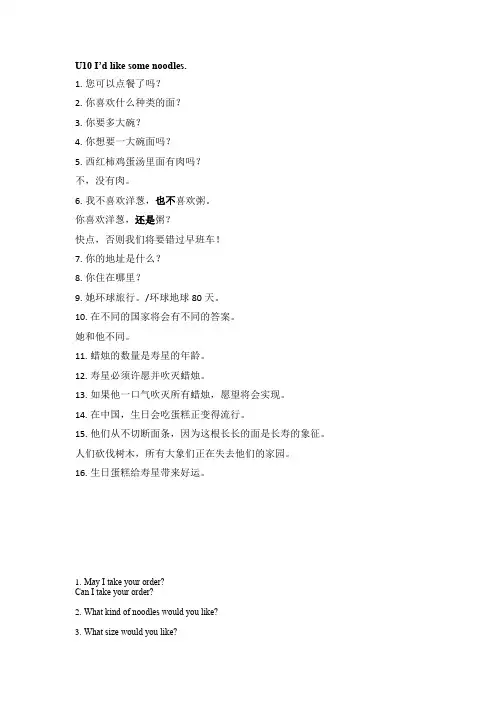
U10 I’d like some noodles.
1. 您可以点餐了吗?
2. 你喜欢什么种类的面?
3. 你要多大碗?
4. 你想要一大碗面吗?
5. 西红柿鸡蛋汤里面有肉吗?
不,没有肉。
6. 我不喜欢洋葱,也不喜欢粥。
你喜欢洋葱,还是粥?
快点,否则我们将要错过早班车!
7. 你的地址是什么?
8. 你住在哪里?
9. 她环球旅行。/环球地球80天。
10. 在不同的国家将会有不同的答案。
她和他不同。
11. 蜡烛的数量是寿星的年龄。
12. 寿星必须许愿并吹灭蜡烛。
13. 如果他一口气吹灭所有蜡烛,愿望将会实现。
14. 在中国,生日会吃蛋糕正变得流行。
15. 他们从不切断面条,因为这根长长的面是长寿的象征。
人们砍伐树木,所有大象们正在失去他们的家园。
16. 生日蛋糕给寿星带来好运。
1. May I take your order?
Can I take your order?
2. What kind of noodles would you like?
3. What size would you like? 4. Would you like a large bowl?
5. Is there any meat in the tomato and egg soup?
No, there isn’t any./No, there’s no meat.
6. I don’t like onions or porridge.
Do you like onions or porridge?
7. What is your address?
8. Where do you live?
9. She travels around the world.
She travels all over the world.
Around the world in 80 days.
10. The answer would be different in different countries.
新目标英语七年级下册Unit8_I'd_like_some_noodle.讲解与练习

1 Unit8 I'd like some noodle.讲解与练习
1.词组
would like to do sth \want to do sth 想要作某事 如:I wouid like to go fishing.=I want to go fishing.
what kind of +名词(可数名词用复数,不可数名词有单数)表示….的种类
(a kind of 一种… some kinds of 许多种…)
what size +n.什么尺寸(what size shoes/pizza/T-shirt 什么尺码的鞋/比萨/衬衫)
a large/medium/small bowl of noodles一份大碗/中碗/小碗面条
beef and potato noodles牛肉土豆面 =noodles with beef and potato 6.some great specials一些不错的特色菜
three oranges 三个桔子(可数) a bottle of orange juice 一瓶桔子汁(不可数)
five bottles of juice五瓶果汁 a cup of tea一杯茶 a cup of green tea一杯绿茶
a large bowl of rice 一大碗米饭 two bowls of porridge两碗粥 a little ice cream一点冰淇淋
a plate of fish一盘鱼 some chicken 一些鸡肉(不可数) three chickens三只小鸡(可数)
2019年春七年级英语下册 Unit 10 I’d like some noodles(第4课时)分层训练 (新版)人教新目标版
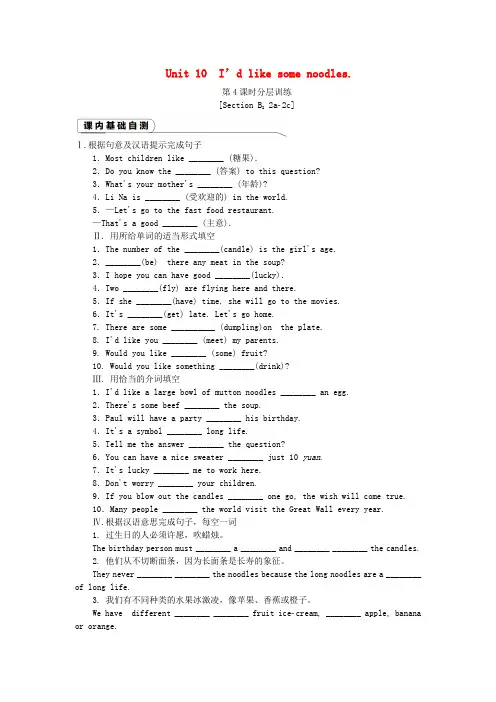
Unit 10 I’d like some noodles.
第4课时分层训练
[Section B2 2a2c]
Ⅰ.根据句意及汉语提示完成句子
1.Most children like ________ (糖果).
2.Do you know the ________ (答案) to this question?
3.What's your mother's ________ (年龄)?
4.Li Na is ________ (受欢迎的) in the world.
5.—Let's go to the fast food restaurant.
—That's a good ________ (主意).
Ⅱ. 用所给单词的适当形式填空
1.The number of the ________(candle) is the girl's age.
2.________(be) there any meat in the soup?
3.I hope you can have good ________(lucky).
4.Two ________(fly) are flying here and there.
5.If she ________(have) time, she will go to the movies.
6.It's ________(get) late. Let's go home.
7. There are some __________ (dumpling)on the plate.
8. I'd like you ________ (meet) my parents.
9. Would you like ________ (some) fruit?
10. Would you like something ________(drink)?
Ⅲ. 用恰当的介词填空
七年级英语下册Unit10I’dlikesome

1 / 6
Unit 10 I'd like some noodles 重点解析
Section A
1. What would you like?
你想要点什么?
原句是what引导的特殊疑问句,用来询问对方想要什么。回答一般用“I
would like (可以缩写成I'd like)...”。would like意为“想要”,相当于want,其中would没有人称和数的变化。would like常用于以下结构:
★would like +名词/代词,表示“想要某物”。如:
I'd like an apple.我想要一个苹果。
★would like to do sth.表示“想要做某事”,是委婉客气的说法。如:
We'd like to go to the movies this evening.
今晚我们想去看电影。
★would like sb. to do sth.表示“想要某人做某事”。如:
He would like me to help him with his English.他想让我帮助他学英语。
I'd like...变一般疑问句时把would提前,即Would you like...?意为“你想要……吗?”,也是征求别人意见的常用句型,语气较委婉。Would you like to do ...?意为“你想做……吗?”回答一般为Yes, I’d like to./ I’d like to, but I...如:—Would you
like some beef?你想要一些牛肉吗?
—Yes, please./ No, thanks.好的。/不,谢谢。
—Would you like to go shopping with me?你愿意和我一起去购物吗?
— Yes, I’d like to./ I’d like to, but I have to visit my friend.是的,我愿意。
人教版七年级Unit-10-I’d-like-some-noodles.知识点及练习
1 / 8 人教版七年级Unit 10 I’d like some noodles.知识点及练习
◆重点词汇:
1. 可数:noodles:面条 potatoes:土豆 tomatoes:西红柿
carrots :胡萝卜 vegetables:蔬菜 onions:洋葱 dumplings:饺子 pancakes:薄饼
2. 不可数:mutton:羊肉 beef:牛肉meat:肉porridge:稀饭Soup:汤 milk:牛奶 water:水
3. 有时可数有时不可数:chicken:鸡肉cabbage:卷心菜fish:鱼
◆重点短语归纳:
1. would like 想要 2. take one’s order 点菜
3. beef soup 牛肉汤 4. one (large)bowl of… 一碗……
5. what size 什么尺寸 6. Mapo tofu with rice带米饭的麻婆豆腐
7. what kind 什么种类 8. small / medium / large bowl 小/ 中/大碗
9. green tea 绿茶 10. orange juice 橘汁;或orange
11. around the world 世界各地 12. birthday cake 生日蛋糕
13. the number of… 的数量 14. make a wish 许个愿望
15. blow out the candles吹灭蜡烛 16. in one go 一口气
Unit 10 I'd like some noodles知识点复习人教版初中英语七年级下册
1 人教版初中英语七年级下册Unit 10 I’d like some noodles.
Section A
一、知识点复习
1. beef n. 牛肉 不可数名词
Some people don’t eat beef. 有的人不吃牛肉。
2. noodle n. 面条(常用复数形式 ) beef noodles egg noodles rice noodles
I’d like a bowl of egg noodles. 我想要一碗鸡蛋面。
The students in our school usually have tomato noodles for breakfast. 我们学校的学生早餐通常吃西红柿面。
3. potatoes n. 土豆;马铃薯
potato --- potatoes
tomato---tomatoes 西红柿
hero--- heroes 英雄
photo- photos 照片
piano- pianos 钢琴
zoo-zoos 动物园
radio---radios 收音机
4. I’m not sure yet.
yet adv. 仍然;还 常用于否定句或疑问句,通常放于句末。 否定句中意为“还;仍然”;用于疑问句中意为“已经”
Have you read the book yet? 你已经看过这本书了吗?
I’m not ready yet. 我还没准备好。
5. Ok, I’d like the beef noodles, please.
would like 愿意;喜欢... 与人称代词连用时,可缩写为“ ‘d like”
For breakfast, Tina would like some milk and cake. 就早餐而言,缇娜喜欢喝牛奶,吃蛋糕。
6. Special 1 1号特色面
special adj. 特别的;特殊的 n. 特色菜;特价品
初中英语七年级下册 Unit10 I’d like some noodles
人教版英语学科第十单元第四课时教学设计
课题 Unit 10 I’d like some noodles. 单元 第十单元 学科 英语 年级 七年级
学习
目标与核心素养 一、教学目标:
1. 1) 能掌握以下单词:world, answer, different, cake, candle, age, blow, blow out,
if, will, UK, candy, lucky, popular, cut up idea
2) 能掌握以下句型:
① The answer would be different in different countries.
② The number of candles is the person's age.
③ In China, it's getting popular
3) 练习运用如何订餐或叫外卖等的用语。
4) 根据所提供的材料能运用所学的知识来补全对话。
5) 总结复习订餐时所用句型结构。
2. 体会学习英语的乐趣,做到“在用中学”“在学中用”。了解世界各地的饮食文化,生日文化等事情,使学生们具有初步的世界文化观念。
重点 1. 教学重点:
1) 通过进行听、说的训练,来提高学生们综合运用所学知识的能力。
2) 通过读、写的训练,来让学生们能真正在实际活动中运用所学的知识。
难点 教学难点
听力训练与阅读训练
教学过程 Learning objectives
Read the article about birthday food to learn the food traditions in the UK and China
To learn to write an ad for your restaurant
Ⅰ. New words
Present the new words
Ⅱ. Warming- up
(完整版)人教版初中英语七年级下册Unit10SectionA教材全解
- 1 - 人教版初中英语七年级下册Unit10SectionA教材全解Unit 10 I’d like some noodles Unit 10 Section A课文全析1.Special 1特色菜1(1号特色菜)【重点注释】special在此是可数名词,在这里表示“特色菜;特价商品;特别的东西;特殊的事物”之意,有时可作“特别之物;特别节目;特刊”等解释。例如:Thursday’s special is steak.星期四的特色菜是牛排。Today’s Special!今日特价!I’d like some specials.我想要一些特色菜。Special 1 is my favourite.1号特色菜是我最喜欢的。We have some great specials.我们有一些很好的特价品。【拓展记忆】special作形容词时,意为“特别的,特殊的”。Specially是其副词形式,意为“特别地”。例如:There is nothing special for me today.对我来说,今天没什么特殊的。I would like to give you a special present.我想要给你一份特别的礼物。It’s a special day today.今天是个特别的日子。Is there anything special in the newspaper today?今天报纸上有什么特别的东西吗?【注意】与special相关的短语:a special train专列;a special hospital专科医院,special education特殊教育。【试题链接】——What was Jim wearing at the party? ——Nothing .He was in his usual shirt and jeans. A.special B.simple C.important D.interesting (答案:A)2.What would you like?你想要什么?【重点注释】would like意为“想要,愿意”,相当于want,但语气比want更加委婉,多用于口语中,would like没有人称和数的变化,后接名词或代词。例如:I would like a cup of coffee.我要两杯咖啡。He’d like some milk.他想要些牛奶。【注意】主语是人称代词时,would可以和前面的人称代词缩写为“…’d”,例如:I’d=I would,she’d=she would,they’d=they would……【拓展记忆】would like的用法:1)would like sth.,即would like后接名词或代词,意为“想要某物”,表示“具体要”某样东西。例如:I’d like some books.我想要些书。I’d like two sweaters for my daughters.我想给我的女儿们买两件毛衣。2)would like to do sth.,即would like后接动词不定式to+动词原形,意为“想要做某事”,常用于有礼貌地提出邀请、请求或建议。例如:I’d like to buy two sweaters for my daughters.我想给我的女儿们买两件毛衣。I’d like to play table tennis.我想要打乒乓球。I’d like to drink some water.我想要喝些水。Would you like to come to supper?你想要来吃晚饭吗?3)would like sb.to do sth.,即would like后接人,然后接动词不定式to+动词原形,意为“想要某人做某事”。例如:I’d like you to meet them.我想要你见他们。I would like the boy to go home.我想要这个男孩回家。4)当主语是第一人称时,would可与should换用。例如:I should like the red one.我想要红色的。5)would和should都可以缩写成’d,would like和should like的like可以换成love。例如:I’m sure( that) he’d love to come.我确信他愿意来。6)would like的句型转化,直接借助于would。例如:I’d like some apples. →I’d not like some apples.=I wouldn’t like any apples. →Would you like some apples? →What would you like? 【辨析记忆】Would you like…?意为“你(们)想要……吗?”,表示向对方提出客气的、有礼貌的请求、邀请、希望或询问等,句中有some时不必变成any。常用句型如下:1)Would you like +名词或代词“你想要点……吗?”,如:Would you like one more glass?您需要再来一杯么?2)Would you like +to do sth.“你想要干什么吗?”,如:Would you like to look around?你想各处看看吗? 3)Would you please + do sth.“请你……好吗?”,如:Would you please come tonight?你今晚来一下好吗?Would you please not do this ?请你不要这样做好吗?4)Please + do sth.,如:Please come here.请过来一下。【注意】Would you like…?的回答。回答Would you like…?的句型时,肯定回答一般用Yes,please.或Yes,I’d(We’d)like(love) to./Certainly./Yes,thank you.等;否定回答一般用No,thanks./No,thank you.等。回答Would you like to…?句型时,to不能省略。例如:——Would you like some green tea?——Yes,please./No,thanks.是的,请。不,谢谢。——Would you like to visit the zoo?——Yes,I’d like/love to.你想要去参观动物园吗?是的,我想去。——Would you like to go skating?——Yes,I’d like/love to(I’d love to,but I have to look after my little sister at home.)你想去滑冰吗?是的,我想去。(我很想去,可我必须在家照顾我的小妹。)3.I’m not sure yet.我还不确定呢(我还没想好)。【重点注释】①在口语中,I’m not sure.常用来表达把握性不大的事。例如:——Our teacher is coming ,isn’t it?我们的老师要来,是吗?——I’m not sure.我不太清楚。【拓展记忆】sure的用法:sure用作形容词,意为“肯定的;当然的;有把握的”。当对方询问你是否对某事有把握时,你觉得有把握用“I'm sure.”。把握性不大时用“I'm not sure.”。1)be sure(不接其它词),意为“肯定的”。例如:Are you sure? 你能肯定吗?I think he is coming, but I'm not quite sure.我想他要来,但我不十分肯定。2)be sure to do sth. 表示要求,意为“务必做某事;请一定做某事”,多用于祈使句。例如:Be sure to telephone me and give me all the news.请一定要给我打电话,让我知道所有的消息。be sure to do sth.还可表示一种推断,意为“一定做某事;肯定做某事”。例如:The child is sure to be a teacher.这孩子一定会成为一名教师。You are sure to win. 你(们)肯定会赢。3)be sure of / about (doing) sth. 表示人对某事(物)的看法,意为“对……有把握”。其后常接名词、代词或动词-ing形式。例如:Are you sure of passing the exam? 你有把握通过考试吗?I'm not sure about English grammar. 我对英语语法没有把握。4)be sure+从句,意为“确信”。例如:I'm not sure that he will come. 我不确信他会来。5)sure 在句子中还可用作定语,意为“确信的、可靠的、稳定的”。例如:Put the key in a sure place.把钥匙放在一个可靠的地方。另外,常见的与sure相关的短语还有:be sure of oneself 有自信心,for sure的确;确实地。【注意】sure用作副词,意为“当然;的确;一定”,常用来回答一般疑问句,意为“当然;的确”,相当于yes或certainly。只是sure 在英国英语中较为常用,而在美国英语中常用certainly。例如:——Are you going with us? 你和我们一起去吗?——Sure. 当然啦。make sure意为“查明;弄清楚”。其后可接of,about或that从句。即:make sure of/ make sure about /make sure that /make sure to do. 例如:You should make sure of the time. 你应该把时间弄清楚。She made sure that she turned off the light. 她确定她已关灯了。Make sure to lock the door before you go out.出去之前一定要锁上门。