
4BUnit4 第二课时
The teaching plan of Oxford English 4B Unit4 (Period 2) Teaching Content:
The second lesson of 4B Unit4.
Teaching Aims:
1. To make Ss understand, speak, read and write the words: apples, oranges, bananas, peaches, grapes, watermelons, pears, buy, some and kilo.
2. To make Ss understand, speak, read and write the daily expressions: I‟d like some… How many kilos? …kilos, please. And penetrate: Can
I help you? How much …?… yuan.
3. To make Ss enjoy fruit and be interested in English.
Key points/Difficult points:
1. To make Ss understand, speak, read and write the daily expressions: I‟d like some… How many kilos? …kilos, please.
2. To make Ss enjoy fruit and be interested in English.
Teaching Procedure:
Step 1. Warming-up and revisions
①. Sing a song
②. Do actions
③. Ask and answer (review the new words and sentences which were taught in last period)
T: Last lesson we went with Miss Li to the orchard, and knew some fruit. Do you still remember?
T: What‟s this?
Ss: It‟s a …
T: What are these/those?
Ss: They‟re …
T: Do you like … ?
Ss: Yes, I do./No, I don‟t..
T: What do you like?
Ss: I like …s.
T: Eating fruit is good for health. Someone once said “An apple a day, the doctor is away”, so we should eat fruit every day.
Step 2. Presentation and practice
①T: What are these on your desk?
S1: They‟re apples.
S2: They‟re bananas.
S3: They‟re pears.
S4: They‟re books.
S5: . They‟re…
T: OK. I‟d like a book. I‟d like a book. (Repeat …I‟d like‟several times, to make Ss understand the meaning.)
S1: Here you are. ( Remind Ss)
T: I‟d like some books. (Explain the word “some”)
S2: Here you are.
T: I‟d like some apples.
Ss: Here you are.
T: Now, practice with your partner.
S1: I‟d like …S2: Here you are.
②T: Do the exercise:(补充习题P15)
③Learn “How many kilos?”
a: Lead in “How many”
b: 重量单位的正确认读
1公斤/千克:one kilo (1 Kg) 3.5公斤/千克: three point five kilos
④(We know Miss Li is in the orchard, Let‟s see what she buys)Listen to the tape and read after the tape.
⑤Practice the dialogue.(Penetrate the sentences “Can I help you?” “How much?”)
e.g. T: Now, I‟m a shop assistant. You can buy fruits from me. Can I help you?
S: I‟d like apples.
T: How many kilos?
S: Two kilos, please.
T: OK, here you are.
S: How much?
T: Eight yuan. Thank you.
S: Thank you. Goodbye!
T: Bye!
Step 3. Consolidation
①Let‟s review
some 一些kilo 千克,公斤
想要买东西时,可以说:
I‟d like …
询问一些物品的名称时,可以说:
A: What are these/those? B: They‟re…
询问物品的重量,可以说:
A: How many kilos? B: … kilo(s).
②Do exercise
Step 4. Homework
Oral work: 1) Read page 30-31 after the tape .
2) Make a dialogue with your partner according to the
sentences which you have learnt today.
Written work: Finish part D of the workbook .
The design of blackboard:
Unit 4
Buying fruit
I‟d like …
How many kilos?
… kilos, please.。
4Bunit4第二课时
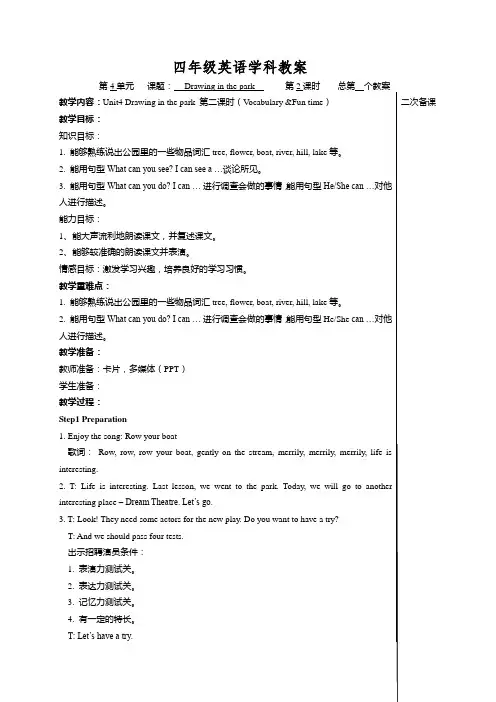
四年级英语学科教案第4单元课题:Drawing in the park 第2课时总第个教案教学内容:Unit4 Drawing in the park 第二课时(V ocabulary &Fun time)二次备课教学目标:知识目标:1. 能够熟练说出公园里的一些物品词汇tree, flower, boat, river, hill, lake等。
2. 能用句型What can you see? I can see a …谈论所见。
3. 能用句型What can you do? I can …进行调查会做的事情,能用句型He/She can …对他人进行描述。
能力目标:1、能大声流利地朗读课文,并复述课文。
2、能够较准确的朗读课文并表演。
情感目标:激发学习兴趣,培养良好的学习习惯。
教学重难点:1. 能够熟练说出公园里的一些物品词汇tree, flower, boat, river, hill, lake等。
2. 能用句型What can you do? I can …进行调查会做的事情,能用句型He/She can …对他人进行描述。
教学准备:教师准备:卡片,多媒体(PPT)学生准备:教学过程:Step1 Preparation1. Enjoy the song: Row your boat歌词:Row, row, row your boat, gently on the stream, merrily, merrily, merrily, life is interesting.2. T: Life is interesting. Last lesson, we went to the park. Today, we will go to another interesting place –Dream Theatre. Let’s go.3. T: Look! They need some actors for the new play. Do you want to have a try?T: And we should pass four tests.出示招聘演员条件:1. 表演力测试关。
人教版小学三年级Unit 4 第二课时 教案
通过简单的手势,让学生在唱的同时动起来、演起来、乐起来,拉进师生间的距离,把学生的思想迅速集中到英语学习上,创造一种学习英语的氛围。
利用情景引入新课,并结合本课的整体评价措施,设置以下的任务。
运用课件出示图片学习单词,可以让学生从直观上理解单词
通过让学生做动作,并吟唱小韵句,加深记忆,真正理解单词含义
5.Homework:
小组内用得到的奖品设计一个简单的动物园,介绍给其他同学。
放录音,和学生一起唱
T:Good morning.
T: Hello,I’m MissDing.What’s your name?
T:Nice to meet you.
创设情景并布置本课的评价措施
适时出示动物园图片,帮助学生理解意思zoo
通过能力强的学生可以得到动物图片这一活动,激发其余学生的学习欲望与热情
通过汇报总结可以梳理一下本节课所学,让学生对本节课知识有一个更清晰明了的印象,加深记忆。
并引出本节课的情感教学,培养学生热爱动物的情感。
通过总结评价每一组的奖品并汇报,不仅可以运用已学句型练习巩固本节课的单词,而且可以树立学生学习的信心培养学习的热情。
学生将图片读出后将图片贴在相对应的单词底下,该生领读该单词,
并得到一个动物图片
第一遍学生听单词,初步感知,汇报听到的单词。
第二,三遍,全体学生听录音跟读单词,要求每读一个单词,手指一个单词并模仿语音语调
学生抢答消失的单词。
学生认真看猜动物。
猜对后,全班学生向动物打招呼:Hello,duck/dog/
(3)再次认读单词
3.Practice
(1)T:The zoo is having a music party.Listen and find who are they.
四年级上册英语教学设计-Unit4 第2课时∣人教新起点
四年级上册英语教学设计-Unit4 第2课时∣人教新起点一、教学目标1.语言知识目标:1.学生能够掌握日常交际用语“How many…”、“I have…”、“I don’t have…”、“How about you?”等。
2.学生能够熟练掌握课文中出现的单词和句型,如各种动物的名称和数量。
2.情感态度目标:1.让学生了解和爱护小动物,培养爱心。
2.培养学生的观察能力和口语表达能力。
二、教学内容1.语音:[d]和[f]的发音。
2.词汇:动物的名称和数字1-10。
3.句型:How many…+ 名词?/I have…/I don’t have…/ How about you?三、教学重难点1.重点:1.掌握动物名称和数字的表达方式。
2.学会用英语问答“How many…”、“I have…”、“I don’t have…”、“How about you?”。
2.难点:1.区分发音相似的[d]和[f]。
2.学生口语表达能力的提高。
四、教学策略1.形成对比:将不同的动物数量放在一起比较。
2.师生互动:教师做示范,学生互相练习问答。
3.多媒体展示:播放动物图片和视频,帮助学生加深印象。
五、教学过程时间内容教学活动2 min热身导入1.播放歌曲“What’s this?”2. 导入本课动物主题。
10 min 拼读新单词1.教师出示单词卡片,学生跟读。
2. 学生判断[d]和[f]的发音。
15 min 认知练习1.展示不同数量的动物图片,学生用英语进行问答练习。
2.学生小组间相互练习。
10 min 单词巩固1.开展单词拼写比赛,积极参与的小组奖励点数。
2.学生复习和掌握新单词。
10 min 句型训练1.播放视频,让学生发现句型表达方式并与老师口语对练。
2.学生分组进行问答练习。
8 min教学反馈1.教师讲解疑点和难点。
2.学生进行评估。
5 min课堂小结自我总结本课的内容,展望下一节课的内容。
六、作业布置1.练习动物名称和数字的表达,写出10个学过的动物名称和数量。
人教版九年级英语上册教案Unit 4 第2课时
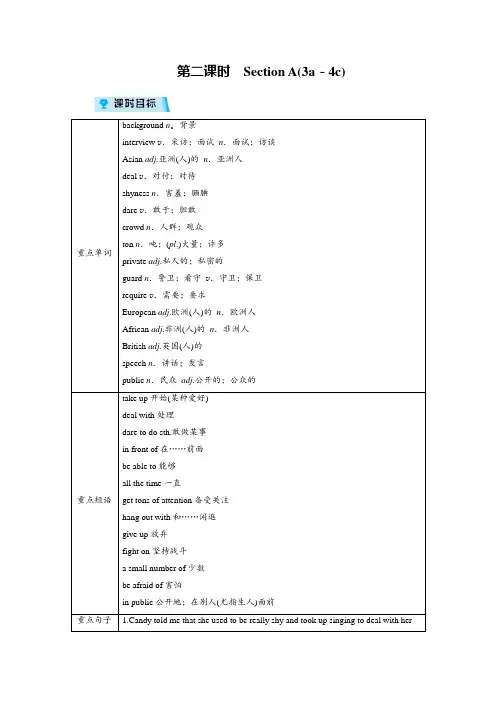
第二课时Section A(3a-4c)重点单词background n.背景interview v.采访;面试n.面试;访谈Asian adj.亚洲(人)的n.亚洲人deal v.对付;对待shyness n.害羞;腼腆dare v.敢于;胆敢crowd n.人群;观众ton n.吨;(pl.)大量;许多private adj.私人的;私密的guard n.警卫;看守v.守卫;保卫require v.需要;要求European adj.欧洲(人)的n.欧洲人African adj.非洲(人)的n.非洲人British adj.英国(人)的speech n.讲话;发言public n.民众adj.公开的;公众的重点短语take up开始(某种爱好)deal with处理dare to do sth.敢做某事in front of在……前面be able to能够all the time一直get tons of attention备受关注hang out with和……闲逛give up放弃fight on坚持战斗a small number of少数be afraid of害怕in public公开地;在别人(尤指生人)面前重点句子 1.Candy told me that she used to be really shy and took up singing to deal with hershyness.坎迪告诉我她过去很害羞,于是她开始唱歌,以克服她的羞怯心理。
2.Now she's not shy anymore and loves singing in front of crowds.现在她不再害羞并且喜欢在众人面前唱歌。
3.I didn't use to be popular in school,but now I get tons of attention everywhere I go.我过去在学校并不受欢迎,但是现在无论我去哪儿都备受关注。
四年级 第四单元 第二课时
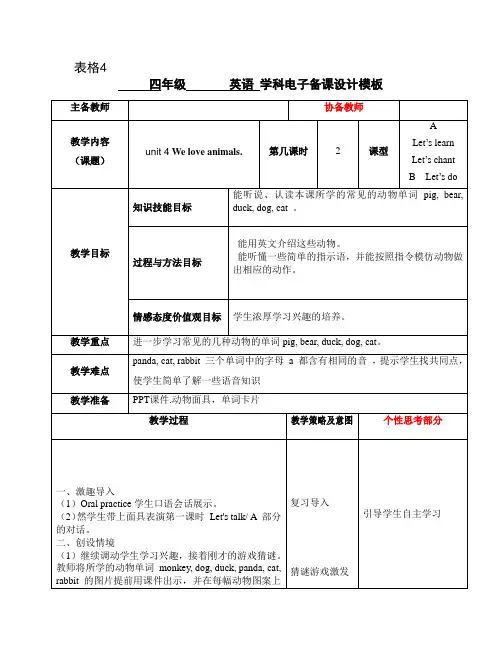
表格4四年级英语学科电子备课设计模板主备教师协备教师教学内容(课题)unit 4 We love animals.第几课时 2 课型ALet’s learnLet’s chantB Let’s do教学目标知识技能目标能听说、认读本课所学的常见的动物单词pig, bear,duck, dog, cat 。
过程与方法目标能用英文介绍这些动物。
能听懂一些简单的指示语,并能按照指令模仿动物做出相应的动作。
情感态度价值观目标学生浓厚学习兴趣的培养。
教学重点进一步学习常见的几种动物的单词pig, bear, duck, dog, cat。
教学难点panda, cat, rabbit 三个单词中的字母a 都含有相同的音,提示学生找共同点,使学生简单了解一些语音知识教学准备PPT课件.动物面具,单词卡片教学过程教学策略及意图个性思考部分一、激趣导入(1)Oral practice学生口语会话展示。
(2)然学生带上面具表演第一课时Let's talk/ A 部分的对话。
二、创设情境(1)继续调动学生学习兴趣,接着刚才的游戏猜谜。
教师将所学的动物单词monkey, dog, duck, panda, cat, rabbit 的图片提前用课件出示,并在每幅动物图案上复习导入猜谜游戏激发引导学生自主学习用遮罩层遮盖好,只露动物的尾巴,让学生猜猜看What is it? ,导入单词的学习。
(2)学生根据动物的尾巴猜谜,并七嘴八舌的讨论。
(3)教师将遮盖层打开,学生自然的发出感叹Wow! Great! 随后教师请学生读单词。
(学生在第一课时已经初步学习了单词)此时教师不要急于纠正学生发音,而让学生相互说说、评评,让学生间相互纠正单词的发音。
(4)教师出示单词卡片,请学生将单词读出后将卡片贴在黑板上,并要求贴在相对应的图片底下。
使单词的音、形、译三者相结合。
(5)教师请五名"小老师"到讲台前带读单词,既是对能力强学生的表彰也是多方面调动学习兴趣的体现。
4B第四单元第二课时教案
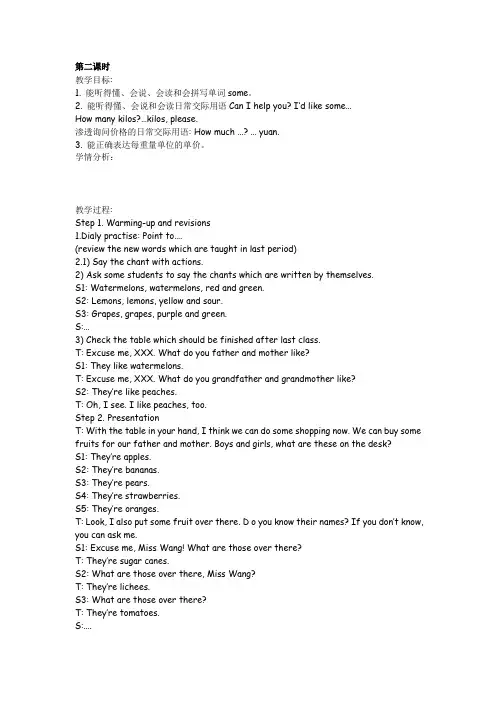
第二课时教学目标:1. 能听得懂、会说、会读和会拼写单词some。
2. 能听得懂、会说和会读日常交际用语Can I help you? I’d like some…How many kilos?…kilos, please.渗透询问价格的日常交际用语: How much …? … yuan.3. 能正确表达每重量单位的单价。
学情分析:教学过程:Step 1. Warming-up and revisions1.Dialy practise: Point to….(review the new words which are taught in last period)2.1) Say the chant with actions.2) Ask some students to say the chants which are written by themselves.S1: Watermelons, watermelons, red and green.S2: Lemons, lemons, yellow and sour.S3: Grapes, grapes, purple and green.S:…3) Check the table which should be finished after last class.T: Excuse me, XXX. What do you father and mother like?S1: They like watermelons.T: Excuse me, XXX. What do you grandfather and grandmother like?S2: The y’re like peaches.T: Oh, I see. I like peaches, too.Step 2. PresentationT: With the table in your hand, I think we can do some shopping now. We can buy some fruits for our father and mother. Boys and girls, what are these on the desk?S1: They’re ap ples.S2: They’re bananas.S3: They’re pears.S4: They’re strawberries.S5: They’re oranges.T: Look, I also put some fruit over there. D o you know their names? If you don’t know, you can ask me.S1: Excuse me, Miss Wang! What are those over there?T: They’re sugar canes.S2: What are those over there, Miss Wang?T: They’re lichees.S3: What are those over there?T: They’re tomatoes.S:….Step 3. New structures learning1. 重量单位和每重量单位单价的正确认读1公斤/千克:one kilo (1 Kg) 3.5公斤/千克: three point five kilos1磅:one pound (1 p)5元/千克:five yuan a kilo (5元/Kg)3.5元/磅:three yuan five jiao a pound (3.5元/p)2.Can I help you? I’d like some….How many kilos? …kilos, please.T: Now, I’m a shop assistant. You can buy fruits from me. Can I help you?S: I’d li ke apples.T: How many kilos?S: Two kilos, please.T: OK, here you are.S: Thank you. Goodbye!T: Bye!T-ST: I also like to buy some fruits for my father and mother. Who’d like to be the shop assistant?S: I try.T: OK. You, please.S1: Can I help you?T: I’d like some strawberries for my mother.S1: How many kilos?T: One kilo, please. How much are they?( Take out the purse in order to help the student understand the meaning of this sentence.)S1:Ten yuan.T: Here you are. And I’d like som e sugar canes for my father, too.S1: How many kilos?T: Three kilos, please. How much are they?S1: Ten yuan.T: No, eight yuan.S1: OK.T: Here you are.S1: Thank you. Goodbye!T: See you.S-T S-SStep 4. PracticeT: Now I’ll divide you into f our groups. You can do some shopping in the classroom. The students of group one are the shop assistants in Lianhua supermarket. Group two are the shop assistants in Rt-market. Group three and four are the customers. OK, you can go now.S: (Do the shopping.)T: OK, the students of group one and group two also like to buy some fruits. So let’s exchange now. The students of group three are the shop assistants in Lianhuasupermarket. Group four are the shop assistants in Rt-market. Group one and two are the customers.S: (Do the shopping.)Step 5. ConsolidationT: Now please open your books and turn to page 31. Let’s read after the tape. Are you ready?S: Yes.T: OK, here we go.S: ( Read after the tape, then read in groups/ pairs.)Today we have learnt how to buy fruits in English. That’s all for today. HomeworkOral work: 1) Read page 30-32 after the tape .2) 利用33页上给出的句型,根据33上四幅图的情景与同桌合作编一个小对话,要求真实可信。
2019-2020年四年级英语上册 unit4 第二课时教案 北师大版
2019-2020年四年级英语上册 unit4 第二课时教案北师大版教学目标:1.知识与能力1.通过教学使学生能够正确听懂、说出、认读以下单词a bed, adesk, a sofa, a chair, floor句子:Where is the ___? It’s _ the __.能够熟练朗读读本课的课文故事,正确唱出本课歌曲。
2.通过学生的感知、理解与模仿,使学生能够进一步感知课文,在适当的情景中运用本课涉及到的词汇正确描述“某物在哪”;能够用学过的语言描述“某物在哪”;能够询问“某物在哪”并进行回答。
2.过程与方法通过引导学生读单词卡片,引导学生感知字母的发音规律;看课件和身边的事物,进一步感知课文,理解Where is the ___? It’s _ the __.这个句型并能根据实际回答问题。
3.情感态度与价值观通过在教学中,引导学生寻找物品的感受,激发学生关心别人的情感;通过小组活动和分角色演唱,引导学生感受歌唱的美。
教学重点:帮助学生正确认读本课单词。
教学难点:使学生感知字母的发音规律。
教学准备:课件,录音磁带,录音机,词汇大卡片。
实践活动:使学生跟着课件分角色朗读课文和为课文配音,并唱歌曲。
板书设计:Unit 4 Where is it?It’s in the water.In front of BehindOn under.教学过程设计:一.Warm up and review.(5分钟)Activity1:播放课件,引导学生跟读并配音。
Activity2:出示单词大卡片,引导学生复习朗读上节课所学的单词。
二.Presentation (1) (5分钟)Drill:学习新单词Activity1:板书出示单词a bed, adesk, a sofa, a chair, floor,引导学生尝试自己认读单词。
Activity2:利用发音规律,教师请学生讲单词,遇较难的单词,教师讲解。
英语四年级Unit4第二课时教学设计
英语四年级Unit4 第二课时教学设计教学重点:1 .句型:What's his name? His name is …He has …2.词汇:Chinese, photo教学难点: 1 .发音:Chinese, his 的尾音2. 句型:He has …教具准备:1 .几张班里同学的照片2. John 和他妈妈的面具或图片。
3. 教材相配套的教学课件[ Unit 3 ,Let ' t s alk/B ]3 .教材相配套的教学录音带教学过程:(一)热身/复习(Warm-up/Revision )1 .问答练习:Who' s your best friend?2. 做“猜人”的游戏。
让一个学生描述班里某一个同学的模样,其他同学来猜这个人是谁。
尽量多做几组,练习句型Who's he/she? He/She is …..(二)表现新课(Presentation )1 •新课导入。
教师先自我介绍My name's….然后提问一名男生What syour name?该名学生回答问题后,教师对大家说:His name is -He is -教师问学生:What's his name? 启发学生回答:His name is... 教师继续指其他男生,让学生回答:What's his name? 教师再指另一个男生,让一个学生问What's your name? 另一个学生回答His name is.. (多做几组)2 .教师指着一个女生说:She' s-Her name is…然后问学生:What' shername ?让学生试着回答:Her name is …教师再指几个女生问:What's her name? 让学生两人一组做What's her name? Her name is …的问答练习。
3. 教师出示课文人物面具,让学生做问答:What's his/her name? His/Her name is …4. 出示班里某个学生的照片,教师说:Look, I have some photos. Look atthis photo, who can tell me his /her name?5. 教读单词photo :教师依次出示一些学生的照片,让学生看着照片使用所学知识对这个学生实行描述。
(新)人教PEP版英语四下《Unit 4 第二课时》教案(推荐)
第二课时一、课时内容A.Let’s talk A. Let’s play二、课时分析本课时是义务教育灵通版(pep)小学英语教科书四年级下册的第四单元第二课时,本课时继续围绕“参观农场”这个话题展开内容,与第一课时紧密相连,包括A.Let’s talk A. Let’s play 两个板块。
本课时的A Let’s talk .部分通过Mike 与Sarah 参加农场并与农场主人对话的情景让学生感知句型:Are these carrots? Yes, they are. No, they aren’t. 以及What are these? They’re tomatoes.的语义及语用情景。
A Let’s play 部分则是用来操练A Let’s talk板块的核心句型。
本课时核心句型是涉及名词复数形式的特殊疑问句和一般疑问句,这一知识点在四年级上册第四单元的B Let’s talk 出现过一次,本册学生用书的前三单元均未有涉及。
教师可创设适当的语境让学生充分的感受并理解名词单、复数的意义以及相应句型变化,并能在情景中正确运用和表达。
三、课时目标1. 能够在情景中运用句型:Are these …? Yes, they are. No, they aren’t. 以及What are these? They’re ….询问物品名称并回答。
2. 能够在情景中运用句型:It’s time for …描述即将要做的事情。
3. 能够在情境中恰当运用句型They ’re good/ so big!描述物品的特点。
4. 能够在语境中理解新词carrot 和tomato 的意思,并能正确发音。
5. 理解A Let’s talk .部分对话大意,能够用正确的语音语调朗读对话。
四、课时重难点1. 课时重点能听、说、认、读本课时的主要句型:Are these …? Yes, they are. No, they aren’t. 以及What are these? They’re ….并能做出正确的回答。
译林版4BUnit4Drawinginthepark五课时教案(含批注和后记)
Unit 4 Drawing in the park第一课时(The first period)一、教学内容:Story time.二、教学目标:1.能听懂、会说、会读单词:draw, picture, park, flower, boat, river, easy, difficult.2.能听懂、会读、会说日常交际用语:Good idea!Sure, it’s easy. It’s difficult, but I can try.3.能初步用以下句型What can you see? I can see …来对看到的事物进行交流;初步用句型Can you …?询问会做的事情。
4.能正确理解课文内容。
5.能够较准确的朗读课文并在教师的指导下尝试表演。
三、教学重难点:1.能听懂、会说、会读单词:draw, picture, park, flower, boat, river, easy, difficult.2.能听懂、会读、会说日常交际用语:Good idea!Sure, it’s easy. It’s difficult, but I can try.3.能初步用以下句型What can you see? I can see …来对看到的事物进行交流;初步用句型Can you …?询问会做的事情。
4.能正确理解课文内容。
四、教具准备:1.事先板书好课题Unit 4 Drawing in the park2.教学图片和卡片。
3.磁带和录音机。
五、教学过程:Step One: Warming up1. Greetings.T: Good morning, boys and girls.Ss: Good morning, Miss Xu.T: How are you?Ss: I’m fine, thank you.T: Nice to see you.Ss:Nice to see you too.2. T: Today, we will begin Unit 4. In this unit, we will go to some interesting places. Look! Here they are. (出示Park, Theatre, Amusement park, Zoo四个场景图) Which one will we go first? Let’s listen to a song.3. Enjoy the song: It’s a beautiful day in the park.4. T: Which one we will go first?Teach: parkT: What parks in Nanjing do you know?Ss: Xuan wu Lake Park, Baima park …Step Two: Presentation and practice.1. Talk about the things in the park.T: We know so many parks. I will draw a picture of it. 边画边问:What can you see in the park?S1: I can see a …T: Yes, it a tall tree.依次教授词语:tree, flower, boat, river注意每个词语教授时和学生拓展交流:What color are the flowers? I can row a boat, can you? … Can I draw …well? Yes, it’s easy for me. I t’s difficult for me, but I can try.2. ChantT: Is it a nice park? Let’s chant about it. Listen to me, first.(节奏声) Chant: In the park, I can see.See some trees, over there.In the park, I can see.See some flowers, under the tree.S: Chant together.3. Change some words and try to make a new chant.4. T: What can you do in the park? I can row a boat.S: I can fly kites/ play football/ride bike/ …Step Three: Story time1. T: Good, Mike and Tim are in the park now. What do they do? Let’s havea look! (出示图1)T: 出图局部,让学生猜测。