
初中英语6大时态练习
1 初中英语动词时态
一、一般现在时 动词+s的变化规则
1.一般情况下,直接加-s,如:cook-cooks, milk-milks
2.以s. x. sh. ch. o结尾,加-es,如:guess-guesses, wash-washes, watch-watches, go-goes
3.以“辅音字母+y”结尾,变y为i, 再加-es,如:study-studies
一般现在时用法专练:
一、 写出下列动词的第三人称单数
drink________go____________stay____________make__________look____________have____________
pass________carry _________come___________watch___________ plant___________ fly______ study________
brush____________
二、用括号内动词的适当形式填空。
1. He often ______(have) dinner at home.
2. 3.We ___________(not watch) TV on Monday.
3. 4. Nick ___________(not go) to the zoo on Sunday.
6. What _______they often _______(do) on Saturdays?
7. _______ your parents _______(read) newspapers every day?
8. The girl _______(teach) us English on Sundays. 9. Mike _______(like) cooking.
10. My aunt _______(look) after her baby carefully.
11.I ____(be) ill. I’m staying in bed.
12. She __________(go) to school from Monday to Friday.
13. -What day ____________(be) it today?
- It’s Saturday.
三、按照要求改写句子
1. Daniel watches TV every evening.(改为否定句)_______________________________________________________
2. I do my homework every day.(改为一般疑问句,作否定回答)___________________________________________
3. She likes milk.(改为一般疑问句,作肯定回答)_______________________________________________________
4. Amy likes playing computer games.(改为一般疑问句,作否定回答)______________________________________
5. He speaks English very well.(改为否定句)___________________________________________________________
6. I like taking photos in the park.(对划线部分提问)______________________________________________________
五、 单选
( )1 Jenny ____ in an office. Her parents ____in a hospital.
A work works B works work C work are working D is working work
( )2 One of the boys_____ a black hat. A have B there is C there are D has
( )3 We will go shopping if it____ tomorrow. A don't rain B didn't rain C doesn't rain D isn't rain
( )4 He said the sun ____in the east and ____in the west. A rose; set B rises; sets C rises, set D rise; sets
( )5 Wang Mei ____ music and often ____ to music. A like; listen B likes; listens C like; are listening D liking ;
listen
( )6 Jenny____ English every evening. A has study B studies C study D studied
2 二、一般过去时 动词过去式变化规则:
1.一般在动词末尾加-ed,如:pull-pulled, cook-cooked
2.结尾是e加d,如:taste-tasted
3.末尾只有一个元音字母和一个辅音字母的重读闭音节,应双写末尾的辅音字母,再加-ed,如:stop-stopped
4.以“辅音字母+y”结尾的,变y为i, 再加-ed,如:study-studied
5.不规则动词过去式:
am,is-was, are-were, do-did, see-saw, say-said, give-gave, get-got, go-went, come-came, have-had, eat-ate, take-took, run-ran,
sing-sang, put-put, make-made, read-read, write-wrote, draw-drew, drink-drank, fly-flew, ride-rode, speak-spoke, sweep-swept,
swim-swam, sit-sat
一、写出下列动词的过去式
is,am_________ fly_______ plant________ are ________drink_________ play_______ go________ make ________
does_________ dance________ worry________ ask _____taste_________ eat__________ draw________ put ______
throw________ kick_________ pass_______ do ________
二、 用be动词的适当形式填空
1. I _______ at school just now. 2. He ________ at the camp last week. 3. We ________ students two years ago.
4. They ________ on the farm a moment ago. 5. Yang Ling ______eleven years old last year.
6. There ________ an apple on the plate yesterday.
三、 句型转换
1. It was exciting. 否定句:____________________
一般疑问句:______________________ 肯、否定回答:_______________________
2. All the students were very excited. 否定句:_____________________________
一般疑问句:______________________________ 肯、否定回答:________________________________
3. He did his homework yesterday. 否定句:_________________________________
一般疑问句:___________________________________ 肯、否定回答:_____________________
七、用行为动词的适当形式填空
1. He _________ (live) in Wuxi two years ago.
2. The cat ________ (eat) a bird last night.
3. We _____ (have) a party last night.
4. Nancy _______(pick) up oranges on the farm last week.
5. I _____ (make) a model ship with Mike yesterday. 6.They ______ (play) chess in the classroom last PE lesson.
7.My mother _______ (cook) a nice food last Spring Festival.
9. I _________ (have) an exciting party last weekend.
10_______she _________(practice) her guitar
yesterday? No, she _________.
11. What ________ Tom ________ (do) on Saturday evening?
He ________(watch) TV and __________(read) an interesting book.
12. They all _________(go) to the mountains yesterday morning. 13. She _________(not visit) her aunt last weekend. She ____ (stay) at home and _____(do) some cleaning.
初中英语动词的时态专项训练100(附答案)

初中英语动词的时态专项训练100(附答案)
一、初中英语动词的时态
1. — Do you know the meeting?
—Tomorrow morning.
A. when they had
B. when they are going to have
C. when did they have
D. when are they going to have
【答案】B
【解析】
【详解】
句意:一一你知道他们什么时候来开会吗? 一一明天早上。
此题考查宾语从句,宾语从句要用陈述句语序, C和D是疑问句语序,故排除;根据回答
Tomorrow morning可知此句时态是一般将来时, A是一般过去时,B是一般将来时;故选
B。
2. I think I _____
my new project tomorrow.
A. start B. started C. will start D . was starting
【答案】C
【解析】句意:我想我明天将要开始我的新项目。本题考查动词的时态。 A. start开始,是
动词原形 B. started开始,是动词的过去式 C. will start将要开始,是动词的将来时 D. was
starting就要开始,是过去将来时。根据句意选 C。
3. -Has your cousin arrived in Beijing yet?
--Yes. She _______ Beijing since yesterday morning.
A. arrived in B. has arrived in C. has been in D. has been to
【答案】C
【解析】句意:你表弟到北京了吗? -是的。她从昨天起就在北京了。 since yesterday
morning自昨天早晨以来,表示的是截止到目前为止的时间段,用于现在完成时态,排除 A; arrived为短暂性动词,不能与表示一段的时间状语连用; have been to表示某人去过某
初中英语动词的时态和语态专项练习50题(附答案解析)
动词的时态和语态专项练习50题(附答案解析)
一、单选题
1.If it _______ rain tomorrow, we _______ go hiking.
A.don't, will B.won't, are C.won't, will D.doesn't,
will
1.答案D
解析句意:如果明天不下雨,我们就去远足。这是if 引导的条件状语从句,满足“主将从现”,即主句用一般将来时,从句用一般现在时,故选D。
点评考查时态,本题涉及一般将来时和一般现在时。
2.We must hurry up. The last train ___________ in 10 minutes.
A.is leaving B.leaves
C.is about to leave D.Left
2.答案A
解析句意:我们必须快点。最后一班火车10分钟后就要开了。此处应表将来含义,如arrive,come,get (to),leave,return,start,travel,take,take off,fly,see off表示位置转移的动词(短语),用现在进行时(am/is are doing)表将来的含义,主要用于按计划或安排将要发生的动作或事件。故选A。
点评考查时态,本题涉及现在进行时表将来。
3.—There __________ a basketball match in our school next Sunday.
—Really? That's new to me.
A.is going to have B.is going to be
C.will have D.will to be
3.答案B
解析句意:——下星期天我们学校将有一场篮球赛。——真的吗?我还不知道呢。由时间状语next Sunday可知,空处谓语动词需用一般将来时;本句是there be句型,其将来时态为:There is going to be。故选B。
(完整版)初中英语各种时态练习题集锦
错误!未指定书签。-1 -
专题五 时态复习
(一)一般现在时
复习要点:1•用法2•时间3•句型转换
一、 用词的适当形式填空。
1. Miss Guo ____________ (teach) us Chin ese this term. She _____________ (be) a very good teacher. She ofte n
________ (talk) with us after class. Many of us like ____________ (talk) with her.
2. Where ___________ their father _________ (work)? He ____________ (work) on a farm.
3. What time ___________ the shop ____________ (close)? It ________ (close) at nine o'clock in the eve ning.
4. He__________ (go) to school by bus every day.
5. Tom can not walk fast because he ________________ (carry) a heavy box.
6. She ofte n __________ (read) En glish in the eve ning.
7. She_______ (go) to school at eight 'lock.
8. He usually __________ up at 17:00. (get)
9. She_______ (live) in Beiji ng.
二、 句型转换:
1.1 like the red sofa.变否定句)
2. She has a nice cap.变一般疑问句,并做肯定及否定回答)
八年级英语∶英语动词的时态专练及答案解析
八年级英语∶英语动词的时态专练及答案解析
一、初中英语动词的时态
1.—Mum, where is my dictionary?
—Oh, I didn’t see it, either. I’m afraid you ___________ it.
A.are losing B.will lose C.have lost D.were losing
【答案】C
【解析】
句意:——妈妈,我的字典在哪里?——哦,我也没有看到它,恐怕你把它弄丢了。A. are
losing现在进行时态; B. will lose一般将来时态;C. have lost现在完成时态; D. were losing过去进行时态。lose这一动词发生在过去,造成的结果是现在看不见了,属于完成的动作,要用现在完成时态来表达,故答案为C。
2.—Shall we play tennis now?
—Sorry, I can’t. I my homework.
A.do B.did C.have done D.am doing
【答案】D
【解析】句意:——我们现在打网球去好吗?——对不起,我不能去,我在做作业。A. do
做,用于一般现在时态,主语复数时; B. did做 ,用于一般过去时态; C. have done
做,用于一般现在完成时态; D. am doing做,用于现在进行时态,主语是I时;根据
now可知用现在进行时态,故选D
3.—You look unhappy. What’s wrong?
—No one ______ me when I was in America. Maybe they all forgot me.
A.phoned B.phones C.has phoned D.had phoned
【答案】A
【解析】句意:-你看起来不开心,怎么了?-当我在美国的时候没有人给我打电话,可能他们都忘了我吧!题干有过去的时间状语when I was in America,需要用一般过去时态用来描述过去的一个动作。故选A。
初中英语语法八大时态总结及练习题
英语语法八大时态
一.一般现在时
结构
肯定句式: 主语+动词原形/动词的第三人称单数+其他
否定句式: 主语+(助动词) don't/doesn't +动词原形+其他
一般疑问句式: Do/Does+主语+动词原形+其他
简略回答: (肯)Yes,主语+do/does (否)No,主语+do/does not
缩写形式: don't = do not doesn't = does not
例句:He often goes swimming in summer.
I usually leave home for school at 7 every morning.
二.一般过去时态
结构
肯定句式: 主语+动词过去式+其他
否定句式: 主语+(助动词)didn’t +动词原形+其他
一般疑问句式: Did+主语+动词原形+其他
简略回答: (肯)Yes,主语+did (否)No,主语+did not
基本结构 否定句 一般疑问句
Be动词 was/were+not was/were提前,放于句首
行为动词 didn’t+do(动词原形) Did+主语+do(动词原形)
三.一般将来时
结构
结构1:
肯定句式:主语+助动词will+动词原形+其他
否定句式:主语+助动词will+动词原形+not+其他
一般疑问句式:助动词Will+主语+动词原形+其他
简单回答:在口语中,will在名词或代词后常缩为’ll,wii not常简缩为won’t。
在疑问句中,主语为第一人称时(I和we)时,常用助动词shall。
例如:She’ll go to play basketball.
Shall we go to the zoo?
结构2:
肯定句式:主语+be going to +动词原形+其他
否定句式:主语+be not going to +动词原形+其他
(完整版)初中英语8种时态练习及答案
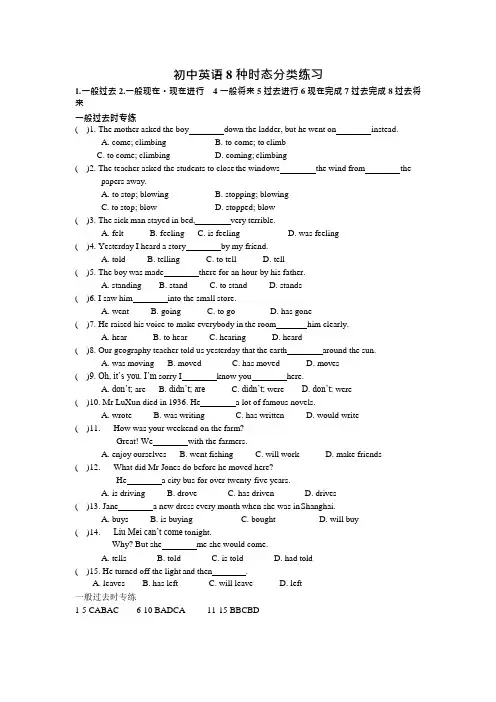
初中英语 8 种时态分类练习
1. 一般过去 2.一般现在。现在进行 4 一般将来 5 过去进行 6 现在完成 7 过去完成 8 过去将来
一般过去时专练
( )1. The mother asked the boy down the ladder, but he went on instead.
A. come; climbing B. to come; to climb
C. to come; climbing D. coming; climbing
( )2. The teacher asked the students to close the windows the wind from the
papers away.
A. to stop; blowing B. stopping; blowing
C. to stop; blow D. stopped; blow
( )3. The sick man stayed in bed, very terrible.
A. felt B. feeling C. is feeling D. was feeling
( )4. Yesterday I heard a story by my friend.
A. told B. telling C. to tell D. tell
( )5. The boy was made there for an hour by his father.
A. standing B. stand C. to stand D. stands
( )6. I saw him into the small store.
A. went B. going C. to go D. has gone
( )7. He raised his voice to make everybody in the room him clearly.
初中英语语法六大时态
初中英语语法六大时态
初中英语通常涵盖的六大时态是:一般现在时、一般过去时、一般将来时、现在进行时、过去进行时和现在完成时。以下是这些时态的基本结构和用法:
1. 一般现在时 (Present Simple)
1. 结构:主语 + 动词原形(第三人称单数使用动词第三人称单数形式)
2. 用途:描述经常发生的动作或状态;表达客观事实、普遍真理或习惯性动作;表示主语的特征或状态。
3. 例子:She always gets up early. (她总是早起。)
2. 一般过去时 (Past Simple)
1. 结构:主语 + 动词过去式
2. 用途:描述过去某个时间发生的动作或状态;叙述过去的事实或经历。
3. 例子:I watched TV last night. (我昨晚看了电视。)
3. 一般将来时 (Future Simple)
1. 结构:主语 + will + 动词原形
2. 用途:表示将来某个时间要发生的动作或状态;表示计划、意愿或预测。
3. 例子:She will go to the party tomorrow. (她明天要去参加聚会。)
4. 现在进行时 (Present Continuous) 1. 结构:主语 + be 动词(am/is/are) + 动词-ing
2. 用途:描述当前正在进行的动作或正在发生的情况。
3. 例子:They are playing football now. (他们现在正在踢足球。)
5. 过去进行时 (Past Continuous)
1. 结构:主语 + be 动词的过去式(was/were) + 动词-ing
2. 用途:描述过去某个时间正在进行的动作或状态。
3. 例子:When I was a child, I was always playing
outside. (当我还是个孩子的时候,我总是在外面玩。)
6. 现在完成时 (Present Perfect)
初中英语时态练习
初中英语时态练习
1、⼀般现在时(1)⼀般现在时表⽰没有时限的持久存在的动作或状态或现阶段反复发⽣的动作或状态,常和副词 usually,often,alwayssometimes, regularly,near,occasionally,every year, every week 等The moon moves round the earth..(2)在由after,until,before,once,when,even if,in case,as long as,as soon as,the moment 以及 if,unless 等引导的时间状语从句或条件状语从句中,通常⽤⼀般现在时代替将来时。例如:I will not go to countryside if it rains tomorrow.2.⼀般过去时(1)表⽰过去某⼀特定时间所发⽣的、可完成的动作或状态,常与表⽰确切过去时间的词、短语或从句连⽤。例如:We went to the pictures last night and saw a very interesting film.(2)表⽰过去习惯性动作。例如:He always went to class last.3.⼀般将来时1)表⽰将来打算进⾏或期待发⽣的动作或状态。例如:I shall graduate next year.替代形式:1) be going to +v在⼝语中⼴泛使⽤,表⽰准备做或将发⽣的事情。2) 表⽰根据计划或安排在最近要进⾏的事情。具有这种语法功能的动词仅限于过渡性动词。即表⽰从⼀个状态或位置转移到另⼀个状态或位置上去的动词。常⽤的有:go,come,leave,start,arrive,return等。例如: They are leaving for HongKong next month.⼆、进⾏时态1.现在进⾏时 :表⽰现在正在进⾏的动作,常与now,right now,at the mother,for the time being,for the present等连⽤。例如:She is reading a newspaper now.2. 过去进⾏时 :过去进⾏时表⽰⼀个过去的动作发⽣时或发⽣后,另⼀个过去的动作正在进⾏,或表⽰过去反复的习惯,常与always,continually,constantly等动词连⽤。例如:1)We were discussing the matter when the headmaster entered.2)Whenever I visited him, he was always writing at the desk.三、完成时态完成时态通常表⽰已完成或从事的动作。它可分为:1. 现在完成时(1)现在完成时⽤来表⽰对⽬前状况仍有影响的,刚刚完成的动作(常与yet,already,just连⽤),或者过去某⼀时刻发⽣的,持续到现在的情况(常与for,since连⽤)。例如:1)I have just finished my homework.2)Mary has been ill for three days.(2)常与现在完成时连⽤的时间状语有:since, for, during, over等引导出的短语;副词already, yet, just, ever, now, before,often, lately, recently等;状语词组this week (morning, month, year), so far, up to now, many times, up to the present等。例如:1)I haven’t been there for five years.2)So far, she hasn’t enjoyed the summer vacation.3)There have been a lot of changes since 1978.2. 过去完成时(1)表⽰过去某时间前已经发⽣的动作或情况,这个过去的时间可以⽤by,before等介词短语或⼀个时间状语从句来表⽰;或者表⽰⼀个动作在另⼀个过去动作之前已经完成。例如:1)We had just had our breakfast when Tom came in.2)By the end of last year they had turned out 5, 000 bicycles.(2)过去完成时常⽤于以下固定句型:1)hardly, scarcely, barely + 过去完成时+ when + 过去时。例如:Hardly had I got on the bus when it started to move.2)no sooner +过去完成时+ than +过去时。例如:No sooner had I gone out than he came to see me.3)by (the end of ) +过去时间,主句中谓语动词⽤过去完成时。例如:The experiment had been finished by 4 o’clock yesterday afternoon.动词的语态语态也是动词的⼀种形式,英语有两种语态:主动语态和被动语态。主动语态表⽰主语是动作的执⾏者,⽽被动语态表⽰主语是动作的承受者。1)We use electricity to run machines. (主动语态)2)Electricity is used to run machines. (被动语态)1. 不能⽤于被动语态的动词和短语(1)在英语中,不及物动词不能⽤于被动语态,但有些不及物动词(包括短语)容易引起误⽤。如:appear, belong,belong, die, escape, fall, happen, last, remain, succeed, occur, come true, take place, consist of。(2)某些表⽰状态或特征的及物动词,如:become, contain, cost, fit, have, resemble, suit也没有被动语态。2. 被动语态的时态形式现在 be( is; am; are) + v-pp
初中英语八大时态练习题
初中英语八大时态练习题
初中英语八大时态是英语学习中的基础,它们分别是一般现在时、一般过去时、一般将来时、现在进行时、过去进行时、将来进行时、现在完成时和过去完成时。以下是针对这些时态的练习题,帮助学生巩固和检验自己的学习成果。
1. 一般现在时(Simple Present Tense)
- 用括号内动词的正确形式填空:
- My father (go) ______ to work by bus every day.
- She (have) ______ a big family.
2. 一般过去时(Simple Past Tense)
- 将下列句子转换为过去时态:
- They play soccer yesterday. (Correct the sentence)
- She was very happy when she received the gift.
3. 一般将来时(Simple Future Tense)
- 用will或going to填空:
- I (visit) ______ my grandparents next weekend.
- It (rain) ______ tomorrow.
4. 现在进行时(Present Continuous Tense)
- 用括号内动词的现在分词形式填空:
- He (read) ______ a book right now.
- We (have) ______ a meeting at this time tomorrow.
5. 过去进行时(Past Continuous Tense)
- 用括号内动词的过去分词形式填空: - They (watch) ______ a movie when I called them last
初中英语时态练习100题(附答案)
初中英语时态练习(1)
1.I will tell him as soon as he _____ back
A. come B. comes C. will come D. came
2. Mary _____ on shoes when she ____ them.
A. tries…buys B. tries… buies C. trys… buys D. trys… buies
3. The girl often ______ cold when she ______.
A. cathcs…dances B. catches… dances C. catchs…dancees D. catches… dancee
4. _____ he ____ himself there? No, I don't think so.
A. Do…enjoy B. Does… enjoies C. Does… enjoys D. Does…enjoy
5. _____ your teacher ____ from them very often? Certainly.
A. Do…hear B. Does…hear C. Do… receive D. receive
6. _____ your mother _____ some cleaning on Sundays?
A. Does…does B. Do…does C. Does…do D. Do… do
7. _____ Tom _____to work hard to help his family ? Yes, he _____.
A. Has… x…does B. Has…x…does C. Does…has…has D. Does… have…does
8. Which teacher _____ lessons to you every day ?