
人教版高中英语必修二:Unit4 Wildlife protection reading课件
are killed and now there are only
79,000 of them left.
milu deer
rhino
crocodile
leopard
giraffe
elephant
tibetan antelope (藏羚羊)
South China tiger 华南虎
Golden monkey金丝猴
quick
fierce lovely loyal
animals
cute clever beautiful dangerous
This passage is mainly about:
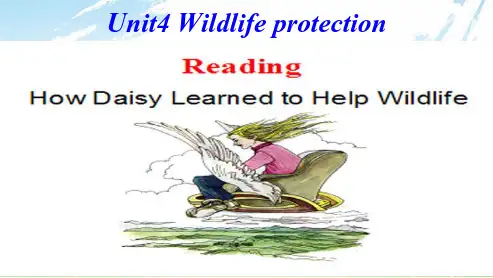
Daisy’s dream. In her dream, she met an antelope, an elephant, and a monkey. Through this dream, she had learned how to help wildlife.
New Words Learning:
1. wild 野生的 2. wild life 野生动物
3. decrease 减少
5. fur皮毛
4. die out 灭亡
6. in peace 和平地
7. antelope 羚羊
8. wool 羊毛,毛线
9. stomach 胃,腹部 10. be gone 消失 11. rhino 犀牛 13. suggest 建议 12. hunt 打猎,猎取 14. thick 厚的,浓的,繁盛的
4. How did it improve for the animals? The animals were no longer killed by the farmers for destroying the crops.
5. In what ways does looking after the rain forest help with wildlife protection? Looking after the rain forest helps wildlife protection because it contains many medicines and drugs that we do not know. These drugs may save lives. No rain forest, no animals and no drugs.
unknown
Listen carefully and answer the questions. 1. Who is hunting and killing the Tibetan antelope? People are hunting and killing the Tibetan antelope. 2. Why are we humans part of this problem? People who buy sweaters made with Tibetan wool are encouraging more people to go out and kill the animals.
are being hunted for the fur their fur is being used to make sweaters… lack of food decrease
Fast Reading:
Read the text in 3 minutes and do the following True or False statements:
•Scanning:
• Read the passage carefully.
• Questions : • 1 . Is this a real story? No, it is a dream. • 2. How many kinds of wild animals are talked in Daisy’s dream world? Antelope, elephant, monkey. • 3 . Which three places are mentioned about? Tibet, Zimbabwe, rainforest.
place
animal
expression
(Daisy)
Emotion(情感) (animal)
Tibet China
antelope
cried
sad
Zimbabwe Africa
elephant
laugh smile
excited
Thick rain forest monkey Brazil
amazed
15. rub 摩擦 16. protect 保护 17. mosquito 蚊子 18. insect 昆虫 19. contain 包含,含有 20. powerful 强大的,有力的 21. drug 药品 22. affect 影响 23. pay attention to 注意 24. WWF = world wildlife fund 世界野生生物基金会
( (
( (
) 3. The second animal Daisy met
was an excited elephant.
) 4. As a result, elephants will no
longer be hunt. ) 5. The monkey rubbed itself to protect itself from mosquitoes. ) 6.WWF means the World Wildlife Fund.
3. How did life improve for the farmers in Zimbabwe? The farmers got money when the government asked the tour companies to pay them to visit and hunt the animals.
高中英语人教版必修二:Unit+4+Wildlife+protection+教案5.doc

Unit 4 Wildlife protection教学目标[知识与技能](Knowledge and skills)1.Get the students to learn the words and expressions about wildlife protection.2.Make students know how to use the Present Progressive Passive Voice.3.Let the students learn how to express our intentions and purposes.[过程与方法](Processes and methods)1.Through the report on some endangered wildlife in China,let students realize the necessities of protecting wildlife.2.By reading Daisy’s wonderful dream,students can know how to protect wildlife by using some teaching software,pictures,flashcardsor objects.3.Get the students to know how to express out intentions and purposes using some sentences.[情感、态度与价值观](Emotion,attitudes and values)1.By learning this unit students can know the living conditions of wildlife at present,at the same time we also understand the necessities of protecting wildlife.2.The content makes students learn something about nature environment,the meaning of protecting wildlife,it can benefit harmonious development between animals and humans.学情分析该部分是本模块的阅读部分,课文重点描述了Daisy在梦中的一次奇妙的飞毯旅行。
高中人教版高中英语必修二Unit4_Wildlife_Protection课件精品ppt课件
While reading:
1.Fast reading
Read the text fast and then finish the true or false exercises.
(1).Antelopes are being killed for the wool beneath their stomachs.
there to save local wildlife. 4.Because if there is no rainforest,there would be no animals ,no drugs. 5. First we should treat wild animals as our friends;
Then we must protect the environment in order to let wild animals have enough food and good living conditions; And we should collect money to protect wildlife; ......
(在危险中;垂危)
Habitats destroyed
Lack of food
Why?
Climate changed
Killed by Man
Pollution
Listening:
1.Where did Daisy go?
Tibet , Zimbabwe, Rainforest.
2.What animals did she see?
1.Because they are being killed for wool beneath our stomachs.Their fur is being used to make sweaters for people. 2.Because the government decided to help . 3.They allowed tourists to hunt only a certain mumber of animals if they paid the farmers.Good things are being done
人教版高一英语必修二《Unit4Wildlifeprotection》评课稿
人教版高一英语必修二《Unit4Wildlifeprotection》评课稿1. 前言《Unit4Wildlifeprotection》是人教版高一英语必修二课程的一部分,主要介绍了野生动物保护的重要性和相关的实践措施。
本评课稿将从教材内容、教学目标、教学方法和教学评价四个方面进行评价,以便更好地指导教学实践。
2. 教材内容评价2.1 教材内容贴切性教材内容贴切地围绕了野生动物保护这一主题展开。
课本中引入了大量的真实案例和相关资料,如濒临灭绝的物种和它们所面临的挑战,以及人类与野生动物共存的方法等。
通过这些丰富的内容,学生能够了解到野生动物保护的紧迫性和必要性。
2.2 教材内容的连贯性和层次性教材内容在层次性上进行了合理的组织。
从引入野生动物保护的重要性开始,逐渐深入探讨了保护措施和相关的法律法规。
学生通过逐步深入的学习,能够逐渐理解和掌握这一主题的各个方面,形成一个完整的知识体系。
2.3 教材内容的兴趣性教材内容设计十分兴趣引人。
除了传统的文字阅读材料外,课本中还包含了图表、图表解读和角色扮演等多种形式的活动。
这些形式多样的活动设计不仅能够激发学生的兴趣,还能培养学生的动手能力和实践能力。
3. 教学目标评价3.1 知识目标根据教学大纲的要求,教学目标明确。
通过学习本单元的内容,学生应该能够掌握有关野生动物保护的相关知识,了解保护措施和相关的法律法规。
3.2 能力目标教学目标中强调了培养学生的口头表达能力、独立思考能力和解决问题的能力。
通过课堂上的互动和小组活动,学生能够得到锻炼,并在实践中不断提升这些能力。
3.3 情感目标教学目标中也涵盖了培养学生的环保意识和责任感。
通过学习野生动物保护的案例和相关知识,学生能够更好地理解人类与自然环境的关系,并形成积极的环保态度。
4. 教学方法评价4.1 多媒体教学法多媒体教学法在本单元教学中得到了广泛运用。
通过使用图片、音频和视频等多种媒体形式,能够更直观地展示野生动物保护的案例和实际情况,提高学生的学习兴趣和理解能力。
高中英语人教版必修二:Unit+4+Wildlife+protection+教案1.doc

Unit 4 Wildlife ProtectionUsing language (listening,speaking and writing)Design concept: the design is about Senior English for China book 2 unit 4 Wildlife protection; this is the Fifth period of this unit teaching, so it’s mainly about listening, speaking and writing. In this design, there are living environments to help students to apply their knowledge to practice and all the activities are centered on the students; besides, the activities are set from easy to difficult, and they are suitable for students of different levels. It is aimed to make students learn happily, experience the happiness of success and improve their abilities of listening, speaking and writing.Part one: Teaching aimsBy the end of this class, the majority of the students will be able to reach these goals.1. Knowledge aims(1). The students will be able to express their intention and purpose.(2). The students will be able to make sentences with the new words andexpressions in this unit.2. Ability aims(1). Through listening, students will improve their listening ability, especially the ability to catch key words and the ability to analyze the information.(2).Students will be able to talk about the endangered animals and the ways to protect them.(3). Through writing practice, Ss will be able to improve their writing skills.3. Emotional aims(1). Stimulate students’ love for wildlife.(2). Cultivate students’ sense of cooperation and build up their confidence in learning English.Part two: The analysis of studentsAccording to the New Standard Curriculum and the New Syllabus and the artistic appreciation, students in grade one are supposed to learn to be independent and cooperative in learning; besides they should learn to find out questions, analyze questions and work out questions in English; meanwhile they are requested to form the habit of thinking in English. My students have just graduated from junior school, they are able to deal with some easy questions, so in this period, I want to help them to listen independently, discuss together and solve difficult questions by teamwork.Part three: The analysis of the teaching materialThe teaching content is from New Senior English For China Module 2, Unit 4 Wildlife protection. This is the fifth period of this unit, which is about the listening, speaking and writing. This unit is about wildlife protection. From learning this period, the students can apply what they have learnt to talk and write, so this period is very important in this unit teaching and learning it well is a must for the students.Teaching important and difficult points:Improve the students’listening ability, especially the ability to catch key words and analyze the information. Improve the students’ writing skills (the ability to “output”after listening and speaking.Part four: teaching conceptsTeaching serves students, so all the activities are centered on students. In the class, the teacher is a guide and helper. Because each student has his own strengths and weakness, and they may not at the same English level, the teacher should set questions of different levels to make every student feel the happiness of development and help them to experience success. Part five: teaching strategiesAccording to the artistic appreciation, the purposeof teaching English is to improve their abilities of language learning, develop their spirit of teamwor k, and help them to learn by themselves. Through listening and speaking, students get the content of writing and get the ideas organized, which makes the writing task easier. So in this period, all the activities are for the students, so the teacher should communicate with students, observe their emotions and make proper adjustment in the class.Part six: teaching environmentEnglish class is the only time when students can practice listening and spoken English, so in the class the students and teachers will mainly use English to learn and communicate. Of course, if the students have difficulty in understanding, I will translate them into English to help them cooperate well. Part seven: Teaching proceduresStep 1. Revision and goals introductionIn this Unit, we talked about wildlife protection, so we know lots of animals are dying out, and also plenty of animals have already disappeared. Today we have some new goals and tasks, so let’s learn it together. Purpose: Make the students be clear about the tasks in this class, and be more careful in learning.Step 2. ListeningTask 1. Wake up your earsPlay a game with the students to arouse their attention about listening.Purpose: attract the students’ attention and make them more careful in listening .Task 2. ListeningActivity 1. Before listeningLook through the questions in listening part, and predict what the listening material is about. Purpose: make the students be prepared for the listening exercise.Activity 2. while listeningLead the students to form the habit of grasping the important words and making notes when listening.For the first time, the students should do Exercise 1 to catch the main idea.For the second time, finish all the exercises on page 30. and try to check their answers.For the third time, ask the students to try to get more details. Activity 3. After listeningHelp the students try to retell what they have listened in their own words. Purpose: help the students get some informationthrough listening .Step 3. SpeakingActivity 1: Free talkCan you list any endangered animals?( Show some pictures to help students know about their present situation and the reasons why they are in danger. )Activity 2. Discussion1. Why are they in danger?2. What should we do to protect these endangered animals? (several minutes later, ask some volunteers to present their ideas.)Purpose: input some content and be prepared for the writing . Step 4. WritingWrite a letter to WWF based on what you have discussed, asking them tohelp save the endangered animals.Firstly, review the start and the end of a letter, be clear about the form of a letter.Secondly, plan the structure of the letter together.Dear xxx,para1: the present situationpara2: the reasonpara3: the measurespare4: conclusion or an appeal yours sincerelyxxx Thirdly, offer some useful expressions to help them writing.Para1: I am writing to…Para2: As we all know, The number of …There are many reasons why… Firstly ,…; secondly, …;thirdly,…Para3: It is time to … take measures to do Above all ,…;Besides, …;what’s more,… It’s a good idea to do… why notdo…?We had better do… We are supposed to doPara4: take action make a difference to… live inharmony withPurpose: give some supporting languages to help them expresstheir ideas freely.Then ask the students to write the letter individually.…..Give an evaluation standard, after the students finish writing,If there are different paragraphs to express your ideas.If there is a topic sentence in each paragraph.If the ideas are organized logically.If the tense and person are used correctly.If your expressions are used properly and vividly.If your handwriting is neat and easy to read.Then, ask students to swap with their desk mates to correct the mistakes.Purpose: make the students know about the writing standard, and learn to find mistakes during learning.Step 5. SummaryAsk the student on duty to make a summary of this period. Step 6. HomeworkPolish your own composition and write it on your exercise. Review this unit and do the exercises in your workbook. Step 7. Reflection after classIn this class, my students are the center, I designed various activities to try to make students involved in the whole class and improve their English learning During listening teaching, I lead them to catch key words and analyze the information. . From listening and discussing, students will make the writing task easier. Through writing, students have improved their writing skills. So from this class, the students form the habitof thinking individually and learning corporately, they have practiced their listening, speaking and writing ability, and improved their English learning. Therefore, this class has reached its original aims and it is a success品味人生1、不管鸟的翅膀多么完美,如果不凭借空气,鸟就永远飞不到高空。
人教版高中英语必修二Unit 4 Wildlife Protection
高中英语学习材料madeofjingetiejiUnit 4 Wildlife ProtectionⅠ.阅读理解A体裁:说明文话题:动物词数:296 时间:6′Lions are family animals and truly social in their own communities.They usually live in groups of 15 or more animals called prides.Prides can be as small as 3 or as big as 40 animals.In a pride,lions hunt food,raise little lions,and defend their territory(领地) together.In prides the females do most of the hunting and care for little ually all the females in the pride are related—mothers,daughters,grandmothers,and sisters.Each pride generally will have no more than two adult males.While the females usually live with the pride for life,the males often stay for only two to four years.After that they go off on their own or are evicted(逐出) by other males who take over the pride.When a new male becomes part of the pride it is not unusual for him to kill all the little lions,making sure that all future little lions will have his genes.The main job of males in the pride is defending the pride's territory.A male's loud roar(吼叫),usually heard after sunset,can carry for as far as eight kilometers.The roar warns off intruders(入侵者) and helps round up small members of the pride.Hunting generally is done in the dark by the females.They often hunt in groups of two or three,using teamwork to surround,and kill other animals.Females aren't the most successful of hunters,because they usually score only one kill out of several tries.After the kill the males usually eat first,females next and the little lions get what's left.Males and females defend against any outside lions that attemptto join their pride.【语篇解读】狮子是百兽之王。
人教版新课标高中英语必修二 Unit 4Wildlife protection Grammar 练习 含答案详解
Unit 4Wildlife protectionGrammarⅠ句型训练1.His suggestion ___________________________(在会上正被讨论) now.2.Many rare animals ________________(正在被猎杀) for food or fur, so they are endangered.3.The fields where crops used to be grown ________________(正被使用) for buildings and soon the buildings will be completed.4.With the development of science, more new knowledge ____________________(正被引进到) the field of IT.Ⅱ在空白处填入适当的内容(1个单词)或括号内单词的正确形式1.To the teacher's anger, the same mistakes are always ________________(make) by his students.2.Traditional folk arts of Tianjin like paper cutting ________________(exhibit) at the culture show now.3.They are living with their parents for the moment because their own house______________(rebuild).4.—I hear you ________________(work) in a pub. What's it like?—Well, it's very hard work and I'm always tired, but I don't mind.5.The driver was at ________ loss when word came that he was forbidden to drive for speeding.6.At present, some of the hotels in my hometown ________________(rebuild).7.—Look! Everything here is under construction.—What's the pretty small house that ________________(build) for?8.—What's that terrible noise, David?—Oh, I forgot to tell you.The new machines in the nearby plant ________________(test).9.I really appreciate________(have) time to relax with you on this nice island.10.He was told that it would be at least three more months ________he could recover and return to work.11.—Have you moved into your new apartment?—Not yet.The building ________________(paint) now, so we have to wait another month.12.The office building is ________ construction. It will be completed next month.13.His computer is ________ use.You can use mine.14.My car is ________ repair, so I have to walk to work.15.John invited about 40 people to his wedding, most of ________ are family members.Ⅲ阅读理解AWhy did the chicken cross the road? To get to the other side.Most people know this joke.But recently, some people have been much more worried about how the grizzly bear and the mountain lion can cross the road.“Millions of animals die each year on the US roads,” the Federal Highway Administration reports.In fact, only about 80 ocelots, an endangered wild cat, exist in the US today.The main reason? Roadkill.“Ecopassages” may help animals cross the road without being hit by cars.They are paths both over and under roads.“These ecopassages can be extremely useful, so that wildlife can avoid road accidents,” said Jodi Hilty of the Wildlife Protectio n Society.But do animals actually use the eco-passages? The answer is yes.Paul Beier of Northern Arizona University found foot marks left by mountain lions on an eco-passage that went under a highway.This showed that the lions used the passage.Builders of eco-passages try to make them look like a natural part of an area by planting trees on and around them.Animals seem to__be__catching__on.Animals as different as salamanders and grizzly bears are using the bridges and underpasses.Next time you visit a park or drive through an area with a lot of wildlife, look around.You might see an animal on an overpass!1.The writer uses the example of ocelots to show that ________.A.wild animals have become more dangerousB.the driving conditions have improved greatlyC.the measure for protecting wildlife fails to workD.an increasing number of animals are killed in road accidents2.When the writer says that animals seem “to be catching on”,he means ________.A.animals begin to realize the danger on the roadB.animals begin to learn to use eco-passagesC.animals are crossing the road in groupsD.animals are increasing in number3.This passage is written to ________.A.protect the endangered animalsB.call on drivers to be careful when seeing animals on the roadC.introduce a new way to help protect wild animalsD.tell us the main reason for the killing of animals in the USBFood webs throughout the ocean are in trouble because of overfishing.About one billion people rely on seafood for protein.However, people are fishing more species faster than those fish can reproduce(繁殖).By 2048, says the World Wildlife Fund, the number of all present food fish could reduce by 90%.So few fish would remain in the world that people couldn't depend on them for food.Climate changes will most likely trouble food webs further.As average global temperatures rise, the ocean gets more carbon dioxide.That makes the ocean more acidic, which does harm to the lives in the ocean.Fewer of those lives will grow stronger, leaving less to eat.There will be more effects on the food web.Aquaculture—raising fish and seafood in farms—isn't necessarily the answer to these problems. Sometimes companies destroy mangrove(红树林) forests and other sensitive habitats in order to build fish farms. Habitat destruction also leaves coastal areas easily flooded.“A lot of our freshwater comes from the ocean as rain,” says Shannon, an ocean scientist. Rain helps crops grow and provides drinking water.But it__can__have__a__dark__side,as when hurricanes cause flooding and blackouts even in inland states, such as Ohio, Missouri, and New Mexico.The ocean affects the air, too.“Half the oxygen that we breathe comes from photosynthesis(光合作用) of sea plants in the ocean,” adds Shannon.That sea air reaches from coast to coast.All those reasons suggest that we have to protect the ocean before it is too late.4.By saying “it can have a dark side”,Shannon means ________.A.rain can make drinking water darkB.rain can have a bad effect tooC.rain can get crops grow darkD.rain can become dark itself5.Which of the following is RIGHT according to the passage?A.By 2048, about one billion people will not depend on seafood any longer.B.Climate changes will most likely cause a lot of trouble to food webs.C.Aquaculture is necessary to solve these problems.D.The ocean and the seafood affect our surroundings.6.The purpose of this passage is to ________.A.prove the advantages of seafoodB.introduce the serious sea pollutionC.explain the formation of food websD.call on people to protect the oceanCWhen I first entered high school, I knew no one at my school.All my friends in middle school went to other schools.I wanted to make some new friends.However, I was shy and wasn't good at making new friends.On my first day at school, I looked at others who were talking in groups happily.How I wish I were one of them!I guess I was very lucky then.At lunch in the dining hall, when I was eating at a table alone, a girl came t o me.“Excuse me, is this seat taken?” she asked.I immediately shook my head.She smiled and sat down opposite to me.I felt a little awkward and didn't know what to say at all, but I really wanted to communicate with her.It was a good opportunity to make friends with her.When I looked up, I found she was smiling at me.Her smile calmed me down.“I really like this school.It's beautiful, but I don't know anyone here.All my friends went to other schools,” said the girl.Hearing her words, I immediately said, “My f riends are not here either.Can we be friends?”I was surprised.I couldn't believe I would say something like that, and to my surprise, that girl immediately said “yes”.We both smiled.We became very good friends.Now it's the beginning of a new term again.Many students may have no friends at their new schools.If you are also as shy as I used to be, please don't be afraid to talk to others.You may get a surprise and make a new friend.After all, others want to make new friends, too.7.We know on her first day at school, the author ________.A.hoped she could make some new friendsB.only knew a few people at her schoolC.met some old friends at her new schoolD.hoped she could go to her old friends' schools8.The underlined word “awkward” in Paragraph 2is closed in meaning to “________”.A.bored B.excitedC.interested D.embarrassed9.After the girl sat down opposite to the author, the author ________.A.immediately shook her handB.immediately said something to keep calmC.wanted to talk with herD.wanted her to go away at once10.What's the author's purpose in writing the passage?A.To show that high school is really exciting.B.To encourage shy people to talk to others.C.To tell us how lucky she was in high school.D.To advise us to have a good first day in high school.Ⅳ概要写作阅读下面短文,根据其内容写一篇60词左右的内容概要。
高中英语人教版必修二:Unit+4+Wildlife+protection+教案6.doc
Unit 4 Wildlife ProtectionI. Teaching goalsKnowledge goals: Get the students to know the present situations and the reasons for the endangered wildlife; Learn some important words and phrases of this unit: die out, hunt, in danger and so on.Ability goal: Enable the students to grasp the main idea of each part and the whole passage and to pick out the detailed information from each part to improve their reading ability.Moral goal: Enable the students to realize the importance of protecting wildlife and do something actual to love nature and live with nature in harmony.II. Teaching important and difficult pointsA. How to summarize the main idea by picking out key words and to locate detailed information in the passage.B. How to make students cooperate with others and how to express their ideas in English.III. Teaching methods: Cooperative learning, task-based approach, discussing and summarizing.IV. Teaching proceduresStep 1 Lead-in. (3 mins)Teaching aim: Enable students to observe what happened to animals byenjoying a song.Greet students as usual.Firstly let’s enjoy a MV (Earth Song by Michael). Pay attention to animals in this music video. (What happened to animals? )T: Boys and girls, does animals live a happy life in this music video?Ss: No!T: Ok, now let’s look at some pictures.Step 2 Warming-up. (3 mins)Teaching aim: Enable students to realize that too much hunting by people is the most important reason for animals’ dying out through some pictures and a question.Picture 1: This is an Tibetan antelope which is very rare. People kill them for their fur, skin and meat.Picture 2: South China Tiger. They are searching for food which means they don’t have a good habitat.Picture 3: Elephant. People kill elephants for their ivories, which are very dear. The ivory has been traded among foreign countries.T: Here we must think about a question: why are these animals dying out?Ss: Hungry, hunting......T: More pictures......Therefore, the most important reason for their dying out is too much hunting, by whom?Ss: By people.T: Right. Good!Step 3 Pre-reading. (2 mins)Teaching aim: Import students into the passage--How Daisy Learned to Help Wildlife quickly.T: Then as middle students, certainly we should protect these miserable animals. What should you do?Ss: Plant trees; eat less animals;......T: You are so good. Now everyone, please open your books and turn to P.26. This class we will discuss how Daisy, a little girl, learned to help wildlife.Step 4 Reading. (19 mins)Teaching aim: Enable the students to grasp the main idea of each part and the whole passage and to pick out the detailed information from each part to retell the passage.1)Analyzing pictures. (2 mins)T: How many pictures are there in this passage?Ss: Two.T: Picture 1 is an Tibetan antelope. Picture 2 is about elephants.2)Listening. (4 mins)Teaching aim: Enable students to listen to the passage based on two questions.According to the two questions, listen to the whole passage and try to underline these answers in the passage.a. Is there any other animal in this passage? If there is, what is it?b. How many places did Daisy travel? What are they?......T: Check answers on the blackboard. (Animals: antelope, elephant and monkey; Places: Tibet, Zimbabwe, and rainforest) But how did Daisy go to these places and see these animals?Ss: A flying carpet.T: Good, she took a flying carpet to these places. Based on these clues, we can divide the passage into 3 parts. (para.1/para.2/para.3-4)3)Skimming. (5 mins)Teaching aim: Enable students to match the main idea of each part by skimming.T: This passage is a story, so we can’t pick out the topic sentence in each part. Then we need to summarize the main idea of each part, but how? Depend on what?Ss: ......T: Key words. Do you still remember? Look at these three sentences in the screen and pick out key words in each sentence. (S1: antelopes; why. S2: get a lot. S3: elephant; good example.) Now finish the task. Three minutes for you.......Check answers. (Ask some student to show his or her ideas.)Para 1: The story of antelopes tells us why we need wildlife protection.Para. 2: The story of elephants is a good example of wildlife protection.Para. 3-4: We can get a lot from wildlife protection.T: All of you did a good job. So here we can summarize the main idea of the whole passage. Look at the screen and fill in the blanks. Together, ok?Ss: In Daisy’s dream, she took a flying carpet to travel and met different animals, which made her realize the importance of protecting wildlife.T: Well done!4)Detailed reading. (8 mins)Teaching aim: Enable students to make a detailed reading about the passage to improve their reading ability.T: Now let’s do something interesting. A competition for you--detailed reading. But how to make detailed reading?Ss: Find information in the passage......T: Right, but imperfect. Look at the screen and read these together. One, two, go.Ss: Locate the key words into the concrete position in the passage, and then look ahead and behind until you find the answers.T: Two points. “Locate”and “look ahead and behind”. Now use this method to read the passage in detail. Three charts for you, about 6 minutes. You are to discuss in groups of six and I will ask some groups to share their answers. Now, begin!Chart 1(para.1):Ask some representatives to check answers. Then read the three sentences together to briefly summarize para.1.Chart 2(para.2):Ask some representatives to check answers. Then read the three sentences together to briefly summarize para.2.Chart 3(para.3-4)Answer these questions together and all the boys read these sentences.Evaluate students: Most of you did a good job in this task. So congratulations, my dear boys and girls (clap hands). Pay attention to the method especially when you meet so many new words.Step 5 Summarize. (3 mins)Teaching aim: Enable students to make a brief summary of the passage based on the blackboard design.Make a summary of the whole passage based on the blackboarddesign from the left to the right (the title, animals, places, how to go, main idea of each part and of the whole passage).Step 6 Retell the passage. (5 mins)Teaching aim: Make students retell the passage to examine whether they have grasped this passage.Fill in the blanks. One passage by one. Then ask some volunteers to share their answers.(One day Daisy went to see the animals that gave fur to make her sweater in a flying carpet. It flew away to Tibet in China first, where she saw an antelope. The antelope told her that they were killed (kill) for the wool.Then they went to Zimbabwe, where Daisy saw an elephant. Farmers used to hunt them without mercy. Now they allowed tourists to hunt only a certain number of animals if they paid the farmers. The problem was solved.In the thick rainforest, a monkey was rubbing a millipede insect which contains a powerful drug to protect (protect)him from mosquitoes. So Daisy decided to produce this new drug with the help of WWF. The carpet rose and flew home.)Step 7 Write a letter. (10 mins)Teaching aim: Enable students to understand how to write a proposal letter so that they can provide some actual advice to protect wildlife topractice their writing ability.1). 假设你是小明,学习本课后,对于中学生如何保护野生动植物有自己的看法,现请你向WWF写一封信,提出几点关于野生动植物保护的建议,并期待他们的回复。
(完整版)人教版高一英语必修二Unit4Wildlifeprotection课文对译
(完整版)人教版高一英语必修二Unit4Wildlifeprotection课文对译Unit 4 Wildlife protectionHOW DAISY LEARNED TO HELP WILDLIFE戴西如何学会了保护野生动植物Daisy had always longed to help endangered species of wildlife.Daisy常常渴望去帮助濒临灭绝的种类的野生动物。
One day she woke up and found a flying carpet by her bed. "Where do you一天她醒来发现一个正在飞行的飞毯在她床边。
want to go?" it asked. Daisy responded immediately. "I'd like to see some “你想去哪里?”它问。
Daisy立刻回答它。
endangered wildlife," she said. "Please take me to a distant land where I can “我想去看那些濒危灭绝的动物,”她说。
“请带我去那个我可以find the animal that gave fur to make this sweater." At once the carpet flew找到供给皮毛去制造这件毛衣的动物的一个遥远的地方。
”away and took her to Tibet. There Daisy saw an antelope looking sad. It said,飞毯立刻带她飞去了西藏。
在那里Daisy看到了一支看起来很伤心的羚羊。
"We're being killed for the wool beneath our stomachs. Our fur is being used to它说,“我们被杀是为了我们肚子下的毛。
高中英语_人民教育出版社高一英语必修2 Unit 4 Wildlife Protection教学设计学情分析教材分析课后反思
Book2 Unit4 Wildlife Protection教学设计Reading 1 How Daisy Learned to Help Wildlife一教材分析(analysis of teaching material)本课选自人民教育出版社高一英语必修2 Unit 4 Wildlife Protection Reading How Daisy learned to help wildlife本单元的中心话题是”野生动物保护”涉及的内容包括濒临灭绝的野生动物的现状;我们要学会如何保护野生动以及要从已经灭绝的动物中吸取哪些经验教训从而促进我们保护野生动物的意识.”阅读”(reading)部分描述了Daisy在梦中经历一次奇妙的飞毯旅行。
通过女孩和藏羚羊、非洲象、猴子的对话,学生进一步意识到野生动物的生存环境日益恶化以及保护野生动物的行动刻不容缓。
通过本节阅读课的训练,锻炼学生听说读写的各种技能,掌握和描述此话题相关的一些词汇,并能熟练运用所学词汇用英语描述发表自己的看法。
二学情分析(analysis of students)学生为高一学生,具有一定的英语水平,感知能力较强。
因为Wildlife Protection这一话题对学生来说有较强的吸引力,而且学生有较强的表现欲。
但学生缺乏根据要点词(key words)和(key sentences)快速阅读把握文章主要信息(main idea)和细节信息(detailed information)的能力,并且需要培养他们英语思维的习惯和用英语表达自己观点的能力,以及和他人合作交流的能力。
三教学目标(teaching aims)1)知识目标:学习并掌握本课单词和短语,把所学知识运用于实际情景中。
long to do …, wake up, find…by one’s bed, a flying carpet, fly away, be killed for…, turn around, in relief, burst into laughter,become endangered, destroy the farm, take photos, hunt…for…, make money for…, as a result, in thick rain forest, protect…from…, rub…over…, a powerful drug, pay attention to…, take…homeGrammar:现在进行时的被动语态。
人教 高中英语必修二:Unit4 Wildlife protection
South China Tiger华南虎
panda
whale
dolphin 中华白海豚, 是世界濒危物种
milu deer
antelope
elephant
leopard
rhino
golden monkey
lion zebra
giraffe
red-crowned crane 丹顶鹤(仙鹤)
Measures to protect the endangered animals:
1.Protect the environment 2.Build conservation zones 3.Forbid people to kill endangered animals 4.Collect money to protect them.
Fast Reading
Where did Daisy go? Who took her there? Tibet, Zimbabwe and rain forest. A flying carpet. What kind of animal did she meet in each place? An antelope, an elephant and a monkey.
Unit 4 Wildlife Protection
Warming up and Reading
What made the world around us so wonderful?
Warming up
wild animal
wildlife: animals or plants which live or grow in natural conditions
Thank you very much!