
新目标九年级Unit 9 When was it invented第一课时
I think it was invented in __.
What is/are … used for? It’s/They’re … used for…
A: What is the _______ used for? B: It is used for talking with people ___________.
i n v e n t i o n s
ice cream oven ice cream
subway
tea ice cream
elevator
vacuum cleaner
A game
network ice cream
Karl Benz
Who was the car invented?
The car was invented by Karl Benz.
1885
When was it invented ?
It was invented in 1885.
Bell
1971
Who was the telephone invented by? B: It was invented by___. A: When was it invented ?
A: B:
What are they used for?
light bulbs
They are used for giving light.
1879
What is it called? It is called a light bulb. When was the light bulb invented? It was invented in 1879.
Thank you for listening!
(talk with people)
A: What is the _______ used for? B: It is used for ___________. (study) studying
A: What is the _______ used for? B: It is used for ___________. (count) counting
Unit 9 When was it invented? Section A (1a-1c)
六安九中 刘华
A computer is an invention.
light bulb Edison
1879年
invention n. 发明物 inventor n. 发明家 invent v. 发明
Edison invented the light bulb
The light bulb was invented by Edison .
A train
A car
A ship A plane
A bicycle
They’re all inventions.
They were invented by inventors.
inventions
telephone
computer
TV
car
calculator 计算器
Which was invented first, the calculator or the computer?
A: I think the calculator was invented before the computer. B: Well, I think the calculator was invented after the computer.
Who was it invented by? It was invented by Edison.
What is it used for? giving light.
It is used for
1817
Delaisse
Karl Benz
1885
Wright brothers
1903
train
1b
a
Listen and match the inventions 85
c
1927
1971 1976
The TV was invented in 1927.
Pairwork (1c:P68)
A: When was the _______ invented? B: I think it was invented in ______. 1971 1927 1885 1976 1876
Camera Joseph
1827
The four great inventions in printing China
• When was it invented? • Who was it invented by? • What was it used for?
gunpowder papermaking compass
人教版新目标英语九年级Unit 9《When was itinvented-》教学设计

人教版新目标英语九年级Unit 9《When was itinvented?》教学设计【关键词】英语教学设计一、教材分析(一)教材内容本课主要学习19世纪和20世纪10项发明(汽车、电视、电话、计算机……)的时间及用途。
语法项目是一般过去时的被动语态结构。
(二)教学特点本课教材的特点是语法项目和日常交际用语自然结合,内容形象直观。
通过操练when开头的特殊疑问句把学生引入话题(谈论重要发明的历史及用途)的语境中。
(三)教学目标1.知识目标通过本课学习学生能掌握10项发明的英语名称及由when引导被动语态一般过去时的特殊疑问句的结构及用法。
2.能力目标能运以下句型进行对话:When wasthe telephone invented?It was invented in 1876.What was it used for?It was used for talking to people in other places.培养学生的观察、分析能力,快速反应能力,自学能力和用英语交流的能力。
3.德育目标教育学生爱学习,爱科学,开阔学生的思路,培养学生的创造精神。
(四)教学重点和难点重点:口头掌握本课核心句型When was the telephone invented?It was invented in 1876.What was it used for?It was used for talking to people in other places.难点:when引导被动语态一般过去时的特殊疑问句的结构及用法。
二、学习分析苏霍姆林斯基认为:“教给学生方法比教给学生知识更重要。
”建构主义是近年来介绍到我国的一种新兴教育理论,它认为知识不是通过教师传授得到,而是学习者在一定的情境即社会文化背景下,借助学习过程中其他人(包括教师和学习伙伴)的帮助,利用必要的学习资料,通过意义建构的方式获得的。
基于这样的认识,结合本课内容和初三年级学生的特点及学习经历,在教学中我侧重指导学生采用以下三种学习方法:1.合作学习法。
人教新目标版英语九《Unit 9 When was it invented》ppt课件(一)
Pairwork---4
• read the listening material and then role play the convention: • Did you know potato chips were invented by mistake? • Wow, I didn’t know that, ………
Name ---tastes
lemon
ice cream sweet
sour, sweet
Name ---tastes
tea
potato chips
crispy, salty
sweet
Please finish 1a and 1b.
Writing----1a----adj
-----------------------------------------------------------------
Who was it invented by?
Let’s learn 2a and see Who was it invented by?
Talking and listening---2
• 1.Look at the picture in 2a and guess when, where , who and how chips are invented. • 2.Words: • in a bad mood, • thick—thin, • customer, • sprinkle, • hate , • by mistake, • by accident:
who---when---where---how---?
•Good bye !
T
F
T
F
新目标九年级英语U9_When_was_it_invented
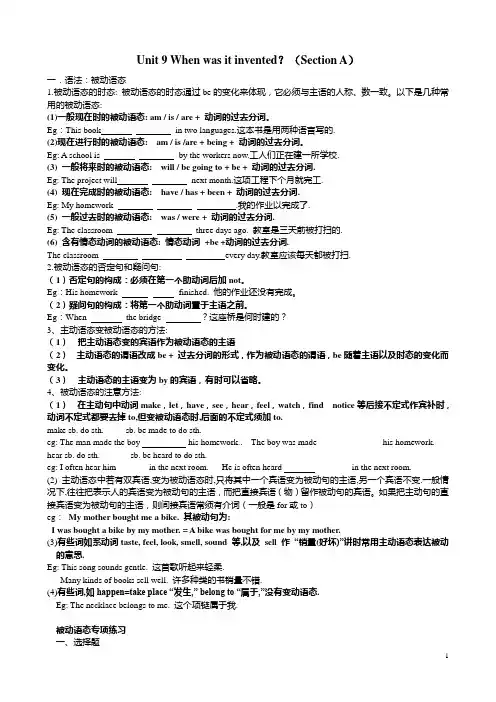
Unit 9 When was it invented?(Section A)一.语法:被动语态1.被动语态的时态: 被动语态的时态通过be的变化来体现,它必须与主语的人称、数一致。
以下是几种常用的被动语态:(1)一般现在时的被动语态: am / is / are + 动词的过去分词。
Eg:This book in two languages.这本书是用两种语言写的.(2)现在进行时的被动语态: am / is /are + being + 动词的过去分词。
Eg: A school is by the workers now.工人们正在建一所学校.(3) 一般将来时的被动语态: will / be going to + be + 动词的过去分词.Eg: The project will next month.这项工程下个月就完工.(4) 现在完成时的被动语态: have / has + been + 动词的过去分词.Eg: My homework .我的作业以完成了.(5) 一般过去时的被动语态: was / were + 动词的过去分词.Eg: The classroom three days ago. 教室是三天前被打扫的.(6) 含有情态动词的被动语态: 情态动词+be +动词的过去分词.The classroom every day.教室应该每天都被打扫.2.被动语态的否定句和疑问句:(1)否定句的构成:必须在第一个助动词后加not。
Eg:His homework finished. 他的作业还没有完成。
(2)疑问句的构成:将第一个助动词置于主语之前。
Eg:When the bridge ?这座桥是何时建的?3、主动语态变被动语态的方法:(1)把主动语态变的宾语作为被动语态的主语(2)主动语态的谓语改成be + 过去分词的形式,作为被动语态的谓语,be随着主语以及时态的变化而变化。
(3)主动语态的主语变为by的宾语,有时可以省略。
九年级英语unit9Whenwasitinvented课件人教新目标版(1)
A: When was … invented ? B: It was invented in… A: Who was … invented by? B: It was invented by…
Where did Edison invent the light bulbs? ---He invented them in America.
---Edison invented the light bulbs.
---The light bulbs were invented by Edison. (对划线部分提问!)
2 千年的读法
2000 2001
two thousand two thousand and one
3 前两个数字不为零,后两个数字为零。
1800 eighteen hundred 1900 nineteen hundred
4 非四位数的年份的读法!
531 five hundred and thirty-one
Alice: How about cars? I bet cars weren’t invented yet.
Woman: Sure they were. Cars were invented in 1885. My family had a car. I think you need to take a history class, Alice.
Woman: You are right. I didn’t have those things when I was young. But I do now!
初三英语教案Unit9 When was it invented

Unit 9 When was it invented?The First PeriodⅠ.Teaching Aims and Demands1.Knowledge Objects(1)Key Vocabulary invent(2)Target LanguageWhen was the telephone invented?I think it was invented in 1876.2.Ability Objects(1)Teach the students to use the new words.(2)Train the students to talk about the history of inventions.(3)Train the students’ listening and speaking skills with the target language.3.Moral ObjectsMany important inventions have changed the world a lot.Do you know the inventors of them? And when were they invented?Ⅱ.Teaching Key Points1.Key Vocabularyinvent2.T arget LanguageTalk about the history of inventions.Ⅲ.Teaching Difficult Points1.Train the students to talk about the history of inventions.2.Train the students to understand the target language in spoken conversation.Ⅳ.Teaching Methods1.Listening.2.Groupwork.3.Pairwork.Ⅴ.Teaching Aids1.A tape recorder.2.Some pictures or real objects of the inventions.Ⅵ.Teaching ProceduresStep I Revision1.Revise the language points in Unit 9.Ask some students to say something about Tina and the stories happened on April Fool’s Day.Encourage them to use the Past Perfect Tense.2.Check the homework by asking some students to share the sentences they made with the verbs with the class.Step Ⅱ1aThis activity reviews vocabulary and introduces new vocabulary which can be used to talk about inventions.Read the inventions to the students.Call the students’ attention to the five pictures, Tell the students that all of these things were invented in the last 150 years.Point to each picture and let the students tell what it is.Write the names of the five inventions on the blackboard.computer, car, calculator, telephone, TV setHave several different students guess and write the dates on the board.Ask the class to repeat the questions and answers like this.T: When was the computer invented?Class repeat.SS: When was the computer invented?T: Good.Now Tom, what is your guess?S1: 1965.T: OK.Tom, repeat after me.The computer was invented in 1965.T: Class, please repeat.SS: The computer was invented in 1965.Repeat the process with several different inventions.Tell the children that they will find out the real dates after they complete the lesson.After that, ask the students the questions below:Questions:1.Which one do you think is the oldest?2.Which one is the newest?3.Which one do you think is the oldest or the first invention?4.Which one is the newest or last invention?Ask different students to answer the questions.Have the students look at the example conversation in the box.Ask two students to read this conversation to the class.A: I think the telephone was invented before the car.B: Well, I think the telephone was invented after the car.Read the instructions again to the students.Remind them to remember the inventions from first to last.Then have the students talk about the five inventions in groups of four, using the sample conversation as a model.Ask several groups to tell the class their answers.The rest of the class listen to them and show they have different answers by raising their hands.In the next activity you will find out the real dates.Step Ⅲ1bThis activity gives students practice in understanding the target language in spoken conversation.Get the whole class to read the instruction together.Call the students’attention to the five inventions in the picture.Ask five students to say the names of them.Then ask them to see the five dates with a blank line in front of each.We’ll listen to a girl and a woman talking about the five inventions.They will talk about when they were invented.Listen carefully and match the inventions and the dates.Write the correct letter in front of each date as the sample given.Ask them to have a look at the sample answer.Tell them the answer in front of 1876 is d.That means that the telephone, which is letter d, was invented in 1876.Play the recording the first time.The students only listen and try to catch the main idea.Play the recording a second time.Let the students match the inventions and the dates.Check the answers by asking several to say the answers to the class.If some of the answers are hard to get for the children, tell them not to worry and they will make it next.Then play the recording again.Pause after each sentence and let the students repeat.For some difficult sentences, get the students to repeat several times.Be sure that they make everything clear.Answersd 1876 a 1885e 1927 c 1971 b 1976TapescriptGirl: Life must have been difficult when you were a kid.Woman: Oh; not really.Why do you say that?Girl: Well, you didn’t have many modern inventions.Like, you probably didn’t have a telephone, right?Woman: Of course we did! How old do you think I am? The telephone was invented in 1876.Girl: How about cars? I bet cars weren’t invented yet.Woman: Sure they were.Cars were invented in 1885.My family had a car.I think you need to take a history class, Alice.Girl: Ha, ha! Well, did you have a TV?Woman: No, we didn’t.The TV was invented around 1927, I think.Some friends of mine had one.But in those days, TVs were really expensive, and we couldn’t afford one.Girl: And I bet you didn’t have calculators and computers and stuff.That’s something I do know.We learned in school that hand-held calculators were invented in 1971 and personal computers were invented in 1976.Woman: You’re right.I didn’t have those things when I was young.But I do now!Step Ⅳ1cThis activity provides guided oral practice using the target language.Read the instructions and point to the list of dates in Activity 1b.You will be talking about the dates things were invented with a partner.Call the students’ attention to the example in the box.Ask a pair of the students to read this conversation to the class.SA: When was the telephone invented?SB: I think it was invented in 1876.Write the conversation on the blackboard.Then get the students to practice in pairs, using the information in Activity 1b.Tell them to do it like this:Student A, covers the dates.Students B, asks Student A when the things in the picture above were invented.Then change roles and practice again.Ask several pairs to share their conversations with the class.Step ⅤSummaryIn this class, we’ve learned to talk about the history of inventions with passive voice.We’ve also done some listening practice in understanding the target language in spoken conversation.And we’ve done much oral practice, using the target language.Step ⅥHomework1.Write out two conversations in Activity 1a.2.Write out two conversations in Activity 1c.Step ⅦBlackboard DesignUnit 10 When was it invented?Section AThe First Period1.The names of the five inventions:computer, car, calculator, telephone, TV set2.T arget language:A: When was the telephone invented?B: I think it was invented in 1876.。
Unit 9 When was it invented?说课稿
Unit 9 When was it invented?说课稿The First Period郭廷艳教学内容:新目标九年级Unit 9 When was it invented?第一课时(1a—2c)一、教材分析1.教材的地位和作用本节课是九年级《go for it》第九单元“When was it invented?”的第一课时。
本单元涉及内容是本书当中比较重要的一部分。
被动语态结构及运用是教学中一个难点和重点,也是学生比较不容易理解的部分,因为它是建立在各种时态之上的。
另外通过对我们熟悉的经常使用的发明物的历史来开阔眼界,丰富学生的阅历,使学生养成勤于思考,善于总结的好习惯。
2.教学目标1)知识目标扩充新单词,提高阅读能力。
理解和良好运用被动语态。
2)技能目标能谈论重要发明的历史及用途,能针对各项发明的用处及特点,发表自己的看法,并说明理由。
3)情感目标使学生懂得人类的科学发明创造了丰富的物质文明。
培养学生的创造发明的能力和愿望3.教学重点掌握一般过去时的被动语态4.教学难点弄清主动语态与被动语态的差异,通过练习和运用加以巩固二、学情分析1. 九年级学生的抽象能力较低,形象思维能力强。
但注意力容易分散。
本节课通过多媒体课件和教师亲和力的语言,增强兴趣和注意力。
2.初中生主要通过他人评价初步形成对自己的评价,所以很在乎他人的评价,同时自我意识不断增强。
因此在本课教学过程中,注意采用任务型教学为主,通过任务和不同的评价方式,提高学生参与意识。
3.九年级上学期学生有较明确的学习动机和态度。
本单元通过发明为载体,各种发明和发明家激励学生求知的欲望。
三、教法渗透1、教学设计思路与教材处理:《新目标英语》中的具体语言目标是通过各种各样的Tasks来实现的;学生需要运用具体而特定的行动来完成一定的交际任务。
因此本节课我将始终引导学生通过完成具体的任务活动来学习语言,让学生为了特定的学习目的去实施特定的语言行动,通过完成特定的交际任务来获得和积累相应的学习经验,让学生在用中学,在学中用。
九年级英语上册 UNIT9 When was it invented 人教新目标版
UNIT9 When was it invented?Outline:1.Analysis of teaching material2.Analysis of teaching methods3.Teaching procedures4.Teaching reflectionPart1 Analysis of the teaching material1. Status and function: This is the first part of Section B, it links the preceding with the following in Unit 9. Not only does it help the students review the food words and the Passive Voice they have learnt before, but also it helps them learn to describe different tastes and talk about the history of the invention. Such a topic is related to daily life, so it is helpful to inspire the students’ learning motivation and interest.2. Teaching aims and demandsKnowledge aims:☆The target words: crispy, salty, sour, chef, sprinkle, by mistake.☆The target language: Did you know potato chips were invented by mistake? Wow, I didn’t know that. Who invented them? ...etc.Ability aims:☆Be able to describe different tastes using the target words.☆Train the students’ listening, speaking, reading and writing skills with the target language.Moral aims:Cultivate the students’ ability of observation, imagination and their spirit of innovation.3. Teaching emphasis and difficulties:Important pointsThe target words and language.(According to the English syllabus and the language structures in this lesson.) Difficult points:The listening practice and correctly express the history of the invention. (According to the teaching prediction and the students’ cognitive level)Part 2 Analysis of teaching methods1. Teaching methods:“Task-based teaching method “with the help of useful situations to classify the tasks and give different students different evaluations.(To make language learning successful through a step-by-step progression that builds confidence and leads to open-ended activities.)2.Teaching aids:Multimedia puter, Tape recorder, PowerPoint.(According to the students’ psychological characteristics. They enjoy music, pictures and cartoons.)Part 3 Teaching proceduresStep 1 BrainstormingPlay guessing games: what inventions are they?One student es to the front to guess, the others describe an invention shown on the screen using the passive sentences: It’s used for… It was invented by…It was invented in…etc.Take turns to show ‘light bulb, alarm clock, microwave oven’with some other helpful pictures that center about them nearby on the screen.(Purpose of designing: To guide the students to review what they learned last lesson)Step 2 Leading-inT: The microwave oven reminds me of some delicious food. I will play a cartoon called “music food” My favorite food is in it. Try to guess what it is.Every time when they give a guess, I will express my like and dislike by using some adjectives like sweet, crispy, salty, sour . Make sure they know the meanings of them. For example:S:ChocolateT: It’s very crispy, but it’s too sweet. I don’t like it Can you guess the meaning of ‘crispy’? It describes food that is hard .dry and easily broken.S :Milk.T:I prefer sour milk to milk. Do you know ‘sour’? Oranges sometimes ta ste sour. S: Fish.T: yes! Fish is my favorite, and I especially like salty fish that is sprinkled with a lot of salt.During this course, write down the new words on the blackboard..Finally play a leading role to read them.(Purpose :To arouse the studen ts’ interest ,create useful situations for them to learn the new words. Prepare for the next step. )Step 3 PracticeTask One writing1a.Show four food pictures on the screen and get the students to describe how the food tastes and write them down.1b.Ask them to list the words of the food that has different tastes according to the headings on the screen as many as possible .sweet crispy salty sourThe teacher moves around the classroom to provide help for the students who have trouble in spelling some hard words and choose three students who write different words from one another.(Purpose: To practice using the target words and review the food words they have learnt before.)Task Two Speaking and actingGet the three students to the front, divide the class into four groups:Sweet Group , Crispy Group, Salty Group , Sour GroupGame begins: The three students read their words loudly in class one by one without repetition, the group members should stand up as soon as they hear a word that belongs to them. Call out the students who stood up by mistake and have them guess the meaning of ‘by mistake’.(Purpose: This is employed to show the words they wrote and link the target words with the food words, and get the whole class moving.)Step 4 PresentationT: Just now you mentioned many kinds of food, but do you know there are some interesting stories behind them. Here is one.Ask the students to look at the picture in 2a and imagine what they are talking about.S: They are talking about the story of potato chips.T: Right .Maybe on the bag it says the invention of them!(Purpose: Cultivate their ability of imagination and present the invention of potato chips.)Step5 PracticeTask One Listening and understanding2a. Let the students look through the six sentences in the box and get some information from them. Then play the tape recording twice for them to listen and circle T or F. Check the answers.(Purpose: To provide practice in listening and understanding the target language in spoken conversation.)Task Two Listening and writing2b. Before playing the recording, get the students to try to give answers by memory, or just by guessing. After a while, play the recording for them to fill in the missing words they hear. Then check the answers while concentrating on the new words: chef, sprinkle…on…(Purpose: To provide practice in understanding and writing the targetlanguage ,break through the difficult point.)Task Three Pairwork2c.Ask the students to make conversations using the information in 2a and 2b ,then ask some pairs to act them out. as follows:A: Did you know potato chips were invented by mistake?B: Wow, I didn’t know that. Who invented them?A: They were invented by a chef called George Crum.B: …(Purpose: Students are willing to show themselves and this task provides benefits for both more fluent and less fluent students to use the new language to talk with others and achieve the ability aim.)Task Four GroupworkT: Are you interested in the history of the sandwich?Show some pictures about the story of sandwiches on the screen, get them to discuss the history in groups of four as follows:Then each group choose a leader to give a report in class after that . (Purpose: This is employed to do further consolidation and extension using the target language, it also fosters a sense of cooperation in the classroom.)Step 6 HomeworkT: Think of a kind of food you like best and try an unusual way to cook at home and write your experience in your exercise book. And ask your parent to sign his/her name on your book.(Purpose: The new type of homework is employed to relate the knowledge that they learn from this lesson with the life realities, and achieve the moral aims.) Blackboard design:(Purpose: To show the language structures they mainly learn from this lesson.)Part 4 Teaching reflectionAccording to << English Course Standard >>,I bine different language structures and functions with different studying tasks. I put emphasis on raising the students’ interest, forming effective strategies and developing the cooperative spirit. And I think I’ll make it.This is a period of various contents, maybe the time of one class is not enough, I need to adjust the teaching steps according to the actual situations. And in 1b. of Step3,it requires the teacher to have a large vocabulary to provide help for students. One minute in class, ten years’ hard working after class—I need to hold on to studying to improve myself.。
Unit_9_When_was_it_invented教案
Unit 9 When was it invented?Section A 1a---1cⅠTeaching Ames and DemandsKnowledge Objects1.V ocabulary: invent calculator2.Target Language: When was it invented? It was invented in 1971.Ability Objects:1.Teach the students to use the new words.2.Train the students to narrate the history of the inventions by using The PassiveV oice.3.Train the students’ listening, speaking, reading and writing skills with the targetlanguage.ⅡTeaching Key Points1.Key V ocabulary: invent calculator2.Target Language: Talk about the history of the inventions.ⅢTeaching Difficult PointsUse The Passive V oice to narrate the history of the inventions.Remember the past participle.ⅣTeaching Methods:Task-based ApproachⅤTeaching ProceduresStep 1: GreetingsStep2: 1aShow the photos of Cai Lun and Edison to the students and teach “ invent/inventor/invention”.invent/inventor/invention 发明(动词)/发明家(名词)/发明(名词)E.g.Cai Lun invented paper.Paper is an invention.Cai Lun is an inventor.Ask Ss make sentences to describe Edison and bulb.Then teach “ was invented”.一般过去时的被动语态: was/were+过去分词,表示过去的被动的情况。
九年级英语全册 Unit 9 When was it invented(第1课时)教案 人教新目标版
Unit 9 When was it invented【教学目标】知识目标:1. 掌握以下词汇:invent, calculator, scoop, adjustable, heel, battery, operate, battery–operated, slipper, heat 2. 掌握并会运用下列重要短语和句型:be used for, adjustable heels, battery–operated slippers, the style of the shoes, electric slippers, see in the dark—When was it invented? —It was invented in 1885.—What are they used for? —They are used for seeing in the dark.—Who were they invented by? —They were invented by Julie Thompson.能力目标听:通过学习本课时的话题,能够听懂有关发明历史的对话。
说:能够准确的用英语谈论发明的历史。
读:能够准确的读出本课的句型及相关的对话。
写:能够利用被动语态造句。
情感目标:了解发明历史,增强科学意识。
【重点难点】重点:能熟练掌握本课时的词汇及句型。
难点:掌握一般过去时的被动语态。
【教学过程】I. Warm up教师活动:出示写有单词的卡片,让生试读,教师及时正音,强调发音规则。
听写单词:invent, calculator, scoop, adjustable, heel, battery, operate, battery–operated, slipper, heat 教师让2个同学在黑板听写,写完后让另外的2名同学来批改,其他的同学与同桌互批。
检查完单词后,教师要多鼓励学生,并结合学生出现的错误适当的讲解一些有规律性的单词记忆法。
九年级英语上册 Unit 9《When was it invented》教案 人教新目标版
Unit 9 When was it invented?Language goals:In this unit students learn to talk about the history of inventions.New languages:When was the car invented?It was invented in 1885.What are they used for?They are used for seeing in the darks.Who were they invented by?It was invented by Julie Thompson.Difficult points:1. In this unit, the structure: Passive voice (questions and statements)2. How to improve the students’ listening, reading and writing ability. Teaching aids:puter, video, recorderTeaching periods:Period 1: Section A 1a / 1b / 1c / 2a / 2b / 2cPeriod 2: Grammar focus / Section A 3a / 3b / 4Period 3: Section B 1a / 1b / 2a / 2b / 2c / Self check 1Period 4: Section B 3a / 3b / 3c / 4 / Self check 2Period 1Teaching aims:1. Teach vocabulary words.2. Target languages:When was the car invented?It was invented in 1885.What are they used for?They are used for seeing in the darks.Who were they invented by?It was invented by Julie Thompson.3. Listen, talk and read about the inventions.4. Train the speaking and listening abilities.Teaching procedures:Step 1. Lead-inAsk students “Who has a mobile phone / bike? Does your family has a car / TV / puter…?” Watch the video and tell students these things were called inventions when they were first made. They are very useful inventions. They can make our life easier. Do you know any other inventions? List them on the paper.Step 2. PresentationAsk “When was the telephone invented?”“The telephone was invented in1876.”Get the students repeat the sentences several times. While students are repeating the sentences, the teacher writes down “When was / were …invented? It / They was / were invented in…”Watch the video. Look at some pictures and practice the similar dialogues.Explain “be +Past Participle” express Passive voice (Show a slide)e.g. English is spoken around the world.A bridge was built last year.Step 3. Section A 1a GroupworkShow a slide.1. Point to the pictures and ask students to say what they are—a puter, acar, a telephone, a TV and a calculator.2. Ask “Which one is the newest? Which one do you think is the oldest?”3. Discuss in groups and Number them 1-5.4. Check the answers.Step 4. Section A 1bThis activity gives students practice in understanding the target language in spoken conversation. Show a slide.1. Look at the pictures and the dates. You will hear a conversation betweena girl and a woman.2. Listen carefully and match the inventions and the dates.3. Listen again until students can catch it.4. Check the answers.Step 5. Section A 1c Pair workThis activity provides guided oral practice using the target language.1. Watch the video and call attention to the conversation. Ask two students to read it.2. Work in pairs. Look at 1b. Student A cover the dates. Student B, ask studentA when the things in the picture were invented. Then change roles andpractice again.3. Ask students to make similar dialogues using the things around them. Step 6. Section A 2a / 2b1. Show a slide with some inventions on it. Teach the vocabulary words. Readthem again and again and try to grasp them.2. Show another slide. Look at the picture. Here are the three inventions.You will hear a conversation between a girl and a boy. Listen and numberthe inventions in the order that you hear them.3. Listen carefully again and check up their answers.4. Ask a student say out his / her answer.5. The teacher shows the correct answers.6. Then show another slide. Look at the chart. It shows the people who inventedthese things and what they are used for. Listen to the recording again andmatch the items in column A, B and C.7. Play the tape many times until the students catch it. Then check the answers.8. Look at the tapescript and read the conversation aloud in pairs again and again.9. Explain the language points.e.g. Who was it invented?It was invented by…What is it used for?It is used for doing…Step 7. Section A 2c Pair workThis activity provides guided oral practice using the target language.1. Call attention to the sample conversation and ask two students to read it aloud.2. Role play the conversations using the information in the chart in 2b. Watchthe video and practice like this:What is it?It is a telephone.When was it invented?It was invented in 1876.Who was it invented by?It was invented by Alexander Bill.What is it used for?It is used for talking to people in other towns.Step 8. Conclusion1. Learn and master the vocabulary words.2. Master the target languages.When was the car invented?It was invented in 1885.What are they used for?They are used for seeing in the darks.Who were they invented by?It was invented by Julie Thompson.Homework:Find out an invention that you think is the most important. Write a short passage about it including the date, thepeople who invented it and what it is used for.Period 2Teaching aims:1. Learn to use Passive voice (questions and statements).2. Master some vocabulary words and target language.What do you think is the most helpful invention?I think the most helpful invention is the light bulb.I’d like to have a radio because I could listen to music all day.3. Train the speaking abilities by talking about more inventions.Teaching procedures:Step 1. Warming upWatch the video. Show some pictures about inventions such as puter, telephone, car, TV, calculator… Ask the students to practice speaking.A: When was…invented?B: It was invented in…A: Who was it invented by?B: It was invented by…A: What is used for?B: It is used for…Step 2. Lead-inWe have known some important inventions. Do you know any other helpful inventions or annoying ones? For example: A vacuum cleaner is helpful. A very loud truck is annoying. Show a slide to explain the language points. Step 3. Section A3a Pairwork1. Watch the video. Look at the pictures. There are some inventions (alarmclock, light club, microwave oven, tea, etc) . Ask students read themloudly.2. Ask students the following questions.T: Is the light club useful or annoying?S: I think it’s useful.T: Why is it?S: Well, it gives people more time to work and play every day.3. Ask the students to make a list of five helpful inventions and five annoyinginventions on their own, move around the room to offer help as needed.4. Let the students who would like to share their answers to read to the classand tell the reason.e.g. The alarm clock is an useful invention, I think. Because it alwayswake me up on time.Step4. Pairwork Section A3b1. Watch the video. Call attention to the conversation. Ask two students toread the conversation.2. Ask the students to work in pairs the following talk using the target language.Step5.GroupworkWatch the video. There is a picture. Imagine that you are alone on a tiny island. Chose five inventions you would like to have on the island with you.Tell the group what you chose and why. Then you can write it down using the following on the slide:I think the most helpful invention is…I’d like to have a… because I could…It’s used for…I also want a… because it…Step 6. PracticeDeal with some exercises about the grammar on the video.Step 7. Conclusion1. Master the target languages:What do you think is the most helpful invention?I’d like to have a radio because I could listen to music.2. Talk about helpful or annoying inventions.Homework:Continue finding out some useful and annoying inventions.Preview Section B 1a / 1b.Period 3Teaching aims:1. Strengthen the target language and practice more.2. Train the speaking and listening abilities.3. Describe some inventions.Teaching procedures:Step 1. Warming upHave a free talk. Ask the students to practice talking to each other.A: What do you think is the most helpful invention?B: I think the most helpful invention is…A: Why do you think so?B: Well, it gives me…Step 2. SectionB1a / 1bThis activity introduces new vocabulary.1. Read the four words and ask students to repeat them. Give them a minuteto read and write the words. Then tell the students they are adjectivesand they are used for describing things. For example: The apple is sweetand sour. Ask students to give some examples with the other words.2. Watch the video and tell what they are. (potato chips, lemon, ice cream, tea)3. Get the students to describe the things with the given adjectives. Somefood have more than one word.4. Check the answers.Say “What kind of food and drink do you like best?”Ask several studentsto write down on the blackboard.5. Such as: chocolate, oranges, banana, apple, salad, popcorn, orange juice and so on.6. Then ask the students to describe how food taste and finish 1b.Step 3. Section B 2a / 2bBrainstorm before listening. First, let students describe how potato chips taste and describe how helpful the potato to chips. Then ask: When and where were potato chips invented? Who were potato chips invented by? How were potato chips invented? Do you want to know?1. Say: You will hear a story about the invention of the potato chips.2. Watch the video. Ask the students to read the sentences and tell the classChinese meanings.3. Play the recording for the first time. Students only listen.4. Play the recording for a second time. Students circle T or F.5. If students can’t catch it, the teacher should play the tape some moretimes until thestudents finish the task.6. Check the answers.7. Watch the video. It shows the history of chips. Listen to the recordingagain and plete the sentences.8. Check the answers.9. Look at the tapescript and read it again and again.10. Watch the video and explain some language points.Step 4. 2c PairworkThis activity provides guided oral practice using the target language.Ask the students work in pairs. Role play the conversation about the invention of the potato chip. Use the information in 2b.e.g. A: Did you know potato chips were invented by mistake?B: Wow, I didn’t know that. Who invented them?A: They were invented by…B: When were they invented?A: They were invented in…B: How were they invented…C: …Step 5. PracticeFinish the exercises on the video in class. (workbook p85 3)Step 6. ConclusionLearn to describe how food taste.Learn some new vocabulary words.Improve speaking and listening abilities.Homework:Write a short passage about the history of an invention you think the most helpful. Preview Section B 3a / 3b / 3c / Self check.Period 4Teaching aims:1. Learn some new vocabulary words.2. Read about tea and know something about it.3. Train the reading and writing abilities.Teaching procedures:Step 1. Warming-upHave a free talk about some inventions.What do you think is the most helpful invention?When was it invented?Who was it invented by?What is it used for?How was it invented?Step2.Lead-inSay: Do you like drinking tea? Tea is a very healthy drink. Watch the video.There are different kinds of tea. Do you know who invented tea? When wastea invented? And how was tea invented?Step3.Reading Section 3a1. Show a picture. Look at the picture. Say: Who was the man? What was hedoing? What happened while he was doing this. Read the article byyourselves and answer the questions on the video. They can discuss ingroups.2. Ask several students to read their answers.3. Check the answers.4. Read the article again and discuss the difficulties in groups.5. Watch the video and explain some language points.6. Read the article again and again and try to retell it.Step5.Task 1 4a1. Say: We all have things that we don’t liking doing. Why not think ofan invention that could help you?2. Watch the video. For example, many students don’t like writing tests.You can invent a pen that listens and writes. It can be used for listeningand writing instead of you. The price should not be too high. It can be100 yuan each.3. Discuss in groups what they don’t like doing. Then think of an inventionthat could help them.4. After five minutes, ask several groups to tell the class their inventions. Step 6. Task 2 4bSay: Imagine you are a businessman. Work in pairs to ask your partner questions about his / her invention. Then try to sell your partner’sinvention to the class.e.g. This special pen was invented by…It has three colors and it is usedfor listening and writing English tests instead of you. And it is quitecheap—100 yuan each. Who wants to buy one?Step9.PracticeDeal with some exercises to consolidate the knowledge learned in this unit on the video in class.Homework:Review the whole unit and preview the reading.Period 5Teaching aims:Learn some new vocabulary words.Know about the history of basketball.Learn how to improve reading ability.Teaching procedures:Step 1. Before you readSay: Do you like doing sports? How many kinds of sports do you know?1. Watch the video. Look at some pictures. There are so many kinds of sports.People like sports because it can keep them fit and make them relaxing.Discuss in pairs. List eight sports played in China. And fill in the chart.2. After a while, ask students to read their answers.Such as: table tennis, tennis, basketball, football, volleyball, running,jumping, swimming, etc.3. Say: Do you think which sport is the most popular? And which one do youthink is less popular? Ask students to rank the sports they listed on orderof popularity. Students should be allowed to differ in opinion, based ontheir own knowledge. When finished, the different results should be shared,to find out which sports are considered the three most popular.Step 2. While you readSay: I think basketball is one of the most popular sports in China. I believe most students like playing basketball, too. Show a picture of Yao Ming. Ask: Do you know him? He is Yao Ming. And Yao Ming is known as a national hero by all the Chinese people. He is the pride of China. I think more and more people like playing basketball because of Yao Ming. But do you know who invented basketball? When was it invented? And how was it invented? Read the article alone, move around the room offering some help about pronunciation and grammar as needed. Find out the phrases. (Show a slide) Then learn them by heart.Step 3. After you read1. Watch the video. plete the mind-map with information from the reading.They can discuss in groups. Then check the answers.2. Without reading the article again, use what you remember from the mind-mapto answer the following questions. (Show a slide)(1) Who invented basketball?(2) Why were the Berlin Olympics important for basketball?(3) What is the aim of basketball?(4) Name a professional basketball organization in America.Step 4. Go For It!Say: Do you like playing basketball? Do you want to be a professional basketball player like Yao Ming? And would you like to play on China’s national basketball team one day? Is it good to be a basketball player? And there must be some difficult things. Discuss in groups to make a list of goodthings and difficult things about being a basketball players. Fill in the chart.(Show a slide)Step 5. ConclusionLearn some vocabulary words and some useful expressions.Improve the reading ability.Know something about basketball.Homework:In pairs, choose an invention and do research on it. Make a mind-map of the information you find. Then write a short passage about it.。