
2014牛津译林版七年级上Unit4Mydaygrammar
2014牛津译林版七年级上Unit4 My day grammar
On Thursday, I will go to Kitty’s flat ____ in the evening. Amy’s birthday is ___ on 2nd
November so we will have a big party. It is
Eddie’s birthday ____ on Saturday. I will take
never ______ seldom _______
_________
0%
20%
sometimes often _______
40%
60% 80% 100%
usually _______
________
always
将左栏中的百分数和右栏中相应的频率副 词对应起来. E 1 . 100% A. sometimes D 2. 80% B. seldom F 3. 60% C. never A 4. 40% D. usually B 5. 20% E. always C 6. o% F. often
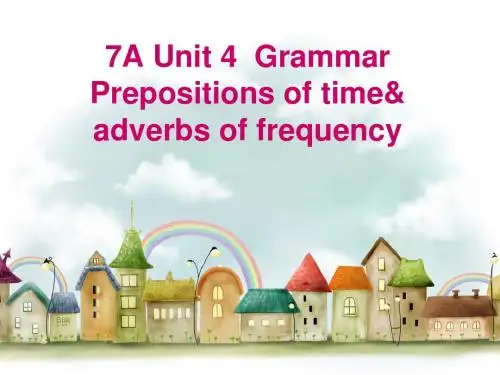
7A Unit 4 Grammar Prepositions of time& adverbs of frequency
in
seasons
spring
summer
autumn
winter
Months January February March April May June July August September October November December
this afternoon.
I always take Eddie for a walk ____ in the evening. in October. We have a long holiday ____
牛津译林版英语七上Unit4《Myday》(Grammar)说课稿
牛津译林版英语七上Unit 4《My day》(Grammar)说课稿一. 教材分析《牛津译林版英语七上Unit 4 My day》主要讲述了日常生活中的活动安排和描述。
通过本单元的学习,学生能够掌握一般现在时态的运用,学会如何用英语描述自己的日常活动。
本单元的核心语法是一般现在时,学生需要掌握其构成、用法以及与一般过去时和一般将来时的区别。
二. 学情分析七年级的学生已经初步掌握了英语的基础知识,具备一定的听、说、读、写能力。
但在此阶段,学生对英语的语法知识掌握还不够深入,需要通过大量的练习来巩固。
此外,学生的学习兴趣和积极性对英语学习成果有很大影响,因此,激发学生的学习兴趣和动机是本节课的重要任务。
三. 说教学目标1.知识目标:学生能够掌握一般现在时的构成、用法,学会用英语描述自己的日常活动。
2.能力目标:学生能够在实际情景中运用一般现在时,提高英语表达能力。
3.情感目标:培养学生热爱生活、积极向上的生活态度,增强同学间的友谊。
四. 说教学重难点1.教学重点:一般现在时的构成、用法以及与一般过去时、一般将来时的区别。
2.教学难点:一般现在时的运用,特别是在具体情境中的运用。
五. 说教学方法与手段本节课采用任务型教学法,通过各种互动活动,让学生在实际操作中掌握一般现在时的用法。
同时,运用多媒体手段,如图片、视频等,辅助教学,提高学生的学习兴趣。
六. 说教学过程1.导入:以一幅描绘日常活动的图片引导学生进行观察,激发学生对课程的兴趣。
2.呈现:通过展示一段视频,让学生了解一般现在时的用法,同时引入本节课的主题。
3.操练:设计各种任务,让学生在实际操作中运用一般现在时,如描述自己的日常活动、编写对话等。
4.巩固:通过小组活动,让学生在互动中进一步巩固一般现在时的用法。
5.拓展:引导学生运用一般现在时描述未来的计划,培养学生的创新思维。
6.总结:对本节课的内容进行归纳总结,强调一般现在时的用法。
7.作业:布置相关练习,让学生课后巩固所学知识。
译林牛津版七年级上册英语 Unit 4 My day 课时4 Grammar 授课课件
单元语法知识梳理
2. 频率副词常放在be动词、情态动词或助动词之后, 实 义动词之前。
eg:Hesometimesgoestoschoolbytaxi. 他有时乘出租车上学。 3. 对频率提问常用howoften(多久一次)。 eg:—Howoftendoyouexercise? 你多久锻炼一次? —Iexerciseveryoften. 我经常锻炼。
12. ChildreninChinastartschooalt
6yearsold.
13. WehaveP. E. classes
MondaatyandThursday.
Butwedon'thaveanylessons on SaturdayorSunday.
14. Theyalwayshavefun
【点拨】句意:——Mary将要飞往哪里?——她马上要飞 去法国。她将在7月2日早上到达巴黎。arrivein+大地点 (一般为:Beijing, Shanghai等), arriveat+小地点(一般为: school, park等), Paris“巴黎”是大地点, 故第一空为介词in; 第二空表示在“具体的某一天的上午”用介词on。
单元语法知识梳理
2. (1)表示“在具体的某一天”或“在具体某一天的上午、下午、 晚上”或morning, afternoon, evening前有修饰语时要用介词on。
eg:onSunday在星期天; onTuesdayevening在星期二晚上; onawarmafternoon在一个温暖的下午 (2)特殊的节日前面用on。 eg:onChildren'sDay; onChristmasDay(注:atChristmas)
【点拨】句意为:——你多久去看一次电影?— —一月一次。howlong多久, 提问时间;howfar多 远, 提问距离;howoften多久一次, 提问频率; howmuch多少, 用于询问不可数名词的量, 价格等。
新译林牛津版初中英语七年级上册Unit 4 My DayGrammar优质课公开课教案
My Day【板块要点】一、教学目标1、用正确的介词来表达时间2、正确识别并使用频度副词二、教学重点、难点1、时间介词。
2、频度副词。
三、词汇、短语三、句型(语法)1.时间介词:in: (1).在一天中的某个时间段,如:in the morning(afternoon, evening, night), in the middle of the day(2)较大的时间概念,星期,月份,季节,年份,世纪等。
如:in January/ in summer/ in 1995/ in the 21st centuryon: 在具体某一天或某一天的某个时候或节日。
on Wednesday (afternoon) on the morning of October 24, 2012on October 24, 2012 on Children’s Dayat: 点钟,三餐,周末,没有day 的节日,年龄at 6 o’clock / at noon / at night / at lunch(time)at the weekend (at weekends) at Christmas at 6 years old (at the age of 6)2.频度副词:always, usually, often, sometimes, seldom, never,对它们进行提问时用how often,对表示频率的短语,如:twice a week,every day(week,…)提问,也用how often. 但仅仅对次数提问,用how many times如:你每周去读书俱乐部几次啊?两次。
_________ _________ do you go to the Reading Club ? Twice a week.________ ________ _________a week do you go to the Reading Club ? Twice.He sometimes goes swimming.(划线提问)_______ _______ _______ he ______ swimming?附:once一次twice两次three times 三次三次和三次以上用times表示。
牛津译林七年级英语上册Unit 4 My day Grammr 课件(24张PPT)
in the first week of this term 这学期的第一周
on: we use ‘on’ before:_d_a_y_s_, _sp__e_c_ia_l_d__a_y_s, _sp__e_c_ia_l_h__o_li_d_a_y_s___, _d_a_t_e_s___.
比较下列句子 :
1. He goes swimming four times a day. How often does he go swimming?
2. He goes swimming four times a day. How many times does he go swimming a day?
day. She _a_l_w_a_y_s_ dances for half an
hour.
6) Millie _s_o_m__e_ti_m__esgoes roller skating, but
she’s not good at it.
We put an adverb of frequency before a verb except when it is the verb ‘to be’.
Homework
n this
lesson. 2. Finish all the exercises about
1、书籍是朋友,虽然没有热情,但是非常忠实。2022年4月22日星期五2022/4/222022/4/222022/4/22 2、科学的灵感,决不是坐等可以等来的。如果说,科学上的发现有什么偶然的机遇的话,那么这种‘偶然的机遇’只能给那些学有素养的人,给那些善于 独立思考的人,给那些具有锲而不舍的人。2022年4月2022/4/222022/4/222022/4/224/22/2022 3、书籍—通过心灵观察世界的窗口.住宅里没有书,犹如房间里没有窗户。2022/4/222022/4/22April 22, 2022
2014牛津译林版七年级上 Unit4 My day Grammar课件
Tuesday Thursday
Saturday
Wednesday
Friday
Sunday
Can you say the names of 12 months ? 12个月的名称 What are they?
12 months in a year
January February
April July October
时间介词 in: 用在: 月份前 1. ______ 2. 3 年份前 _______
in in
October 2012 sp_________ in
4 早中晚前 _____
Fill in the blanks with “in”, “on” and “at”. on 1. Christmas Day is _________ 25 December. 2. The new school term begins ________ September. in 3. Uncle Bob visits his relatives _____ on Thanksgiving Day. 4. David and his friends practise football ______ on Sunday. 5. Tommy wants to go to see the film ______ at 6 p.m. this evening. on 6. They often go swimming ______ Friday afternoon. 7. We have a long holiday _______ summer. in in 8. My grandma likes to watch TV ____the afternoon. 9. The little boy can tell stories______ at the age of 3. in 10.I do not think the world will come to an end ____2012.
牛津译林版七年级上册 Unit 4 My day 课时4 (Grammar)教案
牛津译林版七年级上册Unit 4 My day 课时4 (Grammar)教案(7A U4) My Day Grammar-----Prepositions of TimeAnalysis of teaching material:This is grammar part of unit 4. The lesson focuses on the preposition of time including in on at. These three prepositions of time are closely related to students’ real life and in accord with students’ cognitive level, thus helping students master the usage of prepositions could make students know how to use these prepositions of time correctly and build the confidence of English learning.Analysis of students:The objects of this lesson are students in Grade 7. Students in this level has already learned a little about the prepositions of time, thus they have the ability to learn the prepositions better and more clearly. However, our students don’t know when to use it clearly. Therefore, it requires teachers to set up the tasks from easy to the advanced to guide them.Teaching aims:1.Aims of knowledgeMaster the usage of prepositions of time2.Aims of abilityBe able to use prepositions to talk about their daily life with classmates. Be able to know the differences among these three prepositonsBe able to write an article with prepositions of time correctly.3.Aims of emotionRaise the awareness of interculture.Build confidence towards English grammar.Be active and cooperative in team work4.Aims of strategyMaster some methods of team learning.Conclude the rules from exercises by themselvesTeaching key points:Master the usage of prepositons of time including in on atTeaching difficult points:Some special usage of three prepositions such as we use on when the morning、afternoon、evening with specific adjective; we don’t use preposition if there is next, last and so on before timeTeaching method:1.Task-based teaching method2.Natural approachmunicative language teaching methodputer-assisted instructionTeaching aids:1.Text book2.Power point3.Listening recordingTeaching Procedures:Steps Time Teacher’s activity Students’ activity PurposeStep 1 Lead-in 3 mins show a short video talk about Halloween Enjoy a short video Talk about Halloween To learn something about interculture To be prepared for the classStep2 presentation 10 mins Activity1:(4mins) 1.Text reading and pay attention to the prepositions of time Read the text and then answer questions with in on at To develop general sense of prepositions Activity 2:(6mins) give some examples and make students work out the rules about in on at by team work Talk about rules with classmates To develop general sense of prepositions To develop their team spirits Step3 Practice 20 mins Activity3:(3min) Show some exercise Fill in the blanks with preposition To help Ss consolidate the knowledge of prepositonsActivity4:(6mins) complete the e-mails by listening Listen to the tape and complete the e-mail To improve student’s ability of listeningActivity5: (3mins) fill in the blanks Talk with classmates about the differences in prepositons used before festivals To help students know the differences between on &at used before festivalsActivity6:(3mins) brainstorm Think about more festivals with day, the more the better To encourage students to take part in class and remember the rulesActivity7:(3mins) .make a choice Choose the best answer To help students know that we use on beforeActivity8:(2mins) translation Translate the sentences To help students know that we don’t when we don’t use prepositonsStep4 summary&Homework 7 mins Activity 9: describe the pictures Activity 10: make an interview Assign homework:1.Revise the rules of prepositions of time. 2. Describe your daily life with “in”, “on” and “at.”1.describe the pictures with prepositions2. use the prepositions to make an interview3.reviese the prepositions afterschool To guide Ss use the prepositions correctly and relate the grammar to their lifeTeaching reflection。
牛津译林版英语7A Unit4 My day Grammar课件
3. Tom _____ to work by bicycle. A. sometimes go B. go sometimes C. sometimes goes D. goes sometimes
0% 20% 40% 60% 80% 100%
频度副词 (频率由高到低): always (总是) usually(通常) often (经常) sometimes(有时) seldom(很少) never(从不)
seldom sometimes
often
usually never
always
观察Mary的一周活动表,用适当的频率副词填空:
Thank you !
•不习惯读书进修的人,常会自满于现状,觉得再没有什么事情需要学习,于是他们不进则退。经验丰富的人读书用两只眼睛,一只眼睛看到纸面上的话,另 一眼睛看到纸的背面。2022年4月11日星期一2022/4/112022/4/112022/4/11 •书籍是屹立在时间的汪洋大海中的灯塔。2022年4月2022/4/112022/4/112022/4/114/11/2022 •正确的略读可使人用很少的时间接触大量的文献,并挑选出有意义的部分。2022/4/112022/4/11April 11, 2022 •书籍是屹立在时间的汪洋大海中的灯塔。
七年级上Unit4 Gammar
Prepositions of time表示时间的介词 /prepə'zɪʃ(ə)n/
in
on
at
11 12 1
最新牛津译林版中学七年级英语上册《Unit 4 My day Grammar》教案
《Unit 4 My day Grammar》教案Teaching aims 1,to use different prepositions to talk about time. A级2,to understand and use the Adverbs of frequency. B级Importance1 new words and expressions:Would like all the best life A级2,to use different prepositions to talk about time.A级3,to understand and use the Adverbs of frequency.B级Difficulties1,to use different prepositions to talk about time.2,to understand and use the Adverbs of frequency.Teaching proceduresStep1 presentatio n1, T:What time do you go to school everyday?On What days do you usually have your history lessons?When do you usually have your Chinese lessons? Write the answers on the blackboard:I go to school at 7 o'clock.We have our history lessons on Monday and Frida y.We usually have Chinese lessons in the morning.We use different prepositions to talk about time.2,let Ss think of more usage of"at on i n"3,Let Ss read the table in Part A.then tell the ways of using"at on in"4,Let Ss read the examples together.Step2practise1,communicate with Ss(1)When is Children's Day?(2)What season is it in?(3) What do you do on that day?(4)When do you eat a birthday cak e?(5)When do you usually chat with your classmates?(6)How old do children in your city start learning English?(7)When do you do your morning exercises?2 ,let Ss finish t he exercise.(1)Eric's birthday is ___6 December.(2)The Open Day is ____ Tuesday.(3)I want to play tennis with Simon ____three o'clock ____the afternoon.(4)We have a long holiday ____October.(5)I hope my dream can come true ____25.3,Let Ss finish the E-mail on P 474,Let Ss read the E-mail ,Then check the answers together.5 ,Let Ss read the E-mail together.S tep3 presentation1 Communicate with SsT:Tommy and Millie often chat with each other on the internet.Do you often chat on the Internet?How often do you write e-mails?S:...T:Oh, you chat with your friends on the internet everyday.So you always chat with your friends...\T:Adverbs of frequency tell you how often things happen.2.Let Ss read the picture of Part B ,and work out the rul e:Always-usually-often-sometimes-seldom-neverStep4 practiceLet Ss finish the exercise on P 48Let Ss read it together .and remind them of the adverbs .Step5 ActivityI'll give you some minutes to prepare the conversation about your own day.You can talk about your school day and your daily activities.Pay attention to use the correct prepositions of time and adverbs of frequency.分层效果检测题必做题A层一、用on, in和at填空。
牛津译林版七年级英语上册教案:Unit 4 My day Grammar
课题Unit4 Grammar教学目标能掌握冠词的用法。
能运用方位介词来表达物体的位置。
教学重难点能掌握冠词的用法。
能运用方位介词来表达物体的位置。
课前准备录音机多媒体教师活动内容、方式学生活动内容、方式二次备课Check pre-exerciseA Using a, an and theStep 1. Free talkWhat’s this?It’s a book.Whose book is I It’s…’s.Write the sentences on the blackboard:It’s a book. The book is…’s.Make sentenceseg: This is an apple. The apple is big and red.Step2.PresentationWe use a or an when we mention a person or thing for the first time. We use the before a noun when the person or thing is mentioned again, or when we are talking about a specific person or thing. PracticeWhat’s this? It’s a book.Whose book is it?It’s …’s.Show some pictures and ask students to say something about the pictures:This is a Panda House. We can see some pandas.Look, here is a panda. The panda is eating bamboo.Here’s a panda too. What’s the panda doing?(The panda is lying on the grass.)Here is a baby panda. How cute! It’s so small. But the baby panda doesn’t look like its mother.Step3. PracticePair work .Have a free talk with your partner,try to use a, an and the.Finish these sentences with “a, an, the”.complete text book Page 47: Fun in the zooRead and act out the conversation.B Prepositions of placeStep 1.Presentation1.Introduce some prepositions of place.Eg: I often stand in front of you. Where is … sit?She sits between A and B. She sits in front of C,and C sits behind her.2. Ask and answer, try to make students answer with “inside , outside, beside, next to, left and right”.3. Teacher says: Look, we have some lights. The lights are above us. We have some books here. The books are on the teacher’s desk. We have a national flag. It’s over the blackboard.(Make sure that students can use these words correctly.) Look, here ‘s a panda. The panda is eating bamboo.Look, this is an elephant. The elephant is standing under the tree.Practice it Learn the rules Practice:I often stand in front of you. Where does … sit?She sits between A and B.She sits in front of C,and C sits behind her.4.Read the sentences on Page 48. Then make a simple dialogue to tell other students where you sit.S1: Where do you sit?S2: I sit in front of…/ I sit between…and/… I sit next to…S1: I sit beside…/ I sit behind…Step 2.practiceIn the parkSandy goes to the park every weekend. Look at the picture and tell me what you can see in it.Group work: say something about the picture.Make a conversationT:Where’s the lake?S: It’s beside a football field.T: What are the two boys doing on the lake?S: They’re rowing a boat.T: Where’s a bird singing?S: The bird is singing in the left tree.Complete the article on Page 48.Check the answers. Then read the article.Step 3.Homework1.完成课课练的相关练习。