
人教版八年级下英语Unit 1 --2单元知识总结
1 Unit 1 What's the matter?
重点词汇
词性 单词
名词n. matter(问题;事情),stomachache(胃痛;腹痛),foot(脚;足),neck(颈;脖子),stomach(胃;腹部),throat(咽喉;喉咙),fever(发烧),rest(放松;休息),cough(咳嗽),Xray(X射线;X光),toothache(牙痛),headache(头痛),break(间歇;休息),passenger(乘客;旅客),trouble(问题;苦恼),bandage(绷带),knee(膝;膝盖),
名词n.
nosebleed(鼻出血),climber(登山者;攀登者),risk(危险;风险;冒险),accident((交通)事故;意外遭遇),situation(情况;状况),kilo(千克;公斤),rock(岩石),knife(刀),blood(血),importance(重要性;重要),decision(决定;抉择),control(限制;约束;管理),spirit(勇气;意志),death(死;死亡),nurse(护士)
形容词
adj. sore(疼痛的;酸痛的),sick(生病的;有病的),sunburned(晒伤的)
动词v. lie(躺;平躺),rest(放松;休息),cough(咳嗽),hurt((使)疼痛;受伤),hit((用手或器具)击;打),bandage(用绷带包扎),press(压;挤;按),breathe(呼吸),risk(危险;风险;冒险),mean(意思是;打算;意欲),control(限制;约束;管理)
副词adv. off(离开(某处);不工作;从……去掉) 2 介词
prep. off(离开(某处);不工作;从……去掉),onto(向;朝)
代词pron. herself(她自己),ourselves(我们自己)
重点短语
Section A
1.have a cold/fever/cough 感冒/发烧/咳嗽
2.have a stomachache/headache/toothache 胃痛/头痛/牙痛
3.have a sore back/throat 背痛/喉咙痛
4.too much 太多(后接不可数名词)
5.lie down 躺下
6.see a dentist 看牙医
7.get an Xray 拍X光
8.take one's temperature 量某人的体温
9.take breaks/a break 休息
10.go to a doctor 看医生
11.get off 下车
12.have a heart problem 有心脏病
13.to one's surprise 令某人惊讶的是
14.agree to do sth.同意做某事
15.thanks to多亏;由于 3 16.in time及时
17.think about 考虑;思考
18.right away 立即;马上
19.get into trouble 陷入麻烦
20.fall down 摔倒;跌倒
Section B
21.have a nosebleed 流鼻血
22.have problems doing sth.做某事有困难
23.get sunburned 被晒伤
24.be interested in 对……感兴趣
25.be used to doing sth.习惯做某事
26.take risks/a risk 冒险
27.lose one's life 失去生命
28.because of 因为;由于
29.by oneself 独自;单独
30.run out (of) 用尽;耗光
31.save one's life 拯救某人的生命
32.cut off 切除
33.so that 以便;为的是
34.get out of 离开;从……出来
35.the importance of ……的重要性 4 36.make decisions/a decision 做决定
37.so...that... 如此……以至于……
38.give up 放弃
重点句型
1.What's the matter (with sb.)? (某人)怎么了?
2.What's wrong (with sb.)? (某人)怎么了?
3.What should sb.do? 某人该做什么?
4.You should drink more water.你应该多喝点儿水。
5.He shouldn't eat so much next time.他下次不该吃这么多。
6.—Should I take some medicine? 我应该吃一些药吗?
—Yes, you should./No, you shouldn't.是的,你应该。/不,你不应该。
名言警句
1.An apple a day keeps the doctor away.一日一苹果,医生远离我。
2.Early to bed and early to rise, makes a man healthy, wealthy
and wise.(Benjamin Franklin, American President) 早睡早起会使人健康、富有和聪明。(本杰明·富兰克林,美国总统)
3.The first wealth is health.(Ralph Waldo Emerson, American 5 thinker)健康是人生的第一财富。 (爱默生·R·W,美国思想家)
4.Happiness lies first of all in health.幸福首先在于健康。
5.Health is not valued till sickness comes.病时方知健康可贵。
Unit 2 I'll help to clean up the city parks.
重点词汇
词性 单词
动词v. cheer(欢呼;喝彩),volunteer(义务做;自愿做),notice(注意到;意识到),raise(募集;征集),repair(修理;修补),fix(修理;安装),imagine(想象;设想),open(开;打开),carry(拿;提;扛),train(训练;培训),understand(理解;领会),change(改变;变化),interest(使感兴趣;使关注)
名词n. volunteer(志愿者),sign(标志;信号),notice(通知;通告;注意),feeling(感觉;感触),satisfaction(满足;满意),joy(高兴;愉快),owner(物主;主人),journey((尤指长途)旅行;行程),midnight(午夜;子夜),wheel(车轮;轮子),letter(信;函),Miss(女士;小姐),difficulty(困难;难题),door(门),training(训练;培训),kindness(仁慈;善良),change(改变;变化),interest(兴趣;关注),sir(先生),madam(夫人;女士)
形容词
adj. lonely(孤独的;寂寞的),strong(强烈的;强壮的),broken(破损的;残缺的),disabled(丧失能力的;有残疾的),blind(瞎的;失明的),deaf(聋的),excited(激动的;兴奋的),clever(聪明的;聪颖的)
代词
pron. several(几个;数个;一些) 6 副词
adv. alone(独自;单独)
代词
pron. herself(她自己),ourselves(我们自己)
重点短语
Section A
1.clean up 打扫(或清除)干净
2.cheer up (使)变得更高兴;振奋起来
3.give out 分发;散发
4.volunteer to do sth.志愿做某事
5.come up with 想出;提出(主意、计划、回答等)
6.put off 推迟
7.hand out 分发
8.call up 打电话给(某人);征召
9.used to do sth.过去常常做某事 7 10.used to be 过去曾经……
11.make a plan to do sth.计划做某事
12.help out 帮助摆脱困境
13.care for 照顾;非常喜欢
14.at the age of 在……岁的时候
15.a strong feeling of satisfaction 一种强烈的满足感
16.decide to do sth.决定做某事
17.try out 参加……选拔;试用
18.come true 实现
19.at the same time 同时
20.be busy with sth.忙于某事
21.raise money for 为……筹钱
Section B
22.take after (外貌或行为)像
23.fix up 修理;装饰
24.be similar to 与……相似
25.give away 赠送;捐赠
26.set up 建起;设立
27.make a difference (to) (对……)有影响;有作用
28.imagine doing sth.想象做某事
29.be excited about 对……感到兴奋、激动 8 30.be able to do sth.能够做某事
31.at once 立即;马上
重点句型
1....make it possible for sb.to do sth.……使得做某事对某人来说成为可能。
2.I'd like to do sth.我想要做某事。
3.You could ask hospitals to let you visit the kids and cheer them
up.你可以请求医院让你看望这些孩子并使他们高兴起来。
4.She volunteers there once a week to help kids learn to read.她自愿每周在那工作一次,帮助孩子们学习阅读。
5.Thank you again for changing my life.再次感谢你改变了我的生活。
名言警句
1.It is better to give than to take.给予比得到有福。
2.Helping hands pray more sacred than lips.助人的双手比祈祷的双唇更神圣。
3.The greatest pleasure I know is to do a good action by stealth,
and to have it found out by accident.(Charles Lamb, British writer)
我所知道的最大快乐,是秘密地做善行,然后被人意外地发现。(查
Unit1-Unit10单元知识点人教版英语八年级下册
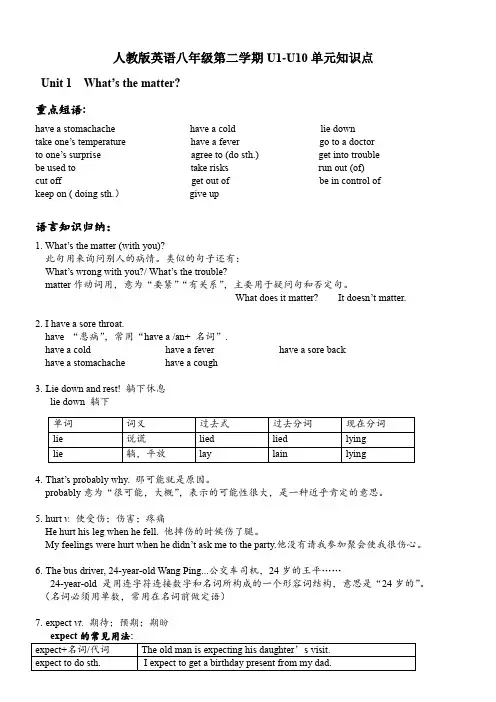
人教版英语八年级第二学期U1-U10单元知识点
Unit 1 What’s the matter?
重点短语:
have a stomachache have a cold lie down
take one’s temperature have a fever go to a doctor
to one’s surprise agree to (do sth.) get into trouble
be used to take risks run out (of)
cut off get out of be in control of
keep on ( doing sth.) give up
语言知识归纳:
1. What’s the matter (with you)?
此句用来询问别人的病情。类似的句子还有:
What’s wrong with you?/ What’s the trouble?
matter作动词用,意为“要紧”“有关系”,主要用于疑问句和否定句。
What does it matter? It doesn’t matter.
2. I have a sore throat.
have “患病”,常用“have a /an+ 名词”.
have a cold have a fever have a sore back
人教版八年级英语下册各单元语法点汇总
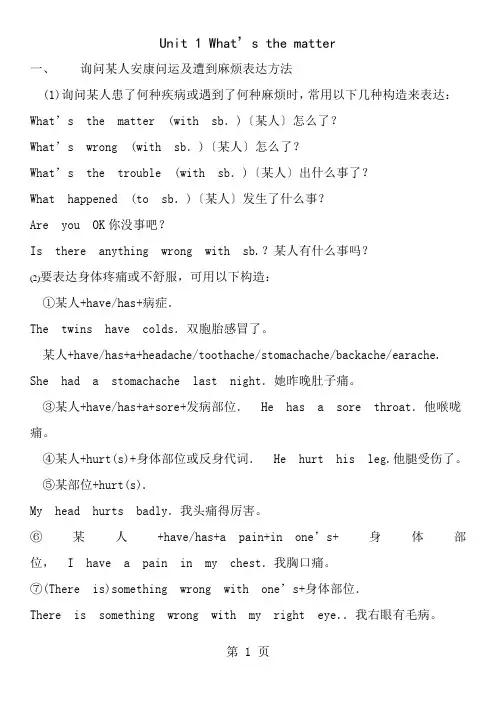
第 1 页 Unit 1 What’s the matter
一、 询问某人安康问运及遭到麻烦表达方法
(1)询问某人患了何种疾病或遇到了何种麻烦时,常用以下几种构造来表达:
What’s the matter (with sb.)〔某人〕怎么了?
What’s wrong (with sb.)〔某人〕怎么了?
What’s the trouble (with sb.)〔某人〕出什么事了?
What happened (to sb.)〔某人〕发生了什么事?
Are you OK你没事吧?
Is there anything wrong with sb.?某人有什么事吗?
(2)要表达身体疼痛或不舒服,可用以下构造:
①某人+have/has+病症.
The twins have colds.双胞胎感冒了。
某人+have/has+a+headache/toothache/stomachache/backache/earache.
She had a stomachache last night.她昨晚肚子痛。
③某人+have/has+a+sore+发病部位. He has a sore throat.他喉咙痛。
④某人+hurt(s)+身体部位或反身代词. He hurt his leg.他腿受伤了。
⑤某部位+hurt(s).
My head hurts badly.我头痛得厉害。
⑥某人+have/has+a pain+in one’s+身体部位, I have a pain in my chest.我胸口痛。
⑦(There is)something wrong with one’s+身体部位.
There is something wrong with my right eye..我右眼有毛病。 第 2 页 ⑧其他表达方式
She has a heart trouble.她有心脏病。
人教版八年级英语下册单元语法归纳及练习全套

人教版八年级英语下册单元语法归纳及练习全套
Unit 1 重点语法
教学目标:掌握情态动词should的用法
掌握反身代词的用法
1. 情态动词should的用法
( 1 ) 情态动词should后接动词原形,变为一般疑问句时将should提前,变为否定句时在should后面加not。
We should listen to our teacher carefully in class.
Should I tell him the news right now?
We shouldn’t come late to school.
( 2 ) should常用于以下两种情况:
提出建议、观点或看法。
You look tired. You should lie down and rest.
表示推测,意为“该,按理应当”。
Wait a minute. I think he should come in a moment.
2. 反身代词
( 1 ) 反身代词的构成
反身代词是表示或强调自身的代词,有人称和数之分。第一、二人称反身代词由“形容词性物主代词 + self ( 单数 )或selves ( 复数 )”构成;第三人称则由“宾格人称代词 +
self ( 单数 )或selves ( 复数 ) ”构成。详见下表:
人称 单数 复数(-selves)
第一人称 myself 我自己 ourselves 我们自己
第二人称 yourself 你自己 yourselves 你们自己
第三人称 himself 他自己
themselves他/ 她/ 它们自己 herself 她自己
itself 它自己
( 2 ) 反身代词的用法
做宾语 You must look after yourself well and keep healthy.
The child can dress himself.
期末Units1-10单元知识点总结 人教版八年级英语下册

Unit 1 What’s the matter?
一、词形变化
1. stomach 名词 胃;腹部——stomachache 名词 胃痛
2. lie 躺 lie—lay—lain lying; 说谎 lie—lied—lied
3. hurt 动词 (使)疼痛;受伤 hurt—hurt—hurt
4. hit 动词 击;打 hit—hit—hit
5. 反身代词(oneself):myself 我自己—ourselves 我们自己
himself 他自己—herself 她自己—themselves 他们自己
yourself 你自己—yourselves 你们自己
enjoy oneself 玩得开心 hurt oneself 伤害自己 by oneself 独自
6. climb 动词 登;爬——climber 名词 登山者
7. knife 名词 小刀——复数:knives
8. mean 动词 意思是;打算 mean—meant—meant
9. important 形容词 重要的—importance 名词 重要性
10. decide 动词 决定——decision 名词
11. die 动词 死——death 名词 死亡——dead形容词 死亡的
die—died—died dying
二、短语归纳 1. lie down 躺下 to one’s (my/his/her...) surprise 令某人惊讶的是
2. take one’s (my/your/his/her..) temperature 量体温
3. take a break = take breaks 休息 take a risk = take risks冒险
4. run out 物做主语:The money ran out. 钱用光了。
人教版八年级下英语各单元重难点归纳

1 / 76
人教版八年级下英语各单元重难点归纳
Unit 1 What’s the matter?
本单元考点,重点三个:一、询问身体不适并给出建议的句型
二、v.-ing形式的非谓语动词
三、反身代词
一、询问身体不适并给出建议的句型:
(一)对“身体不适”的提问: “怎么了?”
1、What’s the matter (with you)?
2、What’s the trouble (with you)?= 3.What’s your trouble?
4、What’s wrong(with you)?
5、What’s up?
6、What happens to you?
7、What’s the problem(with you)?
(二)、“身体不适”的简要表达:
1、主语 + have/has + a + 病症
(1) I have a cold.= I catch a cold. =I get a cold. =I have the flu.我感冒了。
I have a bad cold.我得了重感冒。
(2) I have a fever.我发烧了。I have a high fever.我发高烧了。
(3) I have a cough.我咳嗽了。
(4) I have a nosebleed.我出鼻血了。
2、主语 + have /has + a + 身体部位-ache
(1) I have a toothache.我牙疼。I have a bad toothache.我牙疼的厉害。
(2) I have a stomachache.我胃疼。
(3) I have a headache.我头疼。
(4) I have a backache.我后背疼。
3、主语 + have/has + a + sore + 发病部位
(1) I have a sore back.我后背疼。
人教版英语八年级下册unit1单元知识点归纳总结
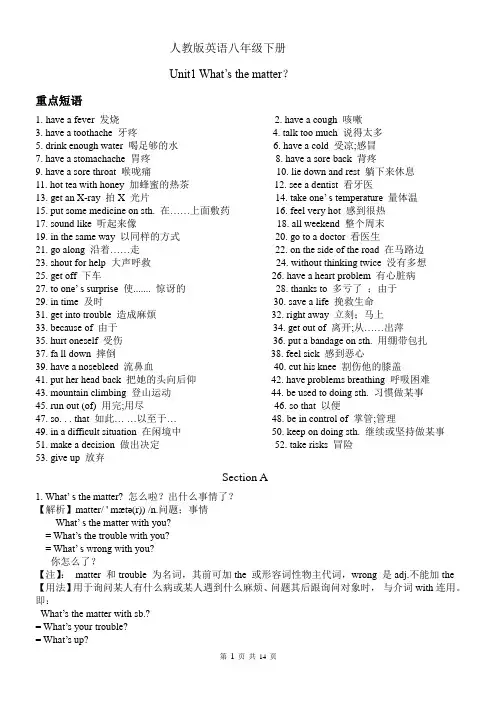
第 1 页 共 14 页 人教版英语八年级下册
Unit1 What’s the matter?
重点短语
1. have a fever 发烧 2. have a cough 咳嗽
3. have a toothache 牙疼 4. talk too much 说得太多
5. drink enough water 喝足够的水 6. have a cold 受凉;感冒
7. have a stomachache 胃疼 8. have a sore back 背疼
9. have a sore throat 喉咙痛 10. lie down and rest 躺下来休息
11. hot tea with honey 加蜂蜜的热茶 12. see a dentist 看牙医
13. get an X-ray 拍X 光片 14. take one’ s temperature 量体温
15. put some medicine on sth. 在……上面敷药 16. feel very hot 感到很热
17. sound like 听起来像 18. all weekend 整个周末
19. in the same way 以同样的方式 20. go to a doctor 看医生
21. go along 沿着……走 22. on the side of the road 在马路边
人教版八年级下册英语Unit 1重点知识汇总
1 人教版八年级下册英语Unit 1重点知识汇总
重点单词
matter v. 重要,要紧,有关系
What's the matter? 怎么了?出什么事了?
sore adj. 疼痛的,酸痛的
have a cold 感冒
stomach n. 胃,腹部
stomachache n. 胃痛,腹痛
have a stomachache 胃痛
foot (复数feet) n. 脚
neck n. 颈,脖子
throat n. 喉咙
fever n. 发烧,发热
lie v. 躺,平躺
lie down 躺下
rest n. 剩余部分,其余;放松,休息
cough n. & v. 咳嗽
X-ray n. X光,X射线
toothache n. 牙痛
take one's temperature 量体温
headache n. 头痛 2 have a fever 发烧
break n. & v. 休息,暂停;打破
take breaks (take a break) 休息
hurt v. 伤害,损害,使受伤
passenger n. 乘客,旅客
off adv. prep. 离开(某处);从…去掉
get off 下车
to one's surprise 使…惊讶,出乎…意料
onto prep. 向,朝
trouble n. 麻烦,烦扰,问题
hit n. & v. 碰撞,打,打击
right away 立即,马上
get into 陷入,参与
herself pron. 她自己,她本身(she的反身代词)
bandage n. & v. 绷带;用绷带包扎
sick adj. 患病的,不适的
knee n. 膝盖
nosebleed n. 鼻出血
breathe v. 呼吸
sunburned adj. 晒伤的
ourselves pron. 我们自己(we的反身代词)
人教版八年级下册各单元英语语法解析知识重点总结
新目标英语八年级(下)重点短语及句型总
Unit 1 Will people have robots?
1. fewer people 更少的人(fewer 修饰名词复数,表示否定)
2. less free time 更少的空闲时间(less 修饰不可数名词,表示否定)
3. in ten years 10年后(in 的时间短语用于将来时,提问用 How soon)
4. fall in love
with … 爱上……
例:When I met Mr. Xu
for the first time, I fell in
love with him at once.
当我第一次见到许老师,我立刻爱上他。
5. live alone 单独居住
6. feel lonely 感到孤独(比较:live alone/ go alone 等)
The girl walked
alone along the street, but she
didn't feel lonely.
那女孩独自沿着街道走,但她并不感到孤独。
最新人教版版八年级下册英语一至三单元知识点.复习进程
资料收集于网络,如有侵权请联系网站删除
word可编辑Unit 1 What’s the matter?
1.What’ sthe matter with you?= What’s the trouble with you?= What’ s wrong with you?你怎么了?
matter 和trouble 为名词,其前可加the 或形容词性物主代词,wrong 是adj. 不能加the
用于询问某人有什么病或某人遇到什么麻烦、问题其后跟询问对象时,与介词with连用。即:
What’s the matter with sb.?= What’s your trouble? = What’s up? = What happens to sb.?
2. I had a cold.我感冒了。 have a cold=catch a cold=have the flu感冒 have a fever 发烧have a cough咳嗽 have a stomachache胃疼,肚子疼 have a toothache牙疼 have a headache头疼3. 身体部位+ache(疼痛)构成新的复合词stomach+ache=stomachache head+ache=headache tooth+ache=toothache back+ache=backache后背痛4. much too+ 形容词,意为太...... ,too much+名词,意为很多,大量。5. enough【形容、副词】足够的/地,enough放在名前后,形副后。good enough足够好,enough money=much money 6. lie down躺下, lie 躺,躺着,过去式lay;lie说谎,过去式lied 7.sound like+名词代词和从句:It sounds like you don’t know the truth. It sounds like a good idea.sound+形容词,“听起来,好像”,The music sounds nice. 8. need 需要,实义动词need+名词,需要某物; need to do sth.需要做某事,主语通常是人,表示人主动的动作:You need to listen carefully during class. need doing sth.主语通常是物,表示被动的动作:Your dirty clothes need washing. 9. get off (the bus) 下(公交车) get on 上车10. agree 同意,赞同;agree with sth. 同意某事agree to sb. 同意某人的意见
人教版英语八年级下册第一单元知识点
人教版英语八年级下册第一单元知识点
Unit1What’sthematter
【单词】
matter /'mt/n.问题;事情
What’s the matter(with sb.)怎么啦出什么事情了询问有什么病或遇到什么麻烦、问题
sore/s:/adj.疼痛的,酸痛的;恼怒的 --have a sore back 后背痛 --sore throat咽喉痛
n. 溃疡,痛处;恨事 pressure sore褥疮, sore spot 伤疤,痛处;伤心事,旧疮疤
stomachache['stmkek] n.胃痛;腹痛
stomach/'stmk/n.胃;腹部
foot/ft/n.脚;足 pl. feet
-- on foot步行;在进行中 -- at the foot of在…(山)脚下;在…的下部
neck/nek/n.颈;脖子
--necklace项链 -- necktie领带 --neck and neck(with sb.) (与…)并驾齐驱,不分上下
throat/θrt/n.咽喉;喉咙
fever/'fi:v/n.发烧 haveafever发烧
lie/la/--vi.躺, 平躺;位于,存在 liedown躺下
--vi.说谎,
作为不及物动词的变化: -- lying,pt-- lied,pp—lied
--vt. 下蛋;放置 ., The hen stopped laying eggs. She laid the baby down gently on the bed.
作为及物动词是的变化: -- laying,pt-- lay,pp—lain
restv.&n.放松;休息
coughn.&v.咳嗽
射线;X光
toothache /'tu:θek/n.牙痛
temperature温度,体温 takeone'stemperature量体温