
人教版八年级英语下册1-2单元知识点总结
s
Unit1 What’the
matter?
1. What’s the matter?=What’s the
trouble?=What’s wrong? 你 怎
么了?
2. have a cold 感 冒 ; have a
stomachache 肚子疼;have a
sore back 嗓子、喉咙疼;have
a fever 发烧;have a toothache
牙疼;have a nosebleed 鼻出
血
3. talk too much 说的太多,too
much 后接不可数名词,而 too
many 后接可数名词复数。
4. lie down and rest 躺下休息
5. hot tea with honey 加蜂蜜的
热茶
6. see a dentist 看牙医; see a
doctor 看医生;go to a doctor
去看医生
7. take one’s temperature 给某人
量体温
8. sound like 听起来像
9. in the same way 以同一个方
式
10.go along 沿着‥‥走
11.see sb doing sth 看到某人在做
某事
12.on the side of the road 在路边
儿
13.shout for help 大声求助
14.get off 下车;get on 上车
15.have a heart problem 患心脏
病
16.take sb to sw.带/送某人去某
地 17.expect sb to do sth 期望某人
做某事
18.wait for the next bus 等下一
辆车
19.to one’s surprise 令某人吃惊
的是
20.agree to do sth 同意做某事
21.move sb/sth onto‥‥吧人或
物抬到‥‥
22.thanks to 幸亏,由于
23.in time 及时
24.think about 考虑
25.save one’s life 拯救某人的生命
26.right away 立刻,马上
27.get into trouble 陷入困境,遇
到麻烦
28.hurt oneself 伤着某人自己;
cut oneself 切/砍到某人自己
29.fall down 摔倒
30.go home and get some rest 回
家休息
31.run it under water 用水冲一冲
32.feel sick 觉得难受/恶心
33.get hit on the head 撞了一下
头
34.mountain climbing 登山
35.be used to sth/doing sth 习惯
于(做)某事;used to do sth
过去经常做某事
36.take risks 冒险
37.because of+词语或短语,后不
能接句子;because 后只从句
38.on that day 在那一天
39.by oneself 独自地
40.be ready to sth 准备做某事
41.so that 以便,为了,引导目
ll
的状语从句。而 so ‥‥ that
如此‥‥以至于‥‥
42.run out of 用完,一般是人做
主语。而 run out 主语一般是
物
43.climb down the mountain 下
山
44.get out of 从‥‥出来
45.the importance of sth/doing
sth(做)的重要性
46.be in control of 掌管、管理
47.keep on doing sth 坚持做某事
48.free oneself 解救自己
49.mind doing sth 介意做某事;
mind one’s doing sth 介意某
人做某事
50.give up sth/doing sth 放弃(做)
某事
Unit 2 I’ help to clean up
the city parks
1. clean up 清洁,打扫
2. cheer up sb=cheer sb up 使某
人振作/高兴起来
3. give out 分发,发放;give away
分发,赠送
4. at the food bank 在食品库,在
食品发放中心
5. come up with 想出(主意或计
划等)
6. put off sth/doing sth 推迟(做)
某事
7. put up signs 张贴标语
8. hand out 散发,发放
9. make plans to do sth 制定计划
做某事 10.help out with 帮助做某事(强
调结果);help with 也是帮助
做某事,但不强调结果
ed to be 过去是
12.lonely adj. 孤独的,寂寞的;
alone adj./adv. 独自的,单独
地
13.care for 关心,关爱
14.future dream job 未来理想的
工作
15.learn more about 更多的了解
有关‥‥
16.at the age of 在多大年龄时
17.try out for 试试,尝试
18.go on a jurney 去旅行
e true(梦想等)实现
20.at the same time 同时
21.volunteer to do sth 志愿做某
事
22.volunteer one ’s time to do sth
志愿付出时间做某事
23.call up sb=call sb up 给某人打
电话=give sb a call
24.worry about 担心,忧虑
25.raise money 筹集钱
26.travel alone 独自旅行
27.run out of 用完,花完,耗尽
(一般人做主语);run out 意
思一样,但一般用物做主语
28.move to 搬迁到; move sth
to 吧某物搬到
29.take after (外貌、性格等)像‥
‥
30.fix up 修理、修好
31.be similar to ‥‥对某人来说
s
;
是熟悉的;
be similar with 人对‥‥熟
悉
32.thank sb for sth/doing sth 因为
‥‥而感谢某人
33.give money to 捐钱给
34.make it possible for sb to do
sth 使得做某事对某人来说成
为可能
35.make a big difference to one’
life 使某人的生活产生很大不
同
36.be like 像‥‥一样
37.think about 考虑
38.normal things 正常的事情
39.be excited about sth/doing sth
对(做)某事感到兴奋
40.be able to do 能够做
41.because of 由于,后接词或词
语;而 because 后接从句
42.disabled people 残疾人
Unit 3 Could you please
clean your room?
1. Could you please do
sth?请你做某事好吗
2. Could you please not
do sth ?请你不要做某事好
吗?
3. do/wash the dishes 洗
餐具
4. take out the rubbish 倒垃圾
5. fold one ’s clothes 叠
衣服
6. Sweep the floor 扫地、
擦地板
7. make one’s/the bed
整理床铺
8. clean the living room
打扫客厅
9. No problem. 没问题
10. at least 至少
11. clean and tidy 干
净整洁
12. be angry with
sb=be mad at sb 生某人的气
13. solve the problem
解决问题
14. throw down 扔下
15. sit down 坐下
16. in front of 在‥‥
前面(指某个范围外的前面)
in the front of 指在某个范围
内的前面
17. take‥‥for a walk
带‥‥去散步; take the dog
for a walk 遛狗
18. all the time 一直、
总是
19. around the house
在家里
20. all day 整天
21. as+adj/adv. 原 形 ,
意思是和‥‥一样‥‥
22. walk away 道教、
走开
23. so+助/情/系+主语,
人教版初二(下)英语unit1 what's the matter知识点讲解与练习
1
八年级下册英语Unit 1 what’s the matter?
词汇篇
学生通过本讲学习,能够掌握本单元的重点词汇句型,并在综合能力上有一定的拓展。
1. matter的用法
(1)名词:事情,问题 What’s the matter? =what’s wrong (with you)? =what’s the trouble
怎么啦?出什么事啦?
(2)动词:有重大影响,有重要性 如:What does it matter?
2. 疾病的表达法
have a cold/a fever/ a toothache/ a stomachache
3. take 的固定搭配
take one’s temperature/ take breaks/ take risks/take some medicine/take off/ take care of/take away
4. surprise的用法
1. 做名词:to one’s surprise 使。。。惊讶的,出乎。。。意料
2. 做动词:surprise sb使某人吃惊
3. 做形容词:surprising, surprised的用法
5. get的用法
get off下车/get on上车/get into陷入,参与
6. be used to sth/doing sth 习惯于做某事
be used to do sth 被用作去做某事
used to do sth 习惯于做某事
7. out of的固定搭配
look out of 向。。。外看/ get out of从。。。出来/ run out of用光
基础演练
1. ---What’s wrong ______you?
---I fell off the bike and hurt my leg.
A. of B. with C. for D. by
人教版八年级英语下册Unit-1--Unit-3-单元知识点归纳
人教版八年级英语下册Unit-1--Unit-3-单元知识点归纳
free【动词】使……解脱,得到自由He could not free his arm.
free from
21. run out用完,用尽 When his water run out, he knew that he would have to do
something to save his own life.
物sth. tun out. 某物用尽了。 人sb. run out of物sth..人用尽了某物。He run out of all
his money last night.
22. risk sth to do sth. 冒着...的风险去做某事 take a risk=take risks 冒险
risk doing ...=take the risk of doing ...
23. the importance of (doing) sth.(做)某事的重要性 We students should know the
importance of (learning) English.
importance n. 重要(性), important adj.重要的,unimportant adj.
24. decision 【名词】决定;抉择; make a decision to do sth.
decide
25. be in the control of …掌管,管理 The headmaster is in the control of this new school.
be out of control无法控制,无法管理 be under control被控制住,在控制之中
26. 【复习】mind意为 介意 , Would you mind my opening the window?
人教版英语八年级下册Unit 1-5 单元语法知识梳理
Unit 1 单元语法知识梳理
一、情态动词 should的用法
情态动词should有自己的意义,但不能单独作谓语,只能和其他动词一起构成谓语,表示说话人的态度或看法,后接动词原形。常见用法有以下几点:
1.表示劝告、建议等,意为“应该”,常指根据常理认为对的事或应该去做的事。
当劝某人做或不做某事时,常用“should do sth.”或 “shouldn't
do sth.”。should 比 must 和 ought to 语气更加委婉。
例句:You should brush your teeth before you go to bed.你在睡觉前应该刷牙。
You shouldn't watch TV every day.你不应该每天看电视。
2.通常用来表示现在或将来的责任或义务。
例句:Children should obey their parents.孩子们应该听从他们的父母。
We should respect the old.我们应该尊敬老人。
3.表示推断,意为“应该;可能”。
例句:They should be there by now,I think.我觉得现在他们应该都已经到了。
4.用于第一人称疑问句,询问对方的意愿,表示说话人的一种谦逊、客气、委婉的语气。
例句:Should I open the window? 我可以打开窗户吗? What should we do now? 我们现在该干什么呢?
5.表示某种感情色彩,意为“竟会”,常用于以how, why开头引导的特殊疑问句中。
例句:Why should you be so early today? 你今天为什么会如此早?
二、反身代词
1.反身代词的构成反身代词是一种表示反射或强调的代词。它由第一人称、第二人称的形容词性物主代词和第三人称代词的宾格加词尾-self或-selves构成。
其构成如下表:
新人教版八年级英语下册第一单元知识点
新人教版八年级英语下册第一单元知识点
第一单元主要介绍了动词的时态、情态动词以及一般现在时态和现在进行时态的用法。
1. 动词的时态:
- 一般现在时:表示经常性或普遍性的动作或状态。
- 一般过去时:表示过去某个时间发生的动作或状态。
- 一般将来时:表示将要发生的动作或状态。
- 现在进行时:表示现在正在进行的动作。
- 过去进行时:表示过去某个时间正在进行的动作。
- 现在完成时:表示过去的某个时间开始,并持续到现在的动作或状态。
- 过去完成时:表示过去的某个时间前完成的动作或状态。
2. 情态动词:
- can/could:表示能力或许可。
- may/might:表示可能性、许可或请求。
- must:表示必须。
- should:表示建议或义务。
- will/would:表示意愿、习惯或请求。
3. 一般现在时的用法:
- 表示经常性或习惯性的动作或状态,常与频率副词连用(如always, often,
sometimes等)。
- 表示客观事实或真理,常用于科学、历史等领域。
- 表示现在的状态、感觉或所属关系。
4. 现在进行时的用法:
- 表示现阶段正在进行的动作或临时状态。
- 表示计划或安排的未来动作。
- 与always或often连用,表示经常性的不满或抱怨。
以上是第一单元的知识点,希望对你有帮助。
人教版八年级英语下册各知识点归纳总结(最新最全)
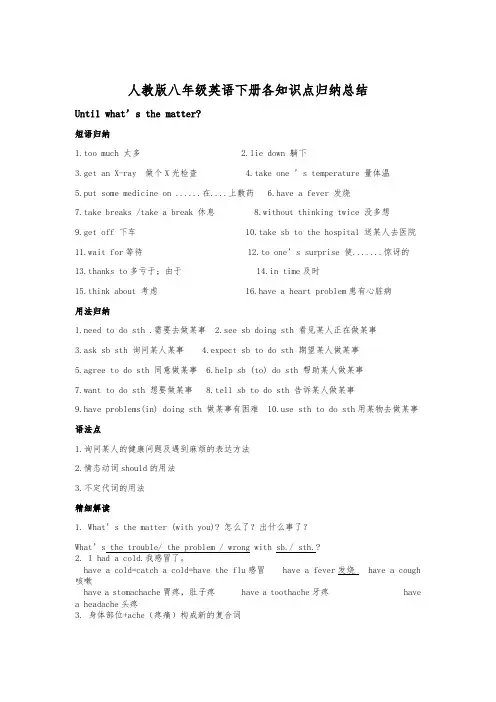
人教版八年级英语下册各知识点归纳总结
Unti1 what’s the matter?
短语归纳
1.too much 太多 2.lie down 躺下
3.get an X-ray 做个X光检查 4.take one ’s temperature 量体温
5.put some medicine on ......在....上敷药 6.have a fever 发烧
7.take breaks /take a break 休息 8.without thinking twice 没多想
9.get off 下车 10.take sb to the hospital 送某人去医院
11.wait for等待 12.to one’s surprise 使.......惊讶的
13.thanks to多亏于;由于 14.in time及时
15.think about 考虑 16.have a heart problem患有心脏病
用法归纳
1.need to do sth .需要去做某事 2.see sb doing sth 看见某人正在做某事
3.ask sb sth 询问某人某事 4.expect sb to do sth 期望某人做某事
5.agree to do sth 同意做某事 6.help sb (to) do sth 帮助某人做某事
7.want to do sth 想要做某事 8.tell sb to do sth 告诉某人做某事
9.have problems(in) doing sth 做某事有困难 e sth to do sth用某物去做某事
期末Units1-10单元知识点总结 人教版八年级英语下册

Unit 1 What’s the matter?
一、词形变化
1. stomach 名词 胃;腹部——stomachache 名词 胃痛
2. lie 躺 lie—lay—lain lying; 说谎 lie—lied—lied
3. hurt 动词 (使)疼痛;受伤 hurt—hurt—hurt
4. hit 动词 击;打 hit—hit—hit
5. 反身代词(oneself):myself 我自己—ourselves 我们自己
himself 他自己—herself 她自己—themselves 他们自己
yourself 你自己—yourselves 你们自己
enjoy oneself 玩得开心 hurt oneself 伤害自己 by oneself 独自
6. climb 动词 登;爬——climber 名词 登山者
7. knife 名词 小刀——复数:knives
8. mean 动词 意思是;打算 mean—meant—meant
9. important 形容词 重要的—importance 名词 重要性
10. decide 动词 决定——decision 名词
11. die 动词 死——death 名词 死亡——dead形容词 死亡的
die—died—died dying
二、短语归纳 1. lie down 躺下 to one’s (my/his/her...) surprise 令某人惊讶的是
2. take one’s (my/your/his/her..) temperature 量体温
3. take a break = take breaks 休息 take a risk = take risks冒险
4. run out 物做主语:The money ran out. 钱用光了。
人教版八年级下册英语Unit1知识点语法归纳总结
⼈教版⼋年级下册英语Unit1知识点语法归纳总结
Unit 1 What’s the matter?
1.短语归纳
2.典句必背
3.⽤法集萃
(1)当别⼈⼼情不好,⾝体不适或遇到⿇烦时,我们可以⽤如下表达表⽰关⼼:?What’s the matter?
What’s the matter with you
What’s wrong with …
What’s the trouble\problem with …
(2)英语中常⽤have描述⾝体的不适,此时have意为“患有”,常⽤结构:
①have a + 疾病
例:have a cold 感冒;have a fever 发烧;have a cough 咳嗽
②have a + ⾝体部位-ache
例:have a headache 头痛;have a toothache ⽛痛
③have a sore + ⾝体部位
例:have a sore throat 咽喉痛;have a sore back 背痛(3)lie down躺下;tell lies/a lie 说谎
(4)maybe & may be
①maybe,“或许”,常⽤于句⾸,表⽰可能性,后加句⼦。例:Maybe you are right.
②may be,是情态动词+be的结构,意为“可能,也许”,后加名词、代词或形容词。
例:He may be angry.(5)sound like & sound
①sound like+名词/代词/从句
例:It sounds like you don’t know the truth. It sounds like a good idea.
②sound+形容词,“听起来,好像”,例:The music sounds nice.(6)…when the driver saw an old man lying on the side of the road. ……
这时司机看到意为⽼⼈躺在路边。
初中英语人教版期中复习 八年级下册 Units1-2_知识梳理和复习
初中英语人教版期中复习 八年级下册 Units1-2_知识梳理和复习
1 / 5 Units1-2 知识梳理与复习
重点词汇 1. m_tter问题;事情 2.thr_at咽喉;喉咙
3.st_macha_he 胃痛;腹痛 4.f_ot脚
5.n_ck颈;脖子 6.fe_er发烧
7.co_gh咳嗽 8.t_ otha_he牙痛
9.he _dac _e头痛 10.psen _er乘客;旅客
11.tro _ble问题;苦恼 12.h_rt(使)疼痛;受伤
13.sit_ ation情况;状况 14.o_f从……去掉
15.im_ort_nce重要性 16.de_ ision决定;抉择
17.c_ntrol限制;约束 18.de_th死;死亡
19.ch _er欢呼;喝彩 20.vol_ ntecr义务做;自愿做
21.n_ tice公告牌;通告 22.lon_ly孤独的
23.sev _ral几个;数个 24.fe_ ling感觉;感触
25.sat_ sfa_ tion满足;满意 26.jur_ ey旅行;行程
27.r_ ise征集;募集 28.re_air修理;修补
29.im_ gine想象;设想 30.ki_ dnss仁慈;善良
31._nders_ and理解;领会 32.d_ sab_ ed丧失能力的
重点短语
1._____the matter怎么了 2.have a_____感冒
3.lie_____躺下 4.have a_____发烧
5.take one's_____量体温 6._____off下车
英语电子课本八年级下册人教版预习笔记第一单元,第二单元
英语电子课本八年级下册人教版预习笔记第一单元,第二单元
《人教版八年级下册英语电子课本第一单元预习笔记》。
一、单元主题。
本单元的主题是关于健康问题以及如何保持健康的生活方式。通过学习本单元,学生能够掌握与健康相关的词汇、短语和句型,了解常见的健康问题及应对方法,提高英语表达和交流能力。
二、重点词汇。
1. matter.
- 读音:英 [ˈmætə(r)] 美 [ˈmætər]。
- 词性:名词和动词。
- 含义:作名词时,意为“问题;事情;物质”;作动词时,意为“要紧;有关系”。
- 常见搭配:
- What's the matter?(怎么啦?出什么事了?)。
- It doesn't matter.(没关系。)。
2. stomachache.
- 读音:英 [ˈstʌməkeɪk] 美 [ˈstʌməkeɪk]。
- 词性:名词。
- 含义:“胃痛;腹痛”。 - 例句:I have a stomachache. I ate too much ice cream.(我胃痛。我吃了太多冰淇淋。)。
3. foot.
- 读音:英 [fʊt] 美 [fʊt]。
- 词性:名词。
- 含义:“脚;足”。其复数形式是“feet”。
- 常见搭配:
- on foot(步行)。
- hurt one's foot(伤到脚)。
4. neck.
- 读音:英 [nek] 美 [nek]。
- 词性:名词。
- 含义:“脖子”。
- 例句:I have a pain in my neck.(我脖子疼。)。
5. throat.
- 读音:英 [θrəʊt] 美 [θroʊt]。
- 词性:名词。
- 含义:“喉咙;咽喉”。
- 常见搭配:
- have a sore throat(喉咙痛)。 三、重点短语。
1. lie down.
- 含义:“躺下”。
- 例句:You should lie down and rest if you feel tired.(如果你觉得累了,就应该躺下休息。)。
八年级英语下册1·2单元知识点汇总
Unit 1 What’s the matter?
一、基础知识
1. What’ s the matter? 怎么啦?出什么事情了?
【解析】matter/ ' mætə(r)) /n.问题;事情
What’ s the matter with you?= What’s the trouble with you? = What’ s wrong with you?
你怎么了?
【注】: matter 和trouble 为名词, 其前可加the 或形容词性物主代词,
wrong 是adj. 不能加the
【用法】用于询问某人有什么病或某人遇到什么麻烦、问题其后跟询问对象时,与介词with连用。
即: What’s the matter with sb.? = What’s your trouble?
= What’s up? = What happens to sb.?
— What’s the matter with you ? — I have a bad cold.
2. I had a cold.我感冒了。 have a cold=catch a cold=have the flu感冒
have a fever 发烧
have a cough咳嗽
have a stomachache胃疼,肚子疼
have a toothache牙疼 have a headache头疼
3. 身体部位+ache(疼痛)构成新的复合词
stomach+ache=stomachache
head+ache=headache
tooth+ache=toothache
back+ache=backache后背痛
4. much too+ 形容词,意为 太...... ,
too much+名词,意为 很多,大量 。