
译林版牛津英语八年级下册Unit 5知识点+测试卷
Unit 5 Good manners内容全解Part One Comic strip重点全解1、You’re old enough to learn about manners now, Hobo. (P 64)(1)manner 可数名词,此处意为“礼貌,礼仪,礼节”,常用复数形式。
常用搭配:good manners 有礼貌bad manners 没礼貌table manners 餐桌礼仪(2) manner 作可数名词,还有“方法,方式”之意,常用单数形式,与way同义。
例如:You should write in this manner.2、First, always share your things with others.(P 64)share sth with sb 意为“和某人分享、合用某物”。
例如:Let’s share the birthday cake with them.3、Second, don’t cut in on others. (P 64)cut in (on sb.) 意为“打断某人的谈话,插嘴”,相当于interrupt sb。
例如:Mary likes to cut in on others.4、Always wait politely. (P 64)(1) politely 副词,意为“礼貌地”,常用来修饰动词。
例如:We should speak to the old politely.(2) polite 形容词,意为“礼貌的”,可用作定语、表语等,它的反义词impolite,意为“无礼的”。
be polite to sb. 意为“对某人有礼貌”。
例如:It’s impolite to shout loudly.The students are polite to their teachers.Part Two Welcome to the unit重点全解1、Leave the tap running.(P 65)(1) leave sth doing意为“使/让.......处于.....状态”。
leave后接名词、形容词、动词ing形式、介词短语作宾语补足语。
例如:Don’t leave the machine turning.(2) run 此处为不及物动词,意为“流动”。
例如:Tears ran from her eyes.run 作不及物动词,意为“跑,奔跑”。
例如:I saw a boy running on the street. run 作不及物动词,意为“机器运转”。
例如:The engine runs properly.run 作不及物动词,意为“掉色,褪色”。
例如:When you wash the blouse in hotwater,the color will run.run 作及物动词,意为“经营,管理”。
例如:They run the restaurant well.2、Pick flowers in the park (P 65)pick 此处为及物动词,意为“采,摘(花朵,果实等)”。
例如:He picked her a rose.pick up 意为“拾起,捡起;用车接人”。
例如:He picked the pen up.3、obey traffic rules(P 65)obey 此处为及物动词,意为“遵守,服从”。
例如:You should obey school rules.obey 还可作不及物动词,意为“服从;听话”。
例如:He is very naughty. He doesn’t like to obey.4、queue for your turn(P 65)(1) queue 此处为不及物动词,意为(人、车等)排队等候。
例如:P lease queue up for a bus.Many people don’t like to queue.queue 还可用作可数名词,意为“队,行列”。
例如:stand in a queue 排队等候jump the queue 插队(2) turn 此处为可数名词,意为“轮流,(轮流的)顺序”。
例如:It’s your turn to read now.与turn相关的短语:take turns 轮流in turn依次,轮流by turns 轮流,交替例如:Please take turns to look after the sick boy.Please answer the question in turn.5、We should keep quiet. (P 65)keep quiet 意为“保持安静”,keep此处为连系动词,意为“保持(某种状态)”,后跟形容词作表语。
例如:You must keep quiet in the hospital.系动词归纳:一是(be)一觉(feel)一保持(keep);四个起来(look看起来,sound听起来,taste尝起来,smell闻起来);似乎(seem)变了四个(get,become, go,turn)6、Anything else? (P65)辨析:else与otherelse:修饰不定代词、疑问代词或疑问副词,放在修饰词之后。
other:修饰名词,位于名词之前。
例如:Do you have anything else to say?What other colors do you like?7、Don’t drop litter everywhere. (P65)litter 不可数名词,意为“垃圾,杂物”。
例如:The street is full of litter.Part Three Reading重点全解1、Today we’ve invited Jenny to talk about manners in the UK . (P 65)invite 为及物动名词,意为“邀请”,invite sb to do sth.意为“邀请某人做某事”。
例如:He sometimes invites me to see the film.invite sb to +名词,意为“邀请某人去.....”.例如:We’ll invite Tom to dinner tomorrow.2、Well, British people say “hello”, or “nice to meet you” and shake your hand when they meet you for the first time. (P 66)shake sb’s hand意为“与某人握手”,相当于shake hands with sb。
例如:You should shake Tony’s hand.=You should shake hands with Tony.3、Do they greet people with a kiss? (P 66)(1) greet 及物动词,意为“问候,打招呼”,相当于say hello to sb.。
例如:He greeted his teacher by saying “Good Morning”.greet sb with a nod意为“以点头招呼某人”。
greeting 可数名词,意为“问候,致意,祝贺”。
(2)kiss 此处为可数名词,意为“亲吻”。
give sb a kiss 意为“吻某人一下;给某人一个亲吻”。
Kiss 还可作为及物动词,意为“吻,亲吻”。
例如:The mother gave her son a kiss and left.He kissed his wife.4、British people only greet relatives or close friends with a kiss . (P 66)close 此处为形容词,意为“亲密的;严密的”,表示关系或情感上的“亲近”,可作定语或表语。
close to “与.....关系密切”。
例如:I’m close to my English teacher.close to 还有“离.....近”之意。
例如:The factory is close to the school.close还可作及物动词,意为“关闭”。
例如:Please close the window.5、But please avoid subjects like age,weight or money . (P 66)(1) avoid 及物动词,意为“避免”,后跟名词、代词或动词ing形式作定语。
例如:You’d better avoid the traffic at rush hour.It’s not easy to avoid making mistakes.(2) subject 此处作为可数名词,意为“话题,主题”。
作可数名词,还有“学科”之意。
例如:Most of us don’t like this subject.How many subjects are you studying this term.6、Do people there behave politely in public? (P 66)(1) behave 不及物动词,意为“表现”。
例如:Children behaved very badly after lunch.(2)public 集合名词,意为“民众,大众”。
in public意为“公开地,当众”。
还可作形容词,意为“公共的,公开的”例如:I don’t like to make a speech in public.a public library 公共图书馆 a public place 公共场所7、They think it’s rude to push in before others. (P 66)push 为不及物动词,意为“推,挤”。
push in意为“插队,加塞”,是英式英语的用法,美式英语常用cut in。
例如:You shouldn’t push in before us.=you shouldn’t cut in before us.8、Also, if they bump into someone in the street, they’ll say “sorry”. (P 67)bump 此处为不及物动词,意为“碰,撞”,常与介词against,into连用bump into 意为“撞上,偶然碰见”。
牛津译林版八年级英语下册第5单元测试卷(含答案)

牛津译林版八年级英语下册第5单元测试卷(含答案)一、单项选择:(本大题共15小题,每小题1分,共15分)1. You need ________ one-to-one conversation with your son. He seems unhappy these days.A. theB. anC. aD. /2. It is _________ to push _________ people in British.A. polite; pastB. impolite; passC. polite; passD. impolite; past3. Checking your answers before handing in your paper can help you _________ mistakes.A. makeB. provideC. avoidD. advise4. --- Nice to see you here. Where have you been?--- The USA. I ________ medicine there for three years.A. studiedB. have studiedC. will studyD. am studying5. David's mother is too busy housework him with his homework.A. doing; to helpB. doing; helpingC. to do; helpingD. to do; to help6. Lucy dances , if not better than, Lily.A. so wellB. as well asC. so well asD. as well7. _________ of them has arrived. So __________ has arrived on time.A. Nobody; noneB. No one; nobodyC. None; no oneD. None; not any one8. The purpose of new inventions is to make life easier, it more difficult.A. not to makeB. not makingC. not makeD. to not make9.The tent is for a family of three .A. big enough; to liveB. enough big; to live in itC. big enough; to live inD. enough big; live in10. John can't explain things well, what he says can't be understood very_____________.A. quietlyB. carefullyC. slowlyD. clearly11. It is impolite _________ others when they are speaking.A. to cut on inB. to cut in onC. cutting on inD. cutting in on12. ---Mum, I’ll get the chance to be trained in Canada for free this summer.---Really? Sounds ___________to be true.A. too goodB. so goodC. quite goodD. good enough13. ---What should I do to improve my listening skills?---I do have some advice. _________ , practice makes perfect.A. After allB. Above allC. At allD. In all14. ---Why didn’t Sally play the violin at the concert last night?---She said that her hand hurt, but that was only a (n)______. I saw her play tennis just now.A. matterB. excuseC. resultD. expression15. --- Mum, after this two-week tennis training, I managed to improve my backhand.--- Honey, like your dad always says .A. practice makes perfectB. the early bird catches the wormC. all roads lead to RomeD. actions speak louder than words二、完形填空:(本大题共10小题,每小题1分,共10分)I thought of myself as a “city girl” because I grew up in the city. I had very 1 knowledge about farming, but all of that changed six years ago when we moved to a farm. I was not used to 7 acres of farmland. 3 , I did enjoy the beauty and peace of thecountryside.I lived on the farm for about 3 years and helped with some jobs 4 feeding cows.When I was 5 to get a real summer job, my father said I could choose between two options(选择)—getting a job at our local Dairy Queen or selling produce that I grew on our farm.While I 1 up with a short list of advantages(优势) to working at the fast food restaurant, Ifound more advantages to selling produce. Shorter work weeks, more 7 time, flexible(灵活的) hours and the potential to make more money interested me. Yet I 8 the disadvantagesto selling produce: responsibility(责任) for the success or failure of the management, hard work,9 mornings and long days. 10 , finally, I decided to start my own farming business.1. A. a little B. little C. a few D. few2. A. hundred B. hundreds C. hundreds of D. hundred of3. A. However B. But C. While D. Otherwise4. A. for example B. like C. liking D. liked5. A. too old B. so old C. enough old D. old enough6. A. came B. was coming C. had come D. would come7. A. huge B. fantastic C. free D. difficult8. A. took B. thought C. realized D. met9. A. lonely B. early C. alone D. spare10. A. Above all B. Moreover C. In some ways D. Anyway三、阅读理解:(本大题共8小题,每小题2分,共16分)( A )Do you know the two lovely mascots (吉祥物)? You may know the five “Fuwa” dolls fromthe 2008 Beijing Olympic Games. On September 17 of this year, the two lovely mascots first showed on TV. Now, let’s see who they are.It is a black and white panda that wears a full-body “shell” made of ice and looks fat, so we call it “Bing Dwen Dwen” The red heart shape in its left palm(手心)means welcoming the friends from other countries. The bright colours of thecircles around its face stand for ice and snow sport tracks, meaning connectivityand advanced technologies “Bing Dwen Dwen” likes ice sports very much and isgood at them. That’s why it is the mascot of 2022 Beijing Winter Olympic Games.Do you think the red mascot looks like a lantern? The lantern’s name is “Shuey Rhon Rhon”When the Chinese New Year comes, people always make orbuy red lanterns. Red is the colour of hope and good luck, so people think theirdreams will come true in the new year. Take a look at its head. There are papercuttings of doves(鸽子)They make up a circle “Shuey Rhon Rhon” can giveplayers hope and help them do well in the 2022 Beijing Winter Paralympic GamesMany people in different countries like the two mascots very much, and they show their lovefor them on the Internet.1. Where is the red heart?A. It’s on Shuey Rhon Rhon’s face.B. It’s on Bing Dwen Dwen’s neck.C. It’s on Shuey Rhon Rhon’s lantern.D. It’s in Bing Dwen Dwen’s left palm.2. Why do people make or buy red lanterns when the Chinese New Year comes?A. Because it is easy to make red lanterns.B. Because “Shuey Rhon Rhon” is a mascot.C. Because people think red lanterns are very lovely.D. Because people think red lanterns can bring good luck.3. From the passage, we can learn _______.A. “Bing Dwen Dwen” can skate very wellB. “Shuey Rhon Rhon” likes ice sports and is good at themC. The two lovely mascots first showed on TV on September 16D. Everybody likes the two mascots and shows his love on the Internet4. What’s the best title of the pas sage?A. The sports in Olympic GamesB. Two Olympic mascots come to lifeC. 2022 Beijing Winter Olympic GamesD. 2022 Beijing Winter Paralympic Games(B)I would like to talk to you about one of the most beautiful places I’ve ever seen. I was born and raised there and now I visit it from time to time. My family moved to the city, so I only go back to see friends or to camp and fish.I grew up in a small town called Antonito Co. Itis surrounded by mountains. So camping is a big source of happiness in the valley(山谷). There are so many beautiful places to hike.The town itself is very small. It is said that if you blink (眨眼) when you’re going thr ough it, you’ll miss it. This has some truth in it considering the size of the town. We have one grocery store (杂货店), a tiny post office , and a tiny bank. There are also a few gas stations, bars, some excellent restaurants, a small hospital and of course several schools. However, for clothing and shoes, you have to drive thirty miles to Alamosa to shop there.Everyone in the town is nice and we all know each other. The crime rate (犯罪率) is zero unless you count some weekend fights that break out because some people drink too much. The classes in school are small, so you get a lot of attention from the teacher.You’re probably wondering why I don’t live there. Well, I can’t get a job there. A lot of the businesses are family-owned. And they never fire (解雇) their employees (雇工). So the employees work there usually until they retire (退休). Most people have to go to other places to get a job.1.We can learn from the last paragraph that in the writer’s hometown ___________ .A. not many job chances are providedB. employees don’t make much moneyC. most people live a very hard lifeD. only the old still live there2.By the underlined part in paragraph 3, the writer wants to show that the town is ___________.A. beautifulB. excitingC. smallD. safe3. Which of the following statements is TRUE?A. Teachers pay more attention to the students because they work hard.B. It is great fun for the writer to go camping in the valley.C. It’s common to see some drunken people in the writer’s hometown.D. The writer moved to the city because he didn’t like his hometown.4.What is this passage mainly about?A. A travel guide of the writer’s hometown.B. The scenery of the writer’s h ometown.C. The history of the writer’s hometown.D. An introduction to the writer’s hometown.四、词汇运用:(本大题共10小题,每小题1分,共10分)1. The boy wants to choose one of his favorite _____________(话题)to talk about.2. He can ___________(表达) his ideas easily in English.3. Our teacher is patient enough to spend more than ten minutes__________(解释) a hard question to us.4. The museum is open to the _______________ (民众) at the weekend5. Everyone knows the English saying. “No____________(痛), no gain."6. After a long (discuss), we decided to have a school trip next week.7. How do ordinary people hide the truth of their feelings so _______________ (success)?8. The more communication we have, the (close) we feel.9. You can’t judge a boo k by its cover, as the old _____________(say) goes.10. Thousands of ________________(Britain) soldiers were standing deep in the water.五、动词填空:(本大题共10小题,每小题1分,共10分)1. She didn’t leave until she _____________ (hear) they were safe.2. He’s the only one of his family who _______________ (pass) the driving test so far, isn’t he?3. ---The little boy often sits under the tree, _________(listen)to “Three Character Classic” in ancient times.--- That’s true. Many kids nowadays can recite(背诵) it very well.4. Post it at once. The company you want to work in _______________ (expect)your reply.5. Different memes are saved in mobile phones _________(express) feelings or what can’t be said directly.6. You _____________(eat) in the new restaurant this evening, aren't you?7. Would you please ______________ (not push) me? Let’s get on the bus one by one.8. This child is old enough (dress) himself without his mother’s help.9. It will be very dangerous to swim alone if you _____________ (not be) careful enough.10.The policeman warned him ___________(obey) the traffic rules, otherwise, he would be fined.六、句子翻译(本大题共5小题,每小题4分,共20分)1. 他们要举办一场有关餐桌礼仪的讲座,真是足够友好。
译林版初中英语八年级下册Unit 5 单元测试题及答案.doc

Unit 5 单元测试题满分100分姓名班级得分第Ⅰ卷选择题(共45分)一、单项选择(每小题1分,共15分)从各题后所给的A、B、C、D四个选项中选出最佳答案。
( )1. —________ do people start a conversation in China?—They often say “Nihao” first.A. WhatB. HowC. WhenD. Which( )2. Please run ________,Linda, or you will miss the new film.A. quickB. slowC. quicklyD. slowly( )3. Peter is ________ careless to ________ the word correctly.A. too; spellingB. so; spellingC. too; spellD. so; spell( )4. Some Westerners like to greet people ________ a kiss.A. byB. withC. ofD. without( )5. Everyone in my class went to the mountains ________ Maria. She was ill in hospital.A. besidesB. withC. exceptD. including( )6. Please keep ________ and don’t eat anything in the library.A. noisilyB. quietC. quietlyD. noisy( )7. It’s no t the ________ time to ask her to the party, because her mother is badly ill.A. usefulB. interestingC. properD. special( )8. The English guest could speak ________ Chinese, so she managed to talk with us.A. a fewB. a littleC. fewD. little( )9. I found it very useful ________ a good book.A. readB. readingC. of readingD. to read( )10. Peter is ________ to get the award of “Best Student”.A. enough excellentB. excellent enoughC. too excellentD. excellent too( )11. —Would you like to collect ________ with us in the park this Saturday?—Yes, I’d love to. Let’s make it clean.A. waterB. treesC. booksD. rubbish( )12. —Can I ________ my car in the park?—I’m afraid not. There are so many people in the park.A. stopB. parkC. buyD. move( )13. Miss Wang is going to visit the Great Wall ________ next week.A. some timeB. sometimesC. some timesD. sometime( )14. —Please help yourself to some meat.—________, but I’m full now.A. You’re kiddingB. I’m sorry to hear thatC. Sorry, I can’tD. Thanks a lot( )15. —Mum, Tony broke my pen again.—Forget it. ________, he’s only two years old.A. After allB. All the timeC. Not at allD. First of all二、完形填空(每小题1分,共10分)根据材料内容,从各题后所给的A、B、C、D四个选项中选出最佳答案。
牛津译林版八年级英语下册 Unit 5 Good manners 单元测试题
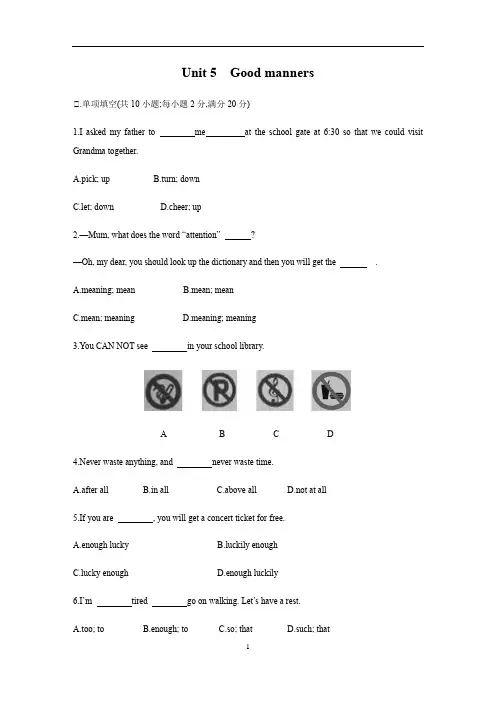
Unit 5Good mannersⅠ.单项填空(共10小题;每小题2分,满分20分)1.I asked my father to me at the school gate at 6:30 so that we could visit Grandma together.A.pick; upB.turn; downC.let; downD.cheer; up2.—Mum, what does the word “attention” ?—Oh, my dear, you should look up the dictionary and then you will get the .A.meaning; meanB.mean; meanC.mean; meaningD.meaning; meaning3.You CAN NOT see in your school library.A B C D4.Never waste anything, and never waste time.A.after allB.in allC.above allD.not at all5.If you are , you will get a concert ticket for free.A.enough luckyB.luckily enoughC.lucky enoughD.enough luckily6.I’m tired go on walking. Let’s have a rest.A.too; toB.enough; toC.so; thatD.such; that7.—Why doesn’t the surgeon stop lunch?—Because he is busy a dying patient in the operation room.A.to have; to saveB.having; to saveC.to have; savingD.having; saving8.The headmaster warns us the school rules, or we’ll be punished.A.to breakB.not to breakC.breakingD.don’t break9.They built a wall to soil being washed away.A.makeB.provideC.avoidD.advise10.—I have spent several nights preparing for the coming exam.—It’s bad for you to stay up too late. As the saying goes, “”A.You are never too old to learn.B.Actions speak louder than words.C.You can’t burn the candle at both ends.D.You can’t put all your eggs in one basket.Ⅰ.完形填空(共15小题;每小题2分,满分30分)“Today I will give you a special test,” said the English teacher with a smile on his face.All the students sat up straight and 11for the test to begin. The teacher began to 12 the test papers to all the students. 13he finished handing out the test papers, he asked them to begin.The students were very 14to see that there was not a question but a black dot(圆点) in the centre of the paper. The teacher 15the students’ surprise and said, “I want you to 16 down what you see there.”At the end of the class, the teacher took all the students’ answer sheets(答题纸) and read the answers. 17of them described the black dot. After reading all the answers, the teacher said, “Here everyone only paid attention to the black dot, 18no one wrote about the white paper.” The whole class listened 19, because they were afraid to fail in the exam.Then the teacher said, “Don’t worry about your 20for this test. I just want you to think about our life. The white paper is like our whole life and the black dot in the centre of the paper 21problems in our daily life.”Our life is a 22given to us by God(上帝), with love and care. 23, we just pay attention to the problems like illnesses and poverty(贫穷), and never see that these problems are very 24compared with everything else we have in our life.So we should try to take our eyes off our problems and 25each moment life gives us.11.A.searched B.looked C.voted D.waited12.A.email B.sell C.give D.donate13.A.After B.Before C.Until D.While14.A.happy B.surprised C.excited D.sad15.A.forgot B.remembered C.noticed D.hated16.A.talk B.write C.hear D.learn17.A.All B.None C.Some D.Many18.A.because B.although C.if D.but19.A.silently B.angrily C.happily D.quickly20.A.presents B.marks C.suggestions D.tasks21.A.helps B.finds C.represents D.solves22.A.problem B.gift C.moment D.door23.A.Still B.Also C.Besides D.Then24.A.serious B.big C.small D.important25.A.refuse B.stop C.waste D.enjoyⅠ.阅读理解(共5小题;每小题2分,满分10分)Few words are spoken more often every day on the streets of Britain than “I’m sorry”. This phrase has become such a common response (反应) that it has taken on a lot of meanings.Saying “Sorry” means to apologize(道歉). This is simple and easy to understand. We learn it both as a native speaker and as a student of foreign languages.But in Britain, it takes on another meaning. It is a cultural expression. Imagine this: a man walks down the street, looking down at his phone. A woman is walking in the opposite direction, towards the man. She sees him, but she can’t get out of the way in time. The man bumps(碰撞) into the woman. Who should say sorry? Naturally, the man should say sorry, because it was he who wasn’t looking where he was going. Yet in Britain, it is common for both to apologize.It is known that British people, like most people, do not enjoy conflict(冲突). So to quickly calm the situation, British people will apologize to each other.Other times it may sound funny to hear “sorry”. Some of my friends say it at restaurants, as they ask the waiter, “Sorry, but can I order another drink?” It is not to apologize, but just to express that we need the waiter. In Britain, sorry doesn’t always mean exactly what you think.26.According to the passage, “saying sorry” is a cultural expression in .A.the USAB.the UKC.the WWFD.the UN27.What does the underlined phrase “take on” mean in Paragraph 1?A.从事B.雇佣C.呈现D.拿起28.The example in the third paragraph is used to .A.describe a situation that people should avoidB.describe how “sorry” has another meaning in BritainC.explain why people should say sorry to each otherD.show how polite British people are29.The restaurant example shows that “sorry” can be used to .A.apologizeB.calm a situation downC.explain what you’re thinking aboutD.ask a waiter to bring something30.What might be a good title for the passage?A.“I’m Sorry” Is More Than just an ApologyB.Traditional British MannersC.How to Best Catch Others’ AttentionD.Finding a Way out of a Difficult SituationⅠ.用所给单词的适当形式填空(共5小题;每小题2分,满分10分)31.We’d better not leave rubbish (care) in order to protect the environment in the tourist attractions.32.Jim (call) you as soon as he gets to Beijing.33. Daniel was too nervous to express (he) clearly at that time.34. When you talk with an Englishman, you should avoid (ask) about his family.35. It’s very important to get to the heart of the (discuss).Ⅰ.根据汉语意思完成句子(共5小题;每小题2分,满分10分)36.戴维花了许多时间给我们解释这些交通规则。
牛津译林版英语八年级下册 Unit5单元测试卷含答案
8B Unit 5 单元测试(满分:120分)一、词形变换或根据汉语提示填入合适的单词:(10分)1.People in our country often queue (patient) while waiting in public places.2.Mrs Lin is too busy _(explain) any of the long sentences right now.3.To play wonderfully tomorrow, she is trying her best to practice ________ (play) the violin.4.It’s a long way,so it’s necessary for us to take turns_________(drive)5.We should stop the pollution ______________(live) a happier life now.6.If you don’t warm up before taking exercise, you will risk _________ (hurt) yourself.7.The museum is open to the_________ (民众)at the weekend8.He didn’t know the ___________ (话题,主题)about the report9.We should wait for our turns to get on the bus (礼貌地).10.The boy had a________(疼痛) in his head and had to see a doctor.二、单项选择:(15分)( )1.____ is really hard for them to climb so high.A ThisB It C.That D.What( )2.The ______ of new inventions should be to make life easier, not to make it harder.A. rulesB. subjectsC. secretsD. purposes( )3.I have spent ______ on this job. I think I can finish it ______ this afternoon.A. sometime; sometimeB. sometimes; some timeC. some time; sometimeD. some times; some time( )4.— Sir, please put out your cigarette (香烟). — Sorry. I _____ the sign.A. don’t n oticeB. didn’t noticeC. haven’t noticedD. won’t notice( )5.Checking your answers before handing in your paper can help you _____ mistakes.A. makeB. provideC. avoidD. advise( )6.Jack is always ______ to wait for a long time without getting angry.A. too patientB. patient enoughC. enough patientD. very patient( )7.— Mum, can you give me some advice on how to behave myself at the table?— Well, I do have some advice. ______, please keep quiet while eating.A. After allB. Of allC. At allD. Above all( )8.— Do you think the question too hard ___? —I don’t think so. He can answer it easilyA. of Jim to answerB. of Jim to answer itC. for Jim to answerD. for Jim to answer it( )9.There used to be a small pretty river _______. Now it has turned into tall buildings.A. at a timeB. all the timeC. at one timeD. from time to time( )10.Remember, boys and girls, _________ you work, ________ result you will get.A. the better; the harderB. the harder; the goodC. the hard; the betterD. the harder; the better( )11.The film is ____interesting ____everyone in our school wants to see it.A. too; thatB. so; thatC. such; thatD. enough; to( )12.The room is ______ small for us ______.A. so; to live inB. too; to liveC. too; to live inD. so; to live( )13.—You’ve spelt the word wrong again, Judy.— Sorry. Maybe I am _____ used to the mistake to think of the right one.A. soB. veryC. quiteD. too( )14.I found her greatly _____ after watching the _____ TV programme.A. excited; excitedB. exciting; excitedC. exciting; excitingD. excited; exciting ( )15.—You didn’t catch the train, did you?—______, though I tried my best to get there on time.A. No, I didn’tB. Yes,I didC. No, I didD. Yes, I didn’t三、完形填空:(15分)Sometimes you may envy(嫉妒) others when they do a ___1__ job than you. It is not strange. If you treat envy in a right way, it can ___2__ you to move ahead. But if you are always __3__others, then it is ___4___ , because much envy may make you ___5__ your own life in the end and you have __6___time to do something you are good at.___7___do you waste time to envy others? Envy ___8___ cannot change anything. Why not spend more time and try your bestto ___9__others? It is up to you.Of course it is easier said than__10__. Maybe you hope not to envy others, but you ___11__how to do it, Maybe you tried many times but___12__failed. Please don’t lose heart. Set a goal (制定目标) for ___13___, and work hard to realize it. Then you have no time to envy others, When you ___14___, you don’t need to envy others any more, Isn’t it true? Believe yourself, it is also very___15____to you.( ) 1. A bad B. good C. worse D. better( ) 2.A. stop B. help C. make D. let( ) 3. A. moving B. helping C. envying D. Stopping( ) 4. A. Lucky B. good C.dangerous D. badly( ) 5. A. have B. to have C. lose D. to lost( ) 6. A. much B. more C. a little D. no( ) 7. A. What B. When C. Why D. How( ) 8. A. Them B. it C. themselves D. itself( ) 9. A. catch B. catch up with(赶上) C. fall behind D. help( ) 10. A. thought B. made C. stopped D. done( ) 11. A. know B. don’t know C. wanted to know D. really knew( ) 12. A. No B. less C. hardly D. Always( )13. A. others B. the others C. You D. yourself( ) 14. A. are happy B. work hard C. succeed D. fail again( ) 15. A. possible B. important C. useless D. dangerous四、阅读理解:(20分)(A)On a hot African(非洲) morning, Leila was lying on her stomach and an elephant was walking towards her. Leila waited. Then she pushed the button (按钮) on her camera. “And I got my best photo of an elephant ever, by lying under my car,” Leila explained. “I wanted to get close to the elephants, but of course this was dangerous; they had their babies with them. So every morning I used to park my car in the open air near the path. They used to take the same path every morning when they left the water hole. After a week, they were used to seeing my car. So the next morning, I lay under it and got my photo!”Many of the best wildlife photos come from good planning. In Africa, photographers (摄影师) set up their hides near water holes. They also set up hides near forest paths, as animals use the same paths every night. For bird-watching, many lakes have hides. Inside the hides, bird-watchers can watch all day out of the wind and rain.Good wildlife photos are needed for books, postcards, magazines and newspapers. But a success rate of 1 in 20 is good.( )1.Leila got her best photo of an elephant ___________.A. near a lakeB. under her carC. in a holeD. inside the hides( )2.Photographers in Africa set up hides near forest paths, because ___________.A. animals take the same pathsB. the hides are out of the wind and rainC. they must park their cars thereD. the paths are safe for them( )3. Which of the following is true?A. The success rate of taking wildlife photos is 50% at most.B. The elephant was frightened when she saw Leila.C. Bird-watchers usually watch birds near forest paths in Africa.D. About 5% of good wildlife photos will be accepted by a magazine.( )4. How can photographers take good photos from the passage?A. By making good preparation.B. By using a good camera.C. By setting their hides .D. By lying under the cars.( )5. What does the underlined word hides mean?A. 隐匿处B.住所C.帐篷D.洞穴(B)In most cultures,when you meet people you know for the first time during a day,it is usual to greet them.Once a young woman from England went to Hong Kong to work.When she first arrived,she knew little about the Chinese culture of language.On her way to school one day,she went to a bank to get some money.To her surprise,the bank clerk asked her if she had had her lunch.She was surprised at such a question because in the British culture it would mean an invitation to lunch.Between unmarried young people it can also mean the young man's interest in dating (和...约会) the girl.Since this bank clerk was a stranger to the British woman,she wasvery puzzled,and quickly answered that she had eaten already.After this she went on to school and was even more surprised when one of the teachers asked her the same question.By now she understood that it could not be an invitation but was puzzled (困惑的) about why they asked it.In the following days, she was asked the same question again and again and she spent many hours trying to work out why so many people kept asking her this.At last she thought that these people must be concerned about(关心) her health.She was rather thin at the time,and she thought they must be worrying that she was not eating well!In fact, the question like that has no real meaning at all — it is only a greeting.( ) 6.According to the writer, when we meet a stranger, it is ______ to greet him or her.A. interestingB. commonC. importantD. generous( ) 7.From the passage, we can know that the writer know _______ about Chinese culture.A. a lotB. a littleC. littleD. much ( ) 8.In China, a stranger will say “__________” when he meets you for the first time.A. How are you?B. How do you do?D. Nice to meet you? D. Have you had lunch?( ) 9.In the writer’s opinion, the Chinese greeting for the first time means “________”.A. popularB. meaningfulC. mannersD. invitation( ) 10.The writer’s main purpose in writing this passage is most probably to _________.A. show himself to be interested in Chinese greetingB. advise people to follow the Chinese greetingC. complain about (抱怨) the Chinese greetingsD. point out the differences of the greetings between the different cultures五、任务型阅读(共l0空;每空l分,计l0分)Writing a thank-you letter can be a great way to express thanks for a favor (帮助;恩惠) someone did for you. Consider (考虑) the following steps when writing your letter, which will help make your thank-you letter more meaningful and sincere(真诚的).Before you start, buy some special stationery, such as nice paper or blank cards. The stationery doesn’t have to be expensive, since even one-dollar card can be very nice. And you must decide whether you prefer to type your letter or (是..还是...) write it by yourself. Handwriting has a more personal feeling, while a printed(打印的)thank-you letter looks more professional (专业的).Now, you can start writing. You should express your purpose from the beginning. Start your letter by thanking the person for the gift or service he or she provided. Then you should explain how you plan to use the gift or service, or explain how the gift or service has already been used. What’s more, you can also express your feelings on the gift or service by saying that “It was a wonderful birthday present…” It also helps to mention a personal feeling such as “I was just so happy with the party.” In the end, you should mention that you want to see or ta lk to the person again soon. For close relatives and friends, you can also tell them how much you miss them and express regret(遗憾) that their visit was short.Sign your thank-you letter personally and with a heart. Try “Love”, “Yours truly”, or “Take care” instead (代替) of “Sincerely” as it is more for business.In this way, you will always maintain (维持) a pleasant relationship(关系) with your friends and relatives.1 2 3 4 56 7 8 9 10六、短文填空:阅读下面的短文,根据所给首字母提示,用合适的单词填空。
牛津译林版英语八年级下册(初二下学期) Unit5单元测试题含答案
牛津译林版英语八年级下册(初二下学期)U n i t5单元测试题含答案work Information Technology Company.2020YEAR八下Unit 5 单元测试题第Ⅰ卷选择题(共65分)Ⅰ. 单项选择(每小题1分,共15分)从各题后所给的A、B、C、D四个选项中选出最佳答案。
( )1. —________ do people start a conversation in China—They often say “Nihao” first.A. WhatB. HowC. WhenD. Which( )2. Please run ________, Linda, or you will miss the new film.A. quickB. slowC. quicklyD. slowly( )3. Peter is ________ careless to ________ the word correctly.A. too; spellingB. so; spellingC. too; spellD. so; spell( )4. Some Westerners like to greet people ________ a kiss.A. byB. withC. ofD. without( )5. Everyone in my class went to the mountains ________ Maria. She was ill in hospital.A. besidesB. withC. exceptD. including( )6. Please keep ________ and don’t eat anything in the library.A. noisilyB. quietC. quietlyD. noisy( )7. It’s not the ________ time to ask her to the party, because her mother is badly ill.A. usefulB. interestingC. properD. special( )8. The English guest could speak ________ Chinese, so she managed to talk with us.A. a fewB. a littleC. fewD. little( )9. I found it very useful ________ a good book.A. readB. readingC. of readingD. to read( )10. Peter is ________ to get the award of “Best Student”.A. enough excellentB. excellent enoughC. too excellentD. excellent too( )11. —Would you like to collect ________ with us in the park this Saturday —Yes, I’d love to. Let’s make it clean.A. waterB. treesC. booksD. rubbish( )12. —Can I ________ my car in the park—I’m afraid not. There are so many people in the park.A. stopB. parkC. buyD. move( )13. Miss Wang is going to visit the Great Wall ________ next week.A. some timeB. sometimesC. some timesD. sometime( )14. —Please help yourself to some meat.—________, but I’m full now.A. You’re kiddingB. I’m sorry to hear thatC. Sorry, I can’tD. Thanks a lot( )15. —Mum, Tony broke my pen again.—Forget it. ________, he’s only two years old.A. After allB. All the timeC. Not at allD. First of allⅡ. 完形填空(每小题1分,共10分)根据材料内容,从各题后所给的A、B、C、D四个选项中选出最佳答案。
牛津译林版八年级下英语Unit5单元测试(有答案)

八年级下牛津译林版英语Unit5单元测试一.单项选择:1. School students _____ smoke because it is bad for their health and it is against the law.A. needn'tB. couldn'tC. shouldn'tD. may not2. I don't think it's _______ to have a birthday party.A. enough specialB. special enoughC. specially enoughD. enough specially3. My little brother was ______ to go to school. He needs to stay at home with my mum.A. so youngB. young enough.C. too youngD. that young4. Ben went to Canada five years ago an_______ a Chinese teacher since then.A. becameB. has becameC. wasD. has been5. -Could you come back home at three o'clock.- _______. I'll be at a meeting at that time.A. id notB. Yes. I hope soC. I think soD. I'm afraid so6. I like maths and she likes math _______.A. eitherB. as well asC. as wellD. so well7. -You are new here, _______?-Yes, I'm from Jiamusi. It's my first time I've Wuxi.A. aren't you; been toB. don't you; been toC. aren't you; been inD. don't you; gone to8. I'm sorry you've waited so long, but there’ll be some time _______ Bran gets backA. whenB. sinceC. tillD. after9. Mother often tells me to speak in a low _______ in public.A. soundB. shoutC. screamD. voice10. -Do you think it will rain tomorrow?- _______. Because farmers need rain very much.A. I think soB. I hope soC. I'm afraid soD. I'm afraid not11. You must _______ me the reason why you came so late this time.A. excuseB. explainC. explain toD. pardon12. -Excuse me, look at the sigh NO PHOTOS! -Oh, sorry. I _______ it.A. don't seeB. didn't seeC. haven't seenD. won’t see13. The sign means " _______ ", so you can't park your new Porsche here.A. No parkingB. No right turnC. You can't turn leftD. No entry14. The problem is _______ hard for me _______ work out.A. enough; to B enough; that I can't C. very; to D. too; to15. J. K. Rowling is a _______ writer. Her book Harry Potter is a great _______.A. success; successful.B. successful; successC. successfully; successD. successful; successfully二.完形填空:I was a single parent of four small children, working at a low-paid job. Money was always tight, but we had a roof over our heads, food on the table, clothes on our backs, and if not a lot, always 1 . Not knowing we were poor, my kids just thought I was strict. I‘ve always been glad about that.It was Christmas time, and although there wasn‘t2__ for a lot of gifts, we planned to celebrate with a family party. But the big__3__for the kids was the fun of Christmas__4___.They planned weeks ahead of time, asking 5 what they wanted for Christmas. Luckily, I had saved $120 for___6 to share by all five of us.The big __7 arrived. I gave each kid a twenty-dollar bill and__8__them to look for gifts about four dollars each. Then everyone scattered(散开). We had two hours to shop, and then we would 9_ back at the Santa‘s Workshop‘.Driving home, everyone was in high Christmas spirits, except my younger daughter, Ginger, who was unusually___10 . She had only one small, flat bag with a few candies --- fifty-cent candies! I was so angry, but I didn‘t say anything 11 __we got home. I called her into my bedroom and closed the door, ready to be angry again. This is what she told me:―I was looking around thinking of what to buy, and I 12_ to read the little cards on the ‗Giving Trees‘. One was for a little girl, four years old, and all she 13_ for Christmas was a doll. So I took the card off the tree and _14__the doll for her. We have so much and she doesn‘t have anything.I never felt so_15_as I did that day.1.A. little B. less C. enough D. more2.A. effort B. room C. time D. money3.A. improvement B. problem C. surprise D. excitement4.A. shopping B. traveling C. parties D. greetings5.A. the other B. each other C. one by one D. every other one6.A. toys B. clothes C. presents D. bills7.A. day B. chance C. cheque D. tree8.A. forced B. reminded C. invited D. begged9.A. draw B. stay C. move D. meet10.A. quiet B. excited C. happy D. ashamed11.A. since B. after C. while D. until12.A. forgot B. stopped C. failed D. hated13.A. wanted B. did C. got D. played14.A. made B. searched C. bought D. fetched15.A. angry B. rich C. patient D. poor三.阅读理解:AThis month,Travelers Corner has three teenagers’ experiences in year-abroad programs.A. she missed her catsB. she was too shy to speakC. she learned about some cultural thingsD. her roommate was easy-going2. Laura couldn’t have a nice long talk with her parents because_________.A. she couldn’t speak English wellB. the phone call was so expensiveC. London was too big to find a pay phoneD. her roommate kept using the telephone3. What is true about Tomomi, Laura and Adam?A. They are all good at speaking English.B. They all spent a year studying abroad.C. They all studied in the same country.D. They all hope to spend more time abroad.BVan Gogh was born in Holland(荷兰)in 1853. He enjoyed drawing as a child. His first connection(关联)with paintings came in 1869.He worked for an art dealer(经营者)in London and Paris for four years, before he became a teacher in England for a short time. He moved back to France in 1877 and soon began to paint. He didn't stay long in Paris. He was attracted(吸引)by the c010urs of the countryside and, in 1883, he moved to Ales, a small town in the south of France. There, he painted his most famous paintings.He enjoyed painting people, farms, flowers, and other natural things. Some of his most famous paintings are The Potato Eaters, The Starry Night, and some different sun flower paintings.The Starry Night is now kept in the Museum of Modern Art in New York.There is a quiet Vi11age and a tall black tree under an angry sky. Some people say that it shows a war(战争)in Van Gogh's mind between peace(和平)and anger.It was finished on June 19th,1889.Scientists say that it is a true picture of the stars on that day.He was poor most of his life. He made hundreds of paintings, but only sold one of them while he lived. He was a lonely, unhappy man and died at the early age of 37.Today, people love Van Gogh's use of colour and the emotional power(激情)of his works. Van Gogh's paintings are world famous and worth(值)millions of dollars. Museums around the world proudly(自豪地)show paintings by the great artist.4.Van Gogh began to paint in_______.A. HollandB. FranceC. LondonD. New York5.Van Gogh moved to Ales because_______.A. it was a famous sma11 townB. it was in the south of FranceC. he liked teaching in the countrysideD. he enjoyed the colours of the countryside6. In Van Gogh's The Starry Night, we can see________A. some peopleB. some flowersC. a villageD. a factory7.Van Gogh died in_______A.1890 B.1888 C.1877 D.18698.His paintings are world famous for_____________A.his poor lifeB.the high pricesC. the use of colour and the emotional powerD. the war in his mind between peace and angerCHow to say hello in Japanese depends on(取决于)when you say it. This is very much like different greetings in English at different times of the day or night. In Japanese culture, it also depends on whether(是否)you are on the phone or you are close to the person you are greeting. We don't get formal(正式)with our friends. We seldom greet them with "Good morning" or "Good evening". A "Hi" is enough.The most popular and most well-known translation for "Hello" is still "Konnichiwa", but it is not exactly how to say hello in Japanese. Perhaps it is not the most suitable word for it. Actually, the correct greeting in English for "Konnichiwa" is "Good day" or "Good noon", and I am sure you wouldn't like greeting people with a "Good day" at any time, and Japanese also don't like to say "Konnichiwa" when they want to say "Hello".Then what to do? Let's do it the way the Japanese do. Use "Ohaiyo Gonzaimasu" when it's noon and "Konbanwa" to greet somebody in the afternoon. Things are different when you are on the phone. Just say "Moshi, Moshi", which is actually similar (相似) to saying "Hello" over the phone, because one doesn't often use "Good morning" or 66Good afternoon" or "Good evening" right after picking up the phone. One invariably uses the sweet old "Hello".Next time, I'll tell you something about my life in Japan.9. How do Japanese people greet each other in the afternoon?A. By saying "Konbanwa".B. By saying "Moshi, Moshi".C. By saying "Konnichiwa".D. By saying "Ohaiyo Gonzaimasu".10. Which of the following is true according to the writer?A. Japanese people are not very friendly to each other.B. Japanese culture is similar to American culture.C. Japanese people don't like using "Konnichiwa" as a greeting for the whole day.D. People don't need to be polite to their close friends.11. The underlined word "invariably" may mean_______.A. likelyB. maybeC. alwaysD. sometimes12. From the passage we know that the writerA. is from BritainB. lived in Japan for some timeC. is working in a radio station nowD. knows both Chinese and Japanese13. The best title for the passage should be_______.A. How to Say HelloB. How to Greet Close Friends in JapaneseC. How to Greet People in JapaneseD. Some Differences between English and Japanese四.词汇运用:1. My father told me not to_______ (碰) the vase in his study. He said it was made in Qing Dynasty.2. A _______ (谚语) is a sentence that people often say and give advice or information abouthuman life and experience.3. Keep working _______ (直到) you all can work this problem out.4._______ (正如) you can see, we are in need of food and drink now.5. These pages aren't in their_______ (适当的) order.6. Reading newspaper_______ (help) us learn about the news both at home and abroad7. So far, we_______ (raise) millions of dollars for the students in poor areas.8. How heavily it_______ (rain)! We have to stay at home today.9. People in the house made a fire_______ (get) warm.10. Tom said he_______ (drive) home when suddenly the man rushed out.五.完成句子:1.你听过“活到老,学到老”吗?__________________________________________________________________________ 2.记住不要乱扔垃圾。
牛津译林版英语八年级下册Unit5单元测试卷(包含答案)
牛津译林版英语八年级下册Unit5单元测试卷(包含答案)8B U5单元测试卷一、听力部分(共计20分)本部分共有10小题,每小题你将听到一段对话,每段对话听两遍,在听每段对话前,你将有5秒钟的时间阅读题目,听完后你将有5秒钟的时间选择最合适的备选、( ) 1. Where does Mr. Robin live now?( ) 2. What does the girl need to change?( ) 3. What did Simon do in the winter holiday?( ) 4. Which book is Peter reading these days?( ) 5.When will the plane take off?A. 7:15.B. 7:00.C. 7:30.( ) 6. What kind of weather doesn’t the man like?A. Cloudy days.B. Hot days.C. Rainy days.( ) 7. Why is the boy still in the library?A. Because the book is interesting.B. Because he forgets the time.C. Because the bad weather prevents him from leaving. ( ) 8. How long has the woman been here?A. For 5 minutes.B. For 20 minutes.C. For 15 minutes.( ) 9. Why are they having a party?A. Because one of them was just married.B. Because they don’t want to go to sleep early.C. Because it was New Year’s Eve.( ) 10. What does the man think of the film?A. Wonderful.B. Boring.C. Interesting.B.听对话和短文回答问题听第1段材料,回答第11--12题。
【牛津译林版】八年级英语下Unit 5试卷(带答案)(1)
一、选择题1.--When is the football game?--It's Saturday afternoon.A.at B.in C.on2.When the class began, I was still making ________ way to school.A.me B.my C.mine3.We were very that Jim didn’t pass the exam.A.surprise B.surprising C.surprised D.surprises 4.—Do you still remember ________with Yao Ming in Beijing?—Yes,of course.Two years ago.A.to meet B.meetingC.meet D.met5.—What were you doing when I phoned you yesterday evening?—I was doing my homework while my parents __________ dinner.A.cooked B.cook C.were cooking 6.—Do you think Kevin can win a prize in the singing competition?—Yes! All of us think he has a good ________.A.voice B.decision C.noise D.habit 7.—Was David's mother talking on the phone ________ David was doing his homework?—Yes, she was.A.while B.after C.until D.before 8.(题文)Martin Luther King was killed ________ April 4, 1986 _______ American history. A.in; in B.on; on C.in; on D.on; in9.As we all know, the sun ________ in the east and sets in the west.A.travels B.raises C.rises10.--Why do you think Old Henry is a man?--He wears a thick coat in summer.A.strange B.talented C.blind D.independent 11.—What are you doing?—I am thinking about at the class meeting.A.how say B.what say C.how to say D.what to say 12.My father was so tired. He as soon as he lay in bed.A.put up B.woke up C.fell down D.fell asleep13.—What happened to Tom?—A car hit him when he ______ along the street.A.walked B.is walkingC.walks D.was walking14.—Anna looks a bit ______ today.What happened?—I don't know.A.blind B.strong C.strange D.fair15.Bob arrived at the train station ________ late ________ he missed the early train. A.enough; to B.too; to C.such; that D.so; that16.I remember ________ my cup on the table, but I can’t find it now.A.to put B.to putting C.putting D.put17.—I heard Frank would join the music club.—________ He’s not interested in music at all.A.Why not? B.No problem.C.You’re kidding!D.It’s up to you.18.— Did you find your dog?— Yes, it was sleeping under my bed ______ I was looking for it everywhere.A.while B.since C.unless D.after19.Mr. Black talked about his son with the teacher the phone.A.by B.on C.in D.with20.I have only two tickets of Kong Fu. you he can go with me.A.Either;or B.Neither;nor C.Both;and【参考答案】***试卷处理标记,请不要删除一、选择题1.C解析:C【解析】句意:——足球比赛何时开始?——在周六下午。
牛津译林版英语八下 Unit 5 期末复习基础知识检测试卷
8B Unit 5 期末复习基础知识检测试卷一、单项填空( )1. Your father has little fast food, ?A. hasn’t heB. has heC. doesn’t heD. does he( )2. There is a big stone my way my way home yesterday.A. at; byB. in; byC. on; inD. in; on( )3. He had to speak in a loud because of the of the party in the next room.A. noise; noiseB. voice; soundC. voice; noiseD. sound; voice( )4. Hard work can bring you , but if you are lazy, you won't become .A. success; successfulB. successful; successfulC. successful; successD. success; success( )5. Sailing on a snowy day means in the sea.A. to risk losing lifeB. risking losing lifeC. to risk to lose lifeD. risking to lose life ( )6. Anna dances , if not better than, Lily.A. so wellB. as well as C, so well as D. as well( )7. Tom's mother is too busy housework him with his homework.A. doing; to helpB. to do; to help C, doing; helping D. to do; helping( )8. —What do you think of this kind of paper? —It’s smooth enough .A. to writeB. to be writtenC. to write withD. to write on( )9. You’d better fix the machine_______ I have told you. Otherwise you will get nothing.A. likeB. withC. asD. follow( )10. —Mum, I’ve got a new job in Beijing! —Really? It just sounds _______ to be true.A. so wellB. too goodC. good enoughD. too well( )11. If you keep _________ English every day, you’ll be better at it.A. practice speakingB. practice to speakC. practicing speakingD. practicing to speak( )12. He ran and ran, but he couldn’t run _________ to catch the bus.A. fast enoughB. enough quickC. enough fastD. enough quickly ( )13.—I play football for every day. What about playing football together now?—Sorry, I can’t. I’m too busy with my homework. What about next week?A. some times; sometimeB. some time; sometimeC. sometime; sometimesD. some time; sometimes( )14. The bag is _________ heavy for me _________.A. so; to carryB. too; to carry itC. not enough; to carry itD. too; to carry ( )15. —My friend has achieved his goal after years of hard work. - Great! .A. Burn the candle at both endsB. No pain, no gainC. Many hands make light workD. A friend in need is a friend indeed二、根据句子意思完成下列单词1. The boy wants to choose one of his favourite _____________ ([ˈsʌbdʒɪkt s]) to talk about.2. The little girl was too shy to _____________ (show one’s idea) herself clearly.3. I don’t understand the passage. Please ______________ (tell sb. about sth. in a way that makes it easy tounderstand) it to me.4. We met our old Physics teacher in the street by a______________.5. To a the heavy traffic, he goes to work early and drives home late.6. The man p away his chair and stood up.7. Do British people greet friends with a k ?8. What does “ Do as R do” mean?9. They usually s hands with people they meet for the first time.10. My grandpa doesn’t have a good hearing, so you have to speak to him in a l voice.11. People with good manners always b politely.12. If nobody drops l, the park will be a clean and comfortable place.13. If you don’t look after your pet bird in p ways, it will get ill easily.14. The policeman warns the drivers (not drive) cars after drinking wine.15. The reserve can keep the birds from (dangerous).16. The elderly should be spoken (polite) to.17. After hours of ______________ (discuss), they let through the report in the end.18. Mrs. Lin is too busy ______________ (explain) the sentences to the students right now.She is going to do that after class.19. It’s a long way, so it’s necessary for us to take turns ____________ (rest).20. If you don’t warm up before taking exercise, y ou will risk ______________ (hurt) yourself.21. Don’t (触摸) anything on show in the museum.22. As everyone knows, (练习) makes perfect.23. The teacher decided to make her opinions _______________(公开的).24. The (目的) of the party is to relax ourselves.25. How do Chinese people start a (谈话)?B. 选择合适的单词,并用其适当形式填空。
译林牛津版八年级下册Unit5单元测试卷及答案
译林牛津版八年级下册Unit5 Good manners单元测试卷一、听力(听力)(共20小题;共20分)一、听力部分(20分)Ⅰ.听句子,选出该句的最佳答语(5分)1. A. No, thanks. B. You are welcome. C. It doesn't matter.2. A. Yes, please. B. I'd love to. C. Here you are.3. A. Not at all.B. I hope you have a good visit.C. With my parents.4. A. It doesn't matter.B. Good idea.C. I'm glad that you like it.5. A. Since 2000. B. In 2000. C. Three years ago.Ⅱ.听对话和问题,选择正确的答案(5分)6. A. Shake hands. B. Bow. C. Kiss.7. A. Some flowers. B. A basketball. C. A box of chocolate.8. A. Table manners. B. Some sayings. C. Life.9. A. B. C.10. A. China. B. South Korea. C. Canada.Ⅲ.听语段、对话和问题,选择正确答案(5分)11. What is David doing?A. He is visiting Beijing.B. He is writing his experiences in Beijing.C. He is writing about Beijing.12. How long did David stay in Beijing?A. For a month.B. For a week.C. For two weeks.13. How many places of interest did David visit in Beijing?A. Two.B. Three.C. We don't know.14. Why did David make some mistakes in Beijing?A. Because of the different customs.B. Because of his carelessness.C. Because of the different languages.15. What did Lin Tao do when David made mistakes?A. Laughed at him.B. Helped him.C. Did nothing.Ⅳ.听短文填空(5分)In most Western restaurants and homes there are rules about how to talk and eat.Usually dinner is enjoyed with xvi. , and people are not allowed to talk about xvii. . For example, if someone wants to leave the table to use the toilet, he has to do it without mentioning what he is going to do.Meals are always xviii. . No eating noises are allowed. Therefore, people have to eat with their xix. . While xx. , coffee or wine, "slurping" is also not allowed.16.17.18.19.20.二、单项选择(共15小题;共15分)21. They arrived London a cold winter night.A. at; inB. in; onC. at; onD. in; at22. Oh, look at the ball it's to hold hundreds of people.A. tall enoughB. big enoughC. too tallD. too big23. She is not only a music lover, but she is a sports lover .A. tooB. eitherC. as wellD. also24. --- Excuse me. What did you say you would like to do, Miss White?--- I said I'd better go back to the office. I someone this afternoon.A. would meetB. metC. am going to meetD. was meeting25. I couldn't get through the door because there was a big box .A. by the wayB. on the wayC. out of the wayD. in the way26. Don't talk . Your grandmother is sleeping now.A. loudB. hardlyC. loudlyD. hard27. Tom, afraid of speaking in front of people. You are the best one.A. don'tB. notC. not beD. don't be28. I'd like to buy a big and modern house. , I hope it's in a quiet neighborhood.A. After allB. Above allC. As a resultD. At that moment29. He studies hard get good grades.A. in order toB. in order thatC. so thatD. whether30. Do you think your resolution is too difficult ?A. keep itB. to keep itC. to keepD. keep31. Parents encourage their children to take part in volunteer work. It will have a goodinfluence on them.A. shouldB. mustn'tC. mightD. can't32. Let's the school rules.A. don't breakB. not to breakC. not breakingD. not break33. It's impolite information directly when asking for help.A. askB. askingC. askedD. to ask34. We are going to the Great Wall this year.A. some timeB. some timesC. sometimeD. sometimes35. Parents always their children play football in the street.A. warn; not toB. say; toC. say; not toD. warn; to三、完形填空(共10小题;共15分)Numbers are part of our everyday life. After all, we live with numbers. From buildings to computers, 36 are used everywhere! People started to make lucky numbers long ago. And people also began to look for that unlucky number. Unluckily, 13 became that " 37 " number.It's said that Judas was the 13th person at the Last Supper. He betrayed Jesus (出卖耶稣). So now many people 38 it very bad to have 13 people around a dinner table. People believe that if 13 people have dinner 39 , one of them would die in the year. Many cities in the UK and the U.S.A. don't have a(n) 40 street or floor.People believe that Friday the 13th is very unlucky because it is an unlucky day 41 an unlucky number. 42 , not everyone is afraid of the number 13. A popular 43 called Taylor Swift draws "13" on her hand before every show. She 44 she was successful because of "13" in the last few years. She said, "I was born on the 13th. I turned 13 years old on Friday the 13th.45 first music CD went top in 13 weeks."So, there are no lucky or unlucky numbers. They might become lucky or unlucky only if we think of them as such.36. A. numbers B. signs C. reports D. tools37. A. silly B. dangerous C. safe D. interesting38. A. keep B. expect C. make D. consider39. A. lonely B. together C. forever D. quietly40. A. eleventh B. twelfth C. thirteenth D. fourteenth41. A. with B. behind C. through D. against42. A. Unluckily B. So C. However D. Also43. A. scientist B. nurse C. writer D. singer44. A. hoped B. thought C. feared D. advised45. A. Her B. His C. Your D. My四、阅读理解(共15小题;共30分)AAudrey is a Chinese-American student. She has found many value(价值观) differences between Chinese and Americans.About money1) Americans would like to spend more than they have, so many of them are always in debt(欠债). Chinese usually spend less than they have, so many of them always have money left in the bank.2) American kids love to make money by themselves. Chinese kids always ask their parents for money.3) American parents think it is not useful to send their children to an expensive university. Chinese parents would do anything to send their children to good universities and that might make them very poor sometimes.About school1) Many American girls take part in sports, dancing and singing groups while Chinese girls take part in academic groups.2) Some American students think that "B" is a gift while Chinese students think that "B" is terrible.American parents and Chinese parentsAmerican parents allow their daughters or sons to go out to have some part-time jobs in their free time or at the weekends. Chinese parents usually don't allow their children to do so in middle or high schools.46. What would a Chinese middle school student probably NOT do at the weekends according to the passage?A. Study at home.B. Do part-time jobs.C. Take part in sports groups.D. Do chores.47. Some Chinese people have money left in the bank because .A. they usually spend less than they have.B. they spend more than they have.C. they don't like spending money at all.D. they make a lot of money.48. Which of the following is NOT mentioned in the passage?A. Chinese parents usually give their kids money.B. American children love to make money by themselves.C. The reason why Chinese parents would do anything to send their children to good universities.D. Americans usually spend more money than they have.49. The underlined word "academic" probably means in Chinese.A. 学术的B. 娱乐的C. 运动的D. 休闲的50. The best title for the passage would probably be .A. Differences between Chinese and AmericansB. Chinese Students and American StudentsC. Chinese Parents and American ParentsD. Chinese Values and American ValuesBChristopher's mother now is sitting proudly and watching TV as Christopher is given the "Child of Courage" prize by his favorite TV star. This makes her remember the accident happened to them. Christopher was sitting in the car with his mother, father, sister Rosie, 10, and brother Mac, 7, when his father drove onto a metal barrier(障碍物). Unluckily, the car fell down from a hill into a deep river. Christopher, then 12, swam through a broken window and got out for the fresh air. Then he realized his brother and sister were still in the car.Christopher took a deep breath and swam back into the car. He saved Mac first, then he swam back to look for Rosie, who was under the cold, dark water, in the car. Christopher had to feel for her seatbelt because he couldn't see anything in the water. He took the seatbelt off her, and went up for air. Finally he went back to pull her out of the car.Christopher's mother and father were thrown out before the car rolled down the hill. When his mother came back to her life, she looked for her children hurriedly. She could see Mac on the bank, but she couldn't find the other ones. She was so worried. Then she saw Christopher come up out of the water like a dolphin with Rosie on his shoulder. She shouted excitedly to Christopher down to the river, "I'm so proud of you."The family called for an ambulance(救护车). It took Christopher's father who was badly hurt to a nearby hospital immediately.51. What is Christopher's mother watching on TV?A. Christopher is accepting a prize.B. Rosie is singing with a TV star.C. Mac is taking part in a TV show.D. Her husband is lying in hospital.52. What happened to Christopher's family?A. They got lost on their way to a wild park.B. Their car fell down from a hill into the river.C. A man broke into their car and drove it away.D. Their car broke down and caught a big fire.53. How do you feel about Christopher?A. Brave.B. Careful.C. Polite.D. Humorous.CIt can't be truer that when in Rome do as the Romans do. So it's necessary for you to know what you can talk about with the local people in other countries.In FranceYou'll find that conversations often turn into heated discussions. You'd better give opinions only on subjects that you are knowledgeable about. There is seldom a moment of silence, except when the topic under discussion has been finished, and nothing new has been introduced.Food, art, music and current events or history are welcome topics. The French believe in freedom, and you can criticize(批评) anyone, but not Napoleon, who stands for the French spirit. Moreover, never use the conversation opener "What do you do?"In AustraliaGenerally speaking, the Australians are excited about discussions. Many topics may be open to discussion, including religion and politics. The best way, however, is to wait for Australians to bring up these two subjects; be prepared to listen to what they are talking about.The Australians like to criticize themselves, but they can't stand being criticized by others. Don't talk big. Instead, the Australians prefer to judge(判断) your abilities through your actions. People who show off their education in conversation may be laughed at.In SwitzerlandThe Swiss may seem cold. Once you get close to them, however, you'll find that they are honest, responsible people, who will respect your interests much.They are good listeners and will remember almost everything you say to them. Sometimes they will even take notes while you speak. The Swiss are a very private people, so you should avoid asking personal questions. They can be rather serious, so it is advisable to avoid playing jokes on them.54. According to the passage, it's better not to criticize .A. the RomansB. the FrenchC. the AustraliansD. the Swiss55. What can we infer from the passage?A. The Swiss are not as cold as they seem to be.B. The French can't stand the heated discussions.C. The Australians like to talk about their success.D. The French usually have a conversation about jobs.56. The writer wants to tell us .A. what to introduce to foreignersB. how to live in foreign countriesC. how to get along with foreignersD. what to talk about in foreign countriesDTable manners are how to behave when you eat a meal. They include how to handle knives, forks and spoons and how to eat in a polite manner. To behave well abroad, you are to know some table manners.EATING MANNERSJapan: It is "perfectly" okay to slurp when you eat noodles. Unlike making big noises, slurping slightly is not rude. Japanese also say it tastes better if you slurp.Russia: Your wrists should be placed on the edge of the table while eating, fork in left hand, and knife in the right. It is not good manners to rest them on your lap. Keep your elbows off the table. Leave some food on your plate to show that the host has given you enough to eat.France: Never discuss money or religion over dinner. What is different from the manners in Russia is that finishing everything on your plate is considered good manners.Mexico: Whenever you catch the eye of someone who' s eating, even a stranger, it' s good manners to say "provecho", which means enjoy. In Mexico, dining is more than a meal. It's a social occasion—lunches are seldom quick and suppers can last for hours. Where you sit matters in the country. Before you get seated, look for place cards, or wait until the host seats you. And you must say "enjoy your meal" before you leave the table.DRINKING MANNERSAmerica: If you empty a bottle into someone's glass, it obliges that person to buy the next bottle. It's polite to put the last drops into your own glass.Australia: In a pub it' s usual to buy a round of drinks for everyone in your group. When it' s your turn, say "It's my round". When it's their round, they will buy it for you. Don't leave before you've bought a round.Japan: Don't fill your own glass of alcohol. Instead, you should pour for others and wait for them to do it for you.57. When you are at table in Mexico, you should .A. keep silent if you catch the eye of a strangerB. eat as quickly as you can to save your timeC. wish others happy with eating before leaving the tableD. seat yourself anywhere before the host tell you to58. According to the passage, it is good manners to .A. keep quiet when eating noodles in JapanB. leave some food on your plate in FranceC. put the fork in the right hand in RussiaD. take turns to treat each other in Australia59. Which of the following can be the best title of this passage?A. Eating MannersB. Drinking MannersC. Table MannersD. Country Manners60. The writer tells us the table manners in many countries in order to .A. attract us to these countries to enjoy foreign foodB. help us behave in a polite manner in different countriesC. teach us how to handle knives, forks and spoonsD. make us able to express thanks to different hosts五、单词拼写(根据中文提示拼写单词)(共10小题;共10分)61. I have done a lot of oral practice so that I can (表达) myself in English.62. Were you (成功的) in finding a new house in Australia?63. Some Westerners (避开) the number 13 because they believe it is unlucky.64. “Would you come here?” he asked very (礼貌地).65. We had a (讨论) about the differences between Britain and the US.66. Don't forget to stay in (接触;联系) with your friends.67. It will be a dangerous trip. Are you sure you want to take the (风险)?68. How many (客人) were there at his birthday party?69. Miss White asked me to (解释) how the machine worked.70. I want to have a (谈话) with you in English.六、单词拼写(单句首字母填空)(共5小题;共5分)71. No. 2 Middle School is a p school, not a private(私立的) one.72. People throw l into the river and make it really dirty.73. --- Why do you come here?--- The p of my coming here is to see you.74. It's i to point at others.75. I will have a birthday cake and c .七、翻译(根据中文提示完成句子)(共10小题;共20分)76. 他跑得不够快, 没能赶上公共汽车。