
7B unit 4教案6
③Giveanexampleofhowtocorrectandevaluateacomposition.Thenencouragethemtocheckwitheachotherbythemselves
Tasklearning,groupwork.
教学环节
主要教学步骤或内容
学生主体活动
教师活动
设计意图
时间
分配
第一环节复习回顾平移的基本性质,引入课题
StepⅠ:Leadin
ReadingexerciseonP54,theAmzaonRainforest.
1.Readthearticle①ReadandfinishtheexerciseonP54.
3.Students’senseofprotectingtheenvironmentisstrengthened.
教学重点
Describetheactivityofplantingtrees.
教学难点
Howtoorganizeawriting.
教学关键
Usingsomeconjunห้องสมุดไป่ตู้tions.
教法与学法指导
3.Recommendsomeworkandlistentolearnandimprovethemselves.
3.Encouragesometoreadtheirbetterwork.
5.Bulidtheirconfidence.
5
第四环节课时小结
第五环节课后作业
Rewriteyourownwritingandreadittothepartner.
教案
课题
Unit4Savethetrees
课型
Writing
备课时间
1Period
材
分
析
教学目标
1.Thestudentscanusethepresentcontinuoustensetodescribepictures.
2.Studentscanwriteoutaserialactivityofatree-plantingday.
2.Leadstudentstolearnthewaysoforganizationawriting.
3.Topracticetheirabilityoflanguageorganization.
4.Totrainthestudents’correctingability.
20
8
第三环节课堂练习
StepⅢ:SHOWTIME
TreeplantingDay.
③Observetheteacher’scorrectingandchecktheworkwitheachother.Thencorrectyourownworkandevaluateit.
2.Teachthemhowtowritethecomposition
.①Askthemtodescribethepicturesusingthepresentcontinuoustense
①Describethepictureslike:
Twoworkersarediggingholesontheground.
②Workinpairstothinkofagoodbeginningandending.Thenchoosesomeconjunctionstoorganizeyourownwriting:
②Discussonwaystoprotecttherainforest.
1.Leadthemtoreadandknowmoreabouttherainforest.Tellthemtoplanttreesaspossibleastheycan.
1.Letthemhavetheideaofplantingmoretrees.
课
堂
教
学
流
程
Reading→Writing→checking→Showtime.
效
果
评
价
与
反
思
7
第二环节观察操作、探索归纳平移的作法
StepⅡ:writing
1.Beforewriting:
Makesentences.
2.Whilewriting:
Organizeacomposition.
3.postwriting:correcting.
2Followtheteacher’sleading.
译林英语7Bunit4教案
Unit 3 Finding your way 学习目标1.认识常见的交通信号标志,在学习的过程中及日常生活中要逐渐培养遵守交通规则的良好习惯。
2.巩固与问路相关的一些常用句子。
3.学习一般将来时的两种表达形式,通过讨论、训练等方法进一步巩固一般将来时态的用法。
重点词汇讲解 1.Don’t afraid.生:“别害怕”译作“Don’t afraid”,为什么老师说是错误的呢?师:因为afraid是形容词,“害怕的”意思,而否定词don’t后应接动词原形,所以应补上动词be。
例:Don’t be late next time. It is going to be rainy tomorrow. 2.north of在……北面生:The city of Beijing is north of China.这个句子老师说有问题,我们讨论又不能知道原因,请解释。
师:这个问题有些复杂,请看图示:B is in the north of A. B在A的北部。
(在同一范围内)C is on(或to)the north of A. C在A 的北边。
(两者相邻)D is to the north of A. D在A的北部。
(两者不接壤)因此,正确的表达应该是The city of Beijing is in the north of China.3.northeast,southwest生:这两个词的汉语意思有些怪,为什么呢?另外方向怎么表示?师:在英语中有少数词的翻译同汉语意思相反。
例如:northeast(东北),southwest(西南),northwest(西北),southeast(东南),you and I (我和你),old and new(新旧),at sixes and sevens(乱七八糟),right and left(左右),heavy and light(轻重),etc. 4.work生:work 是“工作”的意思,我碰到一个句子“My watch doesn’t work”,如果译作“我的手表不工作了”,那太别扭了,怎么办呢?师:work的基本意思是“工作、劳动”。
《牛津初中英语》7BUnit4AmazingthingsGrammar课件+教案grammardoc
《牛津初中英语》7BUnit4AmazingthingsGrammar 课件+教案grammardoc初中英语第一部分简要提示一、年级:七年级二、教学内容:7B Unit 4 Amazing things三、课型:Grammar四、教学目标1 知识目标了解并把握be动词和行为动词过去式的构成。
了解一样过去时的结构和用法。
2 能力目标依照情境正确使用一样过去时谈论过去的事件。
五、教学重难点:1 重点:了解并把握一样过去时的构成及用法。
2 难点:依照情境正确使用一样过去时谈论过去的事件。
第二部分教学流程Step 1 PresentationT:Hello, everyone! Today we’ll learn grammar of unit 4. How are you today?S: I’m fine.T:I’m fine today. But I was ill yesterday. Today I get a little better. So I can be here with you.Where are you now?S: We are at school now.T: We are at school now. But ten hours ago we were at home.T: Is it November this month?S: Yes!T: It is November this month. It was October last month.T: ten hours ago, last month .这些差不多上表示过去的时刻。
When we talk about the things in the past, we use the simple past tense. 当我们谈论过去的情况时,我们用一样过去时。
大伙儿是否观看到be 动词在过去时中的变化呢?Can you work out the rules?Task oneWorking out the rule1. am /is的过去式为;are 的过去式为。
Unit4Reading教学设计牛津译林版七年级英语下册
译林版7B Unit4 Reading I:A trip to the zoo教学设计一、课题(学科和年级)译林版七年级下册Unit4 Finding your way Reading I : A trip to the zoo 二、教材分析本课时选自译林版初中英语七年级下册第四单元《Finding your way》Reading 第一课时,属于第一模块“家和社区”这个主题,与学生的日常生活紧密联系,学生兴趣浓厚。
本课时中,导游通过展示地图向学生们讲解如何游览动物园,从而让学生能根据地图识路,掌握方位的基本表达方法,同时让学生了解到动物园常见动物的名称及基本习性。
三、学情分析授课对象为初一的学生,受生源影响,学生英语水平参差不齐,基础比较薄弱,因此在教学过程中,布置的任务难度降低,并且要兼顾到每个层次的学生,使他们都要有所收获。
四、目标预设1.掌握以下单词、词组及句型并能熟练朗读和运用。
词汇:everybody, straight, bamboo, along, road, king, remember, dangerous, sound, forest, funny, laugh, giraffe, quite, neck,leaf, northeast, bridge, cross词组:like to eat bamboo, lie down all day long, e here to see them, make beautiful sounds, jump around, make people laugh句子:Go straight on, and you’ll find the Panda house.Walk along the road.Turn left, and to the west of the Lions’ Area, you’ll find theWorld of Bird.Northeast of the giraffes there’s a bridge.Cross the bridge, and you’ll see the elephants. Have a nicetrip!2.能根据地图识路, 掌握方位的基本表达方法。
7B4-67B Unit 4 Amazing things
7B Unit 4 Amazing things一.重点句型1. It’s a UFO. Look at its bright light. (注意:1、冠词用a而不是an;2、物主代词its。
) 它是UFO.看它的明亮的灯。
2. It takes about three days to travel from Earth to the moon by spaceship.乘宇宙飞船从地球到月球大约要花三天。
3. Do you know that fish sleep with their eyes open?你知道鱼睁着眼睛睡觉吗?4. A man in the USA was 2.72 meters tall.美国的一个男人2.72米高。
5. Y ou cannot sneeze and keep your eyes open at the same time.你不能在打喷嚏的同时睁着眼睛。
6. There is no plant life without lightning.没有闪电就没有植物。
7. Suddenly they heard something strange from the bushes behind the tree.突然,他们听到了来自树后面的灌木丛的奇怪的东西。
8. They were frightened because they turned around but could not see anything unusual. (为什么用could不用can?frightened的用法与excited、surprised、interested、worried等完全同类。
)他们很害怕因为他们转过身但是没看见任何不寻常的事情。
9. They listened carefully and heard the noise again.他们仔细听,又听见了噪音。
10. People in the center would take care of it. (People in the center说明英语中的限定语较长时要后置;would是will的过去式,此处构成了一个新的时态:过去将来时。
沈阳牛津英语7B精品教案
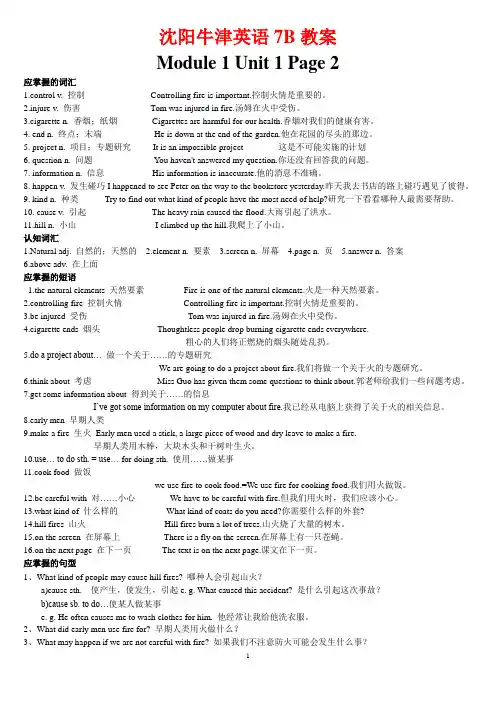
沈阳牛津英语7B教案Module 1 Unit 1 Page 2应掌握的词汇1.control v. 控制Controlling fire is important.控制火情是重要的。
2.injure v. 伤害Tom was injured in fire.汤姆在火中受伤。
3.cigarette n. 香烟;纸烟Cigarettes are harmful for our health.香烟对我们的健康有害。
4. end n. 终点;末端He is down at the end of the garden.他在花园的尽头的那边。
5. project n. 项目;专题研究It is an impossible project 这是不可能实施的计划6. question n. 问题You haven't answered my question.你还没有回答我的问题。
7. information n. 信息His information is inaccurate.他的消息不准确。
8. happen v. 发生碰巧I happened to see Peter on the way to the bookstore yesterday.昨天我去书店的路上碰巧遇见了彼得。
9. kind n. 种类Try to find out what kind of people have the most need of help?研究一下看看哪种人最需要帮助。
10. cause v. 引起The heavy rain caused the flood.大雨引起了洪水。
11.hill n. 小山I climbed up the hill.我爬上了小山。
认知词汇1.Natural adj. 自然的;天然的2.element n. 要素3.screen n. 屏幕4.page n. 页5.answer n. 答案6.above adv. 在上面应掌握的短语1.the natural elements 天然要素Fire is one of the natural elements.火是一种天然要素。
译林牛津版七年级英语下册7B Unit4 按课时知识点梳理及拓展

9. Remember that they are dangerous. 记得他们很危险。
remember (that)+句子 forget, stop
1
7B Unit4 知识重点及拓展
remember to do … 记得去做某事 (未做) Remember to close the window when you leave remember doing … 记得做过某事 (已经做过)
(4) A is to the…of B (A 与 B 不接壤)
Japan is to the east of China.
Cross the bridge, and you’ll see the elephants.= If
you walk across the bridge, you’ll see the elephants.
go up here 从这儿上去
1. a trip to the zoo . the way to school . the key to the door
go up/ upstairs/ downstairs
. the answer to the question
5. Don’t be afraid. . be afraid of sth. /doing sth.
Japan lies to the east of China. 日本位于中国的东边。
lie, lay 躺,位于 lie, lied 撒谎 lie, lying
躺下 lie down 躺在草地上 lie on the grass
4. all day long = the whole day 整天
. all day and all night 整日整夜
7B Unit 4 Integrated skills教案
(7B)Unit 4 Amazing thingsIntegrated skills and pronunciationDanyan Shiyan Middle SchoolJiang YanfeiTeaching aims and demands:1.To identify specific characteristics in descriptions of animals.2. To listen for gist and detail to obtain general information.3. To use information presented in text and pictures to infer generalmeaning and context.4. To extract specific information from listening to a conversation tocomplete a letter.5. To respond to statements expressing surprise, interest and amazement.6. To describe factual details.7. To ask for specific information using …to be‟ questions.8. To make sure of the pronuciation of “ed”Teaching tools: Tape, projector, picturesTeaching periods: 1 periodTeaching procedures:Step 1 Revision (5‟)1. The name of the animals.2. Revise the amazing things about the animals. Do some exercises.Step 2 Part A (A3) (10‟)1. Check answers as a class activity.2. Ask students to read the notes in Part A1 and A2. Ask some generalquestions to check understanding, e,g., Do you know how many bones there are in a giraffe‟s neck? Only focus on the word …bones‟. Create a situation where you are all learning together. Ask What do you know about tortoises? Have you seen one? Where do they live? Where do camels live? (elicit the ideas of sand, wind, desert, etc.) What do you know about ants? (elicit …insects‟) Do you know of any other insects?How do you feel about insects?3. Ask students to read Suzy‟s letter in Part A3. Ask them to try tocomplete the letter from the information they have already identified in the previous listening and the notes they have made.4. Ask students to compare their notes with a partner and identify anydifferences.5. Play the recording again and ask students to check their answers.6. Divide the class into pairs and tell students to read the letter to eachother taking turns to read one sentence at a time. Students compare and check each other‟s choice of nouns. Encourage students to work out whether their choice of nouns makes sense. Then check students‟understanding. Ask several students to each read one sentence aloud to the class, paying attention to fluency and pronunciation. Then check answers as a class. Encourage all students to make their own comments.Step 3 Part B (10‟)1.Tell students to close their books and listen to the teacher.2.Present the conversation line by line focusing on intonation andlinking of words. Ask students to repeat complete phrases as they hearthem.3.Ask students to practise the conversation in pairs and then changeroles. Then ask students to construct their own conversations based onthe model.4.Ask some pairs to present their conversation to the class.Step 4 Competetion. (7‟)Divide the whole class into four groups, have a PK.Group1: Read and complete the table.Group2: Fill in the blanks.Group3: Listeing test.Group4: Play the guessing game.Step 5 Pronuciation (8‟)Give some examples to let the students make sure how to pronounce the “ed” sound.1.Saying …-ed‟ endingsMost verbs in the simple past tense form have …-ed‟ endings . However, we pronounce these endings differently: /t/, /d/ or /id/ .How do you pronounce the following ending ? Listen carefully and repeat these words .2. How do you pronounce the ending of these words ? Listen carefully and write / t / , / d / or / id / in the blanks .Step 6 Homework1.Write an article about amazing animals.2.Recite the pronunciation of the “-ed ”endings .Blackboard designUnit 4 Amazing thingsIntegrated skills and pronunciation1 Thank you for your help. 5 happen to sb.2 know…about 6 What‟s the weight of…3 tell sb. to do sth. = What does it weigh?4 not …any more= no more/ t /(清辅音后)/ d /(浊辅音后)/ id / (/ t // d /之后)。
第7讲 Unit 4 Finding your way(教案)七年级英语下册(译林牛津版)
主题7B Unit 4(Finding your way) 学习目标1. 掌握Comic strip—Grammar重点词汇、句型;2. 掌握Integrated skills—Self-assessment重点词汇、句型;3. 掌握冠词的用法;4. 掌握表示地点的介词的用法。
教学内容【课堂导学】1、上次课后巩固作业复习;(具体内容无须在此呈现出来)2、互动探索(此部分与上次预习思考相一致,且需要在此部分呈现出来)亲爱的同学们!你们给小明指出路线了吗?First, go straight on and turn right at the park.Next, walk along the Shengping Road and then turn left at the first turning.At last, you will see the barbecue bar at the end of the road.must “必须”,没有人称、数、时态的变化,否定式mustn ’t 表示“禁止” 表示说话人主观上的看法,强调主观上的需要【知识梳理5】Sunshine Zoo is north of Sunshine Middle School. 阳光动物园在阳光中学的北部。
(1) north 名词,意为 ,固定结构为 ,表示 。
指范围之外,且中间有一段距离。
(2) 方位名词与介词in, on, to 连用时的区别含义 用法 in+方位名词在……之内 强调 on+方位名词在……之外 强调 to+方位名词在……之外 强调 【例题精讲】1. The tree is in the north of the school.2. The hill is on the north of the school.3. The cinema is to the north of the school.答案:(1) north 名词,意为“北,北方”,固定结构为be+方位词+of ……,表示“某地在另一地的……方向”。
初三一轮复习(7B-Unit3-4)教学案
7B Unit3—4复习教学案重点词组swim across the pool 横游过泳池have to 不得不get out of the car 走出车子grow large teeth 长着巨大的牙齿drive away 开走run out of the building 跑出大楼run away 逃跑jump out of the van 跳出货车at once 立刻three men in police uniform三个穿警服的人take different routes 走不同的路线take another route 走另一条路be surprised to do 惊讶地做某事stop at the traffic lights 在交通灯处停下catch them in the end 最后抓住他们turn right / left 左转或右转stop talking 停止交谈at a crossroads 在十字路口walk / go along 6th Street沿着第六大街走zebra crossing 人行横道walk / go straight on 一直朝前走the corner of the road 街道拐角处cross the road 穿马路go through a tunnel 穿过隧道walk around the table 绕着桌子走walk down the stairs / steps走下楼梯/台阶jump over the chair 从椅子上跳过railway station 火车站live up to…活到…walk over / cross the bridge走过桥t he way to ……去某地的路 a bridge over a small river小河上的一座桥take her dog with her 带着她的狗walk towards the bridge 朝桥走win the game 赢得比赛see the doctor 看病start a campfire 生篝火walk past the station 路过车站a farewell party 一个告别会half of the students 半数的学生have a barbecue 吃烧烤invite …… to ……邀请某人做某事have a picnic 野餐complete the note 完成这张便条the route to ……去某地的路线amazing things 令人惊奇的东西as usual 像往常一样travel by rocket 乘火箭旅行in Africa 在非洲at the same time 同时keep your eyes open 使你的眼睛睁着walk on tiptoe 踮着脚走anything unusual 任何不同寻常的东西sleep with their eyes open睁着眼睡觉turn around 转身show them the ghost 给他们看鬼be frightened 害怕hear a strange noise 听到奇怪的声音float in water 在水里漂浮run into 闯入say to oneself 自言自语tell somebody everything 告诉别人每件事the animal centre 动物中心take care of / look after 照顾the following Sunday 下个周日be fond of music 喜欢音乐be not afraid any more 不再害怕soft noise 柔和的声音be crazy about 为…疯狂kick a stone or a can 踢石头或罐头cartoon films 卡通电影wake up early 早点醒来a hard-working student 一个勤奋的学生be poisonous 有毒a baby panda show 一个小熊猫展览at birth 在出生时take turns to do…轮流做某事fact sheets 资料单push off 推动the tallest man in history历史上最高的人in the daytime 在白天the weight of 6 elephants六头大象的重量eat 100 pounds of grass 吃100磅的草return ……to the museum guide把…还到博物馆的图书馆smell things as well as dogs can 能像狗一样嗅觉灵敏understand more about animals 更多地了解动物remember your words about tortoises 记住你关于乌龟的话the biggest living animals on land 陆上活着的最大的动物in the back of elephants‟ feet 在象腿的背部walk in the mud easily 在泥地里轻松的行走try to open the door with a knife 尝试用小刀打开后门push them in the back of a van 把他们推进货车后面ask them about the robbers 向他们询问小偷的事walk from the sofa to the window 从沙发走到窗户at the other side of the park 在公园的另一边take the second turning on the right 在第二个拐弯处向右转hear a whisper from the bushes 从灌木丛听到低语make a sound like a whisper 发出一个低语似的声音have enough poison to kill 有足够的毒可杀死语法精讲1. 移动的方向介词(Prepositions of movement)1) 常用的移动方向介词(词组)成反义词:down---up, from---to, into---out of, off---on有关联的:across---over, across---through---past, down---along其他:onto, round2) 使用时的注意点A. across和over:这两个单词都可以用在“过桥”时,walk across/over the bridge,over还可以表示“越过”,climb over the hill, jump over the chair, fly over;B. across和through:这两个单词都表示“穿过”,但across是“从表面横穿”,而through是“从内部穿过”,swim across the river, go across the street / playground, climb through the window, walk through the forest(森林);C. up和down是反义词,up表示“向上”,down表示“向下”。
牛津译林版7B Unit4 Finding your way Integrated skills课件(共19张PPT)
Help them put these sentences in the correct order.
Act your dialogue out!
Act your dialogue out!
How do I get there?
• 1. Why would Daniel like to go to Sunny Garden? • Because there is an English Corner this Saturday afternoon. • 2. Does Daniel need to take a bus there? • No, he doesn’t. • 3. Which way should Daniel go at the traffic lights? • Just cross the supermarket and turn left at the first crossing.
A: Would you like to visit…? B: Yes, I’d love to. How can I get there? A: … B: … A: …Make a dialogue with
your partner B: OK! See you there.
walk past the hill 从旁边走过,路过
Cross the bridge and turn left.
Cross the bridge and turn right.
Take the first turning on the left.
Take the second turning on the right.
at the crossing 交叉路口