
七年级英语7b unit 4 check out教案
新版教案7B Unit4
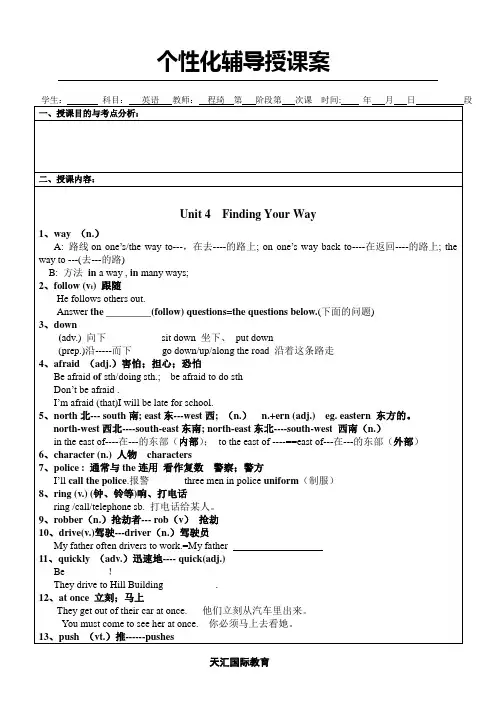
学生:科目:英语教师:程琦第阶段第次课时间: _年月日段一、授课目的与考点分析:二、授课内容:Unit 4 Finding Your Way1、way (n.)A: 路线on one’s/the way to---,在去----的路上; on one’s way back to----在返回----的路上; the way to ---(去---的路)B: 方法in a way , in many ways;2、follow (v t) 跟随He follows others out.Answer the _________(follow) questions=the questions below.(下面的问题)3、down(adv.) 向下sit down 坐下、put down(prep.)沿-----而下go down/up/along the road 沿着这条路走4、afraid (adj.)害怕;担心;恐怕Be afraid of sth/doing sth.; be afraid to do sthDon’t be afraid .I’m afraid (that)I will be late for school.5、north北--- south南; east东---west西; (n.)n.+ern (adj.) eg. eastern 东方的。
north-west西北----south-east东南; north-east东北----south-west 西南(n.)in the east of----在---的东部(内部);to the east of ----==east of---在---的东部(外部)6、character (n.) 人物characters7、police : 通常与the连用看作复数警察;警方I’ll call the police.报警three men in police uniform(制服)8、ring (v.) (钟、铃等)响、打电话ring /call/telephone sb. 打电话给某人。
七年级下册英语优质教案7BUnit4
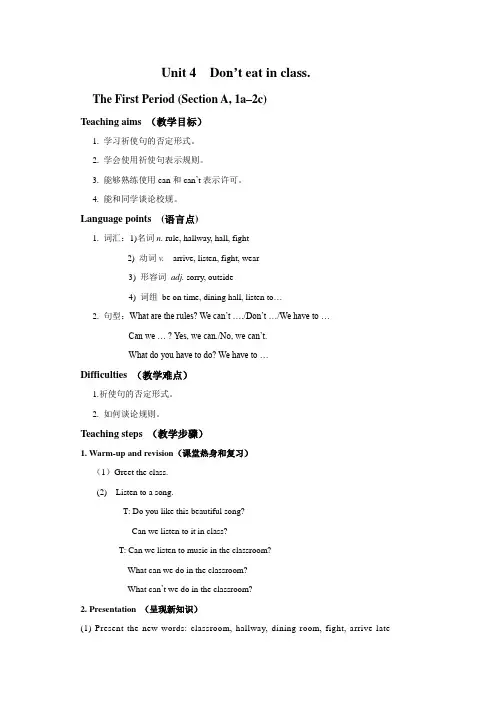
Unit 4 Do n’t eat in class.The First Period (Section A, 1a–2c)Teaching aims (教学目标)1. 学习祈使句的否定形式。
2. 学会使用祈使句表示规则。
3. 能够熟练使用can和can’t表示许可。
4. 能和同学谈论校规。
Language points (语言点)1. 词汇:1)名词n. rule, hallway, hall, fight2) 动词v. arrive, listen, fight, wear3) 形容词adj. sorry, outside4) 词组be on time, dining hall, listen to…2. 句型:What are the rules? We can’t …./Don’t …/We have to …Can we … ? Yes, we can./No, we can’t.What do you have to do? We have to …Difficulties (教学难点)1.祈使句的否定形式。
2. 如何谈论规则。
Teaching steps (教学步骤)1. Warm-up and revision(课堂热身和复习)(1)Greet the class.(2) Listen to a song.T: Do you like this beautiful song?Can we listen to it in class?T: Can we listen to music in the classroom?What can we do in the classroom?What can’t we do in the classroom?2. Presentation (呈现新知识)(1) Present the new words: classroom, hallway, dining room, fight, arrive latefor class.Show some pictures of the new words on the screen. Have Ss read these words.classroom, hallway, dining room, fight, arrive late for class(2) Flash some pictures quickly on the screen. Have Ss say the words according the pictures as quickly as they can.(3) Show some pictures of different activities that are happening in the school.Help Ss understand the school rules.T: Can you run in the hallways? Don’t run in the hallways.T: Can you fight? Don’t fight.T: Can you listen to music in class? Don’t listen to music in class.T: Can you eat in the classroom? Don’t eat in the classroom.You can only eat in the dining hall.T: Can you arrive late for class? Don’t arrive late for class.You must be on time.3. Drill (练习)Show the pictures as quickly as possible. Have Ss say the new words. Then use the new words to make conversations.T: Let’s play a game. Please say the new words as quickly as you can. Then make a conversation like this:A: What are the rules?B: Don’t …4. Work on 1a (完成1a)(1) Which rules are these Ss breaking? Write the number of the rulenext to the student.(2) Talk about the picture with Ss using the target language.5. Work on 1b (完成1b)(1)Listen. What rules are these Ss breaking? Write the numbers after the names.(2) Student A is a new student. Student B tells Student A about the rules.Make conversations with your partner.A: What are the rules?B: Well, we can’t arrive late for class. We must be on ti me.6. Work on 2a & 2b(完成2a和2b)(1)T: Please turn to page 20. Look at the activities in 2a and read them aloud.(2)T: Listen. Check the activities Alan and Cindy talk about.(3)T: Can you get the answers? Listen again and check your answers.(4)T: Listen again. Can Alan and Cindy do these activities? Circle can or can’t.7. Work on 2c (完成2c)Student A is Alan and Student B is Cindy. Talk about the rules in 2a.A: Can we listen to music, Cindy?B: We can’t listen to music in the hallways, but we can listen to it outside.8. Homework (课后作业)The Second Period (Section A, 2d–3c)Teaching aims (教学目标)1. 能使用目标语言谈论学校、图书馆的规则。
7B Unit4(教案)
(活动目的:熟悉课文,老师帮助纠正语音语调。)
Activity 4: Role play
One acts a tour guide, others act tourists.
(活动目的:通过角色扮演,让学生学会指路。)
Finish the guide paper.
七年级 your way
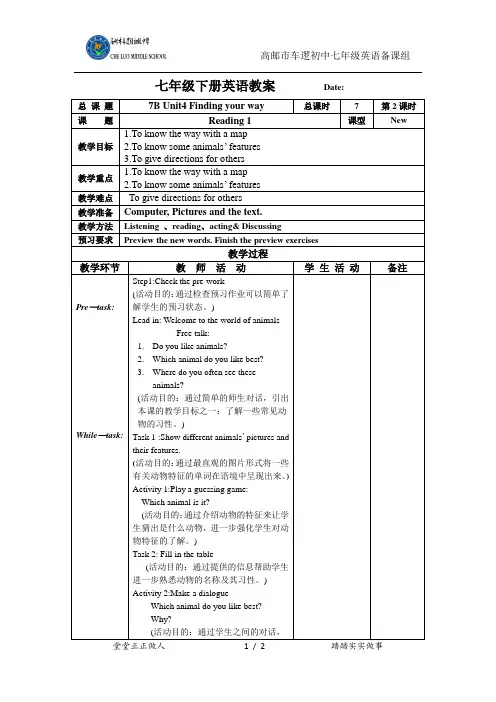
总课时
7
第2课时
课题
Reading 1
课型
New
教学目标
1.To know the way with a map
2.To know some animals’ features
3.To give directions for others
1.How many kinds of animals are there in the article?
2.What are they?
(活动目的:通过学生的略读,大致了解文章所表达的意思。)
Task4: Read freely and make a map.
(活动目的:自由读可以让学生详细了解文章的细节,并且通过绘制地图的形式可以让学生了解动物园里面的各种动物所在的方位。)
教后反思
Task 2: Fill in the table
(活动目的:通过提供的信息帮助学生进一步熟悉动物的名称及其习性。)
Activity 2:Make a dialogue
Which animal do you like best?
Why?
(活动目的:通过学生之间的对话,锻炼学生的口语交际能力。)
Task 3: Watch the video and answer questions.
人教版新目标 七年级英语初一上册Unit4单元教案设计含教学反思
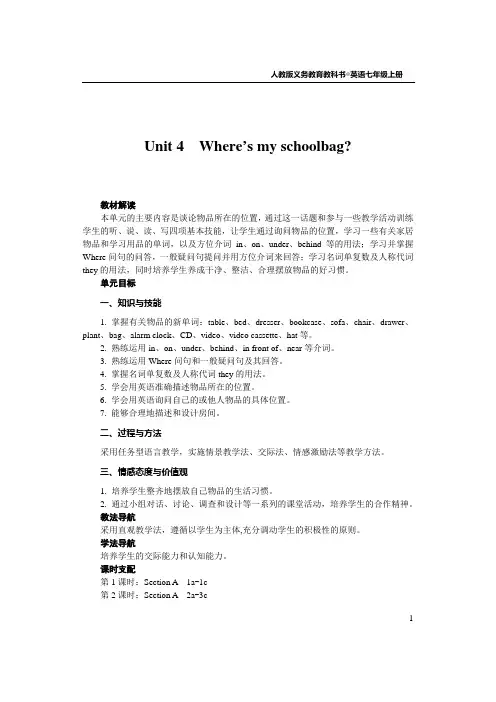
人教版义务教育教科书◎英语七年级上册Unit 4 Where’s my schoolbag?教材解读本单元的主要内容是谈论物品所在的位置,通过这一话题和参与一些教学活动训练学生的听、说、读、写四项基本技能,让学生通过询问物品的位置,学习一些有关家居物品和学习用品的单词,以及方位介词in、on、under、behind等的用法;学习并掌握Where问句的问答,一般疑问句提问并用方位介词来回答;学习名词单复数及人称代词they的用法,同时培养学生养成干净、整洁、合理摆放物品的好习惯。
单元目标一、知识与技能1. 掌握有关物品的新单词:table、bed、dresser、bookcase、sofa、chair、drawer、plant、bag、alarm clock、CD、video、video cassette、hat等。
2. 熟练运用in、on、under、behind、in front of、near等介词。
3. 熟练运用Where问句和一般疑问句及其回答。
4. 掌握名词单复数及人称代词they的用法。
5.学会用英语准确描述物品所在的位置。
6.学会用英语询问自己的或他人物品的具体位置。
7. 能够合理地描述和设计房间。
二、过程与方法采用任务型语言教学,实施情景教学法、交际法、情感激励法等教学方法。
三、情感态度与价值观1. 培养学生整齐地摆放自己物品的生活习惯。
2. 通过小组对话、讨论、调查和设计等一系列的课堂活动,培养学生的合作精神。
教法导航采用直观教学法,遵循以学生为主体,充分调动学生的积极性的原则。
学法导航培养学生的交际能力和认知能力。
课时支配第1课时:Section A 1a-1c第2课时:Section A 2a-3c第3课时:Section B 1a-1e,1第4课时:Section B 2a-Self Check课时教案第1课时Section A1a-1c教学目标一、知识与技能1. 方位介词:in、on、under、behind、in front of、near等的用法。
七年级英语下册7Bunit4教案人教新目标版
Revision Plan for Unit 4 7B执教人:执教班级:执教时刻:年月日Content: the contents of 7B Unit 4Period:6-4Teaching aims and demands:1. Words and phrases2. Recognize and use adjective to describe degree of feelings of likes and dislikes.3. Recognize exclamations and use ‘What’ and ‘How’ to express strong feelings.4. Recognize and use possessive adjectives and possessive pronouns5. Use the nouns with 's to show possessive.Difficult points:Recognize exclamations and use ‘What’ and ‘How’ to express strong feelings.What + a noun phrase!How + adj.!Recognize and use possessive adjectives and possessive pronouns.my mineyour yourshis hisher hersit itsour oursTeaching aids: multi-mediaTeaching methods: Practicing Task-basedTeaching procedures:Exercise (建议设置为16K纸,正好是2页)一、翻译以下词组。
1. as usual around3. something unusual into5. say to oneself care of7. find out birth9. belong to off11. 连番做某事 12.剪头发13 .把┉┉还给┉┉ 14. in history15. as well as 16.活到90岁17.用舌头品尝 18.在┉┉一生中19. more about sth. 20. the most dangerous二.用所给词的适当形式填空1. This isn’t your jacket. It’s (she)2. We take turns to clean the (teacher) office3. Eggs are healthy food but some people (like) eating them.4. I have no more money, so I can buy (something)5. Thank you for (give) me presents and flowers.6. I saw a lot of people (go) into next room.7. Fire can be very (danger) with fire8. I hope it (be) tomorrow, because I (visit) the Great Wall with myclassmates.9. When and where we (meet)?10. We had nothing (do), so he (suggest) (go) to theschool (play) basket.三.依照短文内容,用所给词的正确形式填空。
七年级英语牛津版7bunit4教案

七年级英语牛津版7bunit4教案篇1:七年级英语牛津版7BUnit4教案七年级英语牛津版7BUnit4教案Unit 4 Amazing things Part 1: Teaching design 第一部分教学设计Unit goals ●Learn about interesting facts and strange things about nature, people and animals, especially about animals. Make sure the students can speak or write about some amazing things. ●Learn to use adjectives to describe degree of feelings of likes and dislikes. Recognize exclamations and use‘What ’and ‘How’ to express strong feeling.●Learn to talk about possessions, using possessive adjectives and possessive pronouns. Learn to use apostrophe with ‘s’ to showpossession. Vocabulary amazing, bright, strange, usual, unusual, frightened, weak, following, soft, last, crazy, few, early, hard-working, poisonous, excited, black-and-white, yesterday, carefully, later, even, ago, however, once, travel, sneeze, hear, happen, search, kick, dislike, practice, bark, die, appear, weigh, lay, remember, decide, name, invent, Earth, noon, rocket, elephant, tiptoe, plant, lightning, ghost, whisper, bush, noise, reporter, stone, can, cartoon, guide, introduction, pity, dodo, frog, dinosaur, scientist, kilogram, grass, baby, ant, camel, giraffe, tortoise, bone, neck, eyelid, word, goldfish, second, weight, sandwich, piece, scarf, cigarette, star, history, dish, without, during, over, anybody,nobody, everything, himself, UFO Expressions 1. Come on, Eiddie. It’s jus t a plane. 2. Look at its brigh light. 3. A man in the USA was 2.72 meters tall. 4. You can’t sneeze and keep your eyes open at the same time. 5. Elephants walk on tiptoe. 6. As usual, they sat under the tree. 7. Suddenly, they heard a whisper from the bushes behind the tree. 8. They turned around but could not see anything unusual. 9. People in the center would take care of it. 10. Sion is crazy about football. 11. Sandy is fond of music. 12. He barks at anyone who wake him up. Structures 1. It takes about three days to travel from Earth to the moon by rocket.2. Fish sleep with their eyes open.3. There’s no plant life without lightning.4. Isn’t that interesting? Yes, it is.5. He was now sure the sound came from the bushes.6. There were so many amazing things in the museum.7. The last ones died more than 60 million years ago.8. my father found it interesting too.9. It’s also interesting to knowthat each eye of a camel has three. 10. Let me go with you then. Period 1 Comic Strip + Wele to the unitTe aching goals ●To introduce students to unusual phenomena and events ●To use adjectives to describe feelings and opinions Teaching procedures Step 1 Presentation (The teacher can present a picture which can make the students feel amazed, such as an advertisement about a pair of very huge shoes.) Ask: Look at this picture. How do you feel when you see such big shoes? The world around us is full of amazing things. (on the blackboard) What do you usually see in museum? What do you think you will see in the Funnyworld museum? (Ask the students to use their heads and answer the questions.) (The teacher shows the pictures on P61 Part A to the students one by one. Teach the new words and phrases according to the pictures.) What can you see in the picture 1? I can see… (Present the new words and phrases: lightning, plant life, rocket, from Earth to the moon, at the same time, elephants, walk on tiptoe, with eyes open) Step 2 Consolidation Ask the students to fill in the blanks. 1. It takes about three days to ________ from ________ to the________ by rocket. 2. A man in the ________ was 2.72 meters tall. 3. Fish sleep with their eyes ________. 4. You cannot ________ and keep your eyes open at the same time. 5. ________ walk on tiptoe. 6. There is no ________ life ________ lightning. Step 3 Practicing Divide the class into pairs. A: What can you see inthe picture? B: I can see… A: Do you know that …? B: Oh, really? A: Isn’t that interesting? B: Yes, it is. (Let the students read the words, expressions and sentences correctly by practicing the dialogue.) Step4 Presentation One day, Eddie and Hobo both saw a strange thing, what is it? Let’s look at the picture. (The teacher presents the pictures to the students.) Eddie and hobo are talking about something strange int he sky. Let’s look at he pictures and try to talk about these pictures. Step 5 Listening Play the tapeof ic strip. Before listening, ask a question: Whatare Eddie and hobo talking about? (A strange thing.) Listen again. Try to answer the following questions: 1. Where’s Eddie? What does he see? 2. What does Eddie think of the strange thing? What’s hobo’s idea? 3.Why does Eddie think it’s a UFO? 4. Why does Eddie think it’s not a plane? Step 6 Practicing 1. Read the dialogue 2. Act it out. Step 7 Summary Today we have learned some amazing things. Try to find more amazing things around you. Then tell the other students. Step 8 Consolidation exercises Translation 1. 乘火车从南京到上海旅行大约需花四个小时左右。
7BUnit4教案新译林版英语七年级上册
仪征市古井中学集体备课教案
年级:初一学科:英语备课人:赵家荣
仪征市古井中学集体备课教案
年级:初一学科:英语备课人:赵家荣
仪征市古井中学集体备课教案
年级:初一学科:英语备课人:赵家荣
仪征市古井中学集体备课教案
年级:初一学科:英语备课人:赵家荣
仪征市古井中学集体备课教案
年级:初一学科:英语备课人:赵家荣
仪征市古井中学集体备课教案
年级:初一学科:英语备课人:赵家荣
仪征市古井中学集体备课教案
年级:初一学科:英语备课人:赵家荣。
初一英语导学案(7B unit 4 Integrated skills --Checkout)
初一英语导学案(7B unit 3 Integrated skills --Checkout)学院培训姓名:自主学习1.live up2.as well as3.the weight of4.talk to sb.5.decided to do sth.6.at the age of7.set up 8.see you soon9.I still cannot believe that a tortoise can live up to 150 years .10.I now understand why my mother always tells me to clean the table agter a meal—I knowants can smell things as well as dogs can .11.Is there anything about animals in the book ?12.It says that we eat about 27000 kilos of food during our lives .13.They don’t know what happened to them three seconds ago .14.We decided to go there again next time .15.Then he put meat between two pieces of bread and it as dinner so he could keep onplaying .16.In 1936 , the world’s first TV station--BBC, was set up in London .Explanation:1.live up to , “活到......”,其中up to 用在数字前时,意为“多达,高达”。
如:His grandpa lived up to 90 . 他爷爷活到了90岁。
7BUnit4教案(7份)
Unit 4 Finding your wayComic strip and Welcome to the unitTeaching Aims:1. Introduce the location and traffic topic.2. Talk about visit and traffic mode3. Distinguish directions.Step 1. Presentation1. Show some pictures to learn some words about different directions.trip path north south east west north-west north-east south-west south-east2. Then read aloud the new words.follow vt. 跟随,效仿path n. 小路,小径north n., adj. &adv. 北,北方west n., adj. &adv. 西,西方south n., adj. &adv. 南,南方east n., adj. &adv. 东,东方trip n. 旅行,旅游kilometre=km n.千米,公里have to 不得不,必须Step 2. Practise1. Practise in pairs like this to talk about where the place is.A: Where is …? (旅游)?B: It‟s north / south/east/west of …2. Ask students to complete Part A on Page 43.Step 3. PresentationPresent some pictures for Ss to learn how to get there. Then ask Ss to make some dialogues.Step 4. Listen and answer1. Listen to part B and answer the following question.Where are they going for their class trip?Where is the zoo?How will they get there?2. Read after the recorder.3. Practice in pairs.4. Act it out.5. Make their own dialogue.Step 5. Learn the conversation1. Listen to the tape and ask:1) Where are Hobo and Eddie standing?2) What does Hobo ask Eddie to do in the picture?3) Do they have to go up the hill again?4) Does Hobo really know the way?Keys:1. They are on the top of the hill.2. He asks him to go down the hill.3. Yes, they do.4. No, he doesn‟t.2. Act out the conversationStep 6. Explanation1. 方位介词的用法小结be north/ south/ west/east of... 在……北部/南部/西部/东部be north-east/ south-west of... 在……东北部/西南部be north-west/ south-east of... 在…… 西北部/东南部A is in the...ofB (A在B内部……方位)A is on the…ofB (A与B接壤)A is to the…ofB (A与B不接壤)2. be afraid of doing sth./ of sth. 害怕做某事be afraid that…I‟m afraid…Step 7. ExercisesTranslation.1. 别这么肯定。
7A unit4(checkout) 教学案
7A UNIT 4 FOOD(checkout)课型:新授执笔:鲁河中学陈寿红审核:初一年级英语组一、教学目标:1,能熟练掌握与本单元话题有关的词汇和语法。
2,对本单元进行回顾和学习。
3,对所学内容进行自我检测。
二、课前准备: (上课前预习一下课文,对你可有帮助啦,行动起来吧!)1, 大声认读下面的词,词组和句型吧!坚持用音标拼读,对照录音。
并了解它们的中文意思。
不会的请记录下来。
词:list,2, 总结本单元所学的食物名称,分类,分清可数与不可数,看谁总结得多。
3, 复习可数名词单复数变化。
4, 复习there be句型。
5, 复习冠词的用法。
6, 填写好P73。
通过预习,你还有哪些方面存在疑问?(检测一下预习的效果,比一比谁最棒。
)A、按要求变换词形:1, story(复数)2, kilo (复数)3, hate (反义词)4, health (形容词)5, mango (复数) 6, with (反义词)7, tooth (复数) 8, knife (复数)B, 动词填空:1, Sometimes she (watch) TV in the evening.2, He seldom (go) to his uncle’s.3, You must (do) your homework.4, She needs (see) a doctor.5, She likes fish, but she (not like) meat.三、知识链接:1, list n.“清单”, v. “列举”,make a shopping list 拟一个购物清单,list different kinds of food 列举不同的食物四、教学过程:1, 让学生列举食物名称,分类,弄清哪些是健康的。
2, 完成P73 Part B。
3, 询问学生做事的频率,复习频率副词。
4, 学生两人一组谈论自己的阴虱习惯和生活方式。