
新译林版英语九年级上册unit4状语从句
英语时间状语从句讲解与练习
(一)when, while 和 as 引导时间状语从句的用法一、when 的用法
如果只从现象来看,when 从句用的最多的是一般过去时,而主句的时态没有限制,根据具体情况而定。
1. When he was a child he was always trying out new ideas. 他小时候就常试一些新的设想。
2. When she came into my room, I was just reading a book. 她走进我房间时,我正在看书。
根据以上的例句,我们可以总结出一点:when 从句的A事件,相当于另一个事件B发生的时间点。也就是说,when 从句的重点不在动作本身发生的状态,而只是把它作为一个时间点,所以when 多数情况下用的是一般过去时,则不用正在进行时。因为如果用正在进行时,它表示的就是一段时间而不是一个时间点了。根据这一点,有的文章补充说:when 从句的动词大多是瞬时动词。这种说法也可以参照。
实际上,when 从句也可以有其它的时态,但几乎也不用进行时,因为它也只是作为一个时间参照点。例如:
1. When I got to the airport, the guests had left. 当我赶到飞机场时,客人们已经离开了。
2. When he had finished his homework, he took a short rest.
当他完成作业后,他休息了一会儿。
3. Why do you want a new job when you have got such a good one already?
二、while 的用法
相比于when 来说,while 从句的侧重点就不一样了。while 从句的侧重点在于描述动作正在发生的状态,它的意思是:当while 事件正在发生的时候,另一件事如何如何。所以,while 从句一般用的是正在进行时。而另一件事的状态没有硬性的要求,根据具体情况而定。例如:
1. While my wife was reading the newspaper, I was watching TV.
当妻子正在看报纸的时候,我正在看电视。
2. While Jim was mending his bike, Lin Tao came to see him.
正当吉姆修自行车时,林涛来看他。
从时间的角度来看,while 表示的是一段时间,是一个过程。这是while 的侧重点。因此,如果含有“一段时间”的含义的时候,就可以用while。
Strike while the iron is hot. 趁热打铁。
这句话中,是说趁着铁是热的这段时间,赶紧打铁。如果换成 when 意思就变了,相当于说铁只热了一下,打一下,然后铁就冷了。这显然不符合文意。
三、as 的用法
as 从句表示的也是一件事情正在发生,另一件事也正在进行当中。但与 while 从句不同的是,as 从句用的一般不用正在进行时,而只是一般过去时。as 从句一般可以翻译成“边……边……”。例如:
1. As my mother sang those old songs, tears ran down her cheeks.
当我妈妈唱起那些老歌时,眼泪顺着她的脸颊流了下来。
2. The students took notes as they listened. 学生们边听课边做笔记。
as 表达的事件,往往只是主句动作发生的背景或条件时,as 只是一个次要的时间说明,不像while 从句有强调 while 动作本身的意思。因此,as 常常翻译成“随着……”之意。
例如:
1. As the time went on,the weather got worse. 随着时间的推移,气候更加糟糕。
2. As years go by,China is getting stronger and richer. 随着时间一年一年过去,中国变得越来越富强了。
少数情况下,如果强调动作正在发生,as 从句也可以用正在进行时。这只能算是特例了。
1. The sad mother sat on the roadside, shouting as she was crying.
伤心的妈妈坐在路边,边哭边叫喊。
2. As we were going out, it began to snow. 正当我们出门时,雪开始下起来。
四、when, while, as 的互换
如果从句动作和主句动作同时发生,并且从句动作为延续性动词时,when,while,as 可以互换使用。
1. When /While /As we were dancing, a stranger came in.
当我们跳舞时,一位陌生人走了进来。 [dance 为延续性动词]
2. When /While /As she was making a phone call, I was writing a letter.
当她在打电话时,我正在写信。 [make为延续性动词]
五、比较while, when, as
1)as, when 引导短暂性动作的动词。
例如:Just as / Just when / When I stopped my car, a man came up to me.
我刹车后,有一个人向我走来。
2)当从句的动作发生于主句动作之前,只能用when 引导这个从句,不可用as 或 while。
例如:When you have finished your work, you may have a rest.
干完活后,你可以休息一下。
3)从句表示“随时间推移”连词能用as,不用when 或while。
例如: As the day went on, the weather got worse. 日子一天天过去,天气越变越坏。
(二)before和after引导的时间状语从句
1.Before是主句动作发生在从句的前面。注意before引导的从句不再用否定式的谓语,并且当before引导的从句位于主句之后,有时译成“就,才”。还要注意主句和从句之间的时间关系。当主句用将来时,从句总是用现在时;如果before引导的从句谓语用的是过去时,则主句动词多用过去完成时,这样以便体现动作发生的先后。
2.After表示主句动作发生在从句动作之后。主句和从句的动作的时间关系正好与before引导的从句相反。例如:
It will be four days before they come back. 他们要过四天才能回来。
Einstein almost knocked me down before he saw me.爱因斯坦几乎把我撞倒才看到我。
(三)比较until和till 的用法
此两个连词意义相同。肯定形式表示的意思是“做某事直至某时”,动词必须是延续性的。否定形式表达的意思是“直至某时才做某事”。动词为延续性或非延续性都可以。正确使用这两个连词的关键之一就在于判断句中的动词该用肯定式还是否定式。
肯定句:I slept until midnight. 我一直睡到半夜时醒了。
Wait till I call you. 等着我叫你。
(在肯定句中可用before代替。例如:Let's get in the wheat before the sun sets.)
否定句:She didn't arrive until 6 o'clock. 她直到6点才到。
Don't get off the bus until it has stopped. 公共汽车停稳后再下车。
I didn't manage to do it until you had explained how. 直到你教我后,我才会做。
区别:1)until可用于句首,而till通常不用于句首。
例如:Until you told me, I had heard nothing of what happened.
直到你告诉我以前,出了什么事我一点也不知道。
3)until when 疑问句中,until要放在句首。例如: ---Until when are you staying? 你呆到什么时候?
--- Until next Monday. 呆到下周一。
注意:否定句可用另外两种句式表示。
4)Not until…在句首,主句用倒装。
例如:Not until the early years of the 19th century did man know what heat is.
直到19 世纪初,人类才知道热为何物。
Not until I began to work did I realize how much time I had wasted.
直到工作,才认识到我已蹉跎了许多岁月。
5)It is not until… that….
例如:It was not until I began to work that I realized how much time I had wasted.
(四)巧辨before和until
在日常英语教学中,我们遇到学生问这样的一些问题:1.He will spend six hours at his
desk____he finishes his composition.
A.beforeB.untilC.afterD.when
2.The bike hit the tree____I could get off.
A.whenB.before C.whileD.until
3.I knocked at the door for more than five minutes____Mrs white answered it.
A.until B.when C.afterD.before
4.It was____yesterday____be____the secret.
A.not until;that;knewB.until;when;knew
C.not before;that;foundD.before;that;didn't find
怎样才能清楚地解释其选择的原因,这就涉及到until与before的区别问题。 实际上,只要我们把握住两者使用时本身的含义及主句动词是终止性的,还是延续性的,肯定式,还是否定式两大点,就能容易地解决这类问题。现详细阐明如下: 一、在下列情况下,两者可互换用,但含义略有不同。before表示“在……之前”的意思,强 调时间先后关系;而until表示“直到……才”的意思,主句是肯定句则表示主句动作的终
译林版九年级上册英语Unit 4 Growing up单词用法梳理-

译林版九年级上册英语Unit 4 Growing up单词用法梳理-
1 / 9 Unit 4 Growing up
一、重点单词、词组
1. on one’s mind:挂在心上,惦记;有心事
如: She looks very worried, I wonder what's on her mind. 她满面愁容,不知有什么心事。
注意学习与mind相关的词组: make up one’s mind下定决心,拿定主意
change one’s mind改变注意。
练习:
(1) Harry, who had failed in the final exam, had a great worry _____ his mind
A. on B. to C. with D. at
(2) Don't bother your father tonight, he's got a lot _____ his mind.
A on B. to C. on D. around
(3) Fred, who had expected how it would go with his daughter, had a great worry _____ his mind.
A. on B. in C. with D. at
(4) 汤姆,你有什么心事?
___________________________________, Tom?
(5) 此事挂在我心头已有数月,但依然毫无头绪。
This matter ___________________________________, but I still haven't got a clue.
【答案】:ACA What’s on your mind; has been on my mind for several months.
Unit 4时间状语从句(重点语法提升练)(牛津译林版)

2022-2023学年九年级英语上册单元模块满分必刷题(牛津译林版)
Unit 4【刷语法】(重点语法提升练)
时间状语从句
时间状语从句
引导词 用法 例句
when when引导的时间状语从句中既可接延续性动词,也可接非延续性动词 They were talking happily when I walked past the
door.当我从门前走过,他们正在开心地聊天。
while while强调主句和从句动作同时发生,所引导的时间状语从句只能用延续性动词,多用进行时态。 My mother was cooking while I was doing my
homework.
当妈妈在做饭的时候,我在做作业。
not … until 主句的谓语动词为非延续性动词,主句要用否定式,从句用肯定式。 The bus won’t start until everybody gets on.
公共汽车直到每个人都上车才会发动。
since 主句谓语动词一般用现在完成时,从句谓语动词一般用一般过去时。 Five yeas has passed since we saw each other last
time.
距离我们上次见面已经五年过去了。
before before 引导的从句表示主句的动作发生在从句动作之前。 We turned off the light before we left.
我们在离开前关了灯。
after after 引导的从句表示主句的动作发生在从句动作之后。 He went to bed after he finished his work.
他做完工作后就去睡觉了。
as soon as 若主句为一般将来时,从句常用一般现在时表将来。 I will tell him the news as soon as I see him.
我一看见他,就会告诉他这个消息。
一、单项选择
初中英语 江苏专版牛津译林九年级上册 Unit 4 知识点总结

1 译林版九上U4知识点总结
1. What's on your mind,Eddie? 你在想什么呢,埃迪?
解析:on one's rmind意为“挂在心上;惦念”,其中的mind是可数名词,意为“头脑,思想”。
例:He is very worried these days. He's got a lot on his mind.
这几天他很担心。他烦心事很多。
拓展:mind v. 意为“关心,照顾;介意;在乎;反对”,常用于疑问句、否定句或条件句中,其后常接名词、代词或动词-ing形式做宾语。
例:Do / Would you mind opening the door? 请你把门打开好吗?
固定搭配:含mind的短语
never mind不要紧 keep ... in mind 记住....
change one's mind 改变主意 make up one's mind 做出决定
2. Growing up is hard! 成长真难啊!
解析:该句是动名词短语做主语,谓语动词用单数形式。
例:Playing computer games is great fun.
玩电脑游戏很有趣。
3. You' ve been happy since I first met you.
自从我第一次见到你,你就一直很快乐。
解析:first做副词,意为“第一;首先,起初”。
例:First I'l1 call your narmes. 首先我来点名。
辨析:first,at first,firstly
(1) first和at first都可表示“起初,开始的时候”,first多用在句中,而at first常用在句首或句末;first还可意为“第一”。
(2) firstly通常仅限于列举事例、排列顺序,这时可用first替换。
4. Don't wake me up until you finish building it.
Unit4Grammar时间状语从句语法复习牛津译林版英语九年级上册
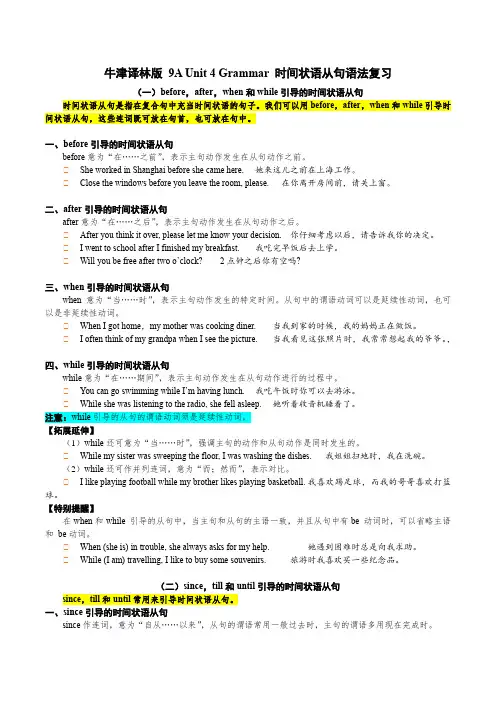
牛津译林版 9A Unit 4 Grammar 时间状语从句语法复习
(一)before,after,when和while引导的时间状语从句
时间状语从句是指在复合句中充当时间状语的句子。我们可以用before,after,when和while引导时间状语从句,这些连词既可放在句首,也可放在句中。
一、before引导的时间状语从句
before意为“在……之前”,表示主句动作发生在从句动作之前。
▶ She worked in Shanghai before she came here. 她来这儿之前在上海工作。
▶ Close the windows before you leave the room, please. 在你离开房间前,请关上窗。
二、after引导的时间状语从句
after意为“在……之后”,表示主句动作发生在从句动作之后。
▶ After you think it over, please let me know your decision. 你仔细考虑以后,请告诉我你的决定。
▶ I went to school after I finished my breakfast. 我吃完早饭后去上学。
▶ Will you be free after two o’clock? 2点钟之后你有空吗?
三、when引导的时间状语从句
when意为“当……时”,表示主句动作发生的特定时间。从句中的谓语动词可以是延续性动词,也可以是非延续性动词。
▶ When I got home,my mother was cooking diner. 当我到家的时候,我的妈妈正在做饭。
▶ I often think of my grandpa when I see the picture. 当我看见这张照片时,我常常想起我的爷爷。,
四、while引导的时间状语从句
while意为“在……期间”,表示主句动作发生在从句动作进行的过程中。
牛津译林版英语九年级上册第四单元知识点
九年级上册
Unit4 growing up
单词
1.time n.时期,时代
【例】The movie is set during the time of the Russian revolution.这部电影以俄国革命时期
为背景。
注意:time作“时期,时代”讲时,经常用其复数 形式。
ancient times古代
people in different times and places不同时代和不同地方的人
【拓展】time n.时间;次数
2. whenever conj. 无论何时
【例】You can go there whenever you want.无论你什么时候想去那里都可以。
注意:whenever相当于no matter when。
【拓展】whenever adv.究竟什么时候
Whenever will you tell us the truth? 你到底什么时候告诉我们真相?
3.through prep.以,凭借
【例】:She got her first job through an employment agency.她通过职业介绍所找到了她的第份工作。
through prep.穿过The sun shone through the window.太阳透过窗户照进来。
4.deal n.很多
【例】In addition to leaves, these animals eat a great deal of fruit.除了树叶之外,这些动物还吃大量的水果。
a great deal (of)大量,许多
注意:a great deal of后接不可数名词。
5.score v.得分
【例】Our team scored five points. 我们队得了五分。
【拓展】score n.分数,成绩
Mr Wang, could you tell me where I can find out the exam scores?王老师,你能告诉我在哪里能查出考试成绩吗?
译林版九年级上册英语Unit 4 Growing up单元知识点梳理
1 Unit 4 Growing up
Comic strip & Welcome to the unit重点单词
1. time n. 时期,时代
time n. 时间;次数
The movie is set at the time of the Russian revolution. 这部电影以俄国革命时期为背景。
2. whenever conj. 无论何时
You can go there whenever you want.
whenever相当于no matter when
whenever adv. 究竟什么时候
Whenever will you tell us the truth?
3. through prep. 以,凭借
She got her first job through an employment agency.
through prep. 穿过
The sun shone through the window.
cross v. 穿过 across prep. 横过
考点详解
1. Growing up is hard! 长大真艰难啊!
动名词或动名词短语在句中作主语时,谓语动词用单数形式。
Walking after supper is good for your health.
动名词还可在句中作表语、宾语或定语。
His hobby is collecting stamps.
I like playing the guitar.
This is a swimming pool. (作定语)
2. What’s up? 怎么了?
What are you doing? What’s up?
What’s up with those two boys?
3. You’ve been happy since I first met you.
since作连词,自从,从句用一般过去时,主句常用现在完成时或现在完成进行时。
牛津译林版九年级英语上册Unit4GrowingupReading教案 (2)
Growingup
教学
目标 1.知识目标:
1)认识、理解本课时中的四会单词。
2)了解词组tryoutfor…loseheart,fromthenon,changeone’smind,goontodosth,asaresult,succeedindoingsth.beinterestedin…,takenoticeof,
giveup
3)理解文章大意
2.能力目标:能使用教材中的词句对课文内容复述
3、情感目标:通过了解SpudWebb的经历,树立对理想积极进取,永不放弃的精神
重点
难点 1、重点:对文章的结构、大意的理解和把握
2、难点:对文章
媒体及准备 1.媒体:PPT
2.教辅:练习册
导学过程 二备
Phase I 预习与展示 Activity1Preview
Ⅰ.Topicsandreport
Topic1:Mydream(Whatdreamdoyouhave?Whatdifficultydoyouhaveachievingyourdream?Whatdoyoudotoovercomethedifficulty?
Topic2:Myidol(Whoisyouridol?What’she/she?What’sspecialabouthim/her?Whatmadehim/herspecial?Whatcanyoulearnfromhim/her?
Prepareoneofthetopicsandreportinclass.
Phase II 学习与检测
Activity2Lead-in&Presentation–Whatcanwedoifwehavedifficultyachievingourdream?
Step1Askandanswer
1.T:Whatarebasketballplayerslike?(Theyaretallandstrong.)
2.T:Isitfora1.7-meter-tallmantoentreNBAandhavemanyachievements?
九年级上册英语Unit 4 Grammar语法讲解-译林版
九年级上册英语Unit 4 Grammar语法讲解-译林版
1 / 3 Unit 4
Grammar
注意回顾学习before, after, when 和 while
before和after引导的时间状语从句
Before是主句动作发生在从句的前面。注意before引导的从句不再用否定式的谓语,并且当before引导的从句位于主句之后,有时译成“就,才”。还要注意主句和从句之间的时间关系。当主句用将来时,从句总是用现在时;如果before引导的从句谓语用的是过去时,则主句动词多用过去完成时,这样以便体现动作发生的先后。
After表示主句动作发生在从句动作之后。主句和从句的动作的时间关系正好与before引导的从句相反。例如:
It will be four days before they come back. 他们要过四天才能回来。
Einstein almost knocked me down before he saw me.
爱因斯坦几乎把我撞倒才看到我。
My father had left for Canada just before the letter arrived.
我父亲恰好在信到之前去加拿大了。
They had not been married four months before they were divorced.
他们结婚还不到四个月就离婚了。
After you think it over, please let me know what you decide.
你仔细考虑过以后,告诉我你是怎样决定的。
After we had finished the work, we went home.
完成工作之后,我们回家了。(从句用过去完成时,主句用一般过去时)
when 的用法
如果只从现象来看,when 从句用的最多的是一般过去时,而主句的时态没有限制,根据具体情况而定。
译林版英语九年级上册_Unit_4_核心词汇变式练(解析版)
1 Unit 4 核心词汇变式练(解析版)
一、whenever conj. 无论何时
【教材原句】
Books allow me to learn about people in different times and places, and I can read them
whenever I want to. 书让我了解在不同的时期和地方的人们,而且无论什么时候我想读书都能读。
【常见用法】
句中 whenever是连词,意为“无论何时”,相当于no matter when,引导让步状语从句。
Whenever you come here,you'll be welcome. =No matter when you come here,you'll be
welcome. 无论你何时来这儿,你都将受欢迎。
【联想拓展】
和whenever一样,可引导让步状语从句的词还有:
whatever =no matter what 无论什么
whoever=no matter who 无论是谁
however =no matter how无论如何;不管怎样
wherever = no matter where 无论在哪里;不管在任何地方
Whatever you do,you must do it well. =No matter what you do, you must do it well. 无论你做什么,都必须做好它。
Wherever he goes,he will take a camera. =No matter where he goes, he will take a camera. 无论他走到哪里,他都带相机。
【典例解读】
1. Dancing on the squares is quite popular among many women,the season is.
Unit4+Growing+up(Reading)教材详解+同步训练 牛津译林版九年级英语上册
Unit4 Growing up
Reading
1. He was very small — much smaller than the other kids at school.他很矮—比学校里的其他孩子要矮不少。
(1) 比较级 + than + the other +复数名词
相当于"比较级 +than +any other +单数名词,表示“比其他(任何)...更...”
Li Hua is taller than the other students in our class.
=Li Hua is taller than any other student in our class.
李华比我们班其他的学生都要高。
2. While attending junior high , Spud tried out for the school team , but he was refused at first because he was too small.上初中时,斯巴德参加了校队的选拔,但起初他因为个子太矮而被拒绝。
(1) try out for sth.参加·选拔(或试演)
Mary decided to try out for a job at an after school reading program last year.
玛丽去年决定去参加一个课外阅读项目(的志愿者)的选拔。
【拓展】
try out 试用(某人);试验
当宾语为代词时,代词应放在 try 与 out 之间
This idea sounds really good but we must try it out.
这个主意听起来确实不错,但是我们必须试验一下。
(2) while 引导的时间状语从句
while[连词]在...期间(此处用法)
引导时间状语从句,表示主句动作发生在从句动作进行的过程中。