
人教版七年级英语语法总结(精品)
1.Turn left on First Avenue and enjoy the
city’s quiet streets and small parks 2. Don’t be late for school. 3. Please write and tell me about yourself. 4. Be quiet. 5. Come in, please. 6. Let me tell you the way to my house.
hope---hoped
3)以重读闭音节结尾的动词,末尾只有一个辅音字 母,应先双写这一辅音字母,再加ed 如 stop---stopped 4)以辅音字母+结尾的动词,先变 “y”为 “i”,再+ed
如 study—studied
cry---crie
不规则动词过去式的变化形式:
教材102页 配套练习片子的练习
现在分词 hearing listening traveling crying walking deciding bringing raining snowing getting
原形动词 ask answer discuss mind join tell lie die enjoy show
过去式 asked answered discussed minded joined told lay died enjoyed showed
过去式 wrote started read got came turned crossed walked became showed
单三动词 writes starts reads gets comes turns crosses walks becomes shows
现在分词 writing starting reading getting coming turning crossing walking becoming showing
原形动词 agree arrive run fight fly meet wait wash water speak teach sing
过去式 agreed arrived ran fought flew met waited washed watered spoke taught sang
单三动词 agrees arrives runs fights flies meets waits washes waters speaks teaches sings
原形动词 hear listen travel cry walk decide bring rain snow get
过去式 heard listened traveled cried walked decided brought rained snowed got
单三动词 hears listens travels cries walks decides brings rains snows gets
现在分词 stopping talking remembering shopping beginning taking forgetting helping washing watching
原形动词 write start read get come turn cross walk become show
单三动词 keeps sleeps spends sends takes stays says studies buys learns practices
现在分词 keeping sleeping spending sending taking staying saying studying buying learning practicing
There be 句型结构讲解:
There be 的一般现在时结构
某地有某物/某时有某事 There is a bank near here. There are many people here on vacation. There isn’t a pay phone across from the bank. Is there a big supermarket near your house?
现在分词 passing relaxing living feeling working building cooking making putting standing leaving cleaning
写作翻译范文:
乡村之旅 星期天,天气晴朗,还很凉快。妈妈让 我带着我的小弟弟到乡下去玩。她告诉我 要好好照顾他。我们沿着公路走,阳光灿 烂,微风拂面。我们看见花儿在向我们微 笑,我们听到了鸟儿在枝头歌唱。这幅景 象真得非常的美丽。当我们感到累的时候, 我们就回家了。我们看见我们的妈妈正在 门口等我们。
现在分词 filling finding having looking liking being knowing wearing telling reading playing
原形动词 stop talk remember shop begin take forget help wash watch
祈使句的复习建议:
掌握祈使句的基本用法和基本形式: 1) 省略第二人称主语 you.
2) 祈使句的肯定形式:Do/Be 开头;
否定祈使句: Don’ t do / Don’ t be开头 3) 为表示礼貌,祈使句前或句末可加please. 句末用please时,please前用“,”隔开。
祈使句的基本含义: 表示请求、命令、劝说、号召、警告等。
过去式 thought grew drew visited played tried sat swam wanted found
单三动词 thinks grows draws visits plays tries sits swims wants finds
现在分词 thinking growing drawing visiting playing tried sitting swimming wanting finding
祈使句的复习方法:
教师设计将陈述句改写成祈使句的练习, 强化祈使句的基本句型结构。 作连词成句的练习,使学生明确祈使句省 略主语和动词原形开头的基本构成形式。 练习写家规,校规的作文,将祈使句的用 法应用到篇章之中。
There be 句型结构复习建议:
复习的层次:
1. be动词与后面名词单复数一致的问题 2. There be 句型结构与have/has的区别 3. There be 句型结构的就近原则
现在分词 agreeing arriving running fighting flying meeting waiting washing watering speaking teaching singing
原形动词 think grow draw visit play try sit swim want find
单三动词 asks answers discusses minds joins tells lies dies enjoys shows
现在分词 asking answering discussing minding joining telling lying dying enjoying showing
过去式 stopped talked remembered shopped began took forgot helped washed watched
单三动词 stops talks remembers shops begins takes forgets helps washes watches
1.句子中的be和后面所跟的名词在数方面必须一致。 2. There be 的肯定式:There be (is/are) 否定式: There isn’t There aren’t 疑问式:is/are 提到there的前面 一般疑问句的回答:Yes, there is/are. No, there isn’t / aren’t. 特殊问句的回答:There is/are
原形动词 pass relax live feel work build cook make put stand leave clean
过去式 passed relaxed lived felt worked built cooked made put stood left cleaned
单三动词 passes relaxes lives feels works builds cooks makes puts stands leaves cleans
原形动词 fill find have look like be know wear tell read play
过去式 filled found had looked liked was/were knew wore told read played
单三动词 fills finds has looks likes is knows wears tells reads plays
七年级英语(下)---语法复习
七年级英语(下)---语法复习内容
1. 冠词的用法 2. 时态:一般现在时 现在进行时 一般过去时 3. There be 句型 4. 句子种类:祈使句 疑问句
一般过去时讲解:
表示:过去某个时间发生的动作或存在的状态。 I got up early yesterday. How was your weekend? It was great. She didn’t play sports last weekend. Did you go to Central Park? Yes, I did. Where did you go on vacation? 1.常带有表过去的时间状语, 如:yesterday, last night, in 2001, just now, two days ago等 2.一般过去时态是由be: was(were) 或 did 来表示
新人教版七年级英语语法知识总结
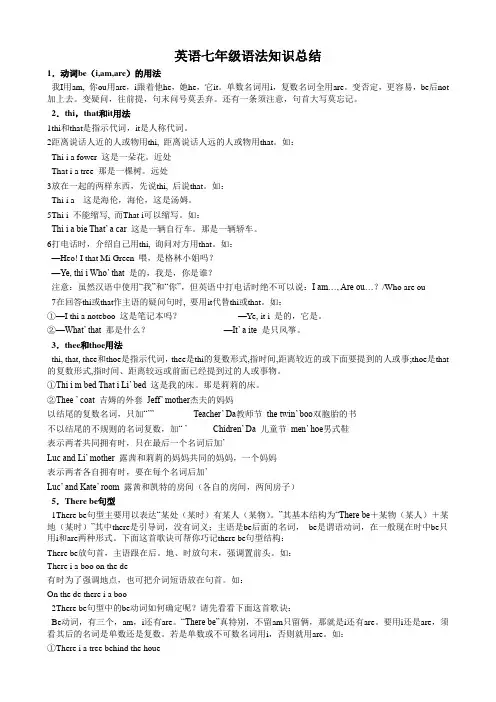
英语七年级语法知识总结1.动词be(i,am,are)的用法我I用am, 你ou用are,i跟着他he,她he,它it。
单数名词用i,复数名词全用are。
变否定,更容易,be后not 加上去。
变疑问,往前提,句末问号莫丢弃。
还有一条须注意,句首大写莫忘记。
2.thi,that和it用法1thi和that是指示代词,it是人称代词。
2距离说话人近的人或物用thi, 距离说话人远的人或物用that。
如:Thi i a fower 这是一朵花。
近处That i a tree 那是一棵树。
远处3放在一起的两样东西,先说thi, 后说that。
如:Thi i a 这是海伦,海伦,这是汤姆。
5Thi i 不能缩写, 而That i可以缩写。
如:Thi i a bie That’ a car 这是一辆自行车。
那是一辆轿车。
6打电话时,介绍自己用thi, 询问对方用that。
如:—Heo! I that Mi Green 喂,是格林小姐吗?—Ye, thi i Who’ that 是的,我是,你是谁?注意:虽然汉语中使用“我”和“你”,但英语中打电话时绝不可以说:I am…,Are ou…?/Who are ou7在回答thi或that作主语的疑问句时, 要用it代替thi或that。
如:①—I thi a noteboo 这是笔记本吗?—Ye, it i 是的,它是。
②—What’ that 那是什么?—It’ a ite 是只风筝。
3.thee和thoe用法thi, that, thee和thoe是指示代词,thee是thi的复数形式,指时间,距离较近的或下面要提到的人或事;thoe是that 的复数形式,指时间、距离较远或前面已经提到过的人或事物。
①Thi i m bed That i Li’ bed 这是我的床。
那是莉莉的床。
②Thee ’ coat 吉姆的外套Jeff’ mother杰夫的妈妈以结尾的复数名词,只加“’”Teacher’ Da教师节the twin’ boo双胞胎的书不以结尾的不规则的名词复数,加“ ’ Chidren’ Da 儿童节men’ hoe男式鞋表示两者共同拥有时,只在最后一个名词后加’Luc and Li’ mother 露茜和莉莉的妈妈共同的妈妈,一个妈妈表示两者各自拥有时,要在每个名词后加’Luc’ and Kate’ room 露茜和凯特的房间(各自的房间,两间房子)5.There be句型1There be句型主要用以表达“某处(某时)有某人(某物)。
(完整版)人教版七年级上册英语全册语法知识点梳理,推荐文档
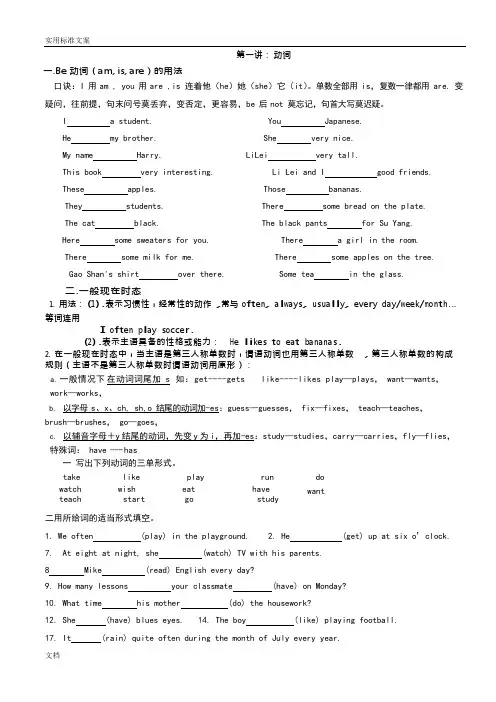
第一讲:动词一.Be 动词(am, is, are)的用法口诀:I 用 am , you 用 are ,is 连着他(he)她(she)它(it)。
单数全部用 is,复数一律都用 are. 变疑问,往前提,句末问号莫丢弃,变否定,更容易,be 后 not 莫忘记,句首大写莫迟疑。
I a student. You Japanese.He my brother. She very nice.My name Harry. LiLei very tall.This book very interesting. Li Lei and I good friends.These apples. Those bananas.They students. There some bread on the plate.The cat black. The black pants for Su Yang.Here some sweaters for you. There a girl in the room.There some milk for me. There some apples on the tree.Gao Shan's shirt over there. Some tea in the glass.二.一般现在时态1.用法:(1).表示习惯性,经常性的动作,常与o f t e n,a l w a y s,u s u a ll y,e v e r y d a y/w ee k/m o n t h…等词连用I o f t e n p l a y s o cc e r.(2).表示主语具备的性格或能力:H e li k e s t o e a t b a n a n a s.2.在一般现在时态中,当主语是第三人称单数时,谓语动词也用第三人称单数, 第三人称单数的构成规则(主语不是第三人称单数时谓语动词用原形):a.一般情况下在动词词尾加 s 如:get----gets like----likes play—plays, want—wants,work—works,b.以字母 s、x、ch, sh,o 结尾的动词加-es:guess—guesses, fix—fixes, teach—teaches,brush—brushes, go—goes,c.以辅音字母+y 结尾的动词,先变y 为i,再加-es:study—studies,carry—carries,fly—flies,特殊词: have --- has一写出下列动词的三单形式。
最新人教版七年级英语语法知识点汇总

新人教版七年级英语语法知识点汇总一.字母和音标1.26个英文字母:5个元音字母a, e, i, o, u (联系汉语拼音中的韵母排列顺序快速记忆)2.48个国际音标:20个元音组合,28个辅音组合.重点辨别相似发音的元音组合.如:[ə] a China breakfast [e] ea head bread [ei] a name cake二.十大词类名词a. 专有名词和普通名词.专有名词指个别的人,事物,地点等专有的名称,如China, Gina. 普通名词如table, chair.b. 可数名词和不可数名词:可数名词有复数形式,如an apple,two apples. 不可数名词一般没有复数形式,如milk, bread, rice.[重点]可数名词的复数变形:有规则变化和不规则变化两种规则变化:○1一般情况直接在词尾加“-s”, 如: bag-bags, day-days, boy-boys, key-keys等.○2以s, x, sh, ch结尾的单词,要在词尾加“-es”, 如: bus-buses, watch-watches, box-boxes等.○3以辅音字母加y结尾的单词,要变y为i再加“-es”, 如:baby-babies, country-countries, family-families等.○4部分以f (e)结尾的单词,要变f (e)为“ves”, 如:knife-knives, half-halves等.顺口溜:小偷(thief)的妻子(wife),为了自己(self)保命(life),站到架子上(shelf),用树叶(leaf)做的小刀(knife),将狼(wolf)劈成了两半(half)○5以字母“o”结尾的单词,没有生命的加“-s”,有生命的加“-es”,如:zoo-zoos, photo-photos, tomato-tomatoes.口诀:黑人(Negro)英雄(hero)爱在火山(volcano)吃土豆(potato)西红柿(tomato)不规则变化:○1改变单数名词中的元音字母:man-men, woman-women, foot-feet, tooth-teeth等. ○2单、复同形:sheep-sheep, Chinese-Chinese, Japanese-Japanese等.○3其他形式如: mouse-mice, child-children等.c. 名词所有格:表示所属关系1. 单数名词词尾直接加’s, 复数名词词尾没有s的也要加’s, 如the boy’s bag 男孩的书包 men’s room 男厕所Children’s Day 儿童节2. 若是复数名词词尾有s ,只加“’”, 如:Teachers’ Day 教师节3. 如果两个名词并列,并且分别有’s,则表示“分别有”;只有一个’s,则表示“共有”,如:John’s and Mary’s room(两间) John and Mary’s room(一间)冠词1.定冠词the:特指某(些)人或某(些)物,如The blue shirt is mine. 蓝衬衫是我的.2.不定冠词a/an: 用来表示“一”这个数量, 其中an放在元音字母开头的名词前面,如an apple, an orange.3.零冠词: 不用冠词的情况.在专有名词,不可数名词,学科名称,三餐和球类运动名称前不用冠词,如:Tian’an Men Square天安门广场I have lunch at school every day.代词(人称、物主、反身代词)物主代词:包括名词性物主代词和形容词性物主代词.前者用法相当于名词,在句中可单独使用,如:--Who’s book is this? --It is mine. 后者用法相当于形容词,在句中不可单独使用,如It is my book.反身代词:表示“自己”,“本身”.指示代词数词1.基数词:表示数目的多少2.序数词:表示事物的先后顺序,往往与冠词the连用基数词变序数词口诀:一、二、三,单独记;八去t,九除e, ve要用f替,整十基数变序数,先把ty变成tie;要是遇到两位数,十位基数个位序,th最后加上去.口诀解析:one→first, two→second, three→third这三个词变化特殊,要单独记;eight →eighth, nine→ninth, 八去t,九去e后再加-th; five→fifth, twelve→twelfth,五和十二把ve换成f再加-th;twenty→twentieth, thirty→thirtieth... 整十先把词尾y改为ie再加-th.两位数时则十位数用基数词,个位数用序数词,如:twenty-first.注:four→fourteen→forty(基数词)fourth→fourteenth→fortieth(序数词)三.时态:一般现在时:a.表示习惯性、经常性、反复性的动作或存在的状态b. 表示事实或客观真理.结构:1. be动词(am, is, are)的用法记忆口诀:“我”用am, “你”用are, is用于“他、她、它”;单数全都用is,复数全部都用are.句子转换:当句子中有be动词或情态动词时,则把be动词或情态动词(can, could 等等)提到主语的前面变成一般疑问句;在be动词或情态动词后面加not变成否定句陈述句:She is a student. 一般疑问: Is she a student? 否定句:She is not a student.2. 实义动词do(除第三人称单数外,谓语动词用原形)句子转换:当句子中既没有be动词,也没有情态动词时,则在主语前加助动词do (I, you, we, they), does(单数she, he, it)变成一般疑问句;在主语后谓语动词前加助动词don’t(I, you, we, they), doesn’t(单数she, he, it)变成否定句,助动词后的动词要变成动词原形.陈述句:We get up at 7:00 every morning.一般疑问句:Do you get up at 7:00 every morning?否定句:We don’t get up at 7:00 every morning.【重点】动词第三人称单数(三单)的规则变化1. 一般在词尾加-s,如: looks, puts, reads, sees等.2. 以-o, -s, -x, -sh, -ch结尾的加-es,如: goes, does, watches, teaches3. 以辅音字母加y结尾的,变y为i再加-es. 注:若是元音字母加y,则直接加-s. 如:fly → flies, try → tries, fry → fries, copy → copiesbuy → buys, enjoy → enjoys, play → plays, say → says, pay → pays总结:三单的变化规律与可数名词复数的(前三种)变化规律相似.现在进行时:1.表示现在(说话的瞬间)正在进行或发生的动作,强调“此时此刻”.如:He is reading . They are talking now.2.表示当前一段时间内的活动或现阶段正在进行的动作.如:They are working on a farm these days.3. 结构:动词be(am/is/are)+V-ingV-ing形式构成:1. 一般在动词词尾加上-ing,如go→going look→looking watch→watching2. 以不发音字母e结尾的动词,先去e,再加-ing. 如write→writing take→taking3. 以重读闭音节结尾,且末尾只有一个辅音字母时,要先将词尾的辅音字母双写再加ing,如run→running shop→shopping get→getting sit→sitting一般过去时:表示过去某个时间里发生的动作或状态;或过去习惯性、经常性的动作、行为(used to);1.句子转换口诀:一般过去并不难,表示过去(动作、状态)记心间. 动词要用过去式,时间状语句末站.否定句很简单,didn't动词(原形)前,其它部分不要变.疑问句也好变,did放在句子前,其它部分依次站.陈述句He(she, it) worked 疑问句Did he(she, it) work?否定句He (she, it)did not work2. 表过去的时间状语如:ago, yesterday, the day before yesterday, last week, last (year, night, month, 具体时间), just now, at the age of , one day, long ago, once upon a time(很久以前)3. 动词变化规则:规则变化:a.一般情况直接加ed,如:work→worked look→lookedb. 以不发音的e结尾的,加-d,如:live →lived hope →hopedc. 以辅音字母+y结尾的,变y为i加ed, 如:study→ studiedd. 以重读闭音节结尾的,末尾只有一个辅音字母,要双写最后的辅音字母加-ed,如: stop→ stopped plan→planned不规则变化:过去时和原形相同, 如:cut→cut read→read四.There be句型结构1. 结构的主谓一致.There is/are+某物/某人+某地/某时表示某地或某时存在某事或某人.句子的结尾往往带有地点状语或时间状语.其中there是引导词,本身没有词意,be是谓语动词,be后面的名词是主语.be的数与后面的名词一致,若be后是两个或多个并列的名词,be则与靠得最近的那个名词的数一致.如There was a meeting yesterday. 昨天有个会议比较:There is a pen, two books and many pencils on the desk. 桌上有一支钢笔、两本书和好些铅笔.There are two books, a pen and many pencils on the desk2.there be的否定、疑问及其回答式(1) 否定式:be后面加not(any)或no.如:There are not any boats on the river. 河上没有船.(2) 疑问句:把be移到there之前.如:Were there many boats on this river? 过去这条河上有许多船吗?回答:Yes, there were. / No, there weren’t.五.句子种类祈使句:表命令、警告、提醒、建议、请求、叮嘱、号召等,谓语动词用原形.主语you通常省略,句末用叹号或句号.肯定式以动词原形开头,否定式在动词原形前加don’t. 如:Don’t arrive late for class. Practice the guitar every day.为了表示礼貌,常在句首或者句末加please,在句末以“,”隔开.如:n,please. Please call me!Let’s祈使句: 包括听话者本人在内,表示建议.如:Let’s go home. 我们回家吧!一般疑问句及特殊疑问句1、一般疑问句:能用Yes或No来回答的问句.一般疑问句句尾读升调.Is he a teacher? Yes, he is./ No, he isn’t.2、特殊疑问句:不能用Yes或No来回答的问句,句尾读降调.(由五个W一个H来引导特殊疑问句)–How was your trip? –It was great.–Where’s Gina? –She is in the teacher’s office.六.情态动词:是一种本身有一定的词义,表示说话人的情绪,态度或语气的动词,但不能单独作谓语,只能和其他动词原形构成谓语.can的基本用法:1.表示能力.I can speak English. 我会讲英语.2.表示许可.You can play football on weekends. 你可以在周末踢足球.3.表示请求.Can you help me? 你能帮助我吗?must表示“必须”. You must read a book before you watch TV.have to表示“不得不”,“必须”,如We have to be quiet in the library.二者区别:1. must表示说话人主观的看法,have to往往强调客观需要.如:I must go.It is a little late and I have to go now.2.否定意义不同:mustn’t 表示“禁止”,而don’t have to 表示“不必”.You mustn’t talk to your mother like that.You don’’t want to.3.must 没有人称和数的变化,但have to有I/You/They must do it now.She has to finish her homework today.八.介词介词是一种虚词,它不能单独担任句子成分,必须与名词或代词或相当于名词的其他词类、短语或从句构成介词短语,才能担任句子成分.1. 表示时间的介词at,in,onA. at:用于表示时刻、时间的某一点at 6 o’clock 在6点at lunch在午饭时at breakfast早餐时at noon正午时at that time那时B. on用于表示某天,某一天的上、下午(指具体的某一天,一律用on)on Monday在周一on Tuesday morning在周二早上 on June 6 在6月6日C. in用于表示周、月、季节、年和泛指的上午、下午、晚上(指在一段时间内)in the afternoon在下午in the week在这周in the holiday在假期中D. for 后面跟一段时间:for two days/hours2. 表示场所、方向的介词at,in,onA.at在某地(表示比较狭窄的场所, 小地方) at school上学at home在家B. on在...上面,有接触面on the desk 在桌子上面on the map在地图上C.in表示一个范围(大地方)in Beijing/China in the water3.固定搭配By+交通工具by bus/ train/plane/bike/subway重点:动词和介词的连用,如:arrive at/in 到达ask for 请求get off 下车listen to 听help sb with sth 帮助某人做某事talk about 谈论look at 看;注视。
(完整)[初一英语]新人教版七年级上册全册语法总结,推荐文档
![(完整)[初一英语]新人教版七年级上册全册语法总结,推荐文档](https://360docs-1393072327.cos.ap-beijing.myqcloud.com/b81e8dce2e3f5727a5e962af.webp)
七年级上册语法总结一、词类词类英语名称意义例词名词Noun (n.)表示人或事物的名称boy, pencil, book冠词Article (art .)用在名词前帮助说明名词的所指的人或事物a, an, the代词Pronoun (pron.)用来代替名词、形容词或数词we, this, what形容词Adjective (adj.) 修饰名词,表述人或事物的特征old, red, good数词Numeral (num.) 表示数量或顺序one, first, thirteen动词Verb (v.)表示动作或状态look, go, play副词Adverb (adv.) 修饰动词、形容词或其它副词not, too, here介词Preposition (prep.) 表示名词、代词等和句中其他词的关系in, under,for连词Conjunction (conj.) 用来连接词与词、短语与短语或句子与句子and, or, but感叹词Interjection (interj.) 表示说话时的喜悦、惊讶等情感oh, hello, hi二、名词1.名词:表示人或事物的名称1)总的来说,名词分为专有名词和普通名词两类。
专有名词时个别的人、事物、地点等专有的名称,如:Gina, China等专有名词,专有名词第一个字母要大写。
2)名词按其所表示事物的性质分为可数名词和不可数名词。
可数名词(Countable Nouns)有复数形式,如:an apple, two apples。
不可数名词(Uncountable Nouns)一般没有复数形式,如:broccoli。
3)可数名词有单数(Singular Form)和复数(Plural Form)两种形式,以下介绍可数名词复数形式变化规则:情况构成方法读音例词一般情况加-s 清辅音后读/s/,浊辅音和元音后读/z/ book—books key—keys以o结尾的词加-s 或-es 读/z/ photo—photostomato—tomatoes 以s, sh, ch, x, 等结尾的词加-es 读/iz/bus—buseswatch—watches以ce, se, ze, (d)ge 等结尾的词加-s 读/iz/price—pricesorange—oranges以辅音字母加y结尾的词变y为i,再加-es 读/z/ comedy—comediesparty—parties*本册出现的不可数名词有:broccoli*既可数又不可数名词有:ice cream,salad,chicken2. 名词所有格表示所属关系的一种格式1)-’s所有格情况构成方法读音例句一般情况加-’s 清辅音后读/s/,浊辅音和元音后读/z/ Mike’s father Jim’s de sk以s结尾的复数名词加’读音不变the teachers’ room 表示两人或多人共有时只变化最后一个名词,加-’sJohn and tom’s father表示为各自所有的各个名词后都要变化,分别加-’sTom’s and Lucy’s books2) 无生命的名词的所有格,一般由“名词+of+名词”构成Eg:a map of China 一副中国地图the capital of America 美国的首都*双重所有格由“名词+of+-’s”或“名词+of+名词性物主代词”构成Eg:a friend of my mother’s 一个我妈妈的朋友a friend of theirs/his/hers/ours三、代词1. 含义:代词是代替名词以及起名词作用的短语、不定式、V-ing形式、从句或整个句子的词。
人教版七年级英语上册重点短语总汇,语法总结

人教版七年级英语上册重点短语总汇,语法总结句型(1)-What+be+主语+doing? ….正在做什么?-主语+be+doing。
…正在做某事。
例:-what are you doing?-I’m doing my homework.(2)-Thanks for … 为。
而感谢例:Thanks for your letter.(3)-Here are/is…例:Here are some of my photos.Here is a photo of my family.(4)-That sounds good.(5)-This TV show is boring.三、日常交际用语(1)-Do you want to go to the movices? –Sure.(2)-When do you want to go? –Let’s go at seven.(3)-Where do people play basketball? –At school.(4)-What’s he waiting for?-He’s waiting for a bus.(5)-What’s he reading? He’s reading a newspaper.1)现在在进行时的形式是:助动词be(am,is,are)+动词-ing形式(也叫现在分词),表示现在(说话的瞬间)正在进行或发生的动作。
2)现在进行时的肯定句形式主语+be(am,is,are)+动词现在分词+其他I’m watching TV.3)现在进行时的否定句形式主语+be(am,is,are)+not+动词现在分词+其他They are not playing soccer.4)现在进行时的一般疑问句形式及回答:Is(am,are)+主语+动词现在分词+其他?Yes,主语+is/am/are. No,主语+isn’t/aren’t/am not.Are you reading? Yes,I am. No,I am not.5) 现在进行时的特殊疑问句形式:特殊疑问词+is/am/are+主语+现在分词+其他?例:What is your brother doing?6) 动词+ing形式(现在分词)的构成.1一般情况下在动词词结尾加-ing.如: eat--eating, do—doing,clean—cleaning,play—playing,2以不发音的元音字母e结尾的动词,先去掉e再加-ing.如:take--taking,write—writing,have-havingcome—coming.dance--dancing3词尾如果是以一个辅音字母结尾的重读闭音节词.应该先双写这个辅音字母,再加-ing.如:run—runing,sit—sitting ,swim—swimming.Shop—shopping.put—putting,sit—sittingUnit 6 It’s raning!一、词组Around The World 世界各地On vacation 度假Take photos 拍照On the beach 在海边a group of people 一群人play beach volleyball 打沙滩排球be surprised 惊讶的be surprised at sth./sb.对某人或某人感到惊讶be relaxed 放松have a good time 玩得很痛快in different kind of weather 在不同的天气里Thank sb for(doing)sth由于(做)某事而感谢某人How’s it going? 近况如何Some…others…一些…另一些…Look like..看起来像。
人教版七年级英语语法
人教版七年级英语语法
人教版七年级英语的语法重点主要包括以下几个部分:
现在进行时:现在进行时表示正在进行的动作,其结构为"be + 动词ing 形式"。
例如:“I am reading a book.”(我正在读一本书。
)。
一般过去时:一般过去时表示过去发生的动作或状态,其结构为"动词的过去式"。
例如:“I went to the park yesterday.”(我昨天去了公园。
)。
特殊疑问句:特殊疑问句是用特殊疑问词(如What, Who, When, Where, Why, How)引导的疑问句。
例如:“What is your name?”(你叫什么名字?)。
情态动词:情态动词(如can, must, have to)用来表示能力、可能性、必要性等。
例如:“I can swim.”(我会游泳。
)。
There be句型:There be句型用来表示"存在……"。
例如:“There is a book on the table.”(桌子上有一本书。
)。
形容词和方位介词:形容词用来描述人或事物的特征,方位介词用来表示位置。
例如:“The cat is under the table.”(猫在桌子下面。
)。
人教版初中英语七年级上册语法知识点总结
人教版初中英语七年级上册语法知识点总结
人教版初中英语七年级上册的语法知识点主要包括以下几个方面:
1. 一般现在时:表示经常性的动作、习惯、常识等。
如:I get up at 7 o'clock every morning.
2. 现在进行时:表示现阶段正在进行的动作。
如:She is watching TV now.
3. 一般过去时:表示已经发生过、已经结束的动作或状态。
如:
I visited my grandparents last weekend.
4. be动词的使用:am、is、are、was、were。
如:She is a teacher.
5. 句子的基本结构:主语+谓语(及物动词/不及物动词)+宾
语/状语/补语。
如:He is reading a book.
6. 人称代词的用法:I、you、he、she、it、we、they。
如:We are students.
7. 物主代词的用法:my、your、his、her、its、our、their。
如:This is my book.
8. 形容词的比较级和最高级:形容词的比较级一般在词尾加-er,最高级一般在词尾加-est。
如:He is taller than his brother. 9. 介词的使用:表示方位、时间、原因等。
如:I live in Beijing.
10. 祈使句的用法:表示命令、请求或建议。
如:Open the window, please.。
2024年初一(七年级)人教版英语语法知识点
2024年初一(七年级)人教版英语语法知识点1.词性(1)名词(Nouns):表示人、地点、事物或概念。
分为可数名词与不可数名词单数与复数(例如:cat-cats,water-不可数)(2)动词(Verbs):表示动作或状态。
分为实义动词与助动词动词的时态(一般现在时、一般过去时、将来时)(3)形容词(Adjectives):描述名词的性质或状态。
比较级与最高级(例如:big-bigger-biggest)(4)副词(Adverbs):描述动词、形容词或其他副词的方式、程度等。
(5)频率副词(如always,usually,sometimes,never)2.句子结构(1)简单句(Simple Sentences):只有一个主语和一个谓语的句子。
例如:I like ice cream.(2)并列句(Compound Sentences):由两个或多个简单句通过连词连接而成。
例如:I like ice cream,and she likes cake.(3)从句(Complex Sentences):包含一个主句和一个或多个从句。
例如:I will go to the park if it is sunny.3.时态(1)一般现在时(Simple Present Tense):表示习惯或经常发生的动作。
结构:主语+动词原形(第三人称单数加-s)例如:He plays football.(2)一般过去时(Simple Past Tense):表示过去发生的动作。
结构:主语+动词的过去式例如:They visited the museum.(3)将来时(Future Tense):表示将要发生的动作。
结构:主语+will+动词原形例如:She will go to school tomorrow.4.疑问句和否定句疑问句(Questions):一般疑问句:助动词+主语+动词原形例如:Do you like pizza?特殊疑问句:疑问词+助动词+主语+动词原形例如:What do you want to eat?否定句(Negative Sentences):结构:主语+助动词+not+动词原形例如:I do not like spinach.5.代词人称代词(Personal Pronouns):I,you,he,she,it,we,they物主代词(Possessive Pronouns):mine,yours,his,hers,its,ours, theirs反身代词(Reflexive Pronouns):myself,yourself,himself,herself, itself,ourselves,yourselves,themselves6.介词表示时间的介词:in,on,at例如:I was born in2005.表示地点的介词:in,on,under,between,behind 例如:The cat is under the table.7.连词并列连词:and,but,or从属连词:because,although,if,when8.常用短语表示喜欢或不喜欢的表达:I like/I don’t like...My favorite...is...表示能力的表达:I can/I can’t...9.常见错误注意主谓一致:如第三人称单数加-s。
人教版最全的七年级上册英语语法
人教版最全的七年级上册英语语法1.一般现在时:主语+do/does(现在分词) We clean the room every day.一般现在时:do(n't)/does(n't)2.一般过去时:主语+did We cleaned the room just now.一般过去式:did(n't)+V.原3.现在进行时:主语+am/is/are doing We are cleaning the room now.现在进行时:am(not)/is(n't)/are(n't)+V.ing4.过去进行时:was/were doing .We were cheaning the room at 5:00 yesterday afternoon.过去进行时:was(n't)/were(n't)+V.ing5.现在完成时: have/has done We have cleaned the room already.现在完成时:have(n't)/has(n't)+过去分词(p.p.)6.过去完成时: had done We had cleaned the room before he arrived.过去完成时:had+p.p.7.一般将来时: will do/ We will clean the room tomorrow.一般将来时:will(not)+V.ing / is(n't)/are(n't)+going to +V.原8.过去将来时: was/were to /would do He said he would clean the room next过去将来时:would(n't) / was(n't)/were(n't)+V.原动词不定式:to+V.ing一、一般现在时:概念:经常、反复发生的动作或行为及现在的某种状况。
人教版七年级上册英语Unit3语法总结
人教版七年级上册英语Unit3语法总结1. 一般现在时:表示现在经常性或惯性的动作、状态或客观事实。
- 结构:主语 + 动词原形(+ 其他)- 例句:I usually get up at 7 o'clock in the morning.2. 现在进行时:表示现在正在进行的动作或情况。
- 结构:主语 + am/is/are + 现在分词(+ 其他)- 例句:She is studying English at the moment.3. 一般过去时:表示过去发生的动作或情况。
- 结构:主语 + 动词过去式(+ 其他)- 例句:They visited their grandparents last weekend.4. 过去进行时:表示过去某一时间点正在进行的动作或情况。
- 结构:主语 + was/were + 现在分词(+ 其他)- 例句:He was sleeping when the phone rang.5. 一般将来时:表示将来发生的动作或情况。
- 结构:主语 + will + 动词原形(+ 其他)- 例句:I will go to the park tomorrow.6. 能力和意愿:can,could,may,might,must,shall,should,would等。
- 例句:You should finish your homework before going out.7. 祈使句:表示命令、请求、建议、劝告或禁止等。
- 结构:动词原形(+ 其他)- 例句:Please pass me the book.8. 直接引语和间接引语:表示他人的陈述、断言或问句等。
- 结构:直接引语:引号内的内容;间接引语:引号外的内容。
- 例句:- 直接引语:He said, "I am studying English."- 间接引语:He said that he was studying English.以上是人教版七年级上册英语Unit3语法总结,供参考。