
Unit 3 Art and architecture
5 p ldw . ul o n拆毁 , 摧毁 ,价格 ) ( 下降 , 体质. 使
减弱 , 挣钱
a g o nt r S o d mo i , O o
a ov t o h r gt oef r e .
r man e i B. r w go
常见搭 配 :ul f脱 ( , 等 ) p lo 帽 衣
f be
—
y t
.
Ma y p e o p le n
,
do
t
i f
e s
d
w
m o
de
m
I
.
K
.
y
s
tr
e
u c
tu
r e
b u il d in g s
w a
w
h i c h l o o k l ik e b o x
m
it h
—
da 8s
to
r a
1
i f
d /e k
l pf
e a v e
h /e t / a g
,
—
,
—
—
—
—
。
.
.
.
.
—
对于
B
而 言正
—
tu
te
r e
.
Ga
s
di be
,
a
m o
a r c
h~e h t
,
—
c
t
o n
ly
w a n
d
n a
tu
l
e
如
C
对 D
II 1
.
样
g
u a
m a
r
ia l
to
.
—
A
n o
e r
fa
— —
m o u s
—
—
—
—
—
—
—
b u i ld i n g i s
m a
a
t
m a
ke
s
U S
h t in k
a
bou
t
n a
tu
r e
.
— — — —
— — — —
s
— — — — —
— — —
—
—
—
。
————————
—
—
—
代 表 象 征 赞成
r
fr
o m
th
e
to p t
,
h t
a
e
2 0 0 8 Oly m p ic
’
S t a d iu
o
m
e e
in
B e ij i n g
v e
m / ak
e
…
…
+
宾语
+
ll s t h
a
t
— — — — — — —
a s
—
— — 一
il T o l~
r e
— — — —
.
宾语 补 足 语
m u c
An
n a
c
ie
u
n
t
a r c
hite de
—
c
tu
m
h
te
c
lo
s e r
2
.
A is
一
t
o
B
。
w
ha
t
C is
to
D
.
A
.
。
.
.
,
—
…
盖印
s s
s
im p r e
b
.
w
ith
s
th
.
使某 人 铭 记
为
…
…
b e im p r e
s s e
d by
…
…
所感动 对
,
…
…
有
印象
3
.
l g
a n c e
a
t
看
一
下
c e
一
,
瞥 扫视
,
n 常 见 搭 配 :g l a n g la
c e o v e r
r o u n
a d /r
o u n
d
浩数 讣 髻
司
高 考英 语
In
s o c
th
e
19 2 0
s
,
a
g r o u p 0f
—
w a n
— —
te
d
to
c
ha
ple
n
’
ge
S
20
二
.
刚 刚起 步 的艺 术 家
语 言精 要
e
n
ie ty
o
w i tl l
b u i l di n g s
a u
a
—
g a in s t
n o
p
n
e o
、
f e e li n g
“ u ^ t
ii u o p联合起来 , n 连接起来 j n t)b i o g t. o h s.n i .h 和某人一道 做某 事 i dns
tre f u do n stre e fe I ti k s e wi h n h l l
—
B tk n o . a e f D. r u h i t b o g tno
2 I d l et ii y u a w . ’ k ovst o t o i i t f
( 你方便 的话)(ovnet . cne i ) n
3 K t . ae
th
o
.
L
ta
a n
n
ge
,
s
s
tu dy
to o
Op e
p ie
—
r a
Ho
— — —
—
u s e
in
Sy dn e y
r
s e a s
ke
.
s
—
—
—
—
pe
—
s
d
ot o o d
d
p
) v 站 立 身高 坐 落 忍 耐
.
,
,
,
f o
—
e
it h e
he lls
m
o r
s
—
—
—
—
hip
s a
il s
●
___ _____一
,。
p e iu r co s
p r n n e ma e t
B. aa c d b n e l
D. tb e s l a
完成 句 子
凑下列各小题 , 根据括号 内的汉语提示 , 用 号内的英语单词 完成句子。
n .. 1 l 一^ 一 一 1
( 对我们不利)( ) .g o
粗 略环 视
,
/ h t
r o u
gh
粗 略看 对
…
… …
一
看 浏览 匆匆
一
ta
ke
.
a
—a
…
n c e
i n t o /t a
… …
看
一
,
瞥
4
jo i n
to
把
与
…
连 接起 来
常 见 搭 配 :j o i n
in
参 加 ( 某 项 活动 )
12
懈 耕
学习 N 舯
胴
绷
引
’
嚣葛嚣
l
I名较学寨 ■ 1
pl n u 匆忙穿戴; lot l o p 拔出 , ; u u 摆脱
p li 站 ,靠/ ; loe 把 ……拉过 来 , u n进 / p vr  ̄u 把 ……划 到岸边 ;u p拉上来 p lu l 停下
tr un
.
D. k e ma
A d a e w l ma e t e sr cu e mu h wie b s i k t t r c l h u
l a t e t h e f o l lo
in g
人 做 某事
2
.
i m lc - t
e s s
口t
.
使 印 象 深 刻 ;使 铭 记 ;盖 印 打
,
1
.
仍 然 同样 的
,
’
记号
2
3
.
以 不 同 的风 格
麟
常 见 搭 配 :i m
刻在
,
…
pr
e s s
…
o n
(u
pon
)使
…
…
印象 深
.
从上 面看
常 见 搭 配 : s ta
n a
o
n
d
u
站起 来 露 头 角
,
一
T h e 2 0 0 8 Olym p ic S ta d iu h t
— —
— — —
i n B e ij i n g i s
th
e r
s
ta n ta n ta n
d by d fo r
d
n u
’
袖 手 旁 观 ;站 在
, ,
起
n c
s
p fo
拥护 辩护
,
lo k s
ju
s
like
o
b ir d
高二英语上Unit 3 Art and architecture
Senior book 3 Unit 3 Art and architectureWarming upWhat kind of house do you live ? What kind of house do you like best ?What’s the difference between modern building and those built in the past?Do you know anything about architecture ?Do you want to be an architect in the future ? It’s a kind of art , do you know?In this Unite, we will mainly talk about art and architecture..Instructions for reading and writing :Reading 1:Altogether there are 8 paragraphs and they can be divided into 3 parts:Part 1 ( para. 1) Architecture can express different ideas of beauty.Part 2 ( para.3—4 ) Differences between modern and traditional architecture in differentWays.Part 3 ( para.5----8 ) Different examples of modern and traditional architecture.Main ideaFrom Reading 1, we mainly talk about the differences between modern and traditional architecture from some examples and we also know that every great culture or different period in the past had its own ideas of beauty expressed in art and architecture. Reading 2 can be divided into 4 partsPart 1 ( para. 1 ) There are a lot of old buildings left everywhere in the world.Part 2 ( para. 2—3 ) Something about Factory 798.Part 3 ( para. 4 ) Talk about the characteristics of old buildings.Part 4 (para. 5—6 ) New uses are given to the old buildings.Main ideaFrom Reading 2, we mainly talk about the new uses of the old building and its characteristic. Take Factory 798 for example.Writing:Writing: 介绍事物时要注意以下内容:1.抓住事物的特征。
unit-3-Art-and-architecture
Pre-listening Questions:
1. If you have a big house, how do you decorate it? 2. What furniture will you buy?
Preference
Have a preference for 更喜欢 He has a preference for French Films . He has a preference for tea over/ to coffee. rather His preference was for _____ brandy ______ _______whisky . than In preference to sth 而不要 I’d choose the small car in preference to the large one . Most of the Americans drinks coffee in preference to tea .
5.
stand V. 人手,承担 I can’t stand Tom because he is so selfish. She can’t stand such told weather.
6. construct V. 建造 The government is planning to construct a bridge over the river. It is a well-constructed novel. 7. impress V. 铭刻,给。。。极深的印象 The book impressed a lot of people. She impressed me as a woman of great kindness.
高二上人教版Unit 3 Art and architecture

高二上人教版Unit 3 Art and architecture艺术与建筑,这两个领域既相互独立,又紧密相连,共同构成了人类文明的重要组成部分。
在高二上人教版的这一单元中,我们深入探索了艺术与建筑的魅力和内涵。
艺术,是人类表达情感、思想和创造力的一种方式。
从远古时期的洞穴壁画到现代的抽象绘画,艺术的形式不断演变,但其核心始终是反映人类的内心世界和对美的追求。
建筑,则是实用与美学的结合。
它不仅为我们提供了居住和工作的空间,还通过其独特的设计和结构展现了时代的特色和文化的底蕴。
在古代,许多建筑本身就是伟大的艺术作品。
比如埃及的金字塔,那巨大而精确的石块堆砌,不仅展示了当时高超的建筑技术,更以其雄伟的外观传递出古埃及人对神灵和来世的信仰。
中国的故宫,红墙黄瓦、雕梁画栋,其布局的严谨和装饰的精美,无不彰显着皇家的威严和中国传统文化的深邃。
艺术和建筑都受到时代背景和文化环境的深刻影响。
文艺复兴时期,人们对古典文化的重新审视和追求,反映在艺术上是对人体比例和美的重新定义,表现在建筑上则是对古希腊罗马建筑风格的借鉴和创新。
巴洛克风格的兴起,又带来了充满动感和华丽装饰的艺术作品和建筑形式。
现代社会,随着科技的飞速发展和人们生活方式的改变,艺术和建筑也在不断创新。
艺术领域出现了各种新的表现形式,如装置艺术、行为艺术等,它们挑战着传统的艺术观念,让人们对艺术的定义有了更广泛的理解。
建筑方面,高层建筑、绿色建筑等新理念不断涌现,材料和技术的进步也使得建筑的造型和功能更加多样化。
艺术和建筑的关系是相辅相成的。
优秀的建筑往往蕴含着艺术的元素,而艺术也常常从建筑中汲取灵感。
建筑的外观、内部空间的布局和装饰等,都可以被视为一种艺术的表达。
同时,艺术家们也会从建筑的结构、比例和形式中获得创作的启发。
在我们的日常生活中,艺术和建筑无处不在。
一座美丽的公园、一栋独特的建筑,都能给我们带来美的享受和心灵的触动。
它们不仅提升了我们的生活品质,还丰富了我们的精神世界。
Unit 3 Art and architecture教学设计20
Unit 3 Art and architecture 的教学设计一、教材分析(一)教材的地位及作用本节课是BookⅡUnit 3 Art and Architecture第一课时,是一节听说课。
本单元的中心话题是“艺术和建筑”,Warming up部分提供了两幅图片引导,启发学生思维通过对于各种不同建筑的谈论,让学生谈一谈自己所喜欢的建筑风格,从而帮助学生更深刻地理解本单元的话题,Speaking 部分承接了Warming up部分的话题,提供了一个喜欢现代式的公寓还是喜欢传统的四合院的对话,激活了学生的思维,丰富了词汇、句型;Listening部分通过在商场买家具的对话,进一步谈论不同喜好,也是对上部分的训练与巩固。
(二)教学目标及其确立的依据高中英语教学大纲指出:英语课是一门实践性很强的工具课,在英语教学中要努力使基础知识转化为语言能力,并发展或运用英语交际能力,英语交际的能力只能通过语言实践活动才能提高,据此确立本课时学习目标如下:1.知识目标:(1)学习谈论艺术和建筑(2)练习表达喜好2.能力目标:培养学生的听、说能力、想象力及合作学习的能力3.德育目标:教育学生要爱身边的所有艺术和建筑(三)重点、难点的确立依据根据大纲要求及本课的特点,本课的教学特点是培养学生说的能力,用英语谈论喜好,难点是能熟练地用英语谈论这一话题。
二、教材处理在教材的处理上我注重调动学生的积极性,培养其学习兴趣,同时注意给学生提示一些词汇,降低对话的难度,由浅入深,层层递进,让学生多体验成功感。
三、教学方法以学生为主体,教师起到示范、引导、总结帮助的作用,采用任务型教学法、交际法和两人或小组合作式学习法,调动学生积极性,从而达到最佳的教学效果。
四、教学手段为了激发学生的学习兴趣,为了体现课堂教学的“大容量、快节奏、高质量、优素质”的现代化教学特点,利用计算机、实物、磁带等手段辅助课堂教学。
五、教学步骤语言学习要遵循循序渐进,教学活动应由浅入深,由易到难层层递进,为此我是这样安排教学步骤的。
人教版高中英语选修六Unit 3 Art and architecture
Unit 3 Art and architectureI. SpeakingTask 1 What is modern architecture?Directions: Have a look at the modern buildings in your city and find out what they have in common. Then give at least 3 characteristics of modern architecture.Task 2 Disadvantages of modern buildingsDirections: Read the report in the form and discuss the following questions in groups.1.If you were a designer, what could be done to prevent birds from beingkilled by collisions?2.What harm do modern buildings do to people in and outside them?Task 3 Imagine future Architecture!Directions: Our lives may be very different in the future. Architecture must change as we change. Work in groups and try to imagine what your future house could be! Complete the task according to the suggested steps.Step 1 Discussions(1)What will houses of the future look like?(2)Will people live on other planets? Or underground or under the sea?(3)What new building materials will we use?(4)Where will your house be built?(5)What will your building site be like?(6)Will you use recycled materials or invent new ones?(7)Will there be new ways to power your house?(8)Will there be new ways your house functions?(9)Will there be new rooms and spaces we don't have now?(10)W ho will live in your house? How many people?(11)W hat form will your future house have? How will it look?Step 2 DrawingDraw a rough sketch of your future house and color it.Step 3 DescribingWrite a short description about your house and how you think the future will be. You can put your drawing and paragraph together on a piece of colored paper for display. A possible version is given to help you.A possible version: My future building is a passive solar, earth shelter house with lots of room to grow food. There are plenty of windows, so it doesn't feel like living underground! I also converted the yard to food growing space. I invented a water collector that also filters the rainwater. For electricity, there are plenty of "windmills." My house is built with materials found on the site and takes little wood.II. Understanding the text1. Buildings, streets, squares and parks are in different styles because _________.A.they were all designed by different architectsB.different ideas of beauty are expressed in themC.they are part of the man-made living environmentD.they are built out of modern building materials.2. Which of the following is NOT true about modernism?A.It has existed for 70 years or soB.Steel, glass and concrete are used as modern architecture materialsC.All the buildings in developing countries belong to modernism.D.Sometimes traditional materials are used in modern architecture3.According to the text, most people think modern buildings are ______________.A. hugeB. beautifulC. friendlyD. welcomingThere are no exact figures on the number of birds killed by collisions(碰撞)with tall buildings and glass windows in houses. According to Sagrillo's report, the estimates range from 100 million to a billion yearly across North America alone. It’s the reflective and transparent characteristic of glass that make windows invisible killers. Birds see the trees reflected in a window, or the plant behind the window, not the glass itself.4. Antonio Gaudi _________________.A.was a traditional architectB.invented modernism in order to change societyC.preferred steel, glass and concrete to natural materialsD.knew that there aren’t any straight lines in nature.5. Which of the following will NOT probably make people think about nature?A.The Opera House in SydneyB.All the art museums in New YorkC.The 2008 Olympic Stadium in BeijingD.Most of Gaudi’s works in and around BarcelonaIII. Post-reading activitiesWhite shell-like roofs, unlike anything else in the world, make the Sydney Opera House an image of timeless beauty. It is famous for being a (1) , not only of a city, but a whole country and continent too. Its (2) , Danish architect Jorn Utzon, turned 85 last Wednesday. And he was awarded the Pritzker prize, (3) as the Nobel Prize of architecture, on April 6.But Utzon has never seen his Opera House. The story began in 1957 when Utzon won an international competition to (4) an opera house in Sydney. But not everyone was excited. Utzon left his Opera project in 1966 after an argument with the local government and a storm of public criticism (批评) over the building's design. It was not completed until seven years later and Utzon has (5) returned to Australia to see the result of his work."Utzon made a building well ahead of its time, and he persevered (坚持) through criticism to build a building that changed the image of an entire country," said Frank Gehry, a Pritzker Architecture Prize judge. (6) the Sydney Opera House was Utzon's masterpiece, it damaged his career. Upon his (7) to Denmark, he found work hard to come by, so he became a teacher at a university in Hawaii.Utzon said he once saw posters of the Opera House. The interiors (内部构造) were different from his designs. But, he said: "There is no (8) , for it gave me such a wonderful experience in Australia, towards which I only have (9) and appreciation." Britain's Queen Elizabeth opened the Opera House in 1973, and it now holds around 3,000 events every year. It is (10) as one of the great symbolic buildings of the 20th century.1 symbol;2 creator;3 known;4 design;5 never;6 Although;7 return;8 regret;9 love; 10 recognizedIV. Language focus1. Usage of words(1)We have both red and white wine. Do you have a p______ for one or the other?(2)The a___________ showed several designs for the new theatre; but none wassatisfying.(3)The couple only moved into the new flat recently and they haven’t got muchf____________.(4)Can I a t__________ piece of that cheese to see what it’s like?(5)Pollution is one of the major problems in the m_________ world.(6)It isn’t c________ to talk at the moment; I’m in the middle of a meeting.(7)These shoes have gone out of s__________, but I like them.(8)Early houses were c____________ out of mud and sticks.(9)Ann is always trying to i____________ people with her new clothes.(10)O ur hotel room had a b__________ where we could sit and look at the lake.age of phrases(1)The man we met on the plane to Tokyo was kind enough to __________ ourguide.(2)Don’t take anything that doesn’t __________ you.(3)There weren’t many people at first but then the room __________.design; never; return; regret; love;recognized; symbol; creator; known; although;far from; compare with; close to; act as; belong to;in and around; fill up; set aside; go against; pull down;(4)Have you __________ some money for your child’s education?(5)Martha __________ her parents’ wishes and married a poor artist.(6)The old cinema has been __________ and a new one will be constructed.(7)—Did you enjoy your holiday? —No, __________ it. It was terrible.(8)__________ the village where I grew up, the city is really exciting.(9)It was __________ midnight when dad came back from work.(10)M ore trees have been planted __________ the village.3. Multiple choice(1) A net is to a fisherman is _________ a gun is to a hunter.A. whatB. whoC. whichD. whom(2) —Which do you ________, the red or the blue one?—I like the blue one better.A. expectB. preferC. wishD. hope(3) We have little in common; our ________ and interests are so different.A. stylesB. tasteC. qualityD. appearance(4) Wherever you go, you can see the product ____________.A. advertiseB. advertisedC. to be advertisedD. being advertised(5) As we all know, modernism was invented ________________.A. in the 1920B. in 1920’sC. in the 1920’sD. in 1920s(6) Jessica _________ a flat near the college with three other girls.A. constructedB. hiredC. preferredD. rented(7) _________ the bad weather we enjoyed our holiday.A. AlthoughB. DespiteC. Because ofD. According to(8) The result of the entrance exams was not made ________ to the public until lastThursday.A. knowingB. knownC. to knowD. to be known(9) The PLA soldiers _____ ready to do what’s necessary to fight against the flood.A. stoodB. belongedC. createdD. acted(10) Antonio Gaudi is the first architect ________ that nature doesn’t not have anystraight lines.A. understandingB. understandsC. to understandD. understood(11) The girl asked him not to leave the door ____________ .A. to closeB. closedC. to be closedD. closing(12) It took quite a long time before we felt we ________ in the city.A. impressedB. constructedC. belongedD. created(13) All the buildings in the district are _____________.A. a colorB. of colorC. of a colorD. of color.(14) ________ the grandparents love the children, they are strict with themA. WhenB. DespiteC. WhileD. Unless(15) With many flowers _______ around the house,it looks like a beautiful garden.A. plantedB. be plantedC. to plantD. to be planted4. ClozeBuilding a house costs quite a lot of money suppose you plan to build a house. Your first (1) will be to find a (2) piece of land. Your (3) will depend on many different things. You will probably try to find a sunny place, with (4) surroundings near shops and bus stops, not too far from your friends and the place where you work.(5) you will find an excellent (6) , and together with the builder you will work out a (7) . The builder will draw the plan. It will (8) the number of rooms, their position and (9) , and other (10) which must be noticed, (11) windows, doors, and electric outlets. The builder will work out how much money is (12) to build your house. He will work out the (13) of the wood, bricks, the glass, and (14) else that must be used in building the house. Later on, when he starts to build, this estimate must be corrected and revised. His estimate is based on (15) price, but prices of such things may change, and many other things may happen (16) the time when he makes the (17) and the time when he builds the house.When the builder gives his estimate, you may wish to change your plan. (You may also wish to change your builder, if his estimate is too (18) !) You may find that some of the features you wanted at first cost too much, or that you can spend a little more and (19) something to your plan. The builder’s estimatedepends on the plan, (20) the final plan depends on the builder’s estimate.⑴A. way B. plan C. step D. idea⑵A. small B. large C. right D. exact⑶A. land B. choice C. house D. preference⑷A. quiet B. pleased C. lonely D. pleasant⑸A. Yet B. Next C. However D. Though⑹A. worker B. engineer C. builder D. drawer⑺A. plan B. cost C. suggestion D. price⑻A. appear B. design C. show D. recite⑼A. height B. width C. length D. size⑽A. rooms B. doors C. parts D. roofs⑾A. for example B. such as C. in other words D. on the other hand⑿A. collected B. spent C. needed D. taken⒀A. numbers B. amount C. cost D. level⒁A. something B. everything C. whatever D. others⒂A. rising B. falling C. existing D. remaining⒃A. by B. in C. among D. between⒄A. plans B. design C. estimate D. cost⒅A. expensive B. high C. cheap D. low⒆A. reduce B. place C. add D. lay⒇A. and B. so C. but D. thenV. More language inputArt museums are places where people can learn about various cultures. The increasingly popular “design museums” that are opening today, however, perform quite a different role. Unlike most art museums, the design museum shows objects that are easily found by the general public. These museums sometimes even place things like fridges and washing machines in the center of the hall.People have argued that design museums are often made use of as advertisements for new industrial technology. But their role is not simply a matter of sales-it is the honoring of excellently invented products. The difference between the window of a department store and the showcase in a design museum is that the first tries to sell you something, while the second tells you the success of a sale.One advantage of design museums is that they are places where people feel familiar with the exhibits. Unlike the average art museum visitors, design museum visitors seldom feel frightened or puzzled. This is partly because design museums clearly show how and why mass-produced products work and look as they do, and how design has improved the quality of our lives. Art museum exhibits , on the other hand , would most probably fill visitors with a feeling that there is something beyond their understanding .In recent years, several new design museums have opened their doors. Each of these museums has tried to satisfy the public’s growing interest in the field with new ideas. London’s Design Museum, for example, shows a collection of mass-produced objects from Zippo lighters to electric typewriters to a group of Italian fish-tins. The choices open to design museums seem far less strict than those to art museums , and visitors may also sense the humorous part of our society while walking around such exhibits as interesting and unusually attractive toys collected in our everyday life .1. Showcases in design museums are different from store windows because they .A. show more technologically advanced productsB. help increase the sales of productsC. show why the products have sold wellD. attract more people than store windows do2. The author believes that most design museum visitors .A. do not admire mass-produced productsB. are puzzled with technological exhibitsC. dislike exhibits in art museumsD. know the exhibits very well3. The choices open to design museums .A. are not as strict as those to art museumsB. are not aimed to interest the publicC. may fail to bring some pleasure to visitorsD. often contain precious exhibits4. The best title for this passage is .A. The forms of design museumsB. The exhibits of design museumsC. The nature of design museumsD. The choices open to design museumsUnit 4 A garden of poemsI. SpeakingTask 1 Your comment!Directions: Read aloud a poem by a writer of your age and tell what it’s about. What does the writer try to tell you? Do you enjoy it? Why? Why not?You want to fly,But you can't.You just can't seem to get free.To let your wings spread.Just let them feel the breeze.All you have is earned,But yet your told you are spoiledAnd give in everything.I don't understand,What did I do to make you shield me?Did I not try at what you wanted.I thought it would please you, but it didn't.Why?What did I ever do to you?Let me free.Let me breath.Just let my wings spreadAnd feel the breeze.Pleas.....Let go and grow on my own.If I need you I will go to you.I have to solve my own problems, you can't.You will not be here all my life;So I ask one thing of you.Let my wings spread and let me fly.Task 2 A promising poet?Directions: First, use the words in the form to complete the passage and then work in groups to discuss the following questions1.What made Wu Bin full marks in his Chinese writing in the NCEE?2.Do a survey to see how many of your classmates are crazy about poems. Ifany, which do you they prefer, ancient or modern poems? Chinese orforeign poems?3.Some people think teenagers should be encouraged to learn more aboutChinese ancient famous poems. Do you agree?Few students get full marks in their Chinese writing in the National College Entrance Examination (NCEE; 高考). But Wu Bin, who has just taken the exam, is (1) to be one of those rare students. He wrote a poem."I've never (2) my poem to be given full marks. I only thought that it would not be that bad," said the 18-year-old boy. Wu (3) from Ruiquan Middle School in Weinan, Shaanxi Province. He said when he heard the news, two strong feelings (4) up inside him — surprise and excitement.Writing a poem in the NCEE is always considered a (5) because teachers find it hard to mark students' poems. Also, there are seldom opportunities for students to read or practice writing poems. And only in the last three years have graduate; proud; expect ; rise; risk;easy; organize; explain; mark; poem;students been allowed to hand in a poem in their writing test. It's (6) for students to write a good argumentative (议论的) or narrative (记叙的) story.Wu started working on his piece in the last 50 minutes of the test. Since he spent almost half that time (7) his ideas, Wu decided to save time by writing a poem that needed fewer words than other types of writing.In the exam, he was asked to (8) why it's not wise for people to make judgments using their hearts rather than their heads."When I looked out the window, the shining sun gave me some ideas on a similar truth. People with sunglasses will say the sunlight is red, orange, yellow, or blue, but everyone knows that its real color is white," he said. So Wu's 27-line modern (9) philosophically (富有哲理地) showed his ideas on the topic. And it turned out to be a great success with the teachers who (10) his paper.II. Understanding the text1. Which is the correct order of time about the following English poets?A.Shakespeare →Alexander Pope →John DonneB.John Donne →Alexander Pope →John KatesC.William Wordsworth →George Gordon Byron →John MiltonD.John Milton →Robert Frost →Gorge Gordon Byron2. When did modern English come into being?A. Towards the end of 16th centuryB. In the 18th centuryC. Towards the end of 19th centuryD. Between 1910 and the late 1930s3. Whose poems do NOT have rhyme at the end of each line?A. Wang Wei’sB. Shakespeare’sC. Su Dongpo’sD. John Milton’s4. Which group of poets did NOT come from the same country?A. Li Bai, Wang Wei, and Su DongpoB. William Wordsworth, Robert Frost and ShakespeareC. John Keats, John Donne, and John MiltonD. George Gordon Byron, Shakespeare and John Keats5. The introduction of English poetry to China began ___________.A. at the start of the 20th centuryB. in the late 1930sC. at the end of the 19th centuryD. between 1910 and the 1930s6. How is an English poem different from its Chinese version(译文)?A. It will become more difficult to understandB. Some of the information in the original poem is missingC. Chinese version will offer readers much less choice.D. Something of the spirit of the original poem will be lostIII. Language focus1. Usage of words(1)I live near an airport; the noises of passing planes drive me m_________!(2)Our new china has a flower p__________ on it. It looks great!(3)They have begun d___________ to improve understanding between the twocountries.(4)Bob has so many friends, but deep down, at the bottom of his heart, he has afear of l____________.(5)Your head teacher will be away for days; I will be in charge in his a________.(6)There was a tense a____________ during the final minutes of the game.(7)—Well, you don’t need an i____________ to each other, do you?—No. We’ve been friends for years.(8)The popular novel has been t___________ from French into English.(9)Barbara speaks 5 languages; she has an e____________ ability to learn foreignlanguages.(10)T he little girl hopes to meet a handsome prince, just like a princess in a fairyt____________.2. Usage of phrases(1)__________ the family doctor quickly; Grandpa is coughing a lot.light up stand out get through call up play withsend for contribute to fall into come into being put together(2)They say they would like to _______ more _______ charity(慈善), but moneyis tight this year.(3)John’s eyes __________ when his dad promised him a sports car as hisbirthday gift.(4)The road sign is easy to read; the words __________ well.(5)—When did the organization__________? —It started in 1978.(6)When the country was at war, all the men between the ages of 18 and 35 were__________.(7)Stop _______ the knife, Tommy! It’s very sharp and you may cut your fingers.(8)The boy took his da d’s watch apart piece by piece, and ______ it back _______again.(9)It was a difficult time but I __________ it and then things improved.(10)A nimals __________ two groups, those with backbones and those without.3. Multiple choice⑴Once the data is collected, the computer will _________ it by date.A. translateB. sortC. reciteD. follow⑵Unless _________ to speak, you should remain silent at the conference.A. invitedB. being invitedC. having invitedD. inviting⑶I’m going to Paris tomorrow. Which hotel can you __________ me to stay in?A. contributeB. suggestC. translateD. recommend⑷The old men like being together and telling stories that can ________ old times.A. call atB. call forC. call onD. call up⑸We've worked out a method ____________ our production can be greatly raised.A. thatB. whatC. of whichD. by which⑹You’ll have to ________ what he says very carefully if you want to understand it.A. followB. sortC. intendD. share⑺This is the first time that Jane has spoken to _______ public about her experiencein ________ public.A. / ; /B. the; /C. / ; theD. the; the⑻Mr. Smith,________ of the _________ speech,started to read a novel.A. tired; boringB. tiring; boredC. tired; boredD. tiring; boring ⑼Generally speaking, when ___________ according to the directions, the drug has no side effect.A. takingB. takenC. to takeD. to be taken⑽________ the general state of his health,it may take him a while to recover from the operation.A. GivenB. To giveC. GivingD. Having given ⑾I’ve got no ___________ of staying indoors on a nice sunny day like this.A. lonelinessB. intentionC. patternD. fantasy⑿It was so hot that the farmers had to go and sit in the _____________.A. shadeB. shadowC. absenceD. district⒀Pearl’s bright clothes always maker her _________in a crowd.A. light upB. call upC. send outD. stand out⒁When you’ve finished, put the books back where they __________.A. collectB. gatherC. belongD. place⒂When the wounded soldier waked up in the hospital, he found ______ by doctors and nurses.A. it to surroundB. himself surroundedC. to be surroundedD. himself surrounding4. ClozeI had offered to watch my 3-year-old daughter, so that my wife could go out with a friend. I was getting some work done in my study while she (1) to be having a good time in the other room .No problem ,I figured .But then it got a little too (2) and I shouted ,“What are you doing ?”No answer. I (3) my question and heard her say ,“Oh,…nothing.”Nothing?I got up from my desk and ran out (4) the living room ,where I saw her running across the hall. I followed and watched her as her little behind made a quick (5) into the bathroom .I had her (6) ! I told her to turn around .She(7) . I pulled out my big Daddy voice ,“Young lady ,I said turn around !”(8) , she turned toward me. In her hand was what was left of my wife’s new lipstick. And every square inch of her face was (9) with bright red ! As she looked up at me with fearful eyes, I heard (10) voice that had beenshouted to me as a child .“How could you …You should know …How many times have you been (11) …What a bad thing to do …”It was just a matter of my picking out which old (12) I was going to use on her so that she would know what a bad girl she had been .But (13) I could let loose ,I looked (14) at the sweater on her .In big (15) it said,“I’M A PERFECT LITTLE ANGEL(天使)!”I looked back up into her tearful eyes and, (16) seeing a bad girl who didn’t listen ,I saw a little angel full of (17) that I had come dangerously close to (18) .“Sweetheart ,let’s take a picture so Mommy ca n see how (19) you look .”I took the picture and thanked God that I didn’t (20) the chance to prove what a perfect little angel He had given me .⑴. A. happened B. liked C. appeared D. pretended⑵. A. long B. quiet C. calm D. strange⑶. A. asked B. answered C. raised D. repeated⑷. A. into B. of C. from D. for⑸. A. way B. turn C. change D. progress⑹. A. followed B. scolded C. cornered D. fooled⑺. A. laughed B. listened C. agreed D. refused⑻. A. Slowly B. Eagerly C. Angrily D. Unfortunately⑼. A. filled B. marked C. printed D. covered⑽. A. every B. such C. any D. one⑾. A. told B. beaten C. frightened D. forbidden⑿. A. reports B. notice C. advice D. words⒀. A. as B. when C. since D. before⒁. A. up B. down C. in D. on⒂. A. signs B. letters C. messages D. figures⒃. A. because of B. instead of C. in spite of D. as a result of⒄. A. value B. sadness C. pities D. tricks⒅. A. preventing B. getting rid ofC. destroyingD. doing wrong on⒆. A. dirty B. ugly C. special D. silly ⒇. A. have B. get C. take D. missIV. More language inputMany a young person tells me he wants to be a writer. I always encourage such people, but I also explain that there's a big difference between “being a writer”and writing. In most cases these people are dreaming of wealth and fame, not the long hours alone at a typewriter. “You've got to want to write,”I say to them, “not want to be a writer.”The reality is that writing is a lonely, private and poor-paying affair. For every writer kissed by fortune there are thousands more whose longing is never rewarded (报答). When I left a 20-year job in the U. S. Coast Guard to become a writer, I had no hopes at all. What I did have was a friend who found me my room in a New York apartment building. It didn't even matter that it was cold and had no bathroom.I immediately bought a used typewriter and felt like a real writer.After a year or so, however, I still hadn't gotten a break and began to doubt myself. It was so hard to sell a story that barely made enough to eat. But I knew I wanted to write. I had dreamed about it for years. I wasn't going to be one of those people who die wondering, what if? I would keep putting my dream to the test ---- even though it meant living with uncertainty and fear of failure. This is the shadow land of hope, and anyone with a dream must learn to live there.1.The passage is meant to ________.E.warn young people of the hardship that a successful writer has toexperienceF.advise young people to give up their idea of becoming a professionalwriterG.show young people it's unrealistic for writers to seek wealth and fameH.encourage young people to seek good jobs2.What can be concluded from the passage?A. Real writers often find their work interesting and rewarding.B. A writer's success depends on luck rather than on effort.C. Famous writers usually live in poverty.D. The chances for a writer to become successful are small.3. .Why did the author begin to doubt himself after the first year of his writing work?A. He wasn't able to produce a single book.B. He hadn't seen a change for the better.C. He wasn't able to have a rest for a whole year.D. He found his dream would never come true.4.“Shadow land”in the last sentence refers to ________.A. the wonderland one often dreams aboutB. the bright future that one is looking forward toC. a world that exists only in one's imaginationD. the state of uncertainty before one's final goal is reachedKey:Unit 3II. Understanding the text1-5 BCADBIII. Post-reading activities1 symbol;2 creator;3 known;4 design;5 never;6 Although;7 return;8 regret;9 love; 10 recognized IV. Language focus ⑴⑵⑶⑷⑸⑹⑺⑻⑼⑽1. Usage of words⑴mad ⑵pattern ⑶dialogues ⑷loneliness ⑸absence⑹atmosphere ⑺introduction ⑻translated ⑼extraordinary ⑽tale2. Usage of phrases⑴act as ⑵belong to ⑶filled up ⑷set aside ⑸went against⑹pulled down ⑺far from ⑻Compared with ⑼close to ⑽in and around3. Multiple choice1-5 ABBBC 6-10 DBBAC 11-15 BCCCA4. Cloze1-5 CCBDB 6-10 CACDC 11-15 BCCBC 16-20 DCBCC V. More language input1-4 CDACUnit 4I. SpeakingTask 21 proud;2 expected;3 graduated;4 rose;5 risk;6 easier;7 organizing;8 explain;9 marked; 10 poem;II. Understanding the text1-5 BADBC 6 DIII. Language focus1. Usage of words⑴preference ⑵architect ⑶furniture ⑷taste ⑸modern⑹convenient ⑺style ⑻constructed ⑼impress ⑽balcony2. Usage of phrases⑴Send for ⑵contribute to ⑶lit up ⑷stand out ⑸come into being⑹called up ⑺playing with ⑻put together ⑼got through ⑽fall into3. Multiple choice1-5 BADDD 6-10 ABABA 11-15 BADCB4. Cloze1-5 CBDAB 6-10 ADDBB 11-15 CDADA 16-20 BACCDIV. More language input1-4 ADBD。
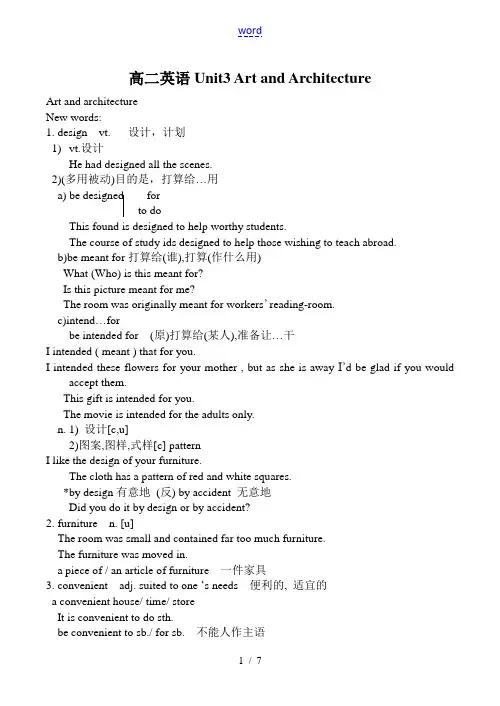
高二英语 Unit3 Art and Architecture
高二英语Unit3 Art and ArchitectureArt and architectureNew words:1. design vt. 设计,计划1)vt.设计He had designed all the scenes.2)(多用被动)目的是,打算给…用a) be designed forto doThis found is designed to help worthy students.The course of study ids designed to help those wishing to teach abroad.b)be meant for打算给(谁),打算(作什么用)What (Who) is this meant for?Is this picture meant for me?The room was originally meant for workers’ reading-room.c)intend…forbe intended for (原)打算给(某人),准备让…干I intended ( meant ) that for you.I intended these flowers for your mother , but as she is away I’d be glad if you wouldaccept them.This gift is intended for you.The movie is intended for the adults only.n. 1) 设计[c,u]2)图案,图样,式样[c] patternI like the design of your furniture.The cloth has a pattern of red and white squares.*by design有意地(反) by accident 无意地Did you do it by design or by accident?2. furniture n. [u]The room was small and contained far too much furniture.The furniture was moved in.a piece of / an article of furniture 一件家具3. convenient adj. suited to one ‘s needs 便利的, 适宜的a convenient house/ time/ storeIt is convenient to do sth.be convenient to sb./ for sb. 不能人作主语Will the 3:30 train be convenient for you?e whenever it is convenient to you.It is convenient to live in the modern house.convenience n. 方便, 合适[u]at one’s convenience在方便的时侯,以方便的方式Deal with it at your convenience.We’ll meet at your convenience.4.construct vt. build, more formal than makeconstruction n.under constructionThere are two new hotels near here under construction.5.impress vt.1)fill sb. with admiration给人深刻的印象,引人注目be impressed by/ at / with被…所感动I was very impressed by/ with their new house.We were deeply impressed by his deeds.2)铭刻,铭记, 让明白(…的重要性)impress on sb. sth.=impress sb. with sth.My father impressed on me the importance of hard work.He impressed me with the importance of the work.=He impressed on me the importance of the work.3) be impressed on one’s mind/ memory被印在脑海里,留下很深印象What he said that day was deeply impressed on my memory.6. belong to (1.不能用被动2.只有一般时,不用进行时)That dictionary belongs to me.is belong to me.×is belonged to me.×is belonging to me.×belongs to mine.×is mine.China is a country belonging to the third world.belongs to×which is belonged to×belonged to×which belongs toText:1. If …were/ did …, … would …If I were you, I would go with him.If she stayed at home now, she would be watching TV.If …did/ should/ were to…, … would…If …had done…,…would have done…2. I’d preferprefer用法:1)prefer+ n.Would you like to live in a modern flat or do you prefer a traditional house?2)prefer + to doIn which house would you prefer to live?3)prefer + doingI prefer working on my own.4)prefer sb./ sth. to sb. / sth.Even today, most Americans prefer coffee to tea.5)prefer doing to doingI prefer staying at home watching TV to going shopping out.6)would prefer thatI’d prefer that the job were a little closer to my home.3. I’d rather1) would/ had rather doI’d rather go myself.2) would rather have done宁愿做过I’d rather not have said that.3) would rather do ..than ..doI’d rather stay at home than go out.Rather than get money in such a dishonest way, he would beg in the streets.4)would rather didI’d rather you went there.4.take examples from模仿His designs tale examples mainly flowers and plants.follow ( copy) example of 以…为榜样set an example totake … for example5. have sth./ sb. dohave sb. / sth. doinghave sth. done 1)让别人来做某事2〕遭到某种情况have sth./ sb. to dowon’t have sb. doing容忍1) I won’t have him cheat me.2)He had the fire burning all night.I had a car waiting at the gate.3) I’ll have my bike repaired.Why didn’t you have your suit cleaned?King Charlie had his head cut off.She had her watch stolen.4) Do you have any clothes to wash?Do you have any clothes to be washed?5) I won’t have you saying like that.get sb. to do sth.get sb./sth. doingget sth. doneget married /changed/drunkeg. Mrs Brown was much disappointed to see the washing machine she had had ___ went wrong again.A. itB. it repairedC.repairedD. to be repaired6. 1)find + O + adj.I found English hard to learn.2)find +O + n.I find it a hard book.3)find + O + doingWe found him waiting to receive us.4)find + O + doneOn his return from his office, he found the house deserted.He found the door closed.5)find + O + adv.We went to her house but we found her out.6)find + O + prep. phr.I found myself in prison.7)find + O + to beI find the Chinese people to be happy and cheerful.We found him ( to be ) dishonest.=that he was dishonest.8)find + O + thatI called on her this evening ; but I found she had gone to the country on a visit.7.go against 1)违背,违反You can’t go against nature.Her father is so strict that she is scared to go against his wishes.2) 对…不利The case may go against you.The game was going against us.8.While in traditional architecture materials such as earth, stone, brick and wood are used, the materials of modern architecture are steel, glass and concrete. 传统建筑使用土石和砖木等材料,而现代建筑的材料是钢铁和混凝土等。
人教版高二Unit3Artandarchetecture
人教版高二Unit 3 Art and archetectureUnit 3 Art and architectureWarming up /listening / speakingWhere would you prefer to live?prefer vt释义:to choose or be in the habit of choosing as more desirable or as having more value 更喜欢结构:⑴ prefer+名词/代词/动词-ing形式(可再接+to+另一名词/代词/动词-ing形式例句①I prefer green to yellow.对于绿色与黄色,我更喜欢绿色。
②I prefer dancing to singing.我喜欢跳舞胜于唱歌。
⑵ prefer +动词不定式(可再接rather than do something)。
例句①They prefer to play cards rather than see such TV plays.他们宁愿打牌也不愿看这样的电视剧。
②The hero preferred to die rather than surrender.这位英雄宁死不屈。
⑶ prefer+宾语+动词不定式(作宾语补足语)。
例句①I should prefer you not to stay here too long.我希望你不要在这里呆得太久了。
②Let me wash the dishes----would you prefer me to dry them?我来洗盘子――你要我擦干盘子吗?⑷ prefer+that从句(从句的谓语动词should型的虚拟语气,should常省略)。
例句①Would you prefer that we reschedule the meeting for next week?你是否愿意我们把会议改期到下周呢?②She preferred that we should do it in the kitchen .她宁愿我们在厨房做这件事。
Unit3ArtandArchitecture全单元1人教版高二英语上册教案教学设计
Unit 3 Art and Architecture 全单元1(人教版高二英语上册教案教学设计)Unit 3 Art and Architecture 全单元1(人教版高二英语上册教案教学设计)「篇一」I Teaching Objectives:1.Develop the student’s abilit of reading skills2. Enable the ss to know more about modern aechitecture。
3. Enable the ss to learn some useful expressions。
II Teaching Methods: task-based teachingIII Key Points and Difficult Points:Key Points: Enable the ss to fulfill the task of reading and understand some language points。
IV Teaching Aids: slideV Teaching Procedures:Step1. review and lead-inT: yesterday, we talked about modernism and compared ancient buildings with modern buildings and we know that the disadvantages of modern architecture is that they look unnatural, unbeautiful and unfriendly, right?S: yes。
T: but some architects are very clever, they learned from theancient buildings. 正所谓,取其精华,去其糟粕,那么我们昨天所说的古代建筑的精华在哪里呢?S: natural, beautiful and friendlyT: yes. They look natural. They only use natural materials. They look beautiful because they have different shapes and have many curves and don’t have many straight lines. 他们有不同的形状,房子设计大部分是曲线,很少有直线条。
高二英语上学期Unit3Artandarchitecture[原创](精)
•Para 3 materials •Para 4 n buildings
• (huge, look like boxes, flat roof, sharp corners, glass walls, hard and unfriendly)
Para 5 ancient architecture
Para 1~2 the history of modern architecture
• Why did the architects want their buildings constructed in a way to look unnatural?
• Because they wanted to change society with buildings that went against people’s feeling of beauty.
What do the words in bold refer to ?
•them the modern architecture Nature does not have •that any straight lines. •his Antonio Gaudi’s •it the 2008 Olympic Stadium
• 1. When did modern architecture begin? In the 1920s. • 2. What is special about modern architecture? Hard and unfriendly. • 3. Which two architects were inspired by looking at nature? Antonio Gaudi and Frank Lloyd Wright. • 4. Why do people call the 2008 Olympic Stadium in Beijing “The Bird’s Nest”? The shape looks like a bird’s nest
Unit 3Art and architecture
7.A newly-devised microcomputer can_________ (充 当) a guide to a blind person. 答案:act as 8.They _________ the tank_________ (加满) petrol at the petrol station on their way home. 答案:filled,up with 9.Please _________ (放在一边) the newspaper you are reading and lay the table for supper. 答案:set aside 10.Smell is to the nose __________________ (如同 味觉与舌头的关系). 答案:what taste is to the tongue
10. _________ with the size of the whole earth,the biggest ocean does not seem big at all. pare B.When comparing paring D.When compared 答案:D 提示:题意是“与整个地球的大小比起来,最大的海洋也根本 不显得很大”。compare是及物动词,常构成 compare...with/to...短语;从逻辑上来说,此句中the biggest ocean与compare是被动关系,故要用compare的过去分词形 式表示被动。 11.We never dreamed of there _________ too difficult a question to work out. A.was B.had been C.being D.to be 答案:C 提示:dream of后接动名词。 12.You’d better _________ some money for future use. A.pick up B.set aside C.put off D.give away 答案:B 提示:本题考查短语动词的意义辨析。短语set aside可作“储 蓄”解,其他选项无此意。