
牛津译林版高中英语必修五Unit 1《Getting along with others》(Welcome to the unit)教案
Unit1 Getting along with others Welcome to the unit
教材:牛津高中英语(模块五)高二上学期
文档内容:教学设计—教案
单元:Unit 1 Getting along with others
板块:Welcome to the unit
Thoughts on the design:
本课为听说课,教师给学生营造民主开放的课堂氛围,使学生在进行大量的听说活动的过程中对朋友和友谊有更深的了解,为本单元后面的教学打下基础。
本课通过大量的听说活动主要解决三个问题:什么是友谊;朋友应该具备怎样的品质;如何与朋友相处。
学生在讨论过程中将能自然运用上一课时所学的有关人的个性特点的形容词,并掌握一定量的有关朋友话题的谚语和俗语。
Teaching aims:
1.Students will be able to talk about friends and friendship freely, improving
their communication skills and oral English;
2.Students will master certain numbers of English proverbs and sayings about
friendship;
3.Students will learn to value friendship more and know how to get on well with
friends.
Tea ching procedures:
Step 1 lead in (PPT4)
1.Teacher reminds students of Ding Wei who has just started university and made
lots of friends. (The material was dealt with in the first lesson.) Hence, the topic of friendship is introduced.
2.Brainstorming: Students are asked to express freely what friendship is in their
minds.
Friendship means my friend and I can trust each other.
Friendship means my friend and I will help and support each other.
Friendship means my friend and I will have a lot in common.
Friendship means my friend and I will readily share happiness and sadness with each other.
…
[Explanation]
此处采用上一课时的材料引入朋友话题,使课时与课时间紧密相连,环环相扣。
通过Brainstorming的方式激发学生思维,使他们对友谊这一话题进行思考,为本课关于朋友和友谊的讨论作好充分热身。
Step 2 What is friendship? (PPT 5-9)
1.Working in a group of four
(1)Students talk about one of the pictures on page 1 and try to understand the proverb.
(Each group is free to choose any one of the pictures to talk about.)
Friends are thieves of time.
The best mirror is an old friend.
If you can buy a person’s friendship, it’s not worth having.
True friends have hearts that beat as one.
(2) Students give an example (either their own experience or a story) to show what the proverb says really makes sense.
2. Representat ives from each group report to the whole class the result of their discussion.
3. Teacher provides more sayings about friends and friendship and encourages students to talk about what they can reveal about friendship by examining these sayings.
4. Students are encouraged to think of more such proverbs and sayings and share with each other.
[Explanation]
此步骤的目的是引导学生对什么是真正的友谊进行思考和探讨。
通过小组讨论的方式,使学生在民主的氛围中,思考自己对友谊的理解和体会,并培养与人交流合作的能力,锻炼自己的口头表达能力。
通过教师的补充和学生已有知识的交流,学生掌握一定量描述友谊的谚语和俗语。
Step 3 What makes a good friend? (PPT 10)
Students are asked to think about the qualities of a good friend and then are invited to write their ideas on the blackboard freely.
A good friend should be:
Open-minded, reliable, friendly, helpful, cheerful, generous, hard-working, diligent, honest, polite …
[Explanation]
在此步骤中,学生能充分运用第一课时所学的词汇知识,展开对朋友应有品质的讨论。
Step 4 How can we get along well with our fr iends?(PPT 11-12)
1. Teacher shows students the following words:
The recipe of friendship:
1 cup of sharing
2 cups of caring
1 cup of forgiveness and hugs of tenderness
Mix all these together ...
to make friends forever.
2. Students are encouraged to work in a group and share with each other their ways of getting along well with friends.
[Explanation]
此处讨论与朋友的相处之道。
教师先出示一段饶有趣味的文字,引发学生对此话题的思考。
学生以小组探讨的形式,彼此交流各自与朋友相处的方法,从中领悟与人相处应有的态度和方法。
Step 5 Conclusion of the lesson(PPT 13-15)
Students and teacher together read aloud the poem: A Friend…to end the lesson. [Explanation]
结尾处采用师生共同朗读诗歌的形式,为整堂课划上句号。
优美而有哲理的诗歌既带来美的享受,又使学生对朋友这一话题有更为感性的认识。
牛津译林版高中英语必修五Unit 1《Getting along with others》单元归纳提升课件
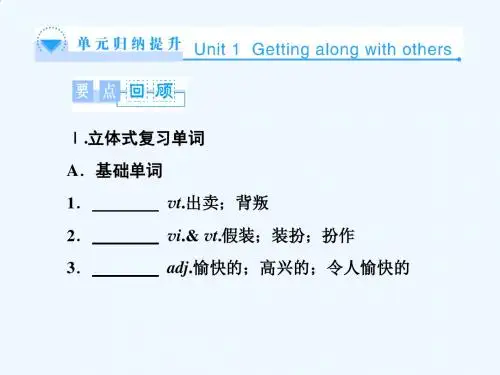
19. admit→ admission
20.beg→begging→beggar 22.truly→ true→ truth
21. swear→ swore→ sworn 23. argue→ argument
24.apologize→ apology
25. amusement→ amused→ amusing 26.hopeless→ hope→ hopeful 27.cautious→ caution
3 . Football is very important to me , but so is our friendship. 【句式仿写】 ③——汤姆去过长城两次。——我也是。 —Tom has been to the Great Wall twice. — .
4. Although you both said cruel things to each other, one of you has to be the first to admit that it was a mistake. 【句式仿写】 ④交友的第一步是微笑。 The first step is to smile.
11. 12. 13. 14. 15. 16. 17. 18.
adj.有天赋的;有天才的 n.话题 n.态度;看法 adj.热切的;急不可待的 vi.做出反应;回应 vi.& n.停顿;暂停 adj.尽心尽力的;坚信的;坚定的 n.宽恕;仁慈
B. 词汇拓展 19. → 20. → 21. → 22. → vt.& vi.承认;允许进入;接纳 n.获准进入;入场费 vt.& vi.请求;恳求;乞讨 n.乞讨→ n.乞丐
新牛津译林版高中英语必修五unit 1《getting along with others》第3课时优秀教案(重点资料).doc

D. be over 45 year old
C) 62. From the passage we can learn that the Post __________.
A. allows article submission within six weeks B. favor science articles
to locate each other. Hunting grounds are distant and it happenrom one another at times. When this happens, howling appears
Our nonfiction needs include how-to, useful articles on gardening, pet
care and training, financial planning, and subjects of interest to a 45-plus,
home-loving readership. For nonfiction art icles, indicate any special
the writer writes about her feelings, e.g. ‘I feel betrayed by my friend
Hannah.’ She goes on to talk about the problem and how it affected her: ‘I
学 felt so ashamed’ and ‘I was so upset that I felt like crying’. By reading the
humans’ singing together in chorus?
牛津译林版高中英语模块5 Unit 1 Getting along with others 课件 1

The recipe of friendship :
1 cup of sharing 2 cups of caring 1 cup of forgiveness and hugs of tenderness Mix all these together... to make friends forever.
Friends are God's way of taking care of us.
Everyone hears what you say. Friends listen to what you say. Best friends listen to what you don't say.
Hold a true friend with both your hands.
Tells you the truth when you need to hear it
Understands you Values you Walks beside you X-explains things you don’t understand Yells when you won’t listen and Zaps you back to reality.
What do they mean?
A real friend is one who walks in when the rest of the world walks out .
True friendship is like sound health; the of it is seldom known until it is lost.
Friendship is one mind in two bodies.
牛津译林版高中英语必修五Unit1Gettingalongwithothers重点词汇讲解

重点词汇讲解1. worth / worthybe worth + money ( the price) 值……钱be (well / better) worth doing sth. (很)值得做某事(worth前的修饰副词只能用well,不可以用very, much等)be worthy of sth. / of being done / to be done1) The trip was expensive but it was worth every penny.这次旅行花费很大,但是花的每一分钱都不冤枉。
2) The book is worth reading. = it is worth reading this book.这本书值得一读。
2. fun u./n.乐趣;有趣的人/ 物funny adj.滑稽的有趣的1) It’s great fun talking with you. 和你交谈很愉快。
2) What fun it is to meet so many new friends!与到这么多新朋友是多么愉快的事啊!3) He is good fun; we all enjoy being with him.他是个有趣的人,我们都喜欢跟他在一起。
3. say=read ……上说/写着1) I found a sign which read/said ‘NO PARKING’.我发现一块告示,上面写着: “不准停车”。
2) When I returned home, I found a note pinned on my door saying that I should go to attend a meeting that afternoon.当我回到家时,我发现门上钉着一张便条,通知我下午去开会。
4. pretend vt./vi. 假装pretend sth./to do/ that从句1) When I went in, he pretended to be reading a book.我进门时,他假装正在看一本书。
牛津译林版高中英语模块5 Unit 1 Getting along with others Welc
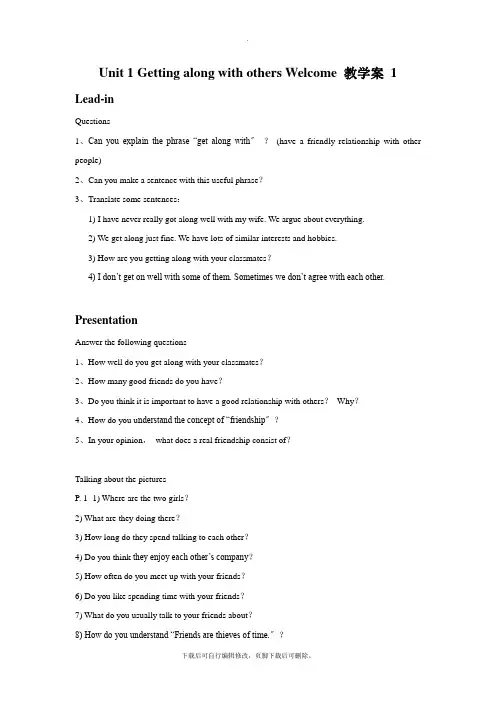
Unit 1 Getting along with others Welcome 教学案1 Lead-inQuestions1、Can you explain the phrase “get along with〞?(have a friendly relationship with other people)2、Can you make a sentence with this useful phrase?3、Translate some sentences:1) I have never really got along well with my wife. We argue about everything.2) We get along just fine. We have lots of similar interests and hobbies.3) How are you getting along with your classmates?4) I don’t get on well with some of them. Sometimes we don’t agree with each other.PresentationAnswer the following questions1、How well do you get along with your classmates?2、How many good friends do you have?3、Do you think it is important to have a good relationship with others?Why?4、How do you u nderstand the concept of “friendship〞?5、In your opinion,what does a real friendship consist of?Talking about the picturesP. 1 1) Where are the two girls?2) What are they doing there?3) How long do they spend talking to each other?4) Do you think they enjoy each other’s company?5) How often do you meet up with your friends?6) Do you like spending time with your friends?7) What do you usually talk to your friends about?8) How do you understand “Friends are thieves of time.〞?P. 2 1) What do you use a mirror for?2) What is the girl on the left doing?3) Do you think the girl on the right is a good friend?Why?4) How long have you known your best friend?5) Does he / she know everything about you?6) Does he / she often give you advice?7) Does he / she point out your mistakes?8) Do you think your friend influences you a lot?9) What do you think the proverb “The best mirror is an old friend.〞Means?P. 3 1) What is the taller boy doing?Why does he do so?2) Why does the shorter boy look puzzled?3) Do you think the shorter boy should take the money?Why?4) Do you think it is possible for a person to buy friendship?5) In your opinion,what is the base of a good friendship?P. 4 1) Aristotle once said “A true friend is one soul in two bo dies〞.Does this proverb imply the same meaning as the one in this picture?2) Do you think friends should be the same age and share the same hobbies and interests?3) Do you have a best friend?Why do you think that he / she is your best friend?Discussion:What is a “true friend〞?is trustworthyyou respect and who respect youis honest,affectionate and lovingA true friend is someone who shares your happiness and sorrowaccepts your differencesis devoted and loyal to youis selfless……There are many other proverbs in English besides these. Can you think of some others?1、A life without a friend is a life without a sun.2、A man who has friends must show himself friendly3、A friend in need is a friend indeed.Reading comprehensionTurn to page 94-95,read the two passages and answer the questions below.Language focus1、practise doing2、present sth. to sb.3、characteristic:adj. 典型的、特有的、独特的It is characteristic of sb. to do sth.:……正是……那种人。
牛津译林版必修五Unit 1《Getting along with others》(Welcome to the unit)word教案
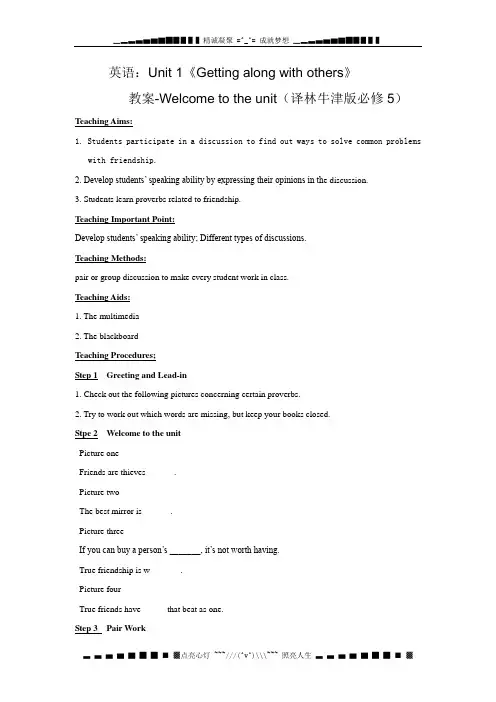
英语:Unit 1《Getting along with others》教案-Welcome to the unit(译林牛津版必修5)Teaching Aims:1. Students participate in a discussion to find out ways to solve common problemswith friendship.2. Develop students’ speaking ability by expressing their opinions in th e discussion.3. Students learn proverbs related to friendship.Teaching Important Point:Develop students’ speaking ability; Different types of discussions.Teaching Methods:pair or group discussion to make every student work in class.Teaching Aids:1. The multimedia2. The blackboardTeaching Procedures;Step 1 Greeting and Lead-in1. Check out the following pictures concerning certain proverbs.2. Try to work out which words are missing, but keep your books closed.Stpe 2 Welcome to the unitPicture oneFriends are thieves ______.Picture twoThe best mirror is ______.Picture threeIf you can buy a person’s _______, it’s not worth having.True friendship is w_______.Picture fourTrue friends have _____ that beat as one.Step 3 Pair Work1. Do you have a best friend? Why do you think that he or she is your best friend?2. How do you get on with your friends? How do you help each other when you haveproblems?3. What do you think are the most important characteristics in a friend?Please talk to your partner. And prepare yourselves to present your discussion in dialogue to the class. (Pay attention that each speaker should have more than three sentences to say.) Step 4 Learning more sayings and brainstorming.To the world you may be just one person, but to one person you may be the world.True friend is one soul in two bodies.True friends are hard to find, difficult to leave, and impossible to forget.To get a good friend, you should first learn to be one.Please brainstorm on how to be a good friend. And give your opinions one by one.Good friends should _______.Step 5 Questions and Discussion IIT: Good friends bring cheering friendship to you. But could there be any problem with friendship? How would you handle some difficult situations that can happen in friendships?For each situation given below, answer these questions:• Ho w would this make you feel?• What is a po sitive way to deal with it?• What is a harmful way to deal with it?Situations1. Your friend starts acting in ways that you think are wrong (drugs, being rude, etc.)2. You find out your friend has been telling stories about you that aren't true.3. Your friend is on the brink of failing a class and begs you to help him/her cheat on the final exam.4. You and your best friend have romantic feelings toward the same person.Attention1. On one of the situations, please discuss in group of three.2. One in the group should listen to the other two and then give a report and comment on what he/she hears.(Pay attention that the reporter should first listen carefully and prepare to report to the class.) Step 6 Homework1. Read Part B on page 95 inworkbook.2. WritingPreview page 2,3 and find out the sticky situations that happen to Sarah and Andrew. Then write a short passage of more than 100 words on how to deal with them in a positive way.。
牛津译林版高中英语必修5Unit 1Getting along with others教案4译林版必修5
高一牛津版(5)Unit one Getting along with othersThe analysis of this unit:This unit introduces and develops the theme of how to get along with others. It provides Ss with the opportunity to learn about getting along with others. Ss are expected to gain some insight into friendships and the problems friendship might bring about. Ss will also learn about understanding emotions in a text. Integrated skills of listening, speaking, reading and writing are practiced and reinforced. Ss are expected to fully participate in the class to further develop both their language skills and the ability of solving problems. This Unit also enables Ss to ask for advice and discuss friendship. Ss are expected to apply what they have learnt to practical use by giving an oral report on the different attitudes to a variety of topics between teenage boys and girls.Teaching aims:1. Integrated skills of listening, speaking, reading and writing arepracticed and reinforced.2. Ss are expected to fully participate in the class to furtherdevelop both their language skills and the ability of solving problems.3. Enables Ss to ask for advice and discuss friendship4. Ss are expected to apply what they have learnt to practical useby giving an oral report on t he different attitudes to a variety of topics between teenage boys and girls.Teaching important points:Ss are expected to fully participate in the class to further develop both their language skills and the ability of solving problems. Teaching methods:1.Listening, speaking, reading and writing2.Group discussion and team workTeaching periods:非谓语动词练习. 动名词和不定式做主语及非谓语动词做表语1. __________ a language requires time and effort.A. LearnB. LearningC. To learnD. Being learned2. It is not always easy __________ invitations.A. to refuseB. refusingC. to be refusedD. being refused3. __________ now seems impossible.A. Saving moneyB. To save moneyC. Being saved moneyD. To be saved money4. To answer correctly is more important than __________A. a quick finishB. to finish quicklyC. finishing quicklyD. you finish quickly5. How __________ the problem will be discussed at tomorrow’s meeting.A. to solveB. to be solvedC. being solvedD. solving6. It was polite _________ the child to give up his seat to the elderly woman.A. forB. ofC. toD. with7. Is it necessary __________ the book immediately?A. for him to returnB. that he returnsC. his returningD. of him to return8. It __________ forty-five minutes __________ there by bus.A. cost, to getB. takes, gettingC. takes, to getD. takes, to get to9. It is no good __________. You should give_________.A. to smoke, it upB. smoking, it upC. smoking, up itD. to smoke, up it10. It is no __________ debating with Tom, because he will never change his mind.A. useB. helpC. timeD. while11. Do you consider it any good __________ again?A. to tryB. tryC. tryingD. for you to try12. I don’t think it’s much good __________ to him.A. writingB. to writeC. to be writtenD. being written13. __________ the assignment made his father lose his temper.A. The boy’s not having doneB. The boy not having doneC. The boy’s having not doneD. The boy having not done14. I don’t remember __________ about it.A. him telling usB. his telling usC. him to tell usD. he tells us15. Her wish is __________ an engineer.A. becomingB. becomeC. to becomeD. being come16.Some peop le’s greatest pleasure is __________.A. fishingB. to fishC. to be fishingD. being fish17. The report was so __________ that they were all __________.A. inspiring, excitingB. inspiring, excitedC. inspired, excitedD. inspired, exciting18. ---“You look pale.” ---“I feel a little __________.”A. tireB. tiredC. tiringD. tiresome19. He seems __________ here for three years.A. to be livingB. to have livedC. to have been livedD. to live20. ---“What’s made you so upset?”---“_________ three tickets to the pop music concert.”A. LostB. LosingC. Because of losingD. Since I lost答案:1-5 BABBA 6-10 BACBA 11-15 CAABC 16-20 ABBBB非谓语动词练习. 动名词和不定式的惯用法76. Though it began _________, they kept on _________ in the field.A. raining, workB. to rain, workingC. raining, with the workD. to rain, to work77. His parents insisted on __________ to college.A. he should goB. he goC. his goingD. him to go78. What a pity! One cannot help __________ sorry for the injured.A. to feelB. oneself to feelC. feelingD. oneself from feeling79. He decided __________ piano because he was tired of it.A. to give teaching upB. giving up teachingC. to give up teachingD. to give in teaching80. Nothing could __________ the boy from __________ the tall building.A. prevent, risking climbingB. prevent, risking to climbC. stop, risk climbingD. keep, risking climb81. On Sundays I prefer __________ at home to __________ out.A. to stay, goB. staying, goC. staying, goingD. to stay, going82. How much time did you spend __________ the text.A. copyingB. to copyC. in copyD. on copying83. After cooking, Mother __________ making tea.A. set outB. set aboutC. set offD. start out84. I __________ see you without __________ your mother.A. never, thinking ofB. never, thinking aboutC. not, think ofD. don’t, think about85. Though it sounds a bit too dear, it is worth __________.A. being boughtB. buyingC. to buyD. buying it86. The novel is well __________.A. worth to readB. worth being readC. worthy to readD. worthy of being read87. The farmers were busy __________ cotton.A. to pickB. pickingC. with pickingD. pluck88. He devoted his life to __________ the atomic theory.A. studyB. be studiedC. studyingD. have studied89. We are both looking forward to __________ next week.A. going on vacationB. go on vacationC. be going on vacationD. have gone on vacation90. Her parents objected to __________ that farmer, though he has a lot of money.A. her marryingB. marryingC. marryD. her marrying with91. If you want to be a writer, I suggest that you should pay attention to __________ the works of Lu Xun.A. readB. readingC. readerD. be read92. He is an experienced driver and he is used __________ in all kinds of weather.A. to drivingB. to driveC. for drivingD. to have driven93. Because of the heavy rain, they had to put off __________ the sports meet.A. taking placeB. to take placeC. holdingD. to hold94. On __________ the news, she turned pale.A. heardB. hearingC. having heardD. her hearing95. ---“Did you get in touch with them later?”---“Yes, I finally succeeded __________ them by phone.”A. to reachB. to reachingC. reachingD. in reaching96. I didn’t feel __________ going out for a walk.A. soB. asC. ratherD. like97. You should work tonight instead of _________ TV.A. to watchB. you watchingC. you watchD. watching98. Besides _________, she is kind and tender.A. beautifulB. being beautifulC. she beautifulD. is beautiful99. What about __________ to the concert with us?A. we goB. we goingC. goingD. to go100. Hadn’t we better __________ a rest before going on?A. haveB. thanC. to haveD. to take101. You’d better _________ her the sad news now.A. not to tellB. won’t tellC. not tellD. don’t tell102. I’d rather lose the game __________.A. not to hurt himB. not hurt himC. than to hurt himD. than hurt him103. Alice says _________ tonight, because there will be an exam tomorrow morning.A. she’d rather not goB. she’d not rather goC. she’ll rather not goD. she won’t rather go104. Tom did nothing but _________ back what he had said.A. takenB. tookC. takingD. take105. There seemed nothing else to do but __________ a doctor.A. to send forB. send forC. call forD. to call in106. ---“I usually go there by train.”---“Why not __________ by boat for a change?”A. to try goingB. trying to goC. to try and goD. try going107. Please _________ me at the station on time.A. to meetB. meetingC. meetD. you meet108. Have I any choice but __________as you tell me?A. to doB. doC. doingD. I’ll do109. I can’t but ________ to hear such a story.A. to laughB. laughC. laughingD. to laughing110. ---“Would you like to go with us for a picnic tomorrow?”---“Yes, __________.”A. I would likeB. I’d like to goC. I’d loveD. I’d like to111. He wanted to go, but he __________.A. wasn’t able toB. wasn’t able to goC. wasn’t ableD. couldn’t able to112. I don’t want to speak to you, but I ___________.A. have to speakB. have toC. must to speakD. must speak113. ---“Did you get a ticket?”---“No, I _________, but there weren’t any left.”A. didB. don’t getC. didn’tD. didn’t get114. She didn’t know __________ her books or _________ for reference.A. whether sell, keep themB. whether to sell, to keep themC. to sell whether, to keep themD. if to sell, should keep them115. Will you show me _________ my bike?A. to put in whereB. to where put whereC. where to putD. where to put in答案:76-80 BCCCA 81-85 CABAB 86-90 DBCAA 91-95 BACBD 96-100 DDBCA 101-105 CDADB 106-110 DCABD 111-112 ABCBC非谓语动词练习5. 不定式做宾语补足语116. Soon they saw the boy _________ in the crowd.A. disappearB. to disappearC. disappearsD. disappeared117. Did you notice the little boy __________ away?A. took the candy and runB. take the candy and runC. taking the candy and runD. who taking the candy running118. I heard him __________ so.A. saysB. sayingC. sayD. said119. Shall we go and listen to the reviewers __________ on the new film?A. to commentB. commentC. to commentingD. being comment120. Professor Black had us __________ compositions every Friday.A. to writeB. writtenC. writeD. writing121. Mrs Smith made her pupils __________ the text three times a week.A. reciteB. recitedC. recitingD. to recite122. Will you __________ me __________ out this problem myself?A. permit, workingB. let, workC. allowed, to workD. forbid, to work123. She was seen __________ model ships in the room.A. madeB. to makeC. makesD. make124. Birds are seldom heard __________ at night.A. singB. singingC. to singD. to be singing125. The areoplane was noticed __________ at six.A. take offB. to take offC. get offD. to get off126. Mr Crossett was make __________ his teaching because of his poor health and old age.A. give upB. give inC. to give upD. to give in127. The book is said __________ into many foreign languages.A. to have been translatedB. to have translatedC. to be translatingD. having been translated128. The Marquis was thought _________ some terrible wrongs to his tenants.A. of doingB. that he had doneC. to have doneD. to have been done129. The teacher asked him __________.A. to repeat the sentence againB. repeat the sentenceC. he would repeat the sentence once moreD. to repeat the sentence130. The doctor advised Lao Li __________ more rest.A. that he getB. to getC. would getD. get131. Joe wishes us __________ with him.A. to go alongB. going alongC. went alongD. will go along132. I don’t want __________ .A. that anybody saw meB. anybody to see meC. that somebody sees meD. nobody will see me133. Do you think it difficult __________ a horse __________?A. to train, jumpingB. training, for jumpingC. to train, jumpD. to train, to jump134. My car has broken down. Would you help me__________?A. to get the car to startB. get the car startC. to get the car startedD. get to start the car135. “Will you join us?” I invited __________ with us?A. her spending weekendB. her to spending weekendC. her to spend weekendD. she spent weekend136. It is master Wu who taught us __________ the machine.A. what to do withB. ranC. how to runD. how could run137. He ordered the room __________.A. to sweepB. to be sweptC. should sweepD. swept138. Tell Tom and Jack _________ each other.A. not quarrelB. not to quarrel withC. to not quarrel withD. they not quarrel139. He would like them __________ every day.A. to practiceB. to practiseC. practicingD. practicing140. ---“Are you going to leaving now?”---“Unless you would prefer me __________ here.”A. to stayB. will stayC. that I’ll stayD. staying答案:116-120 ABCBC 121-125 ABBCB 126-130 CACDB 131-135 ABDCC 136-140 CBBBA。
新牛津译林版高中英语必修五unit 1《getting along with others》第1课时优秀教案(重点资料).doc
revision n. 复习,修订,
修改
●Task 2: Translate the following words
vi. & vt. 假装,装扮,扮作 pretend
vt. & νi.承认 admit
n. & vi. 评论,谈论 remark
vi. 道歉 apologize
νt.责备,谴责 n. (坏事或 错事的)责任;责备,指责 blame adj. 有天赋的,有
betray vt.出卖,背叛
forgive vt.原谅,宽恕
superb adj. 极佳的,卓越的
keep pace with (与…)
学 步调一致,(与…)同步
guilty adj.内疚的;有罪的
argue vi. 争吵,争论
sensitive adj. 易生气的,敏感的;体贴的
envy vt. & n. 羡
Hannah.
_____.
Classmates stared at Sarah when First she was extremely upset and
Wednesday she came into the classroom and a felt like 7. ____. Then she was 8.
天才的 gifted
vt. 克服,解决 overcome
n. 态度,看法 a ttitude
νi.做出反应,回应, 回答 respond
n. 宽恕;仁慈 mercy
Step 3: Text reading
Listen to the text a nd then finish the
following sentences
牛津译林版高中英语模块5 Unit 1 Getting along with others Proj
Unit 1 Getting along with others Project 教学案2 Step one. ReadingToday we’ll read an article about teenage friendship which is taken from a school magazine. This article shows us the different attitudes that teenage boys and girls have towards friendship. After reading,you are required to use what you have learned to complete a project that is to conduct a survey and present it to the class orally.1. Friendship plays an important role in our lives. Everyone needs friends. However,girls and boys have different types of friendships and different attitudes towards friendship. Read the school magazine article carefully and try to answer the following questions.(1) What puzzles Robert?Some things about Amanda and her friends. For example, he can’t understa nd what girls can talk about for so long.(2) What’s the difference between boys and girls in their attitudes towards friendship?Girls always seem to have a lot to talk about with their best friends. They seem to have more friendships than boys. Boys cannot name a single best friend.(3) What’s are boys’ and girls’ friendships each based on?Girls’ friendships are based on shared feelings and support while boys’ friendships are based on shared activities or interests.2. Go over the passage and find the main idea and some detailed information.(1) analyse para.2 to para.7Open your books to p18. First of all,please number the paragraphs. Altogether there are 8 paragraphs. Now please read the first sentence from para.2 to para. 7 in one minute and tell me what the theme of this part is. (Different attitudes of boys and girls towards friendship)What are the differences?(shared activities/shared feelings)Para. 2 Raise the topic of this part: boys and girls have different attitudes towards friendship Para. 3 The result of the some studies.Para. 4 & Para. 5 Adolescent boys cannot name a single best friend. It’s different from adolescent girlsPara. 6 Friendships between girls and boys are based on different things.Para. 7 Conclusion of the differences.2) analyse para. 1Go over para.1 and think about the question what’s the function of the first para. 1?To introduce the topic of this report. Use an example to introduce the topic of differences between boys and girls3) analyse para.8—the last para.The similarities in the attitudes towards friendship between boys and girlsStep two Language pointsugh they get along well,there are some things about Amada and her friends that puzzle Robert. 他们相处得很好,但阿曼达跟她好朋友的有些事情让罗伯特感到困惑。
新牛津译林版高中英语必修五unit 1《getting along with others》第2课时优秀教案(重点资料).doc
Unit 1 Getting along with others学录取了。
The cinC)◆2. argue vt. & vi知识探究:She argued him into/ out of his decision. 她说服他做出/不要做决定。
The scientist argued that his discovery had changed the course of history. 那位科学家认为他的发现改变了历史。
His accent argues him to be a foreigner. 他的口音证明他是外国人。
归纳整理:题练落实:D) 1. He argued ______ smoking and insisted that it was _____ argument that smoking was harmful to health.A. for; beyondB. against; overC. for; overD.against; beyond C) 2. I don’t agree _____ your idea, but I won’t argue ____ you ____ it at the moment.A. to; wi th; onB. on; with; overC. to; with; aboutD. about; to; with联想拓宽:点◆3. blame vt.责备,谴责n.责任知识探究:We blamed him for his carelessness. 我们因为他的粗心而责备他。
We consider that the driver is not to blame. 我们认为这不是司机的过错。
Don't blame it on him, but on me.另怪他,怪我。
The driver tried to put the blame on me.司机想把责任往我身上推。