
【牛津版】八年级下册:Unit 5 Good manners Reading I课件—公开课一等奖课件
八年级英语下册Unit5 Good manners 语法专练课时作业(新版)牛津版
1 Unit 5 Good manners
单元语法专练
enoughto的用法
1.“be+adj.+enough+to do” 结构常用来描述一个人的品质或能力。该结构可以与so...that...句型互换。例如:
He is strong enough to carry the heavy stone.=He is so strong that he can carry
the heavy stone.他够强壮,以至于能搬起这块很重的石头。
2.enough在句中可以作状语、定语和表语。例如:
The house is not big enough for us.这房子对我们来说不够大。(作状语)
Have you got enough money?你有足够的钱吗?(作定语)
Six bottles should be enough.六瓶应该够了。(作表语)
too...to的用法
1.too...to意为“太……而不能……”,该结构表示具有否定意义的结果,否定意义是从too(太,过于)开始的。too后接形容词或副词表示否定的原因,后面的“to+动词原形”表示否定的内容。例如:
Thegirlistootiredtowalk.这个女孩太累了,走不动了。
2.too...to结构以肯定的形式表达了否定的意义,以简单句的结构表达了复合句的内容,这个结构可转换为so...that...句型,也可以用反义的形容词转换为enough to结构。例如: 2 Theroomistoosmalltoholdsomanypeople.
→Theroomissosmallthatitcan’tholdsomanypeople.
→Theroomisn’tbigenoughtoholdsomanypeople.这个房间太小了,容纳不下这么多人。
3.too...to结构中,too后的形容词若修饰单数可数名词,需要加不定冠词a/an,放在形容词之后,名词之前。例如:
2017年牛津译林版英语八年级下Unit5 Good manners全单元教案
牛津译林版英语八年级下Unit5 Good manners全单元教案
1
课 题 8B Unit 5 Good manners
Welcome to the unit & comic strip 课时 1 授课时间 2016 年4 月26日
教学目标 To know about the good manners in public.
To talk about how to behave politely in public.
To get students to develop the habit of good manners.
教 学
重难点 To know about the good manners in public. (Importance)
To talk about how to behave politely in public. (Importance)
To talk about how to behave politely in public. (Difficulty)
预习要求 To think about how to behave politely in public.
教学内容及活动设计 二次复备及教学随感
Step 1 Checking
Let the students try to read the new words
Step 2 Lead –in
1.Free talk
Do you want to be good citizens(公民)? How can you be good citizens?
2. Show some pictures and ask if they are doing the right things
Step 3 Learning
Let the Ss look at the pictures in Part A on Page 65 and teach some
译林版八年级英语下册Unit5 Good manners-Reading 练习
1 练 习
一、词组翻译。
1.和某人握手 2.挡住某人的路
3.第一次见面 4.从某人身旁挤过去
5.主动攀谈 6.在公共场合
7.撞上某人 8.压低声音
二、词汇运用。
1.They are talking in a low (声音) under the tree over there.
2.In big cities there are easy and fast (公共) transports.
3.You should start the (谈话) politely.
4.The new driver is driving slowly along the road to (避免) hitting others.
5.As soon as he (触碰) the button, the bell rang loudly.
三、阅读理解。
Perhaps you have seen the English letters “WC” in your city. They show public toilets. But do you know it is
far from elegant (优雅的) English? In fact, foreigners from English-speaking countries rarely use the letters.
Workers in our city are changing “WC” signs all over the city. The government is spending much money changing
牛津译林版八年级下册Unit 5《Good manners》综合测试
1 / 10 牛津译林版八年级下册Unit 5《Good manners》综合测试
一. 单项选择 (每小题1分,共15分)
( ) 1.— Would you please not speak so loudly in public?
— Sorry. I will remember to speak in lower voice.
A. the; a B. /; a C. the; the D. /; /
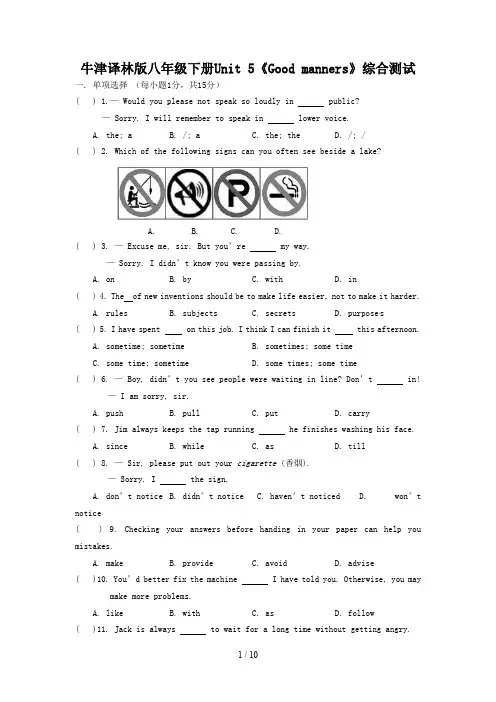
( ) 2. Which of the following signs can you often see beside a lake?
A. B. C. D.
( ) 3. — Excuse me, sir. But you’re
my way.
— Sorry. I didn’t know you were passing by.
A. on B. by C. with D. in
( ) 4.
The of new inventions should be to make life easier, not to make it harder.
A. rules B. subjects C. secrets D. purposes
( ) 5. I have spent
on this job. I think I can finish it
this afternoon.
A. sometime; sometime B. sometimes; some time
C. some time; sometime D. some times; some time
( ) 6. — Boy, didn’t you see people were waiting in line? Don’t
译林版八年级英语下册Unit5 Good manners-reading 学案

Unit5 Good manners
Reading
一、教学目标
1.能读懂有关英国礼仪习惯的采访,能通过上下文猜测生词词义。
2.通过阅读,了解不同国家的礼仪习惯。
3.通过阅读掌握文章内容能解决相关问题,掌握泛读和精读两种阅读技巧。
二、教学重难点
1.通过阅读文章了解并描述英国的礼仪习惯。
2.对一些重点词汇和句型要结合上下文充分理解句子结构和含义。
三、短语、词汇
1. proper adj. 符合习俗的;正确的 adv. properly
2. greet vt 问候,打招呼 n. greeting
3. kiss n&v 亲吻
4. close adj. 亲密的;严密的 closely adv.
5. conversation n. (非正式)交谈,谈话
6. avoid vt 避免 ★ avoid doing sth
7. subject n. 话题;主题
8. behave vi&vt 表现 n. behavior (uc)
9. public n. 民众,群体 in public 公开地,在别人面前
10. push vi&vt 推,挤 → (反)pull 拉 push in =cut in 插队,加塞
11. bump vi&vt 撞,碰 bump into
12. touch vt 触摸,碰
13. excuse vt 原谅,宽恕 excuse me 劳驾 excuse sb. for doing sth
14. till conj. 到……时,直到……为止
15. loudly adv. 大声地
16. as conj. 正如, 如同
17 saying n. 谚语, 格言
18. Roman n. 罗马人 →(复数) Romans
19. shake sb’s hand 与某人握手 shake-shook-shaken
牛津译林八年级上册 教学设计 Unit 5 Good manners Reading (1)
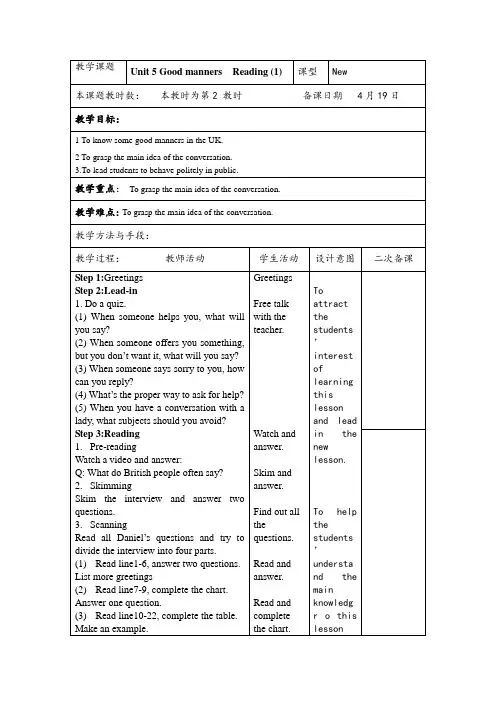
教学课题 Unit 5 Good manners Reading (1) 课型 New
本课题教时数: 本教时为第2 教时 备课日期 4月19日
教学目标:
1 To know some good manners in the UK.
2 To grasp the main idea of the conversation.
3.To lead students to behave politely in public.
教学重点: To grasp the main idea of the conversation.
教学难点: To grasp the main idea of the conversation.
教学方法与手段:
教学过程: 教师活动 学生活动 设计意图 二次备课
Step 1:Greetings
Step 2:Lead-in
1. Do a quiz.
(1) When someone helps you, what will
you say?
(2) When someone offers you something,
but you don’t want it, what will you say?
(3) When someone says sorry to you, how
can you reply?
(4) What’s the proper way to ask for help?
(5) When you have a conversation with a
lady, what subjects should you avoid?
Step 3:Reading
1. Pre-reading
Watch a video and answer:
Q: What do British people often say?
2014译林版英语八年级下册8B Unit5 Good manners(Reading知识点)
8B Unit5 Good manners(Reading知识点)
1. You’re old enough to learn about manners now. 你现在年龄够大了,可以学学礼仪了。
…enough to do… 够……可以做……
他够强壮,举得起这个重箱子。
He is _________ _________ ______ _________the heavy box.
= He is so strong that he can lift the heavy box.
这河很窄,她游得过。
This river is ________ __________ for her _______ _________ __________.
= The river is so narrow that she can swim across it.
2. Don’t cut in on others. 不要打断别人。
cut in 插嘴,打断
老师上课时她爱插嘴。
She likes __________ ______while her teacher is giving a lesson.
cut in on sb./sth. 打断某人谈话,插嘴
老人打断了他们的谈话。
The old man ______ _______ _______their conversation.
别打断她。让她继续发言。
_______ _______ ______ _______ her. Let her continue speaking.
cut in = push in 插队,加塞
她在列队的最前头插队。
She _______ _______at the head of the line.
She _______ _______at the head of the line.
2014版_新目标英语八年级下unit_5导学案_(全单元)
Unit5 What were you doing when the rainstorm came?
1 Unit5 What were you doing when the rainstorm came?
第一课时 Section A 1a—2d导学案
年级: 八 年 级 编写时间:2015年3月1日
主备人:陈 三 菊 审核人: 王 明 华 审批人:张 么 明
教师寄语:Do one thing at a time, and do well一次只做一件事,做到最好!
第一课时 Section A (1a-2c)
自主学习
一 .仔细观察下面的对话,用“_____”标出对话中所出现的时间,并补全句子.
1. A: What are you doing now? B: I am doing my homework now.
2. A: What were you doing at 9 o’clock last night? B: I was doing homework.
C:_________________________________(我正在打扫我的房间).
A: What were you doing when your mother came back yesterday?
B:I ______________________________________(我正在讲电话).
总结:对话1用了_____ _进行时态,对话2用了__________进行时态.
二.将下面的句子翻译成中文,并仔细观察进行比较。
1. The boy was walking down the street when the UFO landed.
2. The girl was shopping when the alien got out.
牛津译林版八年级下册英语教案:Unit5 Good manners reading(1)
关庙中心学校教学设计活页
课
题 主备人 冷雪 课型 New 课时安排 1
8下Unit5 good manners
Reading(1)
授课人
授课时间
教
学
目
标 1. understand the new words and expressions from context;
2. understand the interview about manners in the UK;
3. know about manners in different cultures.
重点难点分析 1. New words and phrases: proper, kiss, close, conversation, avoid, subject, public, push, touch,
excuse, till, loudly, as, greet, behave, bump, saying, Roman, push in,
shake sb.’s hand, in public, in one’s way, excuse me, as well as, by
accident
2. New structures: What’s the proper way to greet people there?
They’ll say “excuse me” and be polite enough to wait till you move.
教学流程安排
集体智慧
(以知识体系为主) 个性设计
(二次备课) 教学后记
Step 1 Lead-in
1. Enjoy a video
2. Be the judge
Step 2 Presentation
1. Watch and find
T: Watch the video and try to find out all the questions in the
最新牛津译林初中八年级英语下册 8B Unit5《Good manners》Reading教学设计
最新初中英语精品资料设计
最新初中英语精品资料设计 1 Reading(2)
Teaching aims:
(1) to make students learn some words and phrases.
(2) To make students learn more about ORBIS
Teaching importances and difficulties:
(1) new words:
operate v 做手术
indeed adv 真正地,确实
proud adj 自豪的
medicine n 医学,药
treat v 治疗,对待
improve v 改善,提高
carry on 继续开展
(2)phrases
Operate on sb
hard work
such an important job
be proud to do sth
something else
carry on with sth
by doing sth
(2)
sentences
How do
people feel about their work?
(1) What does ORBIS need to carry on with their work?what can we do for them?
Step two :teach them phrases and translate some sentences:
Operate on sb=perform an operation on sb=perform operations on sb
马医生在飞机上给150 为病人做手术。
used to do sth
be used to do sth
be used to doing sth
我过去常常一天只做两或三个手术