
Module 11 Body Language Unit 1 They touch noses.
4. In India people put their hands together
and nod their heads. 5. They touch noses! touch noses 表示“碰鼻子”。 6. That’s because people do different things in different countries.
那是因为我对这个国家的肢体语言了解不够。
1. We Chinese often shake hands and
smile.
shake hands 表示“握手”。
Shake hands with sb.
表示“和某人握手”。
2. 名词的复数:
German → Germans Japanese → Japanese Russian → Russians 3. And some kiss or hug each other. each other 表示“彼此,互相”, 通常 放 在动词后。
an American
a Russian
People in different countries may use different body language to express the same meaning and feelings. When you speak with people from other countries, try to understand and respect their body language.
put … together 表示“把……放在一起”。
That’s because … 表示“那是因为……”。
People in different countries may use different body language to greet each other.
hug
smile bow various ways of greeting touch
wave
kiss
shake hands
Match the pictures with the words and expression from the box.
— Yes, they are.
— What are they doing?
— They’re shaking hands. say hello and kissing
shake hands
smile at each other and bow
Lingling is going to welcome some foreign teachers.
• What! • I didn’t know that.
That’s because people do different things in different countries. 那是因为不同国家的人们做法不同。 that’s because …是一个常用句式,表示 “那是因为……”,例如: That’s because you were not careful enough. 那是因为你不够仔细。 That’s because I didn’t know much about body language in this country.
1. Who will come to Lingling’s school?
Some Russian teachers.
2. What will Maori people do when they
meet?
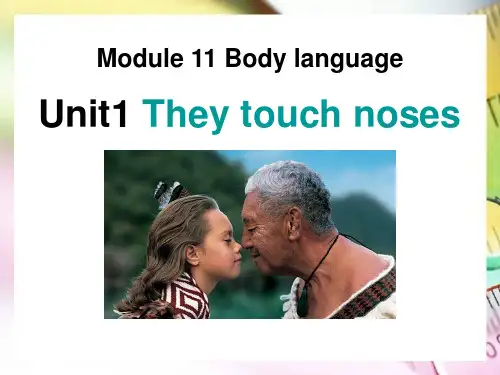
They will touch noses.
Now complete the table with the correct form of the words from the box.
Countries China Japan Britain America France Australia Canada Russia Germany India
People and languages Chinese Japanese British American French Australian Canadian Russian German Indian
India kiss Russia together touch visitor
In China, people shake hands and
smile American people shake hands and kiss sometimes (1) ______
In (2) ______, people put India their hands (3) _______ together and nod their heads In (4) _______, people kiss Russia each other three times touch Maori people (5) ______ noses.
when they meet (6) ________. visitors
A: What do Chinese people do when they meet visitors? B: They shake hands and smile.
Talk about what you do and say when you meet:
your teacher your head teacher your parents after school your best friend your best friend’s parents
your favourite film star
a visitor to your school
bow 3 kiss 1 shake hands 2 smile 1/2/3
Listen and match the pictures with the nationality(国籍).
British German Russian 2 French
1
Japanese 3
— Are they Russian?
外研版七年级下册英语Module11Bodylanguage全模块同步学案(含答案)
外研版七年级下册英语Module 11 Body language ◎第1课时Unit 1 They touch noses!1. We Chinese often shake hands and smile when we meet visitors, and sometimes we nod our heads.当我们遇到来访者的时候,我们中国人经常握手,并且微笑,有时候还点头。
(1)shake hands 意为“握手”。
shake hands with sb. 意为“和某人握手”。
【例】My parents stood up and shook hands with my teacher.我父母站了起来,和老师握手。
(2)smile此处是动词,意为“微笑”,也可作名词。
【例】There is a smile on her face. 她笑容满面。
【拓展】辨析smile和laugh①smile 一般表示不出声的微笑,可以是名词,也可以是动词。
②laugh 指出声的大笑。
laugh at sb. 意为“嘲笑某人”。
2. That’s because people do different things in different countries.那是因为不同国家的人们做法不同。
That’s because …意为“那是因为……”。
是一个常用句型,because后的句子陈述原因。
【例】That’s because she works hard.那是因为她工作努力。
3. In the US some people shake hands, and some kiss or hug each other. 在美国,一些人握手,一些人相互亲吻或者拥抱。
each other意为“互相、彼此”,是固定搭配。
【例】We should learn from each other.我们应当互相学习。
一、根据句意及汉语提示完成单词。
外研社七年级英语下册Module11Bodylanguage知识点复习(最新整理)
MODULE 11短语1.body language 身体语言2.touch noses 碰鼻子touch v.接触、触摸、打动n.接触、联系、关系be/keep in touch with 和…保持联系get in touch with 和……取得联系3.nod head 点头4.in different countries在不同的国家5.shake hands 握手shake hands with… 和…握手6.three times 三次7.each other 互相所有格形式:each other’seach of 后面接复数名词或代词复数,但做主语的时候,谓语要用单数。
Each of us has to take one. each 做主语。
我们每个人必须拿一个We each have to take one. we是主格,做主语。
8.best friend 最好的朋友9.film star 电影明星10.foreign students 外国学生11.talk to… 与….交谈talk with… 和….交谈talk about… 谈论关于…12.stand close to 站得近be close to…离…近13.personal space 私人空间14.arm in arm 臂挽臂hand in hand 手拉手face to face 面对面shoulder to shoulder 肩并肩15.south Americans 南美人16.move away 离开,搬走move on 继续移动17.not at all 一点也不18.be polite to do … 做…是礼貌的19.look at 看20.in other countries 在其他国家21.say goodbye 道别say goodbye to 向…道别,向…分手say hello to 和…打招呼say sorry to 向…道歉22.wave to say goodbye 挥手说再见23.be careful = Take care!=look out 小心24.in fact 事实上25.hold on to… 抓紧Hold on, please. 等一会儿26.be late for class 上课迟到27.class rules 班规28.in class 在课上29.stand in line 站成一排,排队30.on time 准时in time 及时31.enter the lab alone 独自进入实验室32.many other things 许多其他事情33.greet sb. 问候某人34.bring, take与carrybring 表示“拿来,带来”,指从别处把某人或某物带到说话人所在之处take 表示“带走,拿走”,指从说话人所在地把某人或某物带走或拿走carry仅表示“携带,带着”,不含方向句子:1. That’s because people do different things in different countries. 那是因为不同国家的人们做法不同。
外研版七年级英语下册模块11答案部分
Module11 Body LanguageUnit 1 They touch noses!基础练I. 词汇1. bow2. kiss3. shake4. smile5. British6. German7. Japanese8. Russian9. visitor10. wave 11. fact 12. rude 13. bringⅡ.短语1. shake hands2. in fact3. body language4. stand close to sb5. in the Middle East6.personal space7. not at all8. in some places9. in other countriesⅢ.基本句型及交际用语1. That’s because2. goes for a walk3. face; with a smile4.bow to say5. kiss three times6. to greetⅣ.根据句意及首字母提示补全单词1.bow2. kiss3. smile4. visitors5. nod6. touch7.noseⅤ.单项选择1.D 昨天在值班,所以用yesterday。
2.B 昨晚不在家,wasn’t at home .3.A 其中一个女孩是单数。
4.D 去了某个地方,并呆了三天。
5.B either“也”。
6.B what do you think of 觉得怎么样。
7.C finish + doing。
Ⅵ.用所给词的适当形式填空。
1. Don’t be2. Don’t make3. Don’t speak isn’t4. times5. children语法句型练Ⅰ.根据汉语提示完成句子1. greet2. look somewhere3. kiss4. Indian movies5. GermanyⅡ.按照要求转换句型1. Read it2. Please listen to3. Don’t be4.5. Please don’t sitUnit 2 Here are some ways to welcome them.基础练I.词汇1. Russia2. what3. nod4. head5. hug6. each7. India8. together9. Maori 10. move 11. Britain 12. polite 13. somewhereⅡ.短语1. each other2. not at all3. look somewhere else4. look at each other5. wave to say goodbye6. be careful7. in factⅢ.基本句型及交际用语1. visitors2. shake hands3. help each other4. live together5. talk with Ⅳ.根据所给的首字母,写出所缺的单词,使句子意思完整、语法正确1. foreign2. personal3. hold4. polite5. rude6.wave Ⅴ.单项选择1.A 电视机声音太大,应该关小些。
外研版七下Unit1《They touch noses》ppt课件
• 达标检测
一、词组:(10分)
1.some Russian teachers 2.welcome the visitors 3.shake hands 4.nod our heads 5.do different things in different countries 6.hug each other 7.movie stars 8.put their hands together 9.touch noses10.in Germany
(二)重难点解读:(10分钟认真完成并 牢记) 1.three times(译)三次一次once两次 twice 2.three times a week(译)一周三次 ①His parents drove to school three times.
How many times did his parents drive to school?
Stop!
Come It’s ok. here. Bye-bye.
You are very good. / Well done!
surprised
shy
happy
Let’s learn more about body language body language in different countries.
3.be different from(译)和...不同 be the same as(译) 和...相同 • 举例 • ①My book is different from yours. • ②Lucy is the same as Lily.
• 4.翻译句子后牢记:
• ①We should help each other and learn from each other. • 我们应该相互学习互相帮助。 • ②Would you like another banana? • 你想再要个香蕉吗? • ③There are two apples in the basket,one is red,the other is green. 篮 子里有两个苹果,一个红的,一个绿的。 • ④We should try to help others when they are in trouble. • 我们应该尽力帮助有困难的人。
七年级英语下册 Module 11 Body language练习外研版

Module 11 Body language Unit 1 They touch noses!短语互译1.shake hands (with…)2.nod one's head3.three times4.互相句型在线1.你知道新西兰的毛利人见面时做什么吗?And Maori people New Zealand do they meet?2.那是因为不同国家的人们做法不同。
people do different things in different countries.语音知识/t∫//∫//pl/ /fr/ /br/Ⅰ.汉译英1.俄语教师2.在学校3.接待访客4.在不同的国家5.电影明星Ⅱ.根据句意及首字母提示补全单词1.Don't t the dog! It's dangerous.2.In India, people put their hands t and n their heads when they meet.3.Our teacher came into our classroom, with a s on his face.4. She s hands with her old friend yesterday.5.They looked at e other and laughed.Ⅲ. 根据句意及汉语提示完成句子1.—Where is your new friend from?—(印度), an Asian country.2.There is always a big (微笑) on our teacher's face.3.Mrs Black (亲吻) her son and left home in a hurry.4. (那是因为) you got up late this morning.5.Please the red apples (把……放在一起).6.They often (点头) when they meet.Ⅳ.用所给词的适当形式填空1.They (kiss) each other and said goodbye.2.These two (German) are my new friends.3.Mr Li didn't say anything, but just (nod) his head.4.Thousands of (visit) come to visit the Summer Palace every day.5.I (meet) my pen friend tomorrow.6.Russians speak (Russia).7.Look! The little boy (smile) at his father.8.Tom shakes (hand) with his friend to welcome her coming.9. (hug) is a kind of body language.10.Each (have) his own hobby.11.Can you speak (Japan)?12.There are some differences between American English and(Britain) English.Ⅴ.按要求完成句子1.This teacher comes from Russia.(改为同义句)This is a .2.My father likes Beijing Opera because he thinks it is very interestingW. (对画线部分提问)your father Beijing Opera?3.You should speak English in class.(改为祈使句)English in class.4.We met her at the airportW.(对画线部分提问)Where you her?5.She often takes a walk after dinner. (用last year改写句子)She often a walk after dinner last year.6.Maori people touch noses when they meet. (对画线部分提问)Maori people when they meet?7.I go swimming three times a weekW. (对画线部分提问)you go swimming?8.We're going to have some Russian teachers at school tomorrow. (改为同义句)We some Russian teachers at school tomorrow.9.People put their hands together and nod their heads in this country.(改为否定句)People their hands together nod their heads in this country.10.Body language means different things in different countries. (改为一般疑问句)body language different things in different countries?Ⅵ.根据汉语意思完成句子1.他们正在拥抱彼此。
外研七下Module11《Body language》word教案

Module 11 Body language【教学内容分析】本模块以肢体语言为话题。
比较详细的介绍了各国的肢体语言,利用对话等相关内容展示了各国应该遵守的肢体语言规则。
内容充实,且功能性强,学生在语言学习和语言训练的同时可以了解更多的外国文化。
本模块的语法内容是祈使句。
掌握祈使句的定义及特点。
会运用祈使句表达自己的情感、命令和要求。
教师在教学的过程中要运用归纳法来帮助学生形成一个整体的概念。
【学情分析】学生对本模块的中心话题会很感兴趣,握手等身体语言为学生所熟悉,所以便于开展听、说、读、写活动,激发学生的学习热情,积极参加小组活动。
Unit 1 They touch noses!【教学目标】Knowledge objective1. To master some words and expressions: bow, kiss, shake hands, smile, British, German, Japanese, Russian, visitor, Russia, what, nod, head, hug, each, each other, India, together, Maori, touch, nose2. To master the imperative sentence.Ability objective1. To understand a conversation about body language.2. To make a new dialogue about body language.Moral objectiveTo be glad to know about other kinds of culture, and respect the foreign culture.【教学重点】To learn about the different body languages in different countries.【教学难点】To make a new dialogue in pairs.【教学方法】PWP method, task-based method and interactive approach【教学手段】A tape recorder, multimedia and some pictures【教学过程】Teaching Procedures:Step 1 Leading-inSs look the pictures and say what body language they can see.Step 2 Consolidate new wordsLook and say. The teachers shows the pictures of new words and let the students to say as quickly as possible.Step 3 Listen and match the pictures with the nationality1. Look at the pictures and choose the right pictures.2. Work in pairs and check the right answers each other.Step 4 Listen and answerListen and answer the question.Who will come to Linging’s school?What will Maori people do when they meet?Answers: Some Russian teachers.They will touch noses.Step 5 Listen and read1. Complete the table with the correct form of the words from the box.2. Point out the everyday English.3. Point out the language points of the dialogue in Activity 3.Step 6 Learning to learnLet Ss know to understand and respect the body language in other countries.Step 7 Listen and repeatStep 8 Group workMake a conversation to talk about what you do and say when you meet.- What do you do and say when you meet your teacher in the morning?- I smile and say good morning.Step 11 Summary短语。
外研社 七年级下册Module 11 Body language Unit 1 They touch noses!教案设计 李涛 高密市夏庄中学
——What do you do and say when you meet your teacher in the morning? ——I smile and say good morning.
Homework: Write down what you do when you meet the people from Step7. Check on the Internet.
Pictures from: /picview/46766/46766/0/fc5e5f344bb1f40d241f1424. html#albumindex=0&picindex=1 /picview/563080/10221000/0/d57e99942613475ed31 b7036.html#albumindex=0&picindex=0 /picview/698259/698259/0/0b907cd91d23751210df9 b14.html#albumindex=0&picindex=0 /picview/56118/56118/0/964b2e4ec49154d9d1c86a8 7.html#albumindex=0&picindex=1
kiss
smile
bow
smile
shake hands
smileTask2: 利用搜索引擎查找表示各个国家人 的英文,加以319.html
French 法国人 Japanese 日本人 Russian 俄罗斯人 German 德国人 American 美国人
Watch and read Task1: Show the gif listening and let students read after it. ( 教师用书附带光盘) Task2: Let students act out conversations according to the pictures in pairs.
初中英语Module-11-Body-Language单元教学设计以及思维导图
主题单元学习目标
语言知识目标:
1、功能:道歉和提建议。
2、语法:祈使句。
3、词汇:shake, shake hands, smile, what, head, each other, touch, nose, finger, foot, leg, mouth, body, foreign, arm, arm in arm, hold, move, not at all, polite, bring;
语言技能目标:
1、听:能听懂对身势语的描述。
2、说:能用祈使句给对方提出指示和建议。
3、读:能读懂简单的介绍不同国家身势语的短文。
4、写:能用正确的祈使句给出书面指示语的建议。
5、运用:能正确使用祈使句,让他人准确理解所表达的意思并照做。
学习策略:
1、自学策略:能体会、关注不同国家的文化在身势语上体现出的差别。
2、合作学习策略:注意从他人的演示中汲取知识。
文化意识:试比较不同国家身势语的异同,通过身势语了解世界不同地方的风俗习惯。
七年级英语下册Module11BodylanguageUnit1Theytouchnoses同步课件外研版
Ⅰ.从方框中选词填空,有的需要变换形式,每词限用一次
bow,shake,together,Russian,smile
1.He usually
to others because he is Japanese.
2.She
the juice before she drank it.
3.He met ten
3. (2017安徽芜湖二十九中期中)Our teacher says that many
(visit)
will come to our school next day.
4.She wanted to try Japanese food and
(India)food.
5.—What did they do?
例 根据汉语意思完成句子。每空一词
他向我微笑,并和我握手。
He smiled at me and
me.
解析 本题考查shake hands with sb.的固定搭配。
答案 shook hands with
知识点二 nod的用法 nod作动词,意为“点(头)”,可以作及物动词,也可以作不及物动
词。例如: He nodded when I asked if he understood. 当我问他是否懂了的时候,他点了点头。 She nodded her head when she passed me in the street. 她在街上与我擦肩而过时向我点了点头。 拓展 nod one's head 点头 注意 nod的过去式和过去分词是nodded,要双写结尾的d。有的动词的 过去式和过去分词要双写结尾的辅音字母,如stopped,dropped等。
Ⅱ.单项选择
M11 Body language U 1
Step 4 Read and complete the table.
In China, people shake hands and smile. American people shake hands What When they and sometimes _____. kiss do meet In _____ put their they India , people visitors ________? do hands ________ and nod their together when heads. they In _______ , people kiss each Russia meet other three ____ times. _? _____ Maori people touch noses.
Step 2 Listen and Speak
1 What are they doing? ①They are kissing. ②They are shaking hands. ③They are bowing. 2 What are their nationalities(国籍)? ①French ②Russian ③Japanese
Listen: Part 2
We Chinese people_____.
√
A. shake hands and smile B. kiss and hug each other
Listen and match with lines
Americans( US)
Indians
Maoris
touch noses shake hands , kiss put hands together ,nod