
江苏省扬州中学2015-2016学年高二英语上学期期中试题
江苏省扬州中学2015—2016学年第一学期期中考试高二英语试卷2015.11.9注意事项:1、本试卷共分两部分,第Ⅰ卷为选择题,第Ⅱ卷为非选择题。
2、所有试题的答案均填写在答题纸上,答案写在试卷上的无效。
第Ⅰ卷 (选择题三部分共85分)第一部分听力(共两节,满分20分)第一节(共5小题;每小题1分,满分5分)听下面5段对话。
每段对话后有一个小题,从题中所给的A、B、C三个选项中选出最佳选项,并标在试卷的相应位置。
听完每段对话后,你都有10秒钟的时间来回答有关小题和阅读下一小题。
每段对话仅读一遍。
1. What does the woman mean?A. She must go home now.B. She can stay a little longer.C. Her parents expect a lot of her.2. What does the woman think of the party?A. It’s successful.B. It’s not goo d.C. It’s too noisy.3. What time is it now?A. 8:00.B. 8:30.C. 9:00.4. How does the woman feel when she meets with the man?A. Sad.B. Embarrassed.C. Unbelievable.5. Who will pay for the dinner?A. The man.B. The woman.C. They will go Dutch.第二节(共15小题;每小题1分,满分15分)听下面5段对话或独白。
每段对话或独白后有几个小题,从题中所给的A、B、C三个选项中选出最佳选项,并标在试卷的相应位置。
听每段对话或独白前,你将有时间阅读各个小题,每小题5秒钟;听完后,各小题将给出5秒钟的作答时间。
每段对话或独白读两遍。
听第6段材料,回答第6至8题。
6. What is the relationship between the speakers?A. Teacher and student.B. Boss and clerk.C. Interviewer and interviewee.7. Who does the man want?A. A waitress.B. A secretary.C. A director.8. What can we learn about the woman?A. She is studying in a university now.B. She has no working experience.C. She will get the job at last.听第7段材料,回答第9至11题。
9. Where are the speakers?A. In a restaurant.B. In a hotel.C. In a bank.10. How much should the man pay?A.¥206.B.¥216.C.¥260.11. How would the man like to pay?A. By cash.B. By credit card.C. By cheque.听第8段材料,回答第12至14题。
12. Where did Steve come back from last week?A. From America.B. From China.C. From Japan.13. What can we learn from the conversation?A. The woman will visit Steve with the man.B. The woman should wear a formal dress.C. The man wants to buy a bunch of roses.14. How will they deal with their kids?A. Ask the neighbor to look after them.B. Take the kids with them.C. Leave the kids alone at home.听第9段材料,回答第15至17题。
15. Who is the man talking to?A. A teacher.B. A student.C. A librarian.16. What does the woman advise the man to do?A. Limit his search.B. Use a typewriter.C. Try a broader topic.17. What articles can be found in the “Reader’s Guide to Periodical Literature”?A. News articles.B. Magazine articles.C. Newspaper articles.听第10段材料,回答第18至20题。
18. Why did the little boy open the window?A. To feed an elephant.B. To take some photos.C. To enjoy the scenery outside.19. What does Nelson do?A. He is a guard.B. He is a policeman.C. He is a doctor.20. What will happen at last?A. Nelson will be punished.B. Nelson will be forgiven.C. Nelson will be given a glass of beer.第二部分:英语知识运用(共两节,满分35分)第一节:单项填空(共15小题;每小题1分,满分15分)请认真阅读下面各题,从题中所给的A、B、C、D四个选项中,选出最佳选项,并在答题纸上将该项涂黑。
21.It is reported that _______ 3 percent _______ was the government’s aim.A./; economic growthB. a; economy growthC. the; economical growthD. a; economic growth22.The government has announced the plans to cut back ____ defense spending _______ 10% next year.A.upon; toB. on; byC. of; byD. for; to23.Without facts, we can not form a correct opinion, for we need to have actual knowledge _________our thinking.A.which to be based onB. which to base onC. which to baseD. on which to base24.I would appreciate _______, to be frank, if you could come and attend our Thanksgiving party.A.youB. thisC. itD. that25.In order to prepare the speech, I spent three hours ________ in the library, ________ lots of information on the topic.A.locking; referring toB. being locked; mentioningC. locked; consultingD. in locking; having consulted26.---How about the performance?--- Wonderful! This performance is being held for the _______ of the disabled, hoping to raise people’s ________ about their lives.A.benefit; concernB. prize; praiseC. profit; moneyD. interest; level27.---Peter once _______ English at Princeton for three years and now he is a speaker. --- No wonder he _______ perfect English.A.had taught; spokeB. taught; speaksC. is teaching; has spokenD. has been teaching; will speak28.You should have known waiting for you in the rain _______ more than one student, along with all the teachers.A.areB. wasC. wereD. is29.Gold closed Friday just under the record price it had set earlier this month. That’s nearly three times ______ it was selling for six years ago.A.whatB. thatC. more thanD. as30.How elegant and attractive our teacher is today!—Yes. The red dress ____ her hidden beauty.A. brings outB. takes outC. lets outD. gives out31. How can you expect him to make any improvement ______ you never give him an opportunity to have a try.A.unlessB. whenC. untilD. while32.---Tom graduated from college at a very young age.--- Oh, he _______ have been a very smart boy then.B.would B. shouldC. mightD. must33.With a lot of difficult problems _________, the newly-elected president is havinga hard time.A.settledB. to settleC. settlingD. being settled34.____ counts is ____ all those trapped in the building have been rescued.A. It; thatB. What; becauseC. What; thatD.Which; because35.---You shouldn’t have told her about the secret!---____ You know, no one believes her.A. How come?B. That’s amazing.C. Oh, come on!D. What’s up?第二节:完形填空(共20小题;每小题1分,满分20分)请认真阅读下面短文,从短文后各题所给的A、B、C、D四个选项中,选出最佳选项,并在答题纸上将该项涂黑。
江苏省扬州中学2015-2016学年高二上学期期中考试-英语
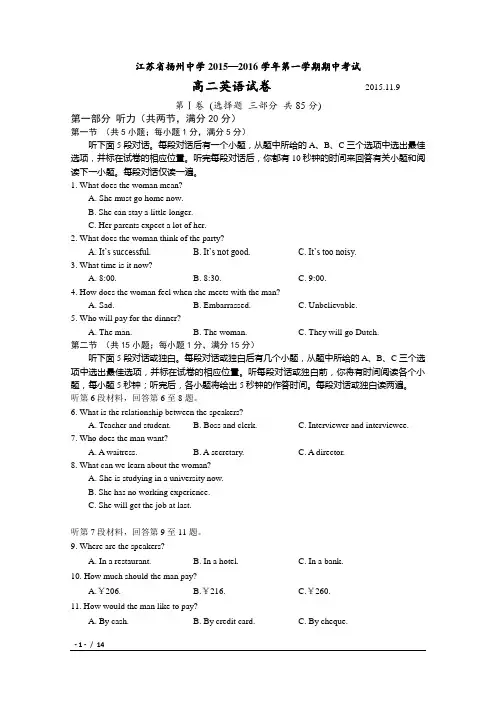
江苏省扬州中学2015—2016学年第一学期期中考试高二英语试卷2015.11.9第Ⅰ卷(选择题三部分共85分)第一部分听力(共两节,满分20分)第一节(共5小题;每小题1分,满分5分)听下面5段对话。
每段对话后有一个小题,从题中所给的A、B、C三个选项中选出最佳选项,并标在试卷的相应位置。
听完每段对话后,你都有10秒钟的时间来回答有关小题和阅读下一小题。
每段对话仅读一遍。
1. What does the woman mean?A. She must go home now.B. She can stay a little longer.C. Her parents expect a lot of her.2. What does the woman think of the party?A. It’s successful.B. It’s not good.C. It’s too noisy.3. What time is it now?A. 8:00.B. 8:30.C. 9:00.4. How does the woman feel when she meets with the man?A. Sad.B. Embarrassed.C. Unbelievable.5. Who will pay for the dinner?A. The man.B. The woman.C. They will go Dutch.第二节(共15小题;每小题1分,满分15分)听下面5段对话或独白。
每段对话或独白后有几个小题,从题中所给的A、B、C三个选项中选出最佳选项,并标在试卷的相应位置。
听每段对话或独白前,你将有时间阅读各个小题,每小题5秒钟;听完后,各小题将给出5秒钟的作答时间。
每段对话或独白读两遍。
听第6段材料,回答第6至8题。
6. What is the relationship between the speakers?A. Teacher and student.B. Boss and clerk.C. Interviewer and interviewee.7. Who does the man want?A. A waitress.B. A secretary.C. A director.8. What can we learn about the woman?A. She is studying in a university now.B. She has no working experience.C. She will get the job at last.听第7段材料,回答第9至11题。
江苏省扬大附中2015-2016学年高二第一学期阶段测试英语试卷

扬大附中2015-2016第一学期阶段测试高二英语试卷1.—With this New Year new challenges.—Sure. Global economy remains uncertain, and many countries continue to struggle.esB. will comeC. is comingD. come2.Though the GDP growth in July-September marked the slowest quarterly growth, it was still the reasonable range set by policy makers and in line with market expectation.A.withinB. againstC. beyondD. alongside3. A new study suggest that yelling at children may have consequences that go beyond of beating them.A.onesB. theseC. thatD. thosest month, part of Britain was struck by snowstorms, from effects most passengers in Healthrow were suffering a lot, especially those with children.A.thatB. thoseC. whoseD. what5.Traffic conditions in Beijing for decades. At first people only complained about jams during rush hours, but today every hour is rush hour.A.is worseningB. have been worseningB. C. have worsened D. worsened6.The dispute between the neighboring states led to Parkistan control of Bangladesh.A.lostB. losingC. loseD. loss7.Male and female students are quite different from each other the age at which they begin to develop an intellectual self-discipline.A.regardless ofB. in favour ofC. in honor ofD. with regard to8.—School is over. How can we contact Robert?—Try phoning him. He be home by now. he lives only a stone’s throw from the school.A.wouldB. shouldC. willD. shall9.We haven’t settled the question of it is necessary for him to study abroad.A.ifB. whereC. whetherD. that10.Though the scheme was well designed, it because people were unwilling to cooperate.A.broke downB. broke throughC. broke outD. broke up11.The most exciting thing for him was he finally found two tinned fruits in seemed to him to be a servant’s bedroom.A.what ; thatB. what ; thatC. that ; thatD. that ; what12.After years of hard work, the writer finally had his book publishedwith farming methods.A.to dealB. dealingC. to be dealtD. being dealt13.All flights because of the air traffic control, the passengers had to wait in the hall.A.Were put offB. having put offC. have been put offD. having been put off14.Don’t worry about Derek. Police believe he gave a reasonably account of what happened.A.anxiousB. accurateC. absurdD. awkward15.—Conductor, can I get to Market Street on the subway?—Of course. It’s leaving. , please.A.Take your time.B. Mind your stepC. Look out.D. Walk slowly 完型填空Carl Walter was my piano teacher. During one of my lessons he asked how much practicing I was doing. I said three or four hours a day.“Do you practice in long stretches, an hour 16 ?”“I try to.”“Well, don‟t,” he said loudly. “When you grow up, 17 won‟t come in long stretches. Practice in minutes, whenever you can find them five or ten before school, after lunch, 18 household tasks. 19 the practice through the day, andpiano-playing will become a part of your life.”When I was teaching at Columbia, I wanted to 20 , but class periods,theme-reading, and committee meetings filled my days and evenings. For two years I got practically nothing down on paper, and my 21 was that I had no time. Then I remembered what Carl Walter had said. During the next 22 I conducted an experiment. Whenever I had five minutes unoccupied, I sat down and wrote a hundred words or so. To my 23 , at the end of the week I had a rather large manuscript ready for revision, later on I wrote novels by the same piecemeal method. 24 my teaching schedule had become heavier than ever, in every day there were idle moments which could be caught and put to use. I 25 took up piano-playing again, finding that the small 26 of the day provided sufficient time for both writing and piano practice.There is an important 27 in this time — you must get into your work quickly. If youhave but five minutes for writing, you can‟t afford to waste four 28 your pencil. You must make your mental preparations 29 , and concentrate on your task almost instantly when the time comes. Fortunately, rapid 30 is easier than most of us realize.I 31 I have never learnt how to let go easily at the end of the five or ten minutes. But 32 can be expected to supply interruptions. Carl Walter has had atremendous 33 on my life. 34 him I owe the discovery that even very short periods of time 35 all useful hours I need.16. A. at no time B. at a time C. at one time D. in no time17. A. time B. life C. work D. success18. A. beyond B. among C. beneath D. between19. A. Separate B. Spread C. Organize D. Arrange20. A. play B. rest C. write D. read21. A. excuse B. reason C. cause D. factor22. A. time B. morning C. week D. day23. A. satisfaction B. disappointment C. depression D. astonishment24. A. Though B. Because C. Whether D. Unless25. A. often B. even C. ever D. always26. A. quantities B. pieces C. intervals D. ranges27. A. period B. link C. stage D. trick28. A. chewing B. sharpening C. repairing D. using29. A. in mind B. in advance C. without delay D. by chance30. A. development B. progress C. concentration D. improvement31. A. admit B. confirm C. claim D. realize32. A. time B. work C. career D. life33. A. affection B. influence C. promotion D. proposal34. A. On B. For C. In D. To35. A. come down with B. look up to C. add up to D. break up with 阅读理解AHolidaymakers who are bored with baking beaches and overheated hotel rooms head for a big igloo. Swedish businessman Nile Bergqvist is delighted with his new hotel, the world's first igloo hotel. Built in a small town in Lapland, it has been attracting lots of visitors, but soon the fun will be over.In two weeks'time Bergqvist's ice creationwill be nothing more than a pool of water. "We don't see it as a big problem," he says. "We just look forward to replacing it."Bergqvist built his first igloo in 1991 for an art exhibition. It was so successful th at he designed the present one, which measures roughly 200 square meters. Six work men spent more than eight weeks piling 1,000 tons of snow onto a wooden base; when the snow froze, the base was removed. "The only wooden thing we have left in the igloo is the front door," he says.After their stay, all visitors receive a survival certificate recording their success. With no windows, nowhere to hang clothes and temperatures below 0℃, it may seem more like a survival test than a relaxinghotel break. "It's great fun," Bergqvist explains , "as well as a good start in survival training."The popularity of the igloo is beyond doubt: it is now attracting tourists from all over the world. At least 800 people have stayed at the igloo this season even though there are only 10 rooms. "You can get a lot of people in," explains Bergqvist. "Thebeds are three meters wide by two meters long, and can fit at least four at one time."36. Bergqvist designed and built the world's first igloo hotel because ______A. he believed people would enjoy trying something newB. he wanted to make a name for the small townC. an art exhibition was about to openD. more hotel rooms were needed37. When the writer says "the fun will be over," he refers to the fact that ______A. hotel guests will be frightened at the thought of the hard testB. Bergqvist's hotel will soon become a pool of waterC. holidaymakers will soon get tired of the big iglooD. a bigger igloo will replace the present one38. According to the text, the first thing to do in building an igloo is ______A. to gather a pool of waterB. to prepare a wooden baseC. to cover the ground with iceD. to pile a large amount of snow39. When guests leave the igloo hotel they will receive a paper stating that _____A. they have visited LaplandB. they have had an ice-snow holidayC. they have had great fun sleeping on iceD. they have had a taste of adventure40. Which of the four pictures below is the closest to the igloo hotel as described in the text?B.Health, Wellness and the Politics of Food9:00—9:45 a.m. Blue TentPanelists(成员):Jami Bernard, David Kamp, Marion Nestle and Peter Singer.Hosted by Denise Gray, science writer for The New York Times.How does what we eat not only affect our bodies, but also the world? The food and nutrition expertsdebate the role that the diet plays in both personal and global health, and present a look at food politics.Sports writing: For the Love of the Game9:50—10:35 a. m. Blue TentPanelists: Christine Brennan, Ira Rosen, Joe Wallace and Joe Drape.Hosted by William C. Rhoden, sports writer for The New York Times.Whether catching that key moment of victory or defeat, or covering breaking news, sports writers areanything but audience. Listen as some professionals discuss the special experience in reporting of sports news.The Art of the Review11:15—12:00 a. m. Green TentPanelists: John Freeman, Barry Gewen, David Orr, Celia McGee and Jennifer Schuessler.Hosted by Sam Tanenhaus, editor for The New York Times Book Review.How much of an effect does the book review have on book sales? Join this group of critics(评论家)as they discuss the reality of the book review and bestseller lists, and how they choose books for review.New York Writers, New York Stories3:003:45 p. m. Green TentPanelists: Cindy Adams, Richard Cohen, Ric Klass and Lauren Redniss.Hosted by Clyde Haberman, columnist(专栏作家)for the City Section of The New York Times.Join this inspiring group of New York-centric writers as they talk about why New York is a goldmine of ideas for their work.41. If you are free in the afternoon, you can attend________.A. The Art of the ReviewB. New York Writers, New York StoriesC. Health, Wellness and the Politics of FoodD. Sports Writing: For the Love of the Game42. If you like sports writing, you will most probably________.A. go to Blue Tent at 1115 a. m.B. enjoy Jami Bernard's talkC. listen to Christine BrennanD. attend the Art of the Review43. Sam Tanenhaus is in charge of________.A. The Art of the ReviewB. Health, Wellness and the Politics of FoodC. New York Writers, New York StoriesD. Sports Writing: For the Love of the Game44. All the four activities above________.A. are about writingB. will last 45 minutes eachC. can be attended freelyD. will attract many readers45. We can learn from the text that_______________.A. sports writers are a type of audienceB. New York Times is a gold mine companyC. Denise Grady will discuss political policyD. book reviews may affect book salesC.The discovery that language can be a barrier (障碍) to communication is quickly made by all who travel, study, govern or sell. Whether the activity is tourism, research, government, policing or business, the lack of a common language can severely delay progress or can stop it altogether.Although communication problems of this kind must happen thousands of times each day, very few become public knowledge. Publicity comes only when a failure to communicate has major results, such as strikes, lost orders, legal problems or deadly accidents--even, at times, war. One reported example of communication failure took place in 1970, when several Americans ate a species of poisonous mushroom.No remedy was known, and two of the people died within days. A radio report of the case was heard by a chemist who knew of a treatment that had been successfully used in 1959 and published in 1963. Why had the American doctors not heard of it seven years later? Possibly because the report of the treatment had been published only in journals written in European languages other than English.Several comparable cases have been reported. But isolated (孤立的) examplesdo not give an impression of the size of the problem--something that can come only from studies of the use or avoidance of foreign-language materials and contacts in different communicative situations. In the English-speaking scientific world, for example, surveys of books and documents consulted in libraries and other information agencies have shown that very little foreign-language material is ever consulted. Library requests in the field of science and technology showed that only 13 percent were for foreign language journals.The language barrier presents itself entirely to firms who wish to market their products in other countries. British industry, in particular, has in recent decades often been criticized for its assumption (设想) that foreign buyers will be happy tocommunicate in English, and that awareness of other languages is not therefore a matter to be considered first. In the 1960s, over two-thirds of British firms dealing with non-English-speaking customers were using English for outgoing letters; many had their sales language only in English; and as many as 40 percent employed no one who was able to communicate in the customer's languages. A similar problem was identified in other English-speaking countries, especially the USA, Australia and New Zealand. And non-English speaking countries were by no means free from the same problem--although the widespread use of English as an alternative (可替换的) language made them a bit more able to communicate with other countries.The criticism and publicity given to this problem since the 1960s seems to have greatly improved the situation. Industrial training projects have promoted an increase in language and cultural awareness. Many firms now have their own translation services. Some firms run part-time language courses in the languages of the countries with which they are most involved; some produce their own technical glossaries (词汇表), to ensure consistency (一致性) when material is being translated. It is now much more readily accepted that marketing efforts can be delayed, damaged or ruined by a failure to take the language needs of the customer into consideration.46. Communication problems may come to the attention of the public when ______.A. somebody has diedB. a serious traffic accident has happenedC. serious results have been causedD. people have trouble in travelling47. What is the probable meaning of the underlined word “remedy” in Paragraph 2?A. doctorB. mushroomC. poisonD. treatment48. What can we infer about American doctors from the case of the poisonous mushrooms?A. They probably only read reports written in English.B. They hadn’t read that report of the treatment.C. They didn’t know how to treat such a case.D. They were unable to get reports written in other languages.49. Firms of English-speaking countries use English only when marketing their products because ______.A. English is their official languageB. they don’t know their products will be sold abroadC. people in their countries don’t know other languagesD. they think foreign customers will be happy when English is used50. Which of the following ways has been used by the British companies to solve the problem of language barrier since the 1960s?A. Employing foreign workers.B. Setting up their own translation services.C. Providing English training for foreign customers.D. Stopping exporting goods to foreign countries.D.Mo was waiting in the corridor outside her class. She was feeling sick. She had tow exams that day and physics was first .She really hated physics. It was her worst subject. Terry Looked back at her from the front of the line, and then looked away quickly. Mo thought she looked guilty. She didn't have a problem with physics ,She didn't have a problem with anything ...Miss Perfect!"Hi ,Mo,it's your foavourite exam today "said Nima ,laughing as she joined the line .Terry was looking at Mo again ."So what's wrong with her?” asked Nima. “I thought you were friends." " Yes, so did I," said Mo. "I)ut she hasn't spoken to me for two weeks now. She promised to help me review for the physics exam too, but then she's ignored all my calls and texts .And when I rang her house, her mum just told me she was busy. She's forgotten who her friends are!" said Mo angrily. "Are you listening to me?" Mr. Reed was talking to the class and the other students were going into the exam room. Mo gave Nima a worried look and followed them.Mo couldn't answer question number five. She looked up and saw Terry sitting two rows in front of her. Mo couldn't believe it! Terry was holding her phone on her knee under the table and reading from it. Is that how Terry always got such good grades? She felt really angry at Terry, but she didn't know what to do. She thought about telling the teacher, but what would everyone else think of her? "Stop writing and put your pens down" said Mr. Reed as he started to collect the exam papers. Oh no, Mo hadn't answered two of the questions. She was going to fail again!Mo wanted to talk to Terry at lunch time, but she couldn't find her anywhere. The next exam was history. That was Mo's favourite subject but she wasn't feeling good. Mo went to the library to study, but she couldn't concentrate. She didn't know what to do about Terry. She thought about telling a teacher, but everyone would hate her if she did that. "It wasn't fair! " she thought. "Terry was getting good grades by cheating all that time. " thought Mo. Just then, Mr. Reed walked past her table. "Mr. Reed. . . "Mo was sitting behind Terry again in the history exam that afternoon. Mo was feeling terrible. Why had she told Mr. Reed? But it was too late now. And anyway, Terry didn't want to be her friend! Mr. Reed wanted her to look at him and nod if she saw that Terry was cheating in the exam. She was working on the last question when she saw that Terry had her phone under the table withou t thinking, Mo looked up and nodded to Mr. Reed. Terry was too busy looking at her phone and she didn't hear himas he walked silently up to her table. Mr. Reed didn't say anything. He jus picked up her exam paper, tore it in half and pointed to the door, to tell Terry to leave the room. Terry was crying as she walked to the door. Everyone was staring at her and Mo felt really guilty now. Why did she tell Mr. Reed?Mo was walking towards the school gate, when she heard footsteps behind her. It was Terry. "Mo, please wait I want to talk to you." Mo could see that Terry had been crying, her face was pale and her eyes were red. Mo couldn't say a word. “Listen," said Terry. "I'm reall y sorry I haven’t answered any of your calls, but we're having a terrible time at home. My dad had a heart attack two weeks ago and he's in hospital. He had a big heart operation today and I was very worried about him. I know it was stupid, but I was reading texts from my mum to see how the operation was going, but Mr. Reed caught me with my phone. He thought I was cheating. He believes me now, but I have to take the exam again. I'm sorry I didn't tell you what was happening. I haven't forgotten that you're a good friend'. Will you forgive me?“51. At the beginning of the story Mo felt sick most probably because ______.A.Terry was looking at her form the front of the lineB. she was worried that she would fail the physics examC. she had to take two different exams within one dayD. she had been waiting in the line for too long a time52. Who does "Miss Perfect" in the first paragraph refer to?A. MoB. NimaC. TerryD. Terry's mum53. It can be inferred from the above passage thatA. students didn't like those who were not faithful to their friendsB. Mr. Reed was a strict teacher who never corrected his mistakesC. The physics exam was much more difficult than the history examD. Mo was angry because Nima laughed at her relationship with Terry54. Terry didn't help Mo review for the physics exam becauseA. she didn't consider Mo as a true friendB. she herself was quite bad at physicsC. she had to look after her sick fatherD. she was selfish and hated to waste time54. At the end of the story Mo probably feltA. confident and optimisticB. glad and inspiredC. sad and angryD. regretful and guilt55. What lesson can we learn from this passage?A. A friend in need is a friend indeed.B. Friendship should be based on trust.C. Old friends and old wines are the best.D. A life without a friend is a life without a sun.任务型阅读Waste to Energy—JUST BURN IT!WHY BURN WASTE?Waste-to-energy plants generate (产生) enough electricity to supply 2.4 million households in the US. But, providing electricity is not the major advantage ofwaste-to-energy plants. In fact, it costs more to generate electricity at awaste-to-energy plant than it does at a coal, nuclear, or hydropower plant.The major advantage of burning waste is that it considerably reduces the amount of trash going to landfills. The average American produces more than 1,600 pounds of waste a year. If all this waste were landfilled (在垃圾填埋地上处理), it would take more than two cubic yards of landfill space. That’s the v olume of a box three feet long, three feet wide, and six feet high. If that waste were burned, the ashes would fit into a box three feet long, three feet wide, but only nine inches high!Some communities in the Northeast may be running out of land for new landfills. And, since most people don’t want landfills in their backyards, it has become more difficult to obtain permits to build new landfills. Taking the country as a whole, the United States has plenty of open space, of course, but it is expensive to transport garbage a long distance to put it into a landfill.TO BURN OR NOT TO BURN?Some people are concerned that burning garbage may harm the environment. Like coal plants, waste-to-energy plants produce air pollution when the fuel is burned to produce steam or electricity. Burning garbage releases the chemicals and substances found in the waste. Some chemicals can be a threat to people, the environment, or both, if they are not properly controlled.Some critics of waste-to-energy plants are afraid that burning waste will hamper (妨碍,阻碍) recycling programs. If everyone sends their trash to a waste-to-energy plant, they say, there will be little motive to recycle. Several states have considered or are considering banning waste-to-energy plants unless recycling programs are in place. Massachusetts, New Jersey, and New York City have delayed new waste-to-energy plants, hoping to increase the level of recycling first.So, what’s the real story? Can recycling and burning waste coexist? At fir st glance, recycling and waste-to-energy seem to be at odds (不一致), but they can actually complement (弥补) each other. That’s because it makes good sense to recycle some materials, and better sense to burn others.Let’s look at aluminum, for example. Al uminum mineral is so expensive to mine that recycling aluminum more than pays for itself. Burning it produces no energy. So clearly, aluminum is valuable to recycle and not useful to burn.Paper, on the other hand, can either be burned or recycled—it all depends on the price the used paper will bring.Plastics are another matter. Because plastics are made from petroleum and natural gas, they are excellent sources of energy for waste-to-energy plants. This is especially true since plastics are not as easy to recycle as steel, aluminum, or paper. Plastics almost always have to be hand sorted and making a product from recycled plastics may cost more than making it from new materials.To burn or not to burn is not really the question. We should use both recycling and waste-to-energy as alternatives to landfilling.Waste to Energy—JUST BURN IT!扬大附中2015-2016第一学期阶段测试高二英语试卷答案单选:DADCB BDBCA DBDBB完型:(淮阴中学2015届高三10月月考英语试题)BADBC ACDAB CDABC ADBDC阅读:A:(2001年全国高考英语试题)ABBDAB:(浙江省湖州市2014高考英语阅读理解一轮(暑假)精炼)BCABD C:(2014浙江高考一模冲刺提优卷)CDADBD:(2014杭州市第一次高考教学质量检测)BCACDB任务型阅读:56. cost 57. reduce / prevent / stop 58. Difficulties 59. lack 60. transporting 61. Concerns / Worries 62. harmful / dangerous 63. Coexistence64. Conclusion 65. replace。
江苏省扬州中学2015-2016学年高二上学期期末调研测试英语试题及答案
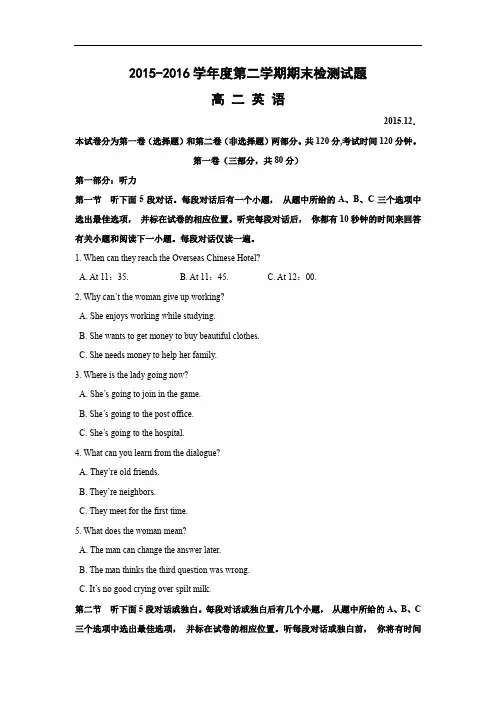
2015-2016学年度第二学期期末检测试题高二英语2015.12.本试卷分为第一卷(选择题)和第二卷(非选择题)两部分。
共120分,考试时间120分钟。
第一卷(三部分,共80分)第一部分:听力第一节听下面5段对话。
每段对话后有一个小题,从题中所给的A、B、C三个选项中选出最佳选项,并标在试卷的相应位置。
听完每段对话后,你都有10秒钟的时间来回答有关小题和阅读下一小题。
每段对话仅读一遍。
1. When can they reach the Overseas ChineseA. At 11:35.B. At 11:45.C. At 12:00.2. Why can’t the woman give up working?3. Where is the lady going now?4. What can you learn from the dialogue?5. What does the woman mean?第二节听下面5段对话或独白。
每段对话或独白后有几个小题,从题中所给的A、B、C 三个选项中选出最佳选项,并标在试卷的相应位置。
听每段对话或独白前,你将有时间阅读各个小题,每小题5秒钟;听完后,各小题将给出5秒钟的作答时间。
每段对话或独白读两遍。
听第6段材料,回答第6、7题。
6. Where does this conversation take place?A. At an airport.B. At a railway station.7. What did Mrs. Jones forget?A. Her passport.B. Her husband.C. Her friend.听第7段材料,回答第8、9题。
8. What does the man want to do?A. He wants to buy a coat.9. Why is the coat 6 dollars cheaper this week than last week?B. Because听第8段材料,回答第10至12题。
江苏省扬中句容中学、句容三中、扬州一中六校2015-2016学年高二上学期12月联考试题 英语 Word版含答案
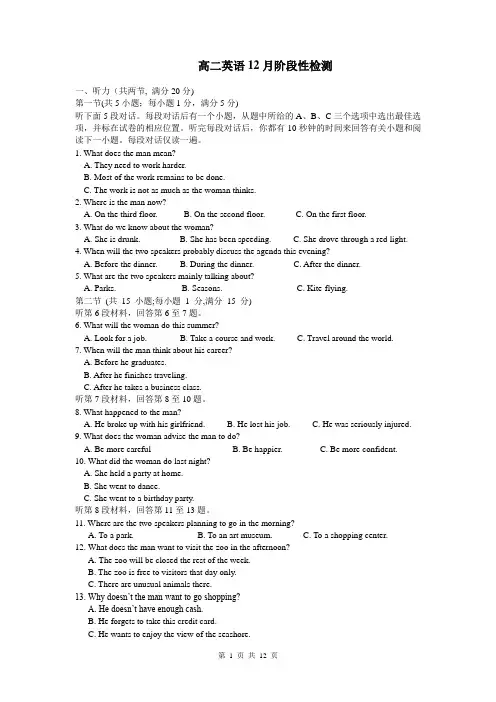
高二英语12月阶段性检测一、听力(共两节, 满分20分)第一节(共5小题;每小题1分,满分5分)听下面5段对话。
每段对话后有一个小题,从题中所给的A、B、C三个选项中选出最佳选项,并标在试卷的相应位置。
听完每段对话后,你都有10秒钟的时间来回答有关小题和阅读下一小题。
每段对话仅读一遍。
1. What does the man mean?A. They need to work harder.B. Most of the work remains to be done.C. The work is not as much as the woman thinks.2. Where is the man now?A. On the third floor.B. On the second floor.C. On the first floor.3. What do we know about the woman?A. She is drunk.B. She has been speeding.C. She drove through a red light.4. When will the two speakers probably discuss the agenda this evening?A. Before the dinner.B. During the dinner.C. After the dinner.5. What are the two speakers mainly talking about?A. Parks.B. Seasons.C. Kite-flying.第二节(共15 小题;每小题 1 分,满分15 分)听第6段材料,回答第6至7题。
6. What will the woman do this summer?A. Look for a job.B. Take a course and work.C. Travel around the world.7. When will the man think about his career?A. Before he graduates.B. After he finishes traveling.C. After he takes a business class.听第7段材料,回答第8至10题。
高二英语月考试题及答案-扬州中学2015-2016学年高二上学期开学考查
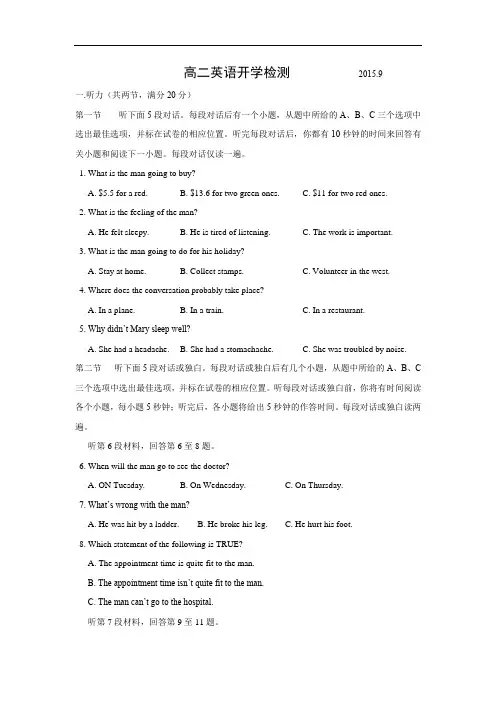
高二英语开学检测2015.9一.听力(共两节,满分20分)第一节听下面5段对话。
每段对话后有一个小题,从题中所给的A、B、C三个选项中选出最佳选项,并标在试卷的相应位置。
听完每段对话后,你都有10秒钟的时间来回答有关小题和阅读下一小题。
每段对话仅读一遍。
1. What is the man going to buy?A. $5.5 for a red.B. $13.6 for two green ones.C. $11 for two red ones.2. What is the feeling of the man?A. He felt sleepy.B. He is tired of listening.C. The work is important.3. What is the man going to do for his holiday?A. Stay at home.B. Collect stamps.C. Volunteer in the west.4. Where does the conversation probably take place?A. In a plane.B. In a train.C. In a restaurant.5. Why didn’t Mary sleep well?A. She had a headache.B. She had a stomachache.C. She was troubled by noise.第二节听下面5段对话或独白。
每段对话或独白后有几个小题,从题中所给的A、B、C 三个选项中选出最佳选项,并标在试卷的相应位置。
听每段对话或独白前,你将有时间阅读各个小题,每小题5秒钟;听完后,各小题将给出5秒钟的作答时间。
每段对话或独白读两遍。
听第6段材料,回答第6至8题。
6. When will the man go to see the doctor?A. ON Tuesday.B. On Wednesday.C. On Thursday.7. What’s wrong with the man?A. He was hit by a ladder.B. He broke his leg.C. He hurt his foot.8. Which statement of the following is TRUE?A. The appointment time is quite fit to the man.B. The appointment time isn’t quite fit to the man.C. The man can’t go to the hospital.听第7段材料,回答第9至11题。
扬州市2015-2016学年上学期高三期中质量检测

扬州市2015-2016学年上学期高三期中质量检测英语学科参考答案听力题:1-5 CABAB 6-10 ACCBC 11-15 ABAAB 16-20 CCCAC单选题:21-25 BCBCD 26-30 ABDAA 31-35 CDABC完形填空:36-40 ABBAD 41-45 CACDD 46-50 BBDAC 51-55 BADCC阅读理解:56-57 AC 58-60 BDB 61-64 CDBA 65-70 DBCACD任务型阅读:71. Approaches 72. Give/Allow/Ensure 73. solve 74. grammar 75. target 76. why 77. familiar 78. skip/ignore 79. performing 80. Access书面表达:Possible version:An exercise requires mutual trust, with one standing facing away and then falling backwards and the other catching him. Most feel uncomfortable with an exception of a girl, who tries and makes it, amazing all present.Similar incidents frequently happen exposing people’s lacking in trust with others. Days ago, a granny lost her footing and fell. Luckily, a girl immediately took her to hospital. But, when her relatives rushed there, they chose not to thank but to blame her for the fall and demanded compensation until a video proved her innocence. As they stated, if it were not your fault, why did you rush for help? We c an not deny that some people take advantage of others’ kindness.Nobody dares say he no longer needs help throughout his life. However, when turning to others, how can he get help if not fully trusting them? Therefore, mutual trust is extremely important and only with it can we solve problems and benefit our society.56. 选A。
江苏省扬州中学2015-2016学年高二英语上册期中考试题
江苏省扬州中学2015—2016学年第一学期期中考试高二英语试卷2015.11.9注意事项:1、本试卷共分两部分,第Ⅰ卷为选择题,第Ⅱ卷为非选择题。
2、所有试题的答案均填写在答题纸上,答案写在试卷上的无效。
第Ⅰ卷(选择题三部分共85分)第一部分听力(共两节,满分20分)第一节(共5小题;每小题1分,满分5分)听下面5段对话。
每段对话后有一个小题,从题中所给的A、B、C三个选项中选出最佳选项,并标在试卷的相应位置。
听完每段对话后,你都有10秒钟的时间来回答有关小题和阅读下一小题。
每段对话仅读一遍。
1. What does the woman mean?A. She must go home now.B. She can stay a little longer.C. Her parents expect a lot of her.2. What does the woman think of the party?A. It’s successful.B. It’s not good.C. It’s too noisy.3. What time is it now?A. 8:00.B. 8:30.C. 9:00.4. How does the woman feel when she meets with the man?A. Sad.B. Embarrassed.C. Unbelievable.5. Who will pay for the dinner?A. The man.B. The woman.C. They will go Dutch.第二节(共15小题;每小题1分,满分15分)听下面5段对话或独白。
每段对话或独白后有几个小题,从题中所给的A、B、C三个选项中选出最佳选项,并标在试卷的相应位置。
听每段对话或独白前,你将有时间阅读各个小题,每小题5秒钟;听完后,各小题将给出5秒钟的作答时间。
江苏省扬州中学2015-2016学年度上学期高二英语期末复习练习(5)
江苏省扬州中学2015-2016学年度上学期高二英语期末复习练习(5)第一节单项填空(共15小题;每小题1分,满分15分)从A、B、C、D四个选项中,选出可以填入空白处的最佳选项。
1.The incomes of skilled workers went up.________,unskilled workers saw their earnings fall.A.Moreover B.Therefore C.Meanwhile D.Otherwise2.He narrowly ________ being killed.A.escaped B.fled C.ran away D.ran out3.It won’t make much ________ whether you agree or not.A.difficulty B.trouble C.difference D.matter4.This article is well ________ reading but it is not ________ of being translated.A.worth;worthwhile B.worth;worthC.worthy;worthy D.worth;worthy5.—Why didn’t you buy that bike yesterday?—I don’t like that color.________,I didn’t take enough money with me.A.As a result B.In addition C.Therefore D.However6.We must plant as many trees as we can to stop the sand ________ by the wind.A.from sending away B.to be sent awayC.being sent away D.to be sending away7.It was foolish of him to ________ his notes during that important test,and as a result,he got punished.A.stick to B.refer to C.keep to D.point to8.A small plane crashed into a hillside five miles east of the city,________ all four people on board.A.killed B.killing C.kills D.to kill9.If we work with a strong will,we can overcome any difficulty ________ great it is.A.what B.how C.however D.whatever10.If I ________ you,I ________ more attention to English idioms and phrases.A.was;shall pay B.am;will payC.would be;would pay D.were;would pay11.Every possible means ________ being used to send ________ materials,food and medical supplies to people in the flooded areas.A.are;shelter B.are;occupation C.is;occupation D.is;shelter12.Can you make sure ________ the gold ring?A.where Alice had put B.where had Alice putC.where Alice has put D.where has Alice put13.—What is that building?—________ the sports equipment is stored.A.That’s the building which B.That is in whichC.The building that D.That’s where14.________ and short of breath,Andy and Ruby were the first to reach the top of Mount Tai.A.To be tired B.Tired C.Tiring D.Being tired15.This printer is of good quality. If it ________ break down within the first year,we would repair it at our expense.A.would B.should C.could D.might第二节:完形填空(共20小题;每小题1分,满分20分)Since finishing my studies at Harvard and Ox ford. I’ve watched one friend after another land high-ranking, high-paying Wall Street jobs. As executives(高级管理人员) with banks, consulting firms, established law firms, and major corporations, many are now 16 on their way to impressive careers. By society’s 17 , they seem to have it made.On the surface, these people seem to be very lucky in life. As they left student life behind, many had a 18 drink at their cheap but friendly local bar, shook hands with Longtime roommates, and 19 out of small apartments into high buildings. They made reservations at restaurants where the cost of a bottle of wine 20 a college year’s monthly rent. They replaced their beloved old car with expensive new sports cars.The thing is, a number of them have 21 that des pite their success, they aren’t happy. Some 22 of unfriendly coworkers and feel sad for eight-hour workweeks devoted to tasks they 23 . Some do not respect the companies they work for and talk of feeling tired and 24 . However, instead of devoting themselves to their work, they find themselves working to support the 25 to which they have so quickly become 26.People often speak of trying a more satisfying path, and 27 the end the idea of leaving, their jobs to work for something they 28or finding a position that would give them more time with their families almost always leads them to the same conclusion; it’ s 29 . They have loans, bills, a mortgage(抵押贷款)to 30 , retirement to save for. They recognize there’s something 31 in their lives, but it’s 32 to step off the track.In a society that tends to 33 everything in terms of dollars and cents, we learn form a young age to consider the costs of our 34 in financial terms. But what about the personal and social costs 35 in pursuing money over meaning? These are exactly the kinds of us tend to ignore — and the very ones we need to consider most.16. A. much B. never C. seldom D. well17. A. policies B. standards C. experiments D. regulations18. A. last B. least C. second D. best19. A. cycled B. moved C. slid D. looked20. A. shared B. paid C. equaled D. collected21. A. advertised B. witnessed C. admitted D. demanded22. A. complain B. dream C. hear D. approve23. A. distribute B. hate C. applaud D. neglect24. A. calm B. guilty C. warm D. empty25. A. family B. government C. lifestyle D. project26. A. accustomed B. appointed C. unique D. available27. A. yet B. also C. instead D. rather28. A. let out B. turn in C. give up D. believe in29. A. fundamental B. practical C. impossible D. unforgettable30. A. take of B. drop off C. put off D. pay off31. A. missing B. inspiring C. sinking D. shining32. A. harmful B. hard C. useful D. normal33. A. measure B. suffer C. digest D. deliver34. A. disasters B. motivations C. campaigns D. decisions35. A. assessed B. involved C. covered D. reduced三、任务型阅读Stephen Covey’s book The 7 Habits of Highly Effective People is very popular among business people who want to improve their careers, but its rules can be applied to any area of life. For example, Covey’s rules can be used to improve relationships between parents and children or to improve the way you manageCovey begins by discussing habits and effectiveness, and why they are both important to success. According to Covey, for an action to become a habit, you must know what to do and why should do it. However, you also must want to do it. On the other hand, effectiveness means having a balance between success and a good relationship with the people around you. In order to be successful, you must have habits that make you able to deal effectively with others and your own personal life.Next, Covey introduces the seven habits of highly effective people. The first three habits focus on personal growth. The next three habits are about how to get along with others. The seventh habit shows how to achieve physical, emotional and mental health.Covey includes exercises to help you analyse your life. He challenges you to decide what you want to contribute to society in your lifetime. He does this by asking you to think about what people to say about you after you die. Your answer to this question will help you make better decisions about how to spend your time. In this way, you can challenge yourself to make your dreams and ambitions come true.五、单词拼写1.It is u________ that the patient should get to hospital.2.I felt I did not have to make such a c________ to them.3.To me,the first thing is to overcome the language b________,or it will be difficult to live here. 4.She a________ a knowledge of Japanese when she was in Japan.5.The lady was beautiful beyond d________(形容).6.The businessman c________ a lot of money to the church.7.First we’ll put you as an a________(助理) to an experienced journalist.8.Marlin is getting along very well with his ________ (同事)9.They looked after the young girl,providing her with food and s________ .10. Shall I f________ you a blanket from the next room?答案一单选CACDB CBBCD DCDBBDBABC CABDC AADCD ABADB26.C 考查动词以及对语境的理解。
江苏省扬大附中2015-2016学年高二英语上册阶段测试卷
扬大附中2015-2016第一学期阶段测试高二英语试卷1.—With this New Year new challenges.—Sure. Global economy remains uncertain, and many countries continue to struggle.esB. will comeC. is comingD. come2.Though the GDP growth in July-September marked the slowest quarterly growth, it was still the reasonable range set by policy makers and in line with market expectation.A.withinB. againstC. beyondD. alongside3. A new study suggest that yelling at children may have consequences that go beyond of beating them.A.onesB. theseC. thatD. thosest month, part of Britain was struck by snowstorms, from effects most passengers in Healthrow were suffering a lot, especially those with children.A.thatB. thoseC. whoseD. what5.Traffic conditions in Beijing for decades. At first people only complained about jams during rush hours, but today every hour is rush hour.A.is worseningB. have been worseningB. C. have worsened D. worsened6.The dispute between the neighboring states led to Parkistan control of Bangladesh.A.lostB. losingC. loseD. loss7.Male and female students are quite different from each other the age at which they begin to develop an intellectual self-discipline.A.regardless ofB. in favour ofC. in honor ofD. with regard to8.—School is over. How can we contact Robert?—Try phoning him. He be home by now. he lives only a stone’s throw from the school.A.wouldB. shouldC. willD. shall9.We haven’t settled the question of it is necessary for him to study abroad.A.ifB. whereC. whetherD. that10.Though the scheme was well designed, it because people were unwilling to cooperate.A.broke downB. broke throughC. broke outD. broke up11.The most exciting thing for him was he finally found two tinned fruits in seemed to him to be a servant’s bedroom.A.what ; thatB. what ; thatC. that ; thatD. that ; what12.After years of hard work, the writer finally had his book publishedwith farming methods.A.to dealB. dealingC. to be dealtD. being dealt13.All flights because of the air traffic control, the passengers had to wait in the hall.A.Were put offB. having put offC. have been put offD. having been put off14.Don’t worry about Derek. Police believe he gave a reasonably account of what happened.A.anxiousB. accurateC. absurdD. awkward15.—Conductor, can I get to Market Street on the subway?—Of course. It’s leaving. , please.A.Take your time.B. Mind your stepC. Look out.D. Walk slowly 完型填空Carl Walter was my piano teacher. During one of my lessons he asked how much practicing I was doing. I said three or four hours a day.“Do you practice in long stretches, an hour 16 ?”“I try to.”“Well, don‟t,” he said loudly. “When you grow up, 17 won‟t come in long stretches. Practice in minutes, whenever you can find them five or ten before school, after lunch, 18 household tasks. 19 the practice through the day, andpiano-playing will become a part of your life.”When I was teaching at Columbia, I wanted to 20 , but class periods,theme-reading, and committee meetings filled my days and evenings. For two years I got practically nothing down on paper, and my 21 was that I had no time. Then I remembered what Carl Walter had said. During the next 22 I conducted an experiment. Whenever I had five minutes unoccupied, I sat down and wrote a hundred words or so. To my 23 , at the end of the week I had a rather large manuscript ready for revision, later on I wrote novels by the same piecemeal method. 24 my teaching schedule had become heavier than ever, in every day there were idle moments which could be caught and put to use. I 25 took up piano-playing again, finding that the small 26 of the day provided sufficient time for both writing and piano practice.There is an important 27 in this time — you must get into your work quickly. If youhave but five minutes for writing, you can‟t afford to waste four 28 your pencil. You must make your mental preparations 29 , and concentrate on your task almost instantly when the time comes. Fortunately, rapid 30 is easier than most of us realize.I 31 I have never learnt how to let go easily at the end of the five or ten minutes. But 32 can be expected to supply interruptions. Carl Walter has had atremendous 33 on my life. 34 him I owe the discovery that even very short periods of time 35 all useful hours I need.16. A. at no time B. at a time C. at one time D. in no time17. A. time B. life C. work D. success18. A. beyond B. among C. beneath D. between19. A. Separate B. Spread C. Organize D. Arrange20. A. play B. rest C. write D. read21. A. excuse B. reason C. cause D. factor22. A. time B. morning C. week D. day23. A. satisfaction B. disappointment C. depression D. astonishment24. A. Though B. Because C. Whether D. Unless25. A. often B. even C. ever D. always26. A. quantities B. pieces C. intervals D. ranges27. A. period B. link C. stage D. trick28. A. chewing B. sharpening C. repairing D. using29. A. in mind B. in advance C. without delay D. by chance30. A. development B. progress C. concentration D. improvement31. A. admit B. confirm C. claim D. realize32. A. time B. work C. career D. life33. A. affection B. influence C. promotion D. proposal34. A. On B. For C. In D. To35. A. come down with B. look up to C. add up to D. break up with 阅读理解AHolidaymakers who are bored with baking beaches and overheated hotel rooms head for a big igloo. Swedish businessman Nile Bergqvist is delighted with his new hotel, the world's first igloo hotel. Built in a small town in Lapland, it has been attracting lots of visitors, but soon the fun will be over.In two weeks'time Bergqvist's ice creationwill be nothing more than a pool of water. "We don't see it as a big problem," he says. "We just look forward to replacing it."Bergqvist built his first igloo in 1991 for an art exhibition. It was so successful th at he designed the present one, which measures roughly 200 square meters. Six work men spent more than eight weeks piling 1,000 tons of snow onto a wooden base; when the snow froze, the base was removed. "The only wooden thing we have left in the igloo is the front door," he says.After their stay, all visitors receive a survival certificate recording their success. With no windows, nowhere to hang clothes and temperatures below 0℃, it may seem more like a survival test than a relaxinghotel break. "It's great fun," Bergqvist explains , "as well as a good start in survival training."The popularity of the igloo is beyond doubt: it is now attracting tourists from all over the world. At least 800 people have stayed at the igloo this season even though there are only 10 rooms. "You can get a lot of people in," explains Bergqvist. "Thebeds are three meters wide by two meters long, and can fit at least four at one time."36. Bergqvist designed and built the world's first igloo hotel because ______A. he believed people would enjoy trying something newB. he wanted to make a name for the small townC. an art exhibition was about to openD. more hotel rooms were needed37. When the writer says "the fun will be over," he refers to the fact that ______A. hotel guests will be frightened at the thought of the hard testB. Bergqvist's hotel will soon become a pool of waterC. holidaymakers will soon get tired of the big iglooD. a bigger igloo will replace the present one38. According to the text, the first thing to do in building an igloo is ______A. to gather a pool of waterB. to prepare a wooden baseC. to cover the ground with iceD. to pile a large amount of snow39. When guests leave the igloo hotel they will receive a paper stating that _____A. they have visited LaplandB. they have had an ice-snow holidayC. they have had great fun sleeping on iceD. they have had a taste of adventure40. Which of the four pictures below is the closest to the igloo hotel as described in the text?B.Health, Wellness and the Politics of Food9:00—9:45 a.m. Blue TentPanelists(成员):Jami Bernard, David Kamp, Marion Nestle and Peter Singer.Hosted by Denise Gray, science writer for The New York Times.How does what we eat not only affect our bodies, but also the world? The food and nutrition expertsdebate the role that the diet plays in both personal and global health, and present a look at food politics.Sports writing: For the Love of the Game9:50—10:35 a. m. Blue TentPanelists: Christine Brennan, Ira Rosen, Joe Wallace and Joe Drape.Hosted by William C. Rhoden, sports writer for The New York Times.Whether catching that key moment of victory or defeat, or covering breaking news, sports writers areanything but audience. Listen as some professionals discuss the special experience in reporting of sports news.The Art of the Review11:15—12:00 a. m. Green TentPanelists: John Freeman, Barry Gewen, David Orr, Celia McGee and Jennifer Schuessler.Hosted by Sam Tanenhaus, editor for The New York Times Book Review.How much of an effect does the book review have on book sales? Join this group of critics(评论家)as they discuss the reality of the book review and bestseller lists, and how they choose books for review.New York Writers, New York Stories3:003:45 p. m. Green TentPanelists: Cindy Adams, Richard Cohen, Ric Klass and Lauren Redniss.Hosted by Clyde Haberman, columnist(专栏作家)for the City Section of The New York Times.Join this inspiring group of New York-centric writers as they talk about why New York is a goldmine of ideas for their work.41. If you are free in the afternoon, you can attend________.A. The Art of the ReviewB. New York Writers, New York StoriesC. Health, Wellness and the Politics of FoodD. Sports Writing: For the Love of the Game42. If you like sports writing, you will most probably________.A. go to Blue Tent at 1115 a. m.B. enjoy Jami Bernard's talkC. listen to Christine BrennanD. attend the Art of the Review43. Sam Tanenhaus is in charge of________.A. The Art of the ReviewB. Health, Wellness and the Politics of FoodC. New York Writers, New York StoriesD. Sports Writing: For the Love of the Game44. All the four activities above________.A. are about writingB. will last 45 minutes eachC. can be attended freelyD. will attract many readers45. We can learn from the text that_______________.A. sports writers are a type of audienceB. New York Times is a gold mine companyC. Denise Grady will discuss political policyD. book reviews may affect book salesC.The discovery that language can be a barrier (障碍) to communication is quickly made by all who travel, study, govern or sell. Whether the activity is tourism, research, government, policing or business, the lack of a common language can severely delay progress or can stop it altogether.Although communication problems of this kind must happen thousands of times each day, very few become public knowledge. Publicity comes only when a failure to communicate has major results, such as strikes, lost orders, legal problems or deadly accidents--even, at times, war. One reported example of communication failure took place in 1970, when several Americans ate a species of poisonous mushroom.No remedy was known, and two of the people died within days. A radio report of the case was heard by a chemist who knew of a treatment that had been successfully used in 1959 and published in 1963. Why had the American doctors not heard of it seven years later? Possibly because the report of the treatment had been published only in journals written in European languages other than English.Several comparable cases have been reported. But isolated (孤立的) examplesdo not give an impression of the size of the problem--something that can come only from studies of the use or avoidance of foreign-language materials and contacts in different communicative situations. In the English-speaking scientific world, for example, surveys of books and documents consulted in libraries and other information agencies have shown that very little foreign-language material is ever consulted. Library requests in the field of science and technology showed that only 13 percent were for foreign language journals.The language barrier presents itself entirely to firms who wish to market their products in other countries. British industry, in particular, has in recent decades often been criticized for its assumption (设想) that foreign buyers will be happy tocommunicate in English, and that awareness of other languages is not therefore a matter to be considered first. In the 1960s, over two-thirds of British firms dealing with non-English-speaking customers were using English for outgoing letters; many had their sales language only in English; and as many as 40 percent employed no one who was able to communicate in the customer's languages. A similar problem was identified in other English-speaking countries, especially the USA, Australia and New Zealand. And non-English speaking countries were by no means free from the same problem--although the widespread use of English as an alternative (可替换的) language made them a bit more able to communicate with other countries.The criticism and publicity given to this problem since the 1960s seems to have greatly improved the situation. Industrial training projects have promoted an increase in language and cultural awareness. Many firms now have their own translation services. Some firms run part-time language courses in the languages of the countries with which they are most involved; some produce their own technical glossaries (词汇表), to ensure consistency (一致性) when material is being translated. It is now much more readily accepted that marketing efforts can be delayed, damaged or ruined by a failure to take the language needs of the customer into consideration.46. Communication problems may come to the attention of the public when ______.A. somebody has diedB. a serious traffic accident has happenedC. serious results have been causedD. people have trouble in travelling47. What is the probable meaning of the underlined word “remedy” in Paragraph 2?A. doctorB. mushroomC. poisonD. treatment48. What can we infer about American doctors from the case of the poisonous mushrooms?A. They probably only read reports written in English.B. They hadn’t read that report of the treatment.C. They didn’t know how to treat such a case.D. They were unable to get reports written in other languages.49. Firms of English-speaking countries use English only when marketing their products because ______.A. English is their official languageB. they don’t know their products will be sold abroadC. people in their countries don’t know other languagesD. they think foreign customers will be happy when English is used50. Which of the following ways has been used by the British companies to solve the problem of language barrier since the 1960s?A. Employing foreign workers.B. Setting up their own translation services.C. Providing English training for foreign customers.D. Stopping exporting goods to foreign countries.D.Mo was waiting in the corridor outside her class. She was feeling sick. She had tow exams that day and physics was first .She really hated physics. It was her worst subject. Terry Looked back at her from the front of the line, and then looked away quickly. Mo thought she looked guilty. She didn't have a problem with physics ,She didn't have a problem with anything ...Miss Perfect!"Hi ,Mo,it's your foavourite exam today "said Nima ,laughing as she joined the line .Terry was looking at Mo again ."So what's wrong with her?” asked Nima. “I thought you were friends." " Yes, so did I," said Mo. "I)ut she hasn't spoken to me for two weeks now. She promised to help me review for the physics exam too, but then she's ignored all my calls and texts .And when I rang her house, her mum just told me she was busy. She's forgotten who her friends are!" said Mo angrily. "Are you listening to me?" Mr. Reed was talking to the class and the other students were going into the exam room. Mo gave Nima a worried look and followed them.Mo couldn't answer question number five. She looked up and saw Terry sitting two rows in front of her. Mo couldn't believe it! Terry was holding her phone on her knee under the table and reading from it. Is that how Terry always got such good grades? She felt really angry at Terry, but she didn't know what to do. She thought about telling the teacher, but what would everyone else think of her? "Stop writing and put your pens down" said Mr. Reed as he started to collect the exam papers. Oh no, Mo hadn't answered two of the questions. She was going to fail again!Mo wanted to talk to Terry at lunch time, but she couldn't find her anywhere. The next exam was history. That was Mo's favourite subject but she wasn't feeling good. Mo went to the library to study, but she couldn't concentrate. She didn't know what to do about Terry. She thought about telling a teacher, but everyone would hate her if she did that. "It wasn't fair! " she thought. "Terry was getting good grades by cheating all that time. " thought Mo. Just then, Mr. Reed walked past her table. "Mr. Reed. . . "Mo was sitting behind Terry again in the history exam that afternoon. Mo was feeling terrible. Why had she told Mr. Reed? But it was too late now. And anyway, Terry didn't want to be her friend! Mr. Reed wanted her to look at him and nod if she saw that Terry was cheating in the exam. She was working on the last question when she saw that Terry had her phone under the table withou t thinking, Mo looked up and nodded to Mr. Reed. Terry was too busy looking at her phone and she didn't hear himas he walked silently up to her table. Mr. Reed didn't say anything. He jus picked up her exam paper, tore it in half and pointed to the door, to tell Terry to leave the room. Terry was crying as she walked to the door. Everyone was staring at her and Mo felt really guilty now. Why did she tell Mr. Reed?Mo was walking towards the school gate, when she heard footsteps behind her. It was Terry. "Mo, please wait I want to talk to you." Mo could see that Terry had been crying, her face was pale and her eyes were red. Mo couldn't say a word. “Listen," said Terry. "I'm really sorry I haven’t answered any of your calls, but we're having a terrible time at home. My dad had a heart attack two weeks ago and he's in hospital. He had a big heart operation today and I was very worried about him. I know it was stupid, but I was reading texts from my mum to see how the operation was going, but Mr. Reed caught me with my phone. He thought I was cheating. He believes me now, but I have to take the exam again. I'm sorry I didn't tell you what was happening. I haven't forgotten that you're a good friend'. Will you forgive me?“51. At the beginning of the story Mo felt sick most probably because ______.A.Terry was looking at her form the front of the lineB. she was worried that she would fail the physics examC. she had to take two different exams within one dayD. she had been waiting in the line for too long a time52. Who does "Miss Perfect" in the first paragraph refer to?A. MoB. NimaC. TerryD. Terry's mum53. It can be inferred from the above passage thatA. students didn't like those who were not faithful to their friendsB. Mr. Reed was a strict teacher who never corrected his mistakesC. The physics exam was much more difficult than the history examD. Mo was angry because Nima laughed at her relationship with Terry54. Terry didn't help Mo review for the physics exam becauseA. she didn't consider Mo as a true friendB. she herself was quite bad at physicsC. she had to look after her sick fatherD. she was selfish and hated to waste time54. At the end of the story Mo probably feltA. confident and optimisticB. glad and inspiredC. sad and angryD. regretful and guilt55. What lesson can we learn from this passage?A. A friend in need is a friend indeed.B. Friendship should be based on trust.C. Old friends and old wines are the best.D. A life without a friend is a life without a sun.任务型阅读Waste to Energy—JUST BURN IT!WHY BURN WASTE?Waste-to-energy plants generate (产生) enough electricity to supply 2.4 million households in the US. But, providing electricity is not the major advantage ofwaste-to-energy plants. In fact, it costs more to generate electricity at awaste-to-energy plant than it does at a coal, nuclear, or hydropower plant.The major advantage of burning waste is that it considerably reduces the amount of trash going to landfills. The average American produces more than 1,600 pounds of waste a year. If all this waste were landfilled (在垃圾填埋地上处理), it would take more than two cubic yards of landfill space. That’s the volume of a box three feet long, three feet wide, and six feet high. If that waste were burned, the ashes would fit into a box three feet long, three feet wide, but only nine inches high!Some communities in the Northeast may be running out of land for new landfills. And, since most people don’t want landfills in their backyards, it has become more difficult to obtain permits to build new landfills. Taking the country as a whole, the United States has plenty of open space, of course, but it is expensive to transport garbage a long distance to put it into a landfill.TO BURN OR NOT TO BURN?Some people are concerned that burning garbage may harm the environment. Like coal plants, waste-to-energy plants produce air pollution when the fuel is burned to produce steam or electricity. Burning garbage releases the chemicals and substances found in the waste. Some chemicals can be a threat to people, the environment, or both, if they are not properly controlled.Some critics of waste-to-energy plants are afraid that burning waste will hamper (妨碍,阻碍) recycling programs. If everyone sends their trash to a waste-to-energy plant, they say, there will be little motive to recycle. Several states have considered or are considering banning waste-to-energy plants unless recycling programs are in place. Massachusetts, New Jersey, and New York City have delayed new waste-to-energy plants, hoping to increase the level of recycling first.So, what’s the real story? Can recycling and burning waste coexist? At first glance, recycling and waste-to-energy seem to be at odds (不一致), but they can actually complement (弥补) each other. That’s because it makes good sense to recycle some materials, and better sense to burn others.Let’s look at aluminum, for example. Aluminum mineral is so expensive to mine that recycling aluminum more than pays for itself. Burning it produces no energy. So clearly, aluminum is valuable to recycle and not useful to burn.Paper, on the other hand, can either be burned or recycled—it all depends on the price the used paper will bring.Plastics are another matter. Because plastics are made from petroleum and natural gas, they are excellent sources of energy for waste-to-energy plants. This is especially true since plastics are not as easy to recycle as steel, aluminum, or paper. Plastics almost always have to be hand sorted and making a product from recycled plastics may cost more than making it from new materials.To burn or not to burn is not really the question. We should use both recycling and waste-to-energy as alternatives to landfilling.Waste to Energy—JUST BURN IT!扬大附中2015-2016第一学期阶段测试高二英语试卷答案单选:DADCB BDBCA DBDBB完型:(淮阴中学2015届高三10月月考英语试题)BADBC ACDAB CDABC ADBDC阅读:A:(2001年全国高考英语试题)ABBDAB:(浙江省湖州市2014高考英语阅读理解一轮(暑假)精炼)BCABD C:(2014浙江高考一模冲刺提优卷)CDADBD:(2014杭州市第一次高考教学质量检测)BCACDB任务型阅读:56. cost 57. reduce / prevent / stop 58. Difficulties 59. lack 60. transporting 61. Concerns / Worries 62. harmful / dangerous 63. Coexistence64. Conclusion 65. replace薄雾浓云愁永昼,瑞脑消金兽。
江苏省扬州中学高二上学期期中考试 英语
江苏省扬州中学2014—2015学年第一学期期中考试高二英语试卷2014.11本卷分为第Ⅰ卷(选择题)和第Ⅱ卷(非选择题),满分120分。
考试时间120分钟。
第I 卷(选择题,三部分,共75分)第一部分听力(共两节,每题0.5分,满分10分)第一节(共5小题;每小题0.5分,满分2. 5分)听下面5段对话。
每段对话后有一个小题,从题中所给的A、B、C三个选项中选出最佳选项,并标在试卷的相应位置。
听完每段对话后,你都有10秒钟的时间来回答有关小题和阅读下一小题。
每段对话仅读一遍。
1. What does the man want?A. A tennis game.B. An online game.C. A shooting game.2. What will the man do next?A. Make dinner.B. Wash the dishes.C. Watch TV.3. What does the man mean?A. He prefers to keep the window closed.B. He is too busy to open the window.C. He agrees to open the window at once.4. What is the time now?A. About 5:30.B. About 5:00.C. About 4:30.5. What does the man suggest doing?A. Pressing the emergency button.B. Calling the service centre.C. Doing nothing for a short while.第二节(共15小题;每小题0.5分,满分7.5分)听下面5段对话。
每段对话后有几个小题,从题中所给的A、B、C三个选项中选出最佳选项,并标在试卷的相应位置。