
人教版小学英语PEP五年级下册第二单元
6. Talk about it in
groups;
7. Teacher play the tape, show the dialogue;
7. Listen
and
repeat;
8. Teacher give the question and show “Let’s 8. Listen
and
talk”;
2. 把时间和短语放在一起综合运用; 3. 用本单元句型描述自己的日常生活;
单元目标
单元重难 点
知识目标:1.能够掌握本单元出现的: take exercises, go shopping 等单词和词组, 并熟练朗读与运用;
2. 能够使用频度副词回答作息时间; 3. 能够运用所学语言知识描述一天中的生活起居以及周末活等; 能力目标:通过语言学习以及多种形式的交际活动,能够掌握本单元词汇和重
教学难
点
学生能够大胆创编和表演有关作息时间的问答小对话;
教学方法
1. Cooperative learning; 2. Situational teaching method; 3. The whole body reaction method; 4. Game teaching method; 5. Game teaching method。
课时 2/6 主备人 蔡 剑
教学内容 Part A : Let’s learn & Ask and write
教学目标
知识目标:A.能够正确听说、朗读“When do you ____? I ___ at____.”等询问 他人和表达自己作息时间的交际用语;
B. 能够正确听说、认读短语,如: do morning exercises, eat breakfast, have---class, play sports, eat dinner. 能力目标:能够听懂、会说 Let’s learn 的内容,并根据实际情况运用本课重 点句型表达自己的作息时间。 情感目标:能够提高口语表达能力,并且进行积极的思考和大胆的创新,提高 自主学习能力;
1. Multimedia courseware.
教学准备
2. Teaching plan
3. Students evaluate small gifts
整理范本
.
教师活动
学生活动
Step1: Free-talk
1. Greetings ; 2. Daily activities :
-------How are you ?
B. 能够听懂问句: When do you get up ? 并能用所学动词短语替换 句型 “ I usually ----at-----.” 中的关键词回答问句;
2、能力目标:能够听懂、会说、会表演 Let’s talk 的内容, 并能在 真实的场景中运用所学语言进行真实的交流和用;
3、情感目标:能够提高口语表达能力和语言组织能力,并且进行积 极的思考和大胆的创新,提高自主学习的能力。
教学 重难点
教学重 点
1.能够在实际语境中交流运用关于作息时间的问答句:“When do you---?” “I usually-----.”
2.能够表演并内化 Main scene 和 Let’s talk 的交际内容;
教学难 点
学生能够大胆创编和表演有关作息时间的问答小对话。
教学方法
1. Cooperative learning; 2. Situational teaching method; 3. The whole body reaction method; 4. Game teaching method; 5. Game teaching method。
设计意图:本环节旨在以歌曲的形式,复习以
前学习过的一些动词,激活学生的知识储备和
相关经验,为新授部分学习动词和名次的搭配
使用做铺垫。通过学生唱,营造了良好的英语
课堂气氛,降低了教学难度能够帮助学生更好
地理解目标语言。
Step2ut a birthday party:
.
PEP 小学英语_五__年级下册教学设计
单元
Unit 1 My day
总课时 6 主备人
蔡剑
教材分析
本单元围绕话题 “What do you do on the weekend?” 和 “When do you ----?”引出两组情景对话和一个趣味故事。本单元是五年级上册第二单元的延 续,重点学习一天中不同时间内学习和生活起居情况以及周末活动安排的表 达。本单元在复习以前学过的表达动作词汇的基础上,重点学习一些与日常作 息有关的动词短语及借此短语。尤其是学会使用频度副词谈论日常生活,用所 学语言知识询问和描述一天中的生活起居及周末活动等,并在此基础上培养学 生的语言交际能力和“用英语做事情”的能力;
3. Make
their
4. Have volunteers practice “ I usually ____at timetable;
___.” In groups;
5. A small survey of time and interest;
5. Do the survey
6. Shoe the picture of “ Main scene” ;
Step2: Presentation
1. Teacher show the time table , but not tell Ss 1. Talk about what
what to do ;
are they usually
do ?
2. Someone do
2. Play a game;
actions and
answer;
9. Replay the tape ;
9. Listen
and
设计意图:Main scene 的学习让学生整体 repeat ;
感知本单元的主要话题-----表达自己一天
的作息时间和询问他人的作息时间,感知
本单元的主要内容,功能语句 “When do
you ___? I usually ____”. 等。为新课的导
someone guess
设计意图: 通过教师制作的作息时间表,来
what do they
让学生思考,这些时间自己通常在做什么?由 do ?
学生来表达这些短语,教师作为一个引路者,
而不是代表替学生思考。作息时间表跟学生的
日常生活联系十分紧密,能够激发学生学习的
兴趣。
整理范本
二次备课
.
3. Divide Ss into different groups;
time
3. Students make
单元难点 1. 掌握四会词组以及重点句型; 2. 能熟练使用频度副词表达日常生活;
整理范本
课题
Unit 1 : My day
.
课时
1/6 主备人 蔡 剑
教学内容 Part A : Let’s try & Let’s talk
教学目标
1、知识目标:A. 能够听说读写: eat lunch, clean my room, have---class , shopping, eat dinner;
入打下了良好的基础。
Step3:Consolidation: 1. Make a dialogue ; 2. Game: Good friends ;
2.Do the survey
Step4: Summing up: 1. Phrases: 2. Sentences :
家庭作业
1、Listen and recite the dialogue; 2、Finish the relevant workbook exercises; 3、Tell your parents your timetable in English ;
点句型,并运用其完成询问他人的能力及介绍自己能力的交际, 形成良好的语言交往能力。 情感态度:1.引导学生养成良好的作息习惯,能够理解尊重从事不同职业人; 2. 训练学生的角色扮演能力,引导他们学会思考如何安排作息间 1. 四会词组:eat breakfast, do morning exercises, have---class, play sports, eat dinner, go for a walk, go shopping , clean my room, take a 单元重点 dancing class. 1、重点句型:----When do you ____?------I often-----------. 4. 语音知识:掌握字母组合 cl, pl 的发音。
学情分析
学生已掌 握的相关
知识
1. 基本掌握时间的整点表达法; 2. 基本能对自己在周几做什么事情进行简单的描述; 3. 基本掌握辅音字母 c , l, p 的发音;
学生可能 遇到的学
习问题
1. 对于频度副词: often, always, usually, sometimes, ever, 的意义 和区别容易混淆;
板书设计
Unit 1 My day ------When do you ______?
Eat lunch at_______. ------I start classes at _______.
整理范本
.
-----------. -------That’s too late.
课题
Unit 1 : My day
1. Greetings; 2. Daily activities :
------How’s the weather today ?
------What day is it ?
------What’s the date today ?
小学英语_Unit 2 My favourite season教学设计学情分析教材分析课后反思
Unit2. My favourite seasonPart A. Let’s learn & Read and match一、学习内容:Part A. Let’s learn & Read and match。
二、学习目标知识与技能:1. 能听、说、读、写单词spring,summer,autumn,winter,season。
2. 能够使用句型Which season do you like best?提问,并能根据实际情况作出回答。
3.能够看懂指示语,并按照指令完成read and match中的简单任务并chant。
过程与方法:通过小组合作、自主探究等方式培养团队合作意识,开拓思维。
情感态度与价值观:1、培养学生热爱四季的积极向上乐观的生活态度。
2、增强学生安全意识。
3、培养学生珍惜时间、珍惜农民劳动成果的习惯。
三、教学重点1.四会单词spring,summer,autumn,winter,season。
2.能用句子Which season do you like best?并能运用于生活中。
四、教学难点:能正确掌握四会单词:spring, summer, autumn, winter, season.五、教学过程1.热身(Warm-up)Let’s sing.2.新课呈现与操练(Presentation and Practice)(1) 运用气候引入What’s your favourite …? 设计如下:T: What’s the weather like today? S: It’s ….(1)分别用简笔画、声音、谜语、视频引出四个季节的单词。
呈现单词spring, summer, autumn , winter。
板书并领读。
(2)用男女生分开读、抢答游戏、单排练习、单列练习等方式操练这四个单词。
(3)用教师个人喜好引出句型Which season do you like best ?学生用开火车的方式根据个人情况作答。
Unit2Myfavouriteseason(单元解读)五年级英语下册(人教PEP版)
五下Unit 2 My favourite season 单元解读一、单元信息二.单元内容分析三、单元教学内容本单元来自PEP 小学英语五年级下册第二单元,主要围绕话题My favourite season 展开A、B、C 三个板块的教学。
梳理各课时语篇之间的延申与递进,话题之间的内在逻辑关联。
语篇一: 基于Part A Let's talk & Part A Let's learn。
该部分的核心内容是: Koala 来到中国访学,认识了Mike 等很多的新朋友,参观了他们的学校。
在相互了解的过程中,大家交流讨论了各自最爱的季节,并结合四季中各自不同的气候变化特征来说说为什么喜欢这个季节的原因。
通过第一节课初步的谈论,让孩子们了解四季的不同气候变化,感受每一个季节的典型特征与独特魅力,并学会正确表达和分享自己对各个季节的喜好。
语篇二: 基于Let's spell 。
该部分的核心内容是: 教师根据单元整体教学内容设计故事情境: Koala 米到中国访学,认识了很多的新朋友,他参观了朋友们的学校,受邀去斌斌家里做客,并和Zoom、Zip 一起度过特别的圣诞节。
现在,他又开心地和朋友们一起上课,发挥自己的特长,帮助孩子们学习英语语音。
本课以Koalas spelling class 为话题内容展开教学,学习br& gr 的自然拼读、发音规律以及应用。
通过本课的学习,帮助孩子们提升英语素养,借助英语这一语言工具,把中国的文化传统推广给世界更多的人,实现文化交流,展现文化自信。
语篇三: 基于Part B Let's talk & Part B Let's learn。
该部分的核心内容是: Koala 参观和欣赏朋友们的季节主题画展。
通过作品的呈现来了解朋友们对四季的不同点好,并结合四季中可以进行的一些典型而有代表性的活动来延申话题内容,从不同维度表达自己喜爱某个季节以及喜欢的原因。
pep人教版五年级英语下册第二单元练习题 测试题
PEP小学英语五年级下册第二单元测试题(基础题)一火眼金睛,找出不同类的单词(5分)()1. A plant B make C best()2. A sky B air C snowwy()3. A season B spring C summer ()4. A river B snow C rain ()5. A which B often C why二、单项选择(15分)( )1. ______ your favourite season?A. What’sB. WhatC. Who’sD. When( )2. Bears can ______ a long time _____ winter.A. sleep,forB. swim,inC. sleep, inD. swim,for( )3.--- ______ do you do morning exercises? ---Because it’s good for my health.A. HowB. WhenC. WhatD. Why( )4. I don’t like winter. It’s too _____.A. coolB. coldC. hotD. warm( )5. I like to _____ in summer.A. going swimmingB. swimC. swimmingD. go swim( )6. We can _____ ice-cream in summer.A. eatingB. eatsC. eatD. to eat( )7. I usually plant ______ in spring.A. treeB. a treesC. treesD. some tree( )8. I like fall ______.A. goodB. wellC. niceD. best.( )9. I don’t like winter , my dad doesn’t like it _____.A.tooB. eitherC. twoD. to( )10.I often fly kites _____ my friends.A.andB. toC. withD. for( )11. What would you like _____?A. doB. doingC. to doD. to doing( )12. Winter is cold for ____. A. we B. I C. my D. me( )13. How many _____ are there in a year?A. seasonsB. yearsC. dayD. week( )14. What’s the weather like _____ fall _____ Xiangyang?A. on, inB. on, onC. in, onD. in, in( )15. When it’s winter in China, it’s _____ in Australia.A. coldB. summerC. fallD. cool三.看下面的东西应哪个季节出现,把它找出来,写在下面对应的横线(10分)swim cold green cool yellow make a snowma n red plant trees hot white climb mountains warmspring: ______________________________________________________________ summer: ______________________________________________________________fall: _____________________________________________________________ _4. winter: _____________________________________________________________四单词排排队,句子自然来(10分)1. Beijing, what, is, weather, the, in, like, fall, in_____________________________________________________________?2. do, we, can, there, what_____________________________________________________________?3. Amy, like, does, best, which, season_____________________________________________________________?4. favourite, is, what, your, season_____________________________________________________________?5. spring, you, do, like, why_____________________________________________________________?五、根据中文,补充句子(10分)1. We can _____ ______ in ______. 我们可以在春天植树。
PEP人教版小学英语五年级下册第二单元试题及答案
PEP人教版小学英语五年级下册第二单元试题及答案1.B (goodbye and good XXX ns。
while cool is an adjective)2.B (rainy and rain are related to each other。
while paint is not)3.B (love and lovely are related to each other。
while five is a number)4.A (fall and tall are related to each other。
while wall is not)5.B (summer and autumn are both seasons。
while season is a general term)II。
(1) autumn (2) spring (3) summer (4) winter (5) summerIII。
1.B (the XXX hobbies。
not shopping)2.B (the n is asking about seasons。
not the concept of four seasons)3.A (the XXX asking about why the person likes snow。
not why they can go on a ic)4.A (the XXX。
not the person's activities)5.B (the XXX winter activities。
not summer activities)IV。
1.winter。
go skiing2.spring。
go hiking3.Which season。
go apple picking4.summer。
go on n with my parentsV。
1.B (goodbye and good XXX ns。
人教版PEP五年级英语下册第二单元《My favourite season》教案
Unit 2 My favourite season教案一、Teaching Contest:本课时教学重点是人教版PEP小学英语五年级下册第二单元《My favourite season》第四课时Let's talk的教学部分。
二、Teaching Objectives:1.Knowledge and Ability:能够在图片和教师的帮助下理解对话大意;能够按照正确的语音、语调及意群朗读对话,并能进行角色表演;能够在情景中运用句型Why?Because I …询问并回答喜欢某个季节的理由。
2.Process and Methods:利用中国古诗和图片呈现Let's talk中的内容;通过Free talk、Pair work、Role-play等形式操练本节课重点句型;最后通过观看四季相关的视频,感知四季之美。
3.Emotion、Attitude and Value:本课通过讨论季节,让学生感受生活之美,培养学生热爱生活的积极态度。
三、Important & difficult points:1.重点:能够在情景中运用句型Why?Because I …询问并回答喜欢某个季节的理由。
2.难点:熟练掌握重点句型,并能够分角色表演或重新编排情景对话。
四、Teaching methods:Free talk、Pair work、Role-play等五、Teaching aids:关于四季季节的图片、诗句、音频和视频六、Teaching procedures:Step 1 Warm up1.--Good morning, class!Today, we'll learn Unit 2 My favourite season.Before the class,let's sing a song about season,OK?--OK...(Teacher&Students sing together.)--Wow,you are so great! Clap hands for yourself.2.Next Let's do a revision.--Which season do you like best?--Spring/Summer/...--Good job? And which season do you like best?--I like summer best.--I like summer, too.Step 2 Presentation and Practice1.Presentation:T:As we know, there are many poems about seasons in China. For example,《春晓》、《春夜喜雨》、《绝句》。
人教版PEP小学五年级英语下册unit2 PartA Let's talk(第1课时)课件
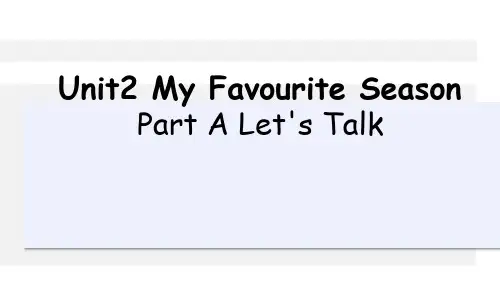
Think and say 思考空白处所缺句子,说说为什么?
Mr
Jones: Mike:
YDeosy. o_u_l_ik_e__th_e①__m_u_si_c_, _ch_i_ld_r_eWn?hat
is
it?
Mr Jones: _____②________ Today we’ll draw the seasons.
pick apples
Presentation
新知呈现
sunny hot
cloudless
T-shirt shorts
go swimming
summer
eat ice-cream
Presentation
新知呈现
snowy cold
white
coat hat
winter
make a
snowman
Presentation
Which season do you like best, Mike!
Mike:____③_____ I like snow.
Mr Jones: I like snow, too. _______④____________.
Wu Yifan: Spring. It’s pretty!
Mr Jones: Yes, it is.
Extension
拓展延伸
Think and discover 思考与发现
Does every place have four seasons?
每个地方都有四季吗?
Extension
拓展延伸
Some places have only two seasons.有些地方只有两个季节。
North Pole
PEP人教版小学英语五年级下册第二单元第17页Let27s talk
背一背 写一写
你最喜欢哪个季节? 秋天。天总是又晴朗又凉爽。 你最喜欢哪个季节? 冬天。我可以玩雪。 我不喜欢冬天。天太冷了。
Learning aims:
1. 能熟练朗读对话; 2. 能准确翻译对话。
•
1、有时候读书是一种巧妙地避开思考 的方法 。20.1 2.1020. 12.10Thursday, December 10, 2020
Guiding 2:
请同学们把Page8 Let’s talk中的内容翻译 为汉语,遇到不会的内 容请划出来,三分钟后, 小组交流。
Which season do you like best? 你最喜欢哪个季节? Fall. It’s always sunny and cool. 秋天。天总是又晴朗又凉爽。 Which season do you like best? 你最喜欢哪个季节? Winter. I can play with snow. 冬天。我可以玩雪。 I don’t like winter. It’s too cold. 我不喜欢冬天。天太冷了。
pep人教版小学英语五年级下册第二单元第17页let27stalk
Unit 2
My Favourite Season
Page 17 Lesson 2
Learning aims:
1. 能熟练朗读对话; 2. 能准确翻译对话。
Guiding 1:
请同学们认真朗读 第17页的Let’s talk中的 对话,并划出不会读的 内容,三分钟后,小组 交流。
•
7、最具挑战性的挑战莫过于提升自我 。。20 20年12 月上午 2时24 分20.12. 1002:2 4December 10, 2020
•
8、业余生活要有意义,不要越轨。20 20年12 月10日 星期四 2时24 分38秒0 2:24:38 10 December 2020
人教PEP版英语五年级下册Unit 2单元概述与课时安排
Unit 2 My favourite season一、单元整体分析本单元是义务教育灵通版(pep)小学英语教科书五年级下册的第二单元。
主要围绕话题My favourite season引出A、B、C三个板块的内容。
A、B部分呈现新知识点,C部分是以讲故事形式巩固或延展知识面。
本单元在内容上和四年级下册第四单元有相同之处,有关描述天气情况的形容词cool,cold,rainy,sunny,windy,snowy等词,学生们在四年级下册的第四单元都学过,教师采用以旧带新的方法教学,降低学生们学习难度,更有利于接受新知。
本单元共分六课时,A部分包括情景对话、重点单词和拼读规则学习三个内容,分三个课时学习,重点掌握spring,summer,autumn,winter等四个季节单词,以及重点句型Which season do you like best? Summer, I can go swimming every day. B部分包括情景对话、重点短语和两部分,分为两个课时,重点掌握go on a picnic, go swimming, pick apples, make a snowman等四个重点动词短语,以及重点句型Which season do you like best? I like spring best. There are beautiful flowers everywhere. I often go on a picnic with my family. C部分是以讲故事方式呈现本单元的重点知识元素,我把B部分的阅读写作,收集归纳和C部分讲故事拼成一个课时进行教学,用以提高学生们读音的准确度,培养学生们把学过的知识进行收集归纳的好习惯,鼓励学生大胆表演故事情节,增强学生们学习英语的浓厚兴趣和自信心。
A和B部分均是首先以语言对话形式呈现本单元的重点内容,让学生感知Which season do you like best?的适用语境,然后设置Let’s learn部分集中呈现新学词汇,培养学生对所学句型灵活运用的能力,在教学本单元内容是,我准备借助一些适当的网络资源,自作课堂相关内容的PPT课件,配套录音磁带、以及相关的图卡、词卡、句卡和人物头饰等辅助教学用具,采用小组对话、配音、表演、猜谜语、看图卡或词卡说句子等等丰富多彩的游戏活动,正确表达自己喜欢的季节,并能说出自己喜欢这个季节的原因,能够正确描述自己在某个季节能做的活动事项,激发学生们的学习英语的浓厚兴趣,充分发挥学生们的积极主动性,学以致用,把新知识尽快融入到真实的生活中去,树立学习英语的自信心,培养学生的语言交际能力,形成良好的运用英语交流的好习惯。
最新人教版pep小学五年级英语下册unit_2_my_favourite_season_part_A_part_B_作文_练习精品ppt课件 - 副本
favorite Fall favorite season. is my
. ,
summer
• 1. best, like, you, which, season, do (?)
• • •
Which season do you like best?
I like summer best.
2. best, like, I, summer (.)
fly kites plant trees
Why do you like spring?
Because I can
plant trees . fly kites
Spring, spring, I like spring. Because I can plant trees . Because I can fly kites .
autumn
-What can you do in autumn? -I can pick apples in autumn.
pick apples
Which season is it?
It's cold. We can skate(滑冰). We can make a snowman.
winter
Why do you like summer?
3. do, like, you, why, summer (?) 4. I, swim, can, lake, because, the, in (.)
Because I can swim in the lake.
sw__m i
sk__te a
pl_nt a tr__s ee
What can you do in spring? What’s your favourite season?
人教版小学英语五年级下册第二单元说课稿
人教版小学英语五年级下册Unit 2 My favourite seasons 说课稿(原创)An interpretation of one lesson on Unit Two ----what’s your favorite season Good morning! My respected judges! It is a great honor to have a chance to stand here and talk to you today. What I am going to talk about is Unit Two ------What‟s Your Favorite Season---- in the PEP Primary English Students‟Book---Book 2 in Grade Five.一、Analysis of textbookThe main topic in this unit is …season‟. There are three major parts in this unit, including Part A, Part B and Part C. Obviously, it is impossible to finish this unit in one lesson hour, so I divided this unit into six lessons hours, and each part takes two lessons hours. And what I am going to talk about is the first lesson. The first lesson includes four small parts: Let‟s start, Let‟s chant, Let‟s learn and Let‟s find out.(一)、Important Points and Difficulties in this lesson1.How to answer the following questions:①What is your favorite season (or Which season do you like best?)?②What is the weather like?③What season is it now?④Why do you like spring/summer/fall/winter?2.How to help students be able to read, speak, listen and write the new words: such as season, spring, summer, fall and winter3.Review some words on weather, such as cool, warm, hot, cold, windy, rainy, sunny, and cloudy.(二)、TeachingGoals in this lesson1. Study the four sentences patterns: ① What is your favorite season (or Which season do you like best?)? ② What is the weather like? ③ What season is it now? ④Why do you spring/summer/fall/winter?2. The student can read, speak, listen and write the new words: season, spring, summer, fall and winter after finishing this lesson.3.Develop the students‟interests in studying English by helping them speak English as much as possible.4. Teach the students some geographical knowledge on weather in different places. (三)、Preparations in this lesson1. Prepare four typical pictures: a spring picture with beautiful flowers and green trees, a summer picture with hot sun and a weeping man, a fall picture with lots of fruits in the trees and a winter with lots of snows.2. Prepare four pictures on a tree in spring, summer, fall and winter.3. Prepare a big map, and the map are marked with some cities on it.4. Prepare some red stars to award the students who do a good job in class.5. Prepare a tape, a recorder and a fan.二、Teaching Methods and studying methods(一) Situational Teaching MethodDuring the teaching procedure, I make several situational conversations forthe students. For example, I choose some students to do the role-playing game, and let them play the roles in the textbook, and make their own conversation by themselves according to their reality. By doing this game, the students can have chances to practice their oral English and join into the teaching procedure.(二) Interactive Teaching MethodGuessing game is one of activities in my teaching procedure. For example, the teacher makes body gestures, and the students guess what the gestures mean. By the interaction between teacher and students can avoid just the teacher‟s talking, also can activate atmosphere of the class, and let them learn English by games. (三) Task-based Teaching MethodIn the first lesson, I design a task for the students, for example. I ask the students to draw four pictures in spring, summer, fall and winter and put the words on the pictures. By doing this activity, the students can memorize the new words better.(四) Group Study MethodI divide the class into four groups and each group has its own name. Group study plays a very important role my lesson. By doing this, the students can study English in competitive cooperation.(五) Practice MethodPractice is very important. The students can not improve their English without practice, because practice makes perfect. By doing practice, the students can make full use of what they have learned in the class.三、Teaching procedures (一)Warm-up(1) Guessing gameIn warming-up step, after the teacher and students greet each other, the teacher begins to make body gestures on weather, such as cold, hot, warm, cool, rainy, windy, cloudy and so on., and asks the students what is the weather like now. And the students guess what kind of weather it is. Such as making a hot weather gesture, the teacher keeps fanning with his hand; making a cold weather gesture, and the teacher keep shaking. Any student guesses the right answer will be awarded a red star for his group. This step helps students go over some words on weather, and makes preparation for the new lesson.(二) Lead-in(1) Learning the new wordsThe teacher takes out four typical pictures in spring, summer, fall and winter, and sticks them on the blackboard. Then the teacher asks the students what season is it, and puts the word …season‟ on the blackboard, and teaches the students how to read it. Then the teacher points at spring picture, and asks students what season it is. The students may not know the word …spring‟, but they can answer it “Chuntian”in Chinese, then the teacher writes down the word …spring‟ below the picture, and teaches them how to read it. Using the same way, the teacher teaches other newwords. After that the teacher invites some students to stand up and read the new words several times.(2) Guessing GameIn this step, the students put the new words into practice. The teacher chooses a volunteer, and shows him a picture of tree, and he draws the picture, and other students guess what season it is based on the picture the volunteer draw. Anyone who guesses right will be awarded a red star for his group. Every group has one chance to answer the question.(3) Task: Drawing picturesIn this step, the teacher requires every student drawing four pictures in spring, summer, fall and winter, and putting the new words on them.(4) Showing the mapIn this step, the teacher takes out a big map, and sticks it on the blackboard, and shows the students some cities on the map, such as Lhasa, Beijing, Shenzhen, Kunming, Harbin, and Jianshui, and begins another Guessing game: the teacher asks “what is the weather like in Lhasa/Shenzhen/Kunming/Harbin/Jianshui in spring/summer/fall/winter”. The students use “it is windy/sunny/warm/cold/hot/warm/cool”answering the questions. Anyone who guesses right will be awarded a red star for his group.(5) Role-playingIn this step,I choose some students to do the role-playing game, and let them play the roles in the textbook, and make their own conversation by themselves according to their reality. Each group at least makes a conversation. Such as: Converstion1A: which season do you like best?B: winterA: why do you like winter?B: Because I like snows.Conversation 2A: what is your favorite season?B: I like summer.A: why do you like summer?B: Because I like swimming.Anyone who does well will be awarded a red star for his group.(6) Let’s chantThe teacher plays the tape of Let‟s chant, and the students follow the tape to chant together for two time. Then the teacher explains what the chant means. And chant it again.(7) Counting the red stars of each groupCongratulations to the winner group, and give them applauses.(8) Homework Each student is required writing the new words and foursentences patterns two times.(9) Blackboard writing planUnit 2 What is your favorite season1. Season, spring, summer, fall, winter.2. What is your favorite season/which season do you like best. I like.....3.Why do you like ….? Because…….4. What is the weather like in …..? It is …….5. What season is it? It is ……四、My teaching plan conceptsLet students study English in situational conversation; let students study English competitive cooperation; let students study English in happiness; Let students have no fear in studying English.五年级下册第二单元说课稿各位评委,各位老师,早上好!很荣幸能够参加今天的说课面试。