
高中英语牛津译林版必修三 Unit2 Extended Reading 课件(共20张PPT)
Reading: My teacher ----By Helen Keller
Skimming
II. Main idea for each part
Part 1 (Para 1): ___H__e_le_n__’s__s_it_u__a_t_io_n__b__e_f_o_r_e__A_n__n_ie__c_a__m_e__t_o__H__e_l_e_n_’s__h__o_u_s_e_._________ Part 2 (Paras 2-5):W__h_a_t__h_a_p__p_e_n_e_d___to__H__e_l_e_n__a_f_t_e_r_A__n_n__ie__c_a_m__e__t_o__H__e_le_n__’s__h_o__u_s_e_. Part 3 (Paras 6-9): __B_a_c_k_g__ro__u_n_d__i_n_f_o_r_m__a_t_i_o_n__f_o_r__A_n__n_ie__’s__b_e_c_o__m__in_g__H__e_l_e_n_’_s_t_e_a__c_h_er Part 4 (Paras 10-11) : A__n_n_i_e_’s__h_e__lp__i_n__H_e__le_n__’s__s_c_h_o_o__l_e_d__u_c_a_t_io__n_.__________________ Part 5 (Para 12): ___H__o_w__A__n_n_i_e__h_e_l_p_e_d__H__e_l_e_n__t_o__s_p_e_a__k_.____________________________ Part 6 (Para 13): ____A_n_n__ie_’_s__in_f_l_u_e_n__c_e__o_n__H_e__le_n__. ___________________________________
Scanning
III. Details (Part 3)
Background information for Annie’s becoming the teacher of Helen ( Paras 6-9)
1. What was Annie’s family background? • Annie was born in a poor family. When she was ten, she and her brother
Scanning
III. Details (Part 2)
After Annie Sullivan came to stay at Helen’s house ( Paras 2-5) 6. What did Helen think of the movements of Annie’s fingers on her hand? • Annie’s movements were some kinds of game. 7. What was the turning point for Helen’s learning? • The turning point was when Annie reached Helen’s understanding by managing to • teach her the word “water” on April 5th, 1887.
into laughter. She also managed to teach Helen to jump and learn the word “jump”. In a few days Helen was learning--- and enjoying it--- like any child.
Scanning
III. Details (Part 2)
After Annie Sullivan came to stay at Helen’s house ( Paras 2-5)
10. How did Helen sense the world through her hands and fingers? • Through her hands and fingers, Helen "heard" the sounds that one hears on
A philanthropist (慈善家) _____W__o_r_k_s________: Three Days to See
The story for my life
Once a ___b_li_n_d___, ___d_e_a_f____ and __d_u_m__b___ girl
Helen Keller ( 1880-1968)
became orphans. Annie and her brother were sent to a children's home (an orphanage), where her brother died. 2. How did Annie become professionally prepared to teach a deaf-blind child? • After four years’ stay at the orphanage, Annie entered an institution for the blind, where she learnt Braille. Later, She recovered part of her sight after receiving an operation. She remained at the institution for six years more, studying the teaching of deaf-blind children.
• It happened at the well where Helen was holding a jar while Annie pumped. As the water flowed onto Helen’s , Annie kept spelling w-a-t-e-r into Helen’s other hand with her fingers. Suddenly Helen understood!
I. A brief introduction to the writer
___N__a_t_io__n_a__li_t_y________: American ___E_d_u_c_a_t_i_o_n_______: She graduated from Harvard Unm__e_n_t_s___: A great writer, social activist
Scanning
III. Details (Part 2)
After Annie Sullivan came to stay at Helen’s house ( Paras 2-5)
1. What contributed to the change of Helen’s situation? • Annie’s arrival at her house and becoming her teacher. 2. What kind of person did Helen think Annie was? • A lively young woman with patience and imagination. 3. What was Annie confident in? • She could turn a deaf-blind person into a useful human being. 4. What did she try to do to help Helen? • She tried to spell words into Helen’s small hand. 5. Did what Annie’s letters or words mean something to Helen? • No. Neither words nor letters meant anything to Helen.
words, for the names of the things she touched. The words - so full of meaning – flew from Annie’s hand to hers. Those first words were to change her world. 9. How did Annie manage to teach Helen to play? • Annie managed to teach Helen to play by using many practical methods. For example, she taught Helen to laugh by putting Helen’s hand on her face, spelling l-a-u-g-h and then touching her lightly on her arm to make her burst
Scanning
III. Details (Part 1)
Before Annie Sullivan came to stay at Helen’s house (Para 1)
1.What had people thought of Helen Keller before Annie Sullivan came to her house? • Simple-minded. 2. What happened to Helen Keller when she was 19 months old? • She became deaf, blind and dumb. 3. What kind of world was Helen struggling in when Annie came to her house? • A world of silence and darkness.
译林版高中英语选必三Unit2 Extended reading 教案
《英语》(选择性必修·第三册)Unit 2Out of this worldExtended readingI. Learning objectivesBy the end of the lesson, students will be able to:1. understand the usage of the following words: origin, frequency, motive, investment, calculate, coverage, mechanic, assistant, incredibly;2. use the above words in new situations;3. analyse some complex sentences in the text;4. summarize the author’s arguments for space exploration.II. Key competence focusMaster and use the above words in new situations.III. Predicted area of difficulty1. Use the above words in new situations.2. Understand some complex sentences in the text.IV. Teaching proceduresStep 1 Reading1. Reading for the main idea and outline of the text.T: Go through the magazine article and find out the main idea of the text.T: Now you have read through the whole text. What’s the main idea of the text?T: Right. The title Why we explore has told us the theme of the text. The main idea is “reasons for space exploration”.T: What should we do to work out the outline of the text?T: In the argumentative essay, you’ll find every first sentence of each paragraph is the subject sentence of the paragraph. Condense and reshape the sentences, and you’ll outline the text. Now please finish part A on page 26.2. Reading for the details.T: Read the text again and fill in the blanks with the given words in their proper forms.economy, education, explore, discovery, investment, origination, learn, know Why do we have interest in the (1)________ of the space? Our nature drives us to know the (2)________. As a result, we learn more about how the universe (3)________ and evolves. Then we can predict where it goes. As we (4)_______ more about the universe, we may find life in outer space. As space technologies like shock absorbers and liquid hydrogen (5)________ and researched, we may solve some big problems on the Earth. Though we have(6)________ the space industry hugely, the space industry can create jobs and benefit us (7)________. What’s more, the next generations(8)________ and inspired to participate in it.3. T asks Ss to finish part B.T: The article talks about the advantages of space exploration. Do you agree or disagree with the author’s opinion? Why?4. T asks Ss to finish part C.T: Our exploration of space has already taught us many things. What do you think the future of space exploration holds for human understanding? Give reasons for your opinion and support your reasons with evidence.【设计意图:首先引导学生获得文章的主旨,再获得文章的主干信息,由此形成课文的概要。
Unit2ExtendedReading课件高中英语牛津译林版(2020)必修第三册
form into 组成;分成 unbearable adj. 难耐的,无法忍受的 bearable adj. 能忍受的 bear vt. 忍受,容忍
The clouds in the sky take the form of different animals.
天空中的云也不同动物的形式出现。
She did not run away, as she might have done. 她本来可以跑掉的,可是她没有走。
The awful night rolled slowly away, and the dawn greyly broke on THE LAST
DAY OF POMPEII! The crowd looked upwards, and saw, with unspeakable fear,
now dark, now light, told a story of past eruptions that might have warned the
city what was to come! 在这一切的上方,云雾笼罩的维苏威火山山顶若隐若现。火山岩忽明忽暗, 讲述着几度喷发的往事,这原本可以警告这座城市里的人们,即将到来的 是什么! might have done 过去本可以做而实际未做
A moment later, the mountain-cloud seemed to roll towards them, dark and rapid,
like a river, at the same time, it threw out a shower of ashes and huge pieces of
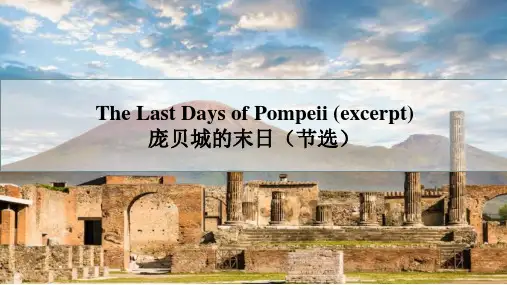
imagines life in the ancient Roman city of Pompeii in the year 79, when Mount
译林英语必修3Unit2Reading课件(共30张PPT)

4. At the end of the __9_th__c_e_n_tu_r_y____, Norwegian words began to be used in the English language.
5. The Normans entered England in _1_0_6_6____.
·In the middle 5th century,
Britain was (4) _o_c_c_u_p_i_ed___ by
the Angles and the Saxons, who
The (3)
brought their language into Old English.
_h_is_t_o_r_y Old ·At the end of the 9th century,
What can you do when you read a history article? Make a time chart, listing important information, such as times, places and events in the article.
返回目录
4. Who made the greatest contribution to the development from Old English to Middle English? The French-speaking Normans, who took control of England in 1066.
2. What did the word English come from? It came from the world Engle, as it was spelt in Old English.
Unit2SportsCulture-ExtendedReading课件-高中英语牛津译林版选择性

Writing
A Find the idioms in the magazine article, explain them in your own words and make sentences using these idioms.
“Throwing in the towel” refers to admitting defeat and no longer wanting to continue doing something. e.g. There is no need to feel ashamed to throw in the towel because it may save you from wasting your time, which can be used to do something else.
Throwing a ball that suddenly turns in the air
A batter is out after making three unsuccessful
attempts to hit the ball.
presenting someone
rough estimates
throw in the towel
放弃 throwing a towel into the ring to end the fight
admitting defeaakes an unfair and cruel remark.
Not mentioned.
and you are out
Boxing:__be_lo_w__th_e_b_el_t;_th_ro_w__in_t_he_t_o_w_el_
Conclusion
Unit3Extendedreading知识点及讲解课件-高中英语牛津译林版选择性必修第三册

Pre-reading
Let’s look at the title and predict what the article is about.
3
While-reading
Fast reading
Intensive reading
美国“亚利桑那号”战列舰 被...唤醒/吵醒
Para.6
After the attack
infamy n.臭名昭著;声名狼藉;恶行;罪恶 infamous adj.声名狼藉的;无耻的;邪恶 的;不名誉的
标注着...... 沉船的残骸
为......祈祷
Para.7
Now
在......底部
memorial a memorial to ......的纪念碑 serve as a memorial to 成为......的 纪念馆/纪念物 pray to 向......祈祷
Important words & phrases
7
升上天空
8
笼罩在海面上
9
感到血液凝固
10 回过神来,苏醒过来
11 冲到甲板上
12 片刻之后
rise into the sky hang over the sea feel one’s blood freeze come to oneself rush up to the deck moments later
Para.4
During the attack
bleed
stop the bleeding 止血 bleed for sb. 为某人流血;
对某人表示同情,体谅某人 bleed to death 流血而死
有幸能做某事
译林牛津必修二Unit2 Extended Reading公开课课件
2)Draw a graph to show the change of the author’s interest in tai chi.
2.Read paragraph 4 and fill in the chart
Essence of taichi
Chinese philosophy of (1)__y_i_n__a_n__d__y_a_ng
(5)____u_p__a_n_d__d_o_ wn (6)__l_e_f_t _a_n_d__r_i_g_ht
breathing in and breathing out
3.What are the benefits of practicing tai chi?
One year lpahtyesr,icIacl abnenheofintsestly say it has had a huge effemctenotnal mbeenepfhityssically and mentally (para.1)
sleep better at night
feel happier and more confident
feel energetic during the day
benefits
(para.5)
relax in mind
stay cool in stressful situations
Step 3 Read for appreciation
balance
stay cool in stressful situations (para5)...
physical balance and mental peace (para4)
Step 4 Conclusion and critical thinking
牛津译林版高中英语必修三英语Unit2Reading课件
raise
adopt
be made up of
The medical team was made up of
twelve doctors. 医疗队由十二名医生组成。 make up 1. 编造 整个故事都是虚构的。 The whole story is made up. 2. 补足,弥补 We need $50 to make up the loss. 我们需要五十元以弥补损失。 3.化装 她花了一个多小时才打扮好。 It took her more than an hour to
7. By the 1_0__t_h__c_e_n__t_u_r_y_, Old English was the official language of English.
Reading strategy: reading a history article
What should you notice? Why?
pick up
1. The boy picked up the hat for the old man. 男孩替老人拾起了帽子。
2. Where did you pick up your technical skill? 你的技术是在哪儿学的?
because the animals were raised
and cooked by English servants.
4. English was used for all official
occasions after tHheenNryorⅣmabnecame
thCeokniqnugeosft.England.
house—houses
Discussion:
nguages borrow words from each other. List some. e.g. Chinese words from English:
Unit2 Extended Reading 知识点课件-高中英语牛津译林版(2020)必修第二册
Practice makes perfect.
1. He suggested __f_o_ll_o_w__in__g_ (follow) the advice properly. 2. I suggested to him that we (_s_h_o_u_l_d_)_s_o_l_v_e_ (solve) the problem. 3. Are you suggesting that I __a_m____ (be) not suited for the job? 4. His cool response suggested that he __d_i_d_n_'_t_l_ik_e___(like) the idea.
v.显示,表明 evidence/results/data/studies suggest(s) that ...
hesitate ➢hesitation n. ➢hesitant adj.
hesitate to do sth.做某事有顾虑 hesitate about/over...对……犹豫不决 without hesitation毫不犹豫地
admit (admitted, admitting) vi./vt. (不情愿地)承认;承认(过错) She admits being hard on her children. No organization has admitted responsibility for the bombing. vt. 允许进入 The ticket admits one person only. She is admitted into/to his ideal university. be admitted to/into (the) hospital ➢ admission n. 承认;允许进入;录取;收治
新牛津译林版高中英语必修三Unit2Natural Disasters-Reading课件
Which of the following words can best describe Sabrina?
A. Enthusiastic and doubtful.
B. Kind and calm.
C. Sympathetic and generous. D. Ambitious and tolerant.
Paras. 2 and 3: How Sabrina saved so many lives.
(Not mentioned.)
News report 1
News report 1
When (1) _1_7_M__a_r_c_h_
Where Falmont Primary School
What
Students and teachers at a primary school (2) _s_a_v_e_d_t_h_e_m__s_e_lv_e_s__f_ro__m__a_n__e_a_rt_h_q_u_a_k_e__.
Report1 (para2-3)
Who
Alice Brown
Students
What
Why
● 1.o_p__e_n_e_d____ the classroom ● in case it became damaged
door
and 2._fa__il_e_d____ to open.
●3._s_ig_n__a_ll_e_d___to her students to ● it was the best time5.
What was her parents’ first reaction when Sabrina warned them of the approaching tsunami?
Unit 2 Extended reading 课件-高中英语牛津译林版(2020)+必修第二册
Nowadays people tend to believe that Chen Wangting, a 17th-century master of Chinese martial arts, developed tai chi based on martial arts skills.
2. Why was the author interested in tai chi in his first few classes?
slowly improved. d. When my friend first suggested that we join the new
Tai Chi Club at school, I hesitated. e. The first few tai chi classes were fun and easy, and the
1. What are the two different explanations for the origin of tai chi?
Zhang Sanfeng, a 13th-century Taoist, was said to have invented tai chi after drawing inspiration from a fight between a snake and a bird.
3. Do you know any other moves in tai chi with descriptive names?
Part the Wild Horse’s Mane on Both Side 左右野马分鬃 Grasping sparrow tail 揽雀尾 …
White crane spreading its wings (白鹤亮翅)