
最新外研版七年级英语下册Module8 Unit1课件
At the same time, there was a little girl called Goldilocks. And she decided to go to the forest…
What will happen next? Let’s go to the forest to see Goldilocks and the three bears.
Listen to the conversation again and number the pictures in Activity 2 in the correct order.
8
7
4
5
1
6
3
Read after the audio
2
Match the Please circle words the following with their words. meanings.
Answer the questions.
1. Did she pick any flowers in the forest? Yes, she did. 2. Did she notice a big tree in the forest? No, she didn’t. She noticed a little house. 3. Was the door open? Yes, it was.
Module 8 story time
Unit 1 Once upon a time…
Classic Fairy tales
Baby Bear. There lived Papa Bear, Mama ______ Bear and ______ They lived in a small house in the middle of a _______. forest
1. The story is Goldilocks and The Three Bears 2. The story begins: Onccks was a girl with hair of gold. 4. Goldilocks lived in the forest.
notice
a. to do sth more quickly b. to say numbers (1, 2, 3, ….) c. to see sb/sth
d. to do sth after thinking carefully
decide hurry count enter
e. to go into
4. Was there food in the bowls?
Yes, there was.
5. Did she want to eat the food?
Yes, she did. 6. Did she like the big bowl? No, she didn’t. She liked the small bowl. 7. Why did she like the little bowl? Because it was just right.
All around the world parents tell their children fairy tales. The stories are exciting and children enjoy listening to them again and again. In the stories, animals often speak and sometimes people become animals. The stories usually begin with “once upon a time” and end with “Happily ever after”.
One day, Mama bear prepared some soup. Papa bear said: "My soup is too hot! Let's go for a walk while it cools a little."
So the family went out.
My name is Goldilocks, because I have beautiful golden hair.
we
knock hurry enter
count
push pick notice be lost
entered, counted, once upon a time,
Once upon a time
picked, was lost, finished, noticed, knocked
_______________, there was a little girl called Goldilocks. One day, she walked in picked the forest and ______ some flowers. Soon was lost noticed she _______. Then she ______ a little knocked house, she _______ on the door but no entered one answered. So she _______ the house. counted On the table she _______ three bowls with food in them. She was very hungry, finished so she _______ all the food in the little bowl.
5. She decided to go for a ride in the forest.
Now let’s listen again andthe check your listen and try to answer following answers. questions. 1. Did she pick any flowers in the forest? 2. Did she notice a big tree in the forest? 3. Was the door open? 4. Was there food in the bowls? 5. Did she want to eat the food? 6. Did she like the big bowl? 7. Why did she like the little bowl?
外研版英语七年级下册课件Module8-Unit1
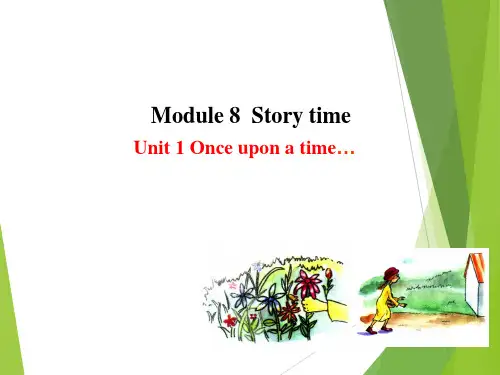
Then she noticed a little house, so she hurried towards it, and knocked on the door. 接着, 她注意到一幢小房子, 于是她赶快朝那幢房子走去, 敲了敲门。
(1)notice ① [动词] 注意到 Did you notice the man with glasses? 你注意到那个戴眼镜的男子了吗?
I noticed her crying in the room. 我注意到她正在房间里哭。(正在哭)
19
Then she noticed a little house, so she hurried towards it, and knocked on the door. 接着, 她注意到一幢小房子, 于是她赶快朝那幢房子走去, 敲了敲门。
(3) little ①[形容词] 小的 与big或large意思相对。 That's a little toy car. 那是一辆小玩具汽车。
②[代词]很少,几乎没有 修饰不可数名词, 表示否定的含义。 There is little time. 时间不多了。
20
Then she noticed a little house, so she hurried towards it, and knocked on the door. 接着, 她注意到一幢小房子, 于是她赶快朝那幢房子走去, 敲了敲门。
A.towards B.against C.opposite
it must be made up D.near
解析: towards意为“往;向”;against意为“与……相 反”;opposite意为“在……对面”;near意为“在……附 近”。由前文“如果成功是一扇大门”可知,通往它(成功) 的道路一定充满困难。
外研版七年级下册英语Module-8-Unit-1-课件

Useful phrases:
1.be born 出生于 2.e.g. I was born in Jiangmen. 3. 我出生于江门。 2. the name of …的名 3.e.g. The name of our school is 4. Chuangxin Middle School. 5. 我们学校的名字是创新中学。
Tapescript
Daming: Where were you born, betty? Betty: I was born in Quincy, a small
town in the USA. Daming: What was your first school
called?
Betty: My first school was called John Adams Primary School.
3. be strict with sb 对某人严格 4.e.g. Our teacher is strict with us. 5. 我们的老师对我们严格要求。 4. well- behaved 5. 有礼貌的,循规蹈矩的
1.Where were you born? 2.What was the name of your first school? 3.3.What was the name of your first
teacher? 4.4.What was he / she like? 5.5.Who were your first friends ? 6.6.What were they like?
friends? Betty: They were called Jamie and Kate.
Daming: What were you like? Betty: They were friendly. But Jamie
MODULE8UNIT1课件外研版英语七年级下册
--Yes, I’d love to. --我很乐意。
3. We sometimes give birthday cards. 有时我们也送生日卡片。
give意为“给,送”,常构成固定短 语give sb. sth.或give sth. to sb. , 意为 “给某人某物”。
_S_o_m__e_ti_m_e_s_ he plays tennis with his friends after school. 3. 我妈妈从不吃牛肉。 My mother __n_e_v_e_r__ _e_a_ts___ beef.
Ⅱ. 汉译英。
• 中国人在生日聚会上通常都做些什么? What do you usually do at a Chinese birthday party?
sometimes often usually always never 1. We ________ have classes from Monday to Friday.
答案:always 2. We ________ have classes on Sundays. 答案:never 3. People ________ have dinner at home, but ________
P48
What do you usually do on your birthday?
have a birthday party 举行生日聚会
light candles 点蜡烛
sing Happy Birthday 唱《生日快乐歌》
eat noodles 吃长寿面 eat birthday cake
Would you like to do sth. ? 常用来向对方 提出有礼貌地请求、邀请等,意为“你 (们) 想要/ 愿意……吗?”。 肯定回答多用Yes, please. / Yes, I’d love to. 否定回答多用No, thanks. / I’d like to, but I have to …等。
Module8Unit1课件外研版英语七年级下册

刚才:
just now;
在2011年:
in 2011
3) 句型转换: She went to school at the weekend.
一般疑问句:
__D_i_d_ she __g_o__ to school at the weekend? 肯定回答:Yes, she _d__id__. 否定回答:No, she d__id__n_’.t
初中英语外研版七年级下
Module 8 Story time Unit 1 Once upon a time…
Do you know?
The Snow White and The Seven Dwarfs
Cinderella (灰姑娘)
[ˌsɪndəˈrelə]
The Little Match Girl (卖火柴的小孩)
4、以元音字母加一 stop--__s__to_p_p__e_d
辅音字母结尾的重读 闭音动词,先双写该 辅音字母,再加ed
live--__l_iv_e_d___ carry--_c_a_r_ri_e_d__ plan--p__la_n_n_e_d__
2)时间特点: 动词一般过去时跟过去时间状语连用: 如:
1. Goldilocks ___w__a__lk__e_d___ (walk) in the forest yesterday. 2. The little boy ___c_a_r_r__ie__d___ (carry) his lovely dog
She was a little girl with hair of _g_o_ld__ .
She was in the forest.
It’s about Goldilocks.
外研社英语七年级下册NSEModule8Unit1PPT课件
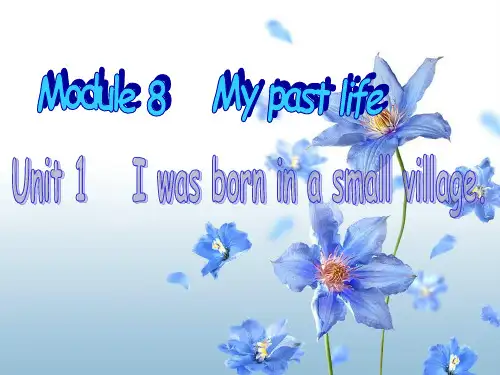
Jin Yong Editor, writer
born in February,1924 Haining, Jiaxing
Yang Liwei the first Chinese astronaut to the moon,
born in Liaoning Province
Adam naughty Darwin Primary School
• Becky • well-behaved • No.1 Primary
School
Who was your first friend? She was Becky.
What was she like? She was well-behaved .
What was the name of your first school?
Listen and answer the questions:
1. Where was Tony born? He was born in Cambridge --- a small city in England.
2. Was Tony well-behaved at school?
No, he wasn’t. He was naughty.
B) No, it wasn’t.
• 3. Was his teacher strict but nice? A) Yes, she was. B) No, she wasn’t.
• 4. Was Ms Yao strict, too? A) Yes, she was. B) No, she wasn’t.
What was the name of your first friend? His name was Adam.
外研英语七年级下册Module8 Unit1(共46张PPT)
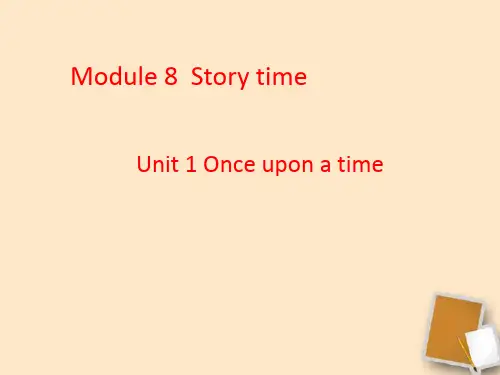
Answer the questions. Use these words.
bowl flower hungry room small 1. What did she pick in the forest? Flower 2. Where in the house did she look into?
4 Name:_G__o_ld_i_l_o_ck__s _ Who was Goldilocks? She was a little girl with __g_o_l_d_e_n__hair.
Where was she? She was in the forest.
5
曾经;一度 once
从前 once upon a time
in the forest.
3
Listen sentence by sentence
A: Do you know any famous old English stories, Tony?
B: Yes. This is called “Goldilocks and the Three Bears”. Once upon a time there was a little girl with golden hair. She was called Goldilocks. She lived near the forest. One day she decided to go for a walk. She walked into the forest with her basket.
4)趁热打铁:用所给单词的适当形式填空。 1. Goldilocks ___w_a_l_k_ed______ (walk) in the forest one day. 2. The little boy ____ca_r_r_i_e_d____ (carry) his lovely dog
外研版七年级下英语Module8 Unit1课件(共27张ppt)
a. to do sth more quickly b. to say numbers (1, 2, 3, ….) c. to see sb/sth
d. to do sth after thinking carefully
decide hurry count enter
e. to go into
1.
2.
3.
4. 5. 6. 7.
Destroy Enter hide Seek Tell Cut Fight
hurry count meet lose sleep hurt catch
destroy-destroyed- destroyed hurry –hurried-hurried enter-entered count-counted hide –hid-hidden meet - met- met seek –sought –sought lose –lost –lost tell-told- told sleep-slept-slept cut –cut –cut hurt –hurt –hurt fight-fought –fought catch-caught-caught
So the family went out.
At the same time, there was a little girl called Goldilocks. And she decided to go to the forest…
• Once upon a time, there was a little girl with hair the color of gold. Her name was Goldilocks. She lived near the forest. One day she decided to go for a walk .She walked into the forest with her basket.
外研版七年级下册Module 8 Unit 1 Once upon a time…(P1)(共18张PPT)
fairy tale
童话故事
They always begin with “ Once upon a time…” “ Long long ago…”
Goldilocks
She was a little girl with hair of gold.
She was in the forest.
basket
Module 8 Story time Unit 1 Once upon a time…(P1)
Do you know them?
The Little Mermaid
The Emperor’s New Clothes
The Little Girl Who Is Selling Matches
Cinderella
√
gold.
near
× 4. Goldilocks lived in the forest.
× 5. She decided to go for a walk in the
fopraerstk with her bdaeskceitd. e to do sth
1.Where was Goldilocks? She was___i_n_t_h_e_f_o_r_e_s_t _.
looked around her noticed a little house
hurried towards it hurry-hurried
knocked on the door Nobody answered.
pushed the door push pull
entered the house enter=go into
外研版七年级英语下册m8u1课件(一)
外研版七年级英语下册m8u1课件(一)外研版七年级英语下册m8u1课件教学内容•Unit 1: Are you going to the party?•学习目标:学习和运用动词be的一般将来时形式。
教学准备•PPT或其他教学工具•板书工具•学生练习册•外研版七年级英语下册教材教学目标•知识目标:学会和运用一般将来时的肯定句和否定句形式。
•能力目标:能够准确地描述将来的活动。
•情感目标:培养学生对英语学习的兴趣和自信心。
设计说明•创设情境,通过图片、对话等方式引起学生兴趣。
•引导学生学习和掌握一般将来时的结构和用法。
•利用多种形式的练习巩固学生的学习成果。
•激励学生利用一般将来时进行实际交流和表达。
教学过程1.课堂导入–利用一张图片引起学生注意,问学生将要做的事情。
–学生互相交流并分享。
2.情境呈现–准备几张图片,描述将来某个时间发生的事情。
–示范几个句子,让学生进行模仿。
3.语法讲解–展示一般将来时的肯定句和否定句结构。
–解释每个部分的用法和意义。
–举例说明。
4.练习活动–完成相关练习,如填空、改错等。
–学生进行小组活动,编对话使用一般将来时交流将来的计划。
5.当堂巩固–老师进行板书总结,帮助学生理解和记忆。
–学生进行口头练习,巩固所学内容。
课后反思这节课的教学目标基本实现,学生对一般将来时的结构和用法有了初步的认识,能够较为准确地描述将来的活动。
由于时间和课堂布置的限制,可能没能充分利用各种形式的练习让学生更好地掌握所学内容。
下节课可以加强练习和口头交流的机会,提高学生的语言表达能力。
教学过程(续)6.扩展练习–给学生一个情境,让他们用一般将来时来描述。
–学生互相交流,分享自己的描述。
7.集体讨论–运用一般将来时的句式进行集体讨论。
–引导学生思考和表达自己的意见。
–学生之间进行互动,提出问题和回答。
8.情景演练–创建几个情景,要求学生用一般将来时来演练对话。
–学生通过角色扮演来实践所学的语言知识。
外研版英语七年级下册:Module 8 Unit 1-课件(共27张PPT)
知识点学习
1. decide to do 决定做某事 e.g. I decide to swim with Tony
The regular simple past verb
① 一般动词原形末尾加-ed。如: look → looked, stay→ stayed ;
② 以e结尾的动词只加-d。如: hope →hoped, live→ lived;
镇 为 代 表 的 肉牛业 、以富 顺县万 寿镇桂 林村、 荣县望 佳镇品 山村、 贡井区 章佳镇 靛 坑 村 等 “ 一村一 品”村 为代表 的肉兔 养殖业 、以荣 县望佳 镇、沿 滩区永 安镇、 大 安 区 大 山 铺镇等 乡镇为 代表的 蛋鸡养 殖、以 自流井 区农团 乡、贡 井区桥 头镇等
乡 镇 为 代 表 的仿土 肉鸡养 殖业快 速发展 。 五 是 畜 禽 品 改稳步 推进。 一是优 质肉猪 比重增 加,生
E.g. pick -- picked
tried shouted
cried
wanted walked opened
Let’s retell: Once upon a time…
1
2
3
4
picked
was lost
some flowers
5
6
noticed a little house
7
hurried to the house
The regular simple past verb
③结尾是“辅音字母+y”的动词, 先将 y改 为i,再加-ed. 如: study → studied
④以“元音字母+一个辅音字母结尾” 的重读闭音节动词,先双写辅音字母, 再加-ed. 如: stop → stopped