
2013外研版七年级英语上册期末知识点复习M1-M10课件
3. This is _____ room. A. Li Lei’s and Li Hua’s B. Li Lei’s and Li Hua C. Li Lei and Li Hua’s
Module 3 知识点总结
1. What’s … like? like prep. 像
v. 喜欢 + doing/ to do 2. furniture 家具的总称(不可数作单数) 3. 数字单词,处所单词 forty 4. there be 句型 谓语be用就近原则 Yes, there is / are
on
at
Friday (星期) Friday morning (某日上下午) October 7th (具体日期) “上演” be on weekdays night 7:00 (具体时间) +小地点 bus stop, police station,
weekends 8. 职业+工作地点 (同步P9)
Quiz
I. 指出并改正下列各句的错误。 (1) What’s she name, please? she改为her (2) His name are Bill Clinton. are改为is (3) He come from Shanghai. come改为comes
二、用所给单词的适当形式填空。
No, there isn’t / aren’t
5. everyone + v.单 6. some 肯定句 any 否定/疑问句 以下句型some不变any
What/ How about some…?
Would you like some…? Can/ Could you …?
7. 区别:在墙壁上
fridge(冰箱).
A.There have B. There are C. There is
5. There is _____ water in the bottle. A.a B. any C. some
6. I am in front of Jim and Jim is ____me. A.in front of B. behind A. He’s sixty-five C. He’s six-five C. next to 7. -How old is your grandpa? -_______ B. He’s sixteen-five
Module 1 知识点总结
1. be动词
I she/ he/ it
am is
they/ you/ we are 2. Class Four Grade Seven 3. What / How about + doing? 4. come from =be from
5. 国家 China America Japan
{
have 助动词
have got
实义动词 “吃” “上课” I have English every day Do you have English every day? Yes, I do. No, I don’t I don’t have English every day.
主语为第三人称单数时,have改 为has;否定用doesn't.
单选题
1.This book is ____. A. Mary brother's B. Mary's brother's C. Mary's brother 2. ______ my parents.They are doctors. A. They are B. These are C.He is D. This is
6. be bad / good for 7. too much/ too many / much too 8. a lot of = lots of + 不可数名词 可数名词复数 9. health n. be good for your health
healthy adj. stay healthy 10. It’s important to do sth 11. get fat 12. 祈使句 肯定句: 以动词原形开头
1. He is from ____ Beijing and he is ___ in my class. 2. I’m from _____ and I’Chinese m China _______.(China) England 3. Lingling is not from _______ and she English isn’t _______ .(English) years 4. Tomare is 15 _____ old. come from 5. .What We ___ students. We ____ _____ Beijing. going 6 about _________ shopping with me ?(go)
Quiz
ห้องสมุดไป่ตู้
注: word 文档 点击此处链接
一、单项选择。 1. —____ is your classroom? —It’s next to the dinning hall. A.Where B. What C. When 2. —Are there any desks in your classroom? —No, . A. they aren’t B. there aren’t C. it isn’t
3. —Are there any trees ____ the house? —Yes, there are . A.in front of B. in the front of C. front of D. on the front of 4. ______ some juice and milk in our
三、用所给单词的适当形式填空。 1. There ____ are (be) 30 students in my class. 2. We see many doctors ______ (doctor) in the hospital. 3. How many people ______ (people) are there in your family? 4. He is Tom. Give ____ him (he) the English book. 5. This is ______ Betty (Betty) family picture. ’s
语言/人 Chinese American Japanese
国家
England
France
Germany
语言/人 English
French
German
6. It’s + adj. +to do
It’s nice to meet It ’s + n. +to do you. It’s time to have lunch.
7.
主格
宾格 物主代词 me you her him it them us my your her his its their our
反身代词 myself yourself herself himself itself themselves ourselves
I
you(你) she he it they we
否定句: 句首加 Don't
二、按要求写出下列单词的复数形式。
bread 1. bread _____
2. candy candies _______ 3. hamburger hamburgers __________ 4. noodle _______ noodles 5. carrot carrots _______ 6. tomato ________ tomatoes
二、 按照括号内的要求改写下列句子。
1. There are some trees on the hill. (变为否定句)
1. There are not any trees on the hill.
2. There are some girls in the classroom. (变为一般 疑问句)
on the wall 在墙壁上
in the wall (嵌在墙壁里)
在...的前面 in front of (不包含) in the front of (包含) 在树上 in the tree(长在树上) on the tree(非长在树) in the middle of between …and on the right / left of next to = near
7. first name= given name (名) P7
last name= family name(姓)
Quiz
注: word 文档 点击此处链接
一、根据汉语提示或首字母完成单词。 1. Peter and tony are from New York and they are Americans _________(美国人). 2. We _____( write 写) English words on the notebook. given 3. Yang Liwei’s _____ name(名) is Liwei. 4. Sunday is the f___ irst day of the week. 5. Where is Michael Jackson f____? rom
问职业: What+be+ sb?
5. hotel managers, factory workers, computer rooms women doctors 6.a friend of mine a photo of Miss Li = Miss Li’s photo 7. 介词总结:in on at in 1998 / January (年份,月份) spring (四季) the morning (早下晚) Dalian (+大地点)
2013外研版七年级英语上册期末知识点复习M1-M10课件

any 否定/疑问句 以下句型some不变any
What/ How about some…?
Would you like some…? Can/ Could you …?
第14页,共65页。
7. 区别:在墙壁上 on the wall 在墙壁上
in the wall (嵌在墙壁里)
第16页,共65页。
3. —Are there any trees ____ the house?
—Yes, there are . A.in front of B. in the front of
B. C. front of D. on the front of 4. ______ some juice and milk in our fridge(冰
v. 喜欢 + doing/ to do 2. furniture 家具的总称(不可数作单数) 3. 数字单词,处所单词 forty
4. there be 句型 谓语be用就近原则
Yes, there is / are
No, there isn’t / aren’t 第13页,共65页。
5. everyone + v.单
第5页,共65页。
Module 2 知识点总结
1. 家庭成员的单词,职业的单词 P8
2. these / those are…this / that is...
3.区别 a university / European an actor / hour / English book
问职业: What+be+ sb? What’s sb’s job?
1. There are not any trees on the hill.
外研七年级英语上册Module10 Unit1 课件

2. Ability objects (1) To identify what people do to prepare for Spring Festival. (2) To identify the questions like What is/are…doing?/What’s happening? (3) To introduce how people prepare for Spring Festival. 3. Moral objects The students in China are familiar with Spring Festival. According to learning this unit, it can cultivate students’ sense of national pride.
Purpose: By doing the exercise, the students will have a better understanding of the dialogue and master some key structures.
1. What’s happening? 发生什么事了?
Part 4 Teaching steps
Warming up
Step1 Pre—reading
Leading in
Step2 While—readingFast reading
Step 3 Post—reading Careful reading Step 4 Practice Step 5 Summary and homework
Part Two ——Teaching and Learning Methods Teaching methods:
外研版七年级上册英语期末复习知识点整理
外研版七年级上册英语期末复习知识点整理(上)Module 1重点短语1.be from... =come from... 来自......2....years old ......岁3.what about...=how about... ......怎么样?4.in Class Ten, GradeSeven在七年级十班5.thecapital of.........的首都/省会6.first name=given name名st name=family name姓8.English name 英文名字9.Chinese name 中文名字重点句子1.I’m Chinese,and I’mfrom China. 我是中国人, 我来自中国(I’m Chinese,and I come from China.)2. Wherearethey from?他们来自什么哪里?(=Where do they come from?)They arefrom America. 他们来自美国.(=They come from America.)3.How oldis that man? 那位男子多少岁了?He is forty-four.他44岁4.The studentsare in Class Five, Grade Seven.这些学生在七年级五班5.Tom is in Class Onewith Lingling. 汤姆和玲玲在一班。
=Tom with Linglingis in ClassOne.=Tom and Lingling are inClass One.6.What about you?=How about you?=And you?你呢?/你怎么样?7.Welcome to Class 6 Grade 7! 欢迎到七年级六班。
8. Beijing is thecapital of China.北京是中国的首都。
外研版七年级英语上册M1-10重点知识大全
外研版七年级英语上册M1-10重点知识大全Module1 My classmates重要知识点讲解Unit 1一、be动词的用法[点拨]1.be动词有三种形式: am, is, are,都是“是”的意思。
be动词与不同人称搭配:我(I)用am,你(you)用are; is用于他(he)她(she)它(it);单数is,复数are。
2.be动词的否定形式表达肯定句改为否定句时,直接在be动词后加not构成。
He is a teacher.他是一名老师。
(肯定句)He is not a teacher.他不是一名教师。
(否定句)3.be动词的一般疑问句表达陈述句改为一般疑问句时直接将be动词提到主语之前构成。
He is a teacher.他是一名老师。
(肯定句)Is he a teacher.他是一名教师吗?(疑问句)肯定回答:Yes, he is.是的,他是。
否定回答:No, he isn’t.不,他不是。
二、询问对方来自哪里的句型-Where are you from? 你来自哪里?-I'm from Beijing.我来自北京。
[点拨]"Where + be + 主语+ from?"意为“...来自哪里/是哪里人?”,多用于询问国籍/籍贯。
回答为“主语+be from+地点”。
be from意为“来自”,其中的be动词要随主语人称和数的变化而变化。
三、用于确定对方国籍的句型-Hi, are you English too?嘿,你也是英国人吗?-No, I’m not. I’m American and my name is Betty King. 不,我不是。
我是美国人,我叫贝蒂·金。
[点拨]"Are you+国籍?"通常在没有把握确定对方国籍时用此句型。
该句是一般疑问句,肯定回答用“Yes,I am.”否定回答用“No,I'm not.”。
外研版七年级英语上册M10-U1课件

Words:
dance clean cook meal speak
happen ready beautiful
Phrases:
make lanterns learn a dragon dance
clean the house sweep the floor
cook the meal get ready for
Task 1
Find out the answers to the following questions.
1. --Who is speaking to Lingling? --______. A. Tony’s mum B. Lingling’s father C. Tony D. Betty
Task 2
3 Choose the correct answer. 1. Are they getting ready for Spring
Festival? Yes, they are./ No, they aren’t. 2. Are Daming and Betty making lanterns? Yes, they are./ No, they aren’t. 3. Is Lingling’s mother sweeping the floor? Yes, she is./ No, she isn’t.
speak v. 说话;讲话 happen v. 发生
ready adj. 有准备的;准备好的 get ready for 为……做好准备
festival n. 节日 quite adv. 十分;相当
at the moment 此刻;目前 beautiful adj. 漂亮的,美丽的 at work 在工作
外研版七年级上册英语 课件 M10U1
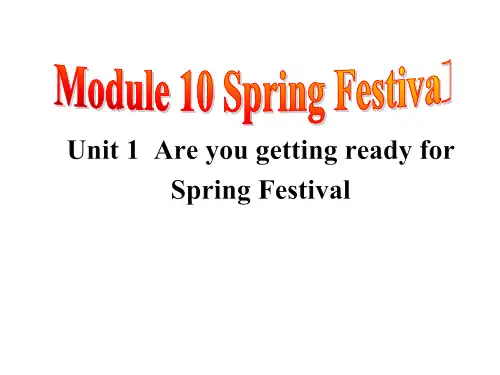
— What is your mother doing now? 你妈妈正在做什么? — She is cooking for dinner in the kitchen. 她正在厨房做晚 饭。
1. She’s cleaning the house and
putting things away.她在打扫
Tony: What are Daming and Betty doing? Linging:They’re kearning a dragon dance with my grandpa . Tony: Can I join them? Linging: Of course . Hurry up!
My father sometimes goes out for dinner with his friends.我爸爸有时 与他的朋友们在外面聚餐。
I often do my homework in the evening. 我经常在晚上做作业。
1. This is Tony speaking.我是托 尼。
— Is Jack playing computer games again? 杰克又在玩电 脑游戏吗?
— Yes, he is. /No, he isn’t. 是的, 他在玩。/ 不,他没有。
3.— What are you doing at the moment? 现在你在做什么呢? — I’m making big red lanterns. 我在做大红灯笼。 询问对方正在做什么时,使用现 在进行时的特殊疑问句形式, 即“What + be + 主语 + v.-ing + 其他?”,其回答要根据具
Tony: Hi , Lingling . This is Tony speaking .What’s happening? Are you getting ready for Spring Festival ? Lingling: Yes , we are . We’re quite busy now . Tony: What are you doing at the moment? Lingling:I’m making big red lanterns. Tony:I like them . They are very beautiful . Is your father helping you?
版外研版七年级上册英语M1-M10知识点期末复习完美版.ppt
Module 6 知识点总结
1. welcome to 2. many kinds of +可数名词复数 3. such as 4. different +可数名词复数 5. called 被称作 6. in Asia
7. a little a few
little
few
8. all over the world
Module 1 知识点总结
1. be动词 I
am
she/ he/ it is
they/ you/ we are
2. Class Four Grade Seven 3. What / How about + doing? 4. come from =be from
5. 国家 China America Japan 语言/人 Chinese American Japanese
8. sports hall
Module 4 知识点总结
• 蔬菜、水果、饮料单词 P20
• 液体、肉类不可数名词 fish, rice, bread
2. 名词变复数规则
3. go shopping for= buy 4. Let’s + v.原 5. I have got some apples Have you got any apples? Yes, I have I haven’t got any apples. No, I haven’t
in
spring (四季) the morning (早下晚)
Dalian (+大地点)
Friday (星期)
on
Friday morning (某日上下午) October 7th (具体日期)
外研版七年级英语上册教学课件:Module 10 Unit 1 (共39张PPT)
Module 10
Spring Festival
Unit 1
Are you getting ready for Spring Festival?
Objectives:
1. To understand people get ready for Spring Festival;
2. To talk about festivals using some information you have got
Yes, she is. 2 Are your classmates listening to your teacher?
No, they aren’t. They are reading their textbook. 3 Are you learning English? Yes, we are./Yes, I am. 4 Is your mother working? Yes, she is. / No, she isn’t. 5 Is your father working?
Speaking
Pronunciation
/ l / learn lantern meal /w/ what work /r / ready very /j / yes you your Now say them aloud.
Answer the questions.
外研版英语七年级上册Module-1-10期末总复习课件
Language points
1. Between this building and the dining hall is the classroom building with twenty-four classrooms.
在b”教这e。t室幢we。楼en和是餐个厅介词之,间常是和教an学d连楼用, :里“面在有……24之间间
There are two dogs and a cat under the tree.
就近原则 be动词单复数形式要跟there be之后的主语保
持一致, 如果主语是单数或不可数名词用is,
如果主语是复数用are。
There is a bird in the tree.(改为否定句) There isn't a bird in the tree.
2.There is a dog sitting in the front of the car.
family 是集合名词。 指家庭, 谓语动词用单数形式; 指成员, 谓语动词用复数形式。
1.His family____is__ big .(is /are) 2.His family all __li_k_e__reading.(like/likes ) 3.___W__h_a_t_h__o_t_ weather it is today ! (What hot/How hot/What a hot/How a hot )
Module 1
My Classmates
Introduction
Work in pairs.
--Where is he from? --He is from China.
He is Chinese.
--Where is she from?
外研版英语七年级上册名师总结:Module1-10知识点汇总
名师总结:七年级上册Module1-10知识点汇总Module 1.1first name=given name名字st name=family name姓3.in Chinese 用汉语4.in English 用英语5.speak Chinese 说汉语6….years old…岁.7.this year今年8.next year明年st year去年10.talk about 谈论(内容)11.talk with/to 与..谈论12.Mr,(先生).Miss (小姐),Mrs (夫人),Ms(女士),后跟姓,13.形容词性物主代词:1)单数:my (我的),your(你的),his(他的),her(她的),its(它的)2)复数:our(我们的),your(你们的),their(他们的,她们的,它们的.)1)单数:I (我),you (你),he(他),she(她),it(它)2)复数:we(我们), you(你们),they(他们,她们,它们)15.What’s your name?=May I know your name?询问对方的名字?16.My name is …/I’m…自我介绍.17.Nice to meet you =Nice to see you 见到你很快乐.18.Where are you from?=where do you come from?你来自哪里?/你是哪里人? 构造:where +be +人+from?=where do/does +人come from?from =come from, is from=comes from20.How old are you?=what’s your age?你多大了.?21.How about =what about..提出建议,后跟V-ing.22.welcome to ..欢送到…23.Class One,Grade One,一年级一班,班在前,年级在后.第一个字母大写.24.big,大的,反义词small小的,25.at first首先26.at last 最后27.all,三者或三者以上都,both两者都.28.be the capital of 是..的首都,..是..的省会.29.It’s +adj.+to do sth .31.from ..to 从..到…st name=family name姓33.first name=given name名34.full name 全名35.at the age of +数字=at+ 数字, 在.. 岁时.36.your teacher你的教师37.my student 我的学生38.our friends我们的朋友,39.the capital of China中国的首都40.everyone,只用来指人, every one可指人,也可指物,后可跟of.41.this这个,复数these这些, that 那个,复数those那些.42.make friends with.sb.,与某人交朋友,口诀:我(I)用am,你(you)用are, is连着他(he),她(she),它(it). 单数名词用is,复数名词全用are,变否认更容易,be后not加上去;变疑问,往前提,句末问号莫丢弃;还有一条需注意,句首大写莫忘记Module 21.family家庭,指一个家庭时,动词用单数形式,指每个成员时,用复数形式.2.on the left,在左边3.on the right在右边4.on the right of在..的右边.5.in front of 在..的前面(外面)6.in the front of 在..的前面(里面)7.a family photo 一张全家福8.take photos拍照9.感慨句构造:what a/an+形容词+单数可数名词; How +形容词/副词(+主语+谓语)10.next to 在..旁边11.by bus 乘公共汽车12.take the bus乘共汽车13.bus stop/station公共汽车站14the same as.和…一样15.look the same看起来一样16.be different from与…不同17,a photo of…的一张照片18.at a school在学校,at 后接小地方,,in 后接大地方19.问职业:1)what d o you do ?=what are you =what’s your job?构造:what+be+人?=what+do/does+人+do?=what’s one’s job?20.on a farm在农场21.for example例如22.teach—teacher(教师),work—worker(工人)23.at the table在桌旁24.at table在吃饭25.in the school在学校里26.at school在读书27.感慨句的两种构造: 1) What +(a/an)+形容词+名词+主语+谓语2)How +形容词+主语(the 名词)+谓语28.at the same hospital在同一家医院29.This is 介绍一个人用,These are..介绍两个人以上用..this(单数这个)—these(复数这些) ,that(单数那个)—those(复数那些)30.冠词:an一个,一件…用于以元音素开头的单词前,a.一个,一件..用于以辅音素开头的单词前,the ,定冠词,这,那,特指.31.the same to you,同样的祝福送给你,用于公共节日的答复.Module 3.1.How many多少,用于可数名词的数量提问,后跟名词复数2.a lot of =lots of 大量,许多,相当于可数的many ,不可数的much.3.a map of the world一张世界地图4.There be句型,表示有,句子里不能用have (有),be 用is 或are,,就近原那么.be 提前成疑问,be 后加not,变否认.5.some和any.some用于肯定句中,表示一些,修饰可数和不可数名词,any 用于疑问和否认句.6.dining hall,饭厅,饭堂7.in the middle of在..中间8.between…and…在..之间9.on在..上面, in 在…里面, under在..下面, behind在…后面, next to..在…旁边. in front of,在…前面10.on the left of在..的左边11.基数词的构成:one, two, three, four, five ,six, seven, eight, nine ,ten ,eleven, twelve, thirteen,fourteen, fifteen, sixteen, seventeen, eighteen,nineteen,(1-19)整十末尾是ty, twenty(二十), thirty (三十), forty(四十),fifty(五十), sixty(六十), seventy(七十), eighty(八十), ninety(九十)..几十几:整十-几12.表达某人的,即所有格,常常在末尾加’s,或者s’.1)一般情况下加’s,2)以s 结尾的加’,3)几个分别拥有,每个后面加’s, 几个共同拥有,最后加’s.13.at the front of=in the front of在..的前面(里面)14.watch TV看电视15.on TV在电视上,通过电视16.what’s …like?是什么样子的.?like,像.17.with,.和..一起, 具有,18.between,用于两个之间,among用于三个及以上之间/19.around the world=all over the world全世界20.go to school,去上学21.primary school,小学, go to primary school去上小学22.secondary school中学23.leave school毕业Module 41.go shopping去购物2.have got拥有3.lots of =a lot of大量,许多4.all right行吧,好吧5.be good for 对..有帮助的6.be bad for对…有害的7.healthy food安康食品8.stay healthy 保持安康,相当于keep healthy,=stay fit,=keep fit9.a bit有点儿,修饰形容词或副词,相当于a little10.a bit of,有点儿,修饰不可数名词,相当于a little11.what kind什么种类.13.all kinds of各种各样的,14different kinds of不同种类的15.a kind of一种16.kind of 有点儿,稍微18.go fishing去钓鱼go swimming去游泳go skiing去滑雪go skating 去滑冰go camping去野营go climbing去爬山19.too much太多,修饰不可数名词, much too ,太,非常,too many太多,修饰可数名词20.eat breakfast=have breakfast,吃早饭eat lunch=have lunch吃午饭eat dinner=have dinner吃晚饭21.child复数children ; tooth复数teeth; foot复数feet22.remember to do sth.记得要做某事; remember doing sth记得做过某事同构造forget(忘记)23.every morning每天早上24.every day每天, everyday每天的.25.buy 买, 短语:buy sth for sb.=buy sb. Sth., 给某人买某物26.for breakfast 就早餐而言,27.what’s your favourite food?你最喜欢的食物是什么? Favourite最喜爱的,相当于like ..best.28.some 一些,用于可数名词或不可数名词, 肯定句,或者希望对方的答复是肯定的疑问句.Any任何,一些,用于可数名词或不可数名词,否认句和疑问句.30.talk with sb./talk to sb 与某人谈论31.a bit tired有点儿累32.get fat 变胖33.in the fridge在冰箱里34.in the west 在西方35.some juice一些橙汁36.favourite drink最喜欢的饮料37.名词修饰名词,1)前面名词用单数;two apple trees.两棵苹果树;2)但man,woman,修饰名词复数时,用复数.two men teachers两个男教师38.可数名词单数变复数规那么:1.直接加S;2,以s, x ,ch ,sh ,结尾的末尾加es;3.以辅音字母加y结尾的,变y 为i,再加es;4.以f或fe结尾的,变f或fe为v ,再加es.5.黑人(negro)是英雄(hero),爱吃土豆(potato)和西红柿(tomato),这四个词后加es.6.不规那么:tooth—teeth; foot—feet; mouse—mice; woman—women; child—children;Sheep—sheep; Chinese—Chinese; Japanese—Japanese口诀:单数变复数,规那么要记住,一般加s,特殊有几处:/s/,es 不离后,末尾字母o,大多加s,两人两菜,es不离口,词尾f,fe, s前有v和e,没有规那么词,必须单独记.Module 5.1.on Monday在星期一2.at five to nine在八点五十五分3.on用于具体的某一天,或对早中晚进展修饰的词语前,at 用于具体的时刻,几点; in 用于年,月,季节,一段时间.4.时间的读法:1)先点后分,整点,数字(+o’clock); 时间不是整点:先读时,再读分, 中间的0可以读成O.2)先分后点:a,分钟数在30分以内(小于等于30),用past,构造:分钟past 点钟B:分钟数大于30,用to ,构造(60-分钟数)to 下一点.30分,可用half,6:30读成thirty past six或half past six15分钟用quarter, 6:45 读成fifteen to seven或a quartet to seven口诀:时间表达法歌谣“时〞在前,〞分〞在后,quarter, half不能有.如果出现past ,to ,我们可要看清楚,前是〞分〞,后是〞点〞,past 或to 立中间,past 要加,to 要减.如果表示〞几点半,〞要用half,past 加钟点.5.问几点?1)what time is it? =what’s the time?6.be good at =do well in擅长,后跟v-ing7.be good to 对…好8.be good for对..有好处9,on Sunday and Saturday在星期六和星期日10.next to my house与我家相邻11.have a break(课间)休息12.on the playgroud在操场13.do my homework做我的家庭作业do one’s homework做某人的家庭作业14.go home 回家,home为副词,类似的有here,there, come here来这儿,go here 去那儿15.play football,踢足球, 球类前也不加冠词, play the piano弹钢琴弹乐器类前要加定冠the16.go to the park去公园17.do sports做运动18.a busy day 繁忙的一天19.wash my hand and face洗手洗脸20.on Friday evening在星期五的晚上21.after school放学后22.have a look看一看23.have classes/lessons 上课24.have a good time玩得快乐25.have a drink喝饮料(酒)26.have a rest 休息一会儿27.have to do sth不得不做某事28.tell a story讲故事30.on weekdays在工作日31.at the weekend在周末.32.go to work上班33.go to bed去睡觉34.go to cinama去看电影35.go to the doctor去看病36.do housework做家务37.do some shopping 去购物38.be interested in对…感兴趣39.say及物动词,后跟说的内容; speak说话,发言,演讲等,跟语言,表说某种语言;tell,及物动词,告诉,讲述.tell sb. Sth告诉某人某事.tell sb to do sth .告诉某人做某事.talk,不及物动词,强调与人交谈.41.四看:watch:用来注视移动着的物体,如看电视,看球赛,看戏等.See.指通过视觉器官看到物体,强调结果,看风景,看电影,看病人,看朋友.Look表示看时,强调动作,不强调是否看见.Read 表示同文字相关的读;阅读.42.get up 起床43.play with sb .和某人一起玩.44.一般现在时1)一般现在时表示经常性或习惯性的动作或状态.句中常常有always ,usually,often ,sometimes, seldom, never, at times ,every day(year,…..)once a week,in the morning..,2)be 常用am ,is ,are. 其余动词在第一人称和第二人称及复数后面用原形, 在第三人称单数后面的动词要加s 或es./are +not;2.此时态的为主动词假设为行为动词,那么在其前加don’t; 假设主语为第三人称单数时,用doesn’t ,m同时行为动词复原为原形。